ASOR’s 2020 Annual Meeting will take place online November 12-15 & 19-22. Live/online sessions and workshops will be held from 11:00am to 3:00pm (4pm on the first day) with built-in breaks to visit the Virtual Exhibit Gallery and connect with other attendees.
The full schedule that includes paper, workshop, and poster listings is available to registered attendees on ASOR’s Virtual Annual Platform. Attendees are able to add sessions/workshops to their digital calendar.
Please note that (with the exception of workshops), paper presentations will not be given live or played back during online sessions. Please view the prerecorded presentations before attending the online sessions. Presentations will be uploaded to the online schedule to be viewed “on demand” as they are received.
Please check this page often for the latest Annual Meeting updates.
ASOR 2020 Virtual Academic Program (updated 11-21-20) – PDF copy of the complete schedule that includes presenters and presentation titles
2020 Business Schedule (updated 11-11-20) – Committee Meetings will be held outside of ASOR’s Virtual Annual Meeting Schedule in 2020. Please contact the Chair of the Committee or Meeting you are affiliated with to get the Zoom link and find out more about the meeting.
Online Schedule: Registered attendees can view the complete program with presentation listings and abstracts on ASOR’s Virtual Annual Meeting Platform and add sessions/workshops to their digital calendar. *If you are not registered for the 2020 Virtual Annual Meeting, you can view the Program as a PDF file or our Annual Meeting Announcement to learn about the presentations on the schedule.
ANNUAL MEETING ABSTRACT BOOKS
Virtual Annual Meeting Session and Workshop Abstracts (coming soon)
*Please e-mail Arlene Press at meetings@asor.orgwith any questions or concerns.
*Please contact Jared Koller at jaredkoller@asor.org if you are a registered attendee and you are unable to log-in on the Virtual Annual Meeting Platform with your e-mail address. A tutorial for using the Virtual Annual Meeting Platform for the first time can be found here.[/vc_column_text][/vc_column][vc_column border_color=”rgba(170,170,170,0.01)” width=”1/6″ css=”.vc_custom_1490571214409{margin-right: 10px !important;margin-bottom: 30px !important;border-right-width: 2px !important;border-bottom-width: 2px !important;padding-top: 30px !important;padding-right: 20px !important;padding-left: 20px !important;background-color: #ffffff !important;border-right-color: rgba(227,228,228,0.75) !important;border-bottom-color: rgba(227,228,228,0.75) !important;}”][vc_wp_posts title=”BROWSE THE NEWS ARCHIVE” number=”4″][/vc_column][vc_column border_color=”rgba(170,170,170,0.01)” width=”1/6″ css=”.vc_custom_1490225688999{margin-right: 10px !important;margin-bottom: 30px !important;border-right-width: 2px !important;border-bottom-width: 2px !important;padding-top: 30px !important;padding-right: 30px !important;padding-left: 20px !important;background-color: #ffffff !important;border-right-color: rgba(227,228,228,0.75) !important;border-bottom-color: rgba(227,228,228,0.75) !important;}”][vc_column_text]Tweets by ASOResearch [/vc_column_text][/vc_column][/vc_row][vc_row][vc_column][vc_column_text]
[/vc_column_text][/vc_column][/vc_row]
[/vc_column_text][mk_divider][vc_column_text]The ASOR Trustee Nominations Committee has selected five highly qualified members to stand for election for four open positions on the Board of Trustees. The Board sets the direction for ASOR and provides oversight for our organization. Among other responsibilities, members of the Board agree to attend two meetings each year, to participate thoughtfully in the governance process, and to contribute financially to ASOR.
There are three candidates running for two openings as Member-elected Trustees for 3-year terms (Melissa Bailey Kutner, Theodore Burgh, and Margaret Cohen). There are two candidates (running unopposed) for two openings as Institutionally-elected Trustees for 3-year terms (Carol Meyers and Jason Ur). All ASOR members are eligible to vote in the Member-elected Trustee Election, while only Institutional Representatives of the 70 ASOR-member schools may vote in the Institutionally-elected Trustee Election.
ASOR will conduct the elections by online ballot, and all members and Institutional Representatives will receive the appropriate ballot(s) via email on or about October 21, 2020. We will send out two reminders, and all ballots must be completed by 12:00 PM Eastern Time on Monday, November 9. If you have difficulties completing the online ballot (once they are distributed), please contact Marta Ostovich at programs@asor.org.[/vc_column_text][mk_divider][vc_column_text]
Nominees for Membership-elected Trustees
(two to be elected)
Melissa Bailey Kutner is Assistant Professor in the department of Ancient Studies at the University of Maryland, Baltimore County. Her research focuses on the late Byzantine economy of Jordan and on the Roman economy more broadly, including issues of standardization and cognitive approaches to value. She has excavated at a variety of sites in Jordan since 2008, and since 2017 has acted as a co-director of the Dhiban Excavation and Development Project. This project investigates long-term occupation at the site of Dhiban in west-central Jordan: how such occupation has waxed and waned in relation to broader regional and political developments and how inhabitants of the site reused and repurposed architecture and features of the landscape. Dr. Kutner focuses especially on the late Byzantine prosperity of the site and its early Islamic transition. She also served as chair of the Archaeology of the Byzantine Near East session at ASOR for six years.
Mission Statement: Throughout my career as an archaeologist, ASOR has played a central role in supporting my own and my colleagues’ research. I am excited to see ASOR continue to grow in ways that increase its diversity, vibrancy, accessibility, and relevance, and I look forward to supporting the goals of ASOR’s mission statement, including excavation, outreach, education, and raising awareness of heritage issues. Since threats to heritage often coincide with intense humanitarian crises, I am especially interested in spreading awareness of the dangers to heritage in ways that also forefront the needs of local communities, and that see archaeological heritage as inextricably linked to human needs and not in opposition to them. I am also interested in promoting best practices in field schools, including ongoing reflection on teaching methods, curricula, and inclusive policies, and encouraging more diversity among field school participants. While my university classes are full of a wide and diverse range of students, those who actually come to Jordan tend to be less so, often because of economic challenges. I hope to increase opportunities for them to excavate and conduct research, and to explore additional ways that ASOR-related research can be made relevant to their lives.[/vc_column_text][/vc_column_inner][/vc_row_inner][mk_divider][vc_row_inner][vc_column_inner width=”1/4″][mk_image src=”http://www.asor.org/wp-content/uploads/2017/10/burgh-e1511882918316.jpg” image_width=”200″ image_height=”250″ hover=”false”][/vc_column_inner][vc_column_inner width=”3/4″][vc_column_text]
Theodore Burgh
Theodore Burgh is Professor and Chair of the Department of Philosophy and Religion at the University of North Carolina Wilmington. He holds his degrees from the University of Arizona (M.A./Ph.D.), Howard University (M.A.), and Hampton University (B.A.). His research interests are the archaeology of ancient Israel and the Near East, the Hebrew Bible, archaeomusicology (the study of ancient music culture), the reconstruction of Syro-Palestinian and Near Eastern music culture and cataloging musical artifacts, utilization analysis of Syro-Palestinian sacred and secular space, and ethnomusicology.
Mission Statement: I have been an active ASOR member since 1996 and a part of the membership committee for nearly 20 years. I now serve as Chair of this incredible group.
As a trustee, I will continue to bring commitment and experience. Building on existing success, ASOR can expand its services to the Academy generally and to members specifically. For example, as a result of the pandemic, we have demonstrated that we can work and thrive virtually. We should continue these efforts to develop virtual archaeology as a sustained part of our organization. Moreover, we should continue implementing technology (e.g, live streaming, recorded Zoom lectures and papers). The popularity and inclusiveness of Zoom lectures displays the desire and need for this approach in the 21st century. These kinds of venues share the fabulous work of our field with new people and those who previously had little to no access to these invaluable sources.
Lastly, I would like to see continued energy with the membership and outreach committee. Efforts with the Friends of ASOR will be essential to maintaining the organization’s future membership and developing inclusivity.[/vc_column_text][/vc_column_inner][/vc_row_inner][mk_divider][vc_row_inner][vc_column_inner width=”1/4″][mk_image src=”https://www.asor.org/wp-content/uploads/2021/03/Cohen-200×300-1.jpg” image_width=”200″ image_height=”250″ hover=”false”][/vc_column_inner][vc_column_inner width=”3/4″][vc_column_text]
Margaret Cohen
Margaret Cohen’s academic training is in Hebrew Bible, and her archaeological training comes from more than twenty years of excavations in Israel, Jordan, and Egypt. She currently lives on the campus of The Albright Institute in Jerusalem where, in pre-COVID times, she was an active participant in the local scholarly community exchange. Prior to her time in Jerusalem, Margaret taught in both large research and small liberal arts settings and has a deep appreciation for and interest in the many forms of the student experience. Her current research focuses on foodways, how food power was wielded in the biblical world, and how some modern-day food movements are informed by ancient texts and practices.
Mission Statement: In a time when uncertainty pervades everything from healthcare to higher education, both steadiness and agility are required for ASOR to flourish, to contribute its expertise to the discipline, and to promote its relevancy in an ever-faster changing world. This may mean altering old models that can feel comfortable, but are not necessarily as productive as they once were, such as imagining future possibilities for scholarly meetings, developing new kinds of venues for publication and exchange of ideas, and embracing innovative programs appearing elsewhere in academia: small, virtual workshops; opportunities reserved for non-TT scholars; social and educational opportunities for members of the general public; the use of virtual tools to connect with future scholars, such as high-school seniors thinking about college or college students considering majors. Driven by its membership, ASOR must constantly adapt to the, at times, divergent needs of those members. Those working to make their mark, those navigating life within their academic positions as well as outside the workplace, and those with hard-won experience that can better the journey for others, all must succeed for the organization to succeed. I am honored to be asked to stand for election to the dedicated group already doing this work, striving to make future-ASOR meaningful for us all.[/vc_column_text][/vc_column_inner][/vc_row_inner][mk_divider][vc_wp_text]
Nominees for Institutionally-elected Trustees
(two to be elected)
A native Pennsylvanian, Meyers earned her A.B. with honors at Wellesley College and her M.A. and Ph.D. in Near Eastern Studies at Brandeis. She began archaeological field work as an undergraduate; subsequently she worked for decades at numerous sites in Israel and co-directed several projects in Galilee. She is currently Mary Grace Wilson Professor Emerita at Duke University.
Meyers specializes in biblical studies, archaeology, and the study of women in the biblical world. A prolific scholar, she is the author of more than 450 articles, reports, reference-book entries, and reviews; and she has authored, co-authored, or edited twenty-two books. Her 2013 book, Rediscovering Eve: Ancient Israelite Women in Context is a landmark multidisciplinary study of women in ancient Israel. Meyers has also written several biblical commentaries; two of them were co-authored with her spouse Eric Meyers, as have been the final excavation reports of several excavations. She is now co-editing a book on food and foodways in ancient Israel (Bloomsbury) and another on households in the biblical world (Oxford).
Meyers has served ASOR in many capacities, including multiple terms on the publications and archaeological-policy committees, since the 1970s. She is currently vice-president of the AIAR, and in 2013 she was president of the Society of Biblical Literature.
Mission Statement: As a member for many decades, I have seen ASOR respond repeatedly to numerous challenges—including economic, political, ideological, and technological ones—and come out stronger. At present, the constraints of a pandemic have added to the ongoing challenges. I’m especially concerned about what the curtailment of field work means for our many archaeological projects, and I believe the board must help those projects remain vital with or without a consistent presence in the field. Similarly, the issue of diversity has emerged recently and requires ASOR’s compassion and action. I hope that the new strategic plan now being developed will help our organization find appropriate ways to address these and other issues and to insure that all members, both junior and senior ones, have a voice.
The energy and wisdom that ASOR’s management team has brought to the task of creating the 2021 virtual annual meeting have been exemplary and inspiring. Also, the concern about the appropriateness of the ASOR name has been addressed with great care, and the outcome of the surveys and deliberations signal a spirit of sensitivity as we move further into this decade. My hopes for the future are that our organization will continue to meet the challenges of these difficult times.[/vc_column_text][/vc_column_inner][/vc_row_inner][mk_divider][vc_row_inner][vc_column_inner width=”1/4″][mk_image src=”https://www.asor.org/wp-content/uploads/2020/10/Ur-Photo-Square.jpg” image_width=”200″ image_height=”250″ hover=”false”][/vc_column_inner][vc_column_inner width=”3/4″][vc_column_text]
Jason Ur
Jason Ur is Stephen Phillips Professor of Archaeology and Ethnology in the Department of Anthropology at Harvard University. He specializes in early urbanism, landscape archaeology, and remote sensing, particularly the use of declassified US intelligence imagery. He was trained in Anthropology at the University of Pennsylvania (BA 1994) and in Near Eastern Languages and Civilizations at the University of Chicago (PhD 2004). He has directed field surveys in Syria, Iraq, Turkey, and Iran. He is the author of Urbanism and Cultural Landscapes in Northeastern Syria: The Tell Hamoukar Survey, 1999-2001 (2010). Since 2012, he has directed the CAP-affiliated Erbil Plain Archaeological Survey, an archaeological survey in the Kurdistan Region of northern Iraq. He is also preparing a history of Mesopotamian cities.
Ur joined ASOR as a student member in the late 1990s. He held the ASOR Mesopotamian Fellowship in 2000-2001 and served on the Committee on Mesopotamian Civilization from 2009-2013. He was the plenary speaker at the 2014 ASOR annual meeting. He organized and chaired the Settlement and Society in the Ancient Near East session from 2008-2010. The Archaeology of the Kurdistan Region of Iraq session, which he founded and chaired from 2017-2019, has now been accepted as a Standing Session.
Mission Statement: As a member of ASOR’s Board of Trustees, I will promote its mission to create and disseminate knowledge of the history and culture of the societies of the Near East, past and present. I intend to champion a geographically-inclusive ASOR that involves broader areas of West Asia beyond ASOR’s traditional areas of strength, and a comparative anthropological perspective to complement its culture-historical emphases. I’m particularly interested to amplify new voices in ASOR: those of our research partners in the Middle East, and those of the next generation of scholars in our graduate and undergraduate classrooms. Finally, I hope to advocate for digital methods of research and outreach, with the goal of making ASOR members’ scholarship more accessible to our colleagues, to the public, and to future generations.[/vc_column_text][/vc_column_inner][/vc_row_inner][/vc_column][vc_column border_color=”rgba(170,170,170,0.01)” width=”1/6″ css=”.vc_custom_1496684098866{margin-right: 5px !important;margin-bottom: 20px !important;border-right-width: 2px !important;border-bottom-width: 2px !important;padding-top: 30px !important;padding-right: 10px !important;padding-left: 10px !important;background-color: #ffffff !important;border-right-color: rgba(227,228,228,0.75) !important;border-bottom-color: rgba(227,228,228,0.75) !important;}”][vc_wp_posts title=”BROWSE THE NEWS ARCHIVE” number=”4″][/vc_column][vc_column border_color=”rgba(170,170,170,0.01)” width=”1/6″ css=”.vc_custom_1496684008271{margin-right: 10px !important;margin-bottom: 30px !important;border-right-width: 2px !important;border-bottom-width: 2px !important;padding-top: 30px !important;padding-right: 20px !important;padding-left: 20px !important;background-color: #ffffff !important;border-right-color: rgba(227,228,228,0.75) !important;border-bottom-color: rgba(227,228,228,0.75) !important;}”][vc_column_text]Tweets by ASOResearch [/vc_column_text][/vc_column][/vc_row]
[/vc_column_text][mk_divider][vc_wp_text]As mentioned in the earlier “Call to Action on ASOR’s Name,” ASOR President Sharon Herbert will convene two Virtual Town Hall Meetings to discuss ASOR’s name and the next steps in our process to remove “Oriental.” The two virtual meetings will take place over Zoom Webinar. We have chosen times that will enable members living in different time zones to attend; the discussion sessions will be held at the following dates and times:[/vc_wp_text][vc_column_text]
[/vc_column_text][vc_wp_text]In addition to President Herbert, the panelists will include Randy Helm (Trustee and Chair, Ad Hoc Committee on ASOR’s Name [AHC]), Susan Ackerman (Trustee and Past President, 2014-2019), Lisa Ackerman (Trustee and AHC member), Eric H. Cline (AHC Member), Geoff Emberling (Past Program Committee Co-chair), Emily Hammer (AHC member), Carol Meyers (Trustee, Sunday only), and Andy Vaughn (Executive Director). We plan to have short presentations or statements by some of the panelists, followed by questions from attendees, and conversation between panelists.
As a reminder, the ASOR Board of Trustees voted unanimously on August 19, 2020 to start a process to remove “Oriental” from our organization’s name. Because ASOR is an incorporated non-profit in the District of Columbia, the Board cannot legally change our name without an amendment to ASOR’s Articles of Incorporation. Amending the articles involves several legal steps including a ratification vote by the whole membership.
As we go through the name discernment process, the ASOR Board has taken steps to remove “Oriental” wherever possible. To that end, you may have noticed that “ASOR” replaced the complete name in the most recent issue of Near Eastern Archaeology, and the November issue of BASOR will contain a cover with Bulletin of ASOR rather than the complete name. These are small but important steps until we can complete the legal amendment to the Articles of Incorporation.
Please mark your calendars so that you can attend one of both of the meetings on October 22 and 25.[/vc_wp_text][mk_divider][vc_wp_text]The following is a copy of the previously posted (Oct. 6) letter from ASOR President Sharon Herbert: [/vc_wp_text][mk_divider][vc_wp_text]Dear Fellow ASOR Members:
I wrote you all in late August with the exciting news that ASOR’s Board of Trustees had voted to remove the word “Oriental” from ASOR’s name. Now I write with an update and a timeline for the next steps, which will include town halls with the membership and two votes over the next month.
All organizations have moments in their history when a transformative change needs to be made. Recognizing ASOR’s 120-year history of leadership, ASOR’s Board of Trustees voted unanimously to remove the word “Oriental” from our name as the first step to ensure that we took a stand against culturally offensive language. Words matter.
The next step requires a ratification of this change and the Board’s recommendation on ASOR’s new name by a majority of the ASOR membership. You will be asked to choose between two ASOR acronyms: the American Schools of Overseas Research or the American Society of Overseas Research. After the choice is made between “society” and “schools,” we will need a final ratification vote by the membership in order to legally amend ASOR’s Articles of Incorporation.
Below is a summary of how the Board arrived at this decision.
The Ad Hoc Committee on the name change (AHC) has been working since January to consider all alternatives, including new acronyms, descriptive language, and a myriad of other options. Their work included two polls of the membership.
After a great deal of discussion and endless hours of trying to find the best answers, AHC recommended that two names be considered: AARCHE, Association for Archaeological Research, Cultural Heritage, and Education and one of two names using the ASOR acronym, either the American Schools of Overseas Research or the American Society of Overseas Research.
After the AHC submitted its final report, the discussion of the full Board in consultation with the AHC focused on whether the new name should retain the ASOR acronym or be completely different, which opened up the opportunity to solve some of the inherent constraints of the ASOR acronym. In AARCHE’s favor were its freshness and the fact that it reflects better the breadth of ASOR’s current work, particularly in cultural heritage. Against it are its somewhat unwieldy length, unfortunate acronym for a renamed BASOR—”BAARCHE”—and its lack of popularity in the July poll of the membership.
With the lack of a membership mandate for AARCHE or any wholesale change in name, the Board turned to the costs of abandoning the ASOR acronym, both tangible and intangible. Our Executive Director estimates that the necessary changes in our now large website presence would cost between $50,000 and $100,000, amounts which do not include a new branding program. Library subscriptions to the renamed “BAARCHE” would undoubtedly drop. The value of the well-known brand would be lost, which our Development Committee believes would have significant adverse effects on fundraising.
In the Board discussion of the AHC recommendations, various members noted that neither of the choices satisfied the desire of 70.3% of the membership in the March poll that the name reflect the geographical scope of ASOR’s work. Accepting that ASOR’s scope will always change and grow, it seemed prudent to keep the name as simple as possible given all that is required legally to change it, but include a yet to be determined geographical tag line below the name as a descriptor.
After lengthy discussion with the AHC, the Board voted 20-3 to put only the two ASOR acronyms, the American Schools of Overseas Research or the American Society of Overseas Research, up for a membership vote.
What’s next? A membership vote on the name change.
[/vc_wp_text][vc_column_text]
Two Zoom town hall meetings with the membership in October.
A vote on the two names in late October.
A vote on ratification of the winning name in November.
[/vc_column_text][vc_wp_text]As always, you can contact me directly at president@asor.org with questions or concerns. Thank you for helping our organization take this vital step into a brighter future for us all.
Best regards,
Sharon Herbert
ASOR President[/vc_wp_text][/vc_column][vc_column border_color=”rgba(170,170,170,0.01)” width=”1/6″ css=”.vc_custom_1496684098866{margin-right: 5px !important;margin-bottom: 20px !important;border-right-width: 2px !important;border-bottom-width: 2px !important;padding-top: 30px !important;padding-right: 10px !important;padding-left: 10px !important;background-color: #ffffff !important;border-right-color: rgba(227,228,228,0.75) !important;border-bottom-color: rgba(227,228,228,0.75) !important;}”][vc_wp_posts title=”BROWSE THE NEWS ARCHIVE” number=”4″][/vc_column][vc_column border_color=”rgba(170,170,170,0.01)” width=”1/6″ css=”.vc_custom_1496684008271{margin-right: 10px !important;margin-bottom: 30px !important;border-right-width: 2px !important;border-bottom-width: 2px !important;padding-top: 30px !important;padding-right: 20px !important;padding-left: 20px !important;background-color: #ffffff !important;border-right-color: rgba(227,228,228,0.75) !important;border-bottom-color: rgba(227,228,228,0.75) !important;}”][vc_column_text]Tweets by ASOResearch [/vc_column_text][/vc_column][/vc_row][vc_row][vc_column][vc_column_text]
[/vc_column_text][/vc_column][/vc_row]
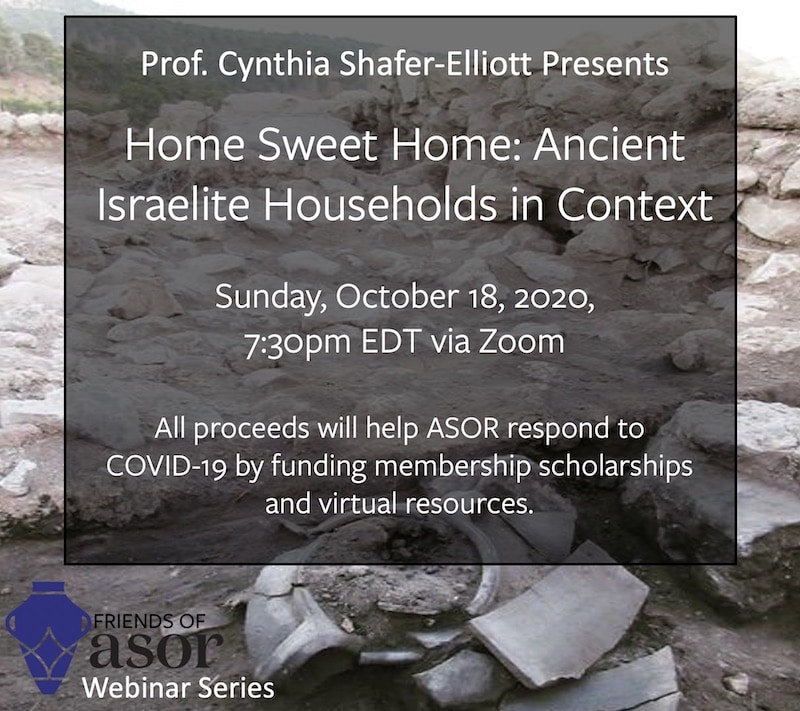
Home Sweet Home: Ancient Israelite Households in Context
Friends of ASOR presents the third webinar in our monthly series on October 18, at 7:30pm EDT, featuring Dr. Cynthia Shafer-Elliott. Our recent quarantine experience has renewed interest in the meaning of ‘home’, whether an apartment in the city or a countryside home. Both in the present as well as in the distant past, the home is the stage for daily life. The form and function of a house, and the activities its household members engage in, can inform us about the daily life of the household and the society of which it is a part.
In this lecture, Dr. Cynthia Shafer-Elliott will introduce the concept of “Household Archaeology” and how it can help us understand the behaviors of kinship and social groups that formed ancient Israelite households. The Iron Age houses at Tell Halif, Israel, will serve to illustrate what the average household was like with particular attention given to the activities of the women of the household and food preparation. The webinar will conclude with a live Q&A session.
Cynthia Shafer-Elliott (Ph.D., The University of Sheffield, England) is an Associate Dean of the School of Theology and Leadership and Associate Professor of Hebrew Bible & Archaeology at William Jessup University in Rocklin, California. Dr. Shafer-Elliott specializes in the cultural and social contexts of ancient Israel and Judah, particularly within domestic contexts.
20% discount from Routledge!
Her major publications include: Food in Ancient Judah: Domestic Cooking in the Time of the Hebrew Bible (2013) and editor of The 5 Minute Archaeologist in the Southern Levant (2016), along with numerous chapters, encyclopedia and dictionary articles, articles, essays, and papers presented on food, households, and gender. She is currently co-editing the T & T Clark Handbook of Food in the Hebrew Bible and Ancient Israel. Dr. Shafer-Elliott is an experienced field archaeologist and is part of the archaeological excavations at Tell Halif and Tell Abel Beth Maacah in Israel.
Thanks to our Silver Sponsor, Routledge, registrants now receive a 20% discount on Prof. Shafer-Elliott’s 2019 book, Food in Ancient Judah. Please email membership@asor.org for the discount code if you have already registered or click the button below to register and receive the code in your confirmation email.
To receive your ASOR member discount, log into the online store. If you are new to ASOR, please click on the “New Visitor Registration” link to enter your email and password for our online store. Then navigate to “Meeting and Event Registration” to register for the webinar and pay the fee. Each paid registrant will receive a confirmation email when you pay for the webinar. If you do not receive this email, then you are not registered. Please e-mail membership@asor.org with any questions or issues with registering.
You will be e-mailed the Zoom Webinar link three times prior to the lecture on October 18, 2020. If you do not receive the link by the Saturday before the webinar, please email membership@asor.org immediately. All webinars are recorded and all paid registrants who cannot attend the webinar will be sent a link to download the recording.
All proceeds from this lecture are used to fund scholarships for members impacted by COVID-19 as well as increasing ASOR’s online resources, which are free to the public.
WHY SPONSOR A WEBINAR?
Several levels of support from $50-$1,000 are available. Proceeds go towards membership scholarships and towards increasing ASOR’s virtual resources. Each sponsorship is tax-deductible and you can give your friends free registrations to a webinar!
Bronze Level ($50): up to 2 guest registrations Silver Level ($100): up to 5 guest registrations Gold Level ($500): up to 20 guest registrations Platinum Level ($1,000): up to 50 guest registrations
After you sign up for a sponsorship online or over the phone, email the names and email addresses of your guests to Felice Herman at membership@asor.org, who will send your guests a confirmation and the Zoom link before the webinar.
WANT TO SAVE $5.00 ON THE NEXT WEBINAR?
Join ASOR as a member! Click here for more details about discounts for events and other benefits of membership. Memberships start at $40 for the year as an Associate Member.
You can now purchase the link to the recording of any webinar. You can also purchase the bundle packages of all webinars from the 2020-2022 seasons. Please e-mail membership@asor.org for purchase details.
To see a printable pdf of the webinar titles from the 2020-2021 season, please click here. To see a printable pdf of the webinar titles from the 2021-2022 season, please click here.
Where Are They Now?: A Preview of 2022 ASOR-Affiliated Fieldwork Projects Michael Given (University of Glasgow), Xenia-Paula Kyriakou (Florida Gulf Coast University), Stephen Batiuk (University of Toronto), Monique Roddy (Walla Walla University), Kent Bramlett (La Sierra University), Friedbert Ninow (La Sierra University), and Michael Hoff (University of Nebraska-Lincoln) | March 8, 2022
Tel Rehov: A Major Bronze and Iron Age City in the Jordan Valley Amihai Mazar (Hebrew University of Jerusalem), Nava Panitz-Cohen ( Hebrew University of Jerusalem), Nota Kourou (Athens University), Naama Yahalom-Mack (Hebrew University of Jerusalem), Robert Mullins (Azusa Pacific University) | February 10, 2022
Archaeogaming: Why Video Games Deserve Their Own Archaeology Tine Rassalle (University of North Carolina at Chapel Hill), Shannon Martino (Morton College), Matthew Winter (University of Arizona), Michael Zimmerman (Rhode Island) | April 18, 2021
By becoming an ASOR member, you join us in our mission to initiate, encourage, and support research into, and public understanding of, the history and cultures of the Near East and wider Mediterranean, from the earliest times. Membership provides valuable benefits, and your dues help us foster original research, exploration, and archaeological fieldwork; encourage scholarship about Near Eastern and Mediterranean traditions and societies; uphold the highest academic standards in interdisciplinary research and teaching; and support efforts to protect, preserve, and present to the public the historic and cultural heritage of the Near Eastern and Mediterranean world.
Please choose from the following memberships levels (details below):
Associate memberships are designed for Public Members whose professional expertise lies beyond the fields of Near Eastern and Mediterranean studies. These memberships are designed for anyone who wishes to be a part of ASOR.
These membership are designed for Public Members who wish to receive all the benefits included in the Associate Membership and who wish to support ASOR through a gift. The annual dues ($125) include a contribution of $100, which may be tax-deductible to the extent allowed by law.
A donation of $100, which may be tax-deductible to the extent allowed by law.
Regular and retired memberships are designed for those who wish to present at the ASOR Annual Meeting, receive academic journals, and/or serve on editorial boards and academic committees. Regular and Retired Members also receive all of the benefits included in the Associate Membership.
Regular – $180 Retired – $160
These memberships include:
Print delivery of any two ASOR journals OR online access to all four (MAARAV is now an ASOR journal!). Both print and online available for an additional fee ($30.00).
No additional charge for print delivery outside U.S.
*Early Career members are required to confirm that they have received a terminal degree in the past five years or earn a pre-tax gross income less than $65,000 US. This confirmation is required at the time of sign-up/renewal in the ASOR Portal.
**Graduate and Undergraduate members are required to upload proof of enrollment (copies of transcripts, class schedules, etc. that state active student status, graduation date, or the CURRENT semester date) while joining as a member/renewing a membership in the ASOR Portal. ***Are you a student outside of North America and joining ASOR membership for the FIRST time? Email the membership office to receive a discount code to save on an onlinenew Student Membership (Undergraduate or Graduate). Proof of student status outside North America will be required for your membership to be be processed. NOTto be used for renewals.
Our highest level of individual membership, it is designed for Public and Academic Members who wish to support ASOR at a higher level and receive some exclusive benefits available only to Sustaining Members and our donors who contribute $1,000 or more a year.
Print delivery and/or online access to all four journals (choice of BASOR, NEA, and JCS for print delivery, MAARAV online only).
No additional charge for print delivery outside U.S.
A donation of $125, which may be tax-deductible to the extent allowed by law.
Friends of ASOR are people who are interested in archaeological and historical research in the Mediterranean and Near Eastern worlds. You may become a Friend for FREE.
We invite you to register today so that you can join our team and receive exclusive benefits, like a free subscription to the Ancient Near East Today e-newsletter.
If you are unsure what membership category to choose, this is a great way to start because it is FREE.
Free Member Online Resources
Resources includes online learning tutorials, videos, virtual tours, and more!
Not ready to join yet? You can still support ASOR’s mission!
Donations can be made to a variety of causes including student support through scholarships & fellowships, publications, cultural heritage initiatives, and our building fund.
Every dollar counts and is meaningful.
You can become part of a lasting legacy at ASOR.
Membership Renewal Policy
Membership renewals extend the expiration date of your most recent membership if within a three month window of that last expiration date. Any missed publications during this period will be sent to a provided address or, in the case of online access, an extended access period will be provided through University Chicago Press. Anything beyond a three month window of the last expiration date will be reviewed with the member or treated as a “new” membership. Questions about our policy can be sent to membership@asor.org.
I wrote you all in late August with the exciting news that ASOR’s Board of Trustees had voted to remove the word “Oriental” from ASOR’s name. Now I write with an update and a timeline for the next steps, which will include town halls with the membership and two votes over the next month.
All organizations have moments in their history when a transformative change needs to be made. Recognizing ASOR’s 120-year history of leadership, ASOR’s Board of Trustees voted unanimously to remove the word “Oriental” from our name as the first step to ensure that we took a stand against culturally offensive language. Words matter.
The next step requires a ratification of this change and the Board’s recommendation on ASOR’s new name by a majority of the ASOR membership. You will be asked to choose between two ASOR acronyms: the American Schools of Overseas Research or the American Society of Overseas Research. After the choice is made between “society” and “schools,” we will need a final ratification vote by the membership in order to legally amend ASOR’s Articles of Incorporation.
Below is a summary of how the Board arrived at this decision.
The Ad Hoc Committee on the name change (AHC) has been working since January to consider all alternatives, including new acronyms, descriptive language, and a myriad of other options. Their work included two polls of the membership.
After a great deal of discussion and endless hours of trying to find the best answers, AHC recommended that two names be considered: AARCHE, Association for Archaeological Research, Cultural Heritage, and Education and one of two names using the ASOR acronym, either the American Schools of Overseas Research or the American Society of Overseas Research.
After the AHC submitted its final report, the discussion of the full Board in consultation with the AHC focused on whether the new name should retain the ASOR acronym or be completely different, which opened up the opportunity to solve some of the inherent constraints of the ASOR acronym. In AARCHE’s favor were its freshness and the fact that it reflects better the breadth of ASOR’s current work, particularly in cultural heritage. Against it are its somewhat unwieldy length, unfortunate acronym for a renamed BASOR—”BAARCHE”—and its lack of popularity in the July poll of the membership.
With the lack of a membership mandate for AARCHE or any wholesale change in name, the Board turned to the costs of abandoning the ASOR acronym, both tangible and intangible. Our Executive Director estimates that the necessary changes in our now large website presence would cost between $50,000 and $100,000, amounts which do not include a new branding program. Library subscriptions to the renamed “BAARCHE” would undoubtedly drop. The value of the well-known brand would be lost, which our Development Committee believes would have significant adverse effects on fundraising.
In the Board discussion of the AHC recommendations, various members noted that neither of the choices satisfied the desire of 70.3% of the membership in the March poll that the name reflect the geographical scope of ASOR’s work. Accepting that ASOR’s scope will always change and grow, it seemed prudent to keep the name as simple as possible given all that is required legally to change it, but include a yet to be determined geographical tag line below the name as a descriptor.
After lengthy discussion with the AHC, the Board voted 20-3 to put only the two ASOR acronyms, the American Schools of Overseas Research or the American Society of Overseas Research, up for a membership vote.
What’s next? A membership vote on the name change.
Two Zoom town hall meetings with the membership in October.
A vote on the two names in late October.
A vote on ratification of the winning name in November.
As always, you can contact me directly at president@asor.org with questions or concerns. Thank you for helping our organization take this vital step into a brighter future for us all.
Best regards,
Sharon Herbert
ASOR President[/vc_column_text][/vc_column][vc_column border_color=”rgba(170,170,170,0.01)” width=”1/6″ css=”.vc_custom_1496684098866{margin-right: 5px !important;margin-bottom: 20px !important;border-right-width: 2px !important;border-bottom-width: 2px !important;padding-top: 30px !important;padding-right: 10px !important;padding-left: 10px !important;background-color: #ffffff !important;border-right-color: rgba(227,228,228,0.75) !important;border-bottom-color: rgba(227,228,228,0.75) !important;}”][vc_wp_posts title=”BROWSE THE NEWS ARCHIVE” number=”4″][/vc_column][vc_column border_color=”rgba(170,170,170,0.01)” width=”1/6″ css=”.vc_custom_1496684008271{margin-right: 10px !important;margin-bottom: 30px !important;border-right-width: 2px !important;border-bottom-width: 2px !important;padding-top: 30px !important;padding-right: 20px !important;padding-left: 20px !important;background-color: #ffffff !important;border-right-color: rgba(227,228,228,0.75) !important;border-bottom-color: rgba(227,228,228,0.75) !important;}”][vc_column_text]Tweets by ASOResearch [/vc_column_text][/vc_column][/vc_row]
[/vc_column_text][mk_divider][vc_wp_text]ASOR is pleased to announce the Student Paper Award. This award is conferred upon the author(s) of a paper presented during the Annual Meeting that conveys the results of a study about ancient Near Eastern and wider Mediterranean societies in a clear, understandable and convincing fashion. The first author and presenter of the paper must be a registered student at the time of presentation in order to be eligible for consideration for this award. Students will need to complete the following steps to be considered for the award. Applications are due October 23.
Students and Early Career Scholars at the 2019 Annual Meeting
1. Please complete Google Form in order to apply for the Student Paper Award.
2. Submit your pre-recorded paper by October 23 via the Presentation Submission Form on ASOR’s Virtual Annual Meeting website.
Applications and Papers are both due by October 23.
Please note that this award is independent of the Sean Dever Memorial Prize, which is conferred by the W.F. Albright Institute of Archaeological Research. To learn more about Awards presented at the Annual Meeting, please visit the Honors and Awards page. For questions and inquiries please email info@asor.org.[/vc_wp_text][/vc_column][vc_column border_color=”rgba(170,170,170,0.01)” width=”1/6″ css=”.vc_custom_1496684098866{margin-right: 5px !important;margin-bottom: 20px !important;border-right-width: 2px !important;border-bottom-width: 2px !important;padding-top: 30px !important;padding-right: 10px !important;padding-left: 10px !important;background-color: #ffffff !important;border-right-color: rgba(227,228,228,0.75) !important;border-bottom-color: rgba(227,228,228,0.75) !important;}”][vc_wp_posts title=”BROWSE THE NEWS ARCHIVE” number=”4″][/vc_column][vc_column border_color=”rgba(170,170,170,0.01)” width=”1/6″ css=”.vc_custom_1496684008271{margin-right: 10px !important;margin-bottom: 30px !important;border-right-width: 2px !important;border-bottom-width: 2px !important;padding-top: 30px !important;padding-right: 20px !important;padding-left: 20px !important;background-color: #ffffff !important;border-right-color: rgba(227,228,228,0.75) !important;border-bottom-color: rgba(227,228,228,0.75) !important;}”][vc_column_text]Tweets by ASOResearch [/vc_column_text][/vc_column][/vc_row]
[/vc_column_text][mk_divider][vc_column_text]The Trustee Nominations Committee announces an open call for (self) nominations for the ASOR Board of Trustees (Class of 2023). There are three primary responsibilities of the members of the Board of Trustees:
Governance: Being aware of issues brought forward to the Board, attending two meetings per year (at your own expense), and bringing issues of concern to the Board.
Fundraising and financial management: Leading in development by thinking of new opportunities, leading in giving, and providing oversight on the audited financial statements. We ask that individual trustees aspire to contribute $500 or more annually.
Strategic planning and policy development: Leading especially in measures that accord with ASOR’s mission.
We anticipate two openings for Membership-Elected Trustees. Any regular ASOR member may be considered for nomination as an Membership-Elected Trustee. If there is someone that you would like the committee to consider—including yourself—please send the person’s name and email address to Marta Ostovich in the ASOR office. If you have any questions about the responsibilities and satisfactions of being a board member, please email Jane DeRose Evans (Chair of the Nominations Committee).
The ASOR office, or a representative from the Nominations Committee, will contact all nominees to describe the responsibilities in greater detail, and to make sure that the nominee is willing to have his or her name discussed by the Trustee Nominations Committee. Please note that nominees will need to submit a brief biography and a mission (or vision) statement for what they would like to accomplish as a trustee to be considered by the Nominations Committee. A sample of these statements can be found in last year’s “Meet Your Board Nominees” webpage. Brief biographies and mission statements should be ca. 200 words each and submitted via e-mail to Marta Ostovich by noon EDT on October 12, 2020.
After the Committee selects individuals for nomination, the election will take place by electronic ballot during October. ASOR is once again conducting online voting to ensure that more of our members are able to participate in this important process. The ASOR office will work with any person who is not able to complete an electronic ballot to ensure that everyone is included.
In order to receive full consideration by the committee, nominations (including supporting documents) should be submitted to programs@asor.org by noon EDT on October 12, 2020.[/vc_column_text][/vc_column][vc_column border_color=”rgba(170,170,170,0.01)” width=”1/6″ css=”.vc_custom_1496684098866{margin-right: 5px !important;margin-bottom: 20px !important;border-right-width: 2px !important;border-bottom-width: 2px !important;padding-top: 30px !important;padding-right: 10px !important;padding-left: 10px !important;background-color: #ffffff !important;border-right-color: rgba(227,228,228,0.75) !important;border-bottom-color: rgba(227,228,228,0.75) !important;}”][vc_wp_posts title=”BROWSE THE NEWS ARCHIVE” number=”4″][/vc_column][vc_column border_color=”rgba(170,170,170,0.01)” width=”1/6″ css=”.vc_custom_1496684008271{margin-right: 10px !important;margin-bottom: 30px !important;border-right-width: 2px !important;border-bottom-width: 2px !important;padding-top: 30px !important;padding-right: 20px !important;padding-left: 20px !important;background-color: #ffffff !important;border-right-color: rgba(227,228,228,0.75) !important;border-bottom-color: rgba(227,228,228,0.75) !important;}”][vc_column_text]Tweets by ASOResearch [/vc_column_text][/vc_column][/vc_row]
EARLY CAREER SCHOLARS BROWN BAG PANEL ON PUBLISHING
[/vc_column_text][mk_divider][vc_column_text]The Early Career Scholars of ASOR will hold a virtual panel discussion on academic journal publishing on October 8, 2020 at 12pm EDT via Zoom. Speakers will include: Dr. Stephanie Budin (Near Eastern Archaeology), Dr. Seth Richardson (Journal of Near Eastern Studies), and Dr. Christopher Rollston (Bulletin of ASOR). The event, a part of our brown bag lunch series, is a *FREE* benefit for ASOR members.
The informational seminar will address key questions such as:
How much should you publish at various stages of your academic career?
What makes a good concept for a journal article?
What factors influence acceptance versus rejection of articles?
What time management strategies will help authors be successful?
Registration is limited to ASOR members and students at ASOR member schools on a first come, first serve basis. Registrants will receive an email with Zoom access information prior to the event
Panelist information:
Stephanie Lynn Budin is an ancient historian who focuses on gender, religion, sexuality, and iconography in ancient Greece and the Near East. Her published works include Women in Antiquity: Real Women Across the Ancient World (Routledge 2016), Artemis (Routledge, 2015), Images of Woman and Child from the Bronze Age (Cambridge University Press, 2011), The Myth of Sacred Prostitution in Antiquity (Cambridge University Press, 2008), and The Origin of Aphrodite (CDL Press, 2003), as well as numerous articles on ancient religion, gender, and iconography. She is the current editor of ASOR’s journal, Near Eastern Archaeology. She has also lectured throughout North America, Europe, the Near East, and Japan.
Seth Richardson is a historian of the ancient Near East whose research engages multiple thematic domains and time periods as a generalist-comparativist. He is the Managing Editor of the Journal of Near Eastern Studies and an Associate at the Oriental Institute since 2011. Prior to this, he was Assistant Professor of Ancient Near Eastern History at the University of Chicago since 2003, having earned his Ph.D. at Columbia University in 2002.
Christopher Rollston is Chair of the Dept. of Near Eastern Languages and Civilizations at The George Washington University. He holds a Ph.D. in Near Eastern Studies from Johns Hopkins University. His research focuses on Biblical and Ancient Near Eastern Studies, especially subjects revolving around ancient languages, Northwest Semitic epigraphy, scribal education, wisdom literature, prophetic literature, as well as ancient and modern textual forgeries. He has published widely in the field and is currently a co-editor (with Eric Cline) of BASOR as well as the editor of MAARAV.
Tiffany Earley-Spadoni will preside. She is Assistant Professor of Digital History at the University of Central Florida and received her Ph.D. in Near Eastern Studies from the Johns Hopkins University. Her research focuses primarily upon historical and archaeological investigations of heavily fortified landscapes. She directs the Vayots Dzor Fortress Landscapes Project in Armenia and co-chairs the Early Career Scholars Committee of ASOR. She has published articles in leading journals and is writing a book, “Landscapes of Warfare: Urartu in Ancient Near Eastern Context,” under advance contract with the University Press of Colorado.[/vc_column_text][/vc_column][vc_column border_color=”rgba(170,170,170,0.01)” width=”1/6″ css=”.vc_custom_1496684098866{margin-right: 5px !important;margin-bottom: 20px !important;border-right-width: 2px !important;border-bottom-width: 2px !important;padding-top: 30px !important;padding-right: 10px !important;padding-left: 10px !important;background-color: #ffffff !important;border-right-color: rgba(227,228,228,0.75) !important;border-bottom-color: rgba(227,228,228,0.75) !important;}”][vc_wp_posts title=”BROWSE THE NEWS ARCHIVE” number=”4″][/vc_column][vc_column border_color=”rgba(170,170,170,0.01)” width=”1/6″ css=”.vc_custom_1496684008271{margin-right: 10px !important;margin-bottom: 30px !important;border-right-width: 2px !important;border-bottom-width: 2px !important;padding-top: 30px !important;padding-right: 20px !important;padding-left: 20px !important;background-color: #ffffff !important;border-right-color: rgba(227,228,228,0.75) !important;border-bottom-color: rgba(227,228,228,0.75) !important;}”][vc_column_text]Tweets by ASOResearch [/vc_column_text][/vc_column][/vc_row]
Pp. 136-145: “Living with Animals: Human–Animal Relations and Society at Çatalhöyük,” by Lindsay Der
Neolithic Çatalhöyük (7100–5950 BCE) is infamous for its sensational and curious material culture. Although the so-called mother goddess figurines have always been a source of great media attention, the vast majority of the visual expressions at the site are not anthropomorphic, but instead centered on wild and dangerous creatures. Many studies have previously considered the Çatalhöyük animal iconography in the context of symbolism and/or religion (Hodder and Meskell ; Stordeur ; Cauvin and Watkins ; Mellaart ). Far fewer works have scrutinized how these materializations speak to the connections forged between people and animals. This article explores the way in which animals were embedded within the social bonds and ontologies of the site through ritual practice. Ritual is not a synonym for religion, but in this study is defined as repetitive, patterned, and symbolic activity that is socially sanctioned (Firth ). In doing so, we can gain new insights into the complexity of the relationship between humans and animals and how this relationship endured across more than a thousand years of continuous occupation.[/vc_column_text][/vc_column_inner][/vc_row_inner][vc_column_text responsive_align=”left”]ASOR Members with online access: navigate to the token link email sent to you (search for “token link” in inbox) before attempting to read this article. Once you have activated your member token, click here to access the above article on The University of Chicago Press Journals’ website.[/vc_column_text][mk_divider][vc_row_inner][vc_column_inner width=”1/4″ css=”.vc_custom_1570041002103{padding-right: 10px !important;}”][mk_image src=”http://www.asor.org/wp-content/uploads/2020/10/End-of-Catalhoyuk-Hole-NEA-83.3-TOC-1.jpg” image_width=”200″ image_height=”500″ crop=”false” hover=”false” custom_url=”https://www.journals.uchicago.edu/doi/10.1086/709999″][/vc_column_inner][vc_column_inner width=”3/4″][vc_column_text]
Pp. 146–154: “Towards the End of the Çatalhöyük East Settlement: A Faunal Approach,” by Kamilla Pawłowska
The Çatalhöyük site produced material from the Neolithic occupation (7100 cal BCE–5900 cal BCE) through the Muslim period, including Bronze Age, Iron Age (Phrygian period), and Hellenistic periods. Twenty-five years of research have allowed us to study various ecofacts and artifacts, including animal and plant remains, human bones, pottery, stamp seals, and figurines. Faunal remains, which are the focus here, have been the subject of intense multidisciplinary research, particularly during the last decade. This has led to a greater understanding of Neolithic farmers’ subsistence patterns in the Anatolian region; the domestication, health and disease in past animal populations; spread of livestock; daily practices of animal food-related activities and management of waste; and of the ecological conditions of the region in which this community operated. Animals were also involved in social practice (Russell, Martin, and Twiss ; Pawłowska ; Pawłowska and Marciszak ; Der this issue) and used as a source of raw material in manufacturing.[/vc_column_text][/vc_column_inner][/vc_row_inner][vc_column_text responsive_align=”left”]ASOR Members with online access: navigate to the token link email sent to you (search for “token link” in inbox) before attempting to read this article. Once you have activated your member token, click here to access the above article on The University of Chicago Press Journals’ website.[/vc_column_text][mk_divider][vc_row_inner][vc_column_inner width=”1/4″ css=”.vc_custom_1570041002103{padding-right: 10px !important;}”][mk_image src=”http://www.asor.org/wp-content/uploads/2020/10/Pigment-use-in-Catalhoyuk-NEA-TOC-83.3.jpg” image_width=”200″ image_height=”500″ crop=”false” hover=”false” custom_url=”https://www.journals.uchicago.edu/doi/10.1086/710212″][/vc_column_inner][vc_column_inner width=”3/4″][vc_column_text]
Pp. 156–167: “Pigment Use at Neolithic Çatalhöyük,” by Eline Schotsmans, Gesualdo Busacca, Lucy Bennison-Chapman, Ashley Lingle, Marco Milella, Belinda Tibbetts, Christina Tsoraki, Milena Vasić, and Rena Veropoulidou
From the Middle Paleolithic onwards, pigments have been used variably in different social and ritual activities as well as in the expression of symbolism through material culture (e.g., Brooks et al. ; D’Errico ). In the Levant and Anatolia, symbolic practices with pigments became increasingly common in the epipaleolithic and pre-pottery Neolithic periods (e.g., Bocquentin and Garrard ; Goring-Morris, Hovers, and Belfer-Cohen ; Richter et al. ; Baird ; Baird et al. ).[/vc_column_text][/vc_column_inner][/vc_row_inner][vc_column_text responsive_align=”left”]ASOR Members with online access: navigate to the token link email sent to you search for “token link” in inbox) before attempting to read this article. Once you have activated your member token, click here to access the above article on The University of Chicago Press Journals’ website.[/vc_column_text][mk_divider][vc_row_inner][vc_column_inner width=”1/4″ css=”.vc_custom_1570041002103{padding-right: 10px !important;}”][mk_image src=”http://www.asor.org/wp-content/uploads/2020/10/Middens-waste-at-Catalhoyuk-NEA-83.3-TOC.jpg” image_width=”200″ image_height=”500″ crop=”false” hover=”false” custom_url=”https://www.journals.uchicago.edu/doi/10.1086/710134″ align=”center”][/vc_column_inner][vc_column_inner width=”3/4″][vc_column_text]Pp. 168–174: “Middens, Waste Disposal, and Health at Çatalhöyük,” by Jesse Wolfhagen, Rena Veropoulidou, Gianna Ayala, Dragana Filipović, Ceren Kabukcu, Carla Lancelotti, Marco Madella, Kamilla Pawłowska, Carlos G. Santiago-Marrero, and John Wainwright
The transition from a mobile hunter-gatherer lifestyle to a settled way of living is one of the most significant processes in human history. There were undeniable benefits to this process, with increased food security and longer lifespans, but there were also negative consequences associated with an increased density of living. At Çatalhöyük we have over one thousand years of continuous occupation from the Pre-Pottery Neolithic to Chalcolithic period (7100–5700 BCE). The settlement changes from a dense agglomeration in its earliest phase, where individual buildings are constructed wall to wall with no gaps or streets between them, to a more open nucleated settlement towards the end of the occupation. Large numbers of people living in a fixed location inevitably leads to the production of large amounts of waste. One of the most significant consequences of these activities is the creation of “pollution,” both in the physical environment, and the decline in air quality.[/vc_column_text][/vc_column_inner][/vc_row_inner][vc_column_text responsive_align=”left”]ASOR Members with online access: navigate to the token link email sent to you (search for “token link” in inbox) before attempting to read this article. Once you have activated your member token, click here to access the above article on The University of Chicago Press Journals’ website.[/vc_column_text][mk_divider][vc_row_inner][vc_column_inner width=”1/4″ css=”.vc_custom_1570041002103{padding-right: 10px !important;}”][mk_image src=”http://www.asor.org/wp-content/uploads/2020/10/Catahoyuk-Database-NEA-83.3-TOC-vert.jpg” image_width=”200″ image_height=”500″ crop=”false” hover=”false” custom_url=”https://www.journals.uchicago.edu/doi/10.1086/710611″][/vc_column_inner][vc_column_inner width=”3/4″][vc_column_text]
Pp. 176–181: “Engaging with the Çatalhöyük Database: House at Çatalhöyük (HATCH) and Other Applications,” by Arkadiusz Marciniak, Jacek Marciniak, Patrycja Filipowicz, Katarzyna Harabasz, and Jędrzej Hordecki
Çatalhöyük remains one of the most intensively and meticulously excavated prehistoric sites in the history of archaeology. Two large excavation campaigns, carried out in the years 1961–1965 and 1993–2017, have generated considerable data. A particularly large body of data was accumulated over the twenty-five-year period of excavation and analyses carried out by the Çatalhöyük Research Project. One of the project’s major undertakings was to make all data collected accessible for wider audiences (Hodder ).[/vc_column_text][/vc_column_inner][/vc_row_inner][vc_column_text responsive_align=”left”]ASOR Members with online access: navigate to the token link email sent to you (search for “token link” in inbox) before attempting to read this article. Once you have activated your member token, click here to access the above article on The University of Chicago Press Journals’ website.[/vc_column_text][mk_divider][vc_row_inner][vc_column_inner width=”1/4″ css=”.vc_custom_1570041002103{padding-right: 10px !important;}”][mk_image src=”http://www.asor.org/wp-content/uploads/2020/10/Catalhoyuk-2004-Field-School-NEA-83.3-TOC-200×500-1.jpg” image_width=”200″ image_height=”500″ crop=”false” hover=”false” custom_url=”https://www.journals.uchicago.edu/doi/10.1086/710253″][/vc_column_inner][vc_column_inner width=”3/4″][vc_column_text]
Pp. 182–190: “Ethnography, Engagement, Evaluations, and Endings: The Achievements and Limitations of Community Outreach at Çatalhöyük,” by Allison Mickel, Patrycja Filipowicz, and Lucy Bennison-Chapman
Over the twenty-five years of community engagement at Çatalhöyük, local community members played integral roles in the production of knowledge about the site. As workers, as cooks and housekeepers, as ethnoarchaeological consultants, as museum exhibit collaborators, men and women living around Çatalhöyük supported the research team in creating the archaeological record of the site.[/vc_column_text][/vc_column_inner][/vc_row_inner][vc_column_text responsive_align=”left”]ASOR Members with online access: navigate to the token link email sent to you (search for “token link” in inbox) before attempting to read this article. Once you have activated your member token, click here to access the above article on The University of Chicago Press Journals’ website.[/vc_column_text][/vc_column][vc_column border_color=”rgba(170,170,170,0.01)” width=”1/6″ css=”.vc_custom_1496684098866{margin-right: 5px !important;margin-bottom: 20px !important;border-right-width: 2px !important;border-bottom-width: 2px !important;padding-top: 30px !important;padding-right: 10px !important;padding-left: 10px !important;background-color: #ffffff !important;border-right-color: rgba(227,228,228,0.75) !important;border-bottom-color: rgba(227,228,228,0.75) !important;}”][vc_wp_posts title=”BROWSE THE NEWS ARCHIVE” number=”4″][/vc_column][vc_column border_color=”rgba(170,170,170,0.01)” width=”1/6″ css=”.vc_custom_1496684008271{margin-right: 10px !important;margin-bottom: 30px !important;border-right-width: 2px !important;border-bottom-width: 2px !important;padding-top: 30px !important;padding-right: 20px !important;padding-left: 20px !important;background-color: #ffffff !important;border-right-color: rgba(227,228,228,0.75) !important;border-bottom-color: rgba(227,228,228,0.75) !important;}”][vc_column_text]Tweets by ASOResearch [/vc_column_text][/vc_column][/vc_row]
 Trustee Nominations Committee has selected five highly qualified members to stand for election for four open positions on the Board of Trustees. The Board sets the direction for ASOR and provides oversight for our organization. Among other responsibilities, members of the Board agree to attend two meetings each year, to participate thoughtfully in the governance process, and to contribute financially to ASOR.
 I wrote you all in late August with the exciting news that ASOR’s Board of Trustees had voted to remove the word “Oriental” from ASOR’s name. Now I write with an update and a timeline for the next steps, which will include town halls with the membership and two votes over the next month.









 The Trustee Nominations Committee announces an open call for (self) nominations for the ASOR Board of Trustees (Class of 2023). There are three primary responsibilities of the members of the Board of Trustees:
