2020 SHEPARD GRANT: THE TABIRA GATE STABILIZATION PROJECT AT ASHUR
ASOR Editorial Note: The ASOR Team is pleased to share a report from the inaugural Shepard Urgent Action Grant for stabilization work at the Tabira Gate at Ashur. These grants are intended to provided emergency funds to carry out critical stabilization, excavation, or documentation projects. Because time of of the essence with these proposals, funds for the grants can be disbursed 4-6 weeks after an application is received. The Tabira Gate at Ashur is an ideal inaugural project because the mudbrick structure was in danger of irreparable damage if repairs were not made before the rainy season this fall.
The Shepard Urgent Action Grant enabled a team from the American University of Iraq, Sulaimani (AUIS) to manufacture the mudbricks required to stabilize the structure, to pay for the added testing measures and PPE, and to pay a Community Liaison Officer responsible for interviewing the local community. The following report from Dr. Tobin Hartnell of AUIS provides a wonderful illustration of how these grants can provide critical support for time-sensitive projects.
Site Background and Significance
When the site of Aššur was founded in the mid-third millennium BCE, the eponymous god Aššur was virtually indistinguishable from countless other gods. Rather, the Sumerian god Enlil (King of the Gods) and goddess Ishtar (God of War and Fertility) were amongst the most significant local gods. By the end of the third millennium (during the Ur III dynasty, 2112 – 2004 BCE), the god Aššur evolved into the dominant local god. By the Old Assyrian period (c. 19th century BCE), Aššur grew to become the dominant god in māt Aššur (the land of Assyria, i.e. northern Mesopotamia).
From the city’s foundation in Sumerian times until its destruction in 612 BCE, the city of Aššur never lost its connection to the dominant female goddess Ishtar (God of War and Fertility). The Tabira Gate serves as the unique link between the main sanctuary of the gods (ina libbi, the heart of the city), and Ishtar’s gardens (the bit akītu). The gateway served as the primary route for processions of people and gods who would visit Ishtar’s gardens or Aššur’s ziggurat and temple. Given Assur’s status as the pre-eminent sanctuary of northern Mesopotamia, there was likely regular traffic along the processional way and through the Tabira Gate, especially during the Spring festivals.
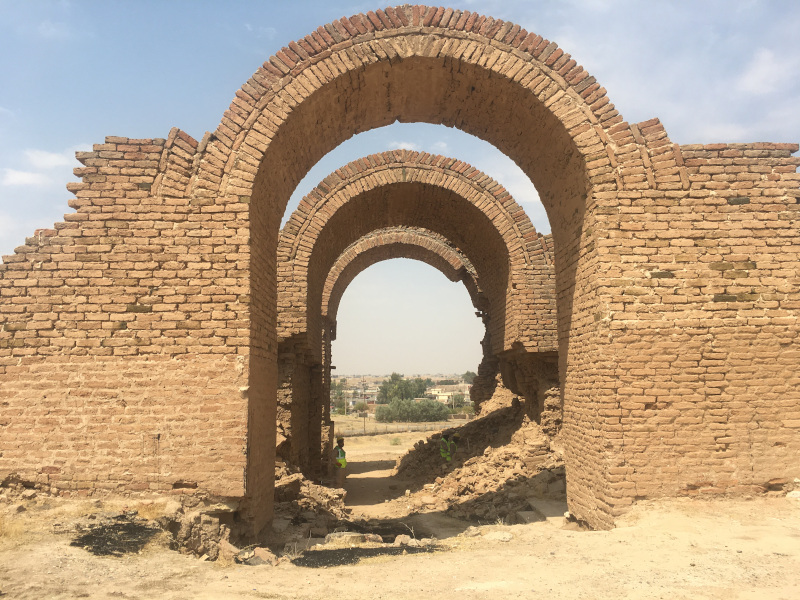
The destroyed Tabira Gate at the World Heritage Site of Ashur. (Photo: Tobin Hartnell, AUIS CACHE)
The Tabira Gate visible today resembles the Middle Bronze Age (18th century BCE) triple arch city gateway of Tel Dan (Israel-Palestine), yet the kings of Aššur constructed the gateway with baked brick. The archaeological arrangement of the gateway implies a connection to the Terrasse des Neuen Palastes (Terrace of the New Palace), seemingly first built by the Assyrian King Aššur-uballit I (1353 – 1318 BCE). Thus, the gateway visible today is most likely originally a Middle Assyrian structure (c. 14th century BCE).
Today, the Tabira Gate serves as a primary symbol of the archaeological site because it is one of the few ancient structures that stand vertically above 1 m. Together with the ziggurat, the gateway serves as an iconic feature of the ancient site for visitors.
Shepard Urgent Action Grant Enables Critical Repairs
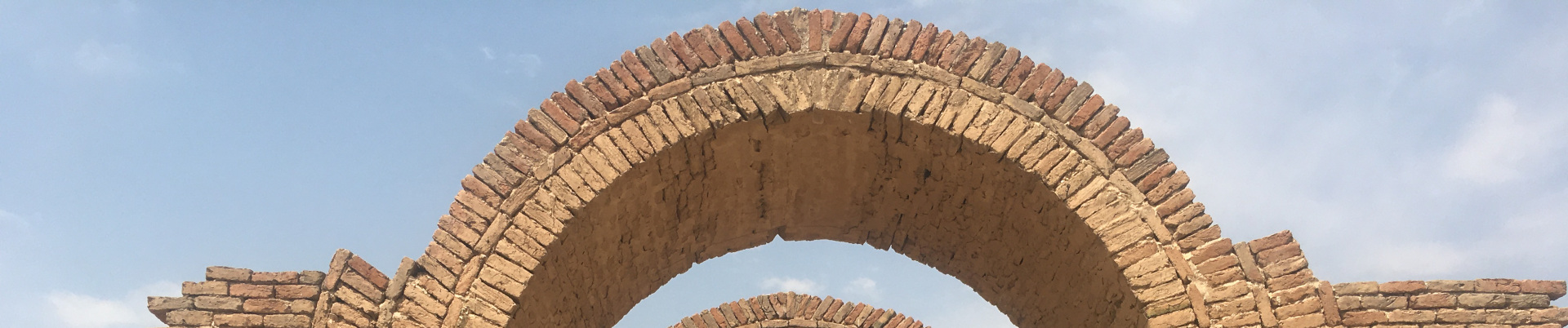
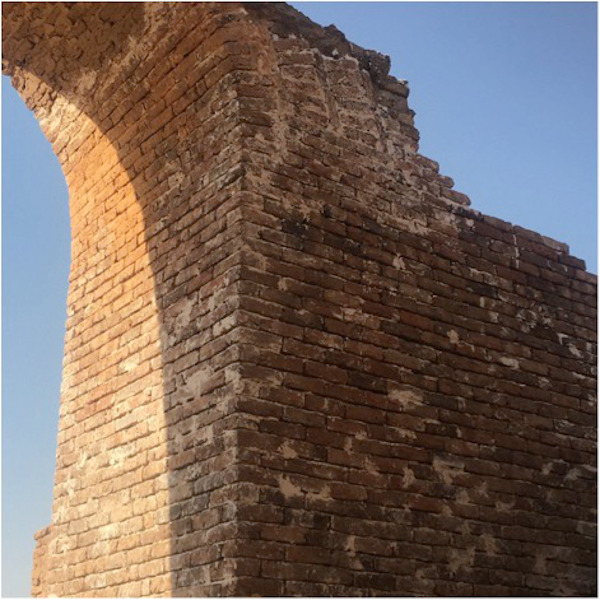
Arch during stabilization work. (Photo: Akam Omer Ahmed, AUIS CACHE)
ISIL attempted to destroy Ashur’s Assyrian-era gateway (the Tabira Gate) in May 2015 (ASOR CHI Weekly Report 42-43) by setting an explosive between the Central and Outer Arch. Whilst the explosion resulted in significant damage to the pillars supporting both arches, the Outer Arch remained particularly vulnerable to collapse because it lacked concrete reinforcement. Over the subsequent five years, bricks from the arch itself periodically fell whilst the damaged pillar gradually weakened through exposure to the elements.
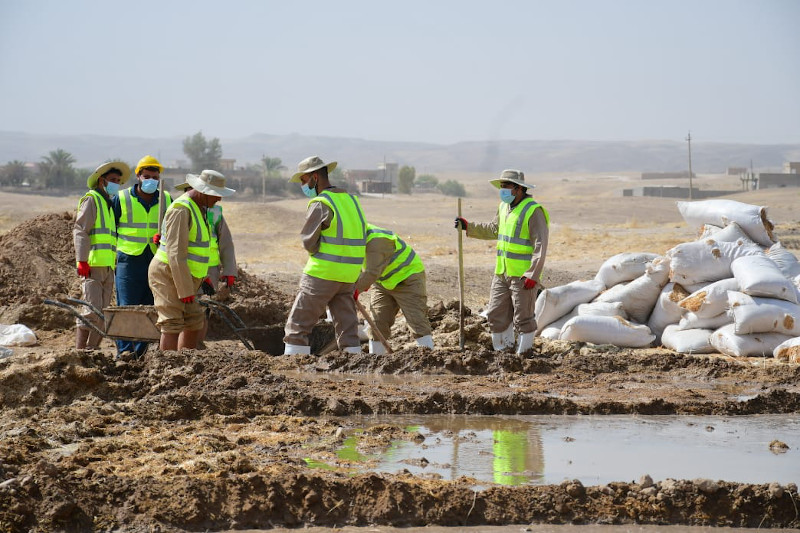
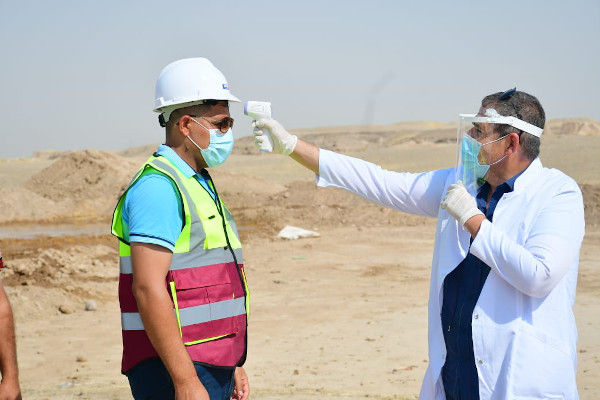
In September 2020, the Center for Archaeology and Cultural Heritage at the American University of Iraq, Sulaimani (AUIS) launched a project to stabilize the damaged pillar. This project was jointly funded by an ALIPH Foundation Emergency Grant and ASOR’s Shepard Urgent Action Grant. The Shepard Urgent Action Grant fully funded the necessary protective health equipment to support the team during the COVID-19 pandemic.
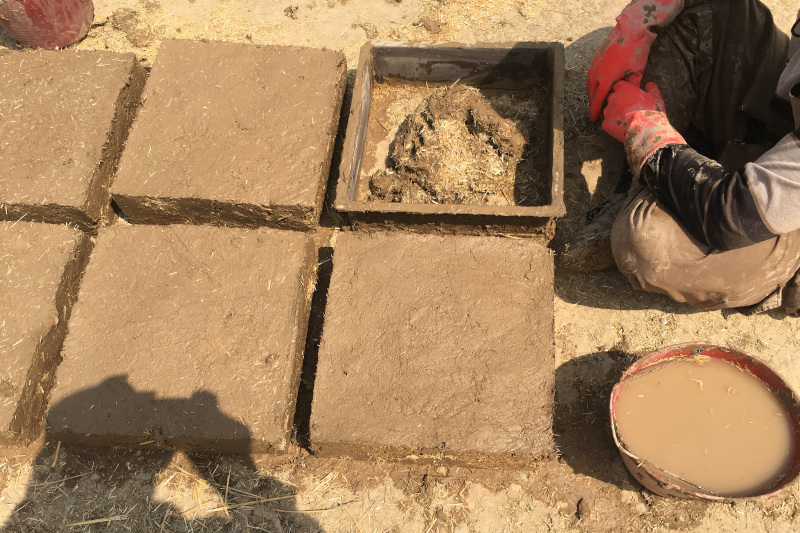
ASOR’s contribution also supported the work of our Community Liaison Officer (Akam Omer Ahmed) who interviewed the local community about their attitudes to heritage. Kak Akam also helped coordinate the project tasks with our construction partner (Bashtabia Organization for the Arts) and the authorized representatives of the State Board of Archaeology and Heritage (SBAH). Finally, ASOR’s grant supported making two thousand extra mud bricks, so that the project could continue with any urgent actions during the rainy season.
Making traditional libn bricks on site at Ashur. (Photo: Akam Omer Ahmed, AUIS CACHE)
Making mudbricks. (Photo: Bashtabia Organization)
Protective Gear used during the Tabira Gate Stabilization Project. (Photo: Bashtabia Organization for the Arts; Courtesy of AUIS CACHE)
I am pleased to report that the stabilization project was successfully completed. The arch now stands under its own weight and it is in no immediate danger of falling. However, significant work remains to be done. The baked brick floor of the gateway is no longer water-proof, and the outer facade is badly cracked. The Central and Inner Arches still need significant attention. AUIS is ready to work with our partners to implement the next stage of rehabilitation, as further funding becomes available.
The Outer Arch of the Tabira Gate after the Stabilization Project is complete. (Photo: Akam Omer Ahmed, A UIS CACHE)
Thank you to the ASOR Shepard Urgent Action Grant Committee, to the local Iraqi Representatives of SBAH, to the Minister of Culture, His Excellency Hassan Nadhem, and his team for supporting our rehabilitation work at Ashur. Thank you to our construction partner, Bashtabia Organization for the Arts. Thank you also to Mrs. Yalda Razmahang, who oversaw the Community Outreach Project, as well as His Excellency, ex-Minister of Science and Technology, Faris Jejjo, who helped coordinate permissions to visit Ashur over the last two years. Thank you to all of our students who worked at Ashur over the last two years, including Adam Azad Tawfeeq and Mohammed Dler.
-Dr. Tobin Hartnell, Director of AUIS Center for Archaeology and Cultural Heritage
This is the inaugural Shepard Urgent Action Grant. Established in 2020 with annual contributions, the “Shepard Urgent Action Grants” program was created to support emergency and rapid response activities on archaeological sites in the greater Mediterranean region. While preference will be given to excavation projects and teams with current ASOR affiliation, applications will be considered from all projects. Non-affiliated teams may apply for affiliation at the same time that they submit a Shepard Urgent Action Grant application. Read more about applying for a Shepard Urgent Action Grant here.
[/vc_column_text][mk_divider][vc_wp_text]ASOR’s 2020 Virtual Annual Meeting was a great success! Thank you to everyone who participated from around the world. There were 1,085 registrants from 39 countries and 6 continents!
More than 430 presenters shared their work in over 80 sessions and workshops on the 2020 Virtual Program. Paper presentation recordings, poster PDF files, and recordings of sessions and workshops will continue to be available to registered attendees through June of 2021. If you missed the meeting, there is still time to gain access to the digital academic content from ASOR’s Virtual Annual Meeting when you buy access to ASOR’s Online Library.
While we would have liked to see everyone in Boston, it was a privilege to provide a platform for our global membership to connect, share, and engage on subjects from the Mediterranean to the Indian Ocean. ASOR is committed to growing and developing our digital offerings, not only during the pandemic, but as a continuing resource for members. As part of this commitment, and with consent from presenters, we will be sharing some content from ASOR’s Virtual Annual Meeting on our public-facing site, ASORtv. Currently you can listen to ASOR’s Executive Director, Andrew Vaughn, give the welcome remarks for our first-ever virtual meeting and watch Monica Hanna’s thought-provoking plenary address, “Does the Future of the Past Lie in the Hands of the Living?”
“Everything was so clear, the website software worked beautifully, and we had all the support we needed–you’ve blown all the other professional societies out of the water. It was so nice to be able to connect with colleagues and carry on with the meeting–honestly, it felt like a little slice of normalcy and was a bright spot for me in this challenging fall.” – Jessie DeGrado
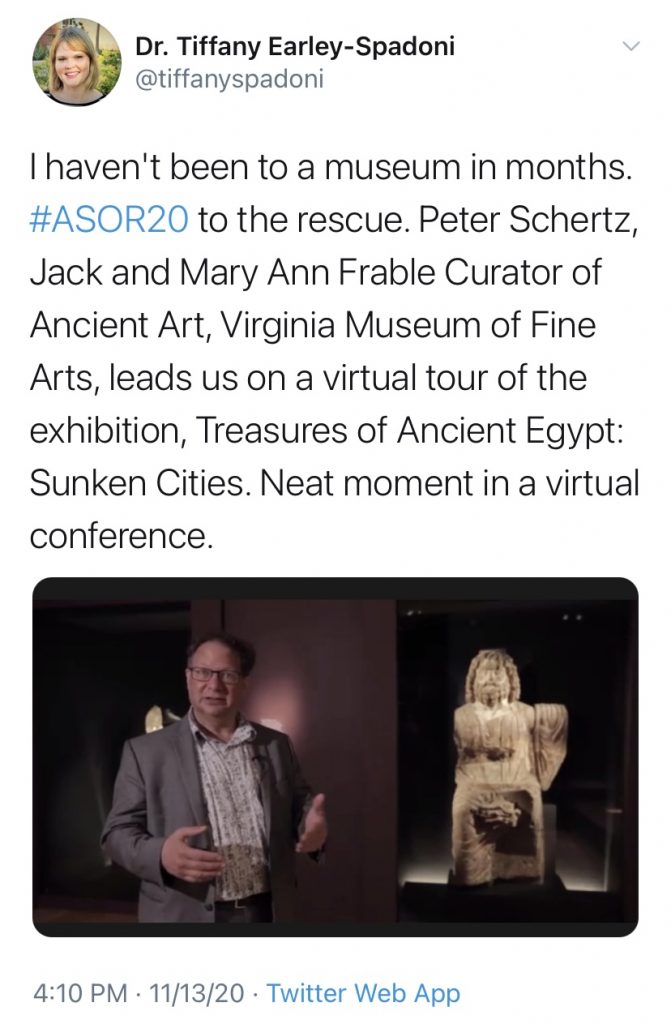
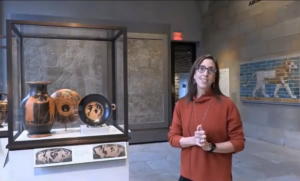
During a time when travel has been restricted and many cultural and social attractions are closed, ASOR attendees were treated to two virtual museum tours, “Treasures of Ancient Egypt: Sunken Cities,” at the Virginia Museum of Fine Arts, and “The Dura-Europas and Gerasa Collections” at the Yale University Art Gallery.
The virtual format offered enhanced options for an inclusive and more accessible meeting, not only in terms of global attendee participation, but also in terms of the academic program. ASOR’s Program Committee (PC) had the herculean task of reworking our program, designed for an in-person meeting, into one that would best reach scholars and enthusiasts at their homes, offices, or wherever they were connecting from during the pandemic.
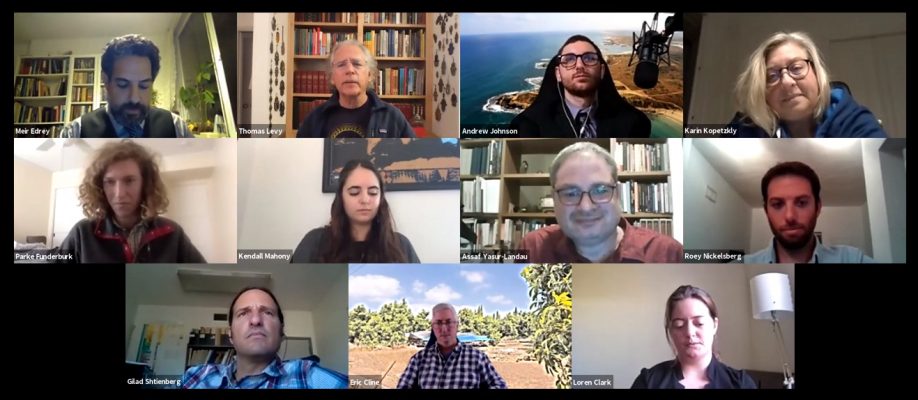
Helen Dixon and Allison Thomason, co-chairs of the Program Committee, would like to thank the dedicated members of the PC for their wise counsel and constructive engagement this year – overcoming the disruption of our usual meeting timeline, the learning curve that comes with new partners and platforms, time zone and other scheduling challenges, as well as worries over our members’ workloads and semesters-from-home. We also want to thank all of the 2020 Session and Workshop Chairs for their flexibility and willingness to adapt to the new format. Thanks to the PC and these Chairs, we were able to put together a strong and diverse program, adding several sessions on cultural heritage, including the plenary by Monica Hanna, and new member-organized sessions and workshops, such as Online Photo Archives as Tools for Archaeological Heritage Preservation and Engagement. We also welcomed scholars and heritage professionals from Libya to the ASOR Annual Meeting program, including a presentation on the Museums in a Suitcase Program. We are happy to report that the virtual format enabled many people to participate who might not normally have the chance: nearly 40% of presenters were from outside of the USA, and 35% attended from outside of North America. Thanks again to all attendees, presenters, and chairs, as well as the tremendous work of the ASOR staff for making our first all-virtual Annual Meeting a success!
“In this time of pandemic, when I start to feel isolated, this ASOR meeting was a breath of fresh air!” – Laura Battini
As 2020 comes to an end, we are hopeful that the new year will bring an end to the global pandemic and that we will be able to meet in person for ASOR’s next Annual Meeting, November 17-20, 2021, in Chicago. ASOR is also planning to continue with a virtual component to be held online in December. Please watch for the 2021 Call for Member-Organized Sessions and Workshops to post next week. Members will be invited to submit proposals for the in-person meeting and/or the virtual component.
All of us at ASOR wish our friends and colleagues around the world a healthy, safe, and joyful New Year!
“This was one of the best virtual meetings I have attended this year! The format worked very well. I’m looking forward to watching many of the presentations over the holidays when I’ll have more time.” – Anonymous
“I wish all conferences would have a virtual component. It is also wonderful to be able to view to sessions in my own time as I can see so many more than I would be able to see in person.” – Anonymous
Dams and reservoirs have transformed the lives and landscapes of the Middle East and North Africa. A new project is examining the tremendous impact on archaeology and heritage. Read More[/vc_column_text][mk_divider thickness=”1″ margin_top=”10″][vc_column_text]
All traditions need anchors in the past. To anchor the church in Rome the fourth century Pope Damasus wrote Roman style poetry and venerated martyrs, above all the Apostle Peter. Read More[/vc_column_text][mk_divider thickness=”1″ margin_top=”10″][vc_column_text]
Mesopotamia is a difficult place to make a mark. But for one Iraqi neurologist, a passion for archaeological photography has opened Mesopotamia to the world. Read More[/vc_column_text][mk_divider thickness=”1″ margin_top=”10″][vc_column_text]
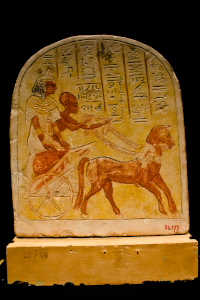
Chariots appear in Egypt in the early second millennium as modes of transportation and weapons of war. For a brief time, women were also drivers. Read More[/vc_column_text][mk_divider thickness=”1″ margin_top=”10″][vc_column_text]
The Cushites are mentioned 54 times in the Hebrew Bible. The texts are conscious of skin color but what mattered was the relationship with God. Read More[/vc_column_text][mk_divider thickness=”1″ margin_top=”10″][/vc_column_inner][/vc_row_inner][/vc_column][/vc_row]
Early Synagogues, Jesus, and Galilee—A Jewish Perspective
Magdala Synagogue Stone Piece
Friends of ASOR presents the fourth webinar in our monthly series on December 13, at 7:30pm EST, featuring Dr. Eric Meyers. An expert in Judaic studies, Dr. Meyers will discuss how archaeological work in the Galilee over the past generation and a half has demonstrated that this region was overwhelmingly Jewish in the first centuries BCE and CE. In addition, the work has revealed a kind of common Judaism that was committed to purity regulations as illustrated by the nearly 1,000 ritual baths and stone vessels that have been found throughout the country. The excavations at Sepphoris Theater bear this out and indicate that large urban growth came only after the wars with Rome. The discovery of the Magdala synagogue in Israel from the time of Jesus, as well as others in the north and south, prove beyond any shadow of doubt that the references in the New Testament to synagogues reflect a genuine material reality.
In this lecture, Prof. Eric Meyers will take us on a journey across the Holy Land to discover how Judaism, and its places of worship, have evolved over the centuries. The webinar will conclude with a live Q&A session.
Eric M. Meyers, a 1962 graduate of Dartmouth College, holds an M.A. in Near Eastern and Judaic Studies from Brandeis University, and received the Ph.D. with distinction from Harvard University in Near Eastern Languages and Literatures, specializing in Bible, Jewish History, and archaeology. He served on the active faculty of Duke University from 1969 to 2015 where he has been a Professor since 1979; he presently is the Bernice and Morton Lerner Emeritus Professor of Judaic Studies and Archaeology at Duke University. From 1975-1976, he served as Director of the W. F. Albright School of Archaeological Research in Jerusalem. Meyers has been on the ASOR Board of Trustees for almost 4 decades. Most notably, he served as ASOR’s President from January 1, 1990, through July 1, 1996, and then again from May 2006 through December 2008. Dr. Meyers was recognized by ASOR in 2007 and awarded its highest honor, the Richard J. Scheuer Medal for distinguished service.
Dr. Meyers has authored or co-authored 15 books, edited 20 others, and has published approximately 370 scholarly papers, reports, and reviews in the field of Hebrew Bible and Biblical Archaeology and Jewish History. The final report on the Excavations at Sepphoris appeared in 2018 published by Eisenbrauns/Penn State University Press: The Architecture, Stratigraphy, and Artifacts of the Western Summit of Sepphoris, 2 volumes, with Carol Meyers and Benjamin D. Gordon. Dr. Meyers has been active in many learned societies besides ASOR including the Association of Jewish Studies, the Society of Biblical Literature, the American Academy of Religion, and the Archaeological Institute of America.
Dr. Meyers has directed digs in Israel and Italy for forty years and is perhaps best known for his 1981 discovery of the oldest Ark from ancient Israel, which coincided with the film, The Raiders of the Lost Ark. Dr. Meyers has served as host and narrator for many television programs about the Bible, Jesus, and archeology in Israel on such channels as WNET, A&E Channel, PBS Frontline, History Channel, BBC/Discovery Channel, NOVA, and National Geographic.
To receive your ASOR member discount, log into the online store. If you are new to ASOR, please click on the “New Visitor Registration” link to enter your email and password for our online store. Then navigate to “Meeting and Event Registration” to register for the webinar and pay the fee. Each paid registrant will receive a confirmation email when you pay for the webinar. If you do not receive this email, then you are not registered. Please e-mail membership@asor.org with any questions or issues with registering.
You will be e-mailed the Zoom Webinar link in the week prior to the lecture on December 13, 2020. If you do not receive the link by the close of business on the Thursday before the webinar, please email membership@asor.org immediately. All webinars are recorded and all paid registrants who cannot attend the webinar will be sent a link to download the recording.
All proceeds from this lecture are used to fund scholarships for members impacted by COVID-19 as well as increasing ASOR’s online resources, which are free to the public.
WHY SPONSOR A WEBINAR?
Several levels of support from $50-$1,000 are available. Proceeds go towards membership scholarships and towards increasing ASOR’s virtual resources. Each sponsorship is tax-deductible and you can give your friends free registrations to a webinar!
Bronze Level ($50): up to 2 guest registrations Silver Level ($100): up to 5 guest registrations Gold Level ($500): up to 20 guest registrations Platinum Level ($1,000): up to 50 guest registrations
After you sign up for a sponsorship online or over the phone, email the names and email addresses of your guests to Felice Herman at membership@asor.org, who will send your guests a confirmation and the Zoom link before the webinar.
WANT TO SAVE $5.00 ON THE NEXT WEBINAR?
Join ASOR as a member! Click here for more details about discounts for events and other benefits of membership. Memberships start at $40 for the year as an Associate Member.
You can now purchase the link to the recording of any webinar. You can also purchase the bundle packages of all webinars from the 2020-2022 seasons. Please e-mail membership@asor.org for purchase details.
To see a printable pdf of the webinar titles from the 2020-2021 season, please click here. To see a printable pdf of the webinar titles from the 2021-2022 season, please click here.
Where Are They Now?: A Preview of 2022 ASOR-Affiliated Fieldwork Projects Michael Given (University of Glasgow), Xenia-Paula Kyriakou (Florida Gulf Coast University), Stephen Batiuk (University of Toronto), Monique Roddy (Walla Walla University), Kent Bramlett (La Sierra University), Friedbert Ninow (La Sierra University), and Michael Hoff (University of Nebraska-Lincoln) | March 8, 2022
Tel Rehov: A Major Bronze and Iron Age City in the Jordan Valley Amihai Mazar (Hebrew University of Jerusalem), Nava Panitz-Cohen ( Hebrew University of Jerusalem), Nota Kourou (Athens University), Naama Yahalom-Mack (Hebrew University of Jerusalem), Robert Mullins (Azusa Pacific University) | February 10, 2022
Archaeogaming: Why Video Games Deserve Their Own Archaeology Tine Rassalle (University of North Carolina at Chapel Hill), Shannon Martino (Morton College), Matthew Winter (University of Arizona), Michael Zimmerman (Rhode Island) | April 18, 2021
Thank you to all the ASOR members who voted in this year’s Board of Trustees election!
The Board of Trustees sets the direction for ASOR and provides oversight for our organization. Among other responsibilities, members of the Board agree to attend two meetings each year, to participate thoughtfully in the governance process, and to contribute financially to ASOR. All ASOR members are eligible to vote in the Member-elected Trustee Election, while only Institutional Representatives of the 70 ASOR-member schools may vote in the Institutionally-elected Trustee Election.
Melissa Bailey Kutner and Theodore Burgh will serve 3-year terms as Member-elected Trustees.
Carol Meyers and Jason Ur will serve 3-year terms as Institutionally-elected Trustees.
Read more about the newly-elected Trustees below.[/vc_wp_text][mk_divider][vc_row_inner][vc_column_inner width=”1/4″][mk_image src=”http://www.asor.org/wp-content/uploads/2020/10/IMG_4124.jpeg” image_width=”200″ image_height=”250″ hover=”false”][/vc_column_inner][vc_column_inner width=”3/4″][vc_column_text]
Melissa Bailey Kutner
Melissa Bailey Kutner is Assistant Professor in the department of Ancient Studies at the University of Maryland, Baltimore County. Her research focuses on the late Byzantine economy of Jordan and on the Roman economy more broadly, including issues of standardization and cognitive approaches to value. She has excavated at a variety of sites in Jordan since 2008, and since 2017 has acted as a co-director of the Dhiban Excavation and Development Project. This project investigates long-term occupation at the site of Dhiban in west-central Jordan: how such occupation has waxed and waned in relation to broader regional and political developments and how inhabitants of the site reused and repurposed architecture and features of the landscape. Dr. Kutner focuses especially on the late Byzantine prosperity of the site and its early Islamic transition. She also served as chair of the Archaeology of the Byzantine Near East session at ASOR for six years.
Mission Statement: Throughout my career as an archaeologist, ASOR has played a central role in supporting my own and my colleagues’ research. I am excited to see ASOR continue to grow in ways that increase its diversity, vibrancy, accessibility, and relevance, and I look forward to supporting the goals of ASOR’s mission statement, including excavation, outreach, education, and raising awareness of heritage issues. Since threats to heritage often coincide with intense humanitarian crises, I am especially interested in spreading awareness of the dangers to heritage in ways that also forefront the needs of local communities, and that see archaeological heritage as inextricably linked to human needs and not in opposition to them. I am also interested in promoting best practices in field schools, including ongoing reflection on teaching methods, curricula, and inclusive policies, and encouraging more diversity among field school participants. While my university classes are full of a wide and diverse range of students, those who actually come to Jordan tend to be less so, often because of economic challenges. I hope to increase opportunities for them to excavate and conduct research, and to explore additional ways that ASOR-related research can be made relevant to their lives.[/vc_column_text][/vc_column_inner][/vc_row_inner][mk_divider][vc_row_inner][vc_column_inner width=”1/4″][mk_image src=”http://www.asor.org/wp-content/uploads/2017/10/burgh-e1511882918316.jpg” image_width=”200″ image_height=”250″ hover=”false”][/vc_column_inner][vc_column_inner width=”3/4″][vc_column_text]
Theodore Burgh
Theodore Burgh is Professor and Chair of the Department of Philosophy and Religion at the University of North Carolina Wilmington. He holds his degrees from the University of Arizona (M.A./Ph.D.), Howard University (M.A.), and Hampton University (B.A.). His research interests are the archaeology of ancient Israel and the Near East, the Hebrew Bible, archaeomusicology (the study of ancient music culture), the reconstruction of Syro-Palestinian and Near Eastern music culture and cataloging musical artifacts, utilization analysis of Syro-Palestinian sacred and secular space, and ethnomusicology.
Mission Statement: I have been an active ASOR member since 1996 and a part of the membership committee for nearly 20 years. I now serve as Chair of this incredible group.
As a trustee, I will continue to bring commitment and experience. Building on existing success, ASOR can expand its services to the Academy generally and to members specifically. For example, as a result of the pandemic, we have demonstrated that we can work and thrive virtually. We should continue these efforts to develop virtual archaeology as a sustained part of our organization. Moreover, we should continue implementing technology (e.g, live streaming, recorded Zoom lectures and papers). The popularity and inclusiveness of Zoom lectures displays the desire and need for this approach in the 21st century. These kinds of venues share the fabulous work of our field with new people and those who previously had little to no access to these invaluable sources.
Lastly, I would like to see continued energy with the membership and outreach committee. Efforts with the Friends of ASOR will be essential to maintaining the organization’s future membership and developing inclusivity.[/vc_column_text][/vc_column_inner][/vc_row_inner][mk_divider][vc_row_inner][vc_column_inner width=”1/4″][mk_image src=”http://www.asor.org/wp-content/uploads/2020/10/Carol-Meyers2.jpg” image_width=”200″ image_height=”250″ hover=”false”][/vc_column_inner][vc_column_inner width=”3/4″][vc_column_text]
Carol Meyers
A native Pennsylvanian, Meyers earned her A.B. with honors at Wellesley College and her M.A. and Ph.D. in Near Eastern Studies at Brandeis. She began archaeological field work as an undergraduate; subsequently she worked for decades at numerous sites in Israel and co-directed several projects in Galilee. She is currently Mary Grace Wilson Professor Emerita at Duke University.
Meyers specializes in biblical studies, archaeology, and the study of women in the biblical world. A prolific scholar, she is the author of more than 450 articles, reports, reference-book entries, and reviews; and she has authored, co-authored, or edited twenty-two books. Her 2013 book, Rediscovering Eve: Ancient Israelite Women in Context is a landmark multidisciplinary study of women in ancient Israel. Meyers has also written several biblical commentaries; two of them were co-authored with her spouse Eric Meyers, as have been the final excavation reports of several excavations. She is now co-editing a book on food and foodways in ancient Israel (Bloomsbury) and another on households in the biblical world (Oxford).
Meyers has served ASOR in many capacities, including multiple terms on the publications and archaeological-policy committees, since the 1970s. She is currently vice-president of the AIAR, and in 2013 she was president of the Society of Biblical Literature.
Mission Statement: As a member for many decades, I have seen ASOR respond repeatedly to numerous challenges—including economic, political, ideological, and technological ones—and come out stronger. At present, the constraints of a pandemic have added to the ongoing challenges. I’m especially concerned about what the curtailment of field work means for our many archaeological projects, and I believe the board must help those projects remain vital with or without a consistent presence in the field. Similarly, the issue of diversity has emerged recently and requires ASOR’s compassion and action. I hope that the new strategic plan now being developed will help our organization find appropriate ways to address these and other issues and to insure that all members, both junior and senior ones, have a voice.
The energy and wisdom that ASOR’s management team has brought to the task of creating the 2021 virtual annual meeting have been exemplary and inspiring. Also, the concern about the appropriateness of the ASOR name has been addressed with great care, and the outcome of the surveys and deliberations signal a spirit of sensitivity as we move further into this decade. My hopes for the future are that our organization will continue to meet the challenges of these difficult times.[/vc_column_text][/vc_column_inner][/vc_row_inner][mk_divider][vc_row_inner][vc_column_inner width=”1/4″][mk_image src=”http://www.asor.org/wp-content/uploads/2020/10/Ur-Photo-Square.jpg” image_width=”200″ image_height=”250″ hover=”false”][/vc_column_inner][vc_column_inner width=”3/4″][vc_column_text]
Jason Ur
Jason Ur is Stephen Phillips Professor of Archaeology and Ethnology in the Department of Anthropology at Harvard University. He specializes in early urbanism, landscape archaeology, and remote sensing, particularly the use of declassified US intelligence imagery. He was trained in Anthropology at the University of Pennsylvania (BA 1994) and in Near Eastern Languages and Civilizations at the University of Chicago (PhD 2004). He has directed field surveys in Syria, Iraq, Turkey, and Iran. He is the author of Urbanism and Cultural Landscapes in Northeastern Syria: The Tell Hamoukar Survey, 1999-2001 (2010). Since 2012, he has directed the CAP-affiliated Erbil Plain Archaeological Survey, an archaeological survey in the Kurdistan Region of northern Iraq. He is also preparing a history of Mesopotamian cities.
Ur joined ASOR as a student member in the late 1990s. He held the ASOR Mesopotamian Fellowship in 2000-2001 and served on the Committee on Mesopotamian Civilization from 2009-2013. He was the plenary speaker at the 2014 ASOR annual meeting. He organized and chaired the Settlement and Society in the Ancient Near East session from 2008-2010. The Archaeology of the Kurdistan Region of Iraq session, which he founded and chaired from 2017-2019, has now been accepted as a Standing Session.
Mission Statement: As a member of ASOR’s Board of Trustees, I will promote its mission to create and disseminate knowledge of the history and culture of the societies of the Near East, past and present. I intend to champion a geographically-inclusive ASOR that involves broader areas of West Asia beyond ASOR’s traditional areas of strength, and a comparative anthropological perspective to complement its culture-historical emphases. I’m particularly interested to amplify new voices in ASOR: those of our research partners in the Middle East, and those of the next generation of scholars in our graduate and undergraduate classrooms. Finally, I hope to advocate for digital methods of research and outreach, with the goal of making ASOR members’ scholarship more accessible to our colleagues, to the public, and to future generations.[/vc_column_text][/vc_column_inner][/vc_row_inner][/vc_column][vc_column border_color=”rgba(170,170,170,0.01)” width=”1/6″ css=”.vc_custom_1496684098866{margin-right: 5px !important;margin-bottom: 20px !important;border-right-width: 2px !important;border-bottom-width: 2px !important;padding-top: 30px !important;padding-right: 10px !important;padding-left: 10px !important;background-color: #ffffff !important;border-right-color: rgba(227,228,228,0.75) !important;border-bottom-color: rgba(227,228,228,0.75) !important;}”][vc_wp_posts title=”BROWSE THE NEWS ARCHIVE” number=”4″][/vc_column][vc_column border_color=”rgba(170,170,170,0.01)” width=”1/6″ css=”.vc_custom_1496684008271{margin-right: 10px !important;margin-bottom: 30px !important;border-right-width: 2px !important;border-bottom-width: 2px !important;padding-top: 30px !important;padding-right: 20px !important;padding-left: 20px !important;background-color: #ffffff !important;border-right-color: rgba(227,228,228,0.75) !important;border-bottom-color: rgba(227,228,228,0.75) !important;}”][vc_column_text]Tweets by ASOResearch [/vc_column_text][/vc_column][/vc_row]
Neo-Babylonian kings are unusual sources of musical inspiration, but Nebuchadnezzar is an exception. What have composers from Verdi to Kanye seen in him? Read More[/vc_column_text][mk_divider thickness=”1″ margin_top=”10″][vc_column_text]
Is Superman Kryptonian or American, a hero, demi-god, or messiah? Or is he a Biblically inspired Moses or Jesus? After more than 80 years, his fans are still unsure. Read More[/vc_column_text][mk_divider thickness=”1″ margin_top=”10″][vc_column_text]
The Aegean is over 6000 kilometers from the Indus Valley. So how did these two centers of ancient civilization come into contact, and why were monkeys involved? Read More[/vc_column_text][mk_divider thickness=”1″ margin_top=”10″][vc_column_text]
The Circus Maximus in Rome could have held as many as 250,000 spectators. The attraction of an edge-of-your-seat, high-speed spectacle is familiar, but the experience was much more. Read More[/vc_column_text][mk_divider thickness=”1″ margin_top=”10″][/vc_column_inner][/vc_row_inner][/vc_column][/vc_row]
[/vc_column_text][mk_divider][vc_wp_text]Just as 2020 will be a year for the history books, this year’s ASOR Annual Meeting will be unlike any other. Not only will attendees be able to participate live from the comfort of their homes, they will be be able to log in as often as they wish through June 2021 to view 450+ presenters and play-back the live discussions of the 2020 meeting. In contrast to an in-person meeting, you won’t have to make difficult decisions about which papers and sessions to attend – view them all! Here is a break-down of ASOR’s Virtual Annual Meeting offerings and what to expect during the online meeting dates of November 12-15 & November 19-22:
PLENARY ADDRESS & MEMBERS’ MEETING: Thursday, November 12, 11am-1:30pm EST. This 2.5-hour segment will be played LIVE. Watch Dr. Monica Hanna’s plenary address on “Does the Future of the Past Lie in the Hands of the Living?” about the different stakeholders of heritage with a focus on the Middle East and Africa and the relationship with the West. Then participate in a live virtual Members’ Meeting to receive updates on ASOR’s finances, membership initiatives, and new Trustees, as well as to hear the 2020 ASOR Honors & Awards announcements.
WORKSHOPS: Primarily scheduled on Thursday, November 12 (2pm-4pm EST) & Friday, November 13 (11am-1pm EST), with two on Sunday afternoon, November 22. These 2-hour online workshops are LIVE. Enjoy presentations, panels, and discussions featuring a number of different topics, ranging from “Ethics in Archaeological Practice” to “Archaeology and Climate Change.”
Example of a Workshop on ASOR’s Online Schedule. You can also view the abstracts of all the live presenters from this page. Attendees will click on the green button to join the online workshop.
POSTERS: Friday, November 13 (2pm-3pm EST) & Saturday, November 14 (11am-12pm EST). Explore the Poster Gallery before the online meeting dates to view digital versions of the posters. Posters have been grouped thematically and assigned to 1-hour LIVE sessions. Poster presenters will be available during this time to discuss their projects and answer questions. There will be 40+ posters available focusing on broad topics such as “Digital Archaeology” and “Tombs and Burial.”
PAPERS: So far more than 300 paper presentations have been uploaded to the Online Schedule of ASOR’s Virtual Annual Meeting, and they will continue to be added as they are received. VIEW THE PAPER PRESENTATIONS BEFORE attending the online meetings in order to fully participate in the live discussions. Paper presentations will not be given live or played-back during the online sessions scheduled for:[/vc_wp_text][vc_column_text]
First week: Saturday, November 14 (12:30pm-3pm EST) & Sunday, November 15 (11am-3pm EST)
Second week: Thursday, November 19-Sunday, November 22 (11am-3pm EST)
[/vc_column_text][vc_wp_text]These 1-hour long sessions are designed for LIVE DISCUSSION and Q&A with presenters and will not include paper presentations.
Example of a paper presentation recording on the ASOR Virtual Annual Meeting Platform hosted by OpenWater.
ENGAGE: The Networking & Chat lounge is already open! ASOR Virtual Annual Meeting participants can connect via 1-to-1 messaging and group chat. Open the Networking & Chat link from the main menu and set up a basic profile (Name, Photo, Affiliation, and Interests) to start connecting with attendees from around the world. Visit the Networking & Chat lounge frequently to see who has joined and read group conversations started by Session and Workshop organizers.[/vc_wp_text][mk_divider][vc_column_text]IMPORTANT LINKS FOR REGISTRANTS:
Printable versions of ASOR’s Virtual Annual Meeting Schedule Online Schedule for ASOR’s Virtual Annual Meeting (login required; begin viewing paper presentations recordings and submissions) Presenter Information Page (tutorials) ASOR Virtual Poster Gallery ASOR Virtual Annual Meeting Exhibitor/Sponsor Gallery ASOR Networking & Chat Lounge hosted by OpenWater (login required; create your attendee profile) ASOR Website Annual Meeting Page Register for the Virtual Annual Meeting[/vc_column_text][/vc_column][vc_column border_color=”rgba(170,170,170,0.01)” width=”1/6″ css=”.vc_custom_1496684098866{margin-right: 5px !important;margin-bottom: 20px !important;border-right-width: 2px !important;border-bottom-width: 2px !important;padding-top: 30px !important;padding-right: 10px !important;padding-left: 10px !important;background-color: #ffffff !important;border-right-color: rgba(227,228,228,0.75) !important;border-bottom-color: rgba(227,228,228,0.75) !important;}”][vc_wp_posts title=”BROWSE THE NEWS ARCHIVE” number=”4″][/vc_column][vc_column border_color=”rgba(170,170,170,0.01)” width=”1/6″ css=”.vc_custom_1496684008271{margin-right: 10px !important;margin-bottom: 30px !important;border-right-width: 2px !important;border-bottom-width: 2px !important;padding-top: 30px !important;padding-right: 20px !important;padding-left: 20px !important;background-color: #ffffff !important;border-right-color: rgba(227,228,228,0.75) !important;border-bottom-color: rgba(227,228,228,0.75) !important;}”][vc_column_text]Tweets by ASOResearch [/vc_column_text][/vc_column][/vc_row]
[/vc_column_text][mk_divider][vc_wp_text]At the 2019 Annual Meeting, Amnon Ben-Tor was awarded The P. E. MacAllister Field Archaeology Award. This award honors an archaeologist who, during their career, has made outstanding contributions to ancient Near Eastern and Eastern Mediterranean archaeology.
Amnon Ben-Tor, Professor Emeritus, Institute of Archaeology, The Hebrew University, has been at the forefront of both research and field archaeology in Israel for over 50 years. Throughout his career, he participated in several important excavations, such as Masada, and directed excavations at numerous sites, among them Atheniou, Tel Yarmuth, Tel Yoqne’am, Tel Qashish, Tel Qiri and, most notably, Tel Hazor. At Hazor, he worked with Yigael Yadin beginning in the 1950s and has directed the “Selz Foundation Hazor Excavations in Memory of Yigael Yadin” since the 1990s, and is currently still working in the field at the age of 84. His research interests and expertise span the Early Bronze to the Iron Ages, with particular focus on the Late Bronze Age in Canaan and its relationship to Egypt and Syro-Mesopotamia. His excavations have cumulatively served as a foundation for understanding the chronology, history, and developmental patterns of material culture for the Bronze and Iron Ages in the Southern Levant. Furthermore, he has trained and mentored a generation of Israeli and foreign archaeologists and the results of his fieldwork have proved to be an inspiration and an exemplar for both his colleagues and his students.[/vc_wp_text][/vc_column][vc_column border_color=”rgba(170,170,170,0.01)” width=”1/6″ css=”.vc_custom_1496684098866{margin-right: 5px !important;margin-bottom: 20px !important;border-right-width: 2px !important;border-bottom-width: 2px !important;padding-top: 30px !important;padding-right: 10px !important;padding-left: 10px !important;background-color: #ffffff !important;border-right-color: rgba(227,228,228,0.75) !important;border-bottom-color: rgba(227,228,228,0.75) !important;}”][vc_wp_posts title=”BROWSE THE NEWS ARCHIVE” number=”4″][/vc_column][vc_column border_color=”rgba(170,170,170,0.01)” width=”1/6″ css=”.vc_custom_1496684008271{margin-right: 10px !important;margin-bottom: 30px !important;border-right-width: 2px !important;border-bottom-width: 2px !important;padding-top: 30px !important;padding-right: 20px !important;padding-left: 20px !important;background-color: #ffffff !important;border-right-color: rgba(227,228,228,0.75) !important;border-bottom-color: rgba(227,228,228,0.75) !important;}”][vc_column_text]Tweets by ASOResearch [/vc_column_text][/vc_column][/vc_row]
[/vc_column_text][mk_divider thickness=”1″ margin_bottom=”30″][vc_single_image image=”68068″ img_size=”full” alignment=”center”][mk_padding_divider][vc_row_inner][vc_column_inner][vc_column_text]Concerned about the impact of war on at-risk sites in Syria, Iraq and Libya? Excited about new methodologies changing how we explore the ancient world? Want the latest about sites from the Mediterranean to the Indus Valley at a time when physical travel is impossible – all without leaving the comfort of your home, school or office?
ASOR’s first-ever Virtual Annual Meeting in November 2020, will bring together over 1000 historians, archaeologists, cultural heritage experts and others who just love to learn from around the world.
Register nowfor this premiere gathering to access over 450 papers, workshops, and poster presentations by scholars from 25 countries for less than 25¢ a presentation.
You will have access to the material through June 2021.
Non-member registrations include a complimentary, one-year ASOR Associate Membership with a subscription to Near Eastern Archaeology.
Live sessions will take place on Thursday–Sunday, November 12–15, & November 19–22. The schedule includes both live and pre-recorded presentations to encourage discussion, collaboration and Q&A. Register here.
[/vc_wp_text][/vc_column_inner][vc_column_inner width=”1/3″ css=”.vc_custom_1602184830259{padding-right: 20px !important;}”][vc_single_image image=”67471″ img_size=”full”][vc_wp_text]
Lynn Welton
Durham University
Changing Animal Herding Strategies in the 4th – 3rd millennia BCE in the Upper Orontes Valley: Preliminary Isotopic Data (δ18O, δ13C, 87Sr/86Sr) from Tell Nebi Mend
The 2020 ASOR Annual Meeting, originally scheduled for November 18-21 in Boston, will be a virtual event taking place Thursday–Sunday, November 12–15 & November 19–22. The above list of speakers and abstracts is only a selection of more than 450 scholars from more than 25 countries around the globe who will be sharing their research. Click here for the entire schedule (not a complete list of speakers).
The virtual academic program will incorporate asynchronous (pre-recorded presentations) that can be viewed “on demand” ahead of (and after) the meeting, and synchronous/live sessions to allow for discussion, collaboration, and Q&A. We are partnering with OpenWater (a virtual platform provider) to ensure the professional delivery and thus the success of the conference. Registered attendees will have access to more than 450 paper, poster, and workshop presentations, as well as a Virtual Exhibit Gallery and networking opportunities to connect with scholars from around the world at your fingertips.
Due to COVID-19, and thanks to ASOR’s generous members, we are committed to funding 100% of requests from current ASOR members for scholarships for the ASOR VAM. If you are a current member (or student at an ASOR member school) and have been negatively impacted (directly or indirectly) by the pandemic, please e-mail asor2020@asor.org with a brief explanation for a registration scholarship. No lengthy application is required.
2020 HARRIS GRANT AWARDEE: THE WADI EL-HUDI EXPEDITION
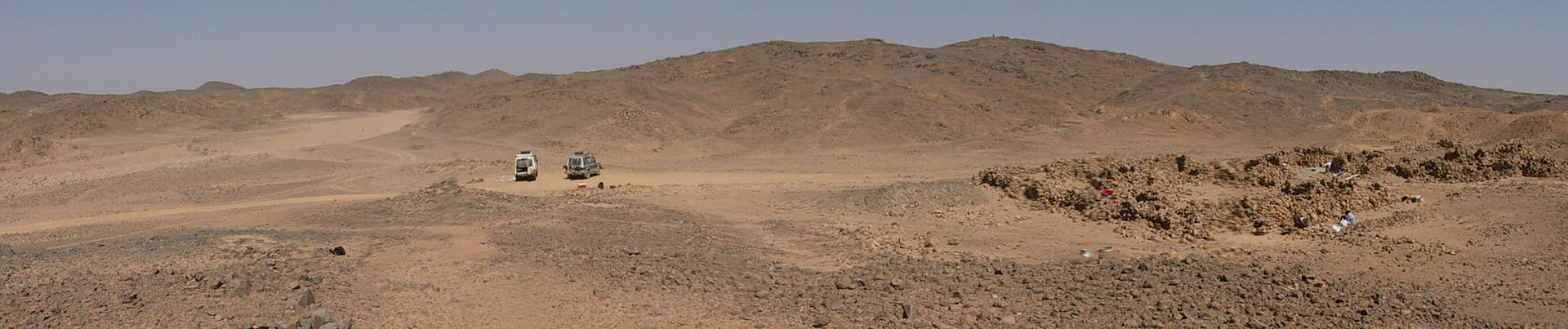
Since 2014, the Wadi el-Hudi Expedition has been working in Egypt’s Eastern Desert to document exceptionally well preserved ancient fortified settlements attached to gold and amethyst mines from the Middle Kingdom (c. 2000-1700 BCE) and the Early Roman Period (c. 50 BCE to 200 CE).
Prior to the Wadi el-Hudi Expedition’s work, all previous studies of Wadi el-Hudi focused solely on the inscriptions. Yet the inscriptions provide only one perspective, that of the ancient administrators. What about the laborers who worked there? The archaeological record can address their lived experience. Questions regarding what the miners ate, how they prepared or stored their food, who supplied the expedition with food and water are primarily answered through the intensive study of ceramics. Daily life of these workers in the settlements as seen through pottery will complement the perspective of the administrators recorded in the inscriptions.
This coming season, we will focus on ceramic analysis and finalize our pottery corpus in order to complete our monograph on the Middle Kingdom pottery at Wadi el-Hudi that incorporates multi-disciplinary perspectives, including scientific analysis of clay. We are also excited to bring a stone conservator to write an initial report to facilitate the conservation and reassembling of important stelae and statues from Wadi el-Hudi.
The Wadi el-Hudi Expedition collaborates with PhD students and early career specialists to give them opportunities upon which they can build their careers. The ASOR Harris Grant will facilitate this.
-Kate Liszka, California State University, San Bernardino
Made possible by a generous endowment given by the late Rev. Charles Harris, Harris Grants are awarded to CAP-affiliated field projects, particularly to newer and smaller projects, to help them get started, and to discrete components of larger projects that can be completed with an award. The Endowment also provides support for off-season research, analysis, and publications. Read more about ASOR Grants for Excavation Projects.


 While we would have liked to see everyone in Boston, it was a privilege to provide a platform for our global membership to connect, share, and engage on subjects from the Mediterranean to the Indian Ocean. ASOR is committed to growing and developing our digital offerings, not only during the pandemic, but as a continuing resource for members. As part of this commitment, and with consent from presenters, we will be sharing some content from ASOR’s Virtual Annual Meeting on our public-facing site, ASORtv. Currently you can listen to ASOR’s Executive Director, Andrew Vaughn, give the
 During a time when travel has been restricted and many cultural and social attractions are closed, ASOR attendees were treated to two virtual museum tours, “Treasures of Ancient Egypt: Sunken Cities,” at the Virginia Museum of Fine Arts, and “The Dura-Europas and Gerasa Collections” at the Yale University Art Gallery.
 As 2020 comes to an end, we are hopeful that the new year will bring an end to the global pandemic and that we will be able to meet in person for ASOR’s next Annual Meeting, November 17-20, 2021, in Chicago. ASOR is also planning to continue with a virtual component to be held online in December. Please watch for the
 [/vc_wp_text][vc_row_inner][vc_column_inner width=”1/2″ css=”.vc_custom_1607362836149{margin-right: 10px !important;}”][vc_wp_text]





 Eric M. Meyers, a 1962 graduate of Dartmouth College, holds an M.A. in Near Eastern and Judaic Studies from Brandeis University, and received the Ph.D. with distinction from Harvard University in Near Eastern Languages and Literatures, specializing in Bible, Jewish History, and archaeology. He served on the active faculty of Duke University from 1969 to 2015 where he has been a Professor since 1979; he presently is the Bernice and Morton Lerner Emeritus Professor of Judaic Studies and Archaeology at





 Prior to the Wadi el-Hudi Expedition’s work, all previous studies of Wadi el-Hudi focused solely on the inscriptions. Yet the inscriptions provide only one perspective, that of the ancient administrators. What about the laborers who worked there? The archaeological record can address their lived experience. Questions regarding what the miners ate, how they prepared or stored their food, who supplied the expedition with food and water are primarily answered through the intensive study of ceramics. Daily life of these workers in the settlements as seen through pottery will complement the perspective of the administrators recorded in the inscriptions.
