ASOR Awardee Spotlight: Birgitta Lindros Wohl

[vc_row fullwidth=”true” attached=”true” css=”.vc_custom_1496247803139{padding-top: 0px !important;padding-right: 0px !important;padding-bottom: 0px !important;padding-left: 0px !important;}”][vc_column][vc_single_image image=”57733″ img_size=”full” alignment=”center”][/vc_column][/vc_row][vc_row fullwidth=”true” css=”.vc_custom_1496682730308{padding-top: 10px !important;padding-right: 0px !important;padding-bottom: 0px !important;padding-left: 0px !important;}”][vc_column width=”1/12″ css=”.vc_custom_1496683820796{margin-right: 10px !important;}” offset=”vc_hidden-md vc_hidden-sm vc_hidden-xs”][vc_column_text]

 SHARE

[/vc_column_text][mk_image src=”http://www.asortest.org/wp-content/uploads/2017/01/social-fb-icon4.jpg” image_width=”42″ image_height=”42″ hover=”false” custom_url=”https://www.facebook.com/ASOResearch/” margin_bottom=”0″][mk_image src=”http://www.asortest.org/wp-content/uploads/2017/01/social-tw-icon4.jpg” image_width=”42″ image_height=”42″ hover=”false” custom_url=”https://twitter.com/ASOResearch?ref_src=twsrc%5Egoogle%7Ctwcamp%5Eserp%7Ctwgr%5Eauthor” margin_bottom=”0″][mk_image src=”http://www.asortest.org/wp-content/uploads/2017/01/social-in-icon4.jpg” image_width=”42″ image_height=”42″ hover=”false” custom_url=”https://www.linkedin.com/company/american-schools-of-oriental-research” margin_bottom=”0″][mk_image src=”http://www.asortest.org/wp-content/uploads/2017/01/social-ml-icon_7.jpg” image_width=”42″ image_height=”42″ hover=”false” custom_url=”mailto:info@asor.org” margin_bottom=”0″][mk_image src=”http://www.asortest.org/wp-content/uploads/2017/01/blog-icon3.jpg” image_width=”42″ image_height=”42″ hover=”false” custom_url=”http://asor.org/blog” margin_bottom=”0″][/vc_column][vc_column border_color=”rgba(255,255,255,0.01)” width=”1/6″ css=”.vc_custom_1496683923840{margin-right: 20px !important;border-left-width: 2px !important;padding-right: 20px !important;padding-left: 20px !important;border-left-color: #99422f !important;}”][mk_divider divider_color=”rgba(255,255,255,0.01)” thickness=”1″ margin_top=”3″ margin_bottom=”3″][vc_column_text]

NEWS@ASOR E-NEWSLETTER

ANCIENT NEAR EAST TODAY E-NEWSLETTER

PAST ASOR NEWS, MONTH BY MONTH

LIFETIME HONOR ROLL OF DONORS

FY20 HONOR ROLL OF DONORS

ASOR VIRTUAL ANNUAL MEETING

[/vc_column_text][/vc_column][vc_column border_color=”rgba(170,170,170,0.01)” width=”1/2″ css=”.vc_custom_1487276122024{margin-right: 10px !important;margin-bottom: 30px !important;border-right-width: 2px !important;border-bottom-width: 2px !important;padding-top: 30px !important;padding-right: 30px !important;padding-left: 20px !important;background-color: #ffffff !important;border-right-color: rgba(227,228,228,0.75) !important;border-bottom-color: rgba(227,228,228,0.75) !important;}”][vc_column_text responsive_align=”left”]

ASOR AWARDEE SPOTLIGHT: BIRGITTA LINDROS WOHL

[/vc_column_text][mk_divider][vc_wp_text]At the 2019 ASOR Annual Meeting in San Diego, Birgitta Lindros Wohl was awarded the W. F. Albright Award. This award honors an individual who has shown special support or made outstanding service contributions to one of the overseas centers, ACOR, AIAR, or CAARI.

Birgitta Lindros Wohl accepts her award at the 2019 Annual Meeting

Birgitta Lindros Wohl, Professor Emerita, Art and Art History, California State University at Northridge (Los Angeles), for her service to the Cyprus American Archaeological Research Institute (CAARI). Birgittahas served as a stalwart Secretary of the Cyprus American Archaeological Research Institute (CAARI) for 5-6 years. She has a long association with the archaeology of Cyprus, beginning with her affiliation with the Swedish Cyprus Expedition that was led by her father. With excavation experience in Sweden, Italy and Greece, her focus has always been on the history of the Swedish Cyprus Expedition and its continued legacy. Still, to this day, Birgitta participates in excavations on Cyprus. Birgitta has recently retired from teaching ancient art history and we thank her for her years of service to CAARI.[/vc_wp_text][mk_divider][vc_wp_text]

Learn more about ASOR Awards

Nominate someone for an award.The deadline for service award nominations is September 11, 2020. The deadline for book award nominations September 18, 2020.

[/vc_wp_text][/vc_column][vc_column border_color=”rgba(170,170,170,0.01)” width=”1/6″ css=”.vc_custom_1496684098866{margin-right: 5px !important;margin-bottom: 20px !important;border-right-width: 2px !important;border-bottom-width: 2px !important;padding-top: 30px !important;padding-right: 10px !important;padding-left: 10px !important;background-color: #ffffff !important;border-right-color: rgba(227,228,228,0.75) !important;border-bottom-color: rgba(227,228,228,0.75) !important;}”][vc_wp_posts title=”BROWSE THE NEWS ARCHIVE” number=”4″][/vc_column][vc_column border_color=”rgba(170,170,170,0.01)” width=”1/6″ css=”.vc_custom_1496684008271{margin-right: 10px !important;margin-bottom: 30px !important;border-right-width: 2px !important;border-bottom-width: 2px !important;padding-top: 30px !important;padding-right: 20px !important;padding-left: 20px !important;background-color: #ffffff !important;border-right-color: rgba(227,228,228,0.75) !important;border-bottom-color: rgba(227,228,228,0.75) !important;}”][vc_column_text] [/vc_column_text][/vc_column][/vc_row]

ANE TODAY VOL VIII n10 (2020)

[vc_row fullwidth=”true” css=”.vc_custom_1486761987223{padding-top: 0px !important;padding-right: 0px !important;padding-bottom: 0px !important;padding-left: 0px !important;}”][vc_column][vc_single_image image=”33901″ img_size=”full”][/vc_column][/vc_row][vc_row fullwidth=”true” css=”.vc_custom_1487275830783{padding-top: 10px !important;padding-right: 0px !important;padding-bottom: 0px !important;padding-left: 0px !important;}”][vc_column width=”1/12″ css=”.vc_custom_1493002455400{margin-right: 10px !important;}” offset=”vc_hidden-md vc_hidden-sm vc_hidden-xs”][vc_column_text]

 SHARE

[/vc_column_text][mk_image src=”http://www.asortest.org/wp-content/uploads/2017/01/social-fb-icon4.jpg” image_width=”42″ image_height=”42″ hover=”false” custom_url=”https://www.facebook.com/ASOResearch/” margin_bottom=”0″][mk_image src=”http://www.asortest.org/wp-content/uploads/2017/01/social-tw-icon4.jpg” image_width=”42″ image_height=”42″ hover=”false” custom_url=”https://twitter.com/ASOResearch?ref_src=twsrc%5Egoogle%7Ctwcamp%5Eserp%7Ctwgr%5Eauthor” margin_bottom=”0″][mk_image src=”http://www.asortest.org/wp-content/uploads/2017/01/social-in-icon4.jpg” image_width=”42″ image_height=”42″ hover=”false” custom_url=”https://www.linkedin.com/company/american-schools-of-oriental-research” margin_bottom=”0″][mk_image src=”http://www.asortest.org/wp-content/uploads/2017/01/social-ml-icon_7.jpg” image_width=”42″ image_height=”42″ hover=”false” custom_url=”mailto:info@asor.org” margin_bottom=”0″][mk_image src=”http://www.asortest.org/wp-content/uploads/2017/01/blog-icon3.jpg” image_width=”42″ image_height=”42″ hover=”false” custom_url=”http://asor.org/blog” margin_bottom=”0″][/vc_column][vc_column border_color=”rgba(255,255,255,0.01)” width=”1/6″ css=”.vc_custom_1493004112151{margin-right: 20px !important;border-left-width: 2px !important;padding-right: 20px !important;padding-left: 20px !important;border-left-color: #99422f !important;}”][mk_divider divider_color=”rgba(255,255,255,0.01)” thickness=”1″ margin_top=”3″ margin_bottom=”3″][vc_widget_sidebar sidebar_id=”sidebar-16″ el_class=”.widget { overflow: hidden; margin-bottom: 0; }”][vc_row_inner][vc_column_inner css=”.vc_custom_1632943387507{padding-top: 10px !important;padding-right: 10px !important;padding-bottom: 5px !important;padding-left: 10px !important;background-image: url(https://www.asor.org/wp-content/uploads/2021/09/ASOR_Patterns_CMYK_Blue_Thin.jpg?id=77162) !important;}”][vc_column_text]

Not a Friend of ASOR yet? Sign up here to receive ANE Today in your inbox weekly!

[/vc_column_text][/vc_column_inner][/vc_row_inner][/vc_column][vc_column border_color=”rgba(170,170,170,0.01)” width=”8/12″ css=”.vc_custom_1487276122024{margin-right: 10px !important;margin-bottom: 30px !important;border-right-width: 2px !important;border-bottom-width: 2px !important;padding-top: 30px !important;padding-right: 30px !important;padding-left: 20px !important;background-color: #ffffff !important;border-right-color: rgba(227,228,228,0.75) !important;border-bottom-color: rgba(227,228,228,0.75) !important;}”][vc_row_inner][vc_column_inner width=”1/3″ css=”.vc_custom_1515087305797{padding-right: 20px !important;}”][mk_image src=”http://www.asor.org/wp-content/uploads/2017/12/foa-reduced-100.png” image_width=”190″ image_height=”100″ crop=”false” hover=”false”][/vc_column_inner][vc_column_inner width=”2/3″][vc_column_text responsive_align=”left”]

October 2020

Vol. 8, No. 10
[/vc_column_text][/vc_column_inner][/vc_row_inner][vc_row_inner][vc_column_inner][mk_divider thickness=”1″ margin_top=”10″][vc_column_text]

Myth and Marvel: Medieval Muslim Writings on Ancient Egypt

By Tara Stephan

Medieval Muslim scholars could not read ancient Egyptian writing. They therefore understood the past through the lenses of literary genres, myths, and the Quran. Read More[/vc_column_text][mk_divider thickness=”1″ margin_top=”10″][vc_column_text]

An Exceptional Discovery at Pompeii: A Victim’s Vitrified Brain Remains

By Pier Paolo Petrone

Human remains are common on archaeological sites. Mount Vesuvius’ sudden eruption preserved bodies in unique ways, including turning rarely seen parts to glass. Read More[/vc_column_text][mk_divider thickness=”1″ margin_top=”10″][vc_column_text]

A Desert Revolution – Transformations in Northwestern Arabia and the Arid Southern Levant in the Late 2nd Millennium BCE

By Juan Manuel Tebes

Archaeology speaks frequently about revolutions, but arid zones are left out of the discussion. But new evidence shows that deserts experienced their own momentous, if slower moving, revolutions. Read More[/vc_column_text][mk_divider thickness=”1″ margin_top=”10″][vc_column_text]

The Archaeology of Clothing in the Ancient Near East

By Allison Thomason

Everyone wore clothes in the ancient Near East but direct evidence is sparse in the archaeological record. Can new methods and a careful look at art bring us closer? Read More[/vc_column_text][mk_divider thickness=”1″ margin_top=”10″][vc_column_text]

The Tree of Life

By Douglas Estes

The Tree of Life is a key feature in the Genesis stories. So why are there so few references in later ancient Near Eastern and Biblical texts and imagery? Read More[/vc_column_text][mk_divider thickness=”1″ margin_top=”10″][/vc_column_inner][/vc_row_inner][/vc_column][/vc_row]

Diversity, Equity, and Inclusion Task Force

[vc_row fullwidth=”true” css=”.vc_custom_1490224714943{padding-top: 0px !important;padding-right: 0px !important;padding-bottom: 0px !important;padding-left: 0px !important;}”][vc_column][vc_single_image image=”66471″ img_size=”full” alignment=”center”][/vc_column][/vc_row][vc_row][vc_column][vc_column_text][/vc_column_text][/vc_column][/vc_row][vc_row fullwidth=”true” css=”.vc_custom_1490225468623{padding-top: 0px !important;padding-right: 0px !important;padding-bottom: 0px !important;padding-left: 0px !important;}”][vc_column width=”1/12″ css=”.vc_custom_1490225195470{margin-right: 10px !important;}” offset=”vc_hidden-sm vc_hidden-xs”][vc_column_text]

  SHARE

[/vc_column_text][mk_image src=”http://www.asortest.org/wp-content/uploads/2017/01/social-fb-icon4.jpg” image_width=”42″ image_height=”42″ hover=”false” custom_url=”https://www.facebook.com/ASOResearch/” margin_bottom=”0″][mk_image src=”http://www.asortest.org/wp-content/uploads/2017/01/social-tw-icon4.jpg” image_width=”42″ image_height=”42″ hover=”false” custom_url=”https://twitter.com/ASOResearch?ref_src=twsrc%5Egoogle%7Ctwcamp%5Eserp%7Ctwgr%5Eauthor” margin_bottom=”0″][mk_image src=”http://www.asortest.org/wp-content/uploads/2017/01/social-in-icon4.jpg” image_width=”42″ image_height=”42″ hover=”false” custom_url=”https://www.linkedin.com/company/american-schools-of-oriental-research” margin_bottom=”0″][mk_image src=”http://www.asortest.org/wp-content/uploads/2017/01/social-ml-icon_7.jpg” image_width=”42″ image_height=”42″ hover=”false” custom_url=”mailto:asor@bu.edu” margin_bottom=”0″][mk_image src=”http://www.asortest.org/wp-content/uploads/2017/01/blog-icon3.jpg” image_width=”42″ image_height=”42″ hover=”false” custom_url=”http://asorblog.org/” margin_bottom=”0″][/vc_column][vc_column border_color=”rgba(255,255,255,0.01)” width=”1/6″ css=”.vc_custom_1490365673198{margin-right: 20px !important;border-left-width: 2px !important;padding-right: 20px !important;padding-left: 20px !important;border-left-color: #99422f !important;}” el_class=”sticky-sidenav”][mk_divider divider_color=”rgba(255,255,255,0.01)” thickness=”1″ margin_top=”3″ margin_bottom=”3″][vc_widget_sidebar sidebar_id=”ca-sidebar-37292″ el_class=”.widget { overflow: hidden; margin-bottom: 0; }”][/vc_column][vc_column border_color=”rgba(170,170,170,0.01)” width=”1/2″ css=”.vc_custom_1490225606852{margin-right: 10px !important;margin-bottom: 30px !important;border-right-width: 2px !important;border-bottom-width: 2px !important;padding-top: 30px !important;padding-right: 30px !important;padding-left: 20px !important;background-color: #ffffff !important;border-right-color: rgba(227,228,228,0.75) !important;border-bottom-color: rgba(227,228,228,0.75) !important;}”][vc_column_text responsive_align=”left”]

ASOR TASK FORCE ON DIVERSITY, EQUITY, AND INCLUSION

Charge

ASOR is and has always been a predominantly white organization. We can tally our members of color on a single page. Why is this the case? How can we make progress toward correcting it? We archaeologists, ancient historians, and philologists who make up the professional membership of ASOR study the origins, growth and transformations of systemically unequal social orders in the past, and we have a duty to use our knowledge to fight the perpetuation of oppressive systems in the present.

Our first job, however, must be to put our own house in order. We have made progress on some diversity issues in the past. Our gender balance has improved markedly; our international membership has grown, and our foreign members now have full status; we have worked to empower our early career scholars. Supporting the latter two groups were goals of our 2015-2020 Strategic Plan. Recruiting Black, Indigenous and People of Color (BIPOC) to our membership was not a priority there. Now is the time to make it one as we revise our current plan and craft our next strategic plan.

Therefore, the first charge to the Task Force on Diversity, Equity, and Inclusion (hereafter DEI) is to seek out methods and recommend programs through which ASOR can recruit and support BIPOC members. This is not a simple task. The pool is shallow. Recent studies (Montañez 2018) show African Americans make up only 1.5% of recent Ph.D.s in Archaeology. Our related disciplines of Classics and Middle Eastern Studies produced a dismal 0% in recent years. Clearly, we must make major efforts to interest young pre-College students in our work. How to do this? Possibly by partnering with community organizations such as Archaeology in the Community (AITC). The task force should seek out and identify such partners.

Once attracted to our discipline how do we encourage BIPOC students to stay in it? Scholarships is one obvious answer, but money is scarce it the humanities. Figuring out how to raise money for such scholarships to support students both in school and in the field should be a priority for the Task Force. Again, partnerships should be sought with colleges, foundations and private donors. We also need to examine our own assumptions about matters of diversity. The DEI Task Force should research and recommend appropriate means of sensitivity training for our leadership.

It is equally important to make ASOR’s activities more attractive and in tune with the concerns of our BIPOC members, as well as the rest of our increasingly socially conscious membership. ASOR was founded in 1900, but times have moved on. Archaeology has a long history of benefitting from and providing intellectual support to colonialism and colonialist goals. The decolonization of our discipline, regardless of our BIPOC members, must be a goal of the organization. We must make ASOR an organization more in tune with the social justice movements of our day. Changing the ways we teach, designing more open syllabi, asking different research questions beyond empires and great men are all good directions. We have made progress in these directions over the past several decades, but there is more to do. A more diverse membership can move us ahead by asking different questions from different viewpoints.

To succeed in these bold changes ASOR must integrate the principles of DEI systematically throughout our organization. Every one of our standing committees will have a role in this, and increasing diversity should be a major goal. For instance, the Program Committee can solicit panels to propose new models of research and teaching; the Committee on Archaeological Research and Policy can fashion fieldwork fellowships for BIPOC members, and the Development Committee can devise ways to fund them. The Outreach and Membership Committee has an important role to play in recruitment and retention, while the Cultural Heritage Committee can see that our treatment of cultural heritage is respectful and takes into account indigenous concerns. Finally, our Honors and Awards and Publication committees can see that work by BIPOC members receives appropriate recognition.

Time Line: A DEI task force has been on our radar for some time; current events make its work urgent. We would like to have the task force formed and working by Oct.1, 2020. With the Chairs Coordinating Council (CCC) committees working on their own diversity goals now, this fall would be the ideal time for the Task Force and the CCC to coordinate their efforts. If possible it would be optimal for the DEI Task Force to provide a preliminary report to the Board at its spring 2021 meeting, when the revised strategic plan will also be presented.

  • Erin Darby, Chair
  • Sharon Herbert, ASOR President
  • Charles Ellwood Jones, ASOR Vice-President
  • Theodore Burgh
  • Kara Cooney
  • Danielle Fatkin
  • Bianca Hand
  • Michael Homan
  • Katherine A. Larson
  • Julia Troche
[/vc_column_text][/vc_column][vc_column border_color=”rgba(170,170,170,0.01)” width=”1/6″ css=”.vc_custom_1490571214409{margin-right: 10px !important;margin-bottom: 30px !important;border-right-width: 2px !important;border-bottom-width: 2px !important;padding-top: 30px !important;padding-right: 20px !important;padding-left: 20px !important;background-color: #ffffff !important;border-right-color: rgba(227,228,228,0.75) !important;border-bottom-color: rgba(227,228,228,0.75) !important;}”][vc_wp_posts title=”BROWSE THE NEWS ARCHIVE” number=”4″][/vc_column][vc_column border_color=”rgba(170,170,170,0.01)” width=”1/6″ css=”.vc_custom_1490225688999{margin-right: 10px !important;margin-bottom: 30px !important;border-right-width: 2px !important;border-bottom-width: 2px !important;padding-top: 30px !important;padding-right: 30px !important;padding-left: 20px !important;background-color: #ffffff !important;border-right-color: rgba(227,228,228,0.75) !important;border-bottom-color: rgba(227,228,228,0.75) !important;}”][vc_column_text] [/vc_column_text][/vc_column][/vc_row][vc_row][vc_column][vc_column_text] [/vc_column_text][/vc_column][/vc_row]
Call for DEI Task Force Nominations

[vc_row fullwidth=”true” attached=”true” css=”.vc_custom_1496247803139{padding-top: 0px !important;padding-right: 0px !important;padding-bottom: 0px !important;padding-left: 0px !important;}”][vc_column][vc_single_image image=”66463″ img_size=”full” alignment=”center”][/vc_column][/vc_row][vc_row fullwidth=”true” css=”.vc_custom_1496682730308{padding-top: 10px !important;padding-right: 0px !important;padding-bottom: 0px !important;padding-left: 0px !important;}”][vc_column width=”1/12″ css=”.vc_custom_1496683820796{margin-right: 10px !important;}” offset=”vc_hidden-md vc_hidden-sm vc_hidden-xs”][vc_column_text]

 SHARE

[/vc_column_text][mk_image src=”http://www.asortest.org/wp-content/uploads/2017/01/social-fb-icon4.jpg” image_width=”42″ image_height=”42″ hover=”false” custom_url=”https://www.facebook.com/ASOResearch/” margin_bottom=”0″][mk_image src=”http://www.asortest.org/wp-content/uploads/2017/01/social-tw-icon4.jpg” image_width=”42″ image_height=”42″ hover=”false” custom_url=”https://twitter.com/ASOResearch?ref_src=twsrc%5Egoogle%7Ctwcamp%5Eserp%7Ctwgr%5Eauthor” margin_bottom=”0″][mk_image src=”http://www.asortest.org/wp-content/uploads/2017/01/social-in-icon4.jpg” image_width=”42″ image_height=”42″ hover=”false” custom_url=”https://www.linkedin.com/company/american-schools-of-oriental-research” margin_bottom=”0″][mk_image src=”http://www.asortest.org/wp-content/uploads/2017/01/social-ml-icon_7.jpg” image_width=”42″ image_height=”42″ hover=”false” custom_url=”mailto:info@asor.org” margin_bottom=”0″][mk_image src=”http://www.asortest.org/wp-content/uploads/2017/01/blog-icon3.jpg” image_width=”42″ image_height=”42″ hover=”false” custom_url=”http://asor.org/blog” margin_bottom=”0″][/vc_column][vc_column border_color=”rgba(255,255,255,0.01)” width=”1/6″ css=”.vc_custom_1496683923840{margin-right: 20px !important;border-left-width: 2px !important;padding-right: 20px !important;padding-left: 20px !important;border-left-color: #99422f !important;}”][mk_divider divider_color=”rgba(255,255,255,0.01)” thickness=”1″ margin_top=”3″ margin_bottom=”3″][vc_column_text]

NEWS@ASOR E-NEWSLETTER

ANCIENT NEAR EAST TODAY E-NEWSLETTER

PAST ASOR NEWS, MONTH BY MONTH

LIFETIME HONOR ROLL OF DONORS

FY20 HONOR ROLL OF DONORS

ASOR VIRTUAL ANNUAL MEETING

[/vc_column_text][/vc_column][vc_column border_color=”rgba(170,170,170,0.01)” width=”1/2″ css=”.vc_custom_1487276122024{margin-right: 10px !important;margin-bottom: 30px !important;border-right-width: 2px !important;border-bottom-width: 2px !important;padding-top: 30px !important;padding-right: 30px !important;padding-left: 20px !important;background-color: #ffffff !important;border-right-color: rgba(227,228,228,0.75) !important;border-bottom-color: rgba(227,228,228,0.75) !important;}”][vc_column_text responsive_align=”left”]

CALL FOR NOMINATIONS: ASOR’S DIVERSITY, EQUITY, AND INCLUSION TASK FORCE

[/vc_column_text][mk_divider][vc_wp_text]ASOR seeks volunteers for a Task Force on Diversity, Equity, and Inclusion (DEI). This Task Force will be comprised of 10-12 ASOR members to be selected by Oct. 1, 2020. We will ask the Task Force to present a preliminary report on next steps directions to take at the spring 2021 Board of Trustees’ meeting. The Task Force will work with ASOR leadership and the Chairs Coordinating Council (CCC) in helping revise the ASOR Strategic Plan. The full charge to the Task Force is posted on the ASOR web site. The summary charge is as follows:

We archaeologists, ancient historians, and philologists who make up the professional membership of ASOR study the origins, growth, and transformations of systemically unequal social orders in the past, and we have a duty to use our knowledge to fight the perpetuation of oppressive systems in the present. To that end, the Task Force on Diversity, Equity, and Inclusion will seek out methods and recommend programs through which ASOR can recruit and support Black, Indigenous, and People of Color (BIPOC) members by (1) identifying partners in community organizations and institutions; (2) creating fundraising initiatives for scholarships that promote BIPOC participation at meetings and in the field; (3) recommending sensitivity training programs for ASOR leadership; and (4) collaborating with all ASOR committees and leadership to integrate these objectives across all areas of our new strategic plan.

Those interested in serving on the task force should contact the Chair, Erin Darby (edarby1@utk.edu). We hope to have the task force determined by Oct. 1, 2020.[/vc_wp_text][/vc_column][vc_column border_color=”rgba(170,170,170,0.01)” width=”1/6″ css=”.vc_custom_1496684098866{margin-right: 5px !important;margin-bottom: 20px !important;border-right-width: 2px !important;border-bottom-width: 2px !important;padding-top: 30px !important;padding-right: 10px !important;padding-left: 10px !important;background-color: #ffffff !important;border-right-color: rgba(227,228,228,0.75) !important;border-bottom-color: rgba(227,228,228,0.75) !important;}”][vc_wp_posts title=”BROWSE THE NEWS ARCHIVE” number=”4″][/vc_column][vc_column border_color=”rgba(170,170,170,0.01)” width=”1/6″ css=”.vc_custom_1496684008271{margin-right: 10px !important;margin-bottom: 30px !important;border-right-width: 2px !important;border-bottom-width: 2px !important;padding-top: 30px !important;padding-right: 20px !important;padding-left: 20px !important;background-color: #ffffff !important;border-right-color: rgba(227,228,228,0.75) !important;border-bottom-color: rgba(227,228,228,0.75) !important;}”][vc_column_text] [/vc_column_text][/vc_column][/vc_row]

ASOR Project Directors Zoom Meeting: Oct. 1

[vc_row fullwidth=”true” attached=”true” css=”.vc_custom_1496247803139{padding-top: 0px !important;padding-right: 0px !important;padding-bottom: 0px !important;padding-left: 0px !important;}”][vc_column][vc_single_image image=”65647″ img_size=”full” alignment=”center”][/vc_column][/vc_row][vc_row fullwidth=”true” css=”.vc_custom_1496682730308{padding-top: 10px !important;padding-right: 0px !important;padding-bottom: 0px !important;padding-left: 0px !important;}”][vc_column width=”1/12″ css=”.vc_custom_1496683820796{margin-right: 10px !important;}” offset=”vc_hidden-md vc_hidden-sm vc_hidden-xs”][vc_column_text]

 SHARE

[/vc_column_text][mk_image src=”http://www.asortest.org/wp-content/uploads/2017/01/social-fb-icon4.jpg” image_width=”42″ image_height=”42″ hover=”false” custom_url=”https://www.facebook.com/ASOResearch/” margin_bottom=”0″][mk_image src=”http://www.asortest.org/wp-content/uploads/2017/01/social-tw-icon4.jpg” image_width=”42″ image_height=”42″ hover=”false” custom_url=”https://twitter.com/ASOResearch?ref_src=twsrc%5Egoogle%7Ctwcamp%5Eserp%7Ctwgr%5Eauthor” margin_bottom=”0″][mk_image src=”http://www.asortest.org/wp-content/uploads/2017/01/social-in-icon4.jpg” image_width=”42″ image_height=”42″ hover=”false” custom_url=”https://www.linkedin.com/company/american-schools-of-oriental-research” margin_bottom=”0″][mk_image src=”http://www.asortest.org/wp-content/uploads/2017/01/social-ml-icon_7.jpg” image_width=”42″ image_height=”42″ hover=”false” custom_url=”mailto:info@asor.org” margin_bottom=”0″][mk_image src=”http://www.asortest.org/wp-content/uploads/2017/01/blog-icon3.jpg” image_width=”42″ image_height=”42″ hover=”false” custom_url=”http://asor.org/blog” margin_bottom=”0″][/vc_column][vc_column border_color=”rgba(255,255,255,0.01)” width=”1/6″ css=”.vc_custom_1496683923840{margin-right: 20px !important;border-left-width: 2px !important;padding-right: 20px !important;padding-left: 20px !important;border-left-color: #99422f !important;}”][mk_divider divider_color=”rgba(255,255,255,0.01)” thickness=”1″ margin_top=”3″ margin_bottom=”3″][vc_column_text]

NEWS@ASOR E-NEWSLETTER

ANCIENT NEAR EAST TODAY E-NEWSLETTER

PAST ASOR NEWS, MONTH BY MONTH

LIFETIME HONOR ROLL OF DONORS

FY20 HONOR ROLL OF DONORS

ASOR VIRTUAL ANNUAL MEETING

[/vc_column_text][/vc_column][vc_column border_color=”rgba(170,170,170,0.01)” width=”1/2″ css=”.vc_custom_1487276122024{margin-right: 10px !important;margin-bottom: 30px !important;border-right-width: 2px !important;border-bottom-width: 2px !important;padding-top: 30px !important;padding-right: 30px !important;padding-left: 20px !important;background-color: #ffffff !important;border-right-color: rgba(227,228,228,0.75) !important;border-bottom-color: rgba(227,228,228,0.75) !important;}”][vc_column_text responsive_align=”left”]

ASOR PROJECT DIRECTORS ZOOM MEETING

[/vc_column_text][mk_divider][vc_wp_text]Following a summer of minimal-to-no fieldwork for almost all ASOR projects, the Chair of the Committee on Archaeological Research and Policy, Steve Falconer, is convening ASOR-affiliated archaeological project directors and the directors of ASOR’s affiliated centers (ACOR, AIAR, and CAARI) to discuss fieldwork prospects for 2021. The Center Directors and other colleagues will briefly summarize the prospects for 2021 fieldwork in Cyprus, Israel, Jordan, Egypt, Turkey, Lebanon, Syria, and Iraq. This meeting is designed to help directors discuss the challenges of planning fieldwork in the current environment (travel restrictions, COVID-19 safety measures, etc.). The overseas research Center Directors will provide perspectives from within their respective countries. The goal is to offer project directors a place to share their experiences, questions, and concerns for fieldwork moving forward.

The meeting is scheduled for October 1 at 12:00 PM EDT.

If you are interested in participating in this Zoom meeting, please contact Marta Ostovich (programs@asor.org). The meeting will be recorded and made available to all who are interested. By participating in the meeting, you agree to ASOR recording the session.

We hope this will be the first in a series of meetings and discussions for ASOR members on 2021 fieldwork.[/vc_wp_text][/vc_column][vc_column border_color=”rgba(170,170,170,0.01)” width=”1/6″ css=”.vc_custom_1496684098866{margin-right: 5px !important;margin-bottom: 20px !important;border-right-width: 2px !important;border-bottom-width: 2px !important;padding-top: 30px !important;padding-right: 10px !important;padding-left: 10px !important;background-color: #ffffff !important;border-right-color: rgba(227,228,228,0.75) !important;border-bottom-color: rgba(227,228,228,0.75) !important;}”][vc_wp_posts title=”BROWSE THE NEWS ARCHIVE” number=”4″][/vc_column][vc_column border_color=”rgba(170,170,170,0.01)” width=”1/6″ css=”.vc_custom_1496684008271{margin-right: 10px !important;margin-bottom: 30px !important;border-right-width: 2px !important;border-bottom-width: 2px !important;padding-top: 30px !important;padding-right: 20px !important;padding-left: 20px !important;background-color: #ffffff !important;border-right-color: rgba(227,228,228,0.75) !important;border-bottom-color: rgba(227,228,228,0.75) !important;}”][vc_column_text] [/vc_column_text][/vc_column][/vc_row]

إحياء فنون مسرح الظل الليبي المفقود

إحياء فنون مسرح الظل الليبي المفقود

بالشراكة مع زملائنا الليبيين ، وبدعم من صندوق سفراء وزارة الخارجية الأمريكية للحفاظ على التراث الثقافي ، وفرقة عمل الآثار الثقافية  ، والمكتب الخارجي لسفارة الولايات المتحدة في ليبيا  ، تقدم رسالة الأمل من خلال ورش العمل الموجهة للمتطوعين في مجال حماية التراث الثقافي (الأحداث التفاعلية) ومن خلال ورش العمل التراثية ليوم واحد. تتناول هذه المقالة الأيام الأخيرة من ورشة العمل التطوعية التي أقيمت في غدامس في مارس 2020.

في مدينة طرابلس القديمة ، ليبيا ، أمام برج ميدان الساعة ، استضاف نجار قديم ذات مرة عروض دمى الظل في متجره كل ليلة خلال شهر رمضان. كانت مجموعة تلو الأخرى من الأطفال تصل بحماسة إلى المتجر ، ليجدوا بسرعة مقاعدعلى الأرض المحاطة بالأبواب الخشبية التي صنعها النجار في ذلك اليوم. كان الضوء الوحيد يأتي من خلف ستار قماشى ، أعاده النجار إلى الحياة من خلال الدمى في القراقوز.

أوضح  الأستاذ يوسف الكردي ، الذي كان أحد هؤلاء الأطفال الجالسين على الأرض في الجمهور في الخمسينيات من القرن الماضي ، “لقد قمت بتخزين هذه التجربة بعيدًا في عمق مخيلتى ، جازماً بإننى سأستخدمها يومًا ما”. بعد مسيرة طويلة كممثل معروف على الشاشة والمسرح ، أمضى الكردي جزءًا من تقاعده في إحياء فن مسرح الظل الليبي المفقود ، حيث استضاف عروضًا مجانية في ساحة ميدان الجزائر بطرابلس خلال شهر رمضان. مثل هذه العروض كانت مسلية وتنقل رسائل أخلاقية عميقة للجمهور الليبي منذ وصول العثمانيين عام 1551. يركز الكردي بشكل عام عروضه على القصص الرومانسية التي تسلط الضوء على الدور الحيوي للمرأة في دعم المجتمع.

للتحضير لعرض ما ، يرسم ملامح شخصياته على الورق الثقيل ثم يقطعها ويكتب النصوص ويؤدي جميع الأصوات بنفسه. “أحاول أن أبقي عروضي قصيرة ، ربما 15 دقيقة فقط ، لكنني أملاها بالكوميديا ​​السوداء التي ستسلي الأطفال وكذلك والديهم. أعرف أن رسائلي قد وصلت عندما أرى الابتسامات تنبعث من الجمهور “.

خلال ورشة العمل الموجهة للمتطوعين في مجال حماية التراث الثقافي التي استضافتها دار الثقافة في غدامس ، كان مسرح الظل ليوسف تتويجًا لورشة العمل التي استغرقت عدة أيام والتي ركزت بشدة على التراث الثقافي غير المادي في ليبيا. تم تناسى أو نسيان أشكال فنية مثل مسرح الظل خلال نظام القذافي وصعود القنوات التلفزيونية المحلية والفضائية في نهاية المطاف. وبحسب الكردي ، “نفقد ثقافتنا ، على وجه الخصوص في هذه الأوقات ، عندما يركز الجميع على البقاء على قيد الحياة فقط ، فمن السهل أن تختفى ألوان مهمة من الثقافة خلال رحلة المخاوف اليومية. أقدم عروضًا مجانية لدمى الظل ، ليس فقط لأنني أستمتع بها ، ولكن كطريقة لنيل عصفورين بحجر واحد. هذه العروض تدعم الفن الليبي وتمثل استثمارًا في جيل الشباب ، وهو أهم استثمار يمكننا القيام به الآن “. بعد سنوات من الآن ، قد يصنع أحد الأطفال من الجمهور الدمى ويؤدي ما أقوم به الأن ، مما يحافظ على الفن حياً “.

قدم الكردي عرضا للمتطوعين خلال ورشة غدامس

مسرح الظل بدار الثقافة في غدامس

بعد عرض الأستاذ يوسف الكردي ، تجولنا على طول الأزقة خافتة الأضواء والمظلمة أحياناً لمدينة غدامس القديمة إلى مطعم في قلبها. هناك ، وبعد عشاء شعبى لذيذ والشاي الأخضر الذي تلاه ، استمر الأداء ، تم إستعراض مقاطع من الشعر الشعبى ، بما في ذلك المساهمات التي أرسلها أولئك الذين لم يتمكنوا من الحضور شخصيًا بسبب الصراع الدائر في ليبيا.

كما تم تذكيرنا خلال ورشة العمل هذه ، الثقافة هي شيء حي بيننا ، فالمباني والمحفوظات والمخطوطات والتقاليد تتحلل كلها إذا لم يتغذى عليها الناس ويتم منها دفقة حياة جديدة مع كل جيل يمر.

زيارة المشاركين المتطوعين لقلب مدينة غدامس.

الاستمتاع بالفولكلور والشعر الشعبى مع الشاي الأخضر.

سافرت فوزية سعيد عمار ، أستاذة التاريخ القديم بجامعة سرت ، من منتصف البلاد و عبر طرق طويلة للانضمام إلى مجموعتنا وحضور ورشة العمل هذه . لقد أدهشتها بشكل خاص قوة المكان ، حين قالت : “غدامس مدينة لا مثيل لها ، وبمجرد وصولنا ، شعرت بشيء يجذبني لها حتى العمق. اللون الوردي لمبانيها مليء بالسحر والخيال ، سواء دخلت المدينة من خلال البوابات التاريخية في جرسان ، أو البر ، أو الظهرة أو غيرها مما لا أذكر أسمه الأن ، تسمح النقوش والزخارف التي تميز منزلًا عن آخر للزائر بفهم المدينة على أنها مجموعة من العائلات  . في الوقت نفسه ، تُظهر البنية التحتية المتطورة لقنوات توزيع المياه المتصلة  ببحيرة عين الفرس أن المدينة لم تكن لتتمكن من الازدهار والصمود والإستمرار في وسط الصحراء دون التزام وإنضباط  دائم من المجتمع الغدامسى  تجاه مدينتهم “.

كان لكلماتها صدى خاص عندما غادرنا غدامس ، وعدنا إلى واقع ليبيا الجريحة المليئة بعدم اليقين بسبب الصراع المستمر والتهديد (الذي كان موجوداً ، والمتزايد الآن) من الوباء العالمي كوفيد 19. الطريقة الوحيدة لحماية واستدامة ليبيا وكذلك ثقافتها وتراثها هي من خلال العمل المجتمعي المتضامن والمستمر الذي يمتد عبر الأجيال والجغرافيا.إنه عمل دؤوب لا نهاية له .

غروب الشمس في منطقة الكثبان الرملية بغدامس.

ANE TODAY VOL VIII n09 (2020)

[vc_row fullwidth=”true” css=”.vc_custom_1486761987223{padding-top: 0px !important;padding-right: 0px !important;padding-bottom: 0px !important;padding-left: 0px !important;}”][vc_column][vc_single_image image=”33901″ img_size=”full”][/vc_column][/vc_row][vc_row fullwidth=”true” css=”.vc_custom_1487275830783{padding-top: 10px !important;padding-right: 0px !important;padding-bottom: 0px !important;padding-left: 0px !important;}”][vc_column width=”1/12″ css=”.vc_custom_1493002455400{margin-right: 10px !important;}” offset=”vc_hidden-md vc_hidden-sm vc_hidden-xs”][vc_column_text]

 SHARE

[/vc_column_text][mk_image src=”http://www.asortest.org/wp-content/uploads/2017/01/social-fb-icon4.jpg” image_width=”42″ image_height=”42″ hover=”false” custom_url=”https://www.facebook.com/ASOResearch/” margin_bottom=”0″][mk_image src=”http://www.asortest.org/wp-content/uploads/2017/01/social-tw-icon4.jpg” image_width=”42″ image_height=”42″ hover=”false” custom_url=”https://twitter.com/ASOResearch?ref_src=twsrc%5Egoogle%7Ctwcamp%5Eserp%7Ctwgr%5Eauthor” margin_bottom=”0″][mk_image src=”http://www.asortest.org/wp-content/uploads/2017/01/social-in-icon4.jpg” image_width=”42″ image_height=”42″ hover=”false” custom_url=”https://www.linkedin.com/company/american-schools-of-oriental-research” margin_bottom=”0″][mk_image src=”http://www.asortest.org/wp-content/uploads/2017/01/social-ml-icon_7.jpg” image_width=”42″ image_height=”42″ hover=”false” custom_url=”mailto:info@asor.org” margin_bottom=”0″][mk_image src=”http://www.asortest.org/wp-content/uploads/2017/01/blog-icon3.jpg” image_width=”42″ image_height=”42″ hover=”false” custom_url=”http://asor.org/blog” margin_bottom=”0″][/vc_column][vc_column border_color=”rgba(255,255,255,0.01)” width=”1/6″ css=”.vc_custom_1493004112151{margin-right: 20px !important;border-left-width: 2px !important;padding-right: 20px !important;padding-left: 20px !important;border-left-color: #99422f !important;}”][mk_divider divider_color=”rgba(255,255,255,0.01)” thickness=”1″ margin_top=”3″ margin_bottom=”3″][vc_widget_sidebar sidebar_id=”sidebar-16″ el_class=”.widget { overflow: hidden; margin-bottom: 0; }”][vc_row_inner][vc_column_inner css=”.vc_custom_1632943679866{padding-top: 10px !important;padding-right: 10px !important;padding-bottom: 5px !important;padding-left: 10px !important;background-image: url(https://www.asor.org/wp-content/uploads/2021/09/ASOR_Patterns_CMYK_Blue_Thin.jpg?id=77162) !important;}”][vc_column_text]

Not a Friend of ASOR yet? Sign up here to receive ANE Today in your inbox weekly!

[/vc_column_text][/vc_column_inner][/vc_row_inner][/vc_column][vc_column border_color=”rgba(170,170,170,0.01)” width=”8/12″ css=”.vc_custom_1487276122024{margin-right: 10px !important;margin-bottom: 30px !important;border-right-width: 2px !important;border-bottom-width: 2px !important;padding-top: 30px !important;padding-right: 30px !important;padding-left: 20px !important;background-color: #ffffff !important;border-right-color: rgba(227,228,228,0.75) !important;border-bottom-color: rgba(227,228,228,0.75) !important;}”][vc_row_inner][vc_column_inner width=”1/3″ css=”.vc_custom_1515087305797{padding-right: 20px !important;}”][mk_image src=”http://www.asor.org/wp-content/uploads/2017/12/foa-reduced-100.png” image_width=”190″ image_height=”100″ crop=”false” hover=”false”][/vc_column_inner][vc_column_inner width=”2/3″][vc_column_text responsive_align=”left”]

September 2020

Vol. 8, No. 9

[/vc_column_text][/vc_column_inner][/vc_row_inner][vc_row_inner][vc_column_inner][mk_divider thickness=”1″ margin_top=”10″][vc_column_text]

#MeToo-potamia (or systemic gender inequality in Mesopotamia)

By Greta Van Buylaere

The contributions of Mesopotamian women must be pieced together from texts. The evidence indicates more than two thousand years of increasing marginalization. Read More[/vc_column_text][mk_divider thickness=”1″ margin_top=”10″][vc_column_text]

Max von Oppenheim and His Tell Halaf

By Lutz Martin

Born into a prominent banking family, Max von Oppenheim seemed destined to study law. But his real contribution was to uncover an Iron Age city in north Syria. Read More[/vc_column_text][mk_divider thickness=”1″ margin_top=”10″][vc_column_text]

Charity (Tzedaqah) as a Late Antique Rabbinic Religious Idea

By Alyssa M. Gray

Charity is a key means of demonstrating righteousness before God. But for different generations of rabbis the core elements of charity – and their underlying meanings – were quite different. Read More[/vc_column_text][mk_divider thickness=”1″ margin_top=”10″][vc_column_text]

Epidemics in Mesopotamia

By Annie Attia

Epidemics have been with us since long before the dawn of history. Three collections of documents record some of the ways ancient Near Eastern societies suffered and coped. Read More[/vc_column_text][mk_divider thickness=”1″ margin_top=”10″][/vc_column_inner][/vc_row_inner][/vc_column][/vc_row]

Fellowship Report: Avary Taylor

[vc_row fullwidth=”true” attached=”true” css=”.vc_custom_1496247803139{padding-top: 0px !important;padding-right: 0px !important;padding-bottom: 0px !important;padding-left: 0px !important;}”][vc_column][vc_single_image image=”65648″ img_size=”full” alignment=”center”][/vc_column][/vc_row][vc_row fullwidth=”true” css=”.vc_custom_1496682730308{padding-top: 10px !important;padding-right: 0px !important;padding-bottom: 0px !important;padding-left: 0px !important;}”][vc_column width=”1/12″ css=”.vc_custom_1496683820796{margin-right: 10px !important;}” offset=”vc_hidden-md vc_hidden-sm vc_hidden-xs”][vc_column_text]

 SHARE

[/vc_column_text][mk_image src=”http://www.asortest.org/wp-content/uploads/2017/01/social-fb-icon4.jpg” image_width=”42″ image_height=”42″ hover=”false” custom_url=”https://www.facebook.com/ASOResearch/” margin_bottom=”0″][mk_image src=”http://www.asortest.org/wp-content/uploads/2017/01/social-tw-icon4.jpg” image_width=”42″ image_height=”42″ hover=”false” custom_url=”https://twitter.com/ASOResearch?ref_src=twsrc%5Egoogle%7Ctwcamp%5Eserp%7Ctwgr%5Eauthor” margin_bottom=”0″][mk_image src=”http://www.asortest.org/wp-content/uploads/2017/01/social-in-icon4.jpg” image_width=”42″ image_height=”42″ hover=”false” custom_url=”https://www.linkedin.com/company/american-schools-of-oriental-research” margin_bottom=”0″][mk_image src=”http://www.asortest.org/wp-content/uploads/2017/01/social-ml-icon_7.jpg” image_width=”42″ image_height=”42″ hover=”false” custom_url=”mailto:info@asor.org” margin_bottom=”0″][mk_image src=”http://www.asortest.org/wp-content/uploads/2017/01/blog-icon3.jpg” image_width=”42″ image_height=”42″ hover=”false” custom_url=”http://asor.org/blog” margin_bottom=”0″][/vc_column][vc_column border_color=”rgba(255,255,255,0.01)” width=”1/6″ css=”.vc_custom_1496683923840{margin-right: 20px !important;border-left-width: 2px !important;padding-right: 20px !important;padding-left: 20px !important;border-left-color: #99422f !important;}”][mk_divider divider_color=”rgba(255,255,255,0.01)” thickness=”1″ margin_top=”3″ margin_bottom=”3″][vc_column_text]

NEWS@ASOR E-NEWSLETTER

ANCIENT NEAR EAST TODAY E-NEWSLETTER

PAST ASOR NEWS, MONTH BY MONTH

LIFETIME HONOR ROLL OF DONORS

FY20 HONOR ROLL OF DONORS

ASOR VIRTUAL ANNUAL MEETING

[/vc_column_text][/vc_column][vc_column border_color=”rgba(170,170,170,0.01)” width=”1/2″ css=”.vc_custom_1487276122024{margin-right: 10px !important;margin-bottom: 30px !important;border-right-width: 2px !important;border-bottom-width: 2px !important;padding-top: 30px !important;padding-right: 30px !important;padding-left: 20px !important;background-color: #ffffff !important;border-right-color: rgba(227,228,228,0.75) !important;border-bottom-color: rgba(227,228,228,0.75) !important;}”][vc_column_text responsive_align=”left”]

A RETURN TO ANCIENT LAGASH

Avary Taylor, 2019 P. E. MacAllister Excavation Fellowship Recipient[/vc_column_text][mk_divider][vc_wp_text]

Avary Taylor collecting geophysical data with Bartington magnetometer.

The P. E. MacAllister Excavation Fellowship financially supported my travel to the site of al-Hiba, Iraq (ancient Lagash) in March and April of 2019 to take part in the Lagash Archaeological Project (LAP). The team—composed of faculty, researchers, and graduate students from the University of Pennsylvania, the University of Cambridge, the Università di Pisa, and the State Board of Antiquities and Heritage of Iraq, as well as myself, a fifth-year PhD candidate in the Near Eastern Studies Department at Johns Hopkins University—surveyed and excavated the site, which had not been revisited since 1990.

Tell al-Hiba is located in the Dhi Qar Province of southern Iraq. The site was briefly excavated by Robert Koldewey in 1887, but it was not until six campaigns led by teams from the Metropolitan Museum of Art and the Institute of Fine Arts of New York University undertaken in the mid- and late-twentieth century that the importance of the site was fully realized. Lagash was one of the earliest cities in the world and was a dominating power in Sumer during the third millennium BCE. The third millennium is characterized by major cultural and political changes. During the Early Dynastic Period, which is named after the earliest evidence for dynastic rule in Mesopotamia, dynastic kings ruled over city-states that emerged in southern Iraq and shared a common, Sumerian identity. Al-Hiba is a significant site in the study of early urbanism in the ancient world. During this period, the city of Lagash grew as large as 600 hectares and competed with other Sumerian city-states.

Area H photograph with excavated kilns immediately below surface.

The 2019 field season at al-Hiba was highly successful and produced many exciting finds, including evidence of a monumental city wall and a royal cone of king Enmetena. The season was focused around surface collection surveys, remote sensing (drone photography and geophysics surveys), and excavations in Area G, a previously opened area with extensive Early Dynastic I levels and a monumental curving wall, and the newly opened Area H, an industrial zone.

My time at Lagash was spent excavating, collecting geophysical data with a magnetometer, and cataloging and analyzing ceramics. I proudly was able to beat many personal bests on the magnetometer, and the team successfully covered a truly massive area of the site during survey and remote sensing. After excavating during the day, I would help catalogue ceramics and I became intimately familiar with the hundreds of beaker sherds that the team excavated this season.

During the team’s days off, we were able to travel to neighboring southern Iraq sites, such as Tell al-Muqayyar (ancient Ur), where we were fortunate enough to experience a massive dust storm immediately followed by a rain storm. Despite how it may sound, this was truly a special experience; pictures of the site, and particularly of the ziggurat, are captured on bright, sunny days. Experiencing the site in more extreme weather provided me with an important alternative view of Ur than many scholars have access to. The team was also able to visit the newly opened Basra Museum, which housed many wonderful Mesopotamian objects within its beautiful building.

Drone flying above sunset landscape of Lagash.

Avary Taylor is a PhD candidate in Near Eastern Studies at Johns Hopkins University. Taylor is an art historian who specializes in the art of the Neo-Assyrian Period. His in-progress dissertation, “The ‘Thing’ About the Palace: A Posthumanist Biography of the Northwest Palace,” seeks to understand the life of a Neo-Assyrian palace, not as a constructed result reflecting human agency and will, but as an autonomous being itself. The dissertation engages with posthumanist theories to explore the proposition that the role of humans is secondary to the “thing.” Taylor is also involved in several archaeological projects in addition to al-Hiba, such as Kurd Qaburstan (Johns Hopkins University).[/vc_wp_text][/vc_column][vc_column border_color=”rgba(170,170,170,0.01)” width=”1/6″ css=”.vc_custom_1496684098866{margin-right: 5px !important;margin-bottom: 20px !important;border-right-width: 2px !important;border-bottom-width: 2px !important;padding-top: 30px !important;padding-right: 10px !important;padding-left: 10px !important;background-color: #ffffff !important;border-right-color: rgba(227,228,228,0.75) !important;border-bottom-color: rgba(227,228,228,0.75) !important;}”][vc_wp_posts title=”BROWSE THE NEWS ARCHIVE” number=”4″][/vc_column][vc_column border_color=”rgba(170,170,170,0.01)” width=”1/6″ css=”.vc_custom_1496684008271{margin-right: 10px !important;margin-bottom: 30px !important;border-right-width: 2px !important;border-bottom-width: 2px !important;padding-top: 30px !important;padding-right: 20px !important;padding-left: 20px !important;background-color: #ffffff !important;border-right-color: rgba(227,228,228,0.75) !important;border-bottom-color: rgba(227,228,228,0.75) !important;}”][vc_column_text] [/vc_column_text][/vc_column][/vc_row]

Ghadames – The Lost Art of Libyan Shadow Theater Revived

The Lost Art of Libyan Shadow Theater Revived

In partnership with our Libyan colleagues, and with support from the U.S. Department of State’s Ambassadors Fund for Cultural Preservation (AFCP), the Cultural Antiquities Task Force (CATF), and the U.S. Embassy Libya External Office (LEO), ASOR is bringing a message of hope through Cultural Heritage Volunteer Weekends (“pop-up” events) and through one-day heritage workshops. This article reports on the final days of a Volunteer Weekend held in Ghadames in March 2020. 

Click here for the Arabic version of this article (إحياء فنون مسرح الظل الليبي المفقود)

In the Old City of Tripoli, Libya, just in front of the clock tower of Midan as Sa’ah, an old carpenter once hosted shadow puppet shows in his shop every night during the month of Ramadan. Group after group of children would excitedly arrive in the shop, quickly finding a seat on the floor surrounded by the wooden doors that the carpenter had made that day.  The only light came from behind a central screen, which the carpenter brought to life through his qaraqoz puppets.

“I stored this experience away in my head, knowing that one day I would use it,” explained Yousef al Kurdi, who had been one of those children sitting on the floor in the audience back in the 1950s. After a long career as a well-known actor for screen and stage, al Kurdi has spent part of his retirement reviving the lost art of Libyan shadow theater, hosting free performances in Tripoli’s Algeria Square during Ramadan. Such shows have been entertaining and imparting moral messages to Libyan audiences since their arrival with the Ottomans in 1551. Al Kurdi, for his part, generally focuses his shows on romantic stories which highlight the vital role of women in sustaining society.

To prepare for a show, he draws the profiles of his characters on heavy paper stock and then cuts them out, writing the scripts and performing all of the voices himself. “I try to keep my shows short, maybe only 15 minutes, but fill them with dark comedy that will entertain children as well as their parents. I know my messages are connecting when I see the smiles beaming back from members of the audience.”

During the recent cultural heritage volunteer weekend that ASOR hosted in Ghadames, Yousef’s shadow theater was the culmination of our multi-day workshop that had placed a strong emphasis on Libya’s intangible cultural heritage. Art forms such as shadow theater had been repressed or forgotten during the Gaddafi regime and the rise of local and eventually satellite television channels. According to al Kurdi, “We’re losing our culture. Particularly in these times, when everyone is focused on just surviving, it is easy to be overwhelmed by day-to-day worries. I provide free shadow puppet performances, not only because I enjoy them, but as a way to kill two birds with one stone. These shows both sustain Libyan art and represent an investment in the young generation, the most important investment we can make right now.” Years from now, one of the children in the audience might make their own puppets and perform, keeping the art alive.

Al Kurdi performed for volunteers during the Ghadames workshop.
Shadow Theater at the House of Culture in Ghadames

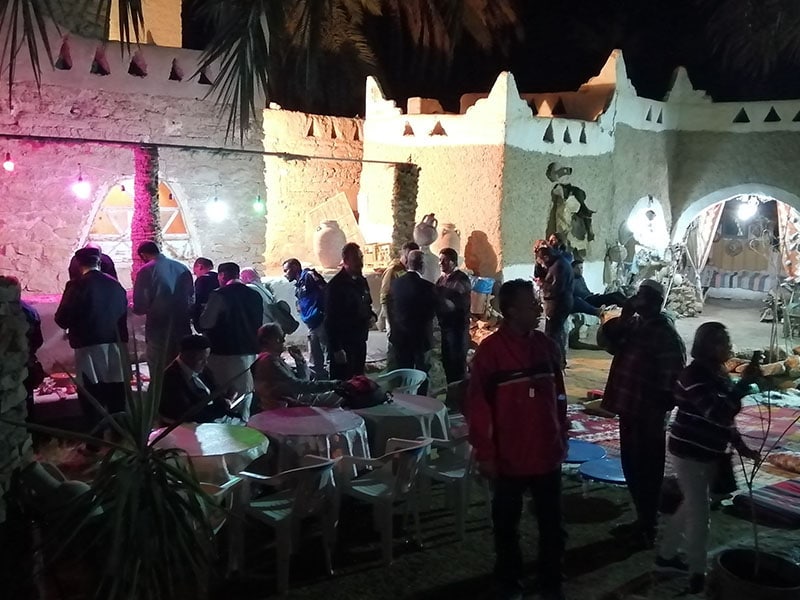
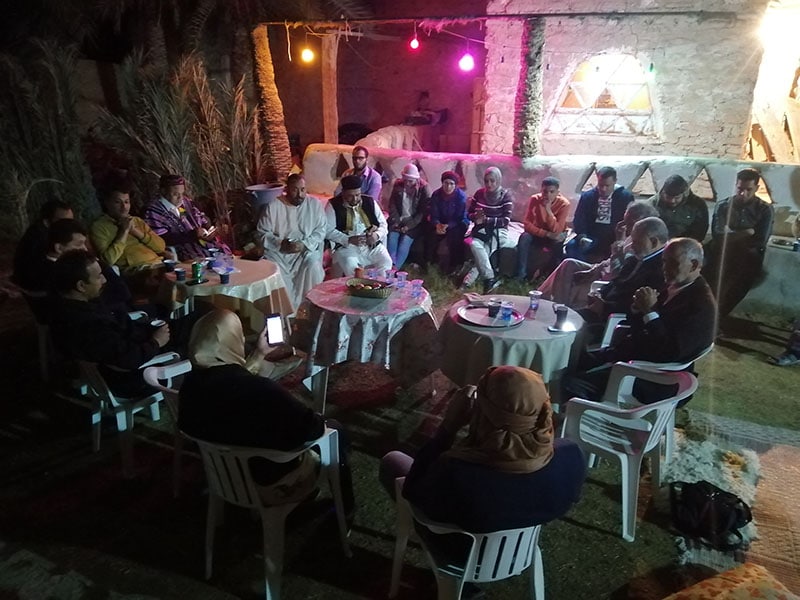
Following Al Kurdi’s show, we wandered along the darkened alleys of the old city of Ghadames to a restaurant at its heart. There, over our meal and the green tea which followed, the performance continued. We recited folklore and poetry, including contributions sent by those who had been unable to attend in person due to the ongoing conflict in Libya.

As we had been reminded throughout this workshop, culture is a living thing. Buildings, archives and traditions all decay if they are not nourished by people and given new life with each passing generation.

Volunteers were welcomed in the heart of Ghadames.

Enjoying folklore and poetry over green tea

Fawzia Saeed Ammar, a professor of ancient history at the University of Sirte, had traveled halfway across the country along treacherous roads to join our group and attend the workshop. She was particularly struck by the power of the place: “Ghadames is a city that has no parallel, and as soon as we arrived, I felt something drawing me in deeper.  The pink color of its buildings is full of magic and imagination, whether you enter the city through the historic gates of Jarsan, Alba’ar, or Dahra. The inscriptions and decorations that distinguish one house from another allow a visitor to understand the city as a collection of individual families. At the same time, the sophisticated water infrastructure connected to the well at Ain Al-Faras demonstrates that the city would not have been able to thrive in the middle of the desert without an enduring commitment to community.”

Her words had a particular resonance as we left Ghadames, returning to a Libya filled with uncertainty due to ongoing conflict and the (then early, now growing) threat of the global pandemic. The only way to protect and sustain Libya as well as its culture and heritage is through communal action spanning both geography and generations.

Sunset in the Ghadames Dunes.