Call for ASOR Trustee Nominations

[vc_row fullwidth=”true” attached=”true” css=”.vc_custom_1496247803139{padding-top: 0px !important;padding-right: 0px !important;padding-bottom: 0px !important;padding-left: 0px !important;}”][vc_column][vc_single_image image=”65399″ img_size=”full” alignment=”center”][/vc_column][/vc_row][vc_row fullwidth=”true” css=”.vc_custom_1496682730308{padding-top: 10px !important;padding-right: 0px !important;padding-bottom: 0px !important;padding-left: 0px !important;}”][vc_column width=”1/12″ css=”.vc_custom_1496683820796{margin-right: 10px !important;}” offset=”vc_hidden-md vc_hidden-sm vc_hidden-xs”][vc_column_text]

 SHARE

[/vc_column_text][mk_image src=”http://www.asortest.org/wp-content/uploads/2017/01/social-fb-icon4.jpg” image_width=”42″ image_height=”42″ hover=”false” custom_url=”https://www.facebook.com/ASOResearch/” margin_bottom=”0″][mk_image src=”http://www.asortest.org/wp-content/uploads/2017/01/social-tw-icon4.jpg” image_width=”42″ image_height=”42″ hover=”false” custom_url=”https://twitter.com/ASOResearch?ref_src=twsrc%5Egoogle%7Ctwcamp%5Eserp%7Ctwgr%5Eauthor” margin_bottom=”0″][mk_image src=”http://www.asortest.org/wp-content/uploads/2017/01/social-in-icon4.jpg” image_width=”42″ image_height=”42″ hover=”false” custom_url=”https://www.linkedin.com/company/american-schools-of-oriental-research” margin_bottom=”0″][mk_image src=”http://www.asortest.org/wp-content/uploads/2017/01/social-ml-icon_7.jpg” image_width=”42″ image_height=”42″ hover=”false” custom_url=”mailto:info@asor.org” margin_bottom=”0″][mk_image src=”http://www.asortest.org/wp-content/uploads/2017/01/blog-icon3.jpg” image_width=”42″ image_height=”42″ hover=”false” custom_url=”http://asor.org/blog” margin_bottom=”0″][/vc_column][vc_column border_color=”rgba(255,255,255,0.01)” width=”1/6″ css=”.vc_custom_1496683923840{margin-right: 20px !important;border-left-width: 2px !important;padding-right: 20px !important;padding-left: 20px !important;border-left-color: #99422f !important;}”][mk_divider divider_color=”rgba(255,255,255,0.01)” thickness=”1″ margin_top=”3″ margin_bottom=”3″][vc_column_text]

NEWS@ASOR E-NEWSLETTER

ANCIENT NEAR EAST TODAY E-NEWSLETTER

PAST ASOR NEWS, MONTH BY MONTH

LIFETIME HONOR ROLL OF DONORS

FY20 HONOR ROLL OF DONORS

ASOR VIRTUAL ANNUAL MEETING

[/vc_column_text][/vc_column][vc_column border_color=”rgba(170,170,170,0.01)” width=”1/2″ css=”.vc_custom_1487276122024{margin-right: 10px !important;margin-bottom: 30px !important;border-right-width: 2px !important;border-bottom-width: 2px !important;padding-top: 30px !important;padding-right: 30px !important;padding-left: 20px !important;background-color: #ffffff !important;border-right-color: rgba(227,228,228,0.75) !important;border-bottom-color: rgba(227,228,228,0.75) !important;}”][vc_column_text responsive_align=”left”]

CALL FOR ASOR TRUSTEE NOMINATIONS 2020

[/vc_column_text][mk_divider][vc_column_text]The Trustee Nominations Committee announces an open call for (self) nominations for the ASOR Board of Trustees (Class of 2023). There are three primary responsibilities of the members of the Board of Trustees:

  • Governance: Being aware of issues brought forward to the Board, attending two meetings per year (at your own expense), and bringing issues of concern to the Board.
  • Fundraising and financial management: Leading in development by thinking of new opportunities, leading in giving, and providing oversight on the audited financial statements. We ask that individual trustees aspire to contribute $500 or more annually.
  • Strategic planning and policy development: Leading especially in measures that accord with ASOR’s mission.

We anticipate two openings for Membership-Elected Trustees. Any regular ASOR member may be considered for nomination as an Membership-Elected Trustee. If there is someone that you would like the committee to consider—including yourself—please send the person’s name and email address to Marta Ostovich in the ASOR office. If you have any questions about the responsibilities and satisfactions of being a board member, please email Jane DeRose Evans (Chair of the Nominations Committee).

The ASOR office, or a representative from the Nominations Committee, will contact all nominees to describe the responsibilities in greater detail, and to make sure that the nominee is willing to have his or her name discussed by the Trustee Nominations Committee. Please note that nominees will need to submit a brief biography and a mission (or vision) statement for what they would like to accomplish as a trustee to be considered by the Nominations Committee. A sample of these statements can be found in last year’s “Meet Your Board Nominees” webpage. Brief biographies and mission statements should be ca. 200 words each and submitted via e-mail to Marta Ostovich by noon EDT on October 12, 2020.

After the Committee selects individuals for nomination, the election will take place by electronic ballot during October. ASOR is once again conducting online voting to ensure that more of our members are able to participate in this important process. The ASOR office will work with any person who is not able to complete an electronic ballot to ensure that everyone is included.

In order to receive full consideration by the committee, nominations (including supporting documents) should be submitted to programs@asor.org by noon EDT on October 12, 2020.[/vc_column_text][/vc_column][vc_column border_color=”rgba(170,170,170,0.01)” width=”1/6″ css=”.vc_custom_1496684098866{margin-right: 5px !important;margin-bottom: 20px !important;border-right-width: 2px !important;border-bottom-width: 2px !important;padding-top: 30px !important;padding-right: 10px !important;padding-left: 10px !important;background-color: #ffffff !important;border-right-color: rgba(227,228,228,0.75) !important;border-bottom-color: rgba(227,228,228,0.75) !important;}”][vc_wp_posts title=”BROWSE THE NEWS ARCHIVE” number=”4″][/vc_column][vc_column border_color=”rgba(170,170,170,0.01)” width=”1/6″ css=”.vc_custom_1496684008271{margin-right: 10px !important;margin-bottom: 30px !important;border-right-width: 2px !important;border-bottom-width: 2px !important;padding-top: 30px !important;padding-right: 20px !important;padding-left: 20px !important;background-color: #ffffff !important;border-right-color: rgba(227,228,228,0.75) !important;border-bottom-color: rgba(227,228,228,0.75) !important;}”][vc_column_text] [/vc_column_text][/vc_column][/vc_row]
ECS Brown Bag Panel on Publishing

[vc_row fullwidth=”true” attached=”true” css=”.vc_custom_1496247803139{padding-top: 0px !important;padding-right: 0px !important;padding-bottom: 0px !important;padding-left: 0px !important;}”][vc_column][vc_single_image image=”30046″ img_size=”1920×400″ alignment=”center”][/vc_column][/vc_row][vc_row fullwidth=”true” css=”.vc_custom_1496682730308{padding-top: 10px !important;padding-right: 0px !important;padding-bottom: 0px !important;padding-left: 0px !important;}”][vc_column width=”1/12″ css=”.vc_custom_1496683820796{margin-right: 10px !important;}” offset=”vc_hidden-md vc_hidden-sm vc_hidden-xs”][vc_column_text]

 SHARE

[/vc_column_text][mk_image src=”http://www.asortest.org/wp-content/uploads/2017/01/social-fb-icon4.jpg” image_width=”42″ image_height=”42″ hover=”false” custom_url=”https://www.facebook.com/ASOResearch/” margin_bottom=”0″][mk_image src=”http://www.asortest.org/wp-content/uploads/2017/01/social-tw-icon4.jpg” image_width=”42″ image_height=”42″ hover=”false” custom_url=”https://twitter.com/ASOResearch?ref_src=twsrc%5Egoogle%7Ctwcamp%5Eserp%7Ctwgr%5Eauthor” margin_bottom=”0″][mk_image src=”http://www.asortest.org/wp-content/uploads/2017/01/social-in-icon4.jpg” image_width=”42″ image_height=”42″ hover=”false” custom_url=”https://www.linkedin.com/company/american-schools-of-oriental-research” margin_bottom=”0″][mk_image src=”http://www.asortest.org/wp-content/uploads/2017/01/social-ml-icon_7.jpg” image_width=”42″ image_height=”42″ hover=”false” custom_url=”mailto:info@asor.org” margin_bottom=”0″][mk_image src=”http://www.asortest.org/wp-content/uploads/2017/01/blog-icon3.jpg” image_width=”42″ image_height=”42″ hover=”false” custom_url=”http://asor.org/blog” margin_bottom=”0″][/vc_column][vc_column border_color=”rgba(255,255,255,0.01)” width=”1/6″ css=”.vc_custom_1496683923840{margin-right: 20px !important;border-left-width: 2px !important;padding-right: 20px !important;padding-left: 20px !important;border-left-color: #99422f !important;}”][mk_divider divider_color=”rgba(255,255,255,0.01)” thickness=”1″ margin_top=”3″ margin_bottom=”3″][vc_column_text]

NEWS@ASOR E-NEWSLETTER

ANCIENT NEAR EAST TODAY E-NEWSLETTER

PAST ASOR NEWS, MONTH BY MONTH

FY20 HONOR ROLL OF DONORS

ASOR ANNUAL MEETING

[/vc_column_text][/vc_column][vc_column border_color=”rgba(170,170,170,0.01)” width=”1/2″ css=”.vc_custom_1487276122024{margin-right: 10px !important;margin-bottom: 30px !important;border-right-width: 2px !important;border-bottom-width: 2px !important;padding-top: 30px !important;padding-right: 30px !important;padding-left: 20px !important;background-color: #ffffff !important;border-right-color: rgba(227,228,228,0.75) !important;border-bottom-color: rgba(227,228,228,0.75) !important;}”][vc_column_text responsive_align=”left”]

EARLY CAREER SCHOLARS BROWN BAG PANEL ON PUBLISHING

[/vc_column_text][mk_divider][vc_column_text]The Early Career Scholars of ASOR will hold a virtual panel discussion on academic journal publishing on October 8, 2020 at 12pm EDT via Zoom. Speakers will include: Dr. Stephanie Budin (Near Eastern Archaeology), Dr. Seth Richardson (Journal of Near Eastern Studies), and Dr. Christopher Rollston (Bulletin of ASOR). The event, a part of our brown bag lunch series, is a *FREE* benefit for ASOR members.

The informational seminar will address key questions such as:

  • How much should you publish at various stages of your academic career?
  • What makes a good concept for a journal article?
  • What factors influence acceptance versus rejection of articles?
  • What time management strategies will help authors be successful?

Registration is limited to ASOR members and students at ASOR member schools on a first come, first serve basis. Registrants will receive an email with Zoom access information prior to the event

Panelist information:

Stephanie Lynn Budin is an ancient historian who focuses on gender, religion, sexuality, and iconography in ancient Greece and the Near East. Her published works include Women in Antiquity: Real Women Across the Ancient World (Routledge 2016), Artemis (Routledge, 2015), Images of Woman and Child from the Bronze Age (Cambridge University Press, 2011), The Myth of Sacred Prostitution in Antiquity (Cambridge University Press, 2008), and The Origin of Aphrodite (CDL Press, 2003), as well as numerous articles on ancient religion, gender, and iconography. She is the current editor of ASOR’s journal, Near Eastern Archaeology. She has also lectured throughout North America, Europe, the Near East, and Japan.

Seth Richardson is a historian of the ancient Near East whose research engages multiple thematic domains and time periods as a generalist-comparativist. He is the Managing Editor of the Journal of Near Eastern Studies and an Associate at the Oriental Institute since 2011. Prior to this, he was Assistant Professor of Ancient Near Eastern History at the University of Chicago since 2003, having earned his Ph.D. at Columbia University in 2002.

Christopher Rollston is Chair of the Dept. of Near Eastern Languages and Civilizations at The George Washington University. He holds a Ph.D. in Near Eastern Studies from Johns Hopkins University. His research focuses on Biblical and Ancient Near Eastern Studies, especially subjects revolving around ancient languages, Northwest Semitic epigraphy, scribal education, wisdom literature, prophetic literature, as well as ancient and modern textual forgeries. He has published widely in the field and is currently a co-editor (with Eric Cline) of BASOR as well as the editor of MAARAV.

Tiffany Earley-Spadoni will preside. She is Assistant Professor of Digital History at the University of Central Florida and received her Ph.D. in Near Eastern Studies from the Johns Hopkins University. Her research focuses primarily upon historical and archaeological investigations of heavily fortified landscapes. She directs the Vayots Dzor Fortress Landscapes Project in Armenia and co-chairs the Early Career Scholars Committee of ASOR. She has published articles in leading journals and is writing a book, “Landscapes of Warfare: Urartu in Ancient Near Eastern Context,” under advance contract with the University Press of Colorado.[/vc_column_text][/vc_column][vc_column border_color=”rgba(170,170,170,0.01)” width=”1/6″ css=”.vc_custom_1496684098866{margin-right: 5px !important;margin-bottom: 20px !important;border-right-width: 2px !important;border-bottom-width: 2px !important;padding-top: 30px !important;padding-right: 10px !important;padding-left: 10px !important;background-color: #ffffff !important;border-right-color: rgba(227,228,228,0.75) !important;border-bottom-color: rgba(227,228,228,0.75) !important;}”][vc_wp_posts title=”BROWSE THE NEWS ARCHIVE” number=”4″][/vc_column][vc_column border_color=”rgba(170,170,170,0.01)” width=”1/6″ css=”.vc_custom_1496684008271{margin-right: 10px !important;margin-bottom: 30px !important;border-right-width: 2px !important;border-bottom-width: 2px !important;padding-top: 30px !important;padding-right: 20px !important;padding-left: 20px !important;background-color: #ffffff !important;border-right-color: rgba(227,228,228,0.75) !important;border-bottom-color: rgba(227,228,228,0.75) !important;}”][vc_column_text] [/vc_column_text][/vc_column][/vc_row]

Table of Contents for NEA 83.3 (2020)

[vc_row fullwidth=”true” attached=”true” css=”.vc_custom_1496247803139{padding-top: 0px !important;padding-right: 0px !important;padding-bottom: 0px !important;padding-left: 0px !important;}”][vc_column][vc_single_image image=”66996″ img_size=”full” alignment=”center”][/vc_column][/vc_row][vc_row fullwidth=”true” css=”.vc_custom_1496682730308{padding-top: 10px !important;padding-right: 0px !important;padding-bottom: 0px !important;padding-left: 0px !important;}”][vc_column width=”1/12″ css=”.vc_custom_1496683820796{margin-right: 10px !important;}” offset=”vc_hidden-md vc_hidden-sm vc_hidden-xs”][vc_column_text]

 SHARE

[/vc_column_text][mk_image src=”http://www.asortest.org/wp-content/uploads/2017/01/social-fb-icon4.jpg” image_width=”42″ image_height=”42″ hover=”false” custom_url=”https://www.facebook.com/ASOResearch/” margin_bottom=”0″][mk_image src=”http://www.asortest.org/wp-content/uploads/2017/01/social-tw-icon4.jpg” image_width=”42″ image_height=”42″ hover=”false” custom_url=”https://twitter.com/ASOResearch?ref_src=twsrc%5Egoogle%7Ctwcamp%5Eserp%7Ctwgr%5Eauthor” margin_bottom=”0″][mk_image src=”http://www.asortest.org/wp-content/uploads/2017/01/social-in-icon4.jpg” image_width=”42″ image_height=”42″ hover=”false” custom_url=”https://www.linkedin.com/company/american-schools-of-oriental-research” margin_bottom=”0″][mk_image src=”http://www.asortest.org/wp-content/uploads/2017/01/social-ml-icon_7.jpg” image_width=”42″ image_height=”42″ hover=”false” custom_url=”mailto:asor@bu.edu” margin_bottom=”0″][mk_image src=”http://www.asortest.org/wp-content/uploads/2017/01/blog-icon3.jpg” image_width=”42″ image_height=”42″ hover=”false” custom_url=”http://asorblog.org/” margin_bottom=”0″][/vc_column][vc_column border_color=”rgba(255,255,255,0.01)” width=”1/6″ css=”.vc_custom_1496683923840{margin-right: 20px !important;border-left-width: 2px !important;padding-right: 20px !important;padding-left: 20px !important;border-left-color: #99422f !important;}”][mk_divider divider_color=”rgba(255,255,255,0.01)” thickness=”1″ margin_top=”3″ margin_bottom=”3″][vc_column_text]

NEWS@ASOR

ANCIENT NEAR EAST TODAY

PAST ASOR NEWS, MONTH BY MONTH

LIFETIME HONOR ROLL OF DONORS

FY20 HONOR ROLL OF DONORS

ASOR VIRTUAL ANNUAL MEETING

[/vc_column_text][/vc_column][vc_column border_color=”rgba(170,170,170,0.01)” width=”1/2″ css=”.vc_custom_1487276122024{margin-right: 10px !important;margin-bottom: 30px !important;border-right-width: 2px !important;border-bottom-width: 2px !important;padding-top: 30px !important;padding-right: 30px !important;padding-left: 20px !important;background-color: #ffffff !important;border-right-color: rgba(227,228,228,0.75) !important;border-bottom-color: rgba(227,228,228,0.75) !important;}”][vc_row_inner][vc_column_inner width=”1/4″ css=”.vc_custom_1570040186774{padding-right: 10px !important;}”][mk_image src=”http://www.asor.org/wp-content/uploads/2020/10/NEA-83.3-Cover_150x199_JPEG.jpg” image_width=”151″ image_height=”200″ hover=”false” custom_url=”https://www.journals.uchicago.edu/toc/nea/2020/83/3″][/vc_column_inner][vc_column_inner width=”3/4″][vc_column_text]

Table of Contents for Near Eastern Archaeology 83.3 (September 2020)

[/vc_column_text][/vc_column_inner][/vc_row_inner][vc_row_inner][vc_column_inner css=”.vc_custom_1570040186774{padding-right: 10px !important;}”][vc_column_text]

You can receive NEA (and other ASOR publications) through an ASOR Membership. Please e-mail the Membership office if you have any questions.

[/vc_column_text][/vc_column_inner][/vc_row_inner][mk_divider][vc_row_inner][vc_column_inner width=”1/4″ css=”.vc_custom_1570041002103{padding-right: 10px !important;}”][mk_image src=”http://www.asor.org/wp-content/uploads/2020/10/Animal-Living-NEA-83.3-TOC.jpg” image_width=”200″ image_height=”500″ crop=”false” hover=”false” custom_url=”https://www.journals.uchicago.edu/doi/full/10.1086/710095″][/vc_column_inner][vc_column_inner width=”3/4″][vc_column_text]

Pp. 136-145: “Living with Animals: Human–Animal Relations and Society at Çatalhöyük,” by Lindsay Der

Neolithic Çatalhöyük (7100–5950 BCE) is infamous for its sensational and curious material culture. Although the so-called mother goddess figurines have always been a source of great media attention, the vast majority of the visual expressions at the site are not anthropomorphic, but instead centered on wild and dangerous creatures. Many studies have previously considered the Çatalhöyük animal iconography in the context of symbolism and/or religion (Hodder and Meskell ; Stordeur ; Cauvin and Watkins ; Mellaart ). Far fewer works have scrutinized how these materializations speak to the connections forged between people and animals. This article explores the way in which animals were embedded within the social bonds and ontologies of the site through ritual practice. Ritual is not a synonym for religion, but in this study is defined as repetitive, patterned, and symbolic activity that is socially sanctioned (Firth ). In doing so, we can gain new insights into the complexity of the relationship between humans and animals and how this relationship endured across more than a thousand years of continuous occupation.[/vc_column_text][/vc_column_inner][/vc_row_inner][vc_column_text responsive_align=”left”]ASOR Members with online access: navigate to the token link email sent to you (search for “token link” in inbox) before attempting to read this article. Once you have activated your member token, click here to access the above article on The University of Chicago Press Journals’ website.[/vc_column_text][mk_divider][vc_row_inner][vc_column_inner width=”1/4″ css=”.vc_custom_1570041002103{padding-right: 10px !important;}”][mk_image src=”http://www.asor.org/wp-content/uploads/2020/10/End-of-Catalhoyuk-Hole-NEA-83.3-TOC-1.jpg” image_width=”200″ image_height=”500″ crop=”false” hover=”false” custom_url=”https://www.journals.uchicago.edu/doi/10.1086/709999″][/vc_column_inner][vc_column_inner width=”3/4″][vc_column_text]

Pp. 146–154: “Towards the End of the Çatalhöyük East Settlement: A Faunal Approach,” by Kamilla Pawłowska

The Çatalhöyük site produced material from the Neolithic occupation (7100 cal BCE–5900 cal BCE) through the Muslim period, including Bronze Age, Iron Age (Phrygian period), and Hellenistic periods. Twenty-five years of research have allowed us to study various ecofacts and artifacts, including animal and plant remains, human bones, pottery, stamp seals, and figurines. Faunal remains, which are the focus here, have been the subject of intense multidisciplinary research, particularly during the last decade. This has led to a greater understanding of Neolithic farmers’ subsistence patterns in the Anatolian region; the domestication, health and disease in past animal populations; spread of livestock; daily practices of animal food-related activities and management of waste; and of the ecological conditions of the region in which this community operated. Animals were also involved in social practice (Russell, Martin, and Twiss ; Pawłowska ; Pawłowska and Marciszak ; Der this issue) and used as a source of raw material in manufacturing.[/vc_column_text][/vc_column_inner][/vc_row_inner][vc_column_text responsive_align=”left”]ASOR Members with online access: navigate to the token link email sent to you (search for “token link” in inbox) before attempting to read this article. Once you have activated your member token, click here to access the above article on The University of Chicago Press Journals’ website.[/vc_column_text][mk_divider][vc_row_inner][vc_column_inner width=”1/4″ css=”.vc_custom_1570041002103{padding-right: 10px !important;}”][mk_image src=”http://www.asor.org/wp-content/uploads/2020/10/Pigment-use-in-Catalhoyuk-NEA-TOC-83.3.jpg” image_width=”200″ image_height=”500″ crop=”false” hover=”false” custom_url=”https://www.journals.uchicago.edu/doi/10.1086/710212″][/vc_column_inner][vc_column_inner width=”3/4″][vc_column_text]

Pp. 156–167: “Pigment Use at Neolithic Çatalhöyük,” by Eline Schotsmans, Gesualdo Busacca, Lucy Bennison-Chapman, Ashley Lingle, Marco Milella, Belinda Tibbetts, Christina Tsoraki, Milena Vasić, and Rena Veropoulidou

From the Middle Paleolithic onwards, pigments have been used variably in different social and ritual activities as well as in the expression of symbolism through material culture (e.g., Brooks et al. ; D’Errico ). In the Levant and Anatolia, symbolic practices with pigments became increasingly common in the epipaleolithic and pre-pottery Neolithic periods (e.g., Bocquentin and Garrard ; Goring-Morris, Hovers, and Belfer-Cohen ; Richter et al. ; Baird ; Baird et al. ).[/vc_column_text][/vc_column_inner][/vc_row_inner][vc_column_text responsive_align=”left”]ASOR Members with online access: navigate to the token link email sent to you search for “token link” in inbox) before attempting to read this article. Once you have activated your member token, click here to access the above article on The University of Chicago Press Journals’ website.[/vc_column_text][mk_divider][vc_row_inner][vc_column_inner width=”1/4″ css=”.vc_custom_1570041002103{padding-right: 10px !important;}”][mk_image src=”http://www.asor.org/wp-content/uploads/2020/10/Middens-waste-at-Catalhoyuk-NEA-83.3-TOC.jpg” image_width=”200″ image_height=”500″ crop=”false” hover=”false” custom_url=”https://www.journals.uchicago.edu/doi/10.1086/710134″ align=”center”][/vc_column_inner][vc_column_inner width=”3/4″][vc_column_text]Pp. 168–174: “Middens, Waste Disposal, and Health at Çatalhöyük,” by Jesse Wolfhagen, Rena Veropoulidou, Gianna Ayala, Dragana Filipović, Ceren Kabukcu, Carla Lancelotti, Marco Madella, Kamilla Pawłowska, Carlos G. Santiago-Marrero, and John Wainwright

The transition from a mobile hunter-gatherer lifestyle to a settled way of living is one of the most significant processes in human history. There were undeniable benefits to this process, with increased food security and longer lifespans, but there were also negative consequences associated with an increased density of living. At Çatalhöyük we have over one thousand years of continuous occupation from the Pre-Pottery Neolithic to Chalcolithic period (7100–5700 BCE). The settlement changes from a dense agglomeration in its earliest phase, where individual buildings are constructed wall to wall with no gaps or streets between them, to a more open nucleated settlement towards the end of the occupation. Large numbers of people living in a fixed location inevitably leads to the production of large amounts of waste. One of the most significant consequences of these activities is the creation of “pollution,” both in the physical environment, and the decline in air quality.[/vc_column_text][/vc_column_inner][/vc_row_inner][vc_column_text responsive_align=”left”]ASOR Members with online access: navigate to the token link email sent to you (search for “token link” in inbox) before attempting to read this article. Once you have activated your member token, click here to access the above article on The University of Chicago Press Journals’ website.[/vc_column_text][mk_divider][vc_row_inner][vc_column_inner width=”1/4″ css=”.vc_custom_1570041002103{padding-right: 10px !important;}”][mk_image src=”http://www.asor.org/wp-content/uploads/2020/10/Catahoyuk-Database-NEA-83.3-TOC-vert.jpg” image_width=”200″ image_height=”500″ crop=”false” hover=”false” custom_url=”https://www.journals.uchicago.edu/doi/10.1086/710611″][/vc_column_inner][vc_column_inner width=”3/4″][vc_column_text]

Pp. 176–181: “Engaging with the Çatalhöyük Database: House at Çatalhöyük (HATCH) and Other Applications,” by Arkadiusz Marciniak, Jacek Marciniak, Patrycja Filipowicz, Katarzyna Harabasz, and Jędrzej Hordecki

Çatalhöyük remains one of the most intensively and meticulously excavated prehistoric sites in the history of archaeology. Two large excavation campaigns, carried out in the years 1961–1965 and 1993–2017, have generated considerable data. A particularly large body of data was accumulated over the twenty-five-year period of excavation and analyses carried out by the Çatalhöyük Research Project. One of the project’s major undertakings was to make all data collected accessible for wider audiences (Hodder ).[/vc_column_text][/vc_column_inner][/vc_row_inner][vc_column_text responsive_align=”left”]ASOR Members with online access: navigate to the token link email sent to you (search for “token link” in inbox) before attempting to read this article. Once you have activated your member token, click here to access the above article on The University of Chicago Press Journals’ website.[/vc_column_text][mk_divider][vc_row_inner][vc_column_inner width=”1/4″ css=”.vc_custom_1570041002103{padding-right: 10px !important;}”][mk_image src=”http://www.asor.org/wp-content/uploads/2020/10/Catalhoyuk-2004-Field-School-NEA-83.3-TOC-200×500-1.jpg” image_width=”200″ image_height=”500″ crop=”false” hover=”false” custom_url=”https://www.journals.uchicago.edu/doi/10.1086/710253″][/vc_column_inner][vc_column_inner width=”3/4″][vc_column_text]

Pp. 182–190: “Ethnography, Engagement, Evaluations, and Endings: The Achievements and Limitations of Community Outreach at Çatalhöyük,” by Allison Mickel, Patrycja Filipowicz, and Lucy Bennison-Chapman

Over the twenty-five years of community engagement at Çatalhöyük, local community members played integral roles in the production of knowledge about the site. As workers, as cooks and housekeepers, as ethnoarchaeological consultants, as museum exhibit collaborators, men and women living around Çatalhöyük supported the research team in creating the archaeological record of the site.[/vc_column_text][/vc_column_inner][/vc_row_inner][vc_column_text responsive_align=”left”]ASOR Members with online access: navigate to the token link email sent to you (search for “token link” in inbox)  before attempting to read this article. Once you have activated your member token, click here to access the above article on The University of Chicago Press Journals’ website.[/vc_column_text][/vc_column][vc_column border_color=”rgba(170,170,170,0.01)” width=”1/6″ css=”.vc_custom_1496684098866{margin-right: 5px !important;margin-bottom: 20px !important;border-right-width: 2px !important;border-bottom-width: 2px !important;padding-top: 30px !important;padding-right: 10px !important;padding-left: 10px !important;background-color: #ffffff !important;border-right-color: rgba(227,228,228,0.75) !important;border-bottom-color: rgba(227,228,228,0.75) !important;}”][vc_wp_posts title=”BROWSE THE NEWS ARCHIVE” number=”4″][/vc_column][vc_column border_color=”rgba(170,170,170,0.01)” width=”1/6″ css=”.vc_custom_1496684008271{margin-right: 10px !important;margin-bottom: 30px !important;border-right-width: 2px !important;border-bottom-width: 2px !important;padding-top: 30px !important;padding-right: 20px !important;padding-left: 20px !important;background-color: #ffffff !important;border-right-color: rgba(227,228,228,0.75) !important;border-bottom-color: rgba(227,228,228,0.75) !important;}”][vc_column_text] [/vc_column_text][/vc_column][/vc_row]

ASOR Awardee Spotlight: Birgitta Lindros Wohl

[vc_row fullwidth=”true” attached=”true” css=”.vc_custom_1496247803139{padding-top: 0px !important;padding-right: 0px !important;padding-bottom: 0px !important;padding-left: 0px !important;}”][vc_column][vc_single_image image=”57733″ img_size=”full” alignment=”center”][/vc_column][/vc_row][vc_row fullwidth=”true” css=”.vc_custom_1496682730308{padding-top: 10px !important;padding-right: 0px !important;padding-bottom: 0px !important;padding-left: 0px !important;}”][vc_column width=”1/12″ css=”.vc_custom_1496683820796{margin-right: 10px !important;}” offset=”vc_hidden-md vc_hidden-sm vc_hidden-xs”][vc_column_text]

 SHARE

[/vc_column_text][mk_image src=”http://www.asortest.org/wp-content/uploads/2017/01/social-fb-icon4.jpg” image_width=”42″ image_height=”42″ hover=”false” custom_url=”https://www.facebook.com/ASOResearch/” margin_bottom=”0″][mk_image src=”http://www.asortest.org/wp-content/uploads/2017/01/social-tw-icon4.jpg” image_width=”42″ image_height=”42″ hover=”false” custom_url=”https://twitter.com/ASOResearch?ref_src=twsrc%5Egoogle%7Ctwcamp%5Eserp%7Ctwgr%5Eauthor” margin_bottom=”0″][mk_image src=”http://www.asortest.org/wp-content/uploads/2017/01/social-in-icon4.jpg” image_width=”42″ image_height=”42″ hover=”false” custom_url=”https://www.linkedin.com/company/american-schools-of-oriental-research” margin_bottom=”0″][mk_image src=”http://www.asortest.org/wp-content/uploads/2017/01/social-ml-icon_7.jpg” image_width=”42″ image_height=”42″ hover=”false” custom_url=”mailto:info@asor.org” margin_bottom=”0″][mk_image src=”http://www.asortest.org/wp-content/uploads/2017/01/blog-icon3.jpg” image_width=”42″ image_height=”42″ hover=”false” custom_url=”http://asor.org/blog” margin_bottom=”0″][/vc_column][vc_column border_color=”rgba(255,255,255,0.01)” width=”1/6″ css=”.vc_custom_1496683923840{margin-right: 20px !important;border-left-width: 2px !important;padding-right: 20px !important;padding-left: 20px !important;border-left-color: #99422f !important;}”][mk_divider divider_color=”rgba(255,255,255,0.01)” thickness=”1″ margin_top=”3″ margin_bottom=”3″][vc_column_text]

NEWS@ASOR E-NEWSLETTER

ANCIENT NEAR EAST TODAY E-NEWSLETTER

PAST ASOR NEWS, MONTH BY MONTH

LIFETIME HONOR ROLL OF DONORS

FY20 HONOR ROLL OF DONORS

ASOR VIRTUAL ANNUAL MEETING

[/vc_column_text][/vc_column][vc_column border_color=”rgba(170,170,170,0.01)” width=”1/2″ css=”.vc_custom_1487276122024{margin-right: 10px !important;margin-bottom: 30px !important;border-right-width: 2px !important;border-bottom-width: 2px !important;padding-top: 30px !important;padding-right: 30px !important;padding-left: 20px !important;background-color: #ffffff !important;border-right-color: rgba(227,228,228,0.75) !important;border-bottom-color: rgba(227,228,228,0.75) !important;}”][vc_column_text responsive_align=”left”]

ASOR AWARDEE SPOTLIGHT: BIRGITTA LINDROS WOHL

[/vc_column_text][mk_divider][vc_wp_text]At the 2019 ASOR Annual Meeting in San Diego, Birgitta Lindros Wohl was awarded the W. F. Albright Award. This award honors an individual who has shown special support or made outstanding service contributions to one of the overseas centers, ACOR, AIAR, or CAARI.

Birgitta Lindros Wohl accepts her award at the 2019 Annual Meeting

Birgitta Lindros Wohl, Professor Emerita, Art and Art History, California State University at Northridge (Los Angeles), for her service to the Cyprus American Archaeological Research Institute (CAARI). Birgittahas served as a stalwart Secretary of the Cyprus American Archaeological Research Institute (CAARI) for 5-6 years. She has a long association with the archaeology of Cyprus, beginning with her affiliation with the Swedish Cyprus Expedition that was led by her father. With excavation experience in Sweden, Italy and Greece, her focus has always been on the history of the Swedish Cyprus Expedition and its continued legacy. Still, to this day, Birgitta participates in excavations on Cyprus. Birgitta has recently retired from teaching ancient art history and we thank her for her years of service to CAARI.[/vc_wp_text][mk_divider][vc_wp_text]

Learn more about ASOR Awards

Nominate someone for an award.The deadline for service award nominations is September 11, 2020. The deadline for book award nominations September 18, 2020.

[/vc_wp_text][/vc_column][vc_column border_color=”rgba(170,170,170,0.01)” width=”1/6″ css=”.vc_custom_1496684098866{margin-right: 5px !important;margin-bottom: 20px !important;border-right-width: 2px !important;border-bottom-width: 2px !important;padding-top: 30px !important;padding-right: 10px !important;padding-left: 10px !important;background-color: #ffffff !important;border-right-color: rgba(227,228,228,0.75) !important;border-bottom-color: rgba(227,228,228,0.75) !important;}”][vc_wp_posts title=”BROWSE THE NEWS ARCHIVE” number=”4″][/vc_column][vc_column border_color=”rgba(170,170,170,0.01)” width=”1/6″ css=”.vc_custom_1496684008271{margin-right: 10px !important;margin-bottom: 30px !important;border-right-width: 2px !important;border-bottom-width: 2px !important;padding-top: 30px !important;padding-right: 20px !important;padding-left: 20px !important;background-color: #ffffff !important;border-right-color: rgba(227,228,228,0.75) !important;border-bottom-color: rgba(227,228,228,0.75) !important;}”][vc_column_text] [/vc_column_text][/vc_column][/vc_row]

Call for DEI Task Force Nominations

[vc_row fullwidth=”true” attached=”true” css=”.vc_custom_1496247803139{padding-top: 0px !important;padding-right: 0px !important;padding-bottom: 0px !important;padding-left: 0px !important;}”][vc_column][vc_single_image image=”66463″ img_size=”full” alignment=”center”][/vc_column][/vc_row][vc_row fullwidth=”true” css=”.vc_custom_1496682730308{padding-top: 10px !important;padding-right: 0px !important;padding-bottom: 0px !important;padding-left: 0px !important;}”][vc_column width=”1/12″ css=”.vc_custom_1496683820796{margin-right: 10px !important;}” offset=”vc_hidden-md vc_hidden-sm vc_hidden-xs”][vc_column_text]

 SHARE

[/vc_column_text][mk_image src=”http://www.asortest.org/wp-content/uploads/2017/01/social-fb-icon4.jpg” image_width=”42″ image_height=”42″ hover=”false” custom_url=”https://www.facebook.com/ASOResearch/” margin_bottom=”0″][mk_image src=”http://www.asortest.org/wp-content/uploads/2017/01/social-tw-icon4.jpg” image_width=”42″ image_height=”42″ hover=”false” custom_url=”https://twitter.com/ASOResearch?ref_src=twsrc%5Egoogle%7Ctwcamp%5Eserp%7Ctwgr%5Eauthor” margin_bottom=”0″][mk_image src=”http://www.asortest.org/wp-content/uploads/2017/01/social-in-icon4.jpg” image_width=”42″ image_height=”42″ hover=”false” custom_url=”https://www.linkedin.com/company/american-schools-of-oriental-research” margin_bottom=”0″][mk_image src=”http://www.asortest.org/wp-content/uploads/2017/01/social-ml-icon_7.jpg” image_width=”42″ image_height=”42″ hover=”false” custom_url=”mailto:info@asor.org” margin_bottom=”0″][mk_image src=”http://www.asortest.org/wp-content/uploads/2017/01/blog-icon3.jpg” image_width=”42″ image_height=”42″ hover=”false” custom_url=”http://asor.org/blog” margin_bottom=”0″][/vc_column][vc_column border_color=”rgba(255,255,255,0.01)” width=”1/6″ css=”.vc_custom_1496683923840{margin-right: 20px !important;border-left-width: 2px !important;padding-right: 20px !important;padding-left: 20px !important;border-left-color: #99422f !important;}”][mk_divider divider_color=”rgba(255,255,255,0.01)” thickness=”1″ margin_top=”3″ margin_bottom=”3″][vc_column_text]

NEWS@ASOR E-NEWSLETTER

ANCIENT NEAR EAST TODAY E-NEWSLETTER

PAST ASOR NEWS, MONTH BY MONTH

LIFETIME HONOR ROLL OF DONORS

FY20 HONOR ROLL OF DONORS

ASOR VIRTUAL ANNUAL MEETING

[/vc_column_text][/vc_column][vc_column border_color=”rgba(170,170,170,0.01)” width=”1/2″ css=”.vc_custom_1487276122024{margin-right: 10px !important;margin-bottom: 30px !important;border-right-width: 2px !important;border-bottom-width: 2px !important;padding-top: 30px !important;padding-right: 30px !important;padding-left: 20px !important;background-color: #ffffff !important;border-right-color: rgba(227,228,228,0.75) !important;border-bottom-color: rgba(227,228,228,0.75) !important;}”][vc_column_text responsive_align=”left”]

CALL FOR NOMINATIONS: ASOR’S DIVERSITY, EQUITY, AND INCLUSION TASK FORCE

[/vc_column_text][mk_divider][vc_wp_text]ASOR seeks volunteers for a Task Force on Diversity, Equity, and Inclusion (DEI). This Task Force will be comprised of 10-12 ASOR members to be selected by Oct. 1, 2020. We will ask the Task Force to present a preliminary report on next steps directions to take at the spring 2021 Board of Trustees’ meeting. The Task Force will work with ASOR leadership and the Chairs Coordinating Council (CCC) in helping revise the ASOR Strategic Plan. The full charge to the Task Force is posted on the ASOR web site. The summary charge is as follows:

We archaeologists, ancient historians, and philologists who make up the professional membership of ASOR study the origins, growth, and transformations of systemically unequal social orders in the past, and we have a duty to use our knowledge to fight the perpetuation of oppressive systems in the present. To that end, the Task Force on Diversity, Equity, and Inclusion will seek out methods and recommend programs through which ASOR can recruit and support Black, Indigenous, and People of Color (BIPOC) members by (1) identifying partners in community organizations and institutions; (2) creating fundraising initiatives for scholarships that promote BIPOC participation at meetings and in the field; (3) recommending sensitivity training programs for ASOR leadership; and (4) collaborating with all ASOR committees and leadership to integrate these objectives across all areas of our new strategic plan.

Those interested in serving on the task force should contact the Chair, Erin Darby (edarby1@utk.edu). We hope to have the task force determined by Oct. 1, 2020.[/vc_wp_text][/vc_column][vc_column border_color=”rgba(170,170,170,0.01)” width=”1/6″ css=”.vc_custom_1496684098866{margin-right: 5px !important;margin-bottom: 20px !important;border-right-width: 2px !important;border-bottom-width: 2px !important;padding-top: 30px !important;padding-right: 10px !important;padding-left: 10px !important;background-color: #ffffff !important;border-right-color: rgba(227,228,228,0.75) !important;border-bottom-color: rgba(227,228,228,0.75) !important;}”][vc_wp_posts title=”BROWSE THE NEWS ARCHIVE” number=”4″][/vc_column][vc_column border_color=”rgba(170,170,170,0.01)” width=”1/6″ css=”.vc_custom_1496684008271{margin-right: 10px !important;margin-bottom: 30px !important;border-right-width: 2px !important;border-bottom-width: 2px !important;padding-top: 30px !important;padding-right: 20px !important;padding-left: 20px !important;background-color: #ffffff !important;border-right-color: rgba(227,228,228,0.75) !important;border-bottom-color: rgba(227,228,228,0.75) !important;}”][vc_column_text] [/vc_column_text][/vc_column][/vc_row]

ASOR Project Directors Zoom Meeting: Oct. 1

[vc_row fullwidth=”true” attached=”true” css=”.vc_custom_1496247803139{padding-top: 0px !important;padding-right: 0px !important;padding-bottom: 0px !important;padding-left: 0px !important;}”][vc_column][vc_single_image image=”65647″ img_size=”full” alignment=”center”][/vc_column][/vc_row][vc_row fullwidth=”true” css=”.vc_custom_1496682730308{padding-top: 10px !important;padding-right: 0px !important;padding-bottom: 0px !important;padding-left: 0px !important;}”][vc_column width=”1/12″ css=”.vc_custom_1496683820796{margin-right: 10px !important;}” offset=”vc_hidden-md vc_hidden-sm vc_hidden-xs”][vc_column_text]

 SHARE

[/vc_column_text][mk_image src=”http://www.asortest.org/wp-content/uploads/2017/01/social-fb-icon4.jpg” image_width=”42″ image_height=”42″ hover=”false” custom_url=”https://www.facebook.com/ASOResearch/” margin_bottom=”0″][mk_image src=”http://www.asortest.org/wp-content/uploads/2017/01/social-tw-icon4.jpg” image_width=”42″ image_height=”42″ hover=”false” custom_url=”https://twitter.com/ASOResearch?ref_src=twsrc%5Egoogle%7Ctwcamp%5Eserp%7Ctwgr%5Eauthor” margin_bottom=”0″][mk_image src=”http://www.asortest.org/wp-content/uploads/2017/01/social-in-icon4.jpg” image_width=”42″ image_height=”42″ hover=”false” custom_url=”https://www.linkedin.com/company/american-schools-of-oriental-research” margin_bottom=”0″][mk_image src=”http://www.asortest.org/wp-content/uploads/2017/01/social-ml-icon_7.jpg” image_width=”42″ image_height=”42″ hover=”false” custom_url=”mailto:info@asor.org” margin_bottom=”0″][mk_image src=”http://www.asortest.org/wp-content/uploads/2017/01/blog-icon3.jpg” image_width=”42″ image_height=”42″ hover=”false” custom_url=”http://asor.org/blog” margin_bottom=”0″][/vc_column][vc_column border_color=”rgba(255,255,255,0.01)” width=”1/6″ css=”.vc_custom_1496683923840{margin-right: 20px !important;border-left-width: 2px !important;padding-right: 20px !important;padding-left: 20px !important;border-left-color: #99422f !important;}”][mk_divider divider_color=”rgba(255,255,255,0.01)” thickness=”1″ margin_top=”3″ margin_bottom=”3″][vc_column_text]

NEWS@ASOR E-NEWSLETTER

ANCIENT NEAR EAST TODAY E-NEWSLETTER

PAST ASOR NEWS, MONTH BY MONTH

LIFETIME HONOR ROLL OF DONORS

FY20 HONOR ROLL OF DONORS

ASOR VIRTUAL ANNUAL MEETING

[/vc_column_text][/vc_column][vc_column border_color=”rgba(170,170,170,0.01)” width=”1/2″ css=”.vc_custom_1487276122024{margin-right: 10px !important;margin-bottom: 30px !important;border-right-width: 2px !important;border-bottom-width: 2px !important;padding-top: 30px !important;padding-right: 30px !important;padding-left: 20px !important;background-color: #ffffff !important;border-right-color: rgba(227,228,228,0.75) !important;border-bottom-color: rgba(227,228,228,0.75) !important;}”][vc_column_text responsive_align=”left”]

ASOR PROJECT DIRECTORS ZOOM MEETING

[/vc_column_text][mk_divider][vc_wp_text]Following a summer of minimal-to-no fieldwork for almost all ASOR projects, the Chair of the Committee on Archaeological Research and Policy, Steve Falconer, is convening ASOR-affiliated archaeological project directors and the directors of ASOR’s affiliated centers (ACOR, AIAR, and CAARI) to discuss fieldwork prospects for 2021. The Center Directors and other colleagues will briefly summarize the prospects for 2021 fieldwork in Cyprus, Israel, Jordan, Egypt, Turkey, Lebanon, Syria, and Iraq. This meeting is designed to help directors discuss the challenges of planning fieldwork in the current environment (travel restrictions, COVID-19 safety measures, etc.). The overseas research Center Directors will provide perspectives from within their respective countries. The goal is to offer project directors a place to share their experiences, questions, and concerns for fieldwork moving forward.

The meeting is scheduled for October 1 at 12:00 PM EDT.

If you are interested in participating in this Zoom meeting, please contact Marta Ostovich (programs@asor.org). The meeting will be recorded and made available to all who are interested. By participating in the meeting, you agree to ASOR recording the session.

We hope this will be the first in a series of meetings and discussions for ASOR members on 2021 fieldwork.[/vc_wp_text][/vc_column][vc_column border_color=”rgba(170,170,170,0.01)” width=”1/6″ css=”.vc_custom_1496684098866{margin-right: 5px !important;margin-bottom: 20px !important;border-right-width: 2px !important;border-bottom-width: 2px !important;padding-top: 30px !important;padding-right: 10px !important;padding-left: 10px !important;background-color: #ffffff !important;border-right-color: rgba(227,228,228,0.75) !important;border-bottom-color: rgba(227,228,228,0.75) !important;}”][vc_wp_posts title=”BROWSE THE NEWS ARCHIVE” number=”4″][/vc_column][vc_column border_color=”rgba(170,170,170,0.01)” width=”1/6″ css=”.vc_custom_1496684008271{margin-right: 10px !important;margin-bottom: 30px !important;border-right-width: 2px !important;border-bottom-width: 2px !important;padding-top: 30px !important;padding-right: 20px !important;padding-left: 20px !important;background-color: #ffffff !important;border-right-color: rgba(227,228,228,0.75) !important;border-bottom-color: rgba(227,228,228,0.75) !important;}”][vc_column_text] [/vc_column_text][/vc_column][/vc_row]

Fellowship Report: Avary Taylor

[vc_row fullwidth=”true” attached=”true” css=”.vc_custom_1496247803139{padding-top: 0px !important;padding-right: 0px !important;padding-bottom: 0px !important;padding-left: 0px !important;}”][vc_column][vc_single_image image=”65648″ img_size=”full” alignment=”center”][/vc_column][/vc_row][vc_row fullwidth=”true” css=”.vc_custom_1496682730308{padding-top: 10px !important;padding-right: 0px !important;padding-bottom: 0px !important;padding-left: 0px !important;}”][vc_column width=”1/12″ css=”.vc_custom_1496683820796{margin-right: 10px !important;}” offset=”vc_hidden-md vc_hidden-sm vc_hidden-xs”][vc_column_text]

 SHARE

[/vc_column_text][mk_image src=”http://www.asortest.org/wp-content/uploads/2017/01/social-fb-icon4.jpg” image_width=”42″ image_height=”42″ hover=”false” custom_url=”https://www.facebook.com/ASOResearch/” margin_bottom=”0″][mk_image src=”http://www.asortest.org/wp-content/uploads/2017/01/social-tw-icon4.jpg” image_width=”42″ image_height=”42″ hover=”false” custom_url=”https://twitter.com/ASOResearch?ref_src=twsrc%5Egoogle%7Ctwcamp%5Eserp%7Ctwgr%5Eauthor” margin_bottom=”0″][mk_image src=”http://www.asortest.org/wp-content/uploads/2017/01/social-in-icon4.jpg” image_width=”42″ image_height=”42″ hover=”false” custom_url=”https://www.linkedin.com/company/american-schools-of-oriental-research” margin_bottom=”0″][mk_image src=”http://www.asortest.org/wp-content/uploads/2017/01/social-ml-icon_7.jpg” image_width=”42″ image_height=”42″ hover=”false” custom_url=”mailto:info@asor.org” margin_bottom=”0″][mk_image src=”http://www.asortest.org/wp-content/uploads/2017/01/blog-icon3.jpg” image_width=”42″ image_height=”42″ hover=”false” custom_url=”http://asor.org/blog” margin_bottom=”0″][/vc_column][vc_column border_color=”rgba(255,255,255,0.01)” width=”1/6″ css=”.vc_custom_1496683923840{margin-right: 20px !important;border-left-width: 2px !important;padding-right: 20px !important;padding-left: 20px !important;border-left-color: #99422f !important;}”][mk_divider divider_color=”rgba(255,255,255,0.01)” thickness=”1″ margin_top=”3″ margin_bottom=”3″][vc_column_text]

NEWS@ASOR E-NEWSLETTER

ANCIENT NEAR EAST TODAY E-NEWSLETTER

PAST ASOR NEWS, MONTH BY MONTH

LIFETIME HONOR ROLL OF DONORS

FY20 HONOR ROLL OF DONORS

ASOR VIRTUAL ANNUAL MEETING

[/vc_column_text][/vc_column][vc_column border_color=”rgba(170,170,170,0.01)” width=”1/2″ css=”.vc_custom_1487276122024{margin-right: 10px !important;margin-bottom: 30px !important;border-right-width: 2px !important;border-bottom-width: 2px !important;padding-top: 30px !important;padding-right: 30px !important;padding-left: 20px !important;background-color: #ffffff !important;border-right-color: rgba(227,228,228,0.75) !important;border-bottom-color: rgba(227,228,228,0.75) !important;}”][vc_column_text responsive_align=”left”]

A RETURN TO ANCIENT LAGASH

Avary Taylor, 2019 P. E. MacAllister Excavation Fellowship Recipient[/vc_column_text][mk_divider][vc_wp_text]

Avary Taylor collecting geophysical data with Bartington magnetometer.

The P. E. MacAllister Excavation Fellowship financially supported my travel to the site of al-Hiba, Iraq (ancient Lagash) in March and April of 2019 to take part in the Lagash Archaeological Project (LAP). The team—composed of faculty, researchers, and graduate students from the University of Pennsylvania, the University of Cambridge, the Università di Pisa, and the State Board of Antiquities and Heritage of Iraq, as well as myself, a fifth-year PhD candidate in the Near Eastern Studies Department at Johns Hopkins University—surveyed and excavated the site, which had not been revisited since 1990.

Tell al-Hiba is located in the Dhi Qar Province of southern Iraq. The site was briefly excavated by Robert Koldewey in 1887, but it was not until six campaigns led by teams from the Metropolitan Museum of Art and the Institute of Fine Arts of New York University undertaken in the mid- and late-twentieth century that the importance of the site was fully realized. Lagash was one of the earliest cities in the world and was a dominating power in Sumer during the third millennium BCE. The third millennium is characterized by major cultural and political changes. During the Early Dynastic Period, which is named after the earliest evidence for dynastic rule in Mesopotamia, dynastic kings ruled over city-states that emerged in southern Iraq and shared a common, Sumerian identity. Al-Hiba is a significant site in the study of early urbanism in the ancient world. During this period, the city of Lagash grew as large as 600 hectares and competed with other Sumerian city-states.

Area H photograph with excavated kilns immediately below surface.

The 2019 field season at al-Hiba was highly successful and produced many exciting finds, including evidence of a monumental city wall and a royal cone of king Enmetena. The season was focused around surface collection surveys, remote sensing (drone photography and geophysics surveys), and excavations in Area G, a previously opened area with extensive Early Dynastic I levels and a monumental curving wall, and the newly opened Area H, an industrial zone.

My time at Lagash was spent excavating, collecting geophysical data with a magnetometer, and cataloging and analyzing ceramics. I proudly was able to beat many personal bests on the magnetometer, and the team successfully covered a truly massive area of the site during survey and remote sensing. After excavating during the day, I would help catalogue ceramics and I became intimately familiar with the hundreds of beaker sherds that the team excavated this season.

During the team’s days off, we were able to travel to neighboring southern Iraq sites, such as Tell al-Muqayyar (ancient Ur), where we were fortunate enough to experience a massive dust storm immediately followed by a rain storm. Despite how it may sound, this was truly a special experience; pictures of the site, and particularly of the ziggurat, are captured on bright, sunny days. Experiencing the site in more extreme weather provided me with an important alternative view of Ur than many scholars have access to. The team was also able to visit the newly opened Basra Museum, which housed many wonderful Mesopotamian objects within its beautiful building.

Drone flying above sunset landscape of Lagash.

Avary Taylor is a PhD candidate in Near Eastern Studies at Johns Hopkins University. Taylor is an art historian who specializes in the art of the Neo-Assyrian Period. His in-progress dissertation, “The ‘Thing’ About the Palace: A Posthumanist Biography of the Northwest Palace,” seeks to understand the life of a Neo-Assyrian palace, not as a constructed result reflecting human agency and will, but as an autonomous being itself. The dissertation engages with posthumanist theories to explore the proposition that the role of humans is secondary to the “thing.” Taylor is also involved in several archaeological projects in addition to al-Hiba, such as Kurd Qaburstan (Johns Hopkins University).[/vc_wp_text][/vc_column][vc_column border_color=”rgba(170,170,170,0.01)” width=”1/6″ css=”.vc_custom_1496684098866{margin-right: 5px !important;margin-bottom: 20px !important;border-right-width: 2px !important;border-bottom-width: 2px !important;padding-top: 30px !important;padding-right: 10px !important;padding-left: 10px !important;background-color: #ffffff !important;border-right-color: rgba(227,228,228,0.75) !important;border-bottom-color: rgba(227,228,228,0.75) !important;}”][vc_wp_posts title=”BROWSE THE NEWS ARCHIVE” number=”4″][/vc_column][vc_column border_color=”rgba(170,170,170,0.01)” width=”1/6″ css=”.vc_custom_1496684008271{margin-right: 10px !important;margin-bottom: 30px !important;border-right-width: 2px !important;border-bottom-width: 2px !important;padding-top: 30px !important;padding-right: 20px !important;padding-left: 20px !important;background-color: #ffffff !important;border-right-color: rgba(227,228,228,0.75) !important;border-bottom-color: rgba(227,228,228,0.75) !important;}”][vc_column_text] [/vc_column_text][/vc_column][/vc_row]

Response From President Sharon Herbert to Open Letter to ASOR Board

[vc_row fullwidth=”true” attached=”true” css=”.vc_custom_1496247803139{padding-top: 0px !important;padding-right: 0px !important;padding-bottom: 0px !important;padding-left: 0px !important;}”][vc_column][vc_single_image image=”36841″ img_size=”full” alignment=”center”][/vc_column][/vc_row][vc_row fullwidth=”true” css=”.vc_custom_1496682730308{padding-top: 10px !important;padding-right: 0px !important;padding-bottom: 0px !important;padding-left: 0px !important;}”][vc_column width=”1/12″ css=”.vc_custom_1496683820796{margin-right: 10px !important;}” offset=”vc_hidden-md vc_hidden-sm vc_hidden-xs”][vc_column_text]

 SHARE

[/vc_column_text][mk_image src=”http://www.asortest.org/wp-content/uploads/2017/01/social-fb-icon4.jpg” image_width=”42″ image_height=”42″ hover=”false” custom_url=”https://www.facebook.com/ASOResearch/” margin_bottom=”0″][mk_image src=”http://www.asortest.org/wp-content/uploads/2017/01/social-tw-icon4.jpg” image_width=”42″ image_height=”42″ hover=”false” custom_url=”https://twitter.com/ASOResearch?ref_src=twsrc%5Egoogle%7Ctwcamp%5Eserp%7Ctwgr%5Eauthor” margin_bottom=”0″][mk_image src=”http://www.asortest.org/wp-content/uploads/2017/01/social-in-icon4.jpg” image_width=”42″ image_height=”42″ hover=”false” custom_url=”https://www.linkedin.com/company/american-schools-of-oriental-research” margin_bottom=”0″][mk_image src=”http://www.asortest.org/wp-content/uploads/2017/01/social-ml-icon_7.jpg” image_width=”42″ image_height=”42″ hover=”false” custom_url=”mailto:info@asor.org” margin_bottom=”0″][mk_image src=”http://www.asortest.org/wp-content/uploads/2017/01/blog-icon3.jpg” image_width=”42″ image_height=”42″ hover=”false” custom_url=”http://asor.org/blog” margin_bottom=”0″][/vc_column][vc_column border_color=”rgba(255,255,255,0.01)” width=”1/6″ css=”.vc_custom_1496683923840{margin-right: 20px !important;border-left-width: 2px !important;padding-right: 20px !important;padding-left: 20px !important;border-left-color: #99422f !important;}”][mk_divider divider_color=”rgba(255,255,255,0.01)” thickness=”1″ margin_top=”3″ margin_bottom=”3″][vc_column_text]

NEWS@ASOR E-NEWSLETTER

ANCIENT NEAR EAST TODAY E-NEWSLETTER

PAST ASOR NEWS, MONTH BY MONTH

LIFETIME HONOR ROLL OF DONORS

FY20 HONOR ROLL OF DONORS

ASOR VIRTUAL ANNUAL MEETING

[/vc_column_text][/vc_column][vc_column border_color=”rgba(170,170,170,0.01)” width=”1/2″ css=”.vc_custom_1487276122024{margin-right: 10px !important;margin-bottom: 30px !important;border-right-width: 2px !important;border-bottom-width: 2px !important;padding-top: 30px !important;padding-right: 30px !important;padding-left: 20px !important;background-color: #ffffff !important;border-right-color: rgba(227,228,228,0.75) !important;border-bottom-color: rgba(227,228,228,0.75) !important;}”][vc_column_text responsive_align=”left”]

RESPONSE FROM PRESIDENT SHARON HERBERT TO OPEN LETTER TO ASOR BOARD

[/vc_column_text][mk_divider][vc_wp_text]

August 25, 2020

Dear Open Letter Signatories,

Many thanks for your thoughtful assessment of two ongoing matters facing ASOR—the racist overtones of its name and the lack of diversity within the organization. Your letter cogently lays out some of our problems concerning these issues, many of which the ASOR Board of Trustees and officers have been wrestling with for some time.

As I think most of you know, in November of 2019, outgoing President Susan Ackerman and I began to form an Ad Hoc Committee to seriously consider changing ASOR’s name. The two principal issues in our charge were 1. Could we in good conscience continue to use “Oriental”, with its increasing racist connotations, in our name? and 2. Could we identify a name that better describes ASOR’s work, mission, and values as they have evolved since its founding in 1900?

The Ad Hoc Committee has been hard at work since January. By the time I received your letter on July 27, they had polled the membership twice and written interim reports to the Board and membership. They were scheduled to make a final report to the Board at its April 2021 meeting, but the events of this spring and summer have added urgency to the matter.

An initial analysis of the data the committee gathered confirmed that there is strong support among the membership for removing “Oriental” from the organization’s name, but no consensus, or even a plurality, emerged about what to do next. The Board of Trustees met on August 19 to consider next steps. It unanimously recommended to remove “Oriental” from ASOR’s name and to begin the legal steps necessary to do so—it’s a process, including a vote by the membership. In the meantime, the organization will simply be known as ASOR. On August 20, I informed the membership of the Board’s decision via an e-mail letter.

The Board further instructed the Ad Hoc Committee to submit a final report suggesting a slate of modified or new names for the organization. After considering the committee’s report the Board will ask the full membership to vote on a new or modified name of the organization. Our goal at this juncture is for the vote to take place in September.

The broader DEI issues within ASOR, specifically racial diversity, were also discussed by the Board during the August 19 meeting. Our shortcomings are obvious on this; how to fix them is not. The good news is that, prior to receiving your letter, positive change was underway. We had already been engaged in discussions about possible solutions in the Chairs Coordinating Council. The ASOR standing committees, in their work on ASOR’s next strategic plan (2021-25) are hard at work crafting committee and organizational action items to promote racial diversity within ASOR, many of which are in line with the recommendations in your letter. Also, I am in the process of assembling a DEI Task Force, whose charge will include serious consideration of the points raised in your letter, including whether to establish a permanent standing committee. This is with a view toward crafting practical and workable plans to achieve the goals outlined in your letter—again, it’s a process. When the Task Force Chair, or co-chairs, is in place, I will make an open call for nominations to serve on it. I hope some of you will volunteer for the job. The DEI Task Force is slated to report its preliminary findings and recommendations to the Board at its 2021 spring meeting. Whether as a member of the DEI Task Force, or a rank-and-file ASOR member, I trust that you will pledge your time, your talents, and your resources to achieve the DEI goals set for ASOR in your letter.

Again, thank you a for raising your concerns to the Board. These are crucial matters that we all believe need action. I look forward to working with you to formulate and carry out an effective plan to address these issues.

Sincerely,

Sharon Herbert
ASOR President[/vc_wp_text][/vc_column][vc_column border_color=”rgba(170,170,170,0.01)” width=”1/6″ css=”.vc_custom_1496684098866{margin-right: 5px !important;margin-bottom: 20px !important;border-right-width: 2px !important;border-bottom-width: 2px !important;padding-top: 30px !important;padding-right: 10px !important;padding-left: 10px !important;background-color: #ffffff !important;border-right-color: rgba(227,228,228,0.75) !important;border-bottom-color: rgba(227,228,228,0.75) !important;}”][vc_wp_posts title=”BROWSE THE NEWS ARCHIVE” number=”4″][/vc_column][vc_column border_color=”rgba(170,170,170,0.01)” width=”1/6″ css=”.vc_custom_1496684008271{margin-right: 10px !important;margin-bottom: 30px !important;border-right-width: 2px !important;border-bottom-width: 2px !important;padding-top: 30px !important;padding-right: 20px !important;padding-left: 20px !important;background-color: #ffffff !important;border-right-color: rgba(227,228,228,0.75) !important;border-bottom-color: rgba(227,228,228,0.75) !important;}”][vc_column_text] [/vc_column_text][/vc_column][/vc_row]

FOA Webinar: Susan Ackerman on Sept. 13

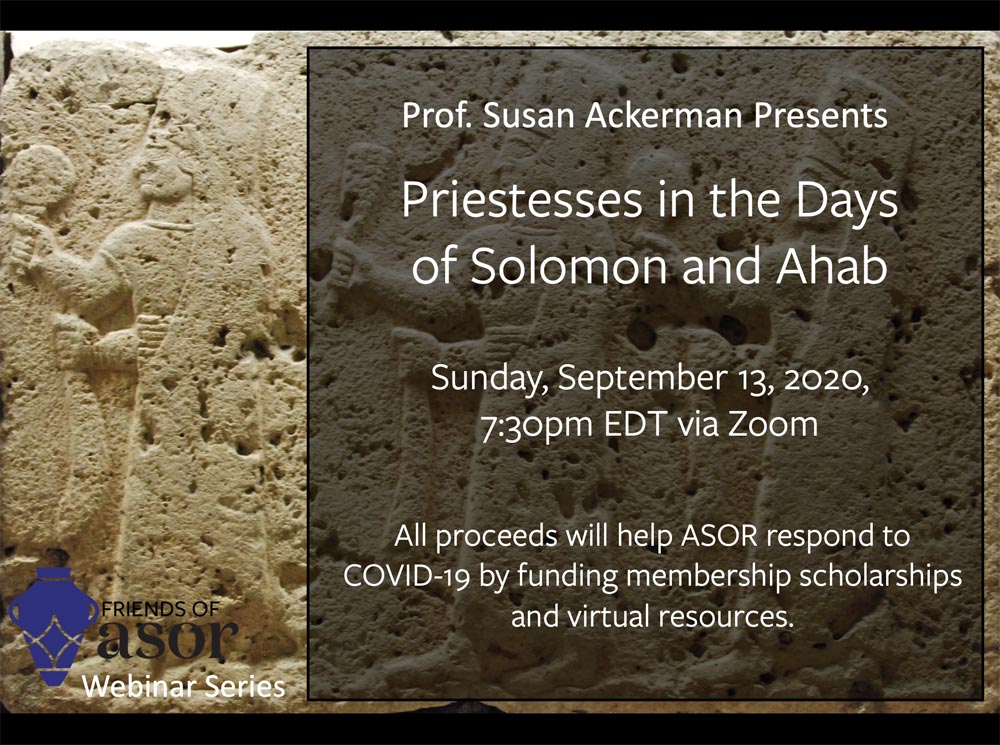
FRIENDS OF ASOR WEBINARS

Priestesses in the Days of Solomon and Ahab


(Image courtesy of the Metropolitan Museum of Art Open-Access Collection)

Friends of ASOR is excited to announce the second webinar in our monthly series on September 13, at 7:30pm EDT, featuring Dr. Susan Ackerman. An expert in the study of gender and religion in ancient Israel, Prof. Ackerman invites us to explore and question our own assumptions about gender roles in the ancient world. Priestesses abound in the religions of the Near East and the eastern Mediterranean — in Mesopotamia, Egypt, ancient Syrian tradition, and Greece. Priestesses are even attested in the records of some of ancient Israel’s closest neighbors (for example, from Phoenicia and the Transjordanian site of Deir Alla).

So why were there no priestesses in ancient Israel? In this lecture, Prof. Ackerman will propose an answer to that question, but also will propose—based on a survey of features commonly manifest by priestesses elsewhere in the biblical world—that there may be a few priestess-like women lurking in the pages of the Bible. The webinar will conclude with a live Q&A session.

Susan Ackerman is the Preston H. Kelsey Professor of Religion, Professor of Women’s, Gender, and Sexuality Studies, and the former Chair of both the Department of Religion and the Program in Women’s, Gender, and Sexuality Studies at Dartmouth College. She also earned her A.B. degree at Dartmouth, majoring in Religion, and then went on to earn a Masters of Theological Studies at Harvard Divinity School and a Ph.D. in Near Eastern Languages and Civilizations from the Harvard Graduate School of Arts and Sciences. Her research specialties include the religion of ancient Israel, women and gender in ancient Israel, myth and ritual studies in ancient Israel, and the Hebrew Bible.


Register and get 25% off Ackerman’s book from Yale University Press!

Her publications include several articles and three books, Under Every Green Tree: Popular Religion in Sixth-Century Judah; Warrior, Dancer, Seductress, Queen: Women in Judges and Biblical Israel; and When Heroes Love: The Ambiguity of Eros in the Stories of Gilgamesh and David. She has recently completed a draft of a new book, on women and the religion of ancient Israel, and is currently at work on another book manuscript on Israelite women’s life-cycle rituals, such as coming-of-age, marriage, motherhood, death.

Ackerman served as ASOR President from 2014-2019. Prior to that, Ackerman served as a member of the ASOR Board for seven years (2007-2013), during which time she was a member of the ASOR Capital Campaign Cabinet, the Task Force on the ASOR Strategic Plan for 2011-2015, and the Finance Committee. She has also served as President of the New England and Eastern Canada Region of the Society of Biblical Literature (2013-2014), as President of the Colloquium for Biblical Research (2008-2010), and as a member and then Secretary of the Board of Trustees of the W. F. Albright Institute for Archaeological Research (AIAR), from 2008-2013.

In November 2019, Ackerman received ASOR’s most prestigious award, the Richard J. Scheuer Medal, for lifetime achievement and professional service.

ASOR Sustaining Members: $0 | ASOR Members: $5 | Public: $10

To receive your ASOR member discount, log into the online store. If you are new to ASOR, please click on the “New Visitor Registration” link to enter your email and password for our online store. Then navigate to “Meeting and Event Registration” to register for the webinar and pay the fee. Each paid registrant will receive a confirmation email when you pay for the webinar. If you do not receive this email, then you are not registered. Please e-mail membership@asor.org with any questions or issues with registering.

You will be e-mailed the Zoom Webinar link prior to the lecture on September 13, 2020. All webinars are recorded and all paid registrants who cannot attend the webinar will be sent a link to download the recording.

All proceeds from this lecture are used to fund scholarships for members impacted by COVID-19 as well as increasing ASOR’s online resources, which are free to the public.

WHY SPONSOR A WEBINAR?

Several levels of support from $50-$1,000 are available. Proceeds go towards membership scholarships and towards increasing ASOR’s virtual resources. Each sponsorship is tax-deductible and you can give your friends free registrations to a webinar!

Bronze Level ($50): up to 2 guest registrations
Silver Level ($100): up to 5 guest registrations
Gold Level ($500): up to 20 guest registrations
Platinum Level ($1,000): up to 50 guest registrations

After you sign up for a sponsorship online or over the phone, email the names and email addresses of your guests to Felice Herman at membership@asor.org, who will send your guests a confirmation and the Zoom link before the webinar.

WANT TO SAVE $5.00 ON THE NEXT WEBINAR?

Join ASOR as a member! Click here for more details about discounts for events and other benefits of membership. Memberships start at $40 for the year as an Associate Member.

Not ready to join yet? Become a Friend of ASOR for FREE!

Click here for more details about our online resources.

PAST WEBINARS

You can now purchase the link to the recording of any webinar. You can also purchase the bundle packages of all webinars from the 2020-2022 seasons. Please e-mail membership@asor.org for purchase details.

To see a printable pdf of the webinar titles from the 2020-2021 season, please click here. To see a printable pdf of the webinar titles from the 2021-2022 season, please click here.

Pricing:

Members: $6.00 per recording
Non-Members: $12.00 per recording
Bundle of 2020-2021 Webinars: $75.00
Bundle of 2021-2022 Webinars: $75.00
Bundle of 2020-2022 Webinars: $125.00

2021-2022 Season

A World at War: Protecting Cultural Heritage in Times of Conflict
Patty Gerstenblith (DePaul University), Lisa Ackerman (Columbus Citizens Foundation), Andrew Cohen (Government Professional and Cultural Heritage Expert) | May 12, 2022

Preserving Cultural Heritage in Hisban and Umm al-Jimal, Jordan
Øystein LaBianca (Andrews University), Elizabeth Osinga (Umm al-Jimal Archaeological Project), Darrell Rohl (Calvin University) | April 24, 2022

Back to the Field: Recent Discoveries & Summer Plans 2022
Lorenzo d’Alfonso (ISAW), Kathryn Grossman (NC State University), James R. Strange (Samford University) | April 3, 2022

Uncovering What is Nubian Beneath the Veneer of Egyptianness: Excavating the Archives
Debora Heard (University of Chicago) | March 20, 2022

Where Are They Now?: A Preview of 2022 ASOR-Affiliated Fieldwork Projects
Michael Given (University of Glasgow), Xenia-Paula Kyriakou (Florida Gulf Coast University), Stephen Batiuk (University of Toronto), Monique Roddy (Walla Walla University), Kent Bramlett (La Sierra University), Friedbert Ninow (La Sierra University), and Michael Hoff (University of Nebraska-Lincoln) | March 8, 2022

Excavations at Tel Gezer: A Personal Story
Sam Wolff (Tel Gezer Laboratory) | February 20, 2022

Tel Rehov: A Major Bronze and Iron Age City in the Jordan Valley
Amihai Mazar (Hebrew University of Jerusalem), Nava Panitz-Cohen ( Hebrew University of Jerusalem), Nota Kourou (Athens University), Naama Yahalom-Mack (Hebrew University of Jerusalem), Robert Mullins (Azusa Pacific University) | February 10, 2022

The Not-So-Innocents Abroad: The Beginnings of American Biblical Archaeology
Rachel Hallote (Samford University) | January 20, 2022

Synagogues as Jesus Knew Them
James R. Strange (Samford University) | December 2, 2021

Under Jerusalem: The Buried History of the World’s Most Contested City
Andrew Lawler | November 4, 2021

Jesus and Jerusalem on TV: How Do Bible Documentaries Get Made?
Robert Cargill (University of Iowa) | October 17, 2021

Digging the Divine?: Judahite Pillar Figurines and the Archaeology of Israelite Religion
Erin Darby (University of Tennessee) | October 7, 2021

David, Solomon, and Rehoboam’s Kingdom—The Archaeological Evidence
Yosef Garfinkel (Hebrew University of Jerusalem) | September 19, 2021

From Standing Stones to Sacred Emptiness: Textual and Visual Portrayals of Israel’s God
Theodore Lewis (Johns Hopkins University) | August 29, 2021

2020-2021 Season

Making May Matter: Webinarathon to Endow Diversity
Multiple Speakers | May 21-23, 2021

Archaeogaming: Why Video Games Deserve Their Own Archaeology
Tine Rassalle (University of North Carolina at Chapel Hill), Shannon Martino (Morton College), Matthew Winter (University of Arizona), Michael Zimmerman (Rhode Island) | April 18, 2021

How the Bible Became a Book
William Schniedewind (UCLA) | March 21, 2021

The Mysteries of Mithras in Caesarea: Exploring the Cult’s Rites and Remains
Jane DeRose Evans (Temple University), Alexandra Ratzlaff (Brandeis University) | March 11, 2021

Archaeology and the Hidden Religious Culture of Israelite Women
Carol Meyers (Duke University) | February 21, 2021

Meet the Directors—Fundraiser to Support ASOR’s Affiliated Overseas Research Centers
Matthew J. Adams (AIAR), Pearce Paul Creasman (ACOR), Lindy Crewe (CAARI) | February 11, 2021

Early Synagogues, Jesus, and Galilee—A Jewish Perspective
Eric Meyers (Duke University) | December 13, 2020

Home Sweet Home: Ancient Israelite Households in Context
Cynthia Shafer-Elliott (William Jessup University) | October 18, 2020

Priestesses in the Days of Solomon and Ahab
Susan Ackerman (Dartmouth College) | September 13, 2020

Digging Deeper: How Archaeology Works
Eric H. Cline (The George Washington University) | August 9, 2020

Letter From President Sharon Herbert Regarding ASOR’s Name

[vc_row fullwidth=”true” attached=”true” css=”.vc_custom_1496247803139{padding-top: 0px !important;padding-right: 0px !important;padding-bottom: 0px !important;padding-left: 0px !important;}”][vc_column][vc_single_image image=”65401″ img_size=”full” alignment=”center”][/vc_column][/vc_row][vc_row fullwidth=”true” css=”.vc_custom_1496682730308{padding-top: 10px !important;padding-right: 0px !important;padding-bottom: 0px !important;padding-left: 0px !important;}”][vc_column width=”1/12″ css=”.vc_custom_1496683820796{margin-right: 10px !important;}” offset=”vc_hidden-md vc_hidden-sm vc_hidden-xs”][vc_column_text]

 SHARE

[/vc_column_text][mk_image src=”http://www.asortest.org/wp-content/uploads/2017/01/social-fb-icon4.jpg” image_width=”42″ image_height=”42″ hover=”false” custom_url=”https://www.facebook.com/ASOResearch/” margin_bottom=”0″][mk_image src=”http://www.asortest.org/wp-content/uploads/2017/01/social-tw-icon4.jpg” image_width=”42″ image_height=”42″ hover=”false” custom_url=”https://twitter.com/ASOResearch?ref_src=twsrc%5Egoogle%7Ctwcamp%5Eserp%7Ctwgr%5Eauthor” margin_bottom=”0″][mk_image src=”http://www.asortest.org/wp-content/uploads/2017/01/social-in-icon4.jpg” image_width=”42″ image_height=”42″ hover=”false” custom_url=”https://www.linkedin.com/company/american-schools-of-oriental-research” margin_bottom=”0″][mk_image src=”http://www.asortest.org/wp-content/uploads/2017/01/social-ml-icon_7.jpg” image_width=”42″ image_height=”42″ hover=”false” custom_url=”mailto:info@asor.org” margin_bottom=”0″][mk_image src=”http://www.asortest.org/wp-content/uploads/2017/01/blog-icon3.jpg” image_width=”42″ image_height=”42″ hover=”false” custom_url=”http://asor.org/blog” margin_bottom=”0″][/vc_column][vc_column border_color=”rgba(255,255,255,0.01)” width=”1/6″ css=”.vc_custom_1496683923840{margin-right: 20px !important;border-left-width: 2px !important;padding-right: 20px !important;padding-left: 20px !important;border-left-color: #99422f !important;}”][mk_divider divider_color=”rgba(255,255,255,0.01)” thickness=”1″ margin_top=”3″ margin_bottom=”3″][vc_column_text]

NEWS@ASOR E-NEWSLETTER

ANCIENT NEAR EAST TODAY E-NEWSLETTER

PAST ASOR NEWS, MONTH BY MONTH

LIFETIME HONOR ROLL OF DONORS

FY20 HONOR ROLL OF DONORS

ASOR VIRTUAL ANNUAL MEETING

[/vc_column_text][/vc_column][vc_column border_color=”rgba(170,170,170,0.01)” width=”1/2″ css=”.vc_custom_1487276122024{margin-right: 10px !important;margin-bottom: 30px !important;border-right-width: 2px !important;border-bottom-width: 2px !important;padding-top: 30px !important;padding-right: 30px !important;padding-left: 20px !important;background-color: #ffffff !important;border-right-color: rgba(227,228,228,0.75) !important;border-bottom-color: rgba(227,228,228,0.75) !important;}”][vc_column_text responsive_align=”left”]

LETTER FROM PRESIDENT SHARON HERBERT REGARDING ASOR’S NAME

[/vc_column_text][mk_divider][vc_wp_text]

August 20, 2020

Dear Fellow ASOR Members:

I write with some exciting news. ASOR will be modifying its name to remove the word “Oriental.” Yesterday (August 19, 2020), the ASOR Board of Trustees voted unanimously to start the organizational and legal process to remove “Oriental” from our society’s name.

Here is the motion approved by Board (30-0) with no one abstaining:

BE IT RESOLVED: The Board of Trustees endorses the Executive Committee recommendation that the American Schools of Oriental Research remove the word “Oriental” from its name. The ASOR Board of Trustees will proceed with all possible speed to seek a vote of the membership on a revised name. Until the membership decides, the organization will use its acronym “ASOR” to identify itself. Moved by Eric Meyers, seconded by R. Peyton Helm.

As President, I am delighted that the ASOR Board has taken this historic step. Words have meaning, but these meanings change over the years as common usage evolves. Along the way they can collect unwelcome baggage and racist overtones as “Oriental “most definitely has. In 2016, the U.  S. Congress unanimously passed bill H.R.4238 to remove the last vestiges of racial terms such as “Oriental” from federal law. ASOR’s decision follows several years of conversation among the membership and in the Board, six months of work by the Ad Hoc Name of ASOR Committee, and extensive consultation by that committee with the membership. Everyone on the Board agreed that now was the time, and ASOR should not wait for the selection of a final name to confirm that we are removing “Oriental” from our name, so offensive it has become to our Asian-American fellow citizens.

What are the next steps? While there was strong support among Board members to retain the ASOR acronym in some form (without “Oriental”), it was decided to return the issue to the Ad Hoc Name Committee without further constraints so as not to incumber their work. That Committee plans to meet next week to finalize a report to the Board and to recommend a name or names. Because our bylaws have minimum time requirements for calling special Board Meetings, we will need to wait until September to discuss the ad hoc committee’s report. We will then ask the membership to vote on a new name—such a vote being required by District of Columbia statutes for non-profit corporations registered in D.C.

In the meantime, I hope that you will contact me with any questions or comments. My e-mail is president@asor.org.

Sharon Herbert
ASOR President[/vc_wp_text][/vc_column][vc_column border_color=”rgba(170,170,170,0.01)” width=”1/6″ css=”.vc_custom_1496684098866{margin-right: 5px !important;margin-bottom: 20px !important;border-right-width: 2px !important;border-bottom-width: 2px !important;padding-top: 30px !important;padding-right: 10px !important;padding-left: 10px !important;background-color: #ffffff !important;border-right-color: rgba(227,228,228,0.75) !important;border-bottom-color: rgba(227,228,228,0.75) !important;}”][vc_wp_posts title=”BROWSE THE NEWS ARCHIVE” number=”4″][/vc_column][vc_column border_color=”rgba(170,170,170,0.01)” width=”1/6″ css=”.vc_custom_1496684008271{margin-right: 10px !important;margin-bottom: 30px !important;border-right-width: 2px !important;border-bottom-width: 2px !important;padding-top: 30px !important;padding-right: 20px !important;padding-left: 20px !important;background-color: #ffffff !important;border-right-color: rgba(227,228,228,0.75) !important;border-bottom-color: rgba(227,228,228,0.75) !important;}”][vc_column_text] [/vc_column_text][/vc_column][/vc_row]