Communications Manager Job Opening

COMMUNICATIONS MANAGER JOB OPENING

December 2024 Update: This position has been filled. 

The American Society of Overseas Research (ASOR) seeks candidates for a full-time Communications Manager to oversee outreach efforts in the areas of social media and communications with ASOR members and the public. This person will also manage the Friends of ASOR (FOA) outreach program. This in-person position is located at The James F. Strange Center—headquarters of ASOR, 209 Commerce St., in historic Old Town Alexandria, VA.

Founded in 1900, the ASOR is a 501(c)(3) non-profit whose mission is to initiate, encourage, and support research into, and public understanding of, the history and cultures of the Near East and wider Mediterranean world, from the earliest times.

The Communications Manager is responsible for ASOR’s marketing and communications strategies. They directly oversee all FOA programming and manage ASOR social media strategies to engage both the public and ASOR members and friends. This position reports to ASOR’s Assistant Director, Marta Ostovich.

Primary Responsibilities:

Communications

  • Under the direction of the Assistant Director, develop and implement a media relations and outreach program. Provide expertise and oversight for ASOR’s social media.
  • Under the direction of the Assistant Director, develop and implement ASOR’s social media strategies using key platforms that connect with our membership and build relationships with those interested in archaeology and history to expand our membership.
  • Monitor and engage with followers on ASOR’s social media accounts, and analyze social media metrics to improve engagement with the public.
  • Work with ASOR staff members to maintain high-quality customer service for our 2,200 members and 17,000 Friends of ASOR (FOA).
  • Work with ASOR staff members to write and edit copy for internal and external communications including press releases, newsletters, social media posts, and website content for a general audience. Ensure consistent brand messaging across all communications.
  • Help prepare materials for presentations, speeches, and meetings.
  • Assist with ASOR’s off-site Annual Meeting (in November of each year) by providing general administrative support including but not limited to, processing payments, answering questions, assisting with communications for attendees, and making all attendees feel welcome. Travel to the meeting is required (once per year).

Friends of ASOR

  • Expand the communications component of FOA, building membership and generating interest in the programs.
  • Manage existing FOA programming including:
  • Design new FOA programming and oversee operating budget for growing FOA programming.
  • Develop and implement a 5-year plan to increase revenue from FOA programs.

Qualifications / Skills Needed:

  • Bachelor’s degree (or equivalent work experience) in a related field such as Communications, Public Relations, or Marketing.
  • 1-2 years of experience (3-5 preferred) in a communications role, with demonstrated experience and expertise in social media.
  • Familiarity with AP Style.
  • Understanding of digital marketing concepts and strategies.
  • Ability to work effectively in a team environment.
  • Excellent attention to detail and accuracy.
  • Strong written and verbal communication skills.
  • Excellent organizational and time management skills.
  • Ability to work independently and handle multiple tasks simultaneously.
  • Experience with social media management.
  • Proficient in Microsoft Office, graphic/image editing (Adobe Creative Suite, Canva, etc.), and popular social media platforms. Website maintenance experience (WordPress) is a plus.

Compensation and Benefits: Salary $60,000-$75,000, based on experience. Benefits include paid vacation, holidays, and sick time; employer retirement contribution after vesting period (currently 6%); and benefit dollars (currently $650 per month).

How To Apply: E-mail letter of interest, resume, and contact information for three references to Marta Ostovich at programs@asor.org. The letter of interest should discuss how ASOR as an organization fits into the applicant’s training and career goals. Please include your name and “Communications Manager” in the subject line.

We are currently reviewing applications on a rolling basis.

ASOR is an equal opportunity employer and all qualified applicants will receive consideration for employment without regard to race, color, gender, religion, national origin, disability, veteran status, age, marital status, sexual orientation, gender identity, genetic information, or any other class protected by federal or state law (EEO/AA).

AM24 Student Travel Grants and Session Assistant Support

2024 ANNUAL MEETING STUDENT TRAVEL GRANTS AND SESSION ASSISTANT SUPPORT

Student Travel Grants

Application Deadline: 5PM ET, August 26, 2024

ASOR is once again pleased to announce up to ten travel scholarships of $250 for students enrolled at an institution that is an institutional member of ASOR (see list of Institutional Members). Funding for these scholarships comes from the institutional membership fees. Applications must be submitted by email and are due by 5PM ET on August 26, 2024. In order to receive the funds, the institutional dues for the student’s school must be current for 2024-2025, and the student must stay at the ASOR hotel. Students need not present a paper in order to be eligible. Preference will be given to students from schools that did not receive an award recipient in the previous year. Recipients will be notified on or around September 6, 2024.

Eligibility: Students must be enrolled at at an institution that is an institutional member of ASOR (see list of Institutional Members).

Apply: Email Marta Ostovich with the following information with the subject heading “Student Travel Grants Application”:

  • A brief (200 words) statement explaining why you want to attend the Annual Meeting and how the experience will help your career goals.
  • Information about the degree program in which you are presently enrolled.


Previous Recipients

Thomas/Bishop Session and Workshop Assistants

ASOR is seeking Session/Workshop Assistants to help support the hybrid aspects of the 2024 Annual Meeting. In exchange for Session Assistant service, ASOR will cover a set number of nights at the Hilton Boston Park Plaza as well as Annual Meeting registration fees. Funding for Session Assistants is made possible through the Thomas/Bishop Annual Meeting Endowment. Session Assistants provide technical support to Session Chairs during sessions in Boston and on Zoom.

Eligibility: Zoom proficiency and the ability to multi-task are required. Session Assistants will need to be present for all three days (Thursday-Saturday, November 21-23) of the Annual Meeting, and for a training session on Wednesday, November 20.

Apply: Please fill out this interest form. 

Email Marta Ostovich at programs@asor.org with any questions. ASOR will contact those who have been selected as Session Assistants in August to work on scheduling.

Note: Selected Session Assistants are required to make their own reservations in ASOR’s block at the Hilton Boston Park Plaza. A credit will be applied to their reservation based on their service hours.

Fall Internships at ASOR

FALL INTERNSHIPS AT ASOR

*All of our fall internships have been filled. Thank you for your interest.*
ASOR seeks candidates for part-time internship positions to begin on or around September 9th. These paid internships are for the fall semester (September-December) with the possibility of renewal for the spring semester. Interns are expect to work 10–15 hours per week at ASOR’s headquarters—The James F. Strange Center, 209 Commerce St., in historic Old Town Alexandria, VA. Hours and schedule are flexible depending on school or other commitments.

Founded in 1900, the ASOR is a 501(c)(3) non-profit whose mission is to initiate, encourage, and support research into, and public understanding of, the history and cultures of the Near East and wider Mediterranean world, from the earliest times. Please visit www.asor.org for more information.

Primary Responsibilities:

  • Maintain high-quality customer service for ASOR’s members and friends
  • Assist with maintenance of ASOR’s website.
  • Assist with ASOR’s Annual Meeting in Boston (November 20-23) by providing off-site administrative support including but not limited to, processing registration and exhibitor payments, answering attendee questions via email, and promoting the Annual Meeting on the ASOR website and social media platforms.
  • Provide general office support (e.g., scanning, copying, ordering supplies, and processing mail, orders, and bills)
  • Assist with membership and donation mailings
  • Perform other office duties as assigned

Qualifications / Skills Desired:

  • General office skills
  • Customer service
  • Microsoft Office
  • Database management
  • Familiarity with social media platforms (Instagram, Facebook, TikTok, and X/Twitter)
  • Graphic and image design and editing (Adobe Photoshop, Canva, etc.)
  • Website management (WordPress or similar)
  • Excellent communication and interpersonal skills
  • Attention to detail; ability to multitask and to prioritize

Compensation: $15/hr

How To Apply: E-mail your resume and a brief statement of interest to Marta Ostovich at programs@asor.org. Please include your name and “ASOR Internship” in the subject line.

Review of applications will begin immediately and continue until the positions are filled.

ASOR is an equal opportunity employer and all qualified applicants will receive consideration for employment without regard to race, color, gender, religion, national origin, disability, veteran status, age, marital status, sexual orientation, gender identity, genetic information, or any other class protected by federal or state law (EEO/AA).

Thank You FY24 Donors

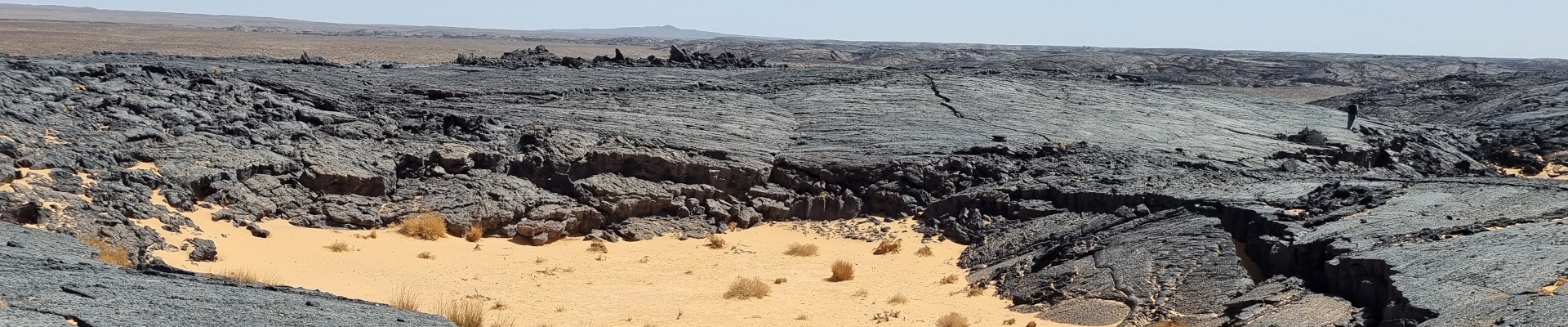
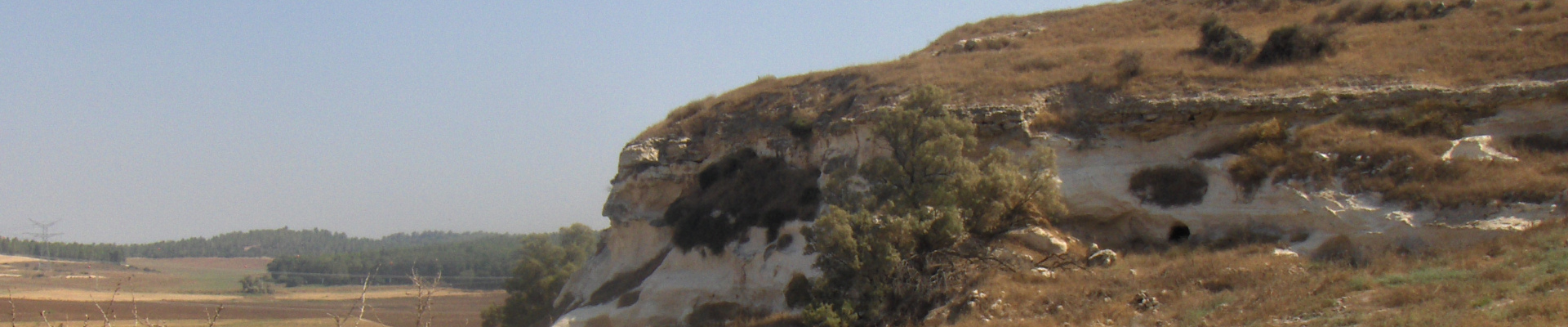
Photo of geological formations in the Wadi Tajnet, Libya.

Thank You FY 2024 Donors

Graph showing donor numbers for 2019 through 2024

We did it (again)!

This fiscal year (July 1, 2023–June 30, 2024) was a record one for ASOR. Donor numbers have been steadily increasing over the past couple of years and this year 905 of ASOR members chose to make a gift of $5 or more! In addition, another 407 people made a gift of less than $5 (primarily from donations to cover credit card fees). Even better news—the cash donations in FY 2024 totaled more than $1,600,000!

Thanks to you, our generous donors, for helping ASOR carry out our mission. It is truly gratifying to see our members and friends choosing to invest in ASOR. Please review the long list of colleagues who donated to make ASOR’s work possible this fiscal year. We are still updating and checking this list, so please contact us with any corrections or comments (info@asor.org).

Benefactor ($20k+) = 6
Patron ($10,000–19,999) = 7
Friend ($5,000–9,999) = 13
Sponsor ($1,000–4,999) = 33
Sustainer ($500–999) = 28
Supporter ($250–499) = 27
Contributor ($100–249) = 180
Donor ($25–99.99) = 136
Ally ($5–24.99) = 475
Gifts under $5 = 407

Why does high donor participation matter?

This large number of donors (almost half of ASOR’s membership) is something that distinguishes ASOR from all other learned societies. And it matters, as the high level of donor participation from our membership engages the attention of foundations and major donors outside ASOR and helps us attract gifts and support from them.

Your donations also enable ASOR to carry out our mission. Subscriptions and memberships only account for about a quarter of our annual budget, so we rely on grants and donations from our members and friends. Even modest gifts add up to create significant support for ASOR, Truly, every donor is important, and every gift is meaningful.

Fiscal Year 2024 Honor Roll

Lifetime Honor Roll of Donors

ASOR Legacy Circle Members

OTHER WAYS TO DONATE

Donate By PhoneDonate By MailMake A Pledge
(Donate Later)
Call ASOR:
(703) 789-9229
ASOR
209 Commerce Street
Alexandria, VA 22314
E-mail ASOR

Collections Fellowship Report: Jon Paul Heyne

2024 Collections Fellowship Report: Social Mobility of the Medieval Mediterranean: The Case of the Franciscan Custody

Jon Paul Heyne, Assistant Professor of History at the University of Dallas

Shortly after the collapse of the Crusader States in the late thirteenth century, small bands of Franciscan friars traveled to Jerusalem to undertake a daunting task: the renewal of a Latin Christian presence in the Holy Land. Courting patronage from the monarchs and pontiffs of Europe and cooperation from the Mamluk sultans of Egypt, the friars succeeded in their project. Forming the Franciscan Custody of the Holy Land c.1333, they gained not only important rights at many of the Holy City’s Christian shrines but also ownership of plots of property—with gardens, cisterns, and residences—first on Mt. Sion in Jerusalem but then later in Bethlehem and Ramla.

Beyond significantly marking a new phase in Latin Christian relations with the Levant, this establishment of the Franciscan Custody demonstrates the social fluidity of the Late Medieval Mediterranean. In uprooting themselves from the Latin West to reside in the Islamic world of the Eastern Mediterranean, the Franciscans dramatically altered their social dynamics with numerous parties—rising in standing in the eyes of some, falling to a minority status in the eyes of others, and taking on social relations with many whom they would never have encountered without making the transit across the sea.

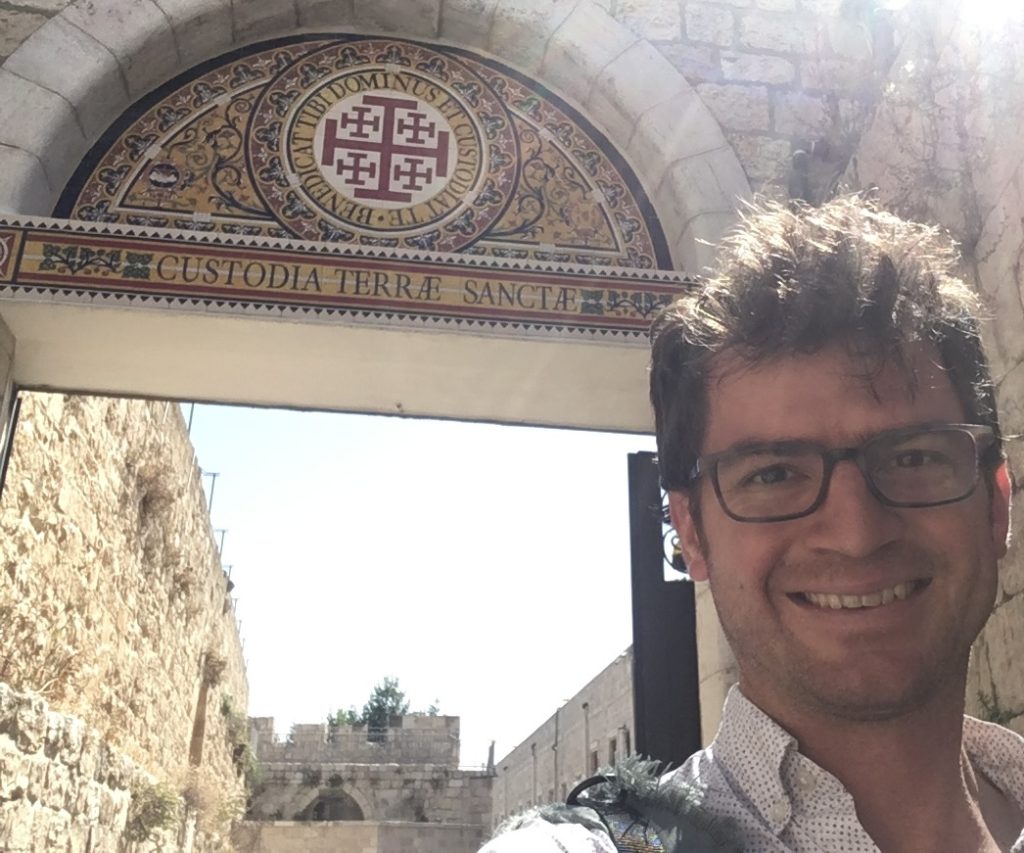
In front of the Franciscan Archivio Storico della Custodia di Terra Santa in Jerusalem. Photo courtesy of author.

With generous funding from ASOR’s Collections Fellowship and the assistance of archivist Fr. Narcyz Klimas, I returned to the Franciscan Archivio Storico della Custodia di Terra Santa to hunt down several unedited purchase deeds related to the history of the Custody. Seemingly dull and overly formulaic, these deeds recount the friars’ acquisition of properties throughout the Holy Land and thus offer some of the most concrete evidence for the development and expansion of their presence in the region in the fourteenth and fifteenth centuries. Additionally, these records provide fascinating details on the Franciscans’ relationships with others in the area, illustrating how the friars negotiated with local Muslim authorities, Italian laywomen, merchants in Ramla, and Armenian archbishops (to name just a few). As I continue the work of transcribing and translating these documents, I offer my sincerest thanks to ASOR and its donors for this opportunity to advance my research.

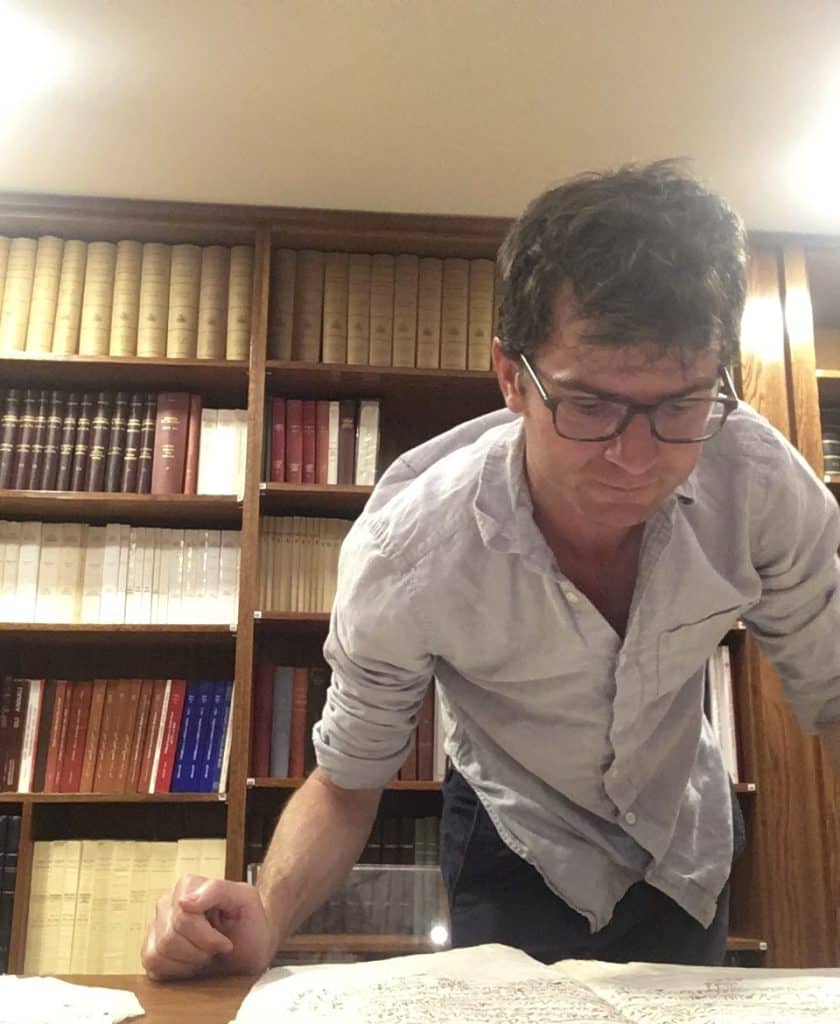
Examining one of the records related to the history of the Custody. Photo courtesy of author.

Fieldwork Report: Emilie Nordhues

The Other Side of Fieldwork

Emilie Nordhues, 2023 G. E. Wright Scholarship Recipient

This past summer I had the opportunity to participate in a study season for the Tel Dan excavation, a site at which I excavated in 2022. The aim of most study seasons is to work toward the publication of excavated material; a study season also provides time to re-examine the finds and stratigraphy from excavation and so test the interpretation of the data which was formed during excavation.

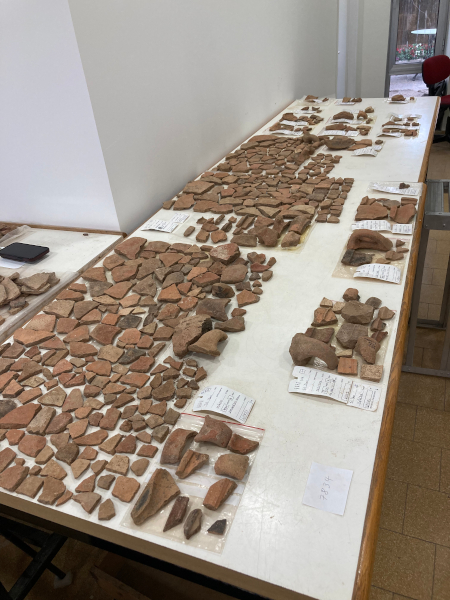
One of the main tasks of this study season was laying out all pottery from the same stratum (material of roughly the same time period at the site) and checking if any of the loci (a stratigraphic excavation unit, like a floor or a pit) contained unexpected material. Certain forms of pottery change more quickly, making them good indicators of date. Since we were working with material from the Late Bronze Age-Iron 1 transition we paid close attention to the cooking pots – in the Late Bronze Age these have an everted rim and in the Iron 1 they have a vertical rim. Thus, cooking pots were a good type of pottery to watch for anything unexpected within a locus or stratum. In an ideal world, all the pottery from the same stratum should reflect the same date.

Some of the pottery which we laid out – it frequently covered more than one table!

There were many instances where the information gained from laying out the pottery matched our initial interpretations. In this case, it was good to have confirmation and it provided a great opportunity for me to grow more familiar with pottery forms. Other times we needed to adjust our interpretation when we reexamined the data. For example, we realized that part of one locus was mixed with later material from a pit which had been missed in excavation. When we returned to the field notes, this also matched observations about an area with a slightly different soil composition. While the pottery was out, several pieces were also selected for illustration.

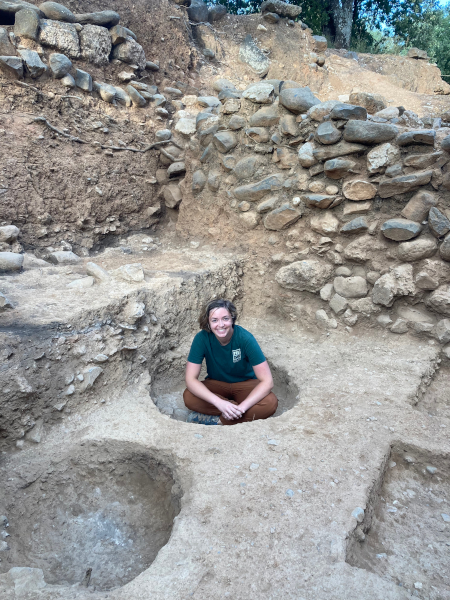
A picture of me from the 2022 excavation season, featuring some of the pits which we did not miss. Photo credit: Sarah Harrington.

Although much of the study season was spent looking over tables filled with pottery, this did not account for the entire study season. One of the more fun and satisfying things we got to do after laying out the pottery was restoration. Sometimes, excavations will recover a large portion of a vessel; if it is broken when it is discovered (which is very often the case), you do not always know how much of it was preserved. Restoration, then, is a three-dimensional puzzle to fit together pieces that belong to the same vessel. Depending on how many pieces the item was in, this can also clarify the original shape of the object.

Finally, work was also done to lay out other artifacts – excavations may also uncover figurines, tools, beads, and many other items that people used in the past. These can frequently reveal a lot about daily life. During the study season, we made sure that all these artifacts were accounted for and took photographs and measurements of many of them. Decisions were also made about whether the Tel Dan team would be able to adequately research and publish this material or if an expert (e.g., in metalworking) would need to be called in to work with the material.

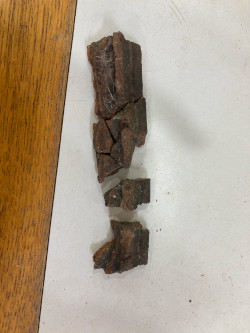
Partway through the restoration of a cooking pot rim – one of the first steps was always to figure out which pieces connected to each other; the color of the rim is due to char from the use of the cooking pot.
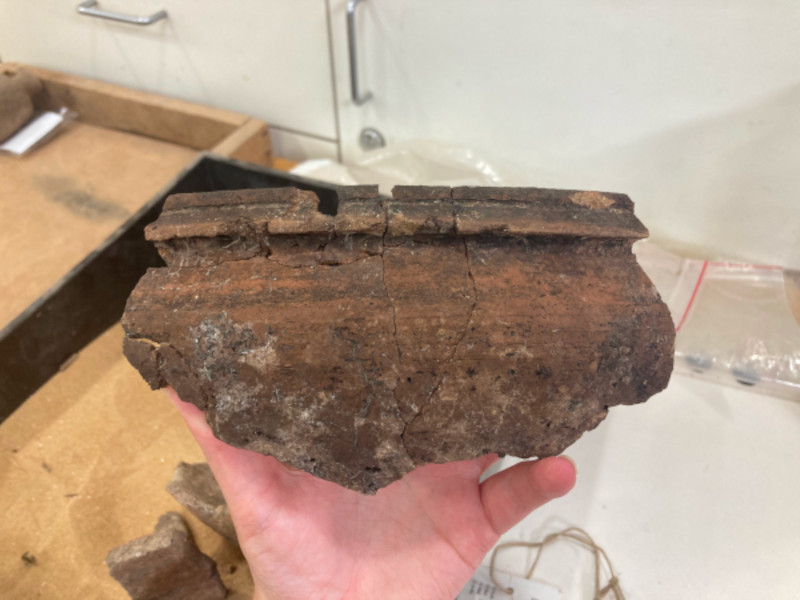
The same cooking pot, with restoration completed, representing all of the pieces which were found during excavation.
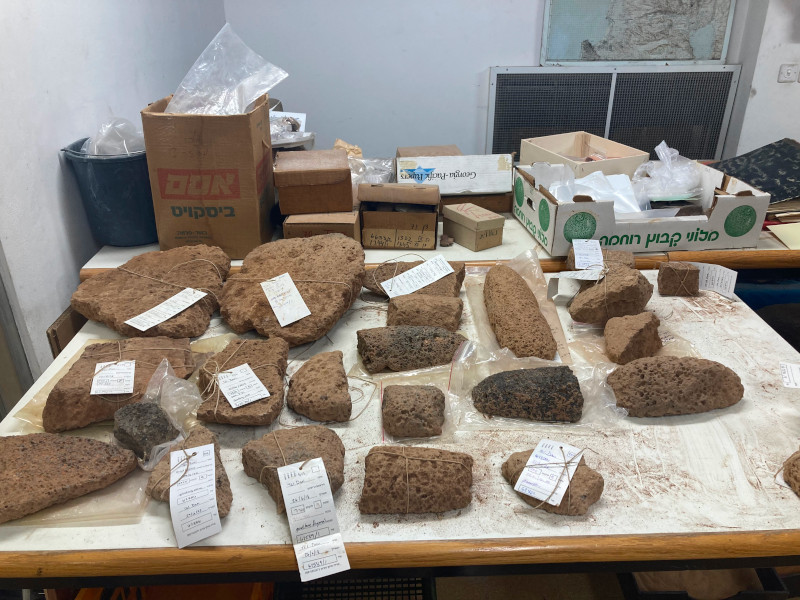
An example of other objects we looked at this summer – these are some of the grinding stone pieces from Tel Dan, which would have been used to grind grain.

All this work has helped move some of the Tel Dan material toward publication. After all, without a solid understanding of the stratigraphy and the artifacts from the site, it is very challenging to write a final report. I look forward to the eventual publication of this material! It will be very cool to see the next stage of the process when I know something of its excavation and study season work.


Emilie Nordhues is a graduate student in the Near Eastern Languages & Cultures Department at UCLA. Her research interests lie in the Achaemenid period and include dealing with identity formation, the impact of empire on daily life and religious practices, and the mobility and impact of various communities of practice (such as craftsmen).


Want to help more students and early career archaeologists get into the field? Donate to the cause today by selecting “Excavation Scholarships” as your gift purpose!

Call for President and Secretary Nominations

CALL FOR PRESIDENT & SECRETARY NOMINATIONS 2024

The Officers Nominations Committee of the American Society of Overseas Research announces a General Call for Candidates for service as Officers of the Corporation. All officers serve on the ASOR Executive Committee. Nominating an officer is an important way for members to participate in the governance of their organization, and we encourage you to nominate or self-nominate!

Two positions are currently open for nominations:

President of ASOR: this person leads the organization, supervises the Executive Director, and is the public face of ASOR. The term of office for this position is three years beginning January 1, 2026; however, the actual total minimum commitment will be five years with the first year (calendar year 2025) as President Elect, followed by a three-year term of office (calendar year 2026-28), and a final year as Past President (calendar year 2029). The position is renewable for a second three-year term. A general description of the Office of President and its responsibilities is in the ASOR Bylaws (see Article IV, Section 4.4). The President is expected to attend all appropriate meetings of the corporation and be available for other travel as necessary.

NOTE: After much discussion, the Board of Trustees approved the role of President Elect and reduced the term of Past President in May 2024. Both changes will require revision to the Bylaws, which we expect to be approved at the November meeting before voting on the President Elect. The changes were intended to shorten the total commitment required by an individual to serve as ASOR President and thus potentially attract more nominations for this important office. A strong majority on the Board also felt there should be no expectation or preference for the ASOR President to serve a second three-year term since we want to encourage nominations of individuals who plan to seek one term as well as those who might be interested in two terms.

Secretary of ASOR: this person is responsible for the minutes of all meetings of the corporation and acts as custodian of the official records of ASOR. The term of office for this position is three years beginning January 1, 2025. The position is renewable for a second three-year term. A general description of the Office of Secretary and its responsibilities is in the ASOR Bylaws (see Article IV, Section 4.9). The Secretary is expected to attend all appropriate meetings of the corporation.

Inquiries should be addressed to Bob Mullins (ramullins@apu.edu), Chair of the Officers Nominations Committee. The other members of the committee are Carol Meyers, Lisa Ackerman, Rick St.-Hilaire, and Sarah Costello, Sharon Herbert (ex-officio, voting), Sheldon Fox (ex-officio, voting), and Andy Vaughn (ex-officio, non-voting).

Nominations should include the candidate’s name, the position for which the candidate is nominated, a one-paragraph academic biography – including membership and activities in ASOR, a brief statement as to why the candidate would be appropriate for the position, and the candidate’s contact information. Self-nominations are encouraged. The Officers Nominations Committee will ask semi-finalists to submit further information, including, but not limited to, a CV and a vision statement.

Nominations should be submitted via e-mail to Bob Mullins (ramullins@apu.edu), Chair of the Officers Nominations Committee. Review of applications and nominations will begin on August 15, 2024, and continue until the position is filled.

The Officers Nominations Committee expects to present nominees for President Elect and Secretary to the ASOR Board of Trustees for a vote at the November 24, 2024 Board meeting in Boston, MA.

Personal Statement from ASOR’s President

What We Lose in Wars. A Personal View from the President of ASOR.

I have served nearly 5 years as President of ASOR. Much of the past year, since October 7th, has been taken up in discussions about statements: should ASOR as an organization say something, anything, about current political events, most urgently the war in Gaza? As a group dedicated to the study of the past from multiple viewpoints, we have elected for the most part (See ASOR’s single statement of Oct. 16th, 2023, behind which I still stand.) to remain silent. We are not as an organization taking sides. This has the dubious advantage of pleasing no one.  Despite its disadvantages, I share the consensus of ASOR’s leadership—my fellow Officers, Executive Committee, and Board of Trustees—that this is the best path for an organization that seeks to provide a welcoming forum where all our members feel free to express their opinions.

Today, I write my own thoughts as one archaeologist who has spent a long career documenting the past in Greece, Israel, and Egypt, and who has been entrusted with the leadership of ASOR by you, its members.

Archaeologists love disasters. Perversely, destruction preserves. Fire bakes unfired clay into nearly indestructible ceramic. Paper documents are turned to ash; stones and pots bear silent witness to people forever lost. In our more macabre moments we archaeologists joke that we love nothing more than a good earthquake or volcanic eruption. We are the ambulance chasers of antiquity, examining, some would say desecrating, the dead in the name of science. We train ourselves to be dispassionate spectators, but of course that is impossible. Each of us, based on our own upbringing, background and experience, reacts viscerally to past and present acts of destruction and loss of life.

ASOR’s core mission is the preservation and study of antiquities in the Near East and wider Mediterranean. We cannot study what war has irrevocably destroyed. Today we face a war in Gaza that scholars estimate has damaged or destroyed at least 57% of all buildings in the territory—the Great Omari Mosque, Saint Porphyrios Greek Orthodox Church, and Pasha Museum in Gaza City to name only three that touch directly on ASOR’s fields of study. In recent years we have seen the destruction of countless sites in Syria and Iraq—the vast Hellenistic city of Dura-Europos reduced to looters’ potholes, much of Palmyra, rubble, countless lives lost and many others crippled.

I ask myself, we all ask ourselves, what can ASOR do in the face of such destruction? Never enough. Beyond our core mission to initiate, encourage, and support research into, and public understanding of the history and cultures of the Near East we are striving to do what we can, where we can, when we can to help our colleagues in need. We pick up the pieces after disasters with our Shepherd Urgent Action Grants. We raise funds to help displaced students continue their educations, we work with local citizens to document and publish their pasts and present efforts to preserve them using open access computer programs. These are only a few of the things we are doing today as we strive to document and save the monuments of past peoples. It can never be enough; no number of monuments can compensate for even a single life lost; but with the help of our members we persevere—one day, one memory at a time.

I am proud to be a member of ASOR even in these dark times. I hope you are as well. I would welcome thoughts from you, our members, on more ways we can act positively in this troubled region.

Sharon Herbert
ASOR President
president@asor.org

AASOR 75: Amman Theater Statue

Ammonite Iron Age Tower in Jordan

New Annual of ASOR Publication

The Amman Theater Statue in its Iron Age Contexts

by Joel S. Burnett

A colossal basalt statue was uncovered through rescue excavation in downtown Amman, Jordan in 2010. Despite the statue’s Roman period find context, its form and motifs show it to be an Iron Age sculpture, and geoscientific testing indicates a regional quarry source. Comparison with an established corpus of Iron Age stone sculpture from Amman shows the Amman Theater Statue shares the distinct iconography of a series of Amman male statues portraying deities and human rulers. Broader art-historical comparisons from Egypt, the Levant, and Mesopotamia indicate that the statue dates ca. 850-825 B.C.E., that it belonged to an Ammonite royal ancestor cult, and that in that setting it portrayed a deified, deceased Ammonite king. Archaeological and epigraphic evidence accompanying those broader Near Eastern comparisons, especially those from Syro-Anatolian political capitals from Iron Age II, and archaeological evidence from Amman indicate that the Amman Theater Statue was incorporated into an architectural structure, either a building façade or monumental gate, on the Amman Citadel (Jabal al-Qal’a), along its southern ascent, or just beyond its southern slope.

With contributions by Romel Gharib and Don F. Parker.

Annual of ASOR, Volume 75, Series Editor William Caraher, December 2023, 220 pages, 15 b/w illustrations, 41 color illustrations, 6 tables. ISBN 9780897571197, $85.95.

Special Offer for ASOR Members

ASOR members (with a mailing address in the USA) can purchase a copy of AASOR 75 at the discounted price of $30.00 (65% discount + $5.00 US shipping) while supplies last. Purchases are restricted to one volume per member. We are unable to offer this discount to members without a US mailing address due to international shipping costs, but you can purchase and ship a copy through the ISD link below. Please contact programs@asor.org with any questions. Click here to purchase your discounted copy in ASOR’s online store.

Available from ISD — Distributor of Scholarly Books
www.isdistribution.com

2024 Grant & Fellowship Awardees

Acropolis Tall Hisban

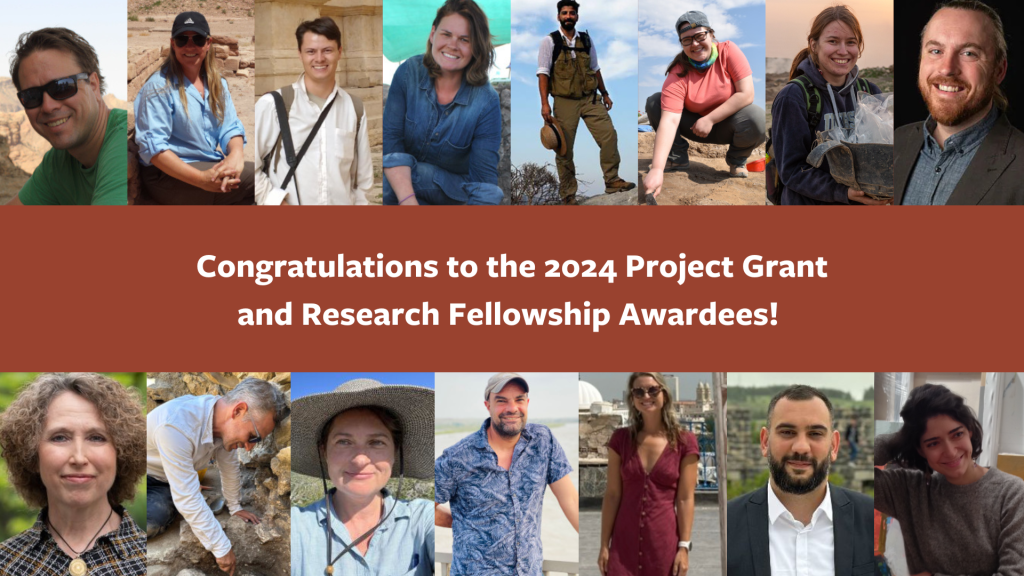
2024 PROJECT GRANT AND RESEARCH FELLOWSHIP AWARDEES

2024 Congrats Grant & Fellowship Awardees Graphic

Grants for Archaeological Projects

Stevan B. Dana Project Grants
  • Jason T. Herrmann, University of Pennsylvania: Phoenician Roots in a Punic City (Sicily, Italy)
  • Sarah A. James, University of Colorado Boulder: The Brač Island Project (Croatia)
  • Jennifer Ramsay, SUNY-Brockport, Björn Anderson,University of Iowa, and Craig Harvey, University of Alberta: Exploring Continuity and Transition in Southern Jordan
Stevan B. Dana Project Grant for Israel
  • Bethany J. Walker, University of Bonn: Study of Cultivation Strategies at Khirbet Beit Loya (Israel)
Charles Harris Project Grants
  • Alexander J. Smith, SUNY-Brockport: Menorca Archaeological Project (Spain)
Joe D. Seger Project Grant
  • Khaled Abu Jayyab, University of Toronto: Paths to Urban Growth in the Nineveh Plain (Iraq)
  • Asil Yaman, University of Pennsylvania: Phoenix Archaeological Project (Turkey)
Shepard Urgent Action Grants
  • Gia Chilingarashvili, Ivane Javakhishvili Tbilisi State University: Rescue Excavation of a Chalcolithic Settlement in South-West Georgia

Research Fellowships

Dar Ben Gacem Tunisian Research Fellowship
  • Caroline Angle Maguire, University of Maryland: Decolonizing Knowledge: Reclaiming Colonial Museums in Francophone North and West Africa (Tunisia)
Study of Collections Fellowships
  • Jennie Ebeling, University of Evansville: Analysis of Ground Stone Artifacts from Tell en-Nasbeh, Palestine at the Badè Museum of Biblical Archaeology
  • Holly Winter, University of Sydney: The Land Behind Aleppo: Urban Life and State Formation in Bronze Age Syria at the Harvard Museum of the Ancient Near East
Mesopotamian Fellowship
  • Elizabeth Gibbon, University of Toronto: The Halaf-Ubaid Transition at Tepe Gawra (Iraq)
  • Jeiran Jahani, Columbia University: Animal Art: Domesticating Wild Ecologies of the First Cities (Iraq)