Register and receive 25% off the purchase of this book!
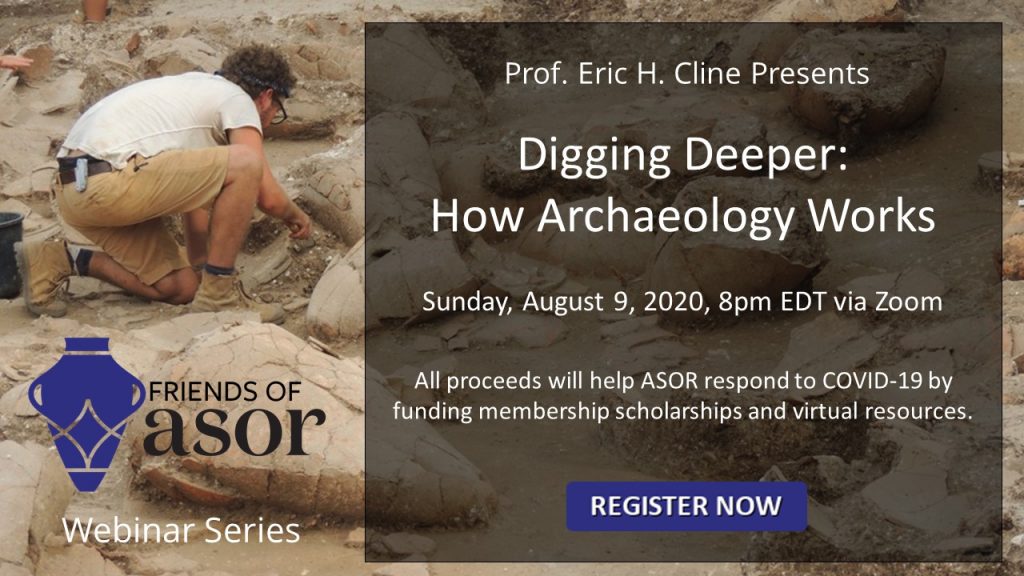
Friends of ASOR is excited to launch our new webinar series on August 9 at 8pm EDT, featuring Dr. Eric H. Cline. An internationally renowned archaeologist with more than thirty seasons of excavation experience, Prof. Cline has conducted fieldwork from Greece and Crete to Egypt, Israel, and Jordan. Drawing on his upcoming book, Digging Deeper, Cline answers questions archaeologists are most frequently asked:
How do you know where to dig? How are excavations actually done? How do you know how old something is? Who gets to keep what is found? How do you know what people from the past ate, wore, and looked like?
This lecture will be filled with insights and practical advice about how archaeology really works. The webinar will conclude with a live Q&A session with Prof. Cline.
Dr. Eric H. Cline is Professor of Classics and Anthropology, Director of the Capitol Archaeological Institute, and former Chair of the Department of Classical and Near Eastern Languages and Civilizations at The George Washington University, in Washington DC. A National Geographic Explorer, Fulbright scholar, and NEH Public Scholar with degrees from Dartmouth, Yale, and the University of Pennsylvania, he is an active field archaeologist with more than 30 seasons of excavation and survey experience, including ten seasons at the site of Megiddo (biblical Armageddon) in Israel and eight seasons at Tel Kabri, also in Israel, where he is currently Co-Director. Winner of the 2014 “Nancy Lapp Award for Best Popular Book” from the ASOR for his book “1177 BC: The Year Civilization Collapsed,” which was also considered for a Pulitzer Prize, and winner of the same award again in 2018 for his book “Three Stones Make a Wall: The Story of Archaeology,” he is also a three-time winner of the Biblical Archaeology Society’s “Best Popular Book on Archaeology” Award (2001, 2009, and 2011). A popular lecturer who has appeared frequently on television documentaries, he has also won national and local awards for both his research and his teaching. He is the author or editor of 20 books, which have been translated into sixteen languages, as well as nearly 100 articles, and several recorded lecture courses. His previous books written specifically for the general public include “The Battles of Armageddon: Megiddo and the Jezreel Valley from the Bronze Age to the Nuclear Age” (2000); “Jerusalem Besieged: From Ancient Canaan to Modern Israel” (2004); “From Eden to Exile: Unraveling Mysteries of the Bible” (2007); “Biblical Archaeology: A Very Short Introduction” (2009); “The Trojan War: A Very Short Introduction” (2013); “1177 BC: The Year Civilization Collapsed” (2014); “Three Stones Make a Wall: The Story of Archaeology (2017); and, most recently, “Digging Up Armageddon: The Search for the Lost City of Solomon” (2020).
Every registration for this webinar includes a coupon code for a 25% discount off and free shipping for Dr. Cline’s new book from Princeton University Press, Digging Deeper (retail price: $12.95)!
Every registrant for this webinar also has exclusive access to a subscription discount from Biblical Archaeology Society: 1 Year of All Access to Biblical Archaeology Review (library, digital, and print) for only 99 cents/month! You will be emailed the link to the offer after you register and pay.
You will be e-mailed the Zoom Webinar link prior to the lecture on August 9, 2020.
All proceeds from this lecture are used to fund scholarships for members impacted by COVID-19 as well as increasing ASOR’s virtual resources, which are free to the public.
Interested in sponsoring these webinars? Several levels of support from $50-$1,000 are available. Please email membership@asor.org with questions or sign up for a sponsorship while registering for this event.
Ready to explore more about ASOR Membership? Click here for more details about discounts for events and other benefits of membership! Memberships start at $40 for the year as an Associate Member.
You can now purchase the link to the recording of any webinar. You can also purchase the bundle packages of all webinars from the 2020-2022 seasons. Please e-mail membership@asor.org for purchase details.
To see a printable pdf of the webinar titles from the 2020-2021 season, please click here. To see a printable pdf of the webinar titles from the 2021-2022 season, please click here.
Where Are They Now?: A Preview of 2022 ASOR-Affiliated Fieldwork Projects Michael Given (University of Glasgow), Xenia-Paula Kyriakou (Florida Gulf Coast University), Stephen Batiuk (University of Toronto), Monique Roddy (Walla Walla University), Kent Bramlett (La Sierra University), Friedbert Ninow (La Sierra University), and Michael Hoff (University of Nebraska-Lincoln) | March 8, 2022
Tel Rehov: A Major Bronze and Iron Age City in the Jordan Valley Amihai Mazar (Hebrew University of Jerusalem), Nava Panitz-Cohen ( Hebrew University of Jerusalem), Nota Kourou (Athens University), Naama Yahalom-Mack (Hebrew University of Jerusalem), Robert Mullins (Azusa Pacific University) | February 10, 2022
Archaeogaming: Why Video Games Deserve Their Own Archaeology Tine Rassalle (University of North Carolina at Chapel Hill), Shannon Martino (Morton College), Matthew Winter (University of Arizona), Michael Zimmerman (Rhode Island) | April 18, 2021
Copy of e-mail sent to Annual Meeting registrants on July 23, 2020
Dear ASOR Friends and Colleagues,
As you have undoubtedly read in various ASOR outlets, the COVID-19 pandemic forced ASOR to move to a virtual meeting out of concern for the safety and well-being of our members and staff.
We (and all of the ASOR staff) will miss seeing you in Boston. The Annual Meeting has been the highlight of our year because it is the time when we get to connect in person with the larger ASOR family. We know that the same is true for our members—even as we all realize that the pandemic left us with no other choice.
While we will miss seeing everyone, ASOR is embracing the opportunity to develop a virtual event that can deliver the robust content of our 2020 academic program in a manner that will serve our community most effectively. We have even had a few members register for the Virtual Meeting who would not have been able to attend in person!
The Virtual Meeting will include both prerecorded presentations and synchronous discussion of research. We are in the process of consulting with the ASOR Program Committee and Session/Workshop Chairs about the requirements for our academic program. The schedule and format of the virtual meeting will be announced (in early August) after we finalize the selection of a third-party virtual partner in light of this consultation. All of this takes some time, and we appreciate your patience as we rework the meeting into a successful virtual experience.
In the meantime, we also want to review some logistics…
Hotel Reservations: If you made a reservation at the Westin Boston Waterfront, your room should have been cancelled automatically. You should have received an e-mail with that cancellation. If you did not receive an e-mail (please check junk mail), we encourage you to review your Bonvoy (Marriott) online account or to contact the hotel (800-937-8461) to confirm that your room has been cancelled.
Conference Registrations: Even though we anticipate greater costs to produce the virtual meeting than an in-person meeting, ASOR has made a commitment to make the Virtual Meeting accessible to the entire ASOR family.
Scholarships: ASOR will meet 100% of scholarship requests for registrations for anyone that has been negatively impacted (directly or indirectly) by COVID-19. In addition, if someone is not currently a member, we will provide membership scholarships on a first-come, first-served basis. To apply, simply e-mail asor2020@asor.org with a brief request.
Transfer your registration—choose one of the following two options:
Do nothing and your registration will be transferred: Your previously paid fee will be applied to the virtual meeting registration. The difference (if any) between the two rates will help ASOR cover our increased costs of the virtual conference and for scholarships. Click here for Virtual Meeting Registration rates.
Request a credit to your ASOR account for any overage: E-mail asor2020@asor.org by August 25, 2020.
Credits can be used for any future ASOR purchase
Alternatively, you can request a refund check for the difference
Cancellation / Refund: If you do not wish to participate in the Virtual Annual Meeting, we ask that you cancel by choosing one of these three options. Please send your request to asor2020@asor.org by August 25, 2020.
You may request a refund check (the usual administrative fees are waived)
You may request a credit to your ASOR account (future memberships, meetings, etc.)
You may designate the registration fee as a donation towards scholarships
Last, but certainly not least, we hope that you and all of the ASOR community are safe and managing these unprecedented circumstances in good health. All of us at ASOR look forward to seeing you online in November!
Warm regards,
Andy Vaughn, ASOR Executive Director (executive-director@asor.org)
Arlene Press, ASOR Director of Meetings & Events (meetings@asor.org)[/vc_column_text][/vc_column][vc_column border_color=”rgba(170,170,170,0.01)” width=”1/6″ css=”.vc_custom_1496684098866{margin-right: 5px !important;margin-bottom: 20px !important;border-right-width: 2px !important;border-bottom-width: 2px !important;padding-top: 30px !important;padding-right: 10px !important;padding-left: 10px !important;background-color: #ffffff !important;border-right-color: rgba(227,228,228,0.75) !important;border-bottom-color: rgba(227,228,228,0.75) !important;}”][vc_wp_posts title=”BROWSE THE NEWS ARCHIVE” number=”4″][/vc_column][vc_column border_color=”rgba(170,170,170,0.01)” width=”1/6″ css=”.vc_custom_1496684008271{margin-right: 10px !important;margin-bottom: 30px !important;border-right-width: 2px !important;border-bottom-width: 2px !important;padding-top: 30px !important;padding-right: 20px !important;padding-left: 20px !important;background-color: #ffffff !important;border-right-color: rgba(227,228,228,0.75) !important;border-bottom-color: rgba(227,228,228,0.75) !important;}”][vc_column_text]Tweets by ASOResearch [/vc_column_text][/vc_column][/vc_row]
By Meagan Shirley and Joe D. Seger[/vc_column_text][mk_divider][vc_wp_text]The last article on ASOR’s history concluded with the foundation of ACOR and the W.F. Albright Institute of Archaeological Research. This article encompasses ASOR’s history from the 1970’s to the present.
The Jerusalem school was named the W. F. Albright Institute in 1970, but the transfer of property title from ASOR to the AIAR Board occurred only in the mid-1990’s. Between 1970 and 1990 ASOR continued to provide support in its budget for each of the overseas centers as the Boards of the centers worked their way to independence. ASOR’s offices in the United States assumed responsibility for the entire organization’s administrative and academic activities. ASOR had central offices at Yale and elsewhere from much earlier which assumed responsibility for administration.
The Jerusalem School, now the home of AIAR, ca. 1930
Beginning in 1966, ASOR made its home at the Harvard Semitic Museum under the leadership of President G.E. Wright. ASOR maintained offices in Cambridge until the appointment of James A. Sauer in 1982, who worked at the University of Pennsylvania. The appointment of Sauer as ASOR President prompted another move to Philadelphia where ASOR took up residence at 4243 Spruce Street. During its tenure in Philadelphia, ASOR thrived due to its close proximity to the university. In 1984 in conjunction with the University Museum, ASOR received an NEH Grant to fund Summer Institutes in Near Eastern Archaeology. These consisted of summer programs taught by ASOR members and leading scholars in the field of archaeology.
The James F. Strange Center, ASOR’s new home in Alexandria, VA.
Following a six-year tenure at Johns Hopkins University, ASOR moved to Boston University in 1996. 656 Beacon Street in Boston remained the home of ASOR for 20 years until Boston University decided to sell the building in which ASOR was located. A New Office Committee was formed and headed by Board Chair Richard Coffman to decide what the best course of action should be for ASOR. It was determined that would be to, “purchase a facility to serve as ASOR’s permanent and independent home. The Board has also determined, again through extensive discussion and through site visits, that the optimal location for our new office is in the Washington, D.C., area” (Ackerman 2018).For the first time in ASOR’s history, the organization is independent of the various universities’ complimentary office space. Through the generous donations of our membership, ASOR was able to purchase an office space outside of Washington, D.C. in Alexandria, VA. This new building was named the James F. Strange Center in honor of longtime member and trustee, Jim Strange. The Strange Center was purchased through a rigorous campaign to raise the funds to purchase the office. Through the generous donations of our membership, ASOR was able to raise the full cost of ASOR’s new home.
Beginning with its time in Philadelphia, ASOR greatly expanded its scope, including new Cultural Heritage Initiatives, expanding oversight of excavation practices, increasing scholarship opportunities for students to travel to the field, and focusing on the dissemination of scholarly research through the Annual Meeting. Meetings had taken place intermittently throughout the 1960s and 1970s in conjunction with other organizations, primarily the Society for Biblical Literature (SBL). ASOR continued meeting with SBL until 1997 when it was decided through a membership meeting the previous year in New Orleans to hold an independent meeting. The 1997 Annual Meeting in Napa Valley was successful with 350 participants (Seger 2001: 68). However, it was decided to hold future meetings in the same city and time frame as the SBL conference due to the many members that attended both. ASOR has held its own Annual Meeting every year since. In 2020, ASOR had to make the difficult decision to cancel its in person meeting in Boston due to the Covid-19 pandemic. This decision was deemed necessary for the safety and well-being of ASOR’s many members. As of the writing of this article, ASOR is working to host a virtual meeting through which many scholars and researchers can still present their research. ASOR looks forward to seeing its members in-person again at the 2021 Annual Meeting in Chicago.
Meyers, Eric M. and Joe D. Seger. 2001. ASOR: A History of the American Schools of Oriental Research. In An ASOR Mosaic, edited by Joe D. Seger, pp. 2-103. American Schools of Oriental Research, Boston.[/vc_wp_text][/vc_column][vc_column border_color=”rgba(170,170,170,0.01)” width=”1/6″ css=”.vc_custom_1496684098866{margin-right: 5px !important;margin-bottom: 20px !important;border-right-width: 2px !important;border-bottom-width: 2px !important;padding-top: 30px !important;padding-right: 10px !important;padding-left: 10px !important;background-color: #ffffff !important;border-right-color: rgba(227,228,228,0.75) !important;border-bottom-color: rgba(227,228,228,0.75) !important;}”][vc_wp_posts title=”BROWSE THE NEWS ARCHIVE” number=”4″][/vc_column][vc_column border_color=”rgba(170,170,170,0.01)” width=”1/6″ css=”.vc_custom_1496684008271{margin-right: 10px !important;margin-bottom: 30px !important;border-right-width: 2px !important;border-bottom-width: 2px !important;padding-top: 30px !important;padding-right: 20px !important;padding-left: 20px !important;background-color: #ffffff !important;border-right-color: rgba(227,228,228,0.75) !important;border-bottom-color: rgba(227,228,228,0.75) !important;}”][vc_column_text]Tweets by ASOResearch [/vc_column_text][/vc_column][/vc_row]
Larry Geraty receives the Harris Award from Honors & Awards Chair, Laura Mazow.
At the 2019 ASOR Annual Meeting in San Diego, Larry Geraty received the Charles U. Harris Service Award. This award is given in recognition of long term and/or special service as an ASOR officer or Trustee.
Lawrence (Larry) T. Geraty, President Emeritus, Director of the Foundation Board and Associate Director of the Center for Near Eastern Studies at La Sierra University, has been engaged with Near Eastern archaeology and with ASOR and its affiliate schools for more than five decades. In this time, he has taken on leadership roles as ASOR President from 2002 to 2006 and by serving on the ASOR Board through 2016 and acting as an Honorary Trustee since then. Larry has also served as ACOR trustee (1976-2002), Secretary-Treasurer (1983) and vice-president (1993). The creation of the newly endowed ASOR Lawrence T. Geraty Community Archaeology Endowment will heighten awareness of cultural heritage by engaging and facilitating partnerships with local communities in heritage protection and community archaeology. This new initiative will serve as a model for ways that archaeologists working in the Near East and Mediterranean region can partner with local communities to their mutual benefit. For Larry’s long-term affiliation, service and support for ACOR, ASOR and AIAR, and his life-long accomplishments in archaeology, he is awarded the Charles U. Harris Service Award.
“It was a privilege for me to serve ASOR during a difficult bridge-time between its glorious past and very successful present. Any contributions I have made were in the context of a team effort with talented colleagues whose friendship and support I’ll always cherish.” Appreciatively, Larry
Geraty chats with colleagues after receiving the Harris Award.
Nominate someone for an award. The deadline for service award nominations is September 11, 2020. The deadline for book award nominations September 18, 2020.[/vc_wp_text][/vc_column][vc_column border_color=”rgba(170,170,170,0.01)” width=”1/6″ css=”.vc_custom_1496684098866{margin-right: 5px !important;margin-bottom: 20px !important;border-right-width: 2px !important;border-bottom-width: 2px !important;padding-top: 30px !important;padding-right: 10px !important;padding-left: 10px !important;background-color: #ffffff !important;border-right-color: rgba(227,228,228,0.75) !important;border-bottom-color: rgba(227,228,228,0.75) !important;}”][vc_wp_posts title=”BROWSE THE NEWS ARCHIVE” number=”4″][/vc_column][vc_column border_color=”rgba(170,170,170,0.01)” width=”1/6″ css=”.vc_custom_1496684008271{margin-right: 10px !important;margin-bottom: 30px !important;border-right-width: 2px !important;border-bottom-width: 2px !important;padding-top: 30px !important;padding-right: 20px !important;padding-left: 20px !important;background-color: #ffffff !important;border-right-color: rgba(227,228,228,0.75) !important;border-bottom-color: rgba(227,228,228,0.75) !important;}”][vc_column_text]Tweets by ASOResearch [/vc_column_text][/vc_column][/vc_row]
LETTER TO MEMBERS ANNOUNCING THAT THE 2020 MEETING WILL SHIFT TO VIRTUAL
[/vc_column_text][mk_divider][vc_wp_text]Dear Members and Annual Meeting Participants,
It is with regret we write to inform you that we have determined ASOR’s 2020 Annual Meeting, scheduled for November 18-21 in Boston, cannot be held in person due to the Covid-19 pandemic. This is particularly disappointing because 2020 marks the 120th anniversary of ASOR’s founding, and we had a particularly special meeting planned.
Even though the pandemic has forced us to hold a different type of meeting, the ASOR staff and Program Committee are preparing to rework this exciting program into a virtual format that will deliver the full content of our record-breaking number of submissions in a manner that will serve our community most effectively. This is a complicated endeavor, but we are confident that the outcome will be a positive new first for ASOR. Please bear with us in the short term; we plan to write with more specifics by mid-July.
In the meantime, we have suspended registration for the Boston in-person meeting. We will be in touch with you by mid-July regarding the 2020 Virtual Annual Meeting logistics and other key information, including how we will handle registration fees that have already been paid.
Questions? Please call or email us.
Sharon Herbert, President
Richard Coffman, Chair of the Board of Trustees
Andy Vaughn, Executive Director[/vc_wp_text][/vc_column][vc_column border_color=”rgba(170,170,170,0.01)” width=”1/6″ css=”.vc_custom_1496684098866{margin-right: 5px !important;margin-bottom: 20px !important;border-right-width: 2px !important;border-bottom-width: 2px !important;padding-top: 30px !important;padding-right: 10px !important;padding-left: 10px !important;background-color: #ffffff !important;border-right-color: rgba(227,228,228,0.75) !important;border-bottom-color: rgba(227,228,228,0.75) !important;}”][vc_wp_posts title=”BROWSE THE NEWS ARCHIVE” number=”4″][/vc_column][vc_column border_color=”rgba(170,170,170,0.01)” width=”1/6″ css=”.vc_custom_1496684008271{margin-right: 10px !important;margin-bottom: 30px !important;border-right-width: 2px !important;border-bottom-width: 2px !important;padding-top: 30px !important;padding-right: 20px !important;padding-left: 20px !important;background-color: #ffffff !important;border-right-color: rgba(227,228,228,0.75) !important;border-bottom-color: rgba(227,228,228,0.75) !important;}”][vc_column_text]Tweets by ASOResearch [/vc_column_text][/vc_column][/vc_row]
The Ad Hoc Committee on ASOR’s Name was appointed by outgoing President Susan Ackerman and incoming President Sharon Herbert at the beginning of January, 2020. Its members include Trustees Randy Helm (chair), Emily Bonney, Lisa Ackerman, and Eric Welch, and members Eric Cline, Emily Hammer, and Kiersten Neumann. The charge to the committee is included as Attachment 1.
Process
Shortly after its membership was confirmed, Chair Helm distributed to the committee study documents relevant to past discussions of ASOR’s name. A list of these documents is included as Attachment 2.
The Committee met four times by Zoom between January 21 and April 22, 2020. After reviewing the materials and discussing the issues, we agreed on a work plan that would (a) assess the possible impact of a name change on the ability to access ASOR publications in the future; and (b) develop a survey that would provide a sense of ASOR members’ views on this question. The subcommittee on publications quickly determined that any impact of a name change on access to publications would be negligible. The survey subcommittee developed an instrument for the committee’s review.
With the assistance of ASOR staff, the survey was made available online to all ASOR members from March 18 – March 28. We received a very healthy response rate of approximately 30 percent. Comparing the demographics of survey respondents to the actual demographics of ASOR’s membership, we noted an overrepresentation of members who have belonged to ASOR for ten or more years (42.6% of respondents v. 29.7% of members). While we agreed that this was worth noting, we also agreed that the robust response made the survey results a reliable guide to members’ views on the issue of the organization’s name.
Survey Respondents skew younger: 56.3% are younger than 55; 43.7% are older than 54. However, we don’t have age data for all ASOR members, so we don’t know if this is representative.
Areas of Consensus
70.3% agree or strongly agree that it is important that the society’s name reflects the geographical scope of ASOR’s work. Only 15% disagree or strongly disagree.
55.9% of respondents agree or strongly agree that it is important that the name reflects the chronological scope of ASOR’s work. Only 25.6% disagree or strongly disagree that this is important.
N.B. The current name does not communicate either the geographical or chronological scope of ASOR’s work.
Areas of Disagreement
Keep the name “American Schools of Oriental Research?
45.3% agree or strongly agree
40.9% disagree or strongly disagree
13.8% undecided
Eliminate the name, but keep the acronym ASOR?
Approximately half of respondents (50.1%) disagree or strongly disagree
A minority (32.2%) agree or strongly agree.
Undecided = 17.7% (somewhat more than are undecided about keeping the historical name).
Create a new name retrofitted to the ASOR acronym?
41.6% disagree or strongly disagree;
34.2% agree or strongly agree;
Observation: Enthusiasm for a retrofitted name is a popular option for members under 35 years old, but drops off sharply among respondents older than 35 and members for more than ten years.
Create an entirely new name that is descriptive in nature (e.g. “Society for Ancient Studies”)?
41.9% have a poor or very poor impression;
35.6% have a good or very good impression.
22.5% are neutral.
Observation: No age group had a majority approving this option; support dropped off sharply among members of more than 10 years
Create an entirely new name based on an ancient word or concept (e.g. “Amphora”)?
48% have a poor or very poor impression;
25.6% have a good or very good impression;
26.4% are neutral.
Observation: This would seem to be the least popular option. No age group had a majority approving this option; support dropped off sharply among members of more than 10 years.
Create a new name that is a new acronym (e.g. “Archaeological Research and Cultural Heritage Education” – ARCHE)?
42.2% have a poor or very poor impression;
33% have a good or very good impression;
24.8% are neutral.
Viable Options
The Committee discussed these results in some detail, noting that older respondents favor retaining the full name and younger respondents favor a change. We acknowledged that the younger respondents represent the future of the organization, while the older respondents represent a group with deep loyalty to and knowledge of the organization.
We also discussed the difficulties that the current name and acronym create for younger scholars in terms of the publication and service records in their tenure and promotion dossiers. Neither the full name nor the acronym explains the organization’s purpose or work. Dossier readers outside the field are unlikely to understand the organization’s relevance or importance.
While the option of a new descriptive name that yields an acronym failed to find majority support among any age group, almost half of the younger members liked it, with stronger disapproval showing up as the age of members increased. We considered the possibility that this option could address the consensus on geographical and chronological descriptors in the name, and make it easier to explain to dossier-readers, younger scholars, and others.
We also noted that keeping the acronym ASOR as the only name of the organization might, even with a descriptive tagline, result in increasing confusion about the name’s meaning and the organization’s purpose over the passage of time. Some committee members felt that this would result in another committee needing to consider the name issue a few years down the road.
ASOR Board Discussion
Committee Member Trustees Ackerman, Bonney, Helm, and Welch provided the ASOR Board with an interim report at its May 14th meeting. While no straw polls were requested or taken, Board members generally agreed that the most productive option would seem to be to come up with a new name that is descriptive of our work and creates an acronym (either a new one, or one that comes close to the present one).
Next Steps
The Committee agreed that this is a suitable moment to seek the membership’s reaction to the survey results and the proposed course of action. Our preliminary assessment of possible names/acronyms yielded the following top five choices:
Society for Archaeology, Philology, and History of the Middle East (SAPHME)
Association for Archaeological Research and Cultural Heritage Education (AARCHE)
Society for Ancient Near Eastern Research (SANER)
Association for Archaeology, Research, Cultural Heritage, and Education (AARCHE)
Society for Archaeology, Philology, and History of the Ancient Near East (SAPHANE)
Two options inspired enthusiastic responses but few votes and received honorable mention as “beautiful losers:”
International Society for Ancient Near Eastern Research (INSANER)
Society for Middle Eastern Research and Social History (SMERSH)
Your Ideas?
We now solicit feedback on the above listed possibilities, as well as new suggestions from all members for a name/acronym that describes our organization’s geographical, chronological, and methodological scope.
Because of the uncertainty of the format of the Fall meeting and the fullness of its schedule (if it happens), the Ad Hoc Committee agrees that this interim report – and our request for feedback – will eliminate the need for an open forum in November. Our hope is to process feedback and suggestions, and suggest naming options to the ASOR Board of Trustees in November.
[/vc_column_text][mk_divider][vc_column_text]Attachment 1: Charge to the Committee
We write, as the outgoing and incoming ASOR Presidents, to ask you to serve on an ad hoc committee charged with evaluating the name of our organization. ASOR Trustee Randy Helm has agreed to chair this committee and has agreed that he would very much like you to serve on this group. We hope you will accept. You are being invited because you have been active in ASOR and, we believe, because you have an open mind on this question. If you feel that you do not meet this last criterion, please let us know. We anticipate that there will be a wide diversity of strongly held opinions on this issue, and it will be important for the Committee to have credibility as a thoughtful and objective group who will be open to the ideas and arguments of others.
Background
ASOR members have been discussing the possibility of changing the organization’s name since at least 1982. Most recently, a workshop was offered at the 2018 ASOR Annual Meeting in Denver on “What’s in a Name? Re-assessing the Oriental in the American Schools of Oriental Research.” The workshop was very well attended, and the presentations and discussion were both thoughtful and provocative. As a result, the organizers created a summary of the workshop’s conversations and forwarded them to various governing bodies within ASOR, including the ASOR Board of Trustees. That summary was delivered in Fall 2019.
After considering this summary, the ASOR Board voted, at its November 2019 meeting, to continue the discussion by forming an ad hoc committee to study ASOR’s name.
Charge
The committee’s charge is to consider whether ASOR’s name is still appropriate for the organization and, if not, to recommend to the Board of Trustees a new name, or a modified name, or some selection of new or modified names that ASOR might adopt instead. Any decision to change or modify ASOR’s name would ultimately be made by the Board.
While this charge is succinctly stated, we do not mean to suggest it is easily undertaken. At a minimum, we envision that the committee will need (1) to review previous discussions about ASOR’s name; (2) review discussions other “O” organizations have had about their names and the decisions they have made, for example, the Oriental Institute at the University of Chicago and the School of Oriental and African Studies at the University of London; (3) review the experiences of other learned societies that have changed their names or have decided not to, including these learned societies’ discussions regarding the names of their publications; and (4) actively solicit and carefully consider input from the ASOR membership about ASOR’s current name and any possible name change.
We anticipate that the committee’s work should take between twelve to fifteen months, depending on how the committee chooses to go about its work, and especially its work of collecting feedback from the ASOR membership. The committee should thus plan on submitting its final report to the ASOR Board, with recommendations, no later than the April 2021 Board meeting. We look forward to supporting the committee in every way that we can, and we have already provided Randy with multiple documents to help in the committee’s deliberations and its decision-making process.
We hope that you will be able to serve on the important committee. Many thanks for considering this invitation, and we look forward to hearing from you.
Sincerely,
Susan Ackerman
ASOR President
Sharon Herbert
ASOR Vice President and President-Elect
Chair, Chairs Coordinating Council[/vc_column_text][mk_divider][vc_column_text]Attachment 2: Study Documents reviewed by Committee Members
C&G Partners, Discovery Findings and Recommendations for ASOR Branding and Website Redesign, March 22, 2016
Orientalism Session – Raw Data 2018
Melissa Bailey Kutner, “Getting Oriented” 2018
Ian W. N. Jones, “’Isn’t that a Little Racist, Dr. Jones,’ or What I learned Trying tro Explain ASOR to High School Students” 2018
Danielle Steen Fatkin, “Orientalism in America: East Asia, West Asia, and the American Racial Imagination” 2018
Danielle Steen Fatkin, “Report to the CCC regarding the workshop ‘What’s in a Name? Re-assessing the Oriental in the American Schools of Oriental Research’ at the November 2018 Annual Meeting”
Michael M. Homan, “Why the Term ‘Oriental’ in ASOR is Neither Accurate Nor Appropriate.” 2018.
THE BULLETIN OF ASOR (BASOR) EDITORIAL TEAM ANNOUNCED
[/vc_column_text][mk_divider][vc_wp_text]ASOR is pleased to announce the appointment of the new editors of The Bulletin of the American Schools of Oriental Research (BASOR)—a team of four scholars from the United States and Europe. Susan Cohen of Montana State University and Regine Pruzsinszky of the Albert-Ludwigs-University Freiburg will lead the team as co-editors. Working with them will be two associate editors: Jana Mynářová of the Charles University in Prague; and Marwan Kilani, currently a postdoc researcher associated with the Freie Universität in Berlin and the Swiss National Science Foundation. All four team members come to the position with extensive editorial experience and diverse academic backgrounds that reflect the diversity of ASOR’s membership and mandate. The editors were nominated by the BASOR Editorial Search Committee after an extensive public search process. The nomination was unanimously endorsed by ASOR’s Publications Committee, and the editors were unanimously approved by the ASOR Board of Trustees in May 2020.
The May 2020 issue of BASOR.
Susan Cohen is an archaeologist, focusing on rural-urban relations and interactions and chronological connections between Egypt and the southern Levant. Regine Pruzsinszky is an Assyriologist with a particular interest in Semitic and Hurrian onomastics, Mesopotamian chronology of the second millennium BCE, and the socio-cultural role of musicians in the Ancient Near East. Jana Mynářová is an Assyriologist and Egyptologist, focusing on political and cultural relations of Egypt and the Near East. Marwan Kilani is an Egyptologist and linguist working on cultural and linguistic interactions between Egypt and the Levant. He has a strong interest in methodological questions, and in digital humanities and computational methods applied to the study of the ancient world. BASOR editors are appointed for a three-year term, with the possibility of being re-appointed for a second term. Their initial term will run from 2021–2023.
The new editors will succeed the current co-editors, Eric Cline and Christopher Rollston, in January 2021. Those interested in publishing in BASOR should continue to submit manuscripts through the online submission system.[/vc_wp_text][/vc_column][vc_column border_color=”rgba(170,170,170,0.01)” width=”1/6″ css=”.vc_custom_1496684098866{margin-right: 5px !important;margin-bottom: 20px !important;border-right-width: 2px !important;border-bottom-width: 2px !important;padding-top: 30px !important;padding-right: 10px !important;padding-left: 10px !important;background-color: #ffffff !important;border-right-color: rgba(227,228,228,0.75) !important;border-bottom-color: rgba(227,228,228,0.75) !important;}”][vc_wp_posts title=”BROWSE THE NEWS ARCHIVE” number=”4″][/vc_column][vc_column border_color=”rgba(170,170,170,0.01)” width=”1/6″ css=”.vc_custom_1496684008271{margin-right: 10px !important;margin-bottom: 30px !important;border-right-width: 2px !important;border-bottom-width: 2px !important;padding-top: 30px !important;padding-right: 20px !important;padding-left: 20px !important;background-color: #ffffff !important;border-right-color: rgba(227,228,228,0.75) !important;border-bottom-color: rgba(227,228,228,0.75) !important;}”][vc_column_text]Tweets by ASOResearch [/vc_column_text][/vc_column][/vc_row]
GCI-ASOR CONSERVATION AND ARCHAEOLOGY WORKSHOP AT THE 2019 ANNUAL MEETING
[/vc_column_text][mk_divider][vc_wp_text]The Getty Conservation Institute (GCI), in collaboration with the American Schools of Oriental Research (ASOR), organized a workshop on conservation and archaeology for selected directors of excavations and members of ASOR following its Annual Meeting in November 2019 in San Diego, CA.
Photograph by Juliette Raffaelli. Image copyright J. Paul Getty Trust.
The workshop grew out of the Archaeology and Conservation Education Roundtable organized by the GCI and hosted by the Getty Villa and the GCI in 2017, an initiative itself rooted in the Institute’s long-term work in archaeological conservation. During the roundtable, the invited faculty in archaeology and conservation, from universities where both fields are taught, identified the need for better knowledge of conservation by archaeologists and better knowledge of archaeology by conservators, to improve collaboration and best practices in fieldwork. One proposed action coming out of the roundtable was delivering workshops or “boot camps” on conservation for archaeologists, and on archaeology for conservators, in association with their respective professional meetings. This GCI-ASOR collaboration was the first of the proposed workshops to be conducted.
Photograph by Juliette Raffaelli. Image copyright J. Paul Getty Trust.
The one-day workshop was attended by twenty-four midcareer and senior excavation directors in the ASOR region and selected staff from the American Center for Oriental Research in Amman, Jordan. It included an introduction to archaeological materials and their deterioration causes and mechanisms, followed by a discussion of ethics in archaeology and conservation. Subsequent presentations by conservators with extensive experience on archaeological excavations focused on the conservation process and the importance of pre-excavation planning. Case studies of best practices in collaborative fieldwork were presented, forming the basis for discussions on planning, budgeting, and funding. This last topic was of particular importance to some participants, who identified it as a primary obstacle to integrating conservation in their research and excavation plans. One potential follow-up of the workshop will be for the GCI to convene a meeting of archaeological organizations and principal funders of archaeological research to advocate for including funding for conservation and a conservator in their research grants.
ENDANGERED CULTURAL HERITAGE OF THE MIDDLE EAST—THE JEWISH HERITAGE OF IRAQ AND SYRIA
[/vc_column_text][mk_divider][vc_column_text responsive_align=”left”]ADDENDUM 6/14/20: JCHI is pleased to report that the Alliance for the Restoration of Cultural Heritage (ARCH) has made significant progress on the restoration of the Shrine of the Prophet Nahum since the drafting of the initial report on the condition of Jewish built heritage in Iraq and Syria. In light of this work, the Shrine of the Prophet Nahum no longer requires the level of intervention called for in the report. For more on ARCH’s work and their current needs, go here[/vc_column_text][mk_divider][vc_wp_text]The Jewish Cultural Heritage Initiative (JCHI)—a joint project of the London-based Foundation for Jewish Heritage and the American Schools of Oriental Research (ASOR)—has completed its initial assessment of present and past Jewish heritage sites in Iraq and Syria. Thanks to the generous sponsorship provided by the Thomas S. Kaplan and Daphne Recanati Family to the Foundation for Jewish Heritage, this work has identified the location and condition of 368 settlements and heritage sites from antiquity to the present day in this once vibrant center of Jewish life.
The geographic distribution of sites in the JCHI database at settlement level.
After 2,600 years of continuous Jewish settlement going back to the time of Babylon, the Jewish community in Iraq and Syria largely came to an abrupt end in the second half of the 20th century. Yet, a significant physical heritage remains. Working remotely and with in-country partners, JCHI gathered the history and significance of Jewish sites in both countries, assessed their condition, and made recommendations for priority emergency relief and preservation projects.
The research identified 27 sites that are still extant and in danger, being in poor or very bad condition. Of these, JCHI selected four significant sites as priority candidates for emergency relief because it was determined that urgent intervention could substantially improve their condition. Due to the infeasibility of carrying out stabilization projects during the ongoing Syrian Civil War, all four are in Iraq. These candidates are:
[/vc_wp_text][vc_column_text]
the Meir Tweig Synagogue in Baghdad—the last surviving ‘functioning’ synagogue in Iraq;
the Al-Habibiyah Jewish Cemetery in Baghdad – created during the early 20th century and the main location for Jewish burial in the city, with many local Jewish notables interred there;
the Sasson Synagogue in Mosul—the main synagogue in the city during the 20th century due to its central location in the Jewish Quarter, it represents the best-preserved Jewish heritage in Mosul;
the Shrine of the Prophet Nahum in al-Qosh—the Shrine dates back to at least the 12th century CE and was an important pilgrimage site for the Jewish community. It consists of a central synagogue with the Prophet’s tomb as well as a series of subsidiary buildings situated around a courtyard.
[/vc_column_text][vc_wp_text]
Video still of the interior courtyard of the Sasson Synagogue in Mosul. (Source: France 24)
JCHI is currently exploring ways to help protect these sites, either through new initiatives or in collaboration with ongoing projects active at some of the sites. JCHI hopes to revisit candidates in Syria when conditions are more stable. The Foundation for Jewish Heritage and ASOR emphasize the importance of documenting and preserving the physical traces of Jewish heritage alongside that of the many other ethnic and religious groups that have lived side-by-side in the Middle East for millennia.
Michael Mail, Foundation Chief Executive stated, “at a time when there is so much attention on saving heritage in danger across the Middle East, this unique research has shone a light on a forgotten aspect – the remarkable ancient Jewish heritage of the region. The Jewish community made a profound contribution and we need to ensure its heritage, and this story, is not erased.”
Andrew Vaughn, Executive Director of ASOR remarked, “During a time when cultural heritage that reflects the ethnic and religious diversity of the Middle East is under attack, the documentation and preservation of Jewish sites as one strand in the region’s rich cultural tapestry has never been more important. These sites bear witness to a past of greater coexistence and cooperation, and calls from across the region for their preservation provide hope for the future.”
Al-Habibiyah Jewish Cemetery in Baghdad.
Dame Helen Hyde, the Chair of the Foundation for Jewish Heritage commented, “We were delighted to partner with ASOR in undertaking this ground-breaking work, and are especially grateful to the Thomas S. Kaplan and Daphne Recanati Kaplan family for their support, which made all this possible.“
Sharon Herbert, ASOR’s President said, “Preservation of antiquities and exploration of the lessons we can glean from them today is at the heart of ASOR’s mission. We are honoured to partner with Foundation for Jewish Heritage in identifying these important monuments of Jewish achievement in the Middle East. We hope this is a first step in protecting them for posterity.”
JCHI is currently assessing ways to make its data on Jewish heritage sites in Iraq and Syria publicly accessible. It is hoped that the research will draw attention to this neglected dimension of Iraqi and Syrian heritage and ensure its protection. Intervention now will save these sites for the appreciation of future generations of Iraqis, Syrians, and international visitors, and preserve a profound legacy of millennia of Jewish life.[/vc_wp_text][mk_divider][vc_wp_text]For further information, please contact Michael Mail, the Chief Executive of the Foundation for Jewish Heritage, at michaelmail@foundationforjewishheritage.com; or Andrew Vaughn, ASOR Executive Director, at executive-director@asor.org.
The mission of the American Schools of Oriental Research is to promote research into, and public understanding of, the history and cultures of the Near East and wider Mediterranean world, and its website is http://www.asor.org/.
ASOR AFFIRMS ACLS’ STATEMENT ON FOSTERING EQUITY AND JUSTICE
[/vc_column_text][mk_divider][vc_wp_text]The American Council of Learned Societies, an organization of which ASOR is member, issued a statement this past week on the role humanistic studies play in fostering equity and justice in society (ACLS Statement Link). ASOR applauds and supports the ACLS statement. As a collective of humanistic scholars and seekers of knowledge about societies in areas far removed from our own time and place, ASOR adheres to the fundamental humanitarian values of fostering equity and justice as it is eloquently formulated by the ACLS. Black lives matter everywhere and always. ASOR deplores racial injustice in all its forms and actively seeks to foster an atmosphere of inclusivity in all our endeavors both in the U.S. and abroad. To that end this past February as we were formulating the goals of our post 2020 strategic plan, we agreed to form an ad hoc committee on issues of diversity, equity and inclusion. More news on this committee will follow on this page as we develop our program.[/vc_wp_text][/vc_column][vc_column border_color=”rgba(170,170,170,0.01)” width=”1/6″ css=”.vc_custom_1496684098866{margin-right: 5px !important;margin-bottom: 20px !important;border-right-width: 2px !important;border-bottom-width: 2px !important;padding-top: 30px !important;padding-right: 10px !important;padding-left: 10px !important;background-color: #ffffff !important;border-right-color: rgba(227,228,228,0.75) !important;border-bottom-color: rgba(227,228,228,0.75) !important;}”][vc_wp_posts title=”BROWSE THE NEWS ARCHIVE” number=”4″][/vc_column][vc_column border_color=”rgba(170,170,170,0.01)” width=”1/6″ css=”.vc_custom_1496684008271{margin-right: 10px !important;margin-bottom: 30px !important;border-right-width: 2px !important;border-bottom-width: 2px !important;padding-top: 30px !important;padding-right: 20px !important;padding-left: 20px !important;background-color: #ffffff !important;border-right-color: rgba(227,228,228,0.75) !important;border-bottom-color: rgba(227,228,228,0.75) !important;}”][vc_column_text]Tweets by ASOResearch [/vc_column_text][/vc_column][/vc_row]


 Dr. Eric H. Cline is Professor of Classics and Anthropology, Director of the Capitol Archaeological Institute, and former Chair of the Department of Classical and Near Eastern Languages and Civilizations at The George Washington University, in Washington DC. A National Geographic Explorer, Fulbright scholar, and NEH Public Scholar with degrees from Dartmouth, Yale, and the University of Pennsylvania, he is an active field archaeologist with more than 30 seasons of excavation and survey experience, including ten seasons at the site of Megiddo (biblical Armageddon) in Israel and eight seasons at Tel Kabri, also in Israel, where he is currently Co-Director. Winner of the 2014 “Nancy Lapp Award for Best Popular Book” from the ASOR for his book “1177 BC: The Year Civilization Collapsed,” which was also considered for a Pulitzer Prize, and winner of the same award again in 2018 for his book “Three Stones Make a Wall: The Story of Archaeology,” he is also a three-time winner of the Biblical Archaeology Society’s “Best Popular Book on Archaeology” Award (2001, 2009, and 2011). A popular lecturer who has appeared frequently on television documentaries, he has also won national and local awards for both his research and his teaching. He is the author or editor of 20 books, which have been translated into sixteen languages, as well as nearly 100 articles, and several recorded lecture courses. His previous books written specifically for the general public include “The Battles of Armageddon: Megiddo and the Jezreel Valley from the Bronze Age to the Nuclear Age” (2000); “Jerusalem Besieged: From Ancient Canaan to Modern Israel” (2004); “From Eden to Exile: Unraveling Mysteries of the Bible” (2007); “Biblical Archaeology: A Very Short Introduction” (2009); “The Trojan War: A Very Short Introduction” (2013); “1177 BC: The Year Civilization Collapsed” (2014); “Three Stones Make a Wall: The Story of Archaeology (2017); and, most recently, “Digging Up Armageddon: The Search for the Lost City of Solomon” (2020).


