Fieldwork Report: Emily Yankura

[vc_row fullwidth=”true” attached=”true” css=”.vc_custom_1496247803139{padding-top: 0px !important;padding-right: 0px !important;padding-bottom: 0px !important;padding-left: 0px !important;}”][vc_column][vc_single_image image=”96202″ img_size=”1000×300″ alignment=”center”][/vc_column][/vc_row][vc_row fullwidth=”true” css=”.vc_custom_1496682730308{padding-top: 10px !important;padding-right: 0px !important;padding-bottom: 0px !important;padding-left: 0px !important;}”][vc_column width=”1/12″ css=”.vc_custom_1496683820796{margin-right: 10px !important;}” offset=”vc_hidden-md vc_hidden-sm vc_hidden-xs”][vc_column_text]

 SHARE

[/vc_column_text][mk_image src=”http://www.asortest.org/wp-content/uploads/2017/01/social-fb-icon4.jpg” image_width=”42″ image_height=”42″ hover=”false” custom_url=”https://www.facebook.com/ASOResearch/” margin_bottom=”0″][mk_image src=”http://www.asortest.org/wp-content/uploads/2017/01/social-tw-icon4.jpg” image_width=”42″ image_height=”42″ hover=”false” custom_url=”https://twitter.com/ASOResearch?ref_src=twsrc%5Egoogle%7Ctwcamp%5Eserp%7Ctwgr%5Eauthor” margin_bottom=”0″][mk_image src=”http://www.asortest.org/wp-content/uploads/2017/01/social-in-icon4.jpg” image_width=”42″ image_height=”42″ hover=”false” custom_url=”https://www.linkedin.com/company/american-schools-of-oriental-research” margin_bottom=”0″][mk_image src=”http://www.asortest.org/wp-content/uploads/2017/01/social-ml-icon_7.jpg” image_width=”42″ image_height=”42″ hover=”false” custom_url=”mailto:info@asor.org” margin_bottom=”0″][mk_image src=”http://www.asortest.org/wp-content/uploads/2017/01/blog-icon3.jpg” image_width=”42″ image_height=”42″ hover=”false” custom_url=”http://asor.org/blog” margin_bottom=”0″][/vc_column][vc_column border_color=”rgba(255,255,255,0.01)” width=”1/6″ css=”.vc_custom_1496683923840{margin-right: 20px !important;border-left-width: 2px !important;padding-right: 20px !important;padding-left: 20px !important;border-left-color: #99422f !important;}”][mk_divider divider_color=”rgba(255,255,255,0.01)” thickness=”1″ margin_top=”3″ margin_bottom=”3″][vc_widget_sidebar sidebar_id=”ca-sidebar-39801″][/vc_column][vc_column border_color=”rgba(170,170,170,0.01)” width=”1/2″ css=”.vc_custom_1487276122024{margin-right: 10px !important;margin-bottom: 30px !important;border-right-width: 2px !important;border-bottom-width: 2px !important;padding-top: 30px !important;padding-right: 30px !important;padding-left: 20px !important;background-color: #ffffff !important;border-right-color: rgba(227,228,228,0.75) !important;border-bottom-color: rgba(227,228,228,0.75) !important;}”][vc_column_text responsive_align=”left”]

Petra: A Long-Expected Journey

Emily Yankura, P.E. MacAllister Scholarship for Fieldwork Participation[/vc_column_text][mk_divider][vc_wp_text]My field experience in Jordan this past summer was one which was both long awaited and highly anticipated. I was originally scheduled to participate in the 2020 field season but, for obvious reasons, was unable to go until this past summer. It was an experience that was well worth the wait!

To be honest, I was initially very nervous to be finally leaving for Jordan. This trip had already been delayed so many times that a part of me thought I would graduate before I could go, and the prospect of now actually having to face the challenges I knew were coming was daunting, to say the least. I would be surrounded by a new language and culture, working outdoors in a desert climate, and hiking to site every day in said climate. There would be new food, new physical challenges, new customs – and that wasn’t even touching on the new tools and strategies I was going to have to learn for archaeological field work.

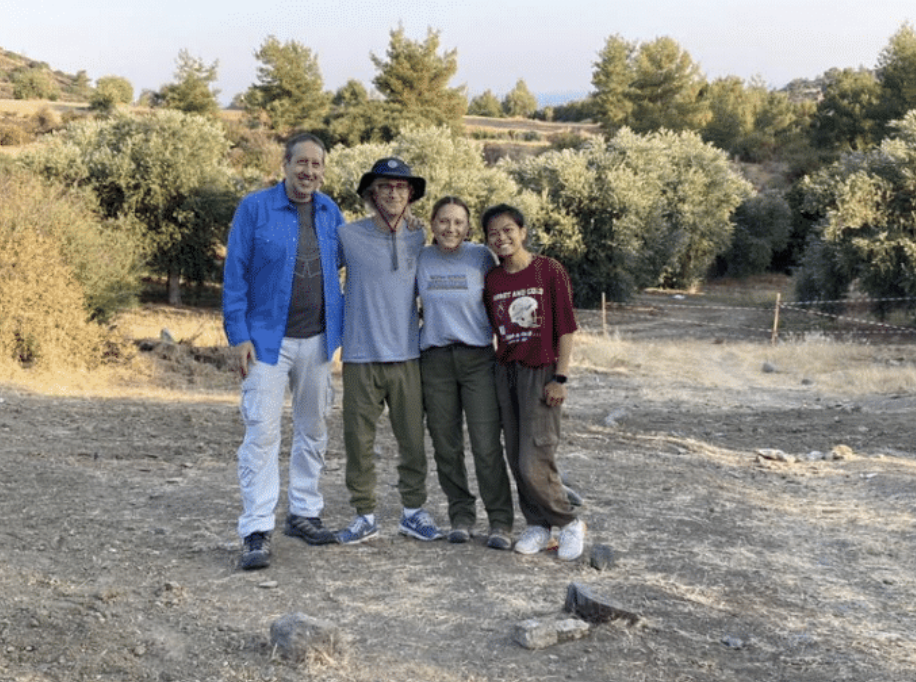
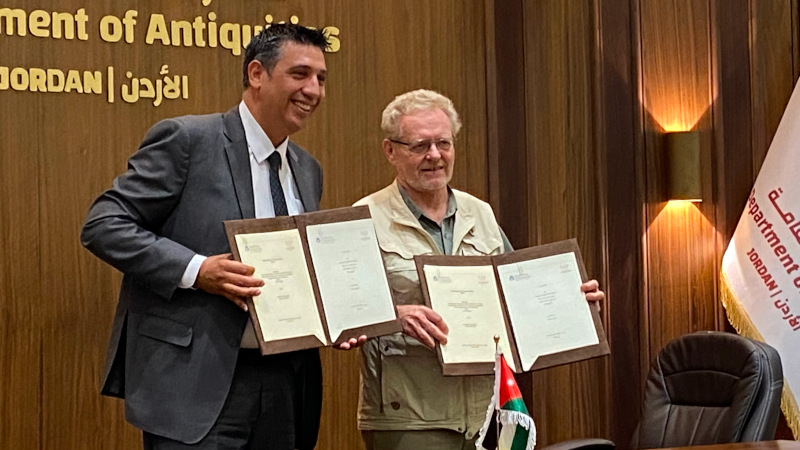
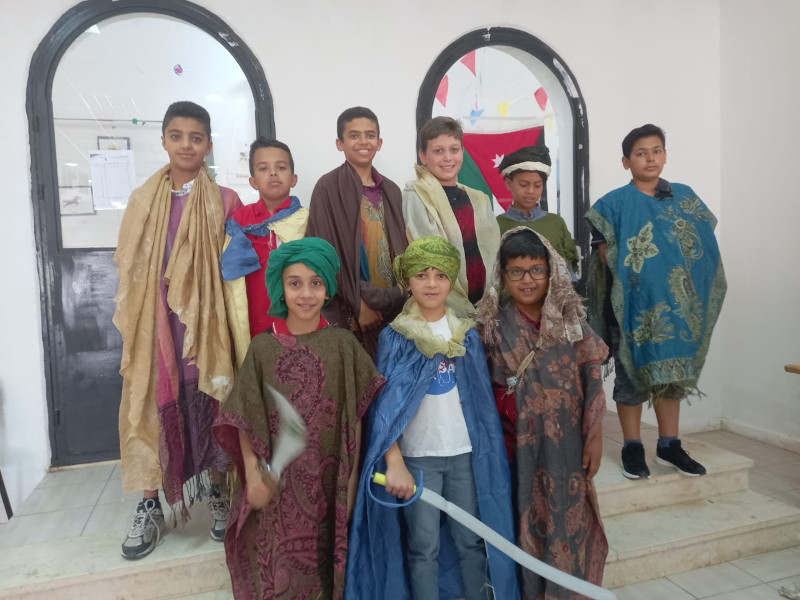
Now, though, I am so glad I went, and so glad I was able to go! I was able to acclimate relatively quickly and soon found myself appreciating the language and culture of Jordan. There were so many differences, large and small, as well as similarities, that had me thinking twice about my own cultural biases. And, once we began excavations, I was relieved to find myself up to the challenge.[/vc_wp_text][vc_row_inner][vc_column_inner][vc_single_image image=”96195″ img_size=”full” add_caption=”yes” alignment=”center” onclick=”img_link_large” img_link_target=”_blank” css=”.vc_custom_1711999521877{padding-right: 10px !important;}”][/vc_column_inner][/vc_row_inner][mk_padding_divider][vc_wp_text]I spent the first three weeks of my time in Jordan excavating in Wadi Mataha with Dr. David Johnson, and then an additional two weeks excavating on the Ad Deir Plateau with Dr. Cynthia Finlayson, under the direction of Dr. Allison Lee as crew chief. Throughout our two months in Jordan our group also had the opportunity to visit various historical and cultural sites. All of these experiences together were an invaluable learning opportunity and opened my eyes to the incredible nature and value of Middle Eastern culture. I gained an appreciation for both the ancient and modern inhabitants of this area by visiting the sites, and through daily interactions with local residents and workers.[/vc_wp_text][vc_single_image image=”96196″ img_size=”full” add_caption=”yes” alignment=”center” onclick=”img_link_large” img_link_target=”_blank” css=”.vc_custom_1711999639735{padding-right: 10px !important;}”][mk_padding_divider][vc_wp_text]My favorite aspect of archaeology is the connection it allows me to feel with the past. I have experienced this before with written reports and theory, but I was thrilled to experience it in actual hands-on fieldwork as well. While excavating, Dr. Lee would often ‘quiz’ us on what we were seeing in the soil – ashy lenses, certain types of artifacts, soil composition – and challenge us to connect those smaller details with a larger picture. These brainstorming sessions were meant as field theories and first impressions, to be checked against further research and site reports later on, but it helped me personally to see how several sherds of coarseware pottery could connect me to the lived experience of ancient Nabataeans at a specific moment in time. It also helped me to better understand how archaeologists transition from digging and uncovering artifacts to using them for analysis. These artifacts we were uncovering would help us to build a picture of the ancient civilization that had left them behind. Archaeologists are actively reconstructing ancient cultures in an attempt to better understand them – and, by extension, ourselves.

At Ad Deir, I learned the value of archaeological context. The area I was assigned to work in was a portion of the Great Circle, which was a water feature/pool on the plateau. In ancient times it would have been filled by seasonal rains; this meant that many of the artifacts we were recovering there had been washed in by water and erosion. Before beginning, I did not fully understand how context could still be derived from objects which had been so clearly taken out of theirs. Now, I know that even these types of objects have value: the different stratigraphic units (SUs) of the Great Circle provide a relative chronology, and within that the types of pottery we find (coarseware, fineware, painted wares, etc.) can help us to know what was being used when. For example, one of our SUs showed a large concentration of pottery and burned bone, along with multiple ashy lenses. This could be an indicator of a cooking and/or eating space, which would mean that the Great Circle was already out of use as a water collector at that time.

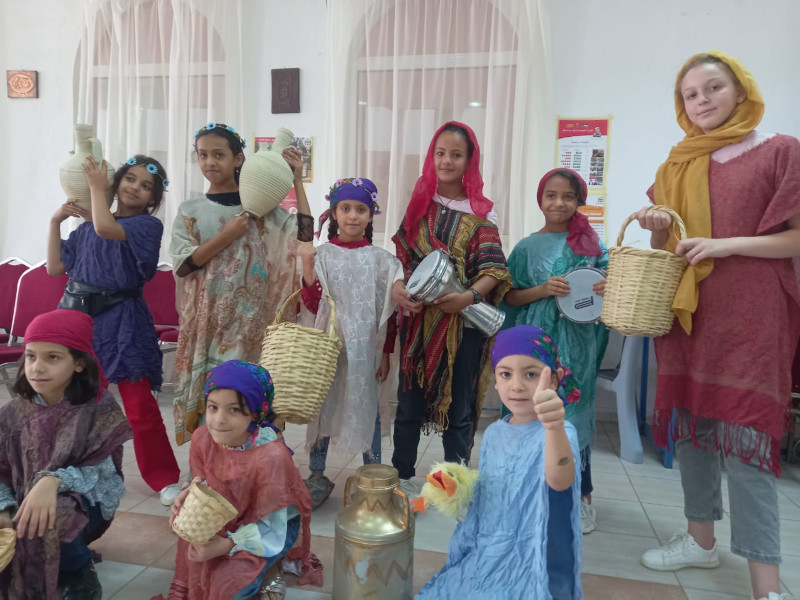
The trips we went on were also very educational. They exposed us to other parts of Nabataean culture that were either not present at either of our sites or else still under excavation. Dr. Johnson took us on a tour of Wadi Mataha that showed us the broader context of the tomb complex that we had been excavating. We saw a sprawling network of dozens of other tombs, cisterns, and water channels, most of which remain unexcavated. On a later trip to Little Petra and a High Place we saw what Nabataean worship may have looked like. These glimpses into the broader scope of Nabataean society helped me to better understand the objects and features we were finding back on site.[/vc_wp_text][vc_single_image image=”96200″ img_size=”full” add_caption=”yes” alignment=”center” onclick=”img_link_large” img_link_target=”_blank” css=”.vc_custom_1711999979902{padding-right: 10px !important;}”][mk_divider][vc_wp_text]The most exciting moment of the entire two months, for me, was finding an amethyst bead at the Wadi Mataha site. My Master’s thesis research has been on jewelry found in burial contexts, so when I saw an amethyst bead in the screen it felt almost unreal – I had spent so much time reading about objects like these and looking at small, black-and-white photos of them, that it was hard to believe I now had one right in front of me! There was an inexplicable feeling of connection as I dusted it off to reveal the carefully drilled holes on either side. Someone, a long time ago, had taken the time to take a beautiful stone and shape it into something that could be worn. A human being had created beauty for the sake of beauty (and possibly profit), and it had survived two thousand years to end up in my hand.

My experiences in Jordan are ones which I will never forget. It is a country rich in history and culture, and I hope that one day I will be able to work there as an archaeologist once again![/vc_wp_text][vc_single_image image=”96202″ img_size=”full” add_caption=”yes” alignment=”center” onclick=”img_link_large” img_link_target=”_blank” css=”.vc_custom_1712000520030{padding-right: 10px !important;}”][mk_divider][vc_wp_text]Emily Yankura is a Master’s student at Brigham Young University studying archaeology and museum studies. Her main areas of interest are the history of the ancient Near East and the portrayal of archaeology in popular media.[/vc_wp_text][mk_divider][vc_wp_text]Want to help more students and early career archaeologists get into the field? Donate to the cause today by selecting “Excavation Scholarships” as your gift purpose!

[/vc_wp_text][mk_padding_divider][/vc_column][vc_column border_color=”rgba(170,170,170,0.01)” width=”1/6″ css=”.vc_custom_1496684098866{margin-right: 5px !important;margin-bottom: 20px !important;border-right-width: 2px !important;border-bottom-width: 2px !important;padding-top: 30px !important;padding-right: 10px !important;padding-left: 10px !important;background-color: #ffffff !important;border-right-color: rgba(227,228,228,0.75) !important;border-bottom-color: rgba(227,228,228,0.75) !important;}”][vc_wp_posts title=”BROWSE THE NEWS ARCHIVE” number=”4″][/vc_column][vc_column border_color=”rgba(170,170,170,0.01)” width=”1/6″ css=”.vc_custom_1496684008271{margin-right: 10px !important;margin-bottom: 30px !important;border-right-width: 2px !important;border-bottom-width: 2px !important;padding-top: 30px !important;padding-right: 20px !important;padding-left: 20px !important;background-color: #ffffff !important;border-right-color: rgba(227,228,228,0.75) !important;border-bottom-color: rgba(227,228,228,0.75) !important;}”][vc_column_text] [/vc_column_text][/vc_column][/vc_row]
Fieldwork Report: Alice Kligerman

Something Old, Something New, Something Borrowed, Something Blue 

Alice Kligerman 

Something Old

Landing in Larnaca, Cyprus this summer was the final exhale from the inhale I took leaving in 2019. My undergraduate field school had come to an end, but I knew I was going to see Makounta – Voules again. Participating in the Makounta – Voules Archaeological Project run by Dr. Grossman and Dr. Paulette, both professors at North Carolina State University, was my first experience with archaeological excavation. As the weeks went on, I found myself falling in love with all aspects of Polis Crysochous. Coming back in 2022 felt like the most natural decision. The museums, exhibits, and sites we had visited in 2019 made their appearances this time too, but I had new questions and observations. I still had the same awe filled reaction to all the sites, however. It was almost comforting to walk through the sites flooded with memories of previous photos backdrops, the best views, and the cool spots around the island. Learning from the first time I was here, I made sure to get gelato as often as possible. The biggest full circle moment occurred when I first saw the open trenches. Being a bit more comfortable with moving fast but delicately, I was reacquainted with the architecture I uncovered and detailed in 2019. However, this time I was removing the buckets of dirt we had put back in at the end of the season on the top of the tarp. I could not merely sit back and watch as they pulled the tarp back and revealed “my” archaeology baby: an in-situ pot smash. I am beyond grateful that the directors let me continue to work on it again. As a young archaeologist, it is beyond thrilling to feel the excitement of finding something new and later being able to work intimately with it again.

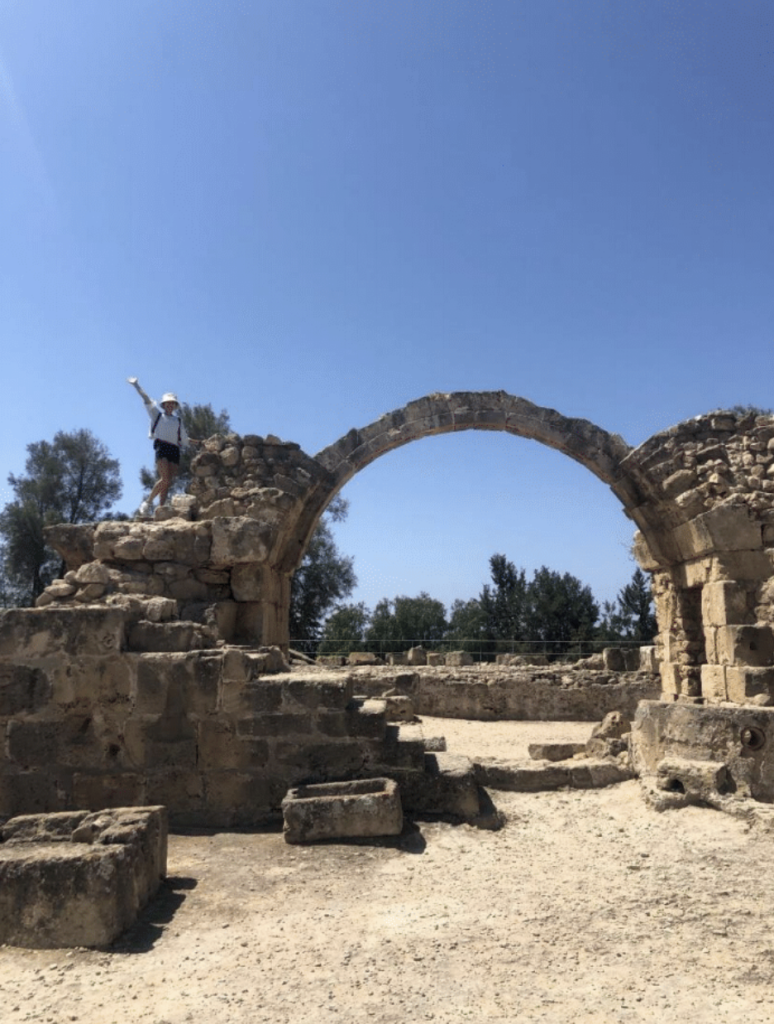
Me at Nea Paphos

Something New

While I was coming back to familiar land, I was entering a whole new chapter in my career. I was bestowed a supervisory position, rather than a field student. A big learning curve came when I had to learn how to sit back and let someone else dig ‘your’ trench, one I was strongly attached to from 2019 as it was the trench I had worked in. It was a new perspective of field notes and final reports. Additionally, I had to let new archaeologists do the tasks that were my favorite (i.e. balk walk cleaning, articulating, and detailing). Being confronted with this invisible expectation I had, that field excavation roles would be the same as 2019, was something I would never have predicted to be difficult to navigate. Also, since this is a field school, I had to learn to be okay with there being accidents, mistakes, and archaeological contexts fudged on accident. These new perspectives on leading a dig only added to the knowledge and experience basket this summer.

Me and my trenchmates! (left to right) Trench supervisor Eric, Students Shane and Olivia, and me!

Something Borrowed

This year, one of my main emphases was gathering background research for my upcoming master’s thesis. This included traveling around the island to find people to talk to, specific documentation, and other minutia of research. Additionally, some days in the field I had to step out to make sure I was writing and reading. I am very luck to have gotten to know, very well, the directors of the field school. Dr. Grossman and Dr. Paulette are from my undergraduate institution of North Carolina State University (Go Pack!). I owe my love of anthropology and drive for field excavation to these two. Simultaneously, Dr. McCarthy and Dr. Graham (assistant directors of MVAP and primary directors of the Prastio Mesorotsos Archaeological Expedition) are a wealth of information and kindness. What I consider borrowed here is their time, expertise, and mentorship. In addition to the sheer number of credit hours I dedicated to Dr. Grossman and Dr. Paulette, they have always been the source of advice regarding steps towards my professional career. This summer, I was watching how they ran the field school more than last. Not only did this expose me to the process of excavations, but I also listened to the methodological reasons behind specific decisions in the field. MVAP 2019 was my first archaeological field school experience, and I was more interested in excavation and hitting the beach. This year, I found it more interesting to understand more about the archaeology of the site we are excavating and history of the island, specifically in archaeological context to the site. Additionally, they directed me towards the best resources for my thesis research. They helped us get permission to go to the CAARI library, and I gathered a wealth of information. Starting my master’s thesis has been infinitely helped because of the archaeological knowledge I was gaining from them. I consider this borrowed because I will always have the intention to return the favor by learning and using what they taught me in my future as an archaeologist.

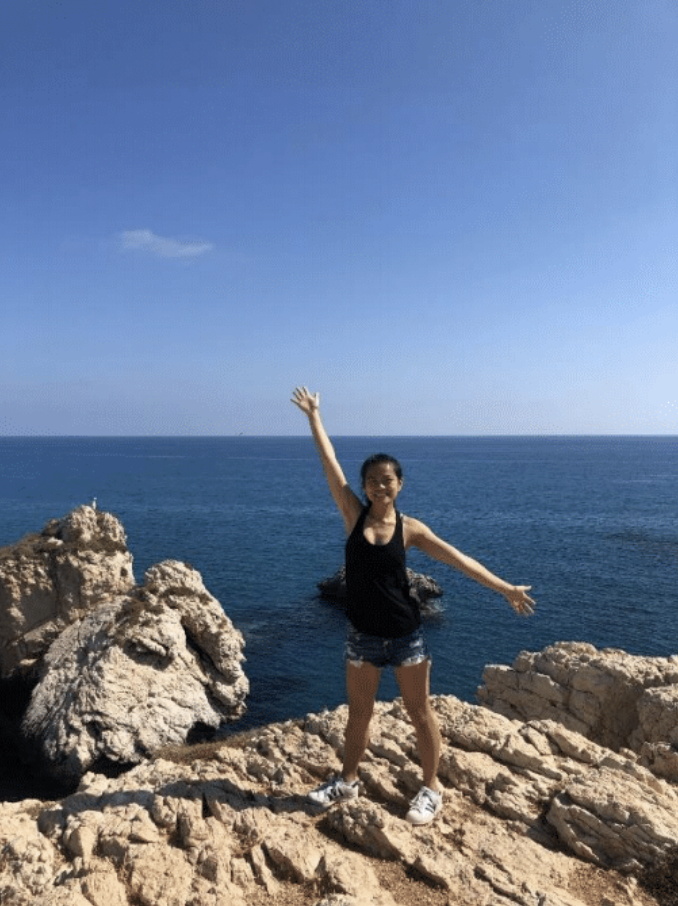
Alice Kligerman on top of Aphrodite's Rock, Cyprus.

Something Blue

Now let’s not forget . . . the site is located on Cyprus, an island in the Mediterranean. Aside from the work that went into the archaeological aspect of this trip, I was fully intending on enjoying the island while I could. Trips to the beach were a must. Many times, I would end up doing my work in settings near the water for the pure relaxation. Fridays were field trip days and, on top of seeing the sites around the island and learning about their significance, there was always a beach stop before heading home. Being reacquainted with the clear, blue gradient waters of the Mediterranean was some of my favorite moments from the trip. I swam to different parts of the beaches than last time, even adventuring into the water-carved caves of Aphrodite’s Rock. I felt like I could breathe clearer than above water while swimming. In conjunction with the blue of the sea, there was the clear blue of the sky. There were a few days of overcast, but the blue sky was present for most of the day, creating an almost ‘light’ feeling. The weather on the island throughout this summer, specifically in the area of Polis Crysochous, was ideal for both fieldwork and leisure.

My summer was filled with new and old experiences in the beloved location of Polis Crysochous, Cyprus. After a COVID-19 break of 2 summer excavations, I was finally able to witness excavation continuity. Seeing the opening of the trenches was very exciting, and the closing of the trenches just as heartbreaking. I was also researching for my thesis, so I was gaining more knowledge about the island’s pre-history, culture, and social dynamics throughout the years. Thus, while I was prepared for there to be new experiences, and expected there to be, I would never have predicted what type. While not in a nuptial setting, I believe this popular saying was appropriate when describing the moving parts of the summer and the many memories made.

Very pixelated, but taken from the top of Aphrodite's Rock to us below

Alice Kligerman is a second-year master’s student at Florida State University. She received her B.A. in Anthropology in 2018 from North Carolina State University. Currently, she is working on her master’s thesis to defend in the spring of 2023. Her interests lie in the prehistory of Cyprus (7000 BC – ~2500 BC, specifically). She is interested in emergent complex societies and the archaeological evidence of increased social differentiation.

Instagram: @alvkh

Email: ak21y@fsu.edu

Want to help more students and early career archaeologists get into the field? Donate to the cause today by selecting “Excavation Scholarships” as your gift purpose!

FOA Webinar: Chris Rollston on January 12

FRIENDS OF ASOR WEBINARS

“Earliest Inscription Found!” Exposing Sensationalism in the Field of Ancient Inscriptions


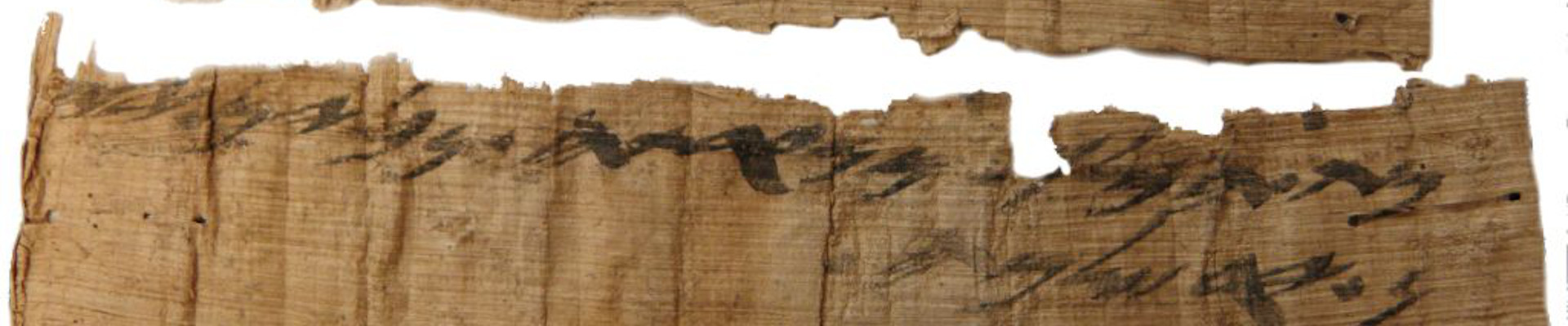
The “‘Ishamael’ Papyrus.” Photo credit: Shai Halevi/IAA via Zenger

Friends of ASOR present the next webinar in our monthly series on January 12, 2023, at 6:00pm EST, featuring Prof. Christopher Rollston and moderated by Prof. Seth Sanders. It has become commonplace during recent times for some scholar to make grandiose claims about an ancient inscription, or an inscription that is claimed to be “ancient” (in the case of modern forgeries which appear on the antiquities market). Such inscriptions (from excavations or from the market) will often be touted as referring to a famous king, a great prophet, or to hail from the city of Jerusalem, or even from the Temple in Jerusalem. In addition, such inscriptions will sometimes be asserted to be “the oldest,” “the first,” or “the most significant.” This lecture will focus on several such inscriptions, including “the ‘Ishamael’ Papyrus,” the recently announced “Hezekiah Stone Inscription,” the “Mount Ebal Curse Inscription,” the “Isaiah Bulla,” and the “Jerusalem Papyrus.” This lecture will call for a healthy dose of realism and caution with regard to all such things.

Join Prof. Rollston as he exposes the truth behind some of the most interesting claims of authenticity of ancient text in the modern world. The webinar will conclude with a live Q&A session moderated by Prof. Seth Sanders (University of California, Davis).

Christopher Rollston is Professor of Northwest Semitic Languages and Literatures at George Washington University (Washington, DC), where he is also Chair of the Department of Classical and Near Eastern Languages and Civilizations. He holds an MA and Ph.D. from Johns Hopkins University, and is a member of Phi Beta Kappa honor society. He publishes widely in the fields of Biblical and Ancient Near Eastern Studies, especially the field of ancient inscriptions (in Hebrew, Aramaic, Phoenician, Greek, Akkadian), and he often serves as a “debunker” of sensational claims regarding inscriptions. He has held two National Endowment for the Humanities Fellowships (one in Israel and one in Jordan).

For six years, he served as the co-editor of the Bulletin of the American Society of Overseas Research, and for twenty years, he served as the editor of MAARAV, a journal of Northwest Semitic languages and literatures. Several years ago, his volume entitled Writing and Literacy in the World of Ancient Israel: Epigraphic Evidence from the Iron Age was selected for the ASOR Frank Moore Cross Prize in Epigraphy. More recently, he has published two edited volumes, Enemies and Friends of the State: Ancient Prophecy in Context (Eisenbrauns, 2018), and Biblical and Ancient Near Eastern Studies in Honor of P. Kyle McCarter Jr. (Society of Biblical Literature, 2022). Chris was also a 2020 recipient of the ASOR Membership Service Award.

This webinar will be recorded and all paid registrants will be sent a link to view the recording.

ASOR Sustaining Members: $0 | ASOR Members: $6 | Public: $12
Season Pass: ASOR Sustaining Members: $0 | ASOR Members: $75 | Public: $150
Buy one here!

To receive your ASOR member discount, log into the online store. If you are new to ASOR, please click on the “New Visitor Registration” link to register your e-mail address and choose a password for our online store. Once logged in, navigate to “Meeting and Event Registration” to register for the webinar and pay the fee. Each paid registrant will receive a confirmation e-mail when you pay for the webinar. If you do not receive this e-mail, then you are not registered. Please e-mail membership@asor.org with any questions or issues with registering.

You will be e-mailed the Zoom Webinar link in the week prior to the lecture on January 12, 2023. If you do not receive the link by the close of business on the Tuesday before the webinar, please e-mail membership@asor.org immediately. This webinar will be recorded and all paid registrants will be sent a link to view the recording.

All proceeds from this webinar are used to fund scholarships for members as well as increasing ASOR’s online resources, which are free to the public.


READY FOR A WEBINAR SEASON PASS?

Buy a season pass for all the webinars* of the 2022-2023 FOA Webinar Season! 1) You will automatically receive the Zoom link for each webinar so no need to register each time. 2) You will also receive the recording of each webinar automatically after the event.

If you have missed webinars earlier in the season and still want to buy the pass, you will receive the links to the recordings of the webinars you missed in your automatic confirmation email after you buy the pass.

*Special symposiums may be excluded from the season pass price.

No more registering for a year if you buy your pass today!

Pricing:

Members: $75.00
Non-Members: $150.00
ASOR Sustaining Members: $0 (automatic registration for each webinar)
Not a member yet? Click here to join as a member and receive the 50% off a season pass!


Log into our online store to purchase the season pass for 2022-2023. If you are new to ASOR and do not have a record in our store yet, click here to register. After you login, navigate to the left to “Meeting and Event Registration.” Please e-mail membership@asor.org if you have any questions or issues.

WHY SPONSOR A WEBINAR?

Several levels of support from $50-$1,000 are available. Proceeds go towards membership scholarships and towards increasing ASOR’s virtual resources. Each sponsorship is tax-deductible and you can give your friends free registrations to a webinar!

Bronze Level ($50): up to 2 guest registrations
Silver Level ($100): up to 5 guest registrations
Gold Level ($500): up to 20 guest registrations
Platinum Level ($1,000): up to 50 guest registrations

After you sign up for a sponsorship online or over the phone, email the names and email addresses of your guests to Felice Herman at membership@asor.org, who will send your guests a confirmation and the Zoom link before the webinar.

WANT TO SAVE $6.00 ON THE NEXT WEBINAR?

Join ASOR as a member! Click here for more details about discounts for events and other benefits of membership. Memberships start at $40 for the year as an Associate Member.

Not ready to join yet? Become a Friend of ASOR for FREE!

Click here for more details about our online resources.

PAST WEBINARS

You can now purchase the link to the recording of any webinar. You can also purchase the bundle packages of all webinars from the 2020-2022 seasons. Please e-mail membership@asor.org for purchase details.

To see a printable pdf of the webinar titles from the 2020-2021 season, please click here. To see a printable pdf of the webinar titles from the 2021-2022 season, please click here.

Pricing:

Members: $6.00 per recording
Non-Members: $12.00 per recording
Bundle of 2020-2021 Webinars: $75.00
Bundle of 2021-2022 Webinars: $75.00
Bundle of 2020-2022 Webinars: $125.00

2021-2022 Season

A World at War: Protecting Cultural Heritage in Times of Conflict
Patty Gerstenblith (DePaul University), Lisa Ackerman (Columbus Citizens Foundation), Andrew Cohen (Government Professional and Cultural Heritage Expert) | May 12, 2022

Preserving Cultural Heritage in Hisban and Umm al-Jimal, Jordan
Øystein LaBianca (Andrews University), Elizabeth Osinga (Umm al-Jimal Archaeological Project), Darrell Rohl (Calvin University) | April 24, 2022

Back to the Field: Recent Discoveries & Summer Plans 2022
Lorenzo d’Alfonso (ISAW), Kathryn Grossman (NC State University), James R. Strange (Samford University) | April 3, 2022

Uncovering What is Nubian Beneath the Veneer of Egyptianness: Excavating the Archives
Debora Heard (University of Chicago) | March 20, 2022

Where Are They Now?: A Preview of 2022 ASOR-Affiliated Fieldwork Projects
Michael Given (University of Glasgow), Xenia-Paula Kyriakou (Florida Gulf Coast University), Stephen Batiuk (University of Toronto), Monique Roddy (Walla Walla University), Kent Bramlett (La Sierra University), Friedbert Ninow (La Sierra University), and Michael Hoff (University of Nebraska-Lincoln) | March 8, 2022

Excavations at Tel Gezer: A Personal Story
Sam Wolff (Tel Gezer Laboratory) | February 20, 2022

Tel Rehov: A Major Bronze and Iron Age City in the Jordan Valley
Amihai Mazar (Hebrew University of Jerusalem), Nava Panitz-Cohen ( Hebrew University of Jerusalem), Nota Kourou (Athens University), Naama Yahalom-Mack (Hebrew University of Jerusalem), Robert Mullins (Azusa Pacific University) | February 10, 2022

The Not-So-Innocents Abroad: The Beginnings of American Biblical Archaeology
Rachel Hallote (Samford University) | January 20, 2022

Synagogues as Jesus Knew Them
James R. Strange (Samford University) | December 2, 2021

Under Jerusalem: The Buried History of the World’s Most Contested City
Andrew Lawler | November 4, 2021

Jesus and Jerusalem on TV: How Do Bible Documentaries Get Made?
Robert Cargill (University of Iowa) | October 17, 2021

Digging the Divine?: Judahite Pillar Figurines and the Archaeology of Israelite Religion
Erin Darby (University of Tennessee) | October 7, 2021

David, Solomon, and Rehoboam’s Kingdom—The Archaeological Evidence
Yosef Garfinkel (Hebrew University of Jerusalem) | September 19, 2021

From Standing Stones to Sacred Emptiness: Textual and Visual Portrayals of Israel’s God
Theodore Lewis (Johns Hopkins University) | August 29, 2021

2020-2021 Season

Making May Matter: Webinarathon to Endow Diversity
Multiple Speakers | May 21-23, 2021

Archaeogaming: Why Video Games Deserve Their Own Archaeology
Tine Rassalle (University of North Carolina at Chapel Hill), Shannon Martino (Morton College), Matthew Winter (University of Arizona), Michael Zimmerman (Rhode Island) | April 18, 2021

How the Bible Became a Book
William Schniedewind (UCLA) | March 21, 2021

The Mysteries of Mithras in Caesarea: Exploring the Cult’s Rites and Remains
Jane DeRose Evans (Temple University), Alexandra Ratzlaff (Brandeis University) | March 11, 2021

Archaeology and the Hidden Religious Culture of Israelite Women
Carol Meyers (Duke University) | February 21, 2021

Meet the Directors—Fundraiser to Support ASOR’s Affiliated Overseas Research Centers
Matthew J. Adams (AIAR), Pearce Paul Creasman (ACOR), Lindy Crewe (CAARI) | February 11, 2021

Early Synagogues, Jesus, and Galilee—A Jewish Perspective
Eric Meyers (Duke University) | December 13, 2020

Home Sweet Home: Ancient Israelite Households in Context
Cynthia Shafer-Elliott (William Jessup University) | October 18, 2020

Priestesses in the Days of Solomon and Ahab
Susan Ackerman (Dartmouth College) | September 13, 2020

Digging Deeper: How Archaeology Works
Eric H. Cline (The George Washington University) | August 9, 2020

Table of Contents for NEA 85.4 (2022)

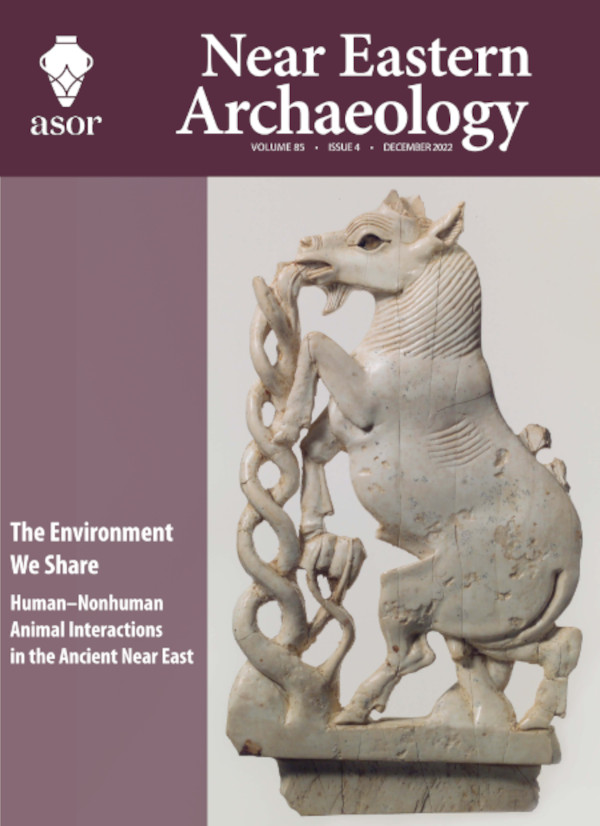
Table of Contents for Near Eastern Archaeology 85.4 (December 2022)

You can receive NEA (and other ASOR publications) through an ASOR Membership.
Please e-mail the Membership office if you have any questions.

Pp. 244–247: “The Environment We Share: Human–Nonhuman Animal Interactions in the Ancient Near East,” by Romina Della Casa and Lidar Sapir-Hen

The studies in this volume display the complexity of human and animal bonds, contributing to the deconstruction of the dichotomy expressed in Western academic traditions between humans and nature. With the goal of contributing to current interdisciplinary debates about the interactions between humans and other animals through the lens of the ancient Near East, this issue opens a space for interdisciplinary collaboration between scholars who explore how ancient societies interacted with their environs, how they experienced and perceived other animals, and how we can grasp a better understanding of the impact other animals had on human societies.

ASOR Members with online access: navigate to the token link email sent to you (search for “token link” in inbox) before attempting to read this article. Once you have activated your member token, click here to access the above article on The University of Chicago Press Journals’ website.

Pp. 248–257: “Flattening the Wild in the Ancient Near East,” by Benjamin S. Arbuckle, Christine Mikeska, and Theo McLeod Kassebaum

In this article the authors explore the impact of wild-domestic dualisms on how wild animals are conceived and framed in the zooarchaeology of the ancient Near East. They argue that this dominant framework flattens the wild into an artificially homogenous entity and funnels scholarly engagement with wild animals into a narrow range of topics. They explore examples from the archaeozoological literature as well as ancient texts that suggest that rather than being peripheral and exotic participants, wild animals were ubiquitous and important contributors to hybrid, multispecies Bronze Age societies. They further suggest a more robust zooarchaeology of the wild through application of flat ontologies and related decentering frameworks.

ASOR Members with online access: navigate to the token link email sent to you search for “token link” in inbox) before attempting to read this article. Once you have activated your member token, click here to access the above article on The University of Chicago Press Journals’ website.

Pp. 258–269: “Encountering Ancient Environments: The Impact of Nonhuman Animals on Populations of Hittite Anatolia,” by Romina Della Casa

This article surveys different textual genres from Hittite tablet collections of Hattusa (Boğazköy/Boğazkale) and Tapikka (Maşat Höyük) with the goal of exploring specific instances where one can detect human responses, strategies, and adaptations in the face of the active presence and behavior of ancient nonhuman animals (henceforth animals). The examples under study explore the animal side of human-animal encounters and involve locusts, wolves, pigs, dogs, donkeys, horses, sheep, and cattle. They reveal the existence of at least two main interrelated modes through which these animals impacted human behavior. One exhibits animal competition with humans for food, leading ancient Anatolian populations to devise strategies to minimize their impact on nearby resources. The other reflects that the behavior of certain animals encouraged practices of containment, regulation, mobility, and care, depicting, overall, key features of how animals shaped the daily life of ancient Anatolia’s human inhabitants.

ASOR Members with online access: navigate to the token link email sent to you (search for “token link” in inbox) before attempting to read this article. Once you have activated your member token, click here to access the above article on The University of Chicago Press Journals’ website.

Pp. 270–278: “Ancient Mesopotamian Animal Omens: Structure and Patterns of Meaning,” by Nicla De Zorzi

The article addresses a Babylonian collection of omens regarding animals and their behavior. These omens are part of a large series of terrestrial omens that is known as Šumma ālu (ina mēlê šakin) “If a city (is set on a height).” The main argument of this article is that these animal omens should not be seen as straightforward reflections of actual animal behavior, but are conceived as a culturally constructed bestiarium, that is, as a mirror of human society. This will be demonstrated through a series of case studies.

ASOR Members with online access: navigate to the token link email sent to you (search for “token link” in inbox) before attempting to read this article. Once you have activated your member token, click here to access the above article on The University of Chicago Press Journals’ website.

Pp. 280–287: “The Merdītu-Offerings: Animal Sacrifice in First-Millennium Babylonian Religious Contexts,” by Rocío Da Riva

Some Late Babylonian texts containing evidence on temple ceremonies refer to a sacrificial offering called merdītu, which was performed on special occasions in the sanctuaries of Uruk and Babylon. The merdītu was a libation of sorts poured directly onto the decapitated head of a sheep and onto the heart extracted from an ox or bull. Although the texts are not very informative, they contain some interesting data on the internal structure of the temples, the ritualization of space, and on the cultic performers involved in the ceremonies.

ASOR Members with online access: navigate to the token link email sent to you (search for “token link” in inbox) before attempting to read this article. Once you have activated your member token, click here to access the above article on The University of Chicago Press Journals’ website.

Pp. 288–295: “Always a Hunter: The Role of Wild Animals during the Late Bronze and Iron Ages of the Southern Levant,” by Lidar Sapir-Hen

By the Late Bronze and Iron Ages in the southern Levant, livestock animals were the dominant meat source, and wild animals constituted a very small supplementary proportion of economy. As a result, wild animals often receive limited attention in studies of these periods. This article aims to examine the role of wild animals based on a large body of published zooarchaeological data. By studying temporal changes in species presence and frequencies, the study tracks the local diminution in several wild species; reveals a clear preference for hunting deer in sites of the Iron Ages, regardless of changes in local landscape; and shows that various other wild animals can be correlated to assemblages that are identified with Egyptian presence. Based on these observations and with correlation to historic events and cultural changes, wild animals’ roles in the economic and symbolic world of past societies are discussed.

ASOR Members with online access: navigate to the token link email sent to you (search for “token link” in inbox) before attempting to read this article. Once you have activated your member token, click here to access the above article on The University of Chicago Press Journals’ website.

Pp. 296–305: “Human–Animal Encounters on Early Iron Age Stamp Seals,” by Ido Koch

Human-animal relations are manifested in encounters that range from confrontation and subjugation to harmonious coexistence. For thousands of years, these encounters have triggered diverse associations that at times have been materialized into visual languages that, despite spatial and chronological particularities, share scenes and protagonists. This essay deals with the depictions of these animals and scenes on early Iron Age stamp seals from the southern Levant. It provides an overview of three typical scenes: figure atop an animal, figure confronting an animal, and figure alongside an animal. Four animals are depicted: the lion, the bull, the ibex, and the ostrich. At the same time, the Iron Age was the last phase of such iconography after millennia of development. During the Iron Age IIB, additional images became popular and widespread, and the animal encounters lost their importance on the local stamp seals.

ASOR Members with online access: navigate to the token link email sent to you (search for “token link” in inbox) before attempting to read this article. Once you have activated your member token, click here to access the above article on The University of Chicago Press Journals’ website.

Pp. 306–308: “She Who Wrote: Enheduanna and Women of Mesopotamia ca. 3400–2000 BCE,” by Stephanie Lynn Budin

The author reviews the exhibit “She Who Wrote: Enheduanna and Women of Mesopotamia” which is on display at the Morgan Library and Museum in New York City from October 2022 to February 2023.

ASOR Members with online access: navigate to the token link email sent to you (search for “token link” in inbox) before attempting to read this article. Once you have activated your member token, click here to access the above article on The University of Chicago Press Journals’ website.

ASOR Members with online access: navigate to the token link email sent to you before attempting to read this issue. Once you have activated your member token, click here to access the the entire issue, including book reviews, on The University of Chicago Press Journals’ website.

2022 Annual Meeting Recap

ASOR 2022 Annual Meeting Recap

In-Person Component | Boston, November 16-19
Virtual Component | Online, October 19-23

The 2022 ASOR Annual Meeting, once again, had both virtual and in-person components.  The virtual component was held online, October 19-23, and the in-person component took place at the Boston Park Plaza, November 16-19.

More than 1,000 people registered for the meeting and more than 600 individuals gave presentations on the 2022 Academic Program. Presenters represented more than 40 countries and 6 continents.

Read on for a summary of each component and click here to see 2022 Honors & Awards that were announced at the Members’ Meeting on November 18th in Boston. If you attended the meeting, please provide important feedback by completing the 2022 Annual Meeting Evaluation.

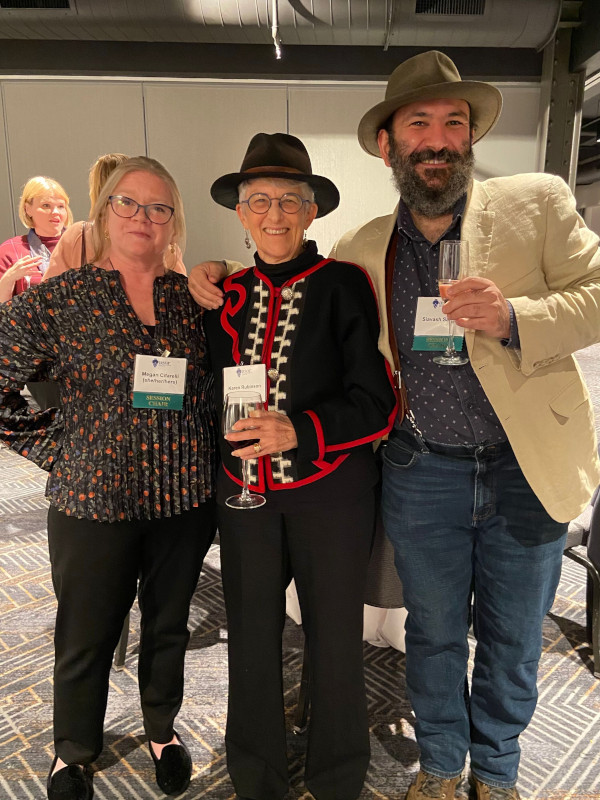
Megan Cifarelli, Karen Rubinson, and Siavash Samei at the Rubinson Celebration. Not for use without permission.

Virtual Component: Online, October 19-23

Nearly 300 presentations were given as part of ASOR’s virtual component in 65 sessions over five days. Attendees viewed pre-recorded paper presentations ahead of the meeting and engaged in discussion sessions online with the presenters. All of the recorded content from the virtual component of the 2022 ASOR Annual Meeting will be available to registered attendees on ASOR’s Virtual Meeting Platform through June 2023.

In-Person Component: Boston, November 16-19

ASOR welcomed nearly 900 attendees in-person at the Boston Park Plaza. Dr. Solange Ashby opened the meeting on November 16 with her Plenary Address titled, Women of the Sacred South: Nubian Women in the temple and Upon the Throne. The presentation generated a lot of discussion and enthusiasm which continued throughout the evening at the Welcome Reception.

The Academic Program was especially robust with 105 sessions and workshops over three days. More than 500 papers, posters, and workshop presentations were delivered in Boston. ASOR CHI projects brought speakers from Tunisia and Libya to Boston to present in multiple sessions, thanks to State Department Embassy grants, and many participants were able to attend the meeting for the first time thanks to travel fellowships funded by generous donations from our members.

Attendees in Boston enjoyed several receptions and special functions during the meeting, such as a reception hosted by CAARI, the Early Career Scholars Reception, and the Women’s Mentoring Lunch was held again for the first time since before the pandemic. The Harvard Museum of the Ancient Near East (HMANE) hosted a private reception for ASOR attendees on Saturday evening after the sessions ended.

ASOR would like to thank everyone who participated and contributed to the success of the 2022 Annual Meeting. We hope that you enjoyed the meeting and will continue to enjoy the photos and the recorded content from the virtual component which will remain online through June 2023.

Please save the dates for ASOR’s 2023 Annual Meeting with a virtual component (October 18-21) and the in-person meeting at the Hilton Chicago (November 15-18). The Call for Member-Organized Session & Workshop Proposals will be open from December 15, 2022 – January 15, 2023.

2023 Annual Meeting Recap

ASOR 2023 Annual Meeting Recap

Chicago and Hybrid | November 15-18

ASOR held its first-ever hybrid format meeting with both in-person and virtual participation last month, November 15-18, at the Hilton Chicago and online.

More than 1,000 people were registered for the meeting with nearly 800 attending in Chicago. There was an increase in virtual attendance leading up to the Annual Meeting as current conditions in the Middle East impacted many registrants and program participants.

During the opening remarks, ASOR’s Executive Director, Andrew Vaughn, and ASOR President, Sharon Herbert, both mentioned the profound impact of the war in Israel and Gaza on the meeting and for our membership. The absence of many colleagues who had planned to come to Chicago was sorely felt and acknowledged.

While recognizing the challenges related to the situation in the Middle East and the hybrid logistics of the meeting, the meeting offered a way for attendees in Chicago and online to share their research and make meaningful connections. If you attended the 2023 Annual Meeting in Chicago or online, please complete the 2023 Annual Meeting Evaluation to provide valuable feedback that will be considered as we plan for 2024 and beyond.

Read on for a summary of the 2023 Annual Meeting, including features from the academic program, the business schedule, special events, and the 2023 ASOR Honors & Awards.

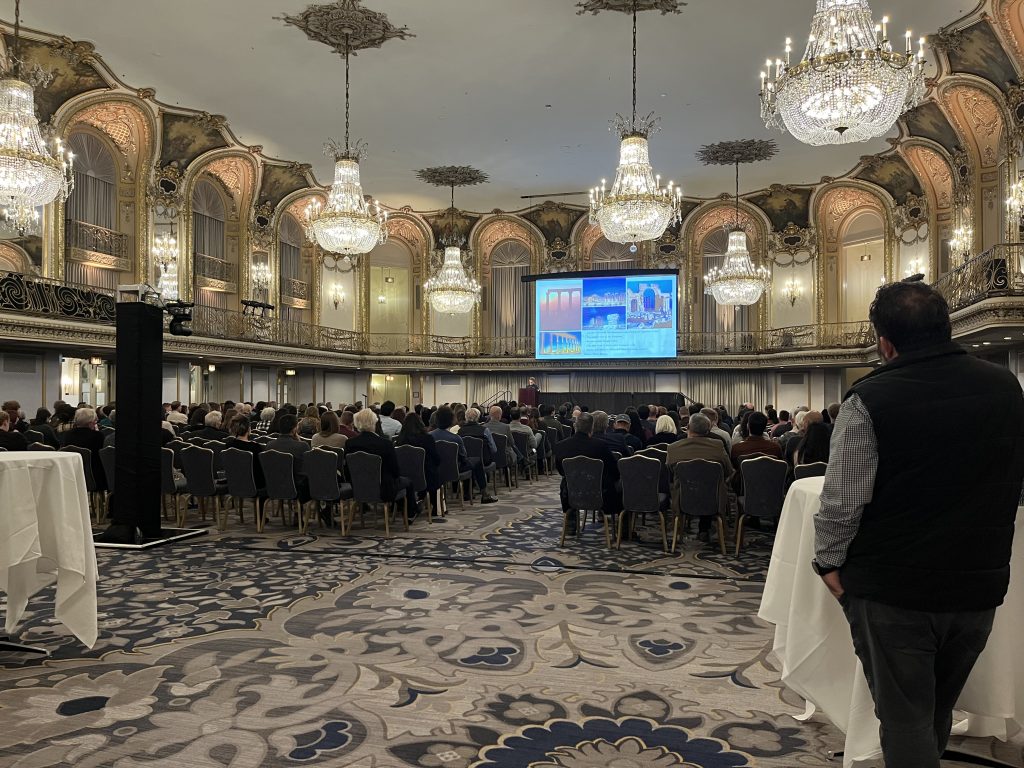
Attendees gathered to listen to Dr. Rubina Raja's Plenary Address to open up the 2023 Annual Meeting. Not for use without permission.

The 2023 hybrid ASOR Annual Meeting opened on Wednesday, November 15, with the Plenary Address by Dr. Rubina Raja (Aarhus University) titled, Death by Data? Or What Has a Decade of Research on Palmyrene Funerary Sculpture Taught Us about the Ancient World? The presentation generated a lot of discussion and enthusiasm which continued throughout the evening at the Welcome Reception.

The sessions and workshops of the academic program took place Thursday-Saturday, November 16-18, with presenters representing 35 countries and 6 continents. More than 500 presentations were given in Chicago and online as part of 112 sessions and workshops. The Poster Session featured 34 projects shared in Chicago, as well a virtual poster gallery. The recorded content of the Annual Meeting is being edited and will be available to registered attendees via the ASOR Hybrid Meeting Platform from mid-December through July of 2024.

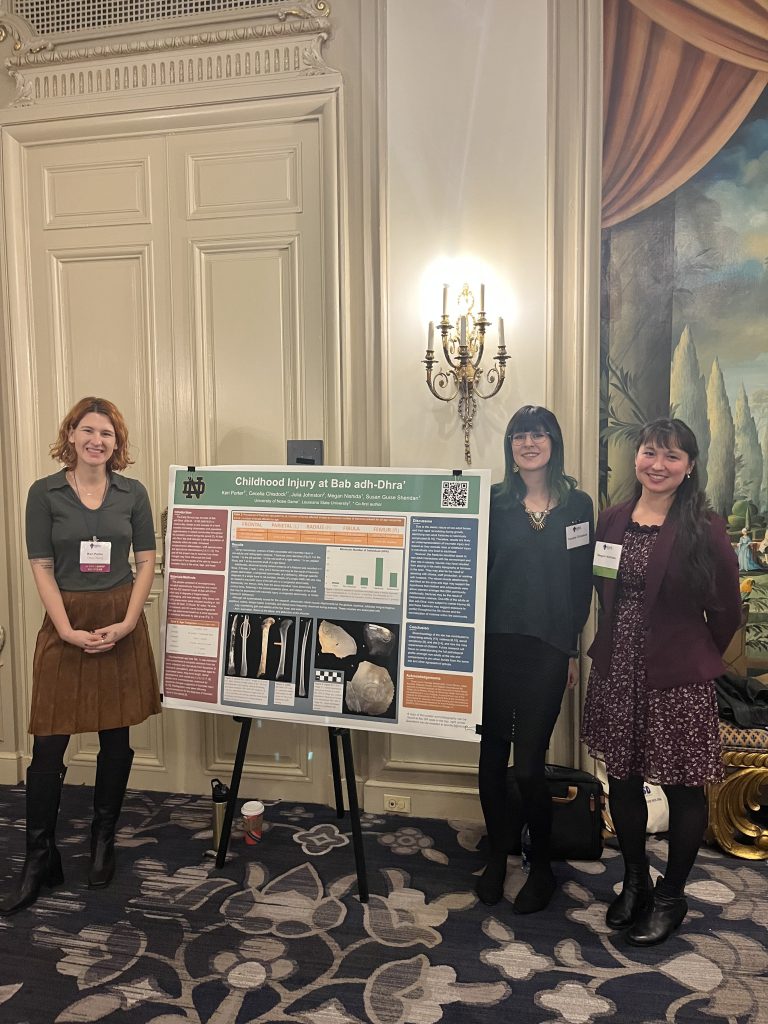
From left; Keri Porter, Cecilia Chisdock, and Megan Nishida present their poster at the Poster Session. Not for use without permission.

Attendees in Chicago enjoyed several special events at the Hilton Chicago and at local museums. Dr. William Parkinson gave a lecture at the Field Museum and offered a walk-through of the new exhibit, First Kings of Europe. Events at the Hilton Chicago included the Women’s Mentoring Lunch, the Early Career Scholars brown-bag lunch panel, and Roundtable Discussions were offered for the first time at ASOR. Receptions were hosted during the event by ASOR, UCLA, and CAARI, as well a celebration in honor of Thomas E. Levy’s festschrift. The Institute for the Study of Ancient Cultures (ISAC) Museum at the University of Chicago hosted a private reception for ASOR attendees on Saturday evening after the meeting ended.

ASOR would like to thank everyone who participated and contributed to the success of the 2023 Annual Meeting. Please enjoy some of the memorable moments captured in the photo album below, and we hope you will continue to enjoy the recorded content from the meeting through June 2024.

Please mark your calendars for ASOR’s 2024 Hybrid Annual Meeting at the Hilton Boston Park Plaza and online, November 20–23. The Call for Member-Organized Session & Workshop proposals will be open from December 15, 2023–January 15, 2024.

FOA Webinar: The Transformation of Ancient Caesarea on Dec. 15

FRIENDS OF ASOR WEBINAR

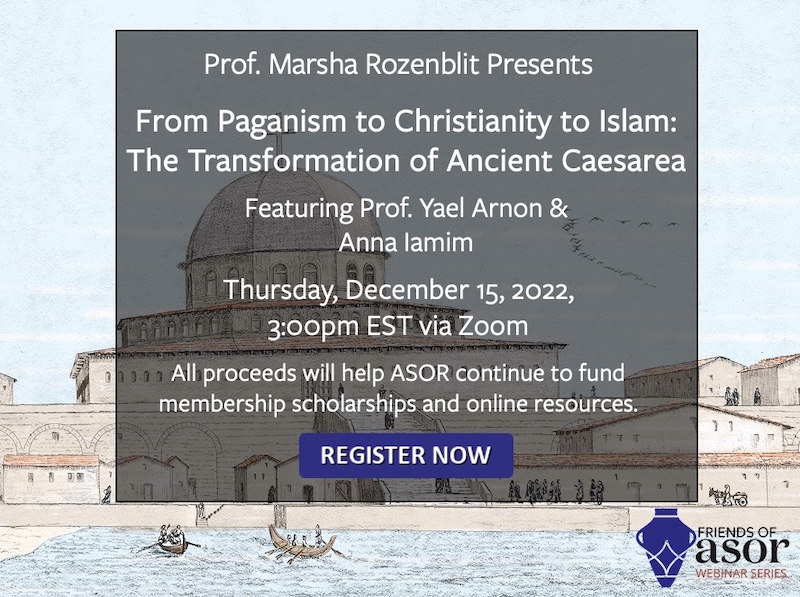
From Paganism to Christianity to Islam: The Transformation of Ancient Caesarea

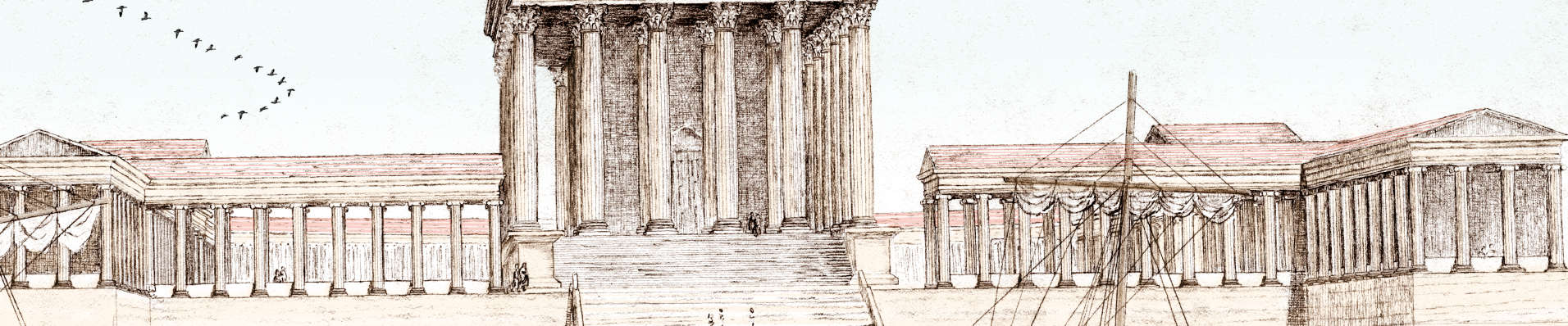
Friends of ASOR presents a webinar on December 15, 2022 from 3:00pm to 4:30pm EDT, “From Paganism to Christianity to Islam: The Transformation of Ancient Caesarea,” featuring Prof. Marsha Rozenblit, Prof. Yael Arnon, and Anna Iamim. This webinar will trace the archaeological evidence for the history of Caesarea Maritima, built by King Herod the Great of Judaea in the late first century BCE on the coast of what is today Israel. At Caesarea, Herod built a splendid city, replete with a theater, hippodrome, palace, aqueduct, city streets, sewers, and especially a magnificent temple dedicated to the pagan gods Roma and Augustus. This temple was located on a specially constructed “hill,” the so-called Temple Platform, and it served as a “harbor temple,” visible to ships entering the artificial harbor constructed by Herod and his engineers. Caesarea flourished as the capital of Roman Palestine and especially in the so-called “Byzantine” period after the Christianization of the Roman Empire in the fourth century CE, reaching its largest extent in size and population in the sixth century CE. The city continued to thrive in a somewhat smaller form after the Muslim conquest in 640 CE and also during the Crusader occupation in the twelfth and thirteenth centuries, but finally ceased to function with the defeat of the Crusaders in 1265.


A lucky winner will receive a free copy of this book!

Archaeologist Kenneth Holum, a professor of Ancient History at the University of Maryland, who passed away in 2017, led the excavations between 1989 and 2003 on the Temple Platform at Caesarea as part of the Combined Caesarea Expeditions with the late Avner Raban of Haifa University leading the excavations of the harbor. This webinar will focus on the archaeological findings on the Temple Platform from the Roman and Byzantine periods, including discoveries about the pagan temple, its willful destruction by the Christian authorities of Caesarea around the year 400 CE, and the construction on the same spot around 500 CE of a large, beautiful, octagonal Christian church, which served as a “harbor church,” visible to all boats that entered the still active harbor in the sixth and seventh centuries. These findings have been meticulously described in Caesarea Maritima: Excavations in the Old City 1989-2003 Conducted by the University of Maryland and the University of Haifa, Final Reports, Volume 1, edited by Kenneth G. Holum (ASOR, Archaeological Reports 27, 2020). Holum finished all the work on the volume before his death, and his wife, Marsha Rozenblit, the moderator of this webinar, oversaw the publication of the volume.

The webinar will consist of short presentations by Rozenblit (University of Maryland) as moderator, by Yael Arnon, the chief ceramicist at the site; and Anna Iamim, who completed all the architectural plans. Rozenblit will then moderate a discussion of the most important findings at the site. The final 20 minutes will be devoted to a live Q&A session with the audience and panelists. The event will be recorded.


ASOR Sustaining Members: $0 | ASOR Members: $6 | Public: $12

Speakers / Presenters

Marsha Rozenblit is the Harvey M. Meyerhoff Professor of Jewish History at the University of Maryland. She is a specialist in the history of the Jews in Austria-Hungary and its successor states, and she has written several books and many scholarly articles on such topics as the Jews of Vienna, the impact of World War I on the Jews, and Jewish marriage and courtship practices. She is the moderator of this session because her late husband Kenneth Holum directed the land excavations on the Temple Platform at Caesarea for many years. After his death in 2017, she oversaw the publication of the final reports from his excavations at Caesarea.

Yael Arnon is a Professor of Archaeology at Oranim College in Israel. At the beginning of her academic career, she focused on early Islamic archaeology, especially material culture. Over the years, she has expanded her studies to include artistic and architectural aspects of archaeology as well as more recent periods of history in the Islamic world in general and the Land of Israel in particular. In 2008, Arnon published a book about the material culture of the early Islamic and Crusader periods in Caesarea, and the relationship between pottery styles and coin dating (Oxford University Press). Arnon’s future research includes changes in Islamic art over time, in particular in Israel and the Galilee. For many years she worked as registrar and ceramicist at Caesarea.

Anna Iamim was a long-time friend and colleague of Ken Holum. At Caesarea, she produced the graphic field documentation, contributed chapters, and drew the architectural reconstructions on the cover of Caesarea Maritima: Excavations in the Old City 1989-2003, Final Reports, Vol. 1, edited by Kenneth G. Holum, ASOR, Archaeological Reports 27 (2020).
ASOR Sustaining Members: $0 | ASOR Members: $6 | Public: $12

To receive your ASOR member discount, log into the online store. If you are new to ASOR, please click on the “New Visitor Registration” link to register your e-mail address and choose a password for our online store. Once logged in, navigate to “Meeting and Event Registration” to register for the webinar and pay the fee. Each paid registrant will receive a confirmation e-mail when you pay for the webinar. If you do not receive this e-mail, then you are not registered. Please e-mail membership@asor.org with any questions or issues with registering.

You will be e-mailed the Zoom Webinar link in the week prior to the lecture on December 15, 2022. If you do not receive the link by the close of business on the Tuesday before the webinar, please e-mail membership@asor.org immediately. This webinar will be recorded and all paid registrants will be sent a link to view the recording.

All proceeds from this lecture are used to fund scholarships for members impacted by COVID-19 as well as increasing ASOR’s online resources, which are free to the public.

READY FOR A WEBINAR SEASON PASS?

Buy a season pass for all the webinars* of the 2022-2023 FOA Webinar Season! 1) You will automatically receive the Zoom link for each webinar so no need to register each time. 2) You will also receive the recording of each webinar automatically after the event.

If you have missed webinars earlier in the season and still want to buy the pass, you will receive the links to the recordings of the webinars you missed in your automatic confirmation email after you buy the pass.

*Special symposiums may be excluded from the season pass price.

No more registering for a year if you buy your pass today!

Pricing:

Members: $75.00
Non-Members: $150.00
ASOR Sustaining Members: $0 (automatic registration for each webinar)
Not a member yet? Click here to join as a member and receive the 50% off a season pass!


Log into our online store to purchase the season pass for 2022-2023. If you are new to ASOR and do not have a record in our store yet, click here to register. After you login, navigate to the left to “Meeting and Event Registration.” Please e-mail membership@asor.org if you have any questions or issues.

WHY SPONSOR A WEBINAR?

Several levels of support from $50-$1,000 are available. Proceeds go towards membership scholarships and towards increasing ASOR’s virtual resources. Each sponsorship is tax-deductible and you can give your friends free registrations to a webinar!

Bronze Level ($50): up to 2 guest registrations
Silver Level ($100): up to 5 guest registrations
Gold Level ($500): up to 20 guest registrations
Platinum Level ($1,000): up to 50 guest registrations

After you sign up for a sponsorship online or over the phone, email the names and email addresses of your guests to Felice Herman at membership@asor.org, who will send your guests a confirmation and the Zoom link before the webinar.


WANT TO SAVE $6.00 ON THE NEXT WEBINAR?

Join ASOR as a member! Click here for more details about discounts for events and other benefits of membership. Memberships start at $40 for the year as an Associate Member.

Not ready to join yet? Become a Friend of ASOR for FREE!

Click here for more details about our online resources.

PAST WEBINARS

You can now purchase the link to the recording of any webinar. You can also purchase the bundle packages of all webinars from the 2020-2022 seasons. Please e-mail membership@asor.org for purchase details.

To see a printable pdf of the webinar titles from the 2020-2021 season, please click here. To see a printable pdf of the webinar titles from the 2021-2022 season, please click here.

Pricing:

Members: $6.00 per recording
Non-Members: $12.00 per recording
Bundle of 2020-2021 Webinars: $75.00
Bundle of 2021-2022 Webinars: $75.00
Bundle of 2020-2022 Webinars: $125.00

2021-2022 Season

A World at War: Protecting Cultural Heritage in Times of Conflict
Patty Gerstenblith (DePaul University), Lisa Ackerman (Columbus Citizens Foundation), Andrew Cohen (Government Professional and Cultural Heritage Expert) | May 12, 2022

Preserving Cultural Heritage in Hisban and Umm al-Jimal, Jordan
Øystein LaBianca (Andrews University), Elizabeth Osinga (Umm al-Jimal Archaeological Project), Darrell Rohl (Calvin University) | April 24, 2022

Back to the Field: Recent Discoveries & Summer Plans 2022
Lorenzo d’Alfonso (ISAW), Kathryn Grossman (NC State University), James R. Strange (Samford University) | April 3, 2022

Uncovering What is Nubian Beneath the Veneer of Egyptianness: Excavating the Archives
Debora Heard (University of Chicago) | March 20, 2022

Where Are They Now?: A Preview of 2022 ASOR-Affiliated Fieldwork Projects
Michael Given (University of Glasgow), Xenia-Paula Kyriakou (Florida Gulf Coast University), Stephen Batiuk (University of Toronto), Monique Roddy (Walla Walla University), Kent Bramlett (La Sierra University), Friedbert Ninow (La Sierra University), and Michael Hoff (University of Nebraska-Lincoln) | March 8, 2022

Excavations at Tel Gezer: A Personal Story
Sam Wolff (Tel Gezer Laboratory) | February 20, 2022

Tel Rehov: A Major Bronze and Iron Age City in the Jordan Valley
Amihai Mazar (Hebrew University of Jerusalem), Nava Panitz-Cohen ( Hebrew University of Jerusalem), Nota Kourou (Athens University), Naama Yahalom-Mack (Hebrew University of Jerusalem), Robert Mullins (Azusa Pacific University) | February 10, 2022

The Not-So-Innocents Abroad: The Beginnings of American Biblical Archaeology
Rachel Hallote (Samford University) | January 20, 2022

Synagogues as Jesus Knew Them
James R. Strange (Samford University) | December 2, 2021

Under Jerusalem: The Buried History of the World’s Most Contested City
Andrew Lawler | November 4, 2021

Jesus and Jerusalem on TV: How Do Bible Documentaries Get Made?
Robert Cargill (University of Iowa) | October 17, 2021

Digging the Divine?: Judahite Pillar Figurines and the Archaeology of Israelite Religion
Erin Darby (University of Tennessee) | October 7, 2021

David, Solomon, and Rehoboam’s Kingdom—The Archaeological Evidence
Yosef Garfinkel (Hebrew University of Jerusalem) | September 19, 2021

From Standing Stones to Sacred Emptiness: Textual and Visual Portrayals of Israel’s God
Theodore Lewis (Johns Hopkins University) | August 29, 2021

2020-2021 Season

Making May Matter: Webinarathon to Endow Diversity
Multiple Speakers | May 21-23, 2021

Archaeogaming: Why Video Games Deserve Their Own Archaeology
Tine Rassalle (University of North Carolina at Chapel Hill), Shannon Martino (Morton College), Matthew Winter (University of Arizona), Michael Zimmerman (Rhode Island) | April 18, 2021

How the Bible Became a Book
William Schniedewind (UCLA) | March 21, 2021

The Mysteries of Mithras in Caesarea: Exploring the Cult’s Rites and Remains
Jane DeRose Evans (Temple University), Alexandra Ratzlaff (Brandeis University) | March 11, 2021

Archaeology and the Hidden Religious Culture of Israelite Women
Carol Meyers (Duke University) | February 21, 2021

Meet the Directors—Fundraiser to Support ASOR’s Affiliated Overseas Research Centers
Matthew J. Adams (AIAR), Pearce Paul Creasman (ACOR), Lindy Crewe (CAARI) | February 11, 2021

Early Synagogues, Jesus, and Galilee—A Jewish Perspective
Eric Meyers (Duke University) | December 13, 2020

Home Sweet Home: Ancient Israelite Households in Context
Cynthia Shafer-Elliott (William Jessup University) | October 18, 2020

Priestesses in the Days of Solomon and Ahab
Susan Ackerman (Dartmouth College) | September 13, 2020

Digging Deeper: How Archaeology Works
Eric H. Cline (The George Washington University) | August 9, 2020

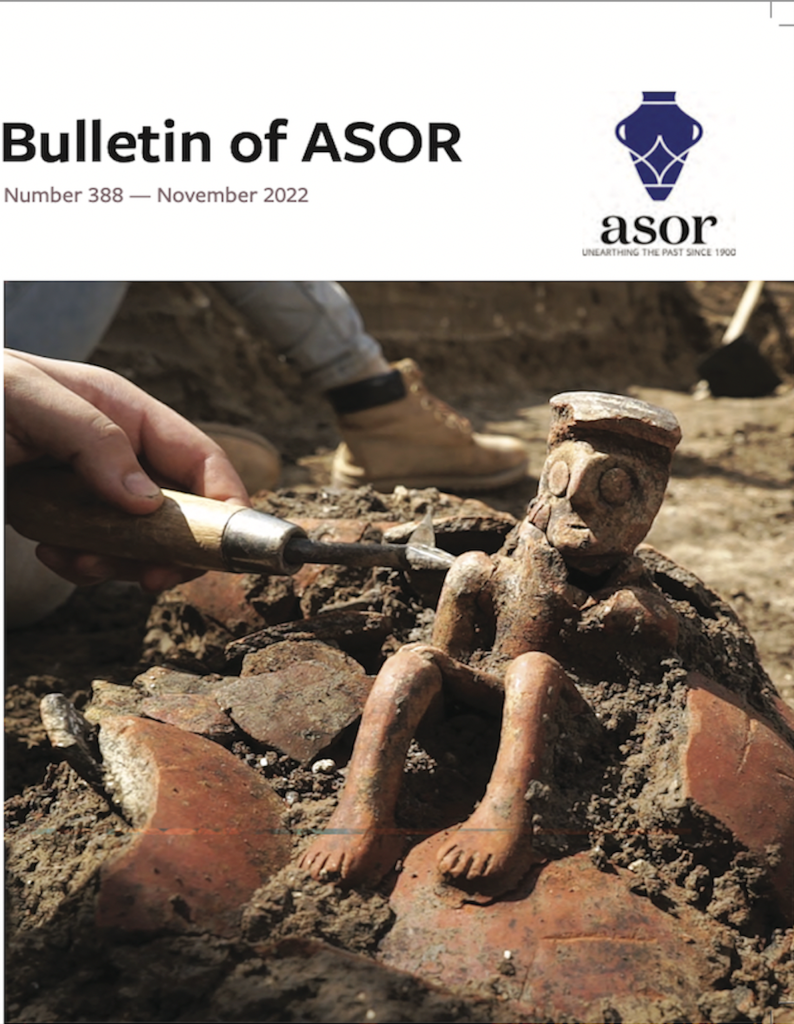
Table of Contents for BASOR 388 (November 2022)

Table of Contents for Bulletin of ASOR 388 (November 2022)

You can receive BASOR (and other ASOR publications) through an ASOR Membership.
Please e-mail the Membership office if you have any questions.
Pp. 1–29: “Recent Discoveries of BE Arrowheads and Joppa Coins in the Eastern Desert of Egypt: In the Footsteps of the Ptolemaic Army,” by Bérangère Redon and Thomas Faucher
 

The article presents recent discoveries made by the French Archaeological Mission to the Eastern Desert of Egypt in two Ptolemaic forts occupied in the second half of the 3rd century b.c., Bir Samut and Abbad, located along the road leading from Edfu to Berenike on the Red Sea Coast at the southern fringes of the Ptolemaic Empire. These artifacts, three copper-alloy arrowheads marked with the monogram BE and four Ptolemaic coins minted in Joppa, were recovered in contexts securely dated to the last decades of the 3rd century b.c. Due to the sealed stratigraphy and the discovery of thousands of ostraca and dozens of coins in the same deposits, it is clear that the forts and these objects were abandoned on the eve of the Great Theban Revolt in Egypt, around 207–206 b.c. These discoveries offer an occasion to reassess the corpus of similar arrowheads and coins found in the Eastern Mediterranean. The catalog presented here includes 45 BE arrowheads and 18 Joppa coins and a careful reassessment of the corpus suggests that they were probably produced by the Ptolemaic regime in direct association with the Fourth Syrian War, which ended with the Battle of Raphia in 217 b.c. The geographic distribution of the arrowheads and coins discussed in the article demonstrates the mobility of the Ptolemaic troops after this intense period of conflict.

ASOR Members with online access: log into ASOR’s Online Portal here. Once logged in, click the JOURNALS tab in the top navigation bar. From here you may select which journal you would like to read. If you have online access, you will see your selected journal’s current issue Table of Contents. Click on the “Current Issue” button and you will then be redirected to the University of Chicago Press’s (UCP) platform to immediately start reading any issue of your choice. Tutorials for how to log in to the Online Portal as well as how to navigate to the Portal Journals page can be found here.

Pp. 31–49: “Two Iron Age Alphabetic Inscriptions from Tell eṣ-Ṣâfi/Gath, Israel,” by Esther Eshel, Tania Notarius, Amit Dagan, Maria Eniukhina, Vanessa Workman, and Aren M. Maeir

This paper presents two brief alphabetic inscriptions from Area D in the lower city of Tell eṣ-Ṣâfi/Gath, both deriving from Iron Age IIA contexts. The first is written in an Early Alphabetic script similar to an inscription previously published from the site (Maeir et al. 2008) and is interpreted as being related to the storage of wine. The second, written in later, “formalized” alphabetic script, is quite fragmentary and difficult to decipher, for which several possible interpretations are suggested. These two new inscriptions join the relatively large number of alphabetic inscriptions from Tell eṣ-Ṣâfi/Gath, second only in number to contemporaneous Tel Rehov, and provide additional evidence to the outstanding role of the site during the early Iron Age.

ASOR Members with online access: log into ASOR’s Online Portal here. Once logged in, click the JOURNALS tab in the top navigation bar. From here you may select which journal you would like to read. If you have online access, you will see your selected journal’s current issue Table of Contents. Click on the “Current Issue” button and you will then be redirected to the University of Chicago Press’s (UCP) platform to immediately start reading any issue of your choice. Tutorials for how to log in to the Online Portal as well as how to navigate to the Portal Journals page can be found here.

Pp. 51–72: “Post-Destruction Squatter Phases in the Iron Age IIB–C Southern Levant,” by Eli Itkin

The destructions caused by the military campaigns of the Neo-Assyrian empire in the southern Levant during the Iron Age IIB and IIC (8th–7th centuries b.c.e.) led to mass deportations of local populations and a forced displacement of refugees. Although several studies in recent years have focused their attention on displacement and refugees in the ancient Near East during the period in question, they often deal with large scale processes, while generally neglecting more localized phenomena. Such phenomena include, among others, post-destruction squatter phases. These frequently overlooked strata reflect the resettlement of a site following its destruction by local individuals who were forced, to some degree, to leave their homes for an unknown period. This paper attempts to define some of these post-destruction squatter phases in the archaeological record during the Iron IIB–C through the analysis of nine case studies, and to examine this phenomenon from a refugee standpoint.

ASOR Members with online access: log into ASOR’s Online Portal here. Once logged in, click the JOURNALS tab in the top navigation bar. From here you may select which journal you would like to read. If you have online access, you will see your selected journal’s current issue Table of Contents. Click on the “Current Issue” button and you will then be redirected to the University of Chicago Press’s (UCP) platform to immediately start reading any issue of your choice. Tutorials for how to log in to the Online Portal as well as how to navigate to the Portal Journals page can be found here.

Grain tribute for Hittites
 

Pp. 73–89: “Why Were the Leaders of the Sea Peoples Called ʿȝ.w and Not wr.w? On the Size and Raiding Character of the Sea Peoples’ Groups,” by Uroš Matić

This paper discusses the use of the terms ʿȝ and wr for the designation of enemy leaders in ancient Egyptian texts of the Ramesside period. Focus is placed on the choice of the term for leaders of the various Sea Peoples’ groups in the texts of the Medinet Habu temple of Ramesses III. The leaders of the Sea Peoples and Shasu are referred to as ʿȝ.w, whereas the leaders of other groups are referred to as wr.w. The terms used for different enemy leaders are indicative of the ancient Egyptian perception of the social organization of the enemy. Focusing on their social organization can provide us with a more stable ground for understanding the Sea Peoples. Several features indicate that they were warrior groups similar to pirates or mercenaries conducting raids, rather than large groups of migrants: 1) the choice of the term for their leaders during the reign of Ramesses III, 2) the relatively small numbers of their captives in the lists of spoils of war of Merneptah, and 3) the fact that no women and children are ever mentioned in these lists, although they are accompanying one of the Sea Peoples’ groups in a single scene from Medinet Habu.

ASOR Members with online access: log into ASOR’s Online Portal here. Once logged in, click the JOURNALS tab in the top navigation bar. From here you may select which journal you would like to read. If you have online access, you will see your selected journal’s current issue Table of Contents. Click on the “Current Issue” button and you will then be redirected to the University of Chicago Press’s (UCP) platform to immediately start reading any issue of your choice. Tutorials for how to log in to the Online Portal as well as how to navigate to the Portal Journals page can be found here.

Pp. 91–111: “Lachish “Letter” 2 (BM 125702): A Polite Letter, an Accreditation Pass, or a Text Used to Teach Letter Writing?,” by Alice Mandell

Lachish 2 is typically described as an enigmatic letter, one that consists mainly of the protocol language used in letter introductions. However, past studies have wrestled with Lines 5–6 of this letter, and noted the linguistic crux posed by the verb ybkr. The present study argues that while Lachish 2 looks like a letter, it plays a different role than letters are traditionally conceived to do (as written communication media that articulate the words of a sender to a recipient). This text’s form, organization, and focus on formulae, and its lack of clear message suggest that Lachish 2 was used as an instructional tool that outlines a letter’s organization and sample epistolary formulae, serving perhaps as a template. This ostracon offers insight into both the practice of letter writing as seen from the internal perspective of a writer, and into education in the process of letter writing in the later days of the Judean monarchy.

ASOR Members with online access: log into ASOR’s Online Portal here. Once logged in, click the JOURNALS tab in the top navigation bar. From here you may select which journal you would like to read. If you have online access, you will see your selected journal’s current issue Table of Contents. Click on the “Current Issue” button and you will then be redirected to the University of Chicago Press’s (UCP) platform to immediately start reading any issue of your choice. Tutorials for how to log in to the Online Portal as well as how to navigate to the Portal Journals page can be found here.

Pp. 113–132: “The Formation of Edom: An Archaeological Critique of the “Early Edom” Hypothesis,” by Piotr Bienkowski

According to the Early Edom hypothesis, the late Iron II kingdom of Edom in southern Jordan emerged from the complex copper-producing society of early Iron II Faynan. A review of the archaeological evidence from the final publication of the Faynan excavations demonstrates that the hypothesis is untenable. There was a chronological gap of 50 to 100+ years between the end of settlement at Faynan, at the end of the 9th century b.c.e., and the earliest settlement in the Edom Highlands; evidence of decreasing social and political complexity at Faynan; no continuity in the scale or technology of copper production at Faynan between early and late Iron II; and completely different settlement patterns at early Iron II Faynan and in the late Iron II highlands, indicating a different economic and social basis. The evidence suggests that early Iron II Faynan was short-lived and linked to the contemporary society in the Negev Highlands, through administration, economy, and workforce. The kingdom of Edom and late Iron II settlement developed in the late 8th century b.c.e. under Assyrian stimulus, which had a direct impact on the expansion of settlement and agriculture, the production of pottery and other goods, and the Arabian trade across the Negev.

ASOR Members with online access: log into ASOR’s Online Portal here. Once logged in, click the JOURNALS tab in the top navigation bar. From here you may select which journal you would like to read. If you have online access, you will see your selected journal’s current issue Table of Contents. Click on the “Current Issue” button and you will then be redirected to the University of Chicago Press’s (UCP) platform to immediately start reading any issue of your choice. Tutorials for how to log in to the Online Portal as well as how to navigate to the Portal Journals page can be found here.

Pp. 133–152: “Note on a White Lustrous Wheel-made Ware Spindle Bottle from Ras Shamra,” by Caroline Sauvage

This study discusses the archaeological and chronological context of a small White Lustrous Wheel-made Ware (WLW-mW) spindle bottle excavated in Ras Shamra by Claude F.-A. Schaeffer in 1933. This spindle bottle is the first of its kind to be positively identified in the Minet el-Beida/Ugarit region, but others could be also identified from Schaeffer’s publications. This spindle bottle belongs to a group of now four similar small WLW-mW examples found in the eastern Mediterranean, which should probably be added to the classification of this ware as a Type IIb. More generally this article reviews the chronology of WLW-mW in the eastern Mediterranean and argues for a broad Late Bronze IB date (1550–1450 b.c.e.) for the ware.

ASOR Members with online access: log into ASOR’s Online Portal here. Once logged in, click the JOURNALS tab in the top navigation bar. From here you may select which journal you would like to read. If you have online access, you will see your selected journal’s current issue Table of Contents. Click on the “Current Issue” button and you will then be redirected to the University of Chicago Press’s (UCP) platform to immediately start reading any issue of your choice. Tutorials for how to log in to the Online Portal as well as how to navigate to the Portal Journals page can be found here.

Pp. 153–179: “An Elite Middle Bronze IIA Warrior Tomb from Yehud, Central Coastal Plain, Israel,” by Gilad Itach, Dor Golan, and Shirly Ben Dor Evian

A salvage excavation held at the city of Yehud (Israel) revealed an unusual burial of the Middle Bronze (MB) IIA period. The grave was isolated from other MB burials in the Yehud area and was exceptionally large and rich in terms of the types and diversity of burial offerings, which included pottery vessels, metal objects, and animal bones. An outstanding find among the burial goods was an anthropomorphic jug whose neck was shaped in the form of a seated figure supporting its head with the right hand, evoking the image of Rodin’s “Le Penseur.” This paper presents the grave and offerings uncovered in the excavation and an interpretation of these finds, along with a discussion of the grave within the wider context of Middle Bronze Age burials in Yehud and beyond, suggesting it was associated with an elite warrior, who served most likely as a local leader.

ASOR Members with online access: log into ASOR’s Online Portal here. Once logged in, click the JOURNALS tab in the top navigation bar. From here you may select which journal you would like to read. If you have online access, you will see your selected journal’s current issue Table of Contents. Click on the “Current Issue” button and you will then be redirected to the University of Chicago Press’s (UCP) platform to immediately start reading any issue of your choice. Tutorials for how to log in to the Online Portal as well as how to navigate to the Portal Journals page can be found here.

Pp. 181–210: “The Khirbet Qeiyafa Ostracon: A New Collation Based on the Multispectral Images, with Translation and Commentary,” by Brian Donnelly-Lewis

This paper provides a new collation of the Khirbet Qeiyafa ostracon on the basis of the multispectral images produced by Gregory Bearman and William Christens-Barry in collaboration with a number of imaging labs in 2009. It proposes 59 letters in total, with 12 new readings, including 5 new partial reconstructions, all supported by an analysis of these detailed, high-definition images. This new collation permits a renewed attempt at translation of the ostracon, which is interpreted as a record of the summons of a defendant in a legal dispute. In the course of analysis, it is argued that if the decipherment is accepted, the language of the text appears to be an archaic, dialectal form of Hebrew.

ASOR Members with online access: log into ASOR’s Online Portal here. Once logged in, click the JOURNALS tab in the top navigation bar. From here you may select which journal you would like to read. If you have online access, you will see your selected journal’s current issue Table of Contents. Click on the “Current Issue” button and you will then be redirected to the University of Chicago Press’s (UCP) platform to immediately start reading any issue of your choice. Tutorials for how to log in to the Online Portal as well as how to navigate to the Portal Journals page can be found here.

Pp. 211–233: “Pit, Loculus, and Ossuary: The Family and the Individual in Late Second Temple Judean Burial Caves,” by Eyal Regev and Omri Y. Abadi

From the Hasmonean period until 70 c.e., there were three consecutive types of family burial in Judea: pit-bench caves, loculi caves, and ossuaries. In each, the treatment of skeletal remains and their distribution within the caves attest to different types of family relationships and different ways in which families perceived themselves. It is suggested that the place of the individual within the family developed gradually along with these burial methods. Pit-bench caves from the Hasmonean period were used by a limited number of families who wished to strengthen their ties or self-identity. The skeletal remains in most of the loculi and ossuaries included adults and children who were buried together. Those buried in the loculi and ossuaries were probably nuclear families, maintaining their identity in relation to other members of the extended family who may have been buried in other loculi/ossuaries in the cave. This attests to the growing importance of the nuclear family in society. Burying a person with only a few close relatives (e.g., young children and spouse) commemorated the individual’s identity. Interment in loculi, and to a greater degree in ossuaries, rendered the identity of the nuclear family and the individual more distinct from other nuclear families and individuals in the cave.

ASOR Members with online access: log into ASOR’s Online Portal here. Once logged in, click the JOURNALS tab in the top navigation bar. From here you may select which journal you would like to read. If you have online access, you will see your selected journal’s current issue Table of Contents. Click on the “Current Issue” button and you will then be redirected to the University of Chicago Press’s (UCP) platform to immediately start reading any issue of your choice. Tutorials for how to log in to the Online Portal as well as how to navigate to the Portal Journals page can be found here.

Fieldwork Report: Nathan Lovejoy

Kınık Höyük 2022: Short but Sweet

Nathan Lovejoy, 2022 Steinmetz Scholarship for Active/Reserve Military or Veterans Recipient

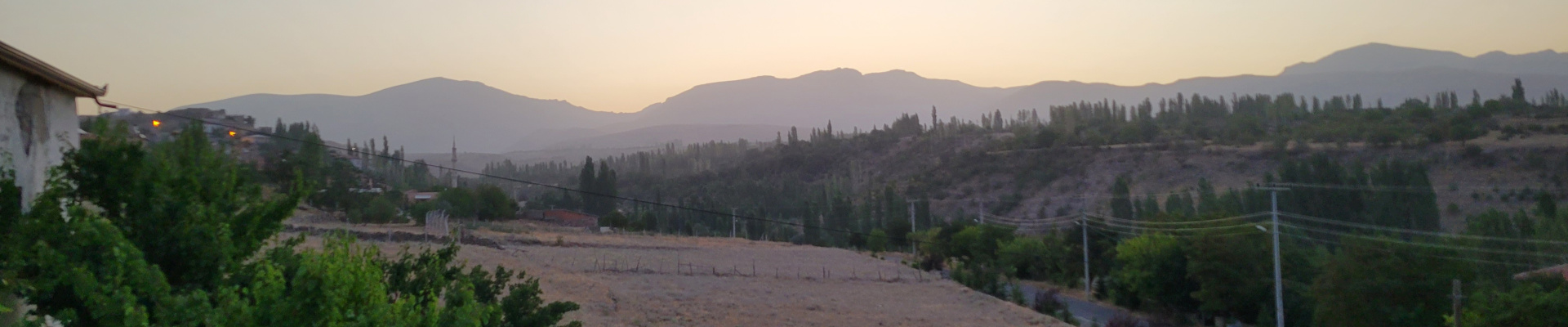
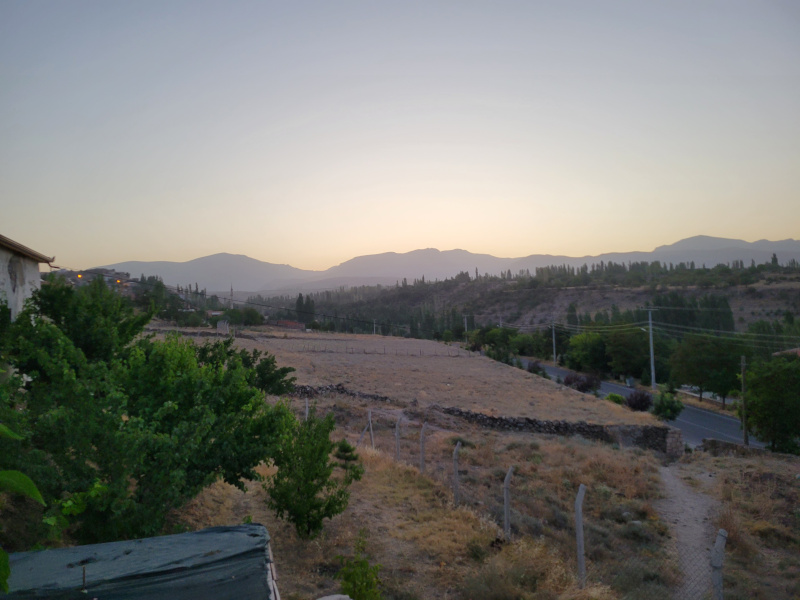
This year, thanks to the generosity of Charles Steinmetz and the help of ASOR, I was able to return to the excavations at Kınık Höyük in Niğde province, Turkey after two years missed due to the pandemic and the birth of my first child. Unfortunately, this season was also shortened by delays in acquiring our excavation permit and research visas, but even so, it was wonderful to be back on the site and at the dig house, and back with friends and colleagues that I hadn’t seen in such a long time. Not to mention, back to such a wonderful morning view before heading to the field.

A lovely morning sunrise at Kınık Höyük.

Nathan holding the fragmentary bronze bowl.

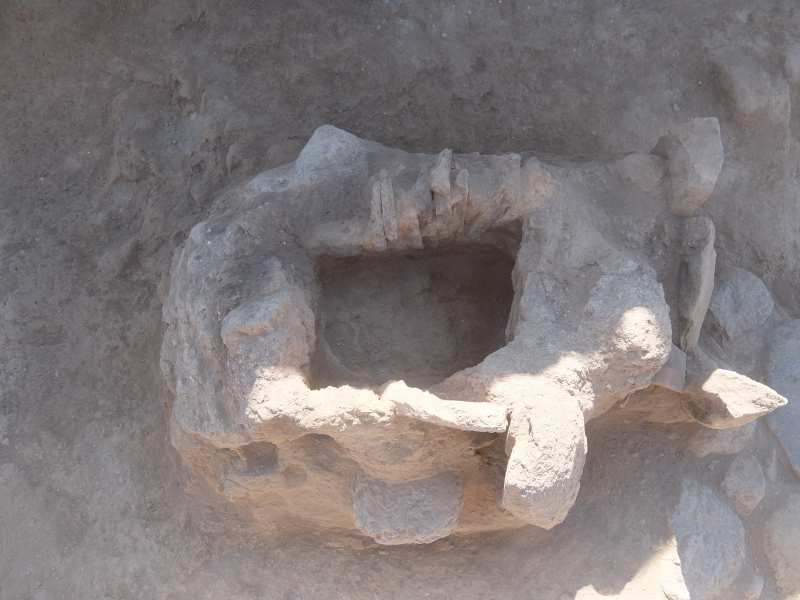
My work this year focused on continued excavations in a Late Iron Age room (ca. 7th-6th c. BCE), which I began to expose in 2017. This entailed excavating a Late Hellenistic occupation layer and Achaemenid period deposits – about two meters of earth – before secure Iron Age contexts were reached. While most of these intervening layers lack a well-defined context, they did produce several interesting finds. One such discovery was a crushed and fragmentary, but mostly complete, bronze bowl found resting on a loosely structured external surface of beaten earth. The bowl awaits restoration to allow for further analysis, but we were quite happy for the discovery in the field.

As for the Late Iron Age room itself, we opened a southern extension of the previously excavated space hoping to better understand its connection with adjacent rooms. The space is particularly interesting in its final phase of use (or perhaps disuse?), when it served as the locus for a midden heap rich in anthropic materials – the collection of these materials has become even more urgent in the last year, as the robust ceramic assemblage is now the focus of PhD research of a colleague at the University of Pavia, Italy. Additionally noteworthy are the peculiar faunal assemblage suggestive of ritual activity in the vicinity – presented at ASOR 2021 – and the recent identification of bone horse bridles, of which we have three – so at least definitely more than a single pair! The new materials collected this year require further analysis before any conclusions can be made, but from impressions made in the field, they appear consistent with past discoveries. One entirely new discovery from the room in the same period as the midden heap was a well-structured oven composed of stones, mud-bricks, and large ceramic sherds – apparently debris collected for reuse. The chamber of the oven sloped downwards to allow for heating without direct exposure to the fire, and the innermost part of the chamber was entirely full of burnt ashy remains of the fuel used for cooking.

A Late Iron Age oven composed of stone, mud-brick, and ceramic sherds.

In all, the season felt way too short, but we all made the best of the time we had. Materials still need to be studied, and more excavations will be needed next year, but the campaign still feels like a success. And in the end, even if we hadn’t been able to put a single trowel to the earth, the renewed collegiality and rekindled friendships with scholars and students from across the globe would have made the short season worth every effort anyway. Thanks again to ASOR, Charles Steinmetz, and the Universities of New York, Pavia, and Florence for facilitating my research and participation in the excavations of Kınık Höyük this year.

Nathan Lovejoy is in the final year of his PhD at the Institute for the Study of the Ancient World at New York University, where he is writing a dissertation on institutional change and identity maintenance in the northeast Mediterranean during the Iron Age. He is a US Army veteran, a father to his amazing son Arthur, and husband to his ever-supportive wife Maggie.

Read more about the Kınık Höyük Archaeological Project.

Want to help more students and early career archaeologists get into the field? Donate to the cause today by selecting “Student Support” as your gift purpose!

Geraty Grant Report Update

A Children’s Book, A Local History Book, Summer Camps, and a Maintenance Agreement: An Update on the Lawrence T. Geraty Community Archaeology Endowment, 2022

In 2020 Andrews University partnered with the American Society of Overseas Research to establish the Lawrence T. Geraty Endowment to foster and serve as an accelerant for the development of know-how and innovative approaches for local community engagement with the custody and care of archaeological sites. The first distribution from the endowment happened in 2021 (read the 2021 report here). A second distribution from the endowment took place this past summer, and here is a brief update on how the funds were spent.

Karam and Hesban is the English translation of a children’s book in Arabic about Hisban authored by Rasha Dababneh and illustrated by Safa Abudoush. The book, which was published in 2021, tells the story of a little boy, Karam, who visits Hisban and while there, meets a local shepherdess, who becomes his guide while also grazing her sheep on the slopes of the tell. The project of producing the book was initiated and supervised by the writer and AlRaqeem,  with funding provided in part by the ASOR Geraty Endowment. Copies of the book have been distributed for free to children living in Hisban. The book is part of the book series “Discover Jordan with Karam.” The sale of the book in local bookstores supports the protection of the site.

Husban Culture and Heritage is a local history book authored by Abdullah Abdulazeese Al-Masha’lah. It was published in 2022 in Arabic and English and offers a local account of the agricultural know-how, crafts, and wisdom of past generations of the contemporary Ajarmah families of Hisban. The book also offers a local perspective on archaeological discoveries at the site. As with the above-mentioned children’s book, the project of producing the book was initiated and supervised by the writer and AlRaqeem,  with funding provided in part by the ASOR Geraty Endowment. The book has been distributed for free to local residents and is available for purchase in local bookstores.

Another archaeology summer camp for Hisban community children and others was organized and supervised on the hill of Hisban by our Sela/AlRaqeem.  The leader was Amr Awawdah, a teacher in the local schools who also is a veteran of more than two decades of excavations at Hisban. Activities for the children—most of whom are elementary level–include learning about stratigraphy, pottery, excavation techniques, and documentation. A capstone activity is a play produced by the children that tell a story that ties in some way to the history of the site . Funding for these camps was provided by the Geraty Endowment.

A Memorandum of Understanding between Andrews University and the Department of Antiquities represents a major milestone on the road toward a sustainable future for the Hisban Archaeological Park. The agreement commits our team to provide funding for an archaeologist to supervise four local workers for 12 weeks spread throughout each of the next three years: 2 weeks in November, 2 in February, 4 in May, 2 in July, and 2 in September. The salary of the archaeologist supervisor will be paid by the Geraty Endowment, while the local workmen’s salaries will be paid by the Department of Antiquities. The overall arrangement and work will be supervised by AlRaqeem and will provide proof of concept for such a partnership involving a foreign university and the Department of Antiquities. The agreement, which was signed in June 2022, also allows time for raising funds to sustain the arrangement into the future.

We are excited about the many ways in which the ASOR Geraty Endowment is proving to be a powerful accelerant for learning about ways to engage host communities as partners in caring for archaeological sites such as Hisban in Jordan. You can help sustain and further grow the impact of the Endowment by selecting “Geraty Endowment Fund” from the drop-down menu at the following link.