[/vc_column_text][vc_column_text]
Available until May 18, 2018[/vc_column_text][mk_divider][vc_column_text]Near Eastern Archaeology, March 2018, “Microarchaeology at Tell eṣ-Ṣâfi/Gath, Area A” by Steve Weiner (Weizmann Institute of Science) and Elisabetta Boaretto (Weizmann Institute of Science).
The overall objective of archaeological excavations is to extract as much reliable information as possible from the whole archaeological record: both macroscopic and microscopic. An effective approach to achieve this goal is to integrate observations on the macroscopic and microscopic records as the excavation proceeds by operating an on-site analytical laboratory at the excavation. In this way important primary context locations can be better identified as they are exposed, and the excavation and sampling strategy can be adapted accordingly (Weiner 2010).
[/vc_column_text][vc_column_text]Every year, ASOR receives more applications for dig scholarships than we can support. Thanks to the generosity of donors who have supported endowment funds for fellowships, and thanks to donors who make annual gifts, we are able to support more and more scholarships every year. We are very proud that ASOR has become one of the largest sources for funding for individuals who want to participate in excavations in the Middle East and wider Mediterranean regions.
When we began the March Fellowship Madness season, ASOR had approximately $36,000 from endowment and annual funds to support 18 scholarships. We are thrilled that through the generosity of our members who contributed to March Fellowship Madness, we raised more than $6,500. This has allowed ASOR to award 21 dig scholarships – 3 more than at the beginning of March!
THOMAS LEVY RECEIVES HONORARY DEGREE FROM CHARLES UNIVERSITY
[/vc_column_text][vc_column_text]Congratulations to ASOR’s former chair of the Committee on Archaeological Research and Policy, Professor Thomas E. Levy of the University of California, San Diego, who received the degree of Doctor honoris causa from Charles University. Charles University, located in Prague and founded in 1348, is the largest and most renowned Czech university and one of the oldest universities in the world.
The degree was awarded to Professor Levy in April 2018, during the two-day meeting of the University’s International Advisory Board. Levy was cited for his outstanding lifelong scientific achievements and for a significant contribution to the development of research in collaboration with Charles University. As the Charles University press release annoucing Professor Levy’s degree reads:
Professor Levy has worked with the Czech Institute of Egyptology at the Faculty of Philosophy at Charles University in the field of archaeology and contact between ancient Egypt and Syropalestine since the beginning of the 21st century. Levy’s research in the Wadi Feynan territory, where his expeditions discovered unique monuments dating to the period between 3000 BCE and 1000 BCE, has been a major contribution to this field. The Czech Institute of Egyptology carries out work on markedly similar topics and Czech archaeological research in Abusir also offers significant parallels for Levy’s work in the Near East in the field of international trade and also in relation to the genesis of the first complex societies between 3000 BCE and 1000 BCE.
The press release goes on to quote Miroslav Bárta, Director, Czech Institute of Egyptology:
“I’ve been collaborating with Prof. Levy for a long time. I had the opportunity to give lectures at the University of California, while Prof. Levy did the same at Charles University. Recently, our collaboration with Prof. Levy focused on the theory of the punctuated equilibrium and its application in such disciplines as archaeology, Egyptology, history, and last but not least, security studies.”
Congratulations, again, to Professor Levy on this great honor!
To view the booklet from the ceremony, which includes the speech given in honor of Professor Levy and the text of his diploma, click here.[/vc_column_text][/vc_column][vc_column border_color=”rgba(170,170,170,0.01)” width=”1/6″ css=”.vc_custom_1496684098866{margin-right: 5px !important;margin-bottom: 20px !important;border-right-width: 2px !important;border-bottom-width: 2px !important;padding-top: 30px !important;padding-right: 10px !important;padding-left: 10px !important;background-color: #ffffff !important;border-right-color: rgba(227,228,228,0.75) !important;border-bottom-color: rgba(227,228,228,0.75) !important;}”][vc_wp_posts title=”BROWSE THE NEWS ARCHIVE” number=”4″][/vc_column][vc_column border_color=”rgba(170,170,170,0.01)” width=”1/6″ css=”.vc_custom_1496684008271{margin-right: 10px !important;margin-bottom: 30px !important;border-right-width: 2px !important;border-bottom-width: 2px !important;padding-top: 30px !important;padding-right: 20px !important;padding-left: 20px !important;background-color: #ffffff !important;border-right-color: rgba(227,228,228,0.75) !important;border-bottom-color: rgba(227,228,228,0.75) !important;}”][vc_column_text]Tweets by ASOResearch [/vc_column_text][/vc_column][/vc_row]
Vincent Cason, 2017 Platt Excavation Fellowship Recipient
Vince and volunteer Josiah uncover a beautiful juglet.
This past summer I was given the opportunity to be a square supervisor on The Fourth Expedition to Tel Lachish, directed by Yosef Garfinkel of The Hebrew University of Jerusalem and Michael Hasel and Martin Klingbeil of Southern Adventist University. I was placed under the supervision of Hoo-Goo Kang of Seoul Jangsin University. While this was my third excavation season at Tel Lachish, previously serving two seasons as a volunteer as an Anthropology major at Virginia Commonwealth University (VCU), it was my first time as a member of the Hebrew University staff. The promotion from volunteer to professional staff required a deeper understand of methodology, a sound interpretation as to what exactly was being uncovered, its relationship to material and strata found in adjacent squares as well as the overall site, and how material finds can support the larger questions of the excavation as determined by the directors (urban planning, social behaviors ethnic identification, etc.). Yet, perhaps what was most surprising about doing field archaeology lies beyond the scientific approach and more in the realm of intuition. It was around midseason that I began to lean on an uncanny sense of where to dig next and when to keep my eyes open.
But how does one really know what to look for?
Vince examines a sling stone in the field.
A common theme in introductory classes to anthropology and archaeology is the holistic nature of our field, taking ideas and influence from many other fields and disciplines. This observation tends to lie dormant in the more theoretical side of things unless students actually have a chance to apply it to or through methodology. When taking part of an archaeological excavation, one can see that this holistic nature applies to much more than theory but additional includes what each staff member brings to the excavation. I found that a basic understanding of trade work can be an invaluable asset to understanding many parts of ancient society.
During my high school education, I focused on agriculture, as I was interested in the history of land use especially farming techniques and this was a strong program in rural North Carolina. I was a member of the Future Farmers of America, took classes on horticulture, and after graduation worked in landscaping for a period. While technology has changed quite a bit over the past few thousand years, many principles are constant, especially when it comes to agriculture. Grain production, from harvest to storage, to milling or grinding, then table use follow essentially the same trajectory even with modern invention. For example, terracing, an ancient method of farming, are still used today to allow agriculture in areas with steep topography.
During the 2017 season, much of my area was uncovering architecture which was another area I had practical work and classroom experience in. In my high school construction class, students built a house, auctioned off at the end of the semester, which in turn funds the class. And here I was, excavating houses! After removing nearly a meter of overburden in two squares, we had two immediate objectives which we methodically dispatched: find the floor and the foundation of the wall of the building. The same process of foundations, framing, flooring, and roofing I learned in high school guided me as I excavated the square, uncovering the walls, ceiling collapse, flooring, and foundational trenches in reverse order.
VCU Rams remove balks to fully expose architecture.
While I was able to lean on past academic and practical experience I did notice an important distinction between construction and deconstruction. Archaeology is often described as a destructive science because, once excavated, the archaeological matrix is gone forever, which necessitates meticulously recording while excavating. While excavating these buildings, I realized that destructive is misleading, that what we do is more “deconstructive” as we examine the structure, piece by piece, from the top down as it is “dismantled.”
This summer working on the Hebrew University staff at Tel Lachish was a truly insightful experience. I have deepened my understanding of what an incredible amount of social organization and labor goes into the building of a city, building a nation. It has left me feeling assured that I have chosen a career path that I truly enjoy, one that has real impact on the world around me. As a prospective graduate student there are few feeling that alleviate the anxiety of taking the next step in my education the way that feeling does. To those that are kind enough to fund fellowships such as the one I was awarded, I cannot thank you enough as I would not have had a chance like this otherwise and there are many others that are in the same situation.
Vincent Cason is a recent graduate of the Anthropology program at Virginia Commonwealth University in Richmond, VA. His research interests include state formation in the Iron Age Levant and agricultural practices in the general Near East. He is currently living in Richmond, VA and preparing graduate program applications.
Table of Contents for Near Eastern Archaeology 81.1 (March 2018)
Subscription Options You can receive NEA (and other ASOR publications) through an ASOR Membership or through an Individual Subscription. Single issues (subject to availability) are available for purchase, with ASOR members receiving a discount. Please email us if you have any questions.
Pp. 4-5: “The Survey of the Site and Its Insights,” by Joe Uziel and Aren M. Maeir
Since its infancy, archaeological research has used survey as a major tool in both regional studies (see, e.g., Conder and Kitchener 1881) and as a tool for project planning. In the former, survey flourished—despite certain critiques as to the validity of the data collected (e.g., Waelkens and Poblome 2004)—whereas the latter was often used minimally in the interpretation of an individual site’s history. In this sense, the survey at Tell eṣ-Ṣâfi/Gath was groundbreaking in its approach— not only as a tool for planning the project, but as the basis for determining aspects of the history of the site (Uziel and Maeir 2005, 2012). The survey was planned by the division of the site into separate fields, based on discrete micro-topographical features. As opposed to an arbitrary grid, the use of the topography of the site considered that these features may have been formed by the changing settlement of the site over time. For example, the eastern slopes (Areas A and E), which have been extensively excavated, each had its own local phasing, which was determined through their separate survey. Had we used a random grid, it is likely the parts of each of these terraced steps would have been lumped together, making the survey a tool for overall evaluation of the site, but not determining differences in the various areas. This proved critical in the planning of the project, which later, through the implementation of the survey results, managed to determine excavation areas according to the research design of the project.
Click here to access the above article on JSTOR (ASOR membership with online access and/or subscription to JSTOR Current Content required).
Pp. 6-14: “New Insights into the Philistines in Light of Excavations at Tell eṣ-Ṣâfi/Gath,” by Louise A. Hitchcock and Aren M. Maeir
Even though the arrival of the Philistines in the southern Levant is an event that happens “off camera,” that is, before the appearance of their settlement remains, it is an event that was narrativized in the recent past by archaeologists working in Philistia who interpreted the local production of Aegean style pottery as evidence of a massive colonization by Mycenaean migrants (Hitchcock and Maeir 2016a). By and large, the understanding of the Philistines and their culture was centered around the biblical and Egyptian images of the Philistines, and their continued reception and interpretation until modern times.
Click here to access the above article on JSTOR (ASOR membership with online access and/or subscription to JSTOR Current Content required).
Pp. 15-18: “Philistine Decorated Pottery at Tell eṣ-Ṣâfi/Gath,” by Linda G. Meiberg
Almost all of the excavated areas at Tell eṣ-Ṣâfi/Gath have yielded Philistine decorated pottery. This includes Areas A (Strata A6 and A5), E (Stratum E3), F (Stratum F11), and P (Stratum P2) on the upper tell, as well as Area D (Stratum D5) in the lower city, thus indicating that the consumption, if not actual production, of Philistine decorated pottery was quite widespread throughout the entire site during the twelfth through tenth centuries B.C.E.
Click here to access the above article on JSTOR (ASOR membership with online access and/or subscription to JSTOR Current Content required).
Pp. 19-21: “Philistine Burial Customs in Light of the Finds at Tell eṣ-Ṣâfi/Gath,” by Joe Uziel and Aren M. Maeir
Despite over a century of research conducted on the Philistines and their material culture, a very small quantity of finds relating to their burial customs has been reported. This has led to quite a lot of speculation on Philistine mortuary customs, with little evidence in support. At a number of sites, suggestions to distinguish “Philistine” burials were attempted, most notably, the erroneous attribution of the anthropoid coffins to the Philistines (Dothan 1982), the suggested cremation burials found at Azor (Dothan and Dothan 1992; Ben-Shlomo 2008, 2012; Buchennino and Yannai 2010), and the burial caves yielding Philistine bichrome pottery at Tel Eton (Edelstein and Aurant 1992). However, the problematic interpretations of these finds, coupled with the fact that none of this evidence was found at the main urban sites of the Philistines, calls into question their centrality within the Philistine realm, and their attribution on a whole to the ethnic group that populated the southern Coastal Plain.
Click here to access the above article on JSTOR (ASOR membership with online access and/or subscription to JSTOR Current Content required).
Pp. 22-23: “What Language(s) Did the Philistines Speak?,” by Brent Davis
The evidence that we have for the language(s) spoken by the Philistines is not plentiful, but what we do have is interesting (though far from conclusive). Two types of evidence predominate: (1) inscriptions from Philistine sites (thus these inscriptions may have been produced by Philistines), and (2) Philistine words and names borrowed into other languages of the region and recorded (however imperfectly) in non-Philistine records.
Click here to access the above article on JSTOR (ASOR membership with online access and/or subscription to JSTOR Current Content required).
Pp. 24-27: “Microarchaeology at Tell eṣ-Ṣâfi/Gath, Area A,” by Steve Weiner and Elisabetta Boaretto
The overall objective of archaeological excavations is to extract as much reliable information as possible from the whole archaeological record: both macroscopic and microscopic. An effective approach to achieve this goal is to integrate observations on the macroscopic and microscopic records as the excavation proceeds by operating an on-site analytical laboratory at the excavation. In this way important primary context locations can be better identified as they are exposed, and the excavation and sampling strategy can be adapted accordingly (Weiner 2010).
Click here to access the above article on JSTOR (ASOR membership with online access and/or subscription to JSTOR Current Content required).
Pp. 28-33: “Excavations in Area D of the Lower City: Philistine Cultic Remains and Other Finds,” by Amit Dagan, Maria Eniukhina and Aren M. Maeir
During the first decade of the Tell eṣ-Ṣâfi/Gath Excavation Project, various areas in the upper city were excavated. Based on the results of the surface survey, however, it was clear that there was extensive settlement in the area to the north of the upper city up until the Elah Valley riverbed. Ten years ago, the excavations were expanded to the lower city, commencing with Area D (fig. 1). Since then, Area D has been extensively excavated, with a broad range of finds mainly from the Iron Age (for additional excavations in Area K of the lower city, see Welch in this issue). Here we will describe some of these finds, with a particular focus on the Philistine cultic remains.
Click here to access the above article on JSTOR (ASOR membership with online access and/or subscription to JSTOR Current Content required).
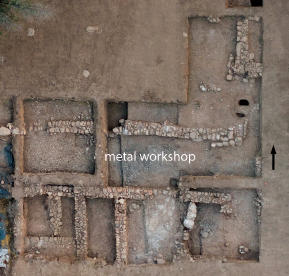
Pp. 34-36: “Iron Age Metal Production at Tell eṣ-Ṣâfi/Gath,” by Adi Eliyahu-Behar and Vanessa Workman
While the increasing appearance of iron objects between the late twelfth and early eleventh centuries B.C.E. has been the greatest indicator for the shift from bronze to iron use that marks the transition to the Iron Age, a nuanced understanding of the technological phenomenon comes from evidence and artifacts of production. The origins of iron production technologies are still hotly debated. In recent years, new and pertinent archaeological data regarding actual iron production, has finally surfaced. Considerable iron production remains of both smelting and smithing had been identified at major sites throughout the region.
Click here to access the above article on JSTOR (ASOR membership with online access and/or subscription to JSTOR Current Content required).
Pp. 37-40: “Women in Distress: Victims of the Iron Age Destruction at Tell eṣ-Ṣâfi/Gath,” by Marina Faerman, Aren M. Maeir, Amit Dagan and Patricia Smith
The widespread signs of destruction and fire seen at Tell eṣ-Ṣâfi/Gath in the upper and lower parts of the city (Namdar et al. 2011; Zukerman and Maeir 2012) include the charred skeletal remains of three women found in Area D, Stratum D3, and five individuals found in Area A, Stratum A3. All appear to have been victims of the same event, namely, the destruction of the city at the end of the ninth century B.C.E. by Hazael of Aram (Maeir 2012). We provide here a detailed description of these remains and the circumstances surrounding their deaths using standards published in Bass 1995 to determine their age and sex, and the Munsell color chart (Ellingham et al. 2015) to estimate the extent and pattern of burning on the bodies.
Click here to access the above article on JSTOR (ASOR membership with online access and/or subscription to JSTOR Current Content required).
Pp. 41-44: “Iron Age Animal Husbandry at Tell eṣ-Ṣâfi/Gath: Notes on the Fauna from Area D,” by Ron Kehati, Amit Dagan and Liora Kolska Horwitz
Faunal remains comprise a significant portion of finds recovered from most archaeological sites in Israel. Among other issues relating to factors such as animal evolution and ecology, their examination can elucidate past human diet, symbolic and cultural behavior, technology relating to animals and animal products, as well as the site’s environment and even paleoclimate of a region (e.g., Reitz and Wing 2008; Russell 2011). These issues were considered when we examined the faunal assemblage recovered from the late Iron Age I (tenth century B.C.E.) through Iron Age IIA-B (post-830 B.C.E.) deposits excavated in Area D at Tell eṣ-Ṣâfi/Gath.
Click here to access the above article on JSTOR (ASOR membership with online access and/or subscription to JSTOR Current Content required).
Pp. 45-47: “Expanding the Lower City: Area K at Tell eṣ-Ṣâfi/Gath,” by Eric L. Welch
Excavations in the lower city of Gath have been ongoing since 2009. In Area D, in the westernmost excavated portion of the lower city, excavations have demonstrated the presence of a well-fortified lower city as early as the eleventh century B.C.E., with the most substantial remains dating to the ninth century B.C.E. (Dagan et al., this issue). With the discovery of a fortified lower city as early as Iron Age I, new research questions about the lower city began to emerge. Of particular interest were questions about the extent of ancient Gath’s lower city and the timeline for when the lower city was inhabited.
Click here to access the above article on JSTOR (ASOR membership with online access and/or subscription to JSTOR Current Content required).
Pp. 48-54: “Judahite Gath in the Eighth Century B.C.E.: Finds in Area F from the Earthquake to the Assyrians,” by Jeffrey R. Chadwick and Aren M. Maeir
After Philistine Gath fell to the Arameans in the late ninth century B.C.E. (Maeir 2008; 2012: 47–48) the huge city atop Tell eṣ-Ṣâfi/Gath was a ghost town for several decades. Some structures had been burnt or otherwise destroyed, but many were simply abandoned to the elements. As years passed, winter storms and the processes of nature eroded the roofs and walls of hundreds of ownerless houses and other buildings. The devastation was alluded to by the Judahite prophet Amos when he predicted the eventual demise of Samaria: “Go down to Gath of the Philistines,” he challenged the Israelites, to behold what complete desolation is like (Amost 6:2; Maeir 2004). Aside from the presence of a few squatters who settled in the north lower-city ruins near the Elah riverbed, the forlorn ghost town of Gath slowly decayed away, until a cataclysmic earthquake shook the entire region somewhere around 760 B.C.E. (Chadwick and Maeir, forthcoming; Maeir 2012:49–50).
Click here to access the above article on JSTOR (ASOR membership with online access and/or subscription to JSTOR Current Content required).
Pp. 55-58: “Textile Production at Iron Age Tell eṣ-Ṣâfi/Gath,” by Deborah Cassuto
Textiles in antiquity were multifunctional, and used much as they are in modern times.1 When we think of textiles, our first thoughts are of clothing. In antiquity, as in modern times, clothing demonstrated social status (e.g., royal, common), occupation (e.g., priestly, military) and ranged from simply constructed frocks to finely manufactured prestige garments. Textiles were also used as furnishings, such as rugs, wall carpets, cushions, and curtains, as boat sails and shelters, or sacks for storage or carriage. In short, they were consumed by everyone for a multitude of needs, ranging from the mundane to the festive, from the functional to the opulent.
Click here to access the above article on JSTOR (ASOR membership with online access and/or subscription to JSTOR Current Content required).
Pp. 59-62: “Iron Age Adornment at Tell eṣ-Ṣâfi/Gath,” by Josephine A. Verduci
Between 1998 and 2014, Iron Age strata from Areas A, C, D, E, F, and P yielded a rich assemblage of 172 objects of adornment. These objects come from contexts dated to the Late Bronze Age-Iron Age transition through to Iron Age IIB. Tomb T1, containing the skeletal remains of over 70 individuals (adults and children) and dated to late Iron I-early Iron IIA, also yielded a large and varied assemblage of 154 adornment objects, not including 65 items of shell that were most likely also used as items of adornment. Among these 326 objects, are examples of metal, stone, and vitreous materials, which are represented by beads, pendants, rings, bangles (bracelets, anklets, and armlets), earrings, and fibulae.
Click here to access the above article on JSTOR (ASOR membership with online access and/or subscription to JSTOR Current Content required).
Pp. 63-65: “Petrographic and Technological Analysis of the Tell eṣ-Ṣâfi/Gath Pottery,” by David Ben-Shlomo
In archaeological research, pottery analysis is of importance for relative dating and reconstructing daily life, as well as for understanding trade patterns and cultural contacts. Trade patterns in table ware and commodities carried in pottery containers can help illuminate the economy and administration of an ancient society. The production technology of pottery, and especially its mode of production, can also reflect social, economic, and political realities in a general manner. However, according to many ethnographic and archaeological studies, the technology of pottery production is relatively conservative, and does not change rapidly.
Click here to access the above article on JSTOR (ASOR membership with online access and/or subscription to JSTOR Current Content required).
Pp. 66-71: “Cooking Installations through the Ages at Tell eṣ-Ṣâfi/Gath,” by Shira Gur-Arieh
While it is debated when exactly humans began regularly to cook their food (Sandgathe and Berna 2017), it is clear that once they did, they never looked back. Cooking raw food improves its nutrient values by enabling more complete digestion, it kills bacteria, and it sometimes helps to preserve the food. But above all, cooking makes many food products taste much better. The combination of such practical benefits, which are essential for our wellbeing, with the communal and social aspects of eating, are what makes cooking and cuisine so central in the culture of many societies worldwide. Yet, although archaeologists are aware of the important role of cooking in the overall assemblage that defines different human cultures, comprehensive study of archaeological cooking installations is still not commonly practiced in excavations of Levantine protohistoric and historic sites (Ebeling and Rogel 2015: 343–44). Such comprehensive studies of cooking technologies, fuel materials, and their spatial and chronological development over time, have the potential to provide invaluable information on topics such as human interaction with the environment, subsistence practice, intercultural transformation, and cultural affiliation, to mention just a few.
Click here to access the above article on JSTOR (ASOR membership with online access and/or subscription to JSTOR Current Content required).
Pp. 72-76: “Seals and Sealings at Tell eṣ-Ṣâfi/Gath,” by Stefan Münger
The currently published glyptic assemblage from Tell eṣ-Ṣâfi/Gath comprises more than sixty seals and sealings (Keel 2013: 94–123; see also Maeir, Shai, and Kolska Horwitz 2011). This corpus provides sound evidence that seals—mostly worn as adornments—and the practice of sealing were part of daily life at Tell eṣ-Ṣâfi/Gath throughout the centuries. In the following, a few outstanding glyptic finds by the current expedition are presented.
Click here to access the above article on JSTOR (ASOR membership with online access and/or subscription to JSTOR Current Content required).
Pp. 77-80: “Plant Use in the Bronze and Iron Ages at Tell eṣ-Ṣâfi/Gath,” by Suembikya Frumin and Ehud Weiss
The long history of settlement at Tell eṣ-Ṣâfi/Gath provides an opportunity to study changes in vegetation and its use in different cultures and periods, as well as aspects relating to local biodiversity over time. These changes may shed light on the local development of agriculture, on cultural changes, on ancient human migrations, and foreign influences. Analyzing archaeological data from several time periods and cultures within the same landscape offers new directions in the study of past cultures, and the origins of their formation (Frumin et al. 2015; Frumin 2017). In the case of the appearance of Philistine culture, which occurred partly through migration, this type of data enables analysis of invasion events using archaeological data, with the aim of reconstructing changes in diet, land use, and in regional and interregional linkages associated with a specific migrant culture.
Click here to access the above article on JSTOR (ASOR membership with online access and/or subscription to JSTOR Current Content required).
Pp. 81-84: “What We Can Learn from the Flint Industries at Tell eṣ-Ṣâfi/Gath,” by Francesco Manclossi and Steven A Rosen
Within Levantine archaeology, the analysis of chipped stone tools from the Metal Ages is reasonably well established. Chipped stone tool manufacture is a reductive process, leaving large quantities of diagnostic waste products, allowing detailed reconstruction not only of the specifics of technologies and function, but also of such issues as on-site/off-site production, trade, and degrees of craft specialization—and ultimately offering insights into social and economic processes not always available from other sources. The materials from Tell eṣ-Ṣâfi/Gath from the Early Bronze (EB), Late Bronze (LB), and Iron Ages (IA) provide a long-term view of these processes at the site, and offer a case study for larger-scale processes.
Click here to access the above article on JSTOR (ASOR membership with online access and/or subscription to JSTOR Current Content required).
Pp. 85-91: “‘The Archaeological Picture Went Blank’: Historical Archaeology and GIS analysis of the Landscape of the Palestinian Village of Tell eṣ-Ṣâfi,” by Liora Kolska Horwitz, Rona Winter-Livneh and Aren M. Maeir
Referring to the dearth of historical archaeological research in Israel, in Between Past and Present: Archaeology, Ideology, and Nationalism in the Modern Middle East, author Neil Silberman states: “Just as the story was beginning to get interesting—when the modern cultures of the region were in the process of formation—the archaeological picture went blank” (1989:233). Since Silberman published his book, the status of historical-archaeological research—notably of the Islamic and Ottoman periods in Israel—has certainly improved. To a large extent, the same cannot be said of archaeological research—either on objects, sites, or historic landscapes—relating to the British Mandate and the early years of the State of Israel.
Click here to access the above article on JSTOR (ASOR membership with online access and/or subscription to JSTOR Current Content required).
[/vc_column_text][mk_divider][vc_column_text]To view the entire issue on JSTOR, click here.[/vc_column_text][/vc_column][vc_column border_color=”rgba(170,170,170,0.01)” width=”1/6″ css=”.vc_custom_1496684098866{margin-right: 5px !important;margin-bottom: 20px !important;border-right-width: 2px !important;border-bottom-width: 2px !important;padding-top: 30px !important;padding-right: 10px !important;padding-left: 10px !important;background-color: #ffffff !important;border-right-color: rgba(227,228,228,0.75) !important;border-bottom-color: rgba(227,228,228,0.75) !important;}”][vc_wp_posts title=”BROWSE THE NEWS ARCHIVE” number=”4″][/vc_column][vc_column border_color=”rgba(170,170,170,0.01)” width=”1/6″ css=”.vc_custom_1496684008271{margin-right: 10px !important;margin-bottom: 30px !important;border-right-width: 2px !important;border-bottom-width: 2px !important;padding-top: 30px !important;padding-right: 20px !important;padding-left: 20px !important;background-color: #ffffff !important;border-right-color: rgba(227,228,228,0.75) !important;border-bottom-color: rgba(227,228,228,0.75) !important;}”][vc_column_text]Tweets by ASOResearch [/vc_column_text][/vc_column][/vc_row]
Well, sometimes I get up later … it’s hard to get out of bed before sunrise in Israel. But I always have to get a little something to eat before working on the tel. My favorite is a plum and bread with peanut butter on it. Then it’s off to excavations with the rest of the Tel Akko Total Archaeology Project.
5:40am: Arrive at Tel Akko
The first thing we all do in the morning is grab our supplies and sweep the park path around the dig site. Our supplies include black buckets for dirt, colored buckets for pottery and small finds, a brush, a trowel, and a patiche. A patiche is almost like a smaller, thinner hammer. This isn’t the most fun part of the day, but I find it gives me some time to wake up before excavation.
5:40-8:30am: Excavation
In the morning, we give our square a general sweep to collect all the loose dirt that blew in overnight. Then we get our plan of the day’s dig from our square supervisor. Then finally we start digging! Mostly, I have been excavating around tabuns (Arabic word for oven) until they are floating and then removing the tabuns. There were four tabuns in my square at the beginning of the season and we are working to remove them all this season.
2017 Tell Akko group
Throughout the day, the tel is filled with music, talking, and conversations. Our excavation has such a great atmosphere and I love it. One professor always goes around and asks everyone, “When was the last time you drank water?” It’s a helpful reminder to stay hydrated in the hot 80-90 degree weather.
Questions and conversations are all around the tel. I have learned to embrace asking questions, every single one. I want to soak up all the knowledge I can while I’m on this excavation. There are people on the dig with their special interests/expertise like metallurgy, lithic tools, Munsell Charts, or ceramics. My interest is in ceramics, though I don’t know the chronology of pottery on the tel very well. I feel really honored, since it is only my first excavation, when someone brings a ceramic sherd or item over for me to look at.
8:30am: Tel Breakfast, also known as 2nd Breakfast
9:00-11:30am: Excavation
After breakfast we all reluctantly get up from the tables and get back to work. Sitting and relaxing for a while makes it hard to get back to work. I usually pick up where I left off before breakfast. For example, if I was trimming a baulk before tel breakfast, I would go back to doing that. A baulk is the half meter section of dirt left on each side of a square. Baulks are helpful to see the stratigraphy of the square. When trimming it, the idea is to make the baulk straight and at a right angle with the floor of the square. Plus it makes the square look clean and nice.
The best part of my day is excavating. Excavation includes so many parts I didn’t know before coming to Tel Akko, like trimming baulks. I also have learned how to use a dumpy level to take elevation points in our square. I find it easy to use and a nice change from digging all day. We take elevations when something significant or special is found, like a unique artifact. In my square, it’s usually a slag cake. Also, elevations are taken at the end of each day not only in my square but every square being excavated at the site. Taking end of the day elevations tells us exactly how far down we excavated that day.
Sherd found on site
I have learned how to identify so many things from digging the past three weeks like bone, vitrified earth, and tabun pieces (which look like really thick clay). This really helps when sifting all the dirt that is pulled out of my square (another skill I have learned). It’s a great feeling when I ask my square supervisor to double check my identification and I got it right!
11:30am-12:00pm: Cleaning and Closing the Square for the Day
Just like at the beginning of the day, we do a general clean sweep of the square to get all the dirt we kicked up throughout excavation. Then I usually help my square supervisor check all our finds for the proper tags and fill out end-of-the-day paperwork.
12:00-12:30pm: Find of the Day
Now that all the squares are closed for the day we can see some cool things people found! Fun or different finds are put up to be voted on, by cheering, for the “find of the day.” Some items that have won are an Egyptian scarab, a ceramic figurine, and a modern bullet.
12:30pm: Walk to the Bus
My day on the tel concludes with carrying all the pottery and soil samples found that day down the long steps to the bus. We need to soak and wash the pottery so it can be studied by the ceramic experts in the lab. I also like to see all the cool pottery found on Tel Akko!
Now there are only a few days left on the tel and I’m wishing for more. I think I wish for more because I have fallen more in love with archaeology (if that’s even possible) and I truly enjoy the people working around me.
Megan Ashbrook is a senior undergraduate at Miami University of Ohio. She is a double major in Anthropology and East Asian Languages and Cultures with a minor in Archaeology. Archaeological ceramic technology and trade is her current area of interest.
Tel breakfast is one of the best meals of the day! Every morning I have hummus, green olives, and tea. Depending on what else there is I also have fruit, vegetables, or a peanut butter and jelly pita sandwich. Breakfast is also nice because it is served family style with all of us siting at one long table. I really enjoy passing the food and talking to my friends and finding out what is happening in their squares. I get to hear about fun things like hearths or almost complete vessels.
[/vc_column_text][vc_column_text]By Susan Ackerman, ASOR President
ASOR members may remember that we reported in the June 6, 2017, edition of News@ASOR that the ASOR offices had moved. This move was necessary because our old office building, which was part of the Boston University campus and where we had been granted complimentary office space by BU for the past twenty years, had been sold to a real estate developer, who required us to vacate.
We vacated to space just down the street—from our old offices at 656 Beacon Street to space at 650 Beacon Street. But we knew when we moved last June that this move was only temporary, as 650 Beacon Street is owned by the same real estate developer who bought 656 Beacon and is a building that is slated, like 656 Beacon Street, for redevelopment, beginning at some point in late 2018.
The ASOR Board, advised by the Board’s New Office Committee (chaired by our Board Chair Richard Coffman), thus entered into extensive discussions regarding the best long-term plan for ASOR. This, we have determined, is to purchase a facility to serve as ASOR’s permanent and independent home. The Board has also determined, again through extensive discussion and through site visits, that the optimal location for our new office is in the Washington, D.C., area.
This decision is based on our conviction that a Washington-based location would best support ASOR’s program goals. ASOR’s scholarly work, for example, is necessarily interdisciplinary—not only because we facilitate the work of scholars across disciplines such as archaeology, cultural heritage, history, and linguistics, but because these disciplines are inherently interdisciplinary. Office space in the Washington, D.C., area will further ASOR’s interdisciplinary engagement by providing opportunities for regular contact with colleagues from like-minded learned societies that are also Washington-based, including the American Anthropological Association, the American Council on the Teaching of Foreign Languages, the American Historical Association, the American Research Center in Egypt, the National Geographic Society, and the Society for American Archaeology. Office space in Washington also offers us opportunities for academic and administrative contact with key higher-education associations that help foster (among other things) the scholarship for which ASOR is known: the American Council on Education, the American Association of State Colleges and Universities, the Association of American Colleges and Universities, the Association of American Universities, and the Council of Independent Colleges.
In addition, office space in the Washington, D.C., area will allow ASOR’s cultural heritage team—who have worked since 2014 to document and raise global awareness about damage to cultural heritage sites in war-torn regions of North Africa and the Middle East, through funding provided primarily by the U.S. Department of State—to work more closely with our State Department colleagues and also our allies at the National Endowment for the Humanities, the National Humanities Alliance, and the Council of American Overseas Research Centers (CAORC). Proximity to Washington’s foreign embassies will also benefit ASOR because of the critical role these embassies play in approving and facilitating the U.S.-based, ASOR-affiliated archaeological excavations, field surveys, and other projects that take place overseas.
Within the Washington area, we have tentatively identified Alexandria, VA—where many other non-profit organizations are located and an easy commute to downtown Washington—as the site of ASOR’s potential new home. Twice in the last two months, I, our Executive Director, and two other officers have met with a Washington-based commercial realtor to confirm that there are appropriate properties in Alexandria that are within our price range. We have also confirmed that the legal aspects of the purchase and establishment of our operations in the Washington area will be handled by ASOR’s pro bono law firm, Arnold and Porter, LLC, which is located in Washington, D.C.
Our plan going forward is to rent office space in Alexandria come June 1, 2018, as we begin relocating our office to this new location and as we continue to identify potential properties that we might buy. We also plan to retain our current Boston staff and continue running some of our operations out of Boston through December 31, 2018, for the sake of continuity and so that we might continue to benefit from our staff’s significant expertise and long-term experience in managing ASOR. We have in addition offered our current staff the opportunity to move with us, although, right now, none of them intends to pursue that possibility.
These are big changes for ASOR—and as with all big changes, there are feelings of sadness and loss, as we say goodbye to our long-time Boston home and, more important, to our devoted Boston staff. There is also still a lot to discuss, and many decisions are still in the offing.
But the biggest decision has been made—to purchase a new and permanent home for ASOR in the Washington, D.C., area—and it is an exciting one. ASOR’s first office, established in 1900, was one large room in a Jerusalem hotel. During the succeeding 118 years, we have dramatically expanded our scholarly capacity and public outreach. A permanent home for ASOR is the logical next step for our organization. This office space will transform ASOR, taking us to a new level, as we work to dig deeper and deeper into the past to accomplish more and more in the future.
Image taken from washington.org.[/vc_column_text][/vc_column][vc_column border_color=”rgba(170,170,170,0.01)” width=”1/6″ css=”.vc_custom_1496684098866{margin-right: 5px !important;margin-bottom: 20px !important;border-right-width: 2px !important;border-bottom-width: 2px !important;padding-top: 30px !important;padding-right: 10px !important;padding-left: 10px !important;background-color: #ffffff !important;border-right-color: rgba(227,228,228,0.75) !important;border-bottom-color: rgba(227,228,228,0.75) !important;}”][vc_wp_posts title=”BROWSE THE NEWS ARCHIVE” number=”4″][/vc_column][vc_column border_color=”rgba(170,170,170,0.01)” width=”1/6″ css=”.vc_custom_1496684008271{margin-right: 10px !important;margin-bottom: 30px !important;border-right-width: 2px !important;border-bottom-width: 2px !important;padding-top: 30px !important;padding-right: 20px !important;padding-left: 20px !important;background-color: #ffffff !important;border-right-color: rgba(227,228,228,0.75) !important;border-bottom-color: rgba(227,228,228,0.75) !important;}”][vc_column_text]Tweets by ASOResearch [/vc_column_text][/vc_column][/vc_row]
[/vc_column_text][vc_column_text]March Fellowship Madness at ASOR was (once again) a huge success. At the beginning of the month, we had funds from endowments and designated gifts to support 18 scholarships of $2,000. We set a goal of funding two more fellowships (or raising $4,000). Thanks to the support of our generous donors, we raised more then $6,000 and awarded 21 dig scholarships. A big THANK YOU to all of those who participated!
It’s never too soon to participate for next year. If you’d like to make a gift to help with scholarships for the summer of 2019, please use our online store at any time during the year and designate your gift for “Excavation Scholarships” in the drop-down menu.[/vc_column_text][mk_divider][mk_skill_meter title=”Money we have raised so far:” percent=”100″ title_color=”#777777″ progress_bar_color=”#dd3333″ track_bar_color=”#eeeeee”][vc_column_text]
We have raised $42,887 out of our $42,000 goal!
[/vc_column_text][mk_button style=”fill” corner_style=”rounded” size=”large” outline_skin=”#1e73be” outline_hover_skin=”#ffffff” url=”https://netforum.avectra.com/eweb/FND/DonateFund.aspx?Site=ASOR&WebCode=DonateNow&Action=Add&prd_key=ad537b8e-eff8-4f2b-8fd7-3f9de1c62edd&fun_key=80ac42fd-74f9-4fe9-ae70-b99051ea42f8&Name=2015%20Development%20Drive%20Donation%20″ align=”center”]Donate Now[/mk_button][mk_divider][vc_column_text]If you donate to March Fellowship Madness, you support archaeology in a very direct way. Every gift matters. ASOR does not charge any administrative fee for gifts made during March Fellowship Madness, so 100% of your contribution will support students who have a demonstrated need.
[/vc_column_text][vc_column_text]James F. (Jim) Strange was our close collaborator for more than a decade and has also been a dear friend for more than four decades. This double relationship goes back to the late 1960s at Tel Gezer where Jim and Eric first met. That initial acquaintance brought an awareness of our shared interest in the archaeological recovery of early Judaism and Christianity and led us all to the Galilee. From 1970 to 1981 we excavated together at four Upper Galilean villages, all with synagogues: Khirbet Shema‘, Meiron, Gush Ḥalav, and Nabratein. We also broke with the usual practice of excavators leaving their families behind; we brought our own families with us to the field and encouraged senior staff to bring their spouses and children.
Thus our relationship deepened not only with Jim but also with his wife Carolyn, who served as Registrar for several seasons at Khirbet Shema‘ and Meiron (and subsequently had other roles on Jim’s later projects), and their children. Sometimes we even had a “kids’ tent” for the offspring. As soon as the children of the Stranges, Meyerses, and other staff were old enough to lug a gufah or manipulate a sifter, they were put to work in the trenches. For the Strange family (but not ours!), this early field experience apparently had a profound impact, for several of the young Stranges are now themselves professionals in archaeology. Perhaps there could be no greater testimony to Jim’s passion for archaeology, which we have always greatly admired, than the fact that he has passed it on to the next generation of his family.
Much of the preparation of the final reports in those early years was done in Durham, and Jim came often to stay with us at our home and work with us on the publications of our excavations and also on the book that Eric and Jim wrote together: Archaeology, the Rabbis, and Early Christianity (Abingdon 1981). When we were not with him in the Duke library or at our offices, we were at home laying out pottery and artifact plates—a task that had to be done manually in those days—on our dining room table. Because all of this was time consuming, Jim was with us so often, sometimes for weeks, that our daughters thought of him as a regular member of the family. At one point, our younger daughter, accustomed to seeing Jim every day in the summers and also during the weeks he stayed with us when working on publications, introduced him to others as her “second daddy.” It’s no wonder we often call him fondly “abunah,” a phrase coined early in the Upper Galilee years when we had to explain to our Druze workers that Jim was a man of the cloth and an archaeologist.
An important component of our Upper Galilee digs was our Field School, which, in addition to the field work, included daily pottery reading and registration, evening lectures and seminars, and weekend tours of our sites and also of others in the region. Jim was an indispensable part of the process: he drafted our invaluable and much used “Manual for Area Supervisors”; he explained our various procedures with characteristic wit and wisdom as well as good-humored patience; and in the lectures and tours he conveyed to both students and staff his deep knowledge of the region and its history. Moreover, he was savvy with the technology of recording as well as of digging; as a result we began to use a computer to record data as early as 1980.
Jim Strange, 2017 Annual Meeting
Just as important, Jim’s keen eye for ceramics contributed enormously to the development of a ceramic typology for the Hellenistic through Byzantine periods. In the 1970s, the pottery of these periods was not well known. Thus one of the chief aims of our years together was to lay the groundwork for a serious, stratigraphically focused approach to the archaeology of the Greco-Roman period; this endeavor would be based on a solid ceramic typology. We accomplished this goal in our years together in no small part because of Jim’s expertise. Another objective was to excavate small Jewish villages, especially ones with synagogues, rather than the urban sites favored by so many archaeologists at that time. Very few synagogue sites had been excavated in the years since the German team of Kohl and Watzinger conducted soundings at number of synagogue sites at the beginning of the twentieth century. By excavating four sites with synagogues, we were able to contribute to what became a rapidly growing and flourishing field—the excavation of classical-period sites in Galilee.
After excavation of those four Upper Galilean village sites, we turned to Lower Galilee and the great urban site of Sepphoris. Although we parted ways and organized separate excavation teams and established different research goals, at heart we all remained faithful Galileans. We all still feel a special kinship to Galilee, especially to the Galilee of early Judaism and Christianity. For, through surveys and field trips as well as excavations, we had become familiar with virtually every nook and cranny of the region.
We shared many archaeological and academic experiences with Jim, and we are delighted to be offering our appreciation to this volume celebrating his many notable contributions to the fields of archaeology, Galilean studies, and the history of ancient Judaism and Christianity. But what is most vivid and what has united us through the years is the close friendship we forged with Jim and his family in our digging days. This special relationship continued in no small measure because of our participation in meetings of the American Schools of Oriental Research (ASOR). Indeed, ASOR has been the instrument that has enabled us to see each other regularly after our field work together came to an end. At the same time, our loyalty to ASOR over the years is in no small measure a byproduct of the strong feelings we developed together in the field.
Jim Strange will be sorely missed. May his memory be for a blessing.
Excerpted and slightly revised and taken from his recent Festschrift: A City Set on a Hill: Essays in Honor of James F. Strange. Edited by Daniel A. Warner and Donald D. Binder. Mountain Home, AR 72654: BorderStone Press, LLC, 2014.[/vc_column_text][/vc_column][vc_column border_color=”rgba(170,170,170,0.01)” width=”1/6″ css=”.vc_custom_1496684098866{margin-right: 5px !important;margin-bottom: 20px !important;border-right-width: 2px !important;border-bottom-width: 2px !important;padding-top: 30px !important;padding-right: 10px !important;padding-left: 10px !important;background-color: #ffffff !important;border-right-color: rgba(227,228,228,0.75) !important;border-bottom-color: rgba(227,228,228,0.75) !important;}”][vc_wp_posts title=”BROWSE THE NEWS ARCHIVE” number=”4″][/vc_column][vc_column border_color=”rgba(170,170,170,0.01)” width=”1/6″ css=”.vc_custom_1496684008271{margin-right: 10px !important;margin-bottom: 30px !important;border-right-width: 2px !important;border-bottom-width: 2px !important;padding-top: 30px !important;padding-right: 20px !important;padding-left: 20px !important;background-color: #ffffff !important;border-right-color: rgba(227,228,228,0.75) !important;border-bottom-color: rgba(227,228,228,0.75) !important;}”][vc_column_text]Tweets by ASOResearch [/vc_column_text][/vc_column][/vc_row]
As an Australian, one of the advantages of coming to Israel to dig in June and July each year is getting to miss the coldest part of winter back home in Sydney. May I say though, this pales in comparison to the real reasons I returned this year to excavate for a second season at Tel Abel Beth Maacah, or ABM as its friends call it. For a start, the site is very relevant to my own doctoral research on the archaeology and history of the United Monarchy and Iron Age IIA period, being mentioned a few times in connection with David’s reign, most particularly 2 Samuel 20. It is also located at the cross-roads of different Iron Age identities or “ethnic groups”, the Israelites, Phoenicians and Arameans, which makes for a fascinating research question and many nerdy conversations on the sociopolitical place of the area itself.
But digging at any site, however relevant it is to one’s research, is only going to be as good as the project itself and the people you are digging with. I am very fortunate in saying that at ABM the work, the atmosphere and especially the people make it fantastic place to come and excavate, whether it’s an exciting or a more lacklustre day in terms of the finds. This starts from the top; our three co-directors, Prof. Bob Mullins of Azusa Pacific University and Drs Nava Panitz-Cohen and Dr Naama Yahalom-Mack of the Hebrew University of Jerusalem set the tone as all good leaders do. It’s one of informality and friendliness alongside collaboration and academic excellence, and it filters down to all the staff and volunteers and to the work we do. This was a tougher year than in 2016 when I first dug at ABM in terms of hot weather but probably surpassed it in terms of discoveries.
Our three directors plus a distinguished visitor, Prof. Amihai Mazar.
ABM is located in the far north of Israel in the Hulah Valley, a 15-20 minute bus ride each morning (if 4.15am is really morning and not still night) from our lodgings at the laid-back Kibbutz Kfar Szold. It is so far north in fact that we have the Golan Heights and views of Mt Hermon on the east and the hills of Lebanon overlooking the Tel on the west. Although the site has produced finds from different periods spanning the Early Bronze to the 20th century, the Middle Bronze Age, Iron Age I and Iron Age II are particularly well represented so far. We had four areas open this year, Areas A, F and O in the lower city and my area, Area B in the upper city. Much of the upper city is overlain by two old army bunkers built out of rubble from the village that occupied the site until the 1940s, so much of it is hard to access archaeologically. Area B sits in part of the upper city below the rubble capping, and before this year had already produced a rampart from the Middle Bronze Age, upon which was built a building from the Iron Age I, a large wall from the Iron Age II and a few phases of architecture from the Persian and Hellenistic period.
The crew of Area B near the start of the season.
This year our major discovery, on top of some great small finds and new phasing, was a second large wall from the Iron Age II running parallel to the one already known with what appear to be cross-walls connecting them. There was much discussion about whether we might have a casemate wall system similar to that from the Iron Age IIA at Hazor, but this is hard to confirm at this point. A big part our work in Area B this year was opening up two new squares on the west, which included D19, for which I was the square supervisor. We first encountered there the partially-collapsed remains of a building probably from the Hellenistic period and below that remains of another building of the Persian-Hellenistic period that had already been found in other squares. Last season I and some volunteers removed part of that building and we did the same this year. As this building stood between me and the Iron Age, I enjoyed dismantling this building this year just as much as I did last year! By the end of the season we had begun to reveal some more of one of the large Iron Age II walls and maybe even part of the another cross-wall. The Area B crew is quite representative of the makeup of ABM’s people in general, a mix of mostly Israelis and those from US partner institutions including Trinity International University and Cornell University (though you’ll find them all together in Area A, those Ivy-League types) plus those like me or our Canadian office manager/osteoarchaeologist/organizational genius Claire who joined the project of their own accord.
Square D19 towards then end of the season.
The personal and professional connections I’ve made among them make the dig both an enjoyable and intellectually rousing place to be. My thanks go to all of them and especially to Bob, Nava and Naama, as well as those who’ve funded me this year, Macquarie University and of course ASOR. Regrettably I think thesis completion will keep me from coming back in 2018, so for whoever is willing to fill in for me (hopefully another Aussie to keep the Yanks in line), they can find more information on the dig website and Facebook page.
Zachary Thomas is a PhD candidate in the Department of Ancient History at Macquarie University in Sydney, Australia. His doctoral thesisre-examines the history and archaeology of the United Monarchy of ancient Israel and the Iron IIA period through scholarship on the native understanding of society in the ancient Near East. His wider research interests include archaeological theory and interpretation, Iron Age ceramics, and the history and sociology of the Levant in the Late Bronze and early Iron Ages.

 [/vc_column_text][/vc_column][vc_column border_color=”rgba(170,170,170,0.01)” width=”1/6″ css=”.vc_custom_1496684098866{margin-right: 5px !important;margin-bottom: 20px !important;border-right-width: 2px !important;border-bottom-width: 2px !important;padding-top: 30px !important;padding-right: 10px !important;padding-left: 10px !important;background-color: #ffffff !important;border-right-color: rgba(227,228,228,0.75) !important;border-bottom-color: rgba(227,228,228,0.75) !important;}”][vc_wp_posts title=”BROWSE THE NEWS ARCHIVE” number=”4″][/vc_column][vc_column border_color=”rgba(170,170,170,0.01)” width=”1/6″ css=”.vc_custom_1496684008271{margin-right: 10px !important;margin-bottom: 30px !important;border-right-width: 2px !important;border-bottom-width: 2px !important;padding-top: 30px !important;padding-right: 20px !important;padding-left: 20px !important;background-color: #ffffff !important;border-right-color: rgba(227,228,228,0.75) !important;border-bottom-color: rgba(227,228,228,0.75) !important;}”][vc_column_text]Tweets by ASOResearch [/vc_column_text][/vc_column][/vc_row]








 In addition, office space in the Washington, D.C., area will allow ASOR’s cultural heritage team—who have worked since 2014 to document and raise global awareness about damage to cultural heritage sites in war-torn regions of North Africa and the Middle East, through funding provided primarily by the U.S. Department of State—to work more closely with our State Department colleagues and also our allies at the National Endowment for the Humanities, the National Humanities Alliance, and the Council of American Overseas Research Centers (CAORC). Proximity to Washington’s foreign embassies will also benefit ASOR because of the critical role these embassies play in approving and facilitating the U.S.-based, ASOR-affiliated archaeological excavations, field surveys, and other projects that take place overseas.