[/vc_column_text][vc_column_text]At the 2018 ASOR Annual Meeting, Lynn Swartz Dodd was awarded the The Charles U. Harris Service Award. This award is given in recognition of long term and/or special service as an ASOR Officer or Trustee.
Lynn Swartz Dodd, Associate Professor of the Practice of Religion, University of Southern California, has served as ASOR Secretary from 2013-2018 (two three-year terms). Of the ASOR officer positions, secretary is perhaps the most thankless task. It requires a commitment to serve as an officer on the Executive Committee and the Board of Trustees, but also—on top of this—to take the minutes at every Executive Committee and Board meeting. Trying to be both an informed and engaged participant, while also taking the minutes and keeping straight the contributions of every other participant in the meetings, is no easy task! Yet Lynn exudes a coolness and calm during Executive Committee and Board meetings that does, in fact, make things look easy. During her tenure as ASOR secretary, Lynn also served as Chair of ASOR’s Ethics Task Force and on ASOR’s Publications and Archaeological Research and Policy (CAP) committees. In recognition of her work as secretary, and her six years as an ASOR officer, it is a pleasure to award her the Charles U. Harris Service Award.
Nominate someone for an award. The deadline for service award nominations is September 2, 2019. The deadline for book award nominations September 16, 2019.[/vc_column_text][/vc_column][vc_column border_color=”rgba(170,170,170,0.01)” width=”1/6″ css=”.vc_custom_1496684098866{margin-right: 5px !important;margin-bottom: 20px !important;border-right-width: 2px !important;border-bottom-width: 2px !important;padding-top: 30px !important;padding-right: 10px !important;padding-left: 10px !important;background-color: #ffffff !important;border-right-color: rgba(227,228,228,0.75) !important;border-bottom-color: rgba(227,228,228,0.75) !important;}”][vc_wp_posts title=”BROWSE THE NEWS ARCHIVE” number=”4″][/vc_column][vc_column border_color=”rgba(170,170,170,0.01)” width=”1/6″ css=”.vc_custom_1496684008271{margin-right: 10px !important;margin-bottom: 30px !important;border-right-width: 2px !important;border-bottom-width: 2px !important;padding-top: 30px !important;padding-right: 20px !important;padding-left: 20px !important;background-color: #ffffff !important;border-right-color: rgba(227,228,228,0.75) !important;border-bottom-color: rgba(227,228,228,0.75) !important;}”][vc_column_text]Tweets by ASOResearch [/vc_column_text][/vc_column][/vc_row][vc_row][vc_column][vc_column_text]
[/vc_column_text][/vc_column][/vc_row][vc_row][vc_column][vc_column_text]
[/vc_column_text][/vc_column][/vc_row]
Pp. 67-74: “The Mainstream Media and the ‘Shocking Bad Art’ from Cyprus: 1870s New York Reacts to the Cesnola Collections,” by Ann-Marie Knoblauch
When the Metropolitan Museum of Art first opened the doors of its Fifth Avenue building on March 30, 1880, the majority of the exhibition space was occupied by Cypriot art purchased by the Met’s trustees from Luigi Palma di Cesnola in two lots, one in 1872 and another in 1876. The two collections amounted to around twenty thousand objects, all finds Cesnola had acquired while serving as US Consul on the island from 1865–1876. After the acquisition of the second collection, Cesnola left Cyprus to become the first director of the Metropolitan Museum, a position he held until his death in 1904. New Yorkers in the 1870s were most intriguing by the works of limestone sculptures from the sanctuary at Golgoi. In the 1880s these objects would become embroiled in a scandal because of the claim that Cesnola had performed intentionally misleading restorations, but before that disgrace and through much of the 1870s, New Yorkers were processing the arrival of an enormous volume of ancient Cypriot objects in a relatively short amount of time.
ASOR Members with online access: navigate to the token link email sent to you before attempting to read this article. Once you have activated your member token, click here to access the above article on The University of Chicago Press Journals’ website.
Pp. 75-81: “Imagining Henenu,” by Carlos Gracia Zamacona
The Middle Kingdom Theban Project, begun in 2014 under the auspices of the Freie Universität Berlin, represents the resumption of the archaeological activities in the Middle Kingdom necropolis of Deir el-Bahari and Asasif. The site had previously been excavated under the auspices of the Metropolitan Museum of Art, New York, initiated by Herbert Eustis Winlock in 1912 with survey activities followed by excavations from 1921–1922 until 1928 (Arnold 1996: 59). Winlock’s excavations had been preceded by Howard Carter’s in 1910–1911 (Morales et al. 2016: 258). The current excavations began in 2015, and have continued annually through 2018 (Morales et al. 2016, 2017, and 2018) under the auspices of the Universidad de Alcalá (Madrid, Spain), with a fifth season scheduled for October 2019.
ASOR Members with online access: navigate to the token link email sent to you before attempting to read this article. Once you have activated your member token, click here to access the above article on The University of Chicago Press Journals’ website.
Pp. 82-88: “Two Punic Stelae Rediscovered in Philadelphia,” by Jean MacIntosh Turfa
In the University of Pennsylvania Museum, Philadelphia, two small, fragmentary Punic stelae were found in storage by Asian Section Keeper Stephen Lang.1 They were remnants from a large donation, made over a century ago, of part of the variegated collection of Maxwell Sommerville, perhaps best known for engraved gems of all kinds, and also much Asian material. Sommerville (1829–1904) was an affluent Philadelphia businessman who devoted his later life (and funds) to world travel and the collection of antiquities in Europe, Turkey, Syria, Egypt, and North Africa as well as China, Japan, India, Burma, and Thailand. He published memoirs of his travels and catalogues and discussions of the gems and seals. His collection, originally exhibited in the Metropolitan Museum of Art, New York (1888–1891), was placed in the Museum of the University of Pennsylvania (1891) and remained there upon his bequest (see Berges 2002: 11–19). Although Sommerville’s memoir Sands of Sahara (1901) describes some of his North African travels, there is no reference to his acquisition of the Punic artifacts.
ASOR Members with online access: navigate to the token link email sent to you before attempting to read this article. Once you have activated your member token, click here to access the above article on The University of Chicago Press Journals’ website.
Pp. 90-101: “A New Jewelry Hoard from Eleventh-Century BCE Megiddo,” by Eran Arie, Elisabetta Boaretto, Mario A. S. Martin, Dvory Namdar, Orit Shamir, and Naama Yahalom-Mack
A magnificent new jewelry hoard was uncovered on July 11, 2010 in Area H of the northwestern sector of Tel Megiddo. This site in the Jezreel Valley (Israel) is one of the most important in the southern Levant thanks to four archaeological expeditions that have thoroughly excavated the mound and rapidly published the results of their digs (Ussishkin 2018). All expeditions unearthed hoards of different types from the Late Bronze and Iron Ages (Hall 2016). This new hoard was unearthed in a destruction debris, securely dated to the Early Iron Age I, ca. 1070 BCE (local Level H-11, which equals University of Chicago’s Stratum VIIA). During this period, part of a building (remnants of two rooms and an inner courtyard surrounded by three large open courtyards) was found in this area (figs. 1–2; Finkelstein et al. 2017: 267–69). The building is positioned only about 30 m from Canaanite Palace 2041 of the city of Stratum VIIA. This article offers a preliminary publication of the hoard; a full report will soon be published in the Megiddo VI volume (Arie forthcoming a).
ASOR Members with online access: navigate to the token link email sent to you before attempting to read this article. Once you have activated your member token, click here to access the above article on The University of Chicago Press Journals’ website.
Pp. 102-113: “Identifying a Dionysian Community in Ashkelon’s Eastern Cemetery,” by Davida Eisenberg-Degen, Ilan Peretz, and Eriola Jakoel
Ashkelon’s Eastern Cemetery was in continuous use for more than half a millennium, from the Hellenistic through Late Byzantine periods (fig. 1). Several excavations carried out in Ashkelon’s Eastern Cemetery reveal simple hewn graves alongside burial structures (Eisenberg-Degen 2017; Peretz 2017 and references listed there). Grave goods were found in several burials dating to the Roman period. Depositing funerary offerings was a common practice in the Roman era. Roughly a third of the excavated Eastern Cemetery (fig. 2, n=24) contained grave goods (Eisenberg-Degen 2017). Taking into account that some pilfering and plundering most likely took place, this figure is consistent with percentages noted in other Roman-period burials (Findlater et al. 2013: 69–80; Winter 2015: 82–87).
ASOR Members with online access: navigate to the token link email sent to you before attempting to read this article. Once you have activated your member token, click here to access the above article on The University of Chicago Press Journals’ website.
Pp. 114-123: “Joseph’s Tomb: A Model of Traditional Islamic Shrines in Palestine,” by Loay Abu Alsaud and Amer Al-Qobbaj
Joseph’s Shrine is located on the outskirts of the eastern side of the city of Nablus (fig. 1), near Tell Balatah, the site of the Canaanite City of Shechem, and 300 m northwest of Jacob’s Well (Pummer 1993: 139; Bruce 1994: 102). Joseph’s tomb has been venerated throughout the ages by Samaritans (for whom it is the second-holiest site), Jews, Christians, and Muslims. The total area of Joseph’s Shrine is 661 m² and it is located in Block 5, parcel 10, according to early Islamic Immovable Property Records from the Department of Al Awqaf Al Islamyah (Jordanian Islamic Endowments), Nablus (fig. 2). Originally situated on an agricultural plain, it is now surrounded by buildings, due to expansion of housing and schools in central Balata.
ASOR Members with online access: navigate to the token link email sent to you before attempting to read this article. Once you have activated your member token, click here to access the above article on The University of Chicago Press Journals’ website.
[/vc_column_text][mk_divider][vc_column_text]ASOR Members with online access: navigate to the token link email sent to you before attempting to read this issue. Once you have activated your member token, click here to access the the entire issue, including book reviews, on The University of Chicago Press Journals’ website.[/vc_column_text][/vc_column][vc_column border_color=”rgba(170,170,170,0.01)” width=”1/6″ css=”.vc_custom_1496684098866{margin-right: 5px !important;margin-bottom: 20px !important;border-right-width: 2px !important;border-bottom-width: 2px !important;padding-top: 30px !important;padding-right: 10px !important;padding-left: 10px !important;background-color: #ffffff !important;border-right-color: rgba(227,228,228,0.75) !important;border-bottom-color: rgba(227,228,228,0.75) !important;}”][vc_wp_posts title=”BROWSE THE NEWS ARCHIVE” number=”4″][/vc_column][vc_column border_color=”rgba(170,170,170,0.01)” width=”1/6″ css=”.vc_custom_1496684008271{margin-right: 10px !important;margin-bottom: 30px !important;border-right-width: 2px !important;border-bottom-width: 2px !important;padding-top: 30px !important;padding-right: 20px !important;padding-left: 20px !important;background-color: #ffffff !important;border-right-color: rgba(227,228,228,0.75) !important;border-bottom-color: rgba(227,228,228,0.75) !important;}”][vc_column_text]Tweets by ASOResearch [/vc_column_text][/vc_column][/vc_row]
Pp. 1–19: “The Terra-cotta Figurines from a Lamp Workshop at Khirbat Shumeila near Beit Nattif, Israel,” by Benyamin Storchan andAchim Lichtenberger
In 1934, excavations conducted at Beit Nattif, in the Judaean Shephelah region, uncovered a rich assemblage of waste from a terra-cotta lamp and figurine workshop. The items produced at the workshop, which are now known by the name of the site, are dated to around 300 c.e. and can be considered a hallmark of the regional material culture of the Late Roman period, a time of wideranging cultural influences. Recent excavations at Khirbat Shumeila, located in the immediate Beit Nattif region, have uncovered the remains of a Beit Nattif lamp workshop. The Khirbat Shumeila workshop can be dated to the late 4th century c.e. During the excavations, a number of typical Beit Nattif figurines and a figurine mold were uncovered, providing an opportunity to analyze the stylistic and morphological development of the figurines over 100 years. While the new workshop was focused primarily on lamp production, figurine production existed as a secondary industry, further implying the existence of multiple parallel workshops in the region.
ASOR Members with online access: navigate to the token link email sent to you before attempting to read this article. Once you have activated your member token, click here to access the above article on The University of Chicago Press Journals’ website.
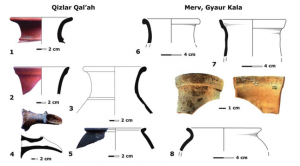
Pp. 21-40: “Correlated Change: Comparing Modifications to Ceramic Assemblages from Qizlar Qalʾeh, Iran, and Ancient Merv, Turkmenistan, during the Seleucid and Parthian Periods,” by Gabriele Puschnigg, Maria Daghmehchi, and Jebrael Nokandeh
From the Seleucid period onward, substantial transformations occurred in the ceramic assemblages from Qizlar Qalʾeh on the Gorgan Plain and ancient Merv (modern Gyaur Kala). Using quantitative and archaeometric analyses, we assess and compare modifications in vessel repertoires, production techniques, and material sources across both sites to understand the nature and chronology of these changes. Similar technological developments are observed at Qizlar Qalʾeh and Merv, and are examined with regard to a potential Hellenistic reception in the ceramic material. Variations in the chronological distribution of innovations and assemblage composition help us to elucidate the neighborhood relations between eastern Iran and western Central Asia at this time. Our comparisons point toward a common cultural environment for both sites especially during the Early Parthian period, which is demonstrated in the many analogies of manufacturing techniques and vessel shapes. At the same time, we see different continuing local traditions, highlighting the flexible mode in which ceramic repertoires are adapted to the changing requirements under Hellenistic rule.
ASOR Members with online access: navigate to the token link email sent to you before attempting to read this article. Once you have activated your member token, click here to access the above article on The University of Chicago Press Journals’ website.
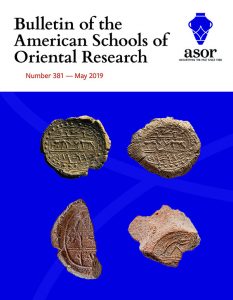
Pp. 41-56: “Four Judean Bullae from the 2014 Season at Tel Lachish,” by Martin G. Klingbeil, Michael G. Hasel, Yosef Garfinkel, and Néstor H. Petruk
The article presents four decorated epigraphic bullae unearthed in the Level III destruction at Lachish during the 2014 season, focusing on the epigraphic, iconographic, and historical aspects of the seal impressions.
ASOR Members with online access: navigate to the token link email sent to you before attempting to read this article. Once you have activated your member token, click here to access the above article on The University of Chicago Press Journals’ website.
Pp. 57-81: “Uninscribed Amethyst Scarabs from the Southern Levant,” by Arlette David
Prompted by the discovery of a schematic uninscribed amethyst scarab at Tel Abel Beth Maacah in the Upper Galilee, an overview of such scarabs found in the southern Levant is provided, with a typological analysis and a tentative dating and origin of these pieces.
ASOR Members with online access: navigate to the token link email sent to you before attempting to read this article. Once you have activated your member token, click here to access the above article on The University of Chicago Press Journals’ website.
Pp. 83-105: “Foreign Food Plants as Prestigious Gifts: The Archaeobotany of the Amarna Age Palace at Tel Beth-Shemesh, Israel,” Ehud Weiss, Yael Mahler-Slasky, Yoel Melamed, Zvi Lederman, Shlomo Bunimovitz, Shawn Bubel, and Dale Manor
In contrast with the relatively rich documentation from the el-Amarna archive related to the main city-states of the southern Levant in the Amarna Age (Late Bronze Age IIA; 14th century b.c.e.), archaeological data from these sites is still wanting. This unfortunate situation highlights the importance of the ca. 60,000-item plant collection from the recently exposed Late Bronze Age IIA palace at Tel Beth-Shemesh. Room L1505 in the palace—apparently a pantry due to its contents of foodstuffs and vessels for food preparation and consumption—contained eight deposits of carbonized crop plants. Deposits of almost pure grains and very low numbers of weed seeds were found, indicating that these stored food plants were ready to be used in food preparation. Of special interest is the presence of a sizeable amount of two rare pulses in Levantine archaeobotany—fenugreek (Trigonella foenum-graecum) and Cyprus vetch (Lathyrus ochrus)—only found in two other Bronze Age royal contexts: Tutankhamun’s tomb in Egypt and the Late Minoan II Unexplored Mansion in Knossos. Thus, in addition to attesting to the agricultural practices and culinary preferences of a Canaanite ruling court during the Amarna Age, this botanical assemblage also hints at prestigious royal gift exchanges of exotic food plants.
ASOR Members with online access: navigate to the token link email sent to you before attempting to read this article. Once you have activated your member token, click here to access the above article on The University of Chicago Press Journals’ website.
Pp. 107-144: “Tel Yaqush—An Early Bronze Age Village in the Central Jordan Valley, Israel,” by Yael Rotem, Mark Iserlis, Felix Höflmayer, and Yorke M. Rowan
This article highlights the results of five excavation seasons at Tel Yaqush, Israel, conducted between the 1989 and 2000 on behalf of The Oriental Institute at The University of Chicago. Tel Yaqush was a medium-sized village, inhabited during the entire Early Bronze Age period, from the mid-4th to the mid-3rd millennia b.c.e. The excavations exposed a dense settlement begun in the Early Bronze Age (EB) I, which ended in a severe conflagration. Apparently rebuilt at the beginning of EB II, the village remained a small site and technically non-urban throughout the period. Destroyed at the end of EB II, it was renewed in EB III, coinciding with the arrival of people bearing the Khirbet Kerak Ware ceramic tradition. This preliminary report includes new observations following recent studies of Tel Yaqush finds, including a new sequence of 14C dates from EB I to III (published in detail elsewhere). The excavation results summarized here reveal the unique role Tel Yaqush played during the shift to urbanism, and its contribution to our understanding of Early Bronze Age village society in the central Jordan Valley.
ASOR Members with online access: navigate to the token link email sent to you before attempting to read this article. Once you have activated your member token, click here to access the above article on The University of Chicago Press Journals’ website.
Pp. 145-162: “‘Crossing the Lines’—Elaborately Decorated Chalcolithic Basalt Bowls in the Southern Levant,” by Rivka Chasan, Edwin C. M. van den Brink, and Danny Rosenberg
The Late Chalcolithic period in the southern Levant shows a marked increase in symbolic expression. While most Late Chalcolithic basalt bowls are undecorated, notable amounts of these were adorned, and their decorations typically conform to a few canonized conventions. A small amount of the decorated Late Chalcolithic basalt bowls are further incised with unconventional, unique designs on their exteriors. These elaborately decorated basalt bowls stand in sharp contrast to the conventionally decorated ones, thus signifying their different roles. This article discusses their geographic distributions, frequencies, and characteristics, and offers further suggestions as to their position within the Late Chalcolithic symbolic and prestige item systems. The analysis reveals regional patterns—the elaborately decorated basalt bowls are constrained to south of the Yarkon River—suggesting that the function and symbolic value of these bowls were probably geographically restricted. Their limited distribution underlines the exclusivity of these elaborately decorated bowls during the Late Chalcolithic period.
ASOR Members with online access: navigate to the token link email sent to you before attempting to read this article. Once you have activated your member token, click here to access the above article on The University of Chicago Press Journals’ website.
Pp. 163-191: “Canaanite Reḥob: Tel Reḥov in the Late Bronze Age,” by Amihai Mazar, Uri Davidovich, and with an Appendix by Arlette David
Tel Reḥov, identified with Reḥob, was one of the largest Canaanite cities in the southern Levant during the Late Bronze Age (15th–13th centuries b.c.e.). Unlike many other Canaanite settlements, the city was founded in the 15th century after a hiatus beginning in Early Bronze Age III. In this article, four major Late Bronze Age occupation strata are described. Notable is a monumental structure dated to the 14th century b.c.e. with unusual architectural features that could be either the residence of a high-ranking family or an administrative building. During the 13th century b.c.e., this building was replaced by a new structure containing a metalsmith’s workshop, inspired by Egyptian 19th Dynasty techniques, while later building phases belong to the final stages of the Late Bronze Age. No destruction layers were found, and the Late Bronze Age city was rebuilt and continued to thrive throughout the Iron Age I. Five Late Bronze Age plaque figurines, some of particular interest, are also described. An appendix discusses a rare funerary scarab of an Egyptian high official found in the 14th-century b.c.e. edifice.
ASOR Members with online access: navigate to the token link email sent to you before attempting to read this article. Once you have activated your member token, click here to access the above article on The University of Chicago Press Journals’ website.
Pp. 193-202: “Abracadabra, or ‘I Create as I Speak’: A Reanalysis of the First Verb in the Katumuwa Inscription in Light of Northwest Semitic and Hieroglyphic Luwian Parallels,” by Timothy Hogue
Previous translations of the Katumuwa Inscription have either rendered the first verbal phrase (qnt ly) “I commissioned for myself,” or “I acquired for myself.” No scholars have yet defended the possibility that it simply means “I made.” In fact, this is likely the case given the typical monumental rhetoric of Northwest Semitic and Hieroglyphic Luwian monumental inscriptions. In particular, a comparison with verbs of monumenting in Hieroglyphic Luwian inscriptions suggests that the monumenting phrase in the Katumuwa Inscription was calqued on a Luwian phrase. This difference is significant because it reveals an important aspect of the inscription’s monumentality and the Syro-Anatolian conception of the stele. The stele that Katumuwa created was not understood merely as the inscribed object. Rather, the monument was the conjunction of material object, ritual engagement, and the resultant manifestation of the monument’s commissioner. There was no monument apart from Katumuwa, whose voice was preserved in the inscription and whose presence could be reactivated through ritual. Therefore, Katumuwa did in fact “create” the stele as he spoke through it to his monument’s users.
ASOR Members with online access: navigate to the token link email sent to you before attempting to read this article. Once you have activated your member token, click here to access the above article on The University of Chicago Press Journals’ website.
Pp. 203-210: “An Inscribed Sherd in Aramaic Script from Barikot, Pakistan,” by Michael Zellmann-Rohrer and Luca Maria Olivieri
This article discusses a sherd inscribed with a text in Aramaic script from Barikot in Pakistan. The site, known in classical sources on Alexander the Great, has been regularly investigated over the last 40 years. In recent excavation campaigns, new evidence of the earliest phases of the city (500–50 b.c.e.) has been discovered, including the sherd treated here, among other inscribed pottery in Greek and Brāhmī.
ASOR Members with online access: navigate to the token link email sent to you before attempting to read this article. Once you have activated your member token, click here to access the above article on The University of Chicago Press Journals’ website.
Pp. 211-236: “An Eighth-Century b.c.e. Gate Shrine at Tel Lachish, Israel,” by Saar Ganor and Igor Kreimerman
Excavations conducted on behalf of the Israel Antiquities Authority at Tel Lachish exposed the southern half of the six-chambered gate in Level III. In the eastern chamber, a gate shrine was uncovered. The shrine was split in two: a larger northern room and a smaller southern room. The southern room, which served as the holy of holies, had a niche in its southern wall in front of which a double altar was placed. Dozens of bowls and oil lamps were revealed inside the shrine. At some point, evidently prior to the destruction of Level III by Sennacherib in 701 b.c.e., the shrine was desecrated and sealed. This act was evident in the breakage of the altar’s horns and the placement of a latrine in the holy of holies. The available data suggests that the desecration of the shrine should be associated with Hezekiah’s cultic reform (2 Kgs 18:4).
ASOR Members with online access: navigate to the token link email sent to you before attempting to read this article. Once you have activated your member token, click here to access the above article on The University of Chicago Press Journals’ website.
[/vc_column_text][mk_divider][vc_column_text]ASOR Members with online access: navigate to the token link email sent to you before attempting to read this issue. Once you have activated your member token, click here to access the the entire issue, including book reviews, on The University of Chicago Press Journals’ website.[/vc_column_text][/vc_column][vc_column border_color=”rgba(170,170,170,0.01)” width=”1/6″ css=”.vc_custom_1496684098866{margin-right: 5px !important;margin-bottom: 20px !important;border-right-width: 2px !important;border-bottom-width: 2px !important;padding-top: 30px !important;padding-right: 10px !important;padding-left: 10px !important;background-color: #ffffff !important;border-right-color: rgba(227,228,228,0.75) !important;border-bottom-color: rgba(227,228,228,0.75) !important;}”][vc_wp_posts title=”BROWSE THE NEWS ARCHIVE” number=”4″][/vc_column][vc_column border_color=”rgba(170,170,170,0.01)” width=”1/6″ css=”.vc_custom_1496684008271{margin-right: 10px !important;margin-bottom: 30px !important;border-right-width: 2px !important;border-bottom-width: 2px !important;padding-top: 30px !important;padding-right: 20px !important;padding-left: 20px !important;background-color: #ffffff !important;border-right-color: rgba(227,228,228,0.75) !important;border-bottom-color: rgba(227,228,228,0.75) !important;}”][vc_column_text]Tweets by ASOResearch [/vc_column_text][/vc_column][/vc_row]
[/vc_column_text][vc_column_text]At the 2018 ASOR Annual Meeting, the P. E. MacAllister Field Archaeology Award was presented to Aren M. Maeir, Professor, The Martin (Szusz) Department of Land of Israel Studies and Archaeology, Bar-Ilan University, for his outstanding career contributions to both ancient Near Eastern and Eastern Mediterranean archaeology.
As Director of the Tell es-Safi/Gath Archaeological Project in Israel, one of the largest and longest-running archaeological field projects (1997-present), Aren brings together an international team of over 100 volunteers and has created a model “teaching dig” for instruction in modern field techniques and archaeological sciences. Philistine Gath bears the legacy of Eastern Mediterranean migration and cultural transfer to Canaan during the Iron Age I and embodies the entanglement of those many heritages into the Iron Age II. Aren’s long-time excavations at Gath have resulted in much broader understanding of many aspects of both ancient Near Eastern and Eastern Mediterranean archaeology. Aren also codirects the Minerva Center for the Relations between Israel and Aram in Biblical Times (RIAB; aramisrael.org) and is co-editor of the Israel Exploration Journal. He has over 100 publications, many co-authored with the students he has mentored. For his commitment to his role as teacher and mentor for generations of archaeology students, he is honored with the P. E. MacAllister Field Archaeology Award.
Nominate someone for an award. The deadline for service award nominations is September 2, 2019. The deadline for book award nominations September 16, 2019.[/vc_column_text][/vc_column][vc_column border_color=”rgba(170,170,170,0.01)” width=”1/6″ css=”.vc_custom_1496684098866{margin-right: 5px !important;margin-bottom: 20px !important;border-right-width: 2px !important;border-bottom-width: 2px !important;padding-top: 30px !important;padding-right: 10px !important;padding-left: 10px !important;background-color: #ffffff !important;border-right-color: rgba(227,228,228,0.75) !important;border-bottom-color: rgba(227,228,228,0.75) !important;}”][vc_wp_posts title=”BROWSE THE NEWS ARCHIVE” number=”4″][/vc_column][vc_column border_color=”rgba(170,170,170,0.01)” width=”1/6″ css=”.vc_custom_1496684008271{margin-right: 10px !important;margin-bottom: 30px !important;border-right-width: 2px !important;border-bottom-width: 2px !important;padding-top: 30px !important;padding-right: 20px !important;padding-left: 20px !important;background-color: #ffffff !important;border-right-color: rgba(227,228,228,0.75) !important;border-bottom-color: rgba(227,228,228,0.75) !important;}”][vc_column_text]Tweets by ASOResearch [/vc_column_text][/vc_column][/vc_row][vc_row][vc_column][vc_column_text]
[/vc_column_text][/vc_column][/vc_row][vc_row][vc_column][vc_column_text]
[/vc_column_text][/vc_column][/vc_row]
Thanks to the generous funding provided by the ASOR Platt Excavation Fellowship, I had the opportunity to participate in an archaeological dig at a site called Khirbet el-‘Eika in Israel this summer. Directed by Uzi Leibner of the Hebrew University of Jerusalem, this was the final excavation season at Khirbet el-‘Eika, part of a larger study of the material culture of rural Galilean settlements in the Hebrew University’s Hellenistic Galilee Project. As this was my first experience with archaeological fieldwork, I had little idea of what to expect. But once I settled into the daily routine of excavating, washing pottery, and attending field trips and lectures, I soon learned that the life of an archaeologist was even more fascinating and enjoyable than I had anticipated.
Before this summer, I had never traveled outside the US; in fact, the longest flight I had ever endured was only from Phoenix to Seattle. In the months leading up to the dig, I was not only trying to learn more about the actual methods used in archaeology, but also mentally preparing myself for my first cross-cultural experience, and for the daunting 18 hours of flights from Phoenix to Tel Aviv (with a couple connections) ahead of me. Despite my concerns about culture shock and sleeping on a plane, my main misgivings about the trip related to my lack of prior archaeological training. My own research has, to this point, exclusively revolved around textual sources. Faced with this exciting new field of study, I had many questions: Would I clumsily destroy some priceless artifact? Or would I not find anything at all? Beyond my vague preconceptions about what an archaeologist actually does (which, I’ll admit, were largely derived from the Indiana Jones movies), I didn’t know quite what I was getting myself into.
Once I arrived in Israel and started the dig, I quickly came to realize that the reality of archaeological fieldwork far surpassed my expectations, particularly with respect to the frequency of finds. I was fortunate to have been assigned to excavate a storage room along with two other volunteers. After a couple days of clearing away a collapse, we began to uncover a variety of large vessels. Perhaps the most exciting moment for me at the dig was finding a small clay juglet that had remained completely intact. After showing it to Dr. Leibner and to my area supervisor, they set it aside for residue analysis. A week later, the juglet was featured in one of our evening lectures on pottery found at the site. In our square we also found numerous bones (primarily from sheep and goats), along with metal implements such as nails and a key. Fortunately, my poor coordination never resulted in destroyed artifacts, despite my fears.
At the risk of sounding cliché, the most memorable part of my experience at Khirbet el-‘Eika was the wonderful group of people I was able to work with. Dr. Leibner and the Hebrew University students not only provided volunteers with helpful guidance and information, but also created an amiable environment in which friendships could develop. I hope to stay in contact with some of my fellow volunteers, and a few of us are planning to coordinate in future summers and get some of the group back together at another excavation. Once the dust at Khirbet el-‘Eika settled, I found that what I missed most was not the thrill of a new find, but sitting at the breakfast table, listening to friends pitch outlandish ideas for science fiction movies.
As a student of early Jewish and Christian literature, one of the lasting effects of my experience this summer will be a vastly improved mental image of the world behind the text, both in terms of the physical landscape and geographical features of Israel, as well as the elements of material culture that shaped daily life in the ancient Mediterranean world. If one wants to gain a better understanding of the setting in which these writings were produced, there is no substitute for the kind of firsthand experience that comes with participating in an excavation.
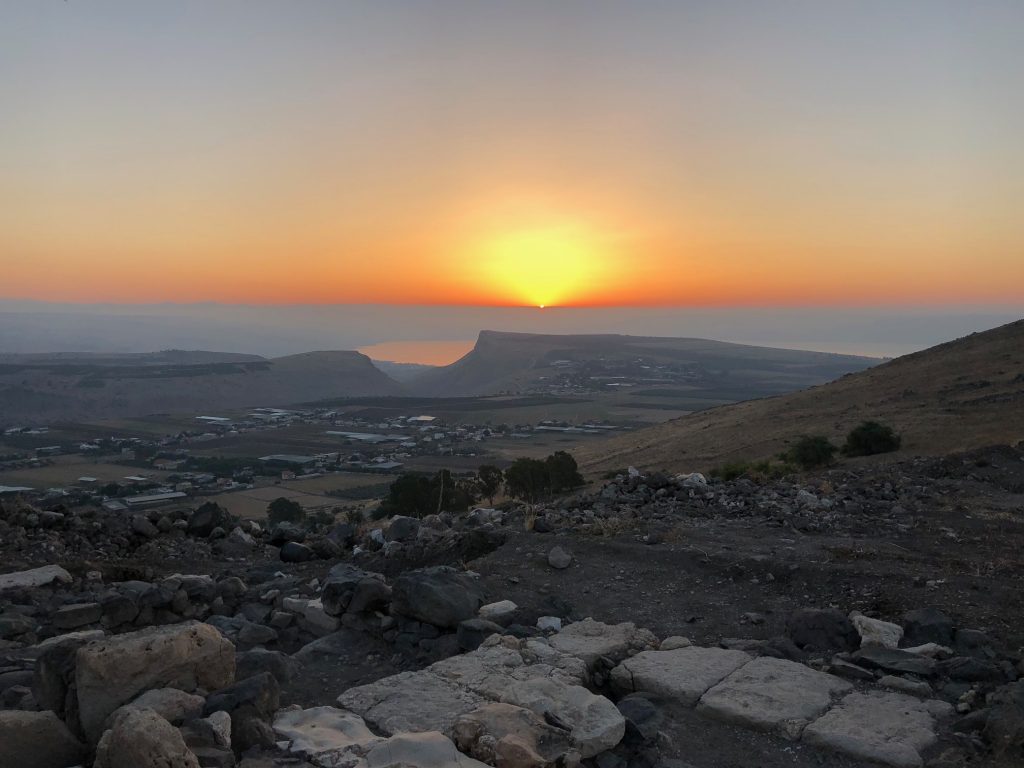
While excavation is hard work, it is exceedingly rewarding; from the beautiful sunrise over the Sea of Galilee and Mount Arbel and exciting discoveries throughout the day, to joking around with the other volunteers, there was never a dull moment digging at Khirbet el-‘Eika. My first archaeological excavation was an unforgettable experience, and I am enormously grateful to ASOR and its donors for making it possible.
Austin Richards is a senior undergraduate at Arizona Christian University in Phoenix, AZ. He is majoring in biblical studies with an emphasis in biblical languages and exegesis, and plans to apply to graduate programs in the upcoming application season. His research interests primarily relate to linguistic analysis of the Greek New Testament.
Want to help more students and young archaeologists get into the field? Donate to the cause today by selecting “Excavation Scholarships” as your gift purpose!
[/vc_column_text][vc_column_text]ASOR President Susan Ackerman and Vice-President Sharon Herbert are pleased to announce they have formed a committee to develop an ASOR Code of Conduct for the Annual Meeting. The committee members — drawn from the membership of ASOR’s six standing governance committees and the Initiative on the Status of Women — are Helen Dixon, Emily Hammer, Mara Horowitz, Ian Jones, R. Scott Moore, Tine Rassalle, Alison Thomason, Lynn Welton, and Vanessa Workman. ASOR Trustee Emily Miller Bonney serves as the committee chair.
We envision that this Code of Conduct will address multiple issues concerning the safety and well-being of participants at the ASOR Annual Meeting including but not limited to (1) discrimination based on sex, gender, gender identity, sexual orientation, race, ethnicity, age, and religion; (2) harassment, including (a) sexual harassment, (b) harassment that creates a hostile or intimidating environment, (c) harassment that demeans a person or group of persons and that the person responsible knew or reasonably ought to have known would cause the target to be humiliated, intimidated, or otherwise gratuitously harmed; and (d) harassment that functions implicitly or explicitly to limit others’ participation in the Annual Meeting’s program and associated activities; (3) assault, including sexual assault. The code should also include plans for emergency management of such incidents at the Annual Meeting.
At the same time the proposed Code of Conduct will recognize that conference participants have protected rights to free speech. The drafters will endeavor to achieve the appropriate balance between asserting ASOR’s commitment to the principle that conference attendees should be free from discrimination, harassment and assault while still able to exercise their academic freedom.
Overall, we hope an ASOR Code of Conduct for the Annual Meeting should set forward a series of principles for respectful and professional behavior to which every participant at the ASOR Annual Meeting should aspire, as well as a series of best practices that ASOR should strive to enact. We are grateful to Emily Miller Bonney and to the members of the Annual Meeting Code of Conduct Committee for their work on this issue, which began already last month. Their goal — and ours — is to have a policy in place for the November 2019 ASOR Annual Meeting in San Diego.[/vc_column_text][/vc_column][vc_column border_color=”rgba(170,170,170,0.01)” width=”1/6″ css=”.vc_custom_1496684098866{margin-right: 5px !important;margin-bottom: 20px !important;border-right-width: 2px !important;border-bottom-width: 2px !important;padding-top: 30px !important;padding-right: 10px !important;padding-left: 10px !important;background-color: #ffffff !important;border-right-color: rgba(227,228,228,0.75) !important;border-bottom-color: rgba(227,228,228,0.75) !important;}”][vc_wp_posts title=”BROWSE THE NEWS ARCHIVE” number=”4″][/vc_column][vc_column border_color=”rgba(170,170,170,0.01)” width=”1/6″ css=”.vc_custom_1496684008271{margin-right: 10px !important;margin-bottom: 30px !important;border-right-width: 2px !important;border-bottom-width: 2px !important;padding-top: 30px !important;padding-right: 20px !important;padding-left: 20px !important;background-color: #ffffff !important;border-right-color: rgba(227,228,228,0.75) !important;border-bottom-color: rgba(227,228,228,0.75) !important;}”][vc_column_text]Tweets by ASOResearch [/vc_column_text][/vc_column][/vc_row][vc_row][vc_column][vc_column_text]
[/vc_column_text][vc_column_text]Update: this is an archived job posting from 2019. The position has been filled; the new Director is Dr. Pearce Paul Creasman (press release link)
The American Center of Oriental Research (ACOR) seeks a Director to lead a wide-ranging research program that orchestrates extensive partnerships with U.S. and Jordanian government agencies, universities, and academics.
Founded in 1968, ACOR has worked at the forefront of international efforts to increase understanding of Jordan past and present and to make Jordan’s cultural heritage a source of economic development. In 2014, ACOR launched the Sustainable Cultural Heritage Through Engagement of Local Communities Project (USAID SCHEP), which helps communities around archaeological sites throughout Jordan to harness their own heritage to create educational and economic opportunities.
ACOR also holds the best library for archaeology and Middle Eastern studies in Jordan, the only place for scholars to access JSTOR, and hostel accommodations for fellows, researchers, and other visitors using its unique resources.
Today ACOR seeks to extend a period of growth that has fostered an atmosphere of openness and accessibility, joint community ventures, and a focus on close mentorship and practical training. ACOR’s planned leadership transition offers an opportunity for the organization to take a fresh look at these initiatives and to extend them in new directions.
The new Director will draw on considerable resources—including government relationships, support from the Board of Trustees, and an active Fellowships Committee–to set ACOR’s strategic course for a next generation of scholars and students devoted to Jordan’s cultural history and to understanding the social and economic issues Jordan faces in the modern world.
The ideal candidate will have:
-At least 10 years of distinguished work experience in: academia, cultural resources management, foreign affairs, business, or non-profit organization management.
-At least 5 years of experience managing staff.
-D. or equivalent in fields including but not limited to Middle Eastern studies, archaeology, history, art history sociology, political science, or anthropology.
-Familiarity with the principles of archaeological preservation and conservation.
-Demonstrated ability to lead, manage, and organize staff to achieve and exceed goals.
-Ability to maintain a positive, collegial, and collaborative work environment.
-Strong organizational abilities, including planning, delegating, and assessment.
-Strong written and oral communication skills.
-Sophisticated ability to navigate cross-cultural encounters and exchanges.
-Strong interest in making a home in Jordan and working with Jordanians.
-Arabic language skills are highly desirable.
Development Resources, inc. is conducting this search for the American Center of Oriental Research. Candidates can learn more and apply at http://driconsulting.com/available-positions/ or by emailing search@driconsulting.com. Applications must be received by July 8, 2019.[/vc_column_text][/vc_column][vc_column border_color=”rgba(170,170,170,0.01)” width=”1/6″ css=”.vc_custom_1496684098866{margin-right: 5px !important;margin-bottom: 20px !important;border-right-width: 2px !important;border-bottom-width: 2px !important;padding-top: 30px !important;padding-right: 10px !important;padding-left: 10px !important;background-color: #ffffff !important;border-right-color: rgba(227,228,228,0.75) !important;border-bottom-color: rgba(227,228,228,0.75) !important;}”][vc_wp_posts title=”BROWSE THE NEWS ARCHIVE” number=”4″][/vc_column][vc_column border_color=”rgba(170,170,170,0.01)” width=”1/6″ css=”.vc_custom_1496684008271{margin-right: 10px !important;margin-bottom: 30px !important;border-right-width: 2px !important;border-bottom-width: 2px !important;padding-top: 30px !important;padding-right: 20px !important;padding-left: 20px !important;background-color: #ffffff !important;border-right-color: rgba(227,228,228,0.75) !important;border-bottom-color: rgba(227,228,228,0.75) !important;}”][vc_column_text]Tweets by ASOResearch [/vc_column_text][/vc_column][/vc_row][vc_row][vc_column][vc_column_text]
ASOR MEMBER JODI MAGNESS ELECTED TO AMERICAN ACADEMY OF ARTS AND SCIENCES
[/vc_column_text][vc_column_text]ASOR congratulates longtime ASOR member, past Annual Meeting Plenary Speaker, and current president of the Archaeological Institute of America, Prof. Jodi Magness, on her election to the American Academy of Arts and Sciences. The Academy recognizes the outstanding achievements of individuals in academia, the arts, business, government, and public affairs. The Academy was founded in 1780 by John Adams, John Hancock, and others who believed the new republic should honor exceptionally accomplished individuals and engage them in advancing the public good. The Academy’s dual mission remains essentially the same 239 years later with honorees from increasingly diverse fields and with the work focused on the arts, democracy, education, global affairs, and science.
Prof. Magness holds a senior endowed chair in the Department of Religious Studies at the University of North Carolina at Chapel Hill: the Kenan Distinguished Professor for Teaching Excellence in Early Judaism. From 1992-2002, Magness was Associate/Assistant Professor of Classical and Near Eastern Archaeology in the Departments of Classics and Art History at Tufts University, Medford, MA. She received her B.A. in Archaeology and History from the Hebrew University of Jerusalem (1977), and her Ph.D. in Classical Archaeology from the University of Pennsylvania (1989).
Magness has participated on 20 different excavations in Israel and Greece, including co-directing the 1995 excavations in the Roman siege works at Masada. From 2003-2007 she co-directed excavations in the late Roman fort at Yotvata, Israel. Since 2011, Magness has directed excavations at Huqoq in Galilee (www.huqoq.org). She recently (Nov. 2018) published the amazing mosaics from Huqoq in the Bulletin of the American Schools of Oriental Research (BASOR) (link).
[/vc_column_text][mk_divider][vc_wp_text]Lorem ipsum dolor sit amet, consectetur adipiscing elit, sed do eiusmod tempor incididunt ut labore et dolore magna aliqua. Ut enim ad minim veniam, quis nostrud exercitation ullamco laboris nisi ut aliquip ex ea commodo consequat. Duis aute irure dolor in reprehenderit in voluptate velit esse cillum dolore eu fugiat nulla pariatur. Excepteur sint occaecat cupidatat non proident, sunt in culpa qui officia deserunt mollit anim id est laborum.
The editors at the 2019 Annual Meeting in San Diego.
Lorem ipsum dolor sit amet, consectetur adipiscing elit, sed do eiusmod tempor incididunt ut labore et dolore magna aliqua. Ut enim ad minim veniam, quis nostrud exercitation ullamco laboris nisi ut aliquip ex ea commodo consequat. Duis aute irure dolor in reprehenderit in voluptate velit esse cillum dolore eu fugiat nulla pariatur. Excepteur sint occaecat cupidatat non proident, sunt in culpa qui officia deserunt mollit anim id est laborum.
Lorem ipsum dolor sit amet, consectetur adipiscing elit, sed do eiusmod tempor incididunt ut labore et dolore magna aliqua. Ut enim ad minim veniam, quis nostrud exercitation ullamco laboris nisi ut aliquip ex ea commodo consequat. Duis aute irure dolor in reprehenderit in voluptate velit esse cillum dolore eu fugiat nulla pariatur. Excepteur sint occaecat cupidatat non proident, sunt in culpa qui officia deserunt mollit anim id est laborum.
Lorem ipsum dolor sit amet, consectetur adipiscing elit, sed do eiusmod tempor incididunt ut labore et dolore magna aliqua. Ut enim ad minim veniam, quis nostrud exercitation ullamco laboris nisi ut aliquip ex ea commodo consequat. Duis aute irure dolor in reprehenderit in voluptate velit esse cillum dolore eu fugiat nulla pariatur. Excepteur sint occaecat cupidatat non proident, sunt in culpa qui officia deserunt mollit anim id est laborum.[/vc_wp_text][/vc_column][vc_column border_color=”rgba(170,170,170,0.01)” width=”1/6″ css=”.vc_custom_1496684098866{margin-right: 5px !important;margin-bottom: 20px !important;border-right-width: 2px !important;border-bottom-width: 2px !important;padding-top: 30px !important;padding-right: 10px !important;padding-left: 10px !important;background-color: #ffffff !important;border-right-color: rgba(227,228,228,0.75) !important;border-bottom-color: rgba(227,228,228,0.75) !important;}”][vc_wp_posts title=”BROWSE THE NEWS ARCHIVE” number=”4″][/vc_column][vc_column border_color=”rgba(170,170,170,0.01)” width=”1/6″ css=”.vc_custom_1496684008271{margin-right: 10px !important;margin-bottom: 30px !important;border-right-width: 2px !important;border-bottom-width: 2px !important;padding-top: 30px !important;padding-right: 20px !important;padding-left: 20px !important;background-color: #ffffff !important;border-right-color: rgba(227,228,228,0.75) !important;border-bottom-color: rgba(227,228,228,0.75) !important;}”][vc_column_text]Tweets by ASOResearch [/vc_column_text][/vc_column][/vc_row]
EXECUTIVE COMMITTEE AND BOARD OF TRUSTEE MEETING REPORT
[/vc_column_text][vc_column_text]By Susan Ackerman, ASOR President
Every spring, the ASOR Board of Trustees and the Board’s Executive Committee meet to engage in discussions and undertake items of business that have come forward since the Executive Committee’s and Board’s gatherings at the November Annual Meeting. This year, the Executive Committee and the Board met during the weekend of April 5-6, in Alexandria, VA.
The meeting was an opportunity for the Board to see — at a gala housewarming reception on Friday, April 5th — ASOR’s fabulous new home in Alexandria, at 209 Commerce Street. At that reception, moreover, we were able to announce that at the request of the extremely generous anonymous donor who has taken the lead in contributing to our building fund, ASOR’s new home will be named in honor of our late ASOR colleague, James Francis Strange. I am writing this report on April 15th, a little more than a year after Jim’s death, on March 23, 2018, and it is deeply gratifying to me to know that ASOR is able to mark the anniversary of Jim’s passing with such a permanent and significant memorial.
The ASOR Annual Meeting
The major item on the agenda for this spring’s Executive Committee and Board of Trustees meetings was a discussion of the future location of the ASOR Annual Meeting. The Executive Committee and Board received a long and detailed report (82 data-packed pages!) from the Ad Hoc Committee on the Future of the Annual Meeting, which included recommendations about what ASOR might do going forward.
Most ASOR members know the problem. In 1997, when ASOR separated from the Society of Biblical Literature (SBL), ASOR committed to hold its annual meeting in the same city, or at least in reasonable geographical proximity, to SBL, and within the same general time frame (during the days immediately prior to the start of the SBL meeting). ASOR members, and the ASOR Executive Committee and Board, reaffirmed this decision at the ASOR Annual Meeting in 2007, and I think it is fair to say that this “meet independently, but in geographical and temporal conjunction with SBL” is a model that worked well for ASOR, and especially for joint SBL-ASOR members, through 2013.
But after SBL rejoined forces with the American Academy of Religion (AAR) in 2011, it became harder and harder for ASOR to secure meeting and hotel space proximate to the combined and very large AAR-SBL meeting. That meant we were in Buckhead in 2015, while AAR-SBL was in downtown Atlanta; we were in a suburban resort in San Antonio in 2016, while AAR-SBL was downtown; in 2017, we were at the waterfront Westin in Boston, while AAR-SBL was downtown at the Hynes Convention Center; and we were at the Denver Tech Park in 2018, while AAR-SBL was in downtown Denver.
Going forward, we continue to face challenges, especially when AAR-SBL is scheduled to meet in smaller cities such as San Antonio (2021, 2023, 2029) and Denver (2022, 2026). Already, then, in 2015, I appointed an Ad Hoc Committee on the Future of the Annual Meeting, charged with developing recommendations regarding a way forward. Many of you will remember that this committee conducted an all-member discussion on Thursday of the 2018 Annual Meeting, to allow ASOR’s members to present their views and discuss issues and options. The committee also conducted a member-wide survey on the future of the Annual Meeting in 2016 and again in February of this year. This 2019 survey was especially important: although it was long — 21 questions — about 580 people (more than 1/3 of the ASOR membership) responded. That’s an extraordinary response rate, and I invite ASOR members to review the results, published in both summary form and as a full data set here.
In its report that assimilated and analyzed all this (and other) data, the Ad Hoc Committee recommended that ASOR find a middle ground going forward: a way that could sustain ASOR’s historic ties to SBL and enable the many joint ASOR-SBL members to attend both meetings, yet could correct the issue that many ASOR members clearly find unsatisfactory: meeting in the outskirts of cities like San Antonio (as in 2016) and Denver (as in 2018) because we cannot secure hotel and meeting space downtown. In the end, the Board adopted what we are calling “the flexibility model,” to wit:
ASOR will make all reasonable efforts to meet in its current time frame (Wednesday to Saturday pattern) in the same city as SBL. In years in which it is not reasonable and economically feasible, ASOR will conduct its meeting in a city that best serves the greatest number of its constituencies.
The Board vote in favor of this decision was unanimous.
It remains only for me to thank the members of the Ad Hoc Committee on the Future of the Annual Meeting for their extremely hard work. They are Gary Arbino (Chair), Kent Bramlett, William Caraher, Sidnie White Crawford, Erin Darby, Karen Rubinson, and Eric Welch. I know (because I am on the e-mail chain) that they performed over and beyond the call of duty, and we in ASOR all owe them our deepest gratitude for everything they have done to make sure the Board could make the best informed decision possible.
The ASOR Budget
Another major item on the agenda for the ASOR Board’s spring meetings is always the budget, both a review of the budget for the current fiscal year (FY 19), which will come to an end on June 30, and approving the budget for the upcoming fiscal year (FY 20), which starts on July 1. The FY 19 budget is balanced – indeed, almost perfectly so, as we imagine ending the year with just a small surplus of $23! For FY 20, the Board approved a budget that also is projecting a small surplus, of $750, with projected revenues of $1,738,000 and projected expenses of $1,737,250.
In both FY 19 and FY 20, our budget — both on the income and expenses side — has a major new item: designated gifts for our new building and its furnishings and maintenance, In FY 19, we anticipate receiving $600,000 in revenue from these designated gifts, income that we will then apply to the purchase price of our building ($1.1 million) at closing (scheduled for April 24th!) and to paying down the balance we owe (financed through a short-term equity line of credit). In FY 20, we will likewise use the $400,000 in revenue we anticipate receiving as designated gifts to pay down our equity loan
We also received, in February, an additional and extraordinarily generous pledge of $450,000 that is conditional to a 2:1 match: i.e., for every $2 of the pledge, we need to raise $1 (or $225,000 total). So far, we have done exceptional work in meeting this challenge, as we have already raised $156,000 in the two-and-a-half months since the challenge was announced. Nevertheless, we need everyone’shelp in raising the last $69,000. If we can raise this last $69,000, that will bring our total fund-raising up to $1.6 million, enough both to buy the building, pay financing, inspection, and closing costs, and to establish a $450,000 endowment (with a $22,500/year payout) to cover building maintenance and annual operating expenses.
ASOR Officers
My term as ASOR’s President and the terms of ASOR’s Board Chair, Richard Coffman, and ASOR’s Vice-President, Sharon Herbert, all expire at the end of December 2019, and the Officers Nominations Committee (ONC) worked hard before the Board meeting to identify how these positions should be filled going forward. The ONC continues, moreover, its hard work, as it is still deliberating regarding a new Vice-President.
But I am thrilled to announce that Sharon Herbert has been elected as ASOR’s new President, for an initial three-year term, and that Richard Coffman has been elected to serve for a second three-year term as Board Chair. Both terms will run from January 1, 2020, through December 31, 2022. Having worked with Sharon as ASOR Vice-President for the past six years, and with Richard as in his role as Board Chair for the past three-and-a-half years (and before that in his role as ASOR Treasurer), I can say unreservedly and with complete authority that ASOR going forward will be in the best possible hands. I join all the Board’s members in congratulating both Sharon and Richard on their appointments, and I know all of us offer them our gratitude and thanks for their willingness to serve ASOR in such important leadership roles.
In addition, the Board welcomed three new members: Emily Miller Bonney and Eric Welch (both Membership-elected Trustees) and Ann Sahlman (a Board-elected Trustee). We’re very happy to have these new colleagues on our Board.
Other Business
The Board finally considered several other matters of ASOR business. Probably most of note for ASOR members, the Board affirmed the President’s and Vice-President’s initiative regarding the creation of another Ad Hoc Committee, this one charged with developing a Code of Conduct for the ASOR Annual Meeting. Many other learned societies have developed such codes, and recent events at the meetings of organizations such as the Society of Classical Studies (see here and here) and the Society for American Archaeology (see here) demonstrate the need for ASOR to have a similar Code of Conduct in place. Relatedly, the Board was pleased to affirm the recently Developed Code of Conduct for Fieldwork Projects that had been put forward by the Committee on Archaeological Research and Policy (CAP).
* * *
Overall, the Board and Executive Committee had a busy set of meetings—but also a productive one, and I am thankful, as I always am, for all that ASOR’s Board members do to ensure that ASOR continues to thrive.[/vc_column_text][/vc_column][vc_column border_color=”rgba(170,170,170,0.01)” width=”1/6″ css=”.vc_custom_1496684098866{margin-right: 5px !important;margin-bottom: 20px !important;border-right-width: 2px !important;border-bottom-width: 2px !important;padding-top: 30px !important;padding-right: 10px !important;padding-left: 10px !important;background-color: #ffffff !important;border-right-color: rgba(227,228,228,0.75) !important;border-bottom-color: rgba(227,228,228,0.75) !important;}”][vc_wp_posts title=”BROWSE THE NEWS ARCHIVE” number=”4″][/vc_column][vc_column border_color=”rgba(170,170,170,0.01)” width=”1/6″ css=”.vc_custom_1496684008271{margin-right: 10px !important;margin-bottom: 30px !important;border-right-width: 2px !important;border-bottom-width: 2px !important;padding-top: 30px !important;padding-right: 20px !important;padding-left: 20px !important;background-color: #ffffff !important;border-right-color: rgba(227,228,228,0.75) !important;border-bottom-color: rgba(227,228,228,0.75) !important;}”][vc_column_text]Tweets by ASOResearch [/vc_column_text][/vc_column][/vc_row][vc_row][vc_column][vc_column_text]

 art purchased by the Met’s trustees from Luigi Palma di Cesnola in two lots, one in 1872 and another in 1876. The two collections amounted to around twenty thousand objects, all finds Cesnola had acquired while serving as US Consul on the island from 1865–1876. After the acquisition of the second collection, Cesnola left Cyprus to become the first director of the Metropolitan Museum, a position he held until his death in 1904. New Yorkers in the 1870s were most intriguing by the works of limestone sculptures from the sanctuary at Golgoi. In the 1880s these objects would become embroiled in a scandal because of the claim that Cesnola had performed intentionally misleading restorations, but before that disgrace and through much of the 1870s, New Yorkers were processing the arrival of an enormous volume of ancient Cypriot objects in a relatively short amount of time.
 activities in the Middle Kingdom necropolis of Deir el-Bahari and Asasif. The site had previously been excavated under the auspices of the Metropolitan Museum of Art, New York, initiated by Herbert Eustis Winlock in 1912 with survey activities followed by excavations from 1921–1922 until 1928 (Arnold 1996: 59). Winlock’s excavations had been preceded by Howard Carter’s in 1910–1911 (Morales et al. 2016: 258). The current excavations began in 2015, and have continued annually through 2018 (Morales et al. 2016, 2017, and 2018) under the auspices of the Universidad de Alcalá (Madrid, Spain), with a fifth season scheduled for October 2019.
 material. Sommerville (1829–1904) was an affluent Philadelphia businessman who devoted his later life (and funds) to world travel and the collection of antiquities in Europe, Turkey, Syria, Egypt, and North Africa as well as China, Japan, India, Burma, and Thailand. He published memoirs of his travels and catalogues and discussions of the gems and seals. His collection, originally exhibited in the Metropolitan Museum of Art, New York (1888–1891), was placed in the Museum of the University of Pennsylvania (1891) and remained there upon his bequest (see Berges 2002: 11–19). Although Sommerville’s memoir Sands of Sahara (1901) describes some of his North African travels, there is no reference to his acquisition of the Punic artifacts.
 in the southern Levant thanks to four archaeological expeditions that have thoroughly excavated the mound and rapidly published the results of their digs (Ussishkin 2018). All expeditions unearthed hoards of different types from the Late Bronze and Iron Ages (Hall 2016). This new hoard was unearthed in a destruction debris, securely dated to the Early Iron Age I, ca. 1070 BCE (local Level H-11, which equals University of Chicago’s Stratum VIIA). During this period, part of a building (remnants of two rooms and an inner courtyard surrounded by three large open courtyards) was found in this area (figs. 1–2; Finkelstein et al. 2017: 267–69). The building is positioned only about 30 m from Canaanite Palace 2041 of the city of Stratum VIIA. This article offers a preliminary publication of the hoard; a full report will soon be published in the Megiddo VI volume (Arie forthcoming a).
 were found in several burials dating to the Roman period. Depositing funerary offerings was a common practice in the Roman era. Roughly a third of the excavated Eastern Cemetery (fig. 2, n=24) contained grave goods (Eisenberg-Degen 2017). Taking into account that some pilfering and plundering most likely took place, this figure is consistent with percentages noted in other Roman-period burials (Findlater et al. 2013: 69–80; Winter 2015: 82–87).
 (for whom it is the second-holiest site), Jews, Christians, and Muslims. The total area of Joseph’s Shrine is 661 m² and it is located in Block 5, parcel 10, according to early Islamic Immovable Property Records from the Department of Al Awqaf Al Islamyah (Jordanian Islamic Endowments), Nablus (fig. 2). Originally situated on an agricultural plain, it is now surrounded by buildings, due to expansion of housing and schools in central Balata.
 The items produced at the workshop, which are now known by the name of the site, are dated to around 300
 quantitative and archaeometric analyses, we assess and compare modifications in vessel repertoires, production techniques, and material sources across both sites to understand the nature and chronology of these changes. Similar technological developments are observed at Qizlar Qalʾeh and Merv, and are examined with regard to a potential Hellenistic reception in the ceramic material. Variations in the chronological distribution of innovations and assemblage composition help us to elucidate the neighborhood relations between eastern Iran and western Central Asia at this time. Our comparisons point toward a common cultural environment for both sites especially during the Early Parthian period, which is demonstrated in the many analogies of manufacturing techniques and vessel shapes. At the same time, we see different continuing local traditions, highlighting the flexible mode in which ceramic repertoires are adapted to the changing requirements under Hellenistic rule.
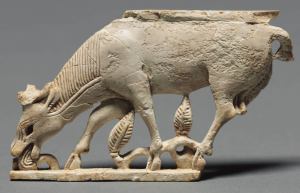 iconographic, and historical aspects of the seal impressions.
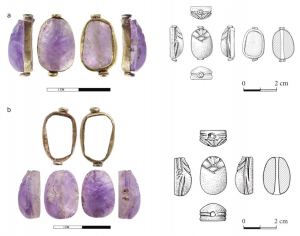 scarabs found in the southern Levant is provided, with a typological analysis and a tentative dating and origin of these pieces.
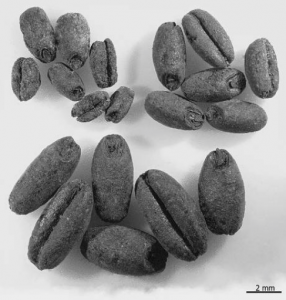 ca. 60,000-item plant collection from the recently exposed Late Bronze Age IIA palace at Tel Beth-Shemesh. Room L1505 in the palace—apparently a pantry due to its contents of foodstuffs and vessels for food preparation and consumption—contained eight deposits of carbonized crop plants. Deposits of almost pure grains and very low numbers of weed seeds were found, indicating that these stored food plants were ready to be used in food preparation. Of special interest is the presence of a sizeable amount of two rare pulses in Levantine archaeobotany—fenugreek (Trigonella foenum-graecum) and Cyprus vetch (Lathyrus ochrus)—only found in two other Bronze Age royal contexts: Tutankhamun’s tomb in Egypt and the Late Minoan II Unexplored Mansion in Knossos. Thus, in addition to attesting to the agricultural practices and culinary preferences of a Canaanite ruling court during the Amarna Age, this botanical assemblage also hints at prestigious royal gift exchanges of exotic food plants.
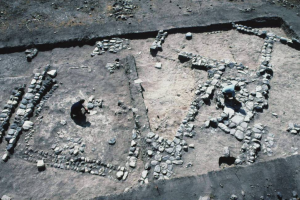 begun in the Early Bronze Age (EB) I, which ended in a severe conflagration. Apparently rebuilt at the beginning of EB II, the village remained a small site and technically non-urban throughout the period. Destroyed at the end of EB II, it was renewed in EB III, coinciding with the arrival of people bearing the Khirbet Kerak Ware ceramic tradition. This preliminary report includes new observations following recent studies of Tel Yaqush finds, including a new sequence of 14C dates from EB I to III (published in detail elsewhere). The excavation results summarized here reveal the unique role Tel Yaqush played during the shift to urbanism, and its contribution to our understanding of Early Bronze Age village society in the central Jordan Valley.
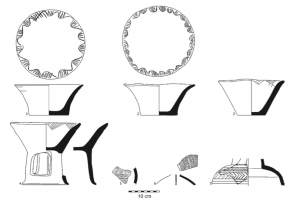 amounts of these were adorned, and their decorations typically conform to a few canonized conventions. A small amount of the decorated Late Chalcolithic basalt bowls are further incised with unconventional, unique designs on their exteriors. These elaborately decorated basalt bowls stand in sharp contrast to the conventionally decorated ones, thus signifying their different roles. This article discusses their geographic distributions, frequencies, and characteristics, and offers further suggestions as to their position within the Late Chalcolithic symbolic and prestige item systems. The analysis reveals regional patterns—the elaborately decorated basalt bowls are constrained to south of the Yarkon River—suggesting that the function and symbolic value of these bowls were probably geographically restricted. Their limited distribution underlines the exclusivity of these elaborately decorated bowls during the Late Chalcolithic period.
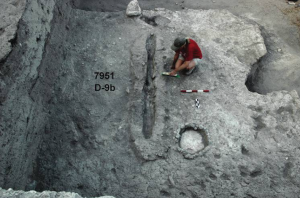 a monumental structure dated to the 14th century b.c.e. with unusual architectural features that could be either the residence of a high-ranking family or an administrative building. During the 13th century b.c.e., this building was replaced by a new structure containing a metalsmith’s workshop, inspired by Egyptian 19th Dynasty techniques, while later building phases belong to the final stages of the Late Bronze Age. No destruction layers were found, and the Late Bronze Age city was rebuilt and continued to thrive throughout the Iron Age I. Five Late Bronze Age plaque figurines, some of particular interest, are also described. An appendix discusses a rare funerary scarab of an Egyptian high official found in the 14th-century b.c.e. edifice.
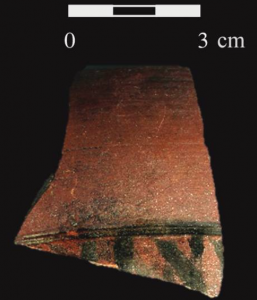 investigated over the last 40 years. In recent excavation campaigns, new evidence of the earliest phases of the city (500–50 b.c.e.) has been discovered, including the sherd treated here, among other inscribed pottery in Greek and Brāhmī.
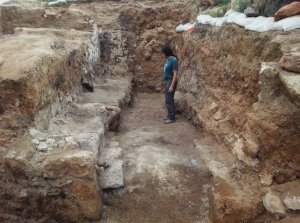 and sealed. This act was evident in the breakage of the altar’s horns and the placement of a latrine in the holy of holies. The available data suggests that the desecration of the shrine should be associated with Hezekiah’s cultic reform (2 Kgs 18:4).

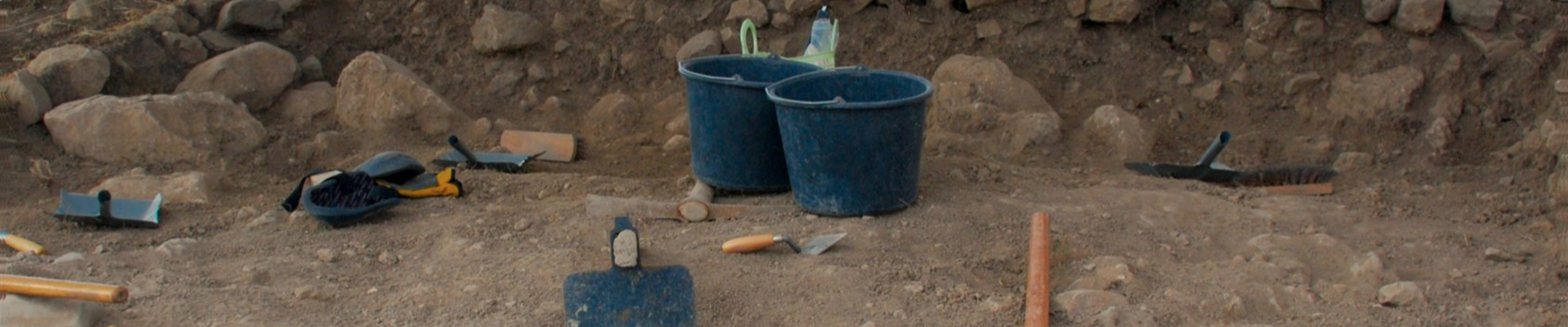
 Directed by Uzi Leibner of the Hebrew University of Jerusalem, this was the final excavation season at Khirbet el-‘Eika, part of a larger study of the material culture of rural Galilean settlements in the Hebrew University’s Hellenistic Galilee Project. As this was my first experience with archaeological fieldwork, I had little idea of what to expect. But once I settled into the daily routine of excavating, washing pottery, and attending field trips and lectures, I soon learned that the life of an archaeologist was even more fascinating and enjoyable than I had anticipated.
 collapse, we began to uncover a variety of large vessels. Perhaps the most exciting moment for me at the dig was finding a small clay juglet that had remained completely intact. After showing it to Dr. Leibner and to my area supervisor, they set it aside for residue analysis. A week later, the juglet was featured in one of our evening lectures on pottery found at the site. In our square we also found numerous bones (primarily from sheep and goats), along with metal implements such as nails and a key. Fortunately, my poor coordination never resulted in destroyed artifacts, despite my fears.