SHARE
[/vc_column_text][mk_image src=”http://www.asortest.org/wp-content/uploads/2017/01/social-fb-icon4.jpg” image_width=”42″ image_height=”42″ hover=”false” custom_url=”https://www.facebook.com/ASOResearch/” margin_bottom=”0″][mk_image src=”http://www.asortest.org/wp-content/uploads/2017/01/social-tw-icon4.jpg” image_width=”42″ image_height=”42″ hover=”false” custom_url=”https://twitter.com/ASOResearch?ref_src=twsrc%5Egoogle%7Ctwcamp%5Eserp%7Ctwgr%5Eauthor” margin_bottom=”0″][mk_image src=”http://www.asortest.org/wp-content/uploads/2017/01/social-in-icon4.jpg” image_width=”42″ image_height=”42″ hover=”false” custom_url=”https://www.linkedin.com/company/american-schools-of-oriental-research” margin_bottom=”0″][mk_image src=”http://www.asortest.org/wp-content/uploads/2017/01/social-ml-icon_7.jpg” image_width=”42″ image_height=”42″ hover=”false” custom_url=”mailto:info@asor.org” margin_bottom=”0″][mk_image src=”http://www.asortest.org/wp-content/uploads/2017/01/blog-icon3.jpg” image_width=”42″ image_height=”42″ hover=”false” custom_url=”http://asor.org/blog” margin_bottom=”0″][/vc_column][vc_column border_color=”rgba(255,255,255,0.01)” width=”1/6″ css=”.vc_custom_1496375273755{margin-right: 20px !important;border-left-width: 2px !important;padding-right: 20px !important;padding-left: 20px !important;border-left-color: #99422f !important;}”][mk_divider divider_color=”rgba(255,255,255,0.01)” thickness=”1″ margin_top=”3″ margin_bottom=”3″][vc_widget_sidebar sidebar_id=”ca-sidebar-63649″][/vc_column][vc_column border_color=”rgba(170,170,170,0.01)” width=”1/2″ css=”.vc_custom_1487276122024{margin-right: 10px !important;margin-bottom: 30px !important;border-right-width: 2px !important;border-bottom-width: 2px !important;padding-top: 30px !important;padding-right: 30px !important;padding-left: 20px !important;background-color: #ffffff !important;border-right-color: rgba(227,228,228,0.75) !important;border-bottom-color: rgba(227,228,228,0.75) !important;}”][vc_column_text responsive_align=”left”]FISCAL YEAR 2019 HONOR ROLL OF DONORS
Current as of 6/30/19. Please send edits and suggestions to ASOR (email; 703-789-9229).
Clink here to view the list of Fiscal Year 2019 Honorific and Memorial Gifts.[/vc_column_text][vc_column_text]
Benefactor ($20,000 and up)
[/vc_column_text][vc_row_inner][vc_column_inner width=”1/2″][vc_column_text]Susan AckermanArnold and Porter, LLC (in kind)
Stevan B. Dana
Lawrence T. Geraty
Sharon Herbert
Norma Kershaw
MacAllister Machinery
P. E. MacAllister[/vc_column_text][/vc_column_inner][vc_column_inner width=”1/2″][vc_column_text]Eric and Carol Meyers
Richard F. Natarian
Ann V. Sahlman
Thomas and Marilyn Schaub*
Wayne Russell Shepard
Carolyn Midkiff Strange
World Monuments Fund[/vc_column_text][/vc_column_inner][/vc_row_inner][vc_column_text]
Patron ($10,000 – $19,999)
[/vc_column_text][vc_row_inner][vc_column_inner width=”1/2″][vc_column_text]AnonymousAnonymous
Anonymous
Sheldon and Debbie Fox[/vc_column_text][/vc_column_inner][vc_column_inner width=”1/2″][vc_column_text]Ronald D. Geraty
W. Mark Lanier Theological Library
Virginia Theological Seminary (in kind)[/vc_column_text][/vc_column_inner][/vc_row_inner][vc_column_text]
Friend ($5,000 – $9,999)
[/vc_column_text][vc_row_inner][vc_column_inner width=”1/2″][vc_column_text]AnonymousSheila T. Bishop
Sonya and Richard Coffman
Susan Laden[/vc_column_text][/vc_column_inner][vc_column_inner width=”1/2″][vc_column_text]Elizabeth Macaulay-Lewis
Joe D. Seger
Andy and Amy Vaughn[/vc_column_text][/vc_column_inner][/vc_row_inner][vc_column_text]
Sponsor ($1,000 – $4,999)
[/vc_column_text][vc_row_inner][vc_column_inner width=”1/2″][vc_column_text]Jeffrey BlakelyJames Bucko
P. M. Michèle Daviau
Ted Dodd and Lynn Swartz Dodd
Jane DeRose Evans
Seymour Gitin
Denise Gold
Timothy P. Harrison
Michael Hasel
Peyton R. Helm
David Hendin
Ann-Marie Knoblauch
Oystein LaBianca[/vc_column_text][/vc_column_inner][vc_column_inner width=”1/2″][vc_column_text]Carol Landes
Alex and Bridget MacAllister
Dale Manor
Daniel Mattson
Andrew Moelis
Christopher Morris
Barbara A. Porter
B. W. Ruffner
H. Katharine Sheeler
Abraham Sofaer and Marian Scheuer Sofaer
Charles W. Steinmetz
Carolyn Waldron
J. Edward and Keeley Wright[/vc_column_text][/vc_column_inner][/vc_row_inner][vc_column_text]
Sustainer ($500 – $999)
[/vc_column_text][vc_row_inner][vc_column_inner width=”1/2″][vc_column_text]Lisa Marilyn AckermanMitchell Allen
William S. Andreas
Gary Arbino
The Boston Foundation
Theodore Burgh
Hanan Charaf
Jürgen Friede
Joseph Greene
Alison Acker Gruseke
Albert Leonard[/vc_column_text][/vc_column_inner][vc_column_inner width=”1/2″][vc_column_text]Beth Alpert Nakhai
Heather Dana Davis Parker
Suzanne Richard
Thomas Schneider
Stuart Swiny
Jane Cahill West
Donald Whitcomb and Janet Johnson
F. Bryan Wilkins
K. Lawson Younger
Jeanine Young-Mason[/vc_column_text][/vc_column_inner][/vc_row_inner][vc_column_text]
Supporter ($250 – $499)
[/vc_column_text][vc_row_inner][vc_column_inner width=”1/2″][vc_column_text]Elie M. AbemayorRichard Adair
Susan Alcock
Lamar Barden
Vivian Bull
Richard R. Burky
Douglas Clark
William W. Ellinger III
Geoff Emberling
Steve E. Falconer
Paul Fitzpatrick
Kristine S. Garroway
Paul Gaylo
Rachel Hallote
James W. Hardin
Alexander Joffe
James F. Joyner III
Melody Knowles[/vc_column_text][/vc_column_inner][vc_column_inner width=”1/2″][vc_column_text]Carroll Kobs
Thomas Levy
Vincent Mauer
Byron McCane
Heather McKee
Piotr Michalowski
John Poss
Jonathan Rosenbaum
Kay Schellhase
Harriet Seiler
Hershel Shanks
John R. Spencer
Matthew Luke Vincent
Jane C. Waldbaum
James L. Walker
Eric L. Welch
Susan Lintz Williams[/vc_column_text][/vc_column_inner][/vc_row_inner][vc_column_text]
Contributor ($100 – $249)
[/vc_column_text][vc_row_inner][vc_column_inner width=”1/2″][vc_column_text]Peggy AckermanMatthew J. Adams
Vernon Appleby
Randall C. Bailey
Mary Jane Barth
Dianne H. Benton
Andrea Berlin
Mildred Bilt
Elizabeth Bloch-Smith
Emily Miller Bonney
Oded Borowski
Karen Borstad
Roger Bove
Margaret Brandt
Thomas Brayshaw
Wilfred F. Bunge
Cynthia Ruth Burdge
Frances Cahill
Annemarie Carr
Christopher Carr
Scott Chesworth
Megan Cifarelli
Mark Chancey
W. Malcolm Clark
William Clark
Eric Cline
Margaret E. Cohen
R. Dennis Cole
Robert E. Cooley
Kevin Cooney
Randy Corbet
Sarah Costello
Sidnie White Crawford
Cheryl Davis
Gregorio del Olmo Lete
Ruth Denault
Elif Denel
Bert DeVries
Michaella Ryan Dial
Helen Dixon
Alison Down
Anne M. Dunn
Jennie Ebeling
Terry Wayne Eddinger
David J. Eidson
Michael Paul Ellingsen
Raymond Ewing
Brian Facemire
Marjorie Fisher
Debra Foran
David Fosse
Catherine P. Foster
Norma J. Franklin
James Fraser
Joe Furr
Steven J. Garfinkle
Robert Gauld
Barbara Geller
Susan Gidley
Barry M. Gittlen
Richard Cartier Godfrey
Morris Golik
Angela Goodwin
David Gordon
Arnold J. Gutierrez
Carl Guzzo
Robert Haak
Jacqueline Haynes
Jennifer Helbley
Ellen Herscher
Forbes Hirsch
Merilyn P. Hodgson
Shirlee Hoffman
Susan Tower Hollis
Janet Horowitz[/vc_column_text][/vc_column_inner][vc_column_inner width=”1/2″][vc_column_text]Stephen Huffman
Herbert B. Huffmon
David Ilan
Massimo Imperiali
Charles Ellwood Jones
Dylan Karges
Trudy Kawami
KDI Capital Partners
Taylor Kelley
Ruth E. Kent
Stephen Kimpel
Sonja M. Klonaris
Stephen Kraft
Manfred Krebernik
David Laird
Nancy Lapp
Frederick Lauritsen
Arthur Lewis
Bjorn F. and Beverly Lindgren
Gloria London
JoAnn Denny Long
Catherine Lorber
Meir Lubetski
Frank Maddox
Charles Marlin
Sheila E. McGinn
Charles Midkiff
William R. Millar
Robert D. Miller
Jenna Morton
Robert A. Mullins
David Norris
Renee O’Brien
John P. Oleson
Marek Olszewski
Randall O’Neill
Thomas R. Pickering
Timothy Potts
Daniel J. Pullen
Jennifer Ramsay
Barbara Rentenbach
Robert Leo Reynolds
Joseph D. Rivera
Thomas Roby
Bruce Romanic
Mitchell Rothman
Robert H. Saunders
Kennett D. Schath
Jennifer Schneider
William Schniedewind
Wolfhart Schubach
Ryland and Carol Scott
Lee R. Seeman
Nancy Serwint
Audrey Shaffer
HL Sheppard
Alan Simmons
Jill Small
Robert Wayne Smith
Ondrej Stehlik
Olin J. Storvick*
James Riley Strange
Janet A. Sullivan
Robert Troth
Herbert Unger
Manny Villafana
Joseph J. Weinstein
Richard E. Whitaker
Robert R. Wilson
Frederick Winter
Irene J. Winter
Randall Younker
Richard Zettler
Ziony Zevit
Frank Zindler[/vc_column_text][/vc_column_inner][/vc_row_inner][vc_column_text]
Donor (up to $100)
[/vc_column_text][vc_row_inner][vc_column_inner width=”1/2″][vc_column_text]ACE ServicesRandy Akers
Susan Allen
Cynthia Allyn
Bjorn Anderson
Jakob Andersson
Nathanael J. Andrade
Austin Andrews
Susan Arter
Brenda Baker
Jose E. Balcells
Nerida Bates
Amanda Bauer
Dennis C. Baugh
Adam Bean
Mark Becker
Leigh-Ann Bedal
Mike BenAvi
Robert Bewley
Alan Bower
Scott Branting
Aaron Brody
Joel P. Butler MW
Mary Callaway
Dennis M. Callies
Mervyn Carson
Evan Carter
Christian Dane Casey
Roy Ciampa
Joseph Cigliano
Maureen Clawson
Betty Coffman
Carson Coffman
Stephen Cook
Aaron Coyle-Carr
Isabel Creasman
Pearce Paul Creasman
Marta D’Andrea
John Darst
Peter Davids
Caroline Davies
Anne McKinney Dehnisch
Paul J. Dirkes
Michel Disdero
Chonglinf Dong
Arthur Drott
Zachary Dunseth
Pinar Durgun
Tiffany Earley-Spadoni
Benjamin Eliason
Sigo Falk
Valerie Fargo
Heidi Fessler
Kevin Fisher
Daniel Fisher-Livne
Paul V. M. Flesher
Elise Friedland
Bryan Fox
Matthew Fox
Eugene M. Futato
Pamela Gaber
Aaron David Gidding
Nathan Gidding
Samuel Gidding
Kathryn Gleason
Shubadhra Gopalakrishnan
Claire Gottlieb
Marylinda Govaars
Samuel Greengus
Jonathan Greer
Paul Gregor
Kathryn Grossman
Reem Habayeb
Melvyn Halbert
Judith Hall
Elaine Handelman
Lowell K. Handy
Edward Hanlon
A. M. Hansen
Walt Harper
Michael Harrower
Rick Hauser
Elliot Heifetz
Daniel Henningsson
Peter Herdrich
Richard Hess
Karyn Hilliard
Kathleen Hollenbeck
Mara T. Horowitz
Marjorie Hoskinson
Jeffrey Hudon
Izaak J. de Hulster
Patricia Hung
Deborah Hurn
Susan Hussein
Institute for Archaeological Research & Discovery[/vc_column_text][/vc_column_inner][vc_column_inner width=”1/2″][vc_column_text]Walter Jacob
Margaret Lois Jansen
Stephen Jervey
Craig Jones
Lillian B. Joyce
Marshall Kaiser
Rachel Kalisher
Debra Kalodner
Jeffery Keefe
Aaron Koller
Paul Korchin
William Krieger
Katherine Larson
Joseph I. Lauer
Randall and Mary Nell Lee
Peter Machinist
David Maltsberger
Suzanne Malush
Faith Mason
Stanley Maxwell
Laura Mazow
James L. McClain
Martin McNamara
Dottie Middleton
James Moore
Melissa Muendel
Shakir Mustafa
Rachel Virginia Nabulsi
Nawal Nasrallah
David L. Nelson
Network for Good
David Nickols
Erika Marie Niemann
Christina Olson
Selma Omerefendic
Paul Orselli
Elizabeth A. Osinga
Marta Ostovich
Christine Elizabeth Palmer
Rosemary N. Palmer
Roy R. Palmer
Tate Paulette
Lawrence Pearl
Jane D. Peterson
Megan A. Perry
Stetson Pevear
Donald Charles Polaski
Sandra Hack Polaski
Taube Ponce
Bezalel Porten
Arlene Press
Robert E. Puscheck
Tine Rassalle
Paul Ray Jr.
William Raynolds
M. Barbara Reeves
Austin Richards
Sarah Richardson
Richard Rismiller
Chris Rollston
Lucille Roussin
Karen S. Rubinson
John Russell
Jeremy B. Rutter
Richard Sarason
Bettina Schwarz-Seibert
Mark Schuler
Stephanie Selover
Sarah Stowell Shapley
China Shelton
Sara Shelton
R. Mark Shipp
Felicia Silcox
Michael Simone
Mali Annika Skotheim
Donald Charles Smith
Betty Snow
Bruno Soltic
Cale Staley
Donna Suloff
Nancy Surdoval
Theodore Swanson
Juan Manuel Tebes
Allison Karmel Thomason
Megan Thomsen
Gordon Tucker
Craig Tyson
Armando Vargas
Monique Vincent
Daniel Warner
Martha Weber
James M. Weinstein
Lynn Welton
Ronn Woolley
Jane Zimmerman
Michael S. Zimmerman[/vc_column_text][/vc_column_inner][/vc_row_inner][vc_column_text]*Deceased[/vc_column_text][/vc_column][vc_column border_color=”rgba(170,170,170,0.01)” width=”1/6″ css=”.vc_custom_1496377378685{margin-right: 10px !important;margin-bottom: 30px !important;border-right-width: 2px !important;border-bottom-width: 2px !important;padding-top: 30px !important;padding-right: 20px !important;padding-left: 20px !important;background-color: #ffffff !important;border-right-color: rgba(227,228,228,0.75) !important;border-bottom-color: rgba(227,228,228,0.75) !important;}”][vc_wp_posts title=”BROWSE THE NEWS ARCHIVE” number=”4″][/vc_column][vc_column border_color=”rgba(170,170,170,0.01)” width=”1/6″ css=”.vc_custom_1496375380556{margin-right: 10px !important;margin-bottom: 30px !important;border-right-width: 2px !important;border-bottom-width: 2px !important;padding-top: 30px !important;padding-right: 20px !important;padding-left: 20px !important;background-color: #ffffff !important;border-right-color: rgba(227,228,228,0.75) !important;border-bottom-color: rgba(227,228,228,0.75) !important;}”][vc_column_text]Tweets by ASOResearch [/vc_column_text][/vc_column][/vc_row]
 art purchased by the Met’s trustees from Luigi Palma di Cesnola in two lots, one in 1872 and another in 1876. The two collections amounted to around twenty thousand objects, all finds Cesnola had acquired while serving as US Consul on the island from 1865–1876. After the acquisition of the second collection, Cesnola left Cyprus to become the first director of the Metropolitan Museum, a position he held until his death in 1904. New Yorkers in the 1870s were most intriguing by the works of limestone sculptures from the sanctuary at Golgoi. In the 1880s these objects would become embroiled in a scandal because of the claim that Cesnola had performed intentionally misleading restorations, but before that disgrace and through much of the 1870s, New Yorkers were processing the arrival of an enormous volume of ancient Cypriot objects in a relatively short amount of time.
 activities in the Middle Kingdom necropolis of Deir el-Bahari and Asasif. The site had previously been excavated under the auspices of the Metropolitan Museum of Art, New York, initiated by Herbert Eustis Winlock in 1912 with survey activities followed by excavations from 1921–1922 until 1928 (Arnold 1996: 59). Winlock’s excavations had been preceded by Howard Carter’s in 1910–1911 (Morales et al. 2016: 258). The current excavations began in 2015, and have continued annually through 2018 (Morales et al. 2016, 2017, and 2018) under the auspices of the Universidad de Alcalá (Madrid, Spain), with a fifth season scheduled for October 2019.
 material. Sommerville (1829–1904) was an affluent Philadelphia businessman who devoted his later life (and funds) to world travel and the collection of antiquities in Europe, Turkey, Syria, Egypt, and North Africa as well as China, Japan, India, Burma, and Thailand. He published memoirs of his travels and catalogues and discussions of the gems and seals. His collection, originally exhibited in the Metropolitan Museum of Art, New York (1888–1891), was placed in the Museum of the University of Pennsylvania (1891) and remained there upon his bequest (see Berges 2002: 11–19). Although Sommerville’s memoir Sands of Sahara (1901) describes some of his North African travels, there is no reference to his acquisition of the Punic artifacts.
 in the southern Levant thanks to four archaeological expeditions that have thoroughly excavated the mound and rapidly published the results of their digs (Ussishkin 2018). All expeditions unearthed hoards of different types from the Late Bronze and Iron Ages (Hall 2016). This new hoard was unearthed in a destruction debris, securely dated to the Early Iron Age I, ca. 1070 BCE (local Level H-11, which equals University of Chicago’s Stratum VIIA). During this period, part of a building (remnants of two rooms and an inner courtyard surrounded by three large open courtyards) was found in this area (figs. 1–2; Finkelstein et al. 2017: 267–69). The building is positioned only about 30 m from Canaanite Palace 2041 of the city of Stratum VIIA. This article offers a preliminary publication of the hoard; a full report will soon be published in the Megiddo VI volume (Arie forthcoming a).
 were found in several burials dating to the Roman period. Depositing funerary offerings was a common practice in the Roman era. Roughly a third of the excavated Eastern Cemetery (fig. 2, n=24) contained grave goods (Eisenberg-Degen 2017). Taking into account that some pilfering and plundering most likely took place, this figure is consistent with percentages noted in other Roman-period burials (Findlater et al. 2013: 69–80; Winter 2015: 82–87).
 (for whom it is the second-holiest site), Jews, Christians, and Muslims. The total area of Joseph’s Shrine is 661 m² and it is located in Block 5, parcel 10, according to early Islamic Immovable Property Records from the Department of Al Awqaf Al Islamyah (Jordanian Islamic Endowments), Nablus (fig. 2). Originally situated on an agricultural plain, it is now surrounded by buildings, due to expansion of housing and schools in central Balata.
 The items produced at the workshop, which are now known by the name of the site, are dated to around 300
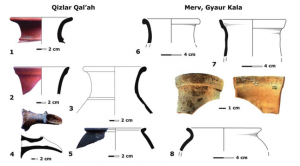 quantitative and archaeometric analyses, we assess and compare modifications in vessel repertoires, production techniques, and material sources across both sites to understand the nature and chronology of these changes. Similar technological developments are observed at Qizlar Qalʾeh and Merv, and are examined with regard to a potential Hellenistic reception in the ceramic material. Variations in the chronological distribution of innovations and assemblage composition help us to elucidate the neighborhood relations between eastern Iran and western Central Asia at this time. Our comparisons point toward a common cultural environment for both sites especially during the Early Parthian period, which is demonstrated in the many analogies of manufacturing techniques and vessel shapes. At the same time, we see different continuing local traditions, highlighting the flexible mode in which ceramic repertoires are adapted to the changing requirements under Hellenistic rule.
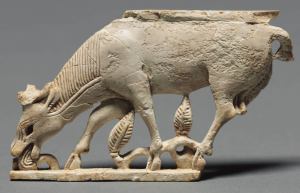 iconographic, and historical aspects of the seal impressions.
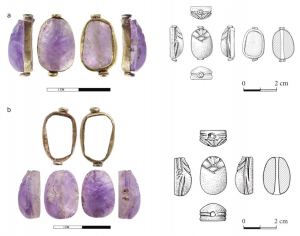 scarabs found in the southern Levant is provided, with a typological analysis and a tentative dating and origin of these pieces.
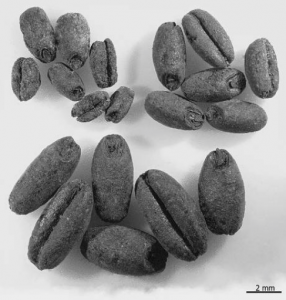 ca. 60,000-item plant collection from the recently exposed Late Bronze Age IIA palace at Tel Beth-Shemesh. Room L1505 in the palace—apparently a pantry due to its contents of foodstuffs and vessels for food preparation and consumption—contained eight deposits of carbonized crop plants. Deposits of almost pure grains and very low numbers of weed seeds were found, indicating that these stored food plants were ready to be used in food preparation. Of special interest is the presence of a sizeable amount of two rare pulses in Levantine archaeobotany—fenugreek (Trigonella foenum-graecum) and Cyprus vetch (Lathyrus ochrus)—only found in two other Bronze Age royal contexts: Tutankhamun’s tomb in Egypt and the Late Minoan II Unexplored Mansion in Knossos. Thus, in addition to attesting to the agricultural practices and culinary preferences of a Canaanite ruling court during the Amarna Age, this botanical assemblage also hints at prestigious royal gift exchanges of exotic food plants.
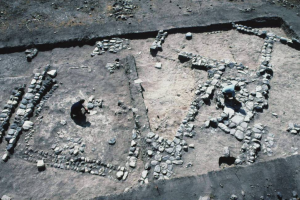 begun in the Early Bronze Age (EB) I, which ended in a severe conflagration. Apparently rebuilt at the beginning of EB II, the village remained a small site and technically non-urban throughout the period. Destroyed at the end of EB II, it was renewed in EB III, coinciding with the arrival of people bearing the Khirbet Kerak Ware ceramic tradition. This preliminary report includes new observations following recent studies of Tel Yaqush finds, including a new sequence of 14C dates from EB I to III (published in detail elsewhere). The excavation results summarized here reveal the unique role Tel Yaqush played during the shift to urbanism, and its contribution to our understanding of Early Bronze Age village society in the central Jordan Valley.
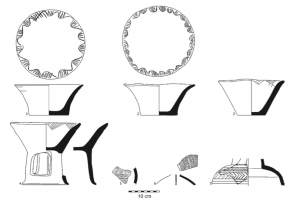 amounts of these were adorned, and their decorations typically conform to a few canonized conventions. A small amount of the decorated Late Chalcolithic basalt bowls are further incised with unconventional, unique designs on their exteriors. These elaborately decorated basalt bowls stand in sharp contrast to the conventionally decorated ones, thus signifying their different roles. This article discusses their geographic distributions, frequencies, and characteristics, and offers further suggestions as to their position within the Late Chalcolithic symbolic and prestige item systems. The analysis reveals regional patterns—the elaborately decorated basalt bowls are constrained to south of the Yarkon River—suggesting that the function and symbolic value of these bowls were probably geographically restricted. Their limited distribution underlines the exclusivity of these elaborately decorated bowls during the Late Chalcolithic period.
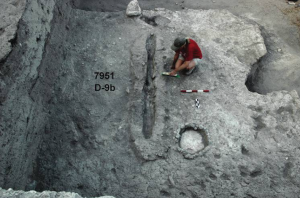 a monumental structure dated to the 14th century b.c.e. with unusual architectural features that could be either the residence of a high-ranking family or an administrative building. During the 13th century b.c.e., this building was replaced by a new structure containing a metalsmith’s workshop, inspired by Egyptian 19th Dynasty techniques, while later building phases belong to the final stages of the Late Bronze Age. No destruction layers were found, and the Late Bronze Age city was rebuilt and continued to thrive throughout the Iron Age I. Five Late Bronze Age plaque figurines, some of particular interest, are also described. An appendix discusses a rare funerary scarab of an Egyptian high official found in the 14th-century b.c.e. edifice.
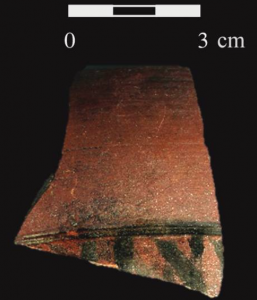 investigated over the last 40 years. In recent excavation campaigns, new evidence of the earliest phases of the city (500–50 b.c.e.) has been discovered, including the sherd treated here, among other inscribed pottery in Greek and Brāhmī.
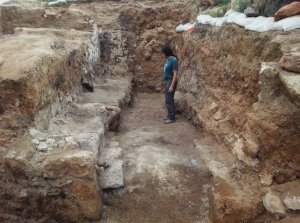 and sealed. This act was evident in the breakage of the altar’s horns and the placement of a latrine in the holy of holies. The available data suggests that the desecration of the shrine should be associated with Hezekiah’s cultic reform (2 Kgs 18:4).


 WELCOME TO THE ASOR BLOG