CALL TO ASOR’S MEMBERSHIP FOR OFFICERS AND BOARD OF TRUSTEES NOMINATIONS
[/vc_column_text][vc_column_text]The ASOR Board of Trustees sets the direction for ASOR and provides oversight for our organization. We encourage you to consider serving on the Board as an elected member or an officer. We also encourage you to share names of people who you think would be a good fit. Among other responsibilities, ASOR officers and members of the Board agree to attend two meetings each year at their own expense, to participate thoughtfully in the governance process, and to contribute financially to ASOR.
The Officers Nominations Committee (Joe Seger, Chair) in conjunction with the Trustees Nominations Committee (Ann-Marie Knoblauch, Chair) solicit nominations for Officer and Trustee positions as follows for terms January 1, 2019 – December 31, 2021
Vice President
Secretary
Institutionally-elected Trustee (2 positions)
Membership-elected Trustee (2 positions)
Expressions of interest or nominations for Vice President and Secretary should be sent to Joe Seger by no later than March 25, 2018 (e-mail docjoeds@gmail.com).
Expressions of interest or nominations for Trustee positions should be sent to Ann-Marie Knoblauch not later than April 15, 2018 (e-mail amk@vt.edu).
All ASOR Members in good standing are eligible for nomination to officer and member-elected posts. Institutionally-elected Trustees must be an Institutional Representative for an Institution Member School of ASOR.[/vc_column_text][/vc_column][vc_column border_color=”rgba(170,170,170,0.01)” width=”1/6″ css=”.vc_custom_1496684098866{margin-right: 5px !important;margin-bottom: 20px !important;border-right-width: 2px !important;border-bottom-width: 2px !important;padding-top: 30px !important;padding-right: 10px !important;padding-left: 10px !important;background-color: #ffffff !important;border-right-color: rgba(227,228,228,0.75) !important;border-bottom-color: rgba(227,228,228,0.75) !important;}”][vc_wp_posts title=”BROWSE THE NEWS ARCHIVE” number=”4″][/vc_column][vc_column border_color=”rgba(170,170,170,0.01)” width=”1/6″ css=”.vc_custom_1496684008271{margin-right: 10px !important;margin-bottom: 30px !important;border-right-width: 2px !important;border-bottom-width: 2px !important;padding-top: 30px !important;padding-right: 20px !important;padding-left: 20px !important;background-color: #ffffff !important;border-right-color: rgba(227,228,228,0.75) !important;border-bottom-color: rgba(227,228,228,0.75) !important;}”][vc_column_text]Tweets by ASOResearch [/vc_column_text][/vc_column][/vc_row]
[/vc_column_text][vc_column_text]UPDATE: We have surpassed our first goal of raising $4,000 to fund two additional fellowships! Thank you to all of our generous donors who responded to our call. Since it’s only mid-March, we’re updating our goal to raise an additional $600 so that we can fund three additional fellowships instead of two. Can you help us reach our new goal?
As an added incentive, during the first week of the women’s and men’s NCAA tournaments, an anonymous donor has agreed to match any gifts up to $50 one to one, for a total of $500. For example, if someone gives $25, the gift will be matched with $25. If someone gives $10, it will be matched with another $10. So if you can donate an amount up to $50, we hope you consider doing so today!
ASOR is fortunate to have many generous members and friends, and any gift—$10, $25, $100, $250, or more—will truly make a difference. To date, with generous support of endowed funds and other donors, we can now support 20 fellowships. Please join the Madness by making a tax-deductible gift that will help us reach our goal of funding (now) 21 fellowships! If you use our online store during March Fellowship Madness, please designate your gift for “Excavation Scholarships.”[/vc_column_text][mk_divider][mk_skill_meter title=”Money we have raised so far:” percent=”98.57″ title_color=”#777777″ progress_bar_color=”#dd3333″ track_bar_color=”#eeeeee”][vc_column_text]
We have raised $41,400 out of our $42,000 goal.
[/vc_column_text][mk_button style=”fill” corner_style=”rounded” size=”large” outline_skin=”#1e73be” outline_hover_skin=”#ffffff” url=”https://netforum.avectra.com/eweb/FND/DonateFund.aspx?Site=ASOR&WebCode=DonateNow&Action=Add&prd_key=ad537b8e-eff8-4f2b-8fd7-3f9de1c62edd&fun_key=80ac42fd-74f9-4fe9-ae70-b99051ea42f8&Name=2015%20Development%20Drive%20Donation%20″ align=”center”]Donate Now[/mk_button][mk_divider][vc_column_text]If you donate to March Fellowship Madness, you support archaeology in a very direct way. Every gift matters. ASOR does not charge any administrative fee for gifts made during March Fellowship Madness, so 100% of your contribution will support students who have a demonstrated need.
By Jake Hubbert, Platt Excavation Fellowship Recipient
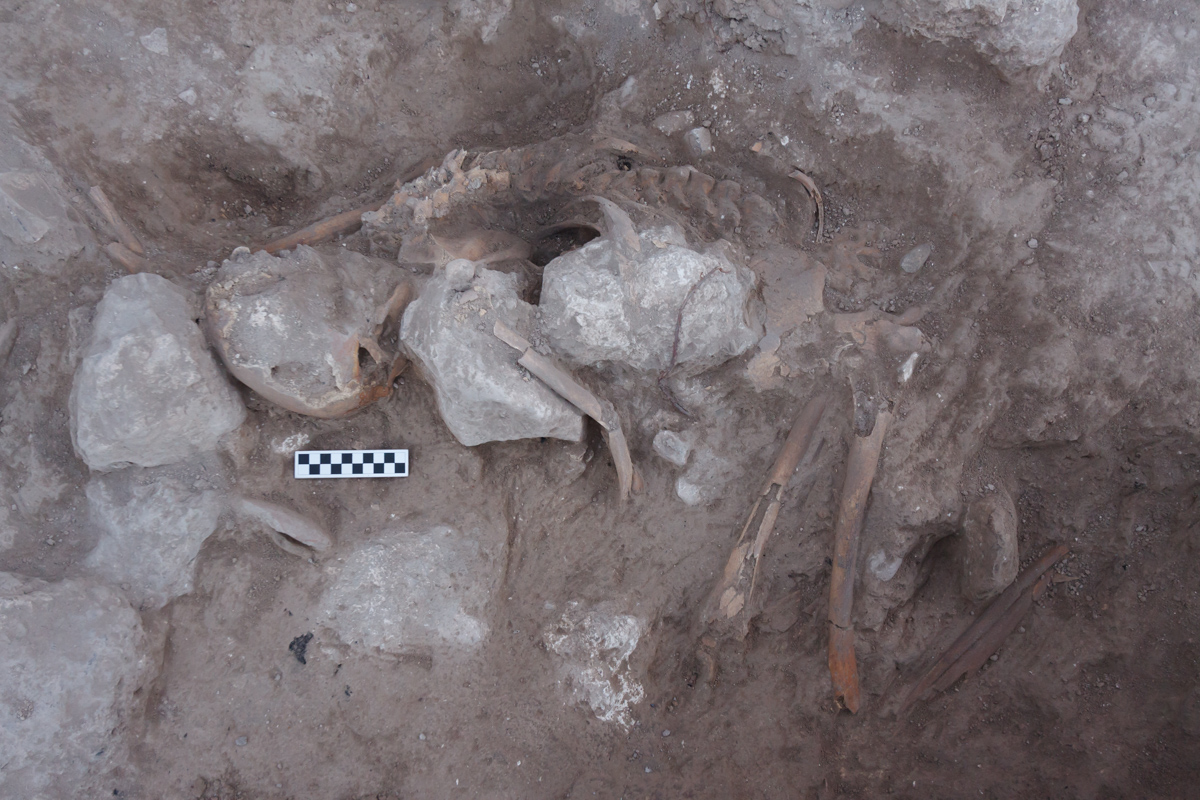
This past summer, I had the experience of a lifetime. I spent six weeks excavating with Brigham Young University in Petra, Jordan. This was part of a field school offered through Brigham Young University. For the first two weeks, I helped excavate in a place called Wadi Mataha where my fellow students and I were taught proper excavation techniques that pertain to graves and osteology. We were lucky enough to have found what we believe is a secondary burial with a variety of bones that will be later analyzed in labs back at Brigham Young University. My time there was amazing and I feel that I learned so much. I learned about the ancient Nabataeans and their burial traditions as well as about the methods and theories of archaeology in the field.
After my two weeks at Wadi Mataha, I was transferred with my group of five other students up to the Ad-Deir Monument where I was assigned to work in the Eastern Cistern B. The objective of this project, as well as that of others on the plateau, is to put back into use the water systems that were once in use by the Nabateans to aid the current Bedouin populations that live and work on the Ad-Deir plateau. Excavations therefore, were focused towards restoration. Excavation is facilitated by the fact that the built up stratigraphy is yearly erosion fill, and therefore provides very little knowledge about the chronology of the site. This has allowed us to conduct mass excavations to remove the erosion fill to make the several areas under excavation accessible. Despite the rapid pace of work and the unusual circumstances of this site, my supervisors made sure that I still learn and master proper excavation techniques such as cutting straight balks and making sure they have the proper right angles where they meet up with other balks or other trenches or pits. Other skills that I have learned include the proper process of taking levels, and the importance of taking correct levels so as to understand the volume of dirt being removed from the overall area.
My favorite part has been the utilization of my art skills. I love art but I never really understood how my art skills could transfer over to archaeology. I was able to do some simple sketches for the official field note book at the Cistern. I have also been able to learn some digital art and its importance in archaeology. Another major factor of this dig has been the opportunity to live with the Bedouin tribe and family where we stayed. Since archaeology is a part of anthropology, I loved being able to study both the dead cultures in Petra but also the living cultures which have occupied the empty shell that has been left behind. For the past year I have also been taking introduction Arabic classes and have loved it and I have loved my opportunity to use what I have learned with the Bedouins. I love what Gertrude Bell once said in relation to the Bedouins, that they are a people who love and enjoy freedom. The way they live of being able to go wherever whenever is amazing. But this will have to come later if I decide that it is in this area that I want to pursue my future in archaeology. Petra has been such an amazing place and I will forever remember it as the place where first learned to be an archaeologist.
Jake Hubbert is an undergraduate student at Brigham Young University studying archaeology. He studies the Near East and has interests in Transcaucasia as well.
ASOR/EPHE EUROPEAN SYMPOSIUM: FIRST OVERSEAS SYMPOSIUM TO BE HELD IN PARIS, FRANCE IN SEPTEMBER
[/vc_column_text][vc_column_text]The ASOR Membership and Outreach Committee is pleased to announce its first overseas outreach initiative at the Sorbonne, in partnership with Ecole Pratique des Hautes Etudes – Paris Sciences et Lettres (EPHE-PSL), in Paris, September 4-6, 2018. The event will be a scholarly symposium with honorary chairs Susan Ackerman, President of ASOR, and Hubert Bost, President of EPHE-PSL. Over 45 scholars from Europe (including Russia), Brazil, Israel, and Turkey will make presentations on the themes of Violence in the Ancient Near East and on Digital Humanities (DH), including a forum-round table in order to set up an action plan regarding the growing inequalities between training in DH, among other discussed topics. Presentations will be video recorded and live broadcast. The symposium participants will also enjoy a guided-tour of the Louvre and a social cocktail in the Luxembourg Garden among other special activities. ASOR members who happen to be in Paris during that time are welcome to join the symposium to hear the presentations. We hope this event will be a first step in expanding European membership and involvement in ASOR. Randy Younker, chair Membership and Outreach Committee, Vanessa Juloux chair, Membership and Outreach Committee Sub-committee for Europe.
For weblinks on the Paris Symposium, see the following:
By Lyndelle Webster, Heritage Excavation Fellowship Recipient[/vc_column_text][vc_column_text]With the support of a 2017 Heritage Excavation Fellowship, I spent four weeks during May-June excavating at Tel Gezer. This is a beautiful site with an impressive view over the coastal plain and the Aijalon Valley. Located near the junction between the Via Maris and a major route to Jerusalem, this was a prominent site during the Middle Bronze through Iron Age periods. In the Late Bronze Age it was the center of a major city-state, whose rulers appear in the Amarna Letters.
There are two excavation teams currently working to address important research questions at Tel Gezer. The expedition led by Dr. Steve Ortiz of Southwestern Baptist Theological Seminary and Dr. Sam Wolff of the Israel Antiquities Authority, have been working near the Iron Age gateway (central-southern edge of the tell) for the past ten years. Another team from the Israel National Parks Authority and New Orleans Baptist Seminary have been exposing an impressive water system, now dated to the Middle Bronze Age; for the past few seasons they have also worked in the nearby Middle Bronze gateway.
My PhD research concerns Late Bronze Age chronology from the perspective of radiocarbon dating, and it is in this context that I began doing some work in cooperation with the Tandy excavation, whose directors kindly gave me the opportunity to work on their material. Whilst the Iron Age has been the predominant focus of research, in the past few seasons a series of early Iron Age and Late Bronze Age strata have been excavated. For me, this provided a great opportunity to extend my research, which had begun with the Late Bronze strata of Tel Azekah – another important current excavation in the Shephelah region.
2017 was the last year in the field for the Tandy excavation team before going to publication stage. As such, it turned out to be a very exiting and productive season. A thick destruction layer was exposed, including complete vessels and much evidence of burning. Remains of three individuals were found who had clearly died as a result of the dramatic event. The excavators currently identify this destruction with the historically-recorded campaign of Merneptah in the late 13th century BCE. In the Merneptah Stela – famous for the first known reference to “Israel” – the pharaoh boasts of conquering several cities in southern Canaan, including Gezer. In another inscription Merneptah describes himself as the “subduer of Gezer”. These references make it clear that Gezer was a strategic, important site, and gaining control over it was worth boasting about.
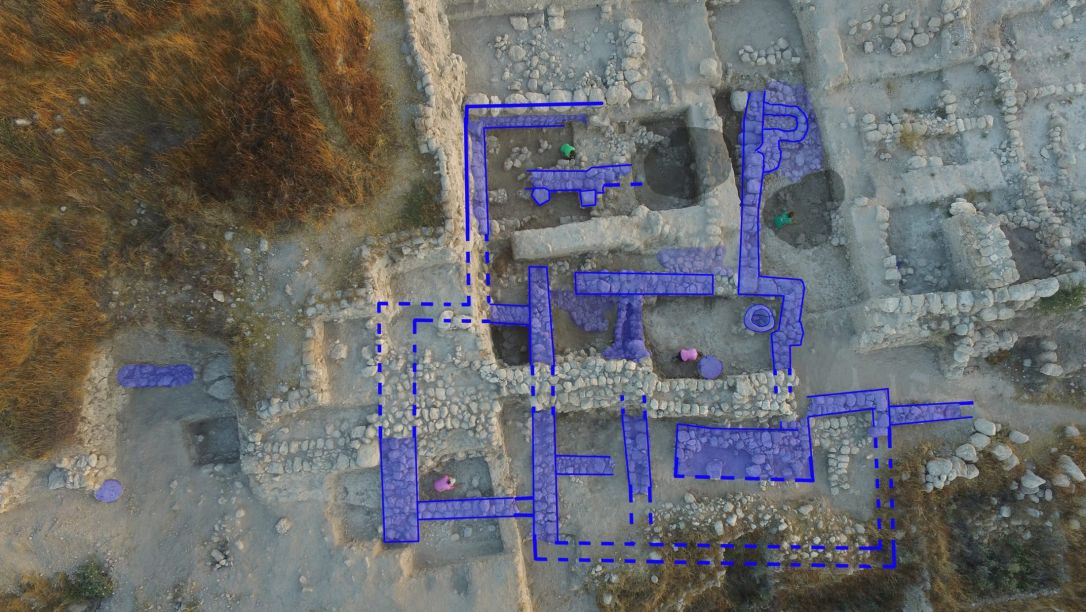
Aerial view of Field W, highlighting the Late Bronze Age stratum
which ended with a dramatic destruction event.
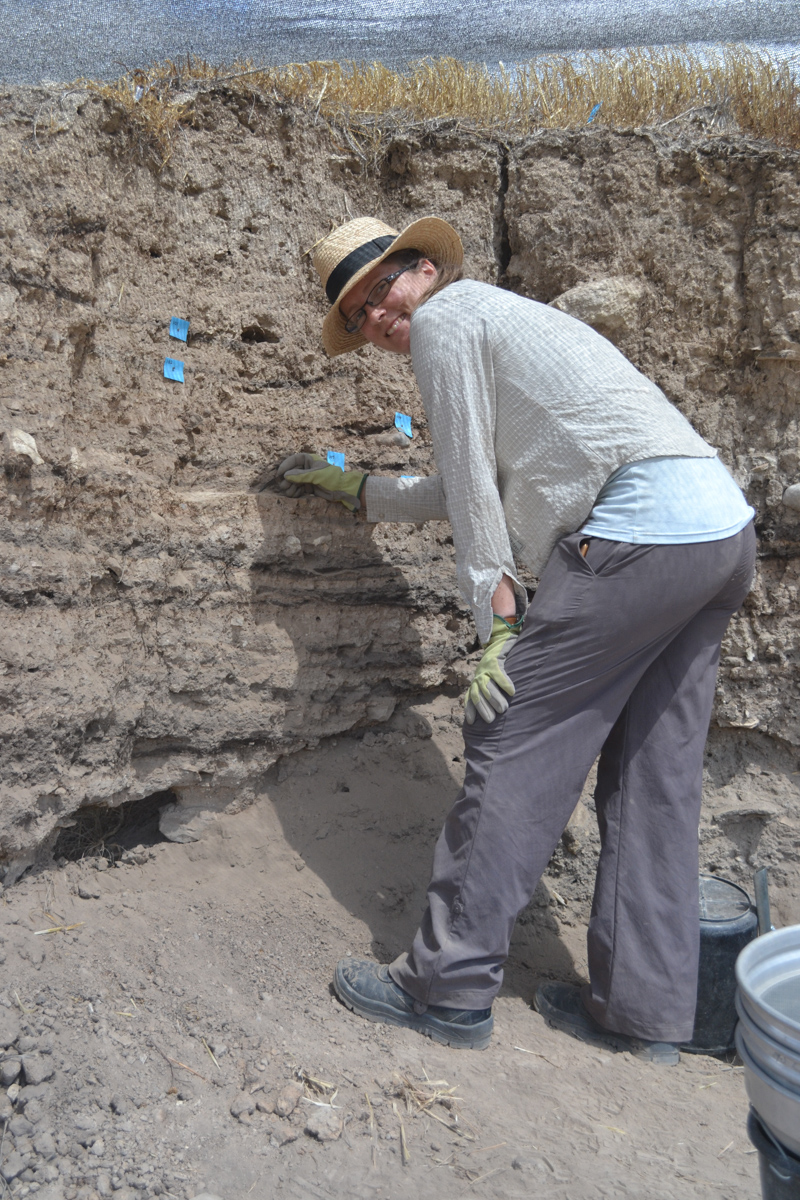
My role in the field this season was to provide support in regard to sampling for radiocarbon dating. When working with radiocarbon samples and data it is incredibly valuable to have firsthand knowledge of the archaeological contexts. Working together with the team in the field gave opportunity to discuss and evaluate contexts, and put in focused efforts to improve the number of good contexts yielding suitable material. (The target material is short-lived organics, typically seeds; at a site like Gezer these are mainly carbonized – having been preserved by burning.)
In addition to working with the excavation near the Iron Age gateway, I had the opportunity to carry out some small projects elsewhere on the tell, sampling from exposed sections left by the Hebrew Union College excavations that were conducted in the 1960s to 1980s under the direction of William Dever.
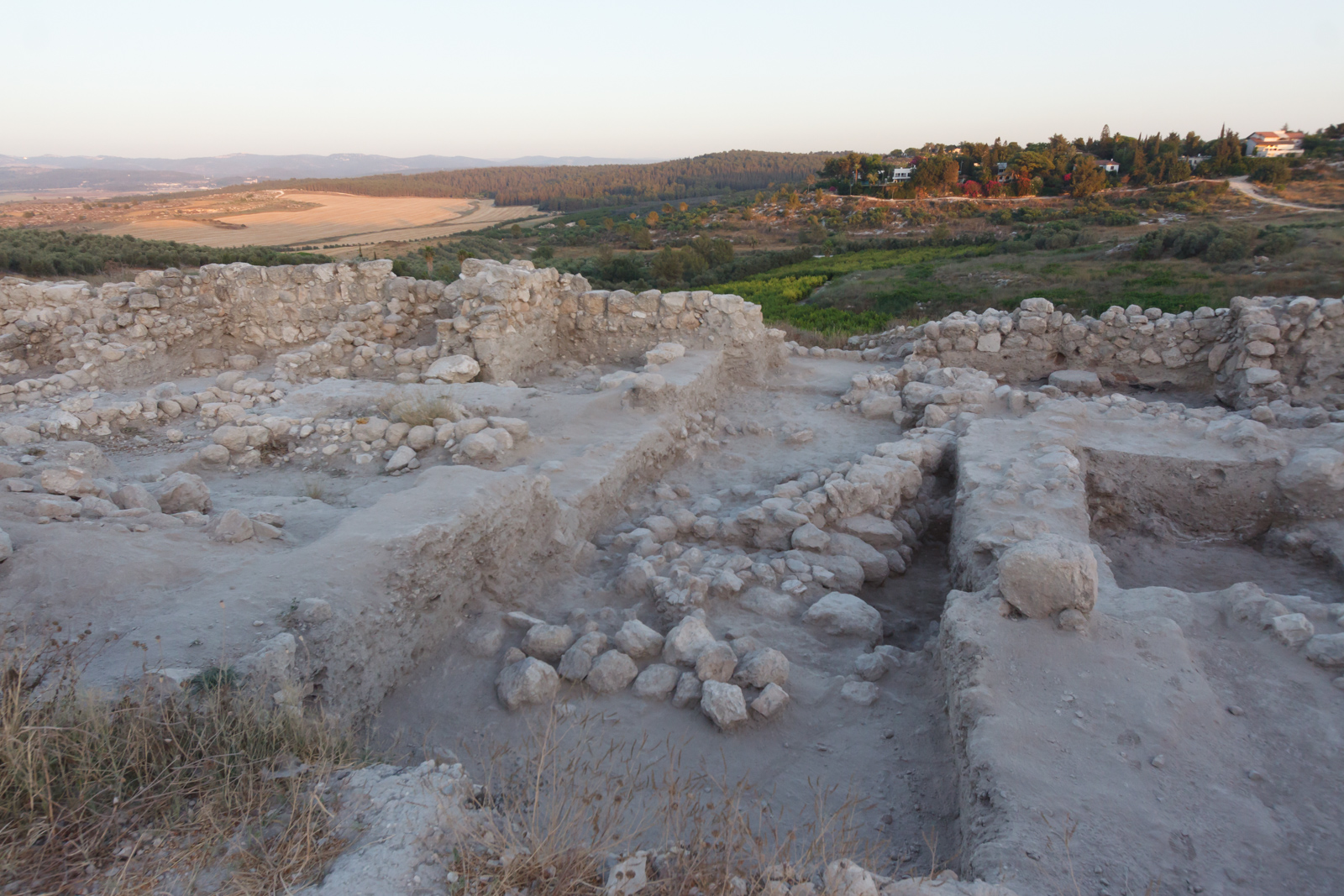
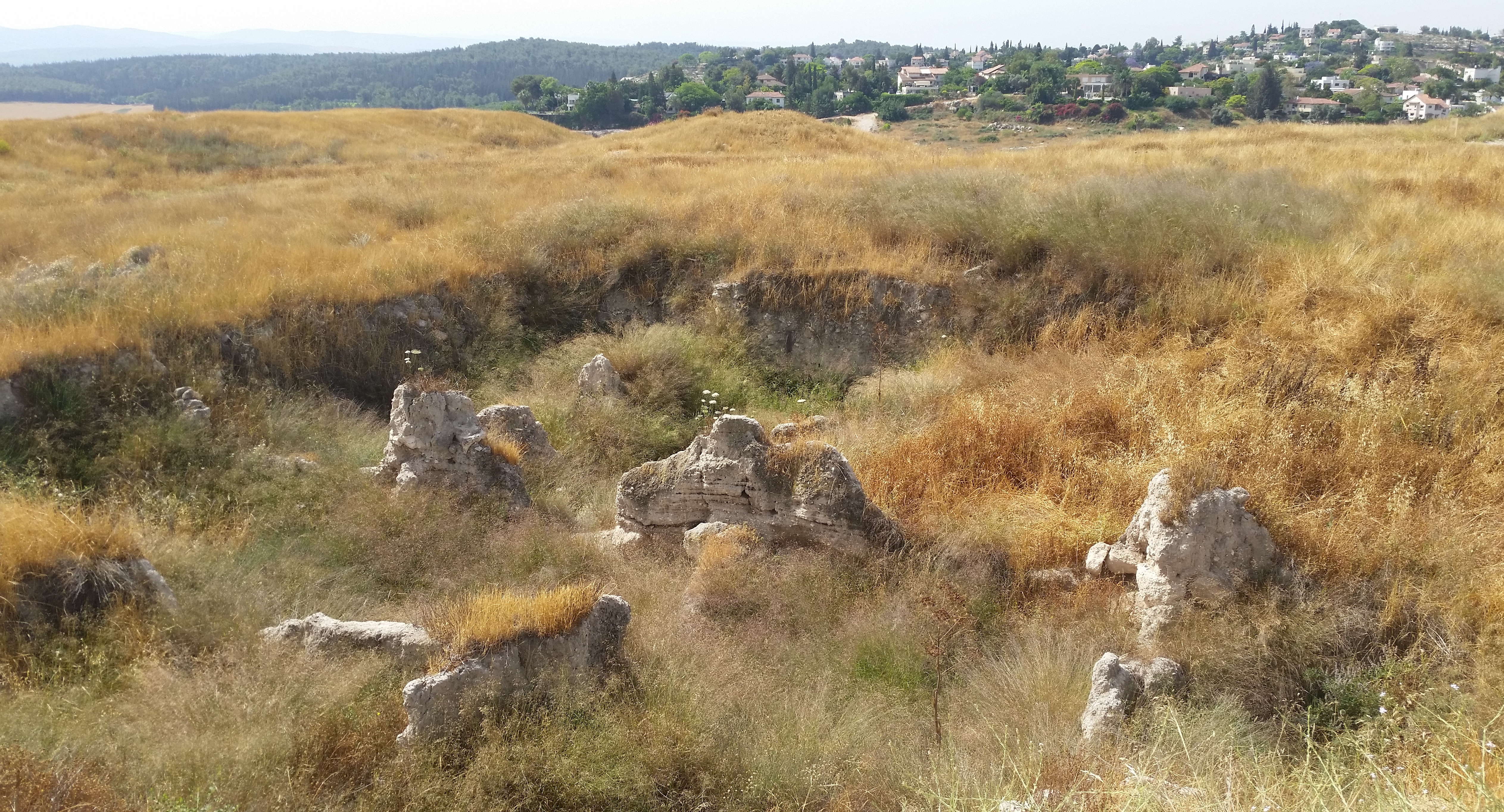
View southward across the tell; Field VI in the foreground
was excavated in the 1960s-70s by Hebrew Union College.
I am looking forward to seeing how new radiocarbon data from Tel Gezer contributes to our understanding of the Late Bronze Age, as well as other key periods under investigation at the site – the Iron and Middle Bronze Ages.
One of the best things about excavation is the people you meet and the friendships developed. It is always a little daunting to start working with a new site and a new team. I appreciated the warm welcome from the ‘Gezerites’, who quickly made me part of their team. It was a great season and wonderful group of people to work with. Thank you!
I want to express my sincerest thanks to ASOR and to Mr. Sheldon Fox, the donor for this fellowship, for supporting my field research this year.
Lyndelle Webster is a PhD student at Macquarie University and the University of Vienna. She is currently based in Vienna at the Institute for Oriental and European Archaeology at the Austrian Academy of Sciences, where she is a member of the project “Tracing transformations in the southern Levant: from collapse to consolidation in the mid-second millennium BC”. [/vc_column_text][/vc_column][vc_column border_color=”rgba(170,170,170,0.01)” width=”1/6″ css=”.vc_custom_1496684098866{margin-right: 5px !important;margin-bottom: 20px !important;border-right-width: 2px !important;border-bottom-width: 2px !important;padding-top: 30px !important;padding-right: 10px !important;padding-left: 10px !important;background-color: #ffffff !important;border-right-color: rgba(227,228,228,0.75) !important;border-bottom-color: rgba(227,228,228,0.75) !important;}”][vc_wp_posts title=”BROWSE THE NEWS ARCHIVE” number=”4″][/vc_column][vc_column border_color=”rgba(170,170,170,0.01)” width=”1/6″ css=”.vc_custom_1496684008271{margin-right: 10px !important;margin-bottom: 30px !important;border-right-width: 2px !important;border-bottom-width: 2px !important;padding-top: 30px !important;padding-right: 20px !important;padding-left: 20px !important;background-color: #ffffff !important;border-right-color: rgba(227,228,228,0.75) !important;border-bottom-color: rgba(227,228,228,0.75) !important;}”][vc_column_text]Tweets by ASOResearch [/vc_column_text][/vc_column][/vc_row]
[/vc_column_text][vc_column_text]ASOR seeks a candidate for a full-time, temporary position of Office Assistant to begin as soon as possible and to continue through at least June 30.
Founded in 1900 and currently located in Kenmore Square in Boston, the American Schools of Oriental Research (ASOR) is a non-profit 501(c)(3) organization whose mission is to initiate, encourage, and support research into, and public understanding of, the history and cultures of the Near East and wider Mediterranean world, from the earliest times. Please visit www.asor.org for more information.
Primary Responsibilities:
Work with members of the ASOR staff to maintain high-quality customer service for our members and subscribers.
Answer the ASOR telephone and email account. Provide customer service for ASOR’s 1,800 members.
Assist with ASOR’s off-site Annual Meeting by processing payments, answering questions, and making all potential attendees feel welcome.
General office support including ordering supplies, processing mail, and general office maintenance.
Under the direction of other ASOR staff, supervise student assistants.
Additional duties as assigned, including processing payments and updating website (WordPress); processing fellowship applications; collecting author contracts; and invoicing for institutional memberships.
Qualifications / Skills Needed:
Associate Degree or equivalent work experience; Bachelor’s Degree preferred.
1-3 years of office experience preferred; experience with databases, Microsoft Office, WordPress, general office management also preferred.
Excellent communication and interpersonal skills.
Attention to detail; ability to multitask and to prioritize.
Compensation and Benefits: Hourly pay between $15.00 and $17.00 per hour. Benefits include paid vacation and sick time; paid holidays; employer retirement contribution (6%); and benefit dollars ($500 per month).
How To Apply: E-mail letter of interest, resume, and contact information for three references to Britta Abeln at info@asor.org. Please include your name and “ASOR Office Assistant” in the subject line.
ASOR is an equal opportunity employer and all qualified applicants will receive consideration for employment without regard to race, color, gender, religion, national origin, disability, veteran status, age, marital status, sexual orientation, gender identity, genetic information, or any other class protected by federal or state law (EEO/AA).[/vc_column_text][/vc_column][vc_column border_color=”rgba(170,170,170,0.01)” width=”1/6″ css=”.vc_custom_1496684098866{margin-right: 5px !important;margin-bottom: 20px !important;border-right-width: 2px !important;border-bottom-width: 2px !important;padding-top: 30px !important;padding-right: 10px !important;padding-left: 10px !important;background-color: #ffffff !important;border-right-color: rgba(227,228,228,0.75) !important;border-bottom-color: rgba(227,228,228,0.75) !important;}”][vc_wp_posts title=”BROWSE THE NEWS ARCHIVE” number=”4″][/vc_column][vc_column border_color=”rgba(170,170,170,0.01)” width=”1/6″ css=”.vc_custom_1496684008271{margin-right: 10px !important;margin-bottom: 30px !important;border-right-width: 2px !important;border-bottom-width: 2px !important;padding-top: 30px !important;padding-right: 20px !important;padding-left: 20px !important;background-color: #ffffff !important;border-right-color: rgba(227,228,228,0.75) !important;border-bottom-color: rgba(227,228,228,0.75) !important;}”][vc_column_text]Tweets by ASOResearch [/vc_column_text][/vc_column][/vc_row][vc_row][vc_column][vc_column_text]
By Cecelia Chisdock, FOA Dig Scholarship Recipient[/vc_column_text][vc_column_text]For the last eight years, ASOR members and donors have funded dig scholarships for students and early career scholars to participate in archaeological fieldwork. Last year (2017), The Friends of ASOR contributed funds for an separate scholarship to send an additional student into the field.
Cecelia Chisdock, the 2017 recipient of the Friends of ASOR Excavation Fellowship, reports about her experience excavating at Tel Kabri. The Friends of ASOR enabled Cecelia to have this experience, and we hope to raise funds for an additional scholarship in 2018. Keep an eye out for an appeal during our upcoming fellowship drive, March Fellowship Madness, for an opportunity to help send more students to the field!
Over the summer I went on my first excavation to Tel Kabri in northern Israel, a site most famous for the wine cellar in the Bronze Age Canaanite palace. I dug for three weeks, doing everything from pickaxing a plaster floor to articulating some incredibly crumbly pottery and everything in between. The experience was amazing, and when I returned home I noticed a few questions I got from almost everyone who knew I went on this trip, here are some of them:
1. How was your vacation?
If there is one thing everyone understands (even those who don’t know archaeology past Indiana Jones) is that archaeology is fun, so it’s hard to explain that your “vacation” was actually for your job, or in my case for credit to graduate (and hopefully experience for a future job). When I broke it to them that I was up every day at 4:00 in the morning, and pickaxing before I even ate breakfast, they were a little shocked. Of course, I have to re-emphasize that it was still amazingly fun, even if it was not quite a relaxing vacation!
2. Why did you sleep for 14 hours (or days)?
This goes hand in hand with the inevitable vacation question. Most friends and family think it’s all fun, and it is, but it’s also enough to give you blisters and 6 new chiropractor appointments.
3. Did you find anything exciting?
My friends who I kept in touch with despite the 7 hour time difference know my varying degrees of excitement for what I was digging up on any given day. “Wow pottery in the back dirt!” turned into “More pottery in the back dirt…” and then into “Wow pottery from the wine cellar!”. I was always very excited to find any kind of bone, no matter how small or fragmented. But it really varies, while I would be most thrilled to tell everyone about the cute little sheep femur or piece of charcoal, some might think the pottery or the architecture was the most exciting!
4. Did you get to keep anything? / What did you bring home?
Everyone from your mom to your friend from middle school thinks you get to keep what you dig up. The concept of looting seems a little more extreme than just brining a tiny piece of pottery home, but it’s all the same to most who excavate. Bring them back some keychains, magnets, or a Buffalo Bills shirt in Hebrew (like I did), but no one is bringing home gold coins, ancient figurines, or the Ark of the Covenant. Even Indiana Jones said it should be in a museum!
5. What was the culture like? Was there running water? Cars?
Archaeology, being the study of the remains of past peoples/cultures is associated with everything ancient, so I wasn’t very surprised that I got this kind of question. But archaeology takes place everywhere, including modern industrialized nations like Israel and the United States. Of course, there were cultural differences (tipping was the hardest to figure out on our weekend trips) but unlike what some people thought we didn’t need to ride horses down dirt paths and cook all our food on a fire. We got Pizza Hut delivered, rented a car for a Dead Sea trip, and took a nice bus to dig every morning. We could dig up things from a time without indoor plumbing, but luckily we didn’t have to live with it!
Author Bio: Cecelia Chisdock is junior at George Washington University studying archaeology and biological anthropology. She is most interested in bioarchaeology and hopes to work with ancient human remains in the future.
Subscription Options You can receive BASOR (and other ASOR publications) through an ASOR Membership or through an Individual Subscription. Single issues (subject to availability) are available for purchase, with ASOR members receiving a discount. Please email us if you have any questions.
Pp. 1-23: “Cup-Marks and Citadels: Evidence for Libation in 2nd-Millennium B.C.E. Western Anatolia,” by Christina Luke and Christopher H. Roosevelt
Shallow conical depressions hewn into bedrock, known as cup-marks, have been documented at and around 2nd-millennium B.C.E. citadels in the Marmara Lake basin of the Gediz Valley, western Anatolia. These rupestral features are among the best indications of the presence of libation ceremonies in the region and provide evidence that local communities shared in cultural traditions spread over western and central Anatolia. Libation rituals in the basin were probably intended to summon the divine for protection, stewardship of the dead, and/or assurance of agricultural prosperity through maintenance of stable environmental conditions. Periodic catastrophes, resulting from massive inundations and/or droughts typical to the region, weigh in favor of an environmental interpretation. We frame our discussion of the topography and archaeology of the Gediz Valley and the evidence for Middle to Late Bronze Age cup-marks within the context of historical geography and the archaeology of Anatolia.
Click here to access the above article on JSTOR (ASOR membership with online access and/or subscription to JSTOR Current Content required).
Pp. 25-53: “Early Ottoman Archaeology: Rediscovering the Finds of Ascalon (Ashkelon), 1847,” by Edhem Eldem
Very little is known about the acquisitions of the (Ottoman) Imperial Museum during the first decades of its existence. As a consequence of the haphazard way in which objects were collected and the absence of any form of institutionalization, the collections inherited from this early period generally lack the most basic contextual information concerning their provenance, date of entry, and mode of acquisition. Nevertheless, historical and archival research can offer a solution to this archaeological dead-end by tapping into other available sources to fill these lacunae. The following case study reconstructs the story of three marble reliefs in the collection utilizing such documentation. Although they were thought to be from Salonika (Thessaloniki) in northern Greece, they are in fact from Ascalon (Ashkelon) in modern Israel—the product of one of the earliest campaigns carried out by an Ottoman state official to fill the newly established museum in Constantinople with antiquities. Apart from correcting later attributions and guesses, this study also proposes a critical reassessment of the nature of early Ottoman archaeological ventures and a systematic analysis of the accumulation (or not) of knowledge and scholarship on the fringes of Europe.
Click here to access the above article on JSTOR (ASOR membership with online access and/or subscription to JSTOR Current Content required).
Pp. 55-69: “Seismic Environments of Prehistoric Settlements in Northern Mesopotamia: A Review of Current Knowledge,” by Eric R. Force
Historical archives, modern instruments, and archaeological excavations at plate-boundary sites have recorded an intricate—at times, seemingly relentless—recurrence of severe earthquakes related to the northward movement and convergence of the Arabian tectonic plate with neighboring plates. Based on such information, it is possible to contour average earthquake frequency and/or severity across the northern Mesopotamian region within about 200 km from the plate boundaries.
The environments of the Late Neolithic and Chalcolithic habitations of this area range seismically from very active to nearly quiescent; however, not a single excavation report from sites therein considers seismic hypotheses for recorded damage. Exceptionally detailed excavation reports of tells located in two contrasting seismic environments nevertheless show some evidence more consistent with seismic damage than with other causes. The record for Tepe Gawra in the more active area suggests severe earthquakes closely clustered in time. In both areas, there is evidence of some earthquake damage averaging every 500 years or less, and almost all Halaf sites and Halaf-to-Ubaid transitions in northern Mesopotamia plot in areas where such frequencies are expected. Expected seismicity derived from the voluminous historical and instrumental records should play a prominent part in the interpretation of archaeological evidence of this region, as in others near tectonic plate margins.
Click here to access the above article on JSTOR (ASOR membership with online access and/or subscription to JSTOR Current Content required).
Pp. 71-94: “Contexts and Repetitions of Cypro-Minoan Inscriptions: Function and Subject Matter of Clay Balls,” by Silvia Ferrara and Miguel Valério
This article follows the trail of previous suggestions that the so-called clay balls inscribed in the Cypro-Minoan script bear personal names and titles, possibly of high-ranking individuals responsible for industrial and cultic activities at Enkomi, in other Cypriot centers, and at Tiryns on the Greek mainland. We examine attestations of sign-sequences and single signs found on these spherical objects, which occur also in other inscriptions, and cross-check them with the available find contexts of the balls vis-à-vis the structure of their inscriptions. Beyond the likelihood that these objects bear designations of individuals, we suggest that the single signs that often follow a specific sign-sequence on the balls may represent an abbreviated version of the second “word” found on the balls that bear two sequences and no single sign. Furthermore, it is argued that these words in the second position represent a qualifying description of the individual designated by the first sequence. Finally, it is suggested that these objects were possibly used for lot-casting—specifically, for calling individuals to certain tasks.
Click here to access the above article on JSTOR (ASOR membership with online access and/or subscription to JSTOR Current Content required).
Pp. 95-111: “Administration, Interaction, and Identity in Lydia before the Persian Empire: A New Seal from Sardis,” by Elspeth R. M. Dusinberre
A stamp seal excavated at Sardis in 2011 is a local product dating to the period of the Lydian Kingdom. It was found in a churned-up deposit along with artifacts dating before the mid-6th century B.C.E., including a large proportion of high-status items: the seal itself and an ivory furniture inlay showing a female figure holding a lion upside down, as well as fine pottery, bronze arrowheads, a few scattered human bones, and other items. The deposit seems to be destruction debris from the Persian sack of the city in ca. 550 B.C.E. The seal is unique and is one of the only artifacts available to help us understand the administration of the Lydian Kingdom, to see what seal art looked like before the Persians arrived in Lydia, and to help us interpret the bureaucratic system and the cultural milieu of individual taste at Sardis in the Lydian period. A modest little seal thus has a great deal of importance in our analysis and interpretation of historical events, political developments, and society in general in Lydia during the years before 550 B.C.E.
Click here to access the above article on JSTOR (ASOR membership with online access and/or subscription to JSTOR Current Content required).
Pp. 113-125: “A Brand New Old Inscription: Arad Ostracon 16 Rediscovered via Multispectral Imaging,” by Anat Mendel-Geberovich, Arie Shaus, Shira Faigenbaum-Golovin, Barak Sober, Michael Cordonsky, Eli Piasetzky and Israel Finkelstein
Arad Ostracon 16 is part of the Elyashiv Archive, dated to ca. 600 B.C. It was published as bearing an inscription on the recto only. New multispectral images of the ostracon have enabled us to reveal a hitherto invisible inscription on the verso, as well as additional letters, words, and complete lines on the recto. We present here the new images and offer our new reading and reinterpretation of the ostracon.
Click here to access the above article on JSTOR (ASOR membership with online access and/or subscription to JSTOR Current Content required).
Pp. 127-143: “Population Contraction in Late Roman Galilee: Reconsidering the Evidence,” by Hayim Lapin
Based on detailed archaeological survey, Uzi Leibner argued that there was a substantial decline in population in late antique Galilee. This article reviews the evidence from the survey, making use of standard quantitative methods, and points to non-demographic factors that have shaped the evidence on which the conclusion depends.
A predominant proportion of the pottery was produced at a single site (Kefar Ḥananiah), and these forms generally have a higher sherd count than non–Kefar Ḥananiah forms. As sherd count is strongly correlated with the number of sites at which a form appears, assessments of the survival and population of sites based on proportions of pottery is distorted by the distribution of Kefar Ḥananiah pottery, which can be shown to decline with distance. Once we control for distance, site size also appears to be an important factor in the proportions of pottery from every period. Although these factors taken together do not necessarily negate Leibner’s conclusion, they do necessitate a reevaluation.
Click here to access the above article on JSTOR (ASOR membership with online access and/or subscription to JSTOR Current Content required).
Pp. 145-162: “RYT or HYT in Line 12 of the Mesha Inscription: A New Examination of the Stele and the Squeeze, and the Syntactic, Literary, and Cultic Implications of the Reading,” by Aaron Schade
This article presents arguments in favor of reading ryt in line 12 of the Mesha Inscription. A new examination of the stele and squeeze at the Musée du Louvre has yielded results that can offer, in my opinion, more evidence in favor of ryt over hyt. Within this article, I highlight the difficulties associated with the reading hyt on both the stele and the squeeze, and I provide new photographs that seem to more adequately support ryt. I also briefly discuss how ryt fits into the inscription from a syntactic, literary, and cultic perspective, thus eliminating some of the criticisms often attached to its elusive etymology. The conclusions reached in this study suggest that we should have more reservations about accepting hyt, as there is not a lot of evidence to support it.
Click here to access the above article on JSTOR (ASOR membership with online access and/or subscription to JSTOR Current Content required).
Pp. 163-202: “The Circles Building (Granary) at Tel Bet Yerah (Khirbet el-Kerak): A New Synthesis (Excavations of 1945–1946, 2003–2015),” by Raphael Greenberg, Hai Ashkenazi, Alice Berger, Mark Iserlis, Yitzhak Paz, Yael Rotem, Ron Shimelmitz, Melissa Tan and Sarit Paz
New excavations conducted in the Circles Building (Granary) at Tel Bet Yerah, first excavated in 1946, form the basis for a revised, detailed description of the construction and use of this unique structure. Stratigraphic soundings have established that the structure consisted of three platforms with seven circles sunk into them, enclosing a paved courtyard that was open toward the east. The structure was constructed in a single operation, at the transition between Early Bronze Age II and III, but it seems to have been abandoned before it was completed and given over to new tenants who changed the trajectory of its use. These new inhabitants are responsible for the bulk of the deposits excavated in and around the building, which are characterized by large quantities of Khirbet Kerak Ware and complementary lithic and other assemblages. We suggest that the building was conceived as part of the corporate urbanizing project of Early Bronze Age II, but was overtaken by a crisis that deflected the urban trajectory of Tel Bet Yerah in Early Bronze Age III and allowed the entry of migrant groups, such as those bearing the Khirbet Kerak Ware tradition.
Click here to access the above article on JSTOR (ASOR membership with online access and/or subscription to JSTOR Current Content required).
Pp. 203-222: “Phoenician Bathing in the Hellenistic East: Ashkelon and Beyond,” by Kathleen Birney
Excavations of a Hellenistic neighborhood at Ashkelon revealed a suite of heavily plastered rooms, one with a mosaic floor, decorated in Greek Masonry Style. These rooms resemble the bathing suite identified in an elite 2nd-century residence at Tel Anafa and likely reflect a Phoenician style of “cleansing bathing” documented at Phoenician sites from the 4th through 2nd centuries B.C. Such suites differ in character, bathing type, and placement from Greek public and private baths in the Mediterranean and Levant, as well as from ritual baths in the Judaean tradition. The bathing suites appear at Phoenician and Phoenician-influenced sites in Israel during the Persian and Hellenistic periods but are presently under-recognized. This article presents a set of criteria by which to understand and identify Phoenician bathing suites and argues that the preference for this bathing style may, in part, explain why immersion bathing—popular in the western Mediterranean—failed to catch on in the Hellenistic East until the era of Roman control.
Click here to access the above article on JSTOR (ASOR membership with online access and/or subscription to JSTOR Current Content required).
[/vc_column_text][mk_divider][vc_column_text]To view the entire issue on JSTOR, click here.[/vc_column_text][/vc_column][vc_column border_color=”rgba(170,170,170,0.01)” width=”1/6″ css=”.vc_custom_1496684098866{margin-right: 5px !important;margin-bottom: 20px !important;border-right-width: 2px !important;border-bottom-width: 2px !important;padding-top: 30px !important;padding-right: 10px !important;padding-left: 10px !important;background-color: #ffffff !important;border-right-color: rgba(227,228,228,0.75) !important;border-bottom-color: rgba(227,228,228,0.75) !important;}”][vc_wp_posts title=”BROWSE THE NEWS ARCHIVE” number=”4″][/vc_column][vc_column border_color=”rgba(170,170,170,0.01)” width=”1/6″ css=”.vc_custom_1496684008271{margin-right: 10px !important;margin-bottom: 30px !important;border-right-width: 2px !important;border-bottom-width: 2px !important;padding-top: 30px !important;padding-right: 20px !important;padding-left: 20px !important;background-color: #ffffff !important;border-right-color: rgba(227,228,228,0.75) !important;border-bottom-color: rgba(227,228,228,0.75) !important;}”][vc_column_text]Tweets by ASOResearch [/vc_column_text][/vc_column][/vc_row]
[/vc_column_text][vc_column_text]Lawrence (“Larry”) Stager was born January 5, 1943, on a farm near Dunkirk, Ohio. He was the first in his family to go to college. He chose Harvard College, graduating in archaeology and history of the Ancient Near East with a B.A. magna cum laude in 1965. He continued his studies there under the tutelage of G. Ernest Wright and Frank Moore Cross, among others, earning his M.A. in 1972 and his Ph.D. (‘with distinction”) in 1975, with a dissertation dealing with desert farming. He went on to teach Syro-Palestinian Archaeology at the Oriental Institute of the University of Chicago from 1973-1985, before returning to Harvard to an endowed chair, as the inaugural Dorot Professor of the Archaeology of Israel, and Director of the Semitic Museum. He retired in 2012, after 40 years of teaching, and serving as primary director of over fifty doctoral students and their dissertations.
Stager’s field research and writing focused on Canaanites, Phoenicians, Philistines, and Israelites. Since 1965 Stager was active in archaeological fieldwork in the the Levant and the Mediterranean: he was co-director with Anita Walker of the excavations at Idalion, Cyprus. He then turned his attention farther west, directing the Punic Project at Carthage from 1975-1980, with excavations at the Commercial Port and in the Tophet. And starting in 1985, he directed and recently co-directed with Daniel Master the Leon Levy Expedition to Ashkelon, Israel.
Among his popular works is the award-winning Life in Biblical Israel (co-authored with Philip King) and Ashkelon Discovered (from the Bronze Age through the Medieval Period). Ashkelon 3: The Seventh Century B.C. won the Levi-Sala Book Prize, for best final excavation report on a site in Israel. This is one of a projected twelve-volume series of technical reports.
In 1999 Stager teamed up with Robert Ballard on a seaborne excursion that discovered by remote sensing and robotics two Phoenician shipwrecks, swamped in the deep-sea ca. 750 B.C., carrying cargo of over 800 wine amphoras being shipped from Tyre to Egypt. This amazing discovery appears as a National Geographic Society video entitled “Lost Ships of the Mediterranean.”
Stager elaborated an economic model for commercial maritime kingdoms in contrast to the land-based agrarian ones in a paper entitled “Port Power in the Early and the Middle Bronze Age,” and has successfully applied it to later periods, including Phoenician ports in the Mediterranean and the Atlantic. In his synthesis of Israelite society, he studied this land-locked culture in its physical setting in the highlands, its livelihood as kin-based agro-pastoral villages, its houses and family structures, and its demographic features in a pioneering article entitled “The Archaeology of the Family in Ancient Israel,” the most frequently cited and downloaded article published by the Bulletin of the American Schools of Oriental Research.
Stager gave the Schweich Lectures; his subject, “Ashkelon: Seaport of the Canaanites and the Philistines.” He was named a Corresponding Member of the Austrian Academy of Sciences. In 2008 he was honored with a Festschrift of 50 essays, Exploring the Longue Durée (ed. J. David Schloen; Eisenbrauns, 2009). The essays cover an array of topics reflecting the wide range of Stager’s intellectual interests, especially ancient economies and societies.
This notice is adapted from here, posted in September 2014.[/vc_column_text][/vc_column][vc_column border_color=”rgba(170,170,170,0.01)” width=”1/6″ css=”.vc_custom_1496684098866{margin-right: 5px !important;margin-bottom: 20px !important;border-right-width: 2px !important;border-bottom-width: 2px !important;padding-top: 30px !important;padding-right: 10px !important;padding-left: 10px !important;background-color: #ffffff !important;border-right-color: rgba(227,228,228,0.75) !important;border-bottom-color: rgba(227,228,228,0.75) !important;}”][vc_wp_posts title=”BROWSE THE NEWS ARCHIVE” number=”4″][/vc_column][vc_column border_color=”rgba(170,170,170,0.01)” width=”1/6″ css=”.vc_custom_1496684008271{margin-right: 10px !important;margin-bottom: 30px !important;border-right-width: 2px !important;border-bottom-width: 2px !important;padding-top: 30px !important;padding-right: 20px !important;padding-left: 20px !important;background-color: #ffffff !important;border-right-color: rgba(227,228,228,0.75) !important;border-bottom-color: rgba(227,228,228,0.75) !important;}”][vc_column_text]Tweets by ASOResearch [/vc_column_text][/vc_column][/vc_row]
The Honors and Awards Committee is an ASOR standing committee with a three-year opening for one new member. ASOR invites nominations, including self-nominations, from ASOR members who are interested in being considered by the committee for this opening.
The Honors and Awards Committee is currently chaired by Laura Mazow. The ASOR Bylaws state: This committee [Honors and Awards] will oversee all ASOR honors. As the name suggests, this committee oversees ASOR’s efforts to recognize and reward individuals who have demonstrated notable service to the organization, as well as those who have produced exceptional recent scholarship (books and posters).
To ensure balanced representation of different sub-fields within the committee, preference will be given to individuals who complement the committee makeup.[/vc_column_text][/vc_column][vc_column border_color=”rgba(170,170,170,0.01)” width=”1/6″ css=”.vc_custom_1496684098866{margin-right: 5px !important;margin-bottom: 20px !important;border-right-width: 2px !important;border-bottom-width: 2px !important;padding-top: 30px !important;padding-right: 10px !important;padding-left: 10px !important;background-color: #ffffff !important;border-right-color: rgba(227,228,228,0.75) !important;border-bottom-color: rgba(227,228,228,0.75) !important;}”][vc_wp_posts title=”BROWSE THE NEWS ARCHIVE” number=”4″][/vc_column][vc_column border_color=”rgba(170,170,170,0.01)” width=”1/6″ css=”.vc_custom_1496684008271{margin-right: 10px !important;margin-bottom: 30px !important;border-right-width: 2px !important;border-bottom-width: 2px !important;padding-top: 30px !important;padding-right: 20px !important;padding-left: 20px !important;background-color: #ffffff !important;border-right-color: rgba(227,228,228,0.75) !important;border-bottom-color: rgba(227,228,228,0.75) !important;}”][vc_column_text]Tweets by ASOResearch [/vc_column_text][/vc_column][/vc_row]

 sets the direction for ASOR and provides oversight for our organization. We encourage you to consider serving on the Board as an elected member or an officer. We also encourage you to share names of people who you think would be a good fit. Among other responsibilities, ASOR officers and members of the Board agree to attend two meetings each year at their own expense, to participate thoughtfully in the governance process, and to contribute financially to ASOR.

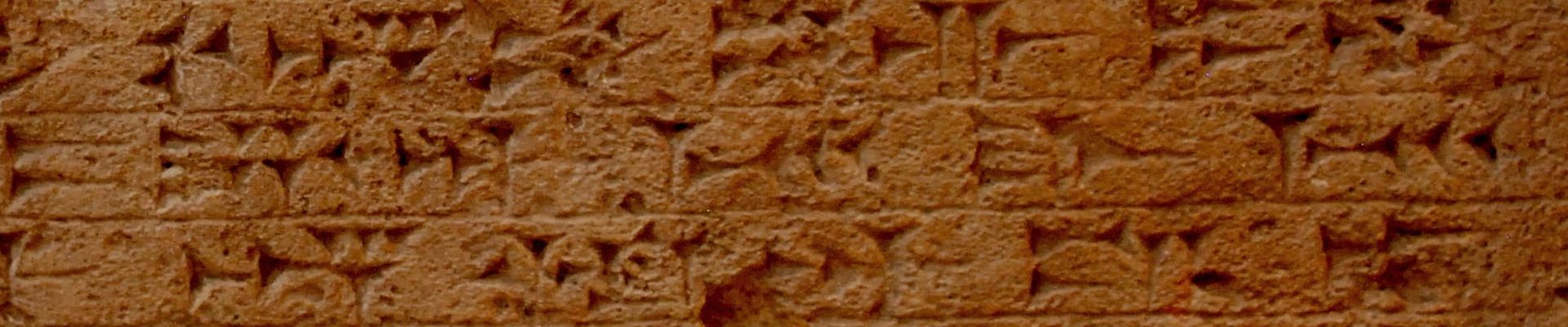
 I spent six weeks excavating with Brigham Young University in Petra, Jordan. This was part of a field school offered through Brigham Young University. For the first two weeks, I helped excavate in a place called Wadi Mataha where my fellow students and I were taught proper excavation techniques that pertain to graves and osteology. We were lucky enough to have found what we believe is a secondary burial with a variety of bones that will be later analyzed in labs back at Brigham Young University. My time there was amazing and I feel that I learned so much. I learned about the ancient Nabataeans and their burial traditions as well as about the methods and theories of archaeology in the field.







 -demographic factors that have shaped the evidence on which the conclusion depends.


