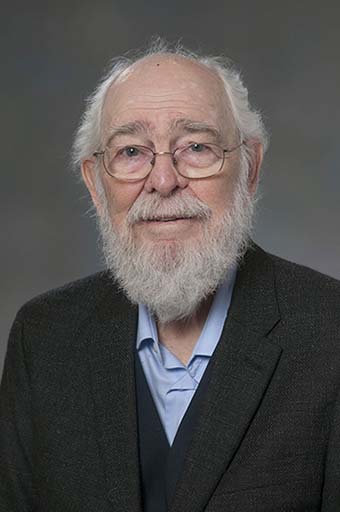
Vincent Cason, 2017 Platt Excavation Fellowship Recipient
Vince and volunteer Josiah uncover a beautiful juglet.
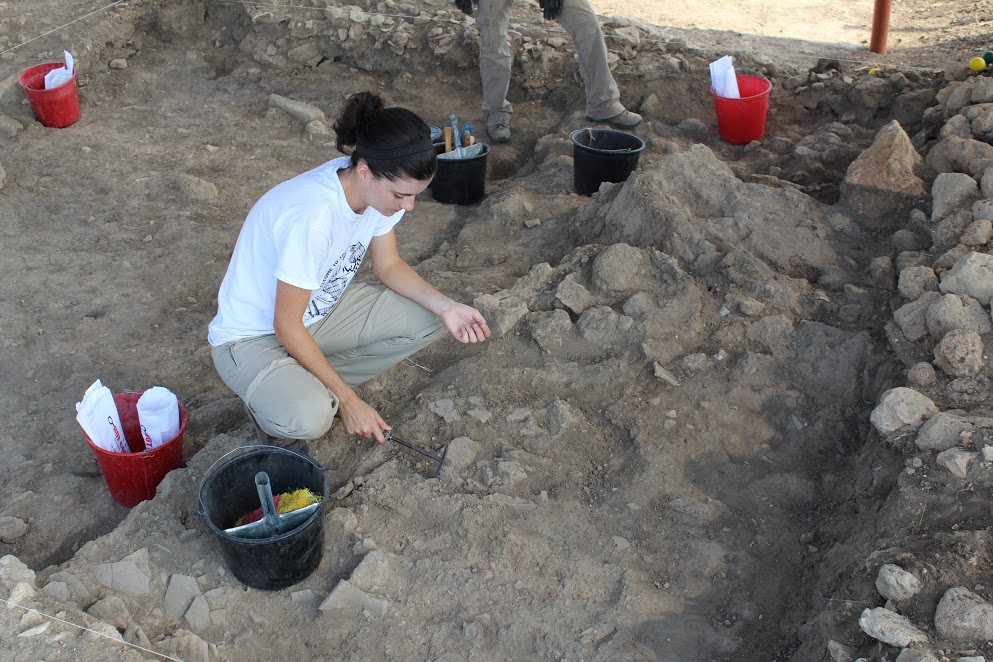
This past summer I was given the opportunity to be a square supervisor on The Fourth Expedition to Tel Lachish, directed by Yosef Garfinkel of The Hebrew University of Jerusalem and Michael Hasel and Martin Klingbeil of Southern Adventist University. I was placed under the supervision of Hoo-Goo Kang of Seoul Jangsin University. While this was my third excavation season at Tel Lachish, previously serving two seasons as a volunteer as an Anthropology major at Virginia Commonwealth University (VCU), it was my first time as a member of the Hebrew University staff. The promotion from volunteer to professional staff required a deeper understand of methodology, a sound interpretation as to what exactly was being uncovered, its relationship to material and strata found in adjacent squares as well as the overall site, and how material finds can support the larger questions of the excavation as determined by the directors (urban planning, social behaviors ethnic identification, etc.). Yet, perhaps what was most surprising about doing field archaeology lies beyond the scientific approach and more in the realm of intuition. It was around midseason that I began to lean on an uncanny sense of where to dig next and when to keep my eyes open.
But how does one really know what to look for?
Vince examines a sling stone in the field.
A common theme in introductory classes to anthropology and archaeology is the holistic nature of our field, taking ideas and influence from many other fields and disciplines. This observation tends to lie dormant in the more theoretical side of things unless students actually have a chance to apply it to or through methodology. When taking part of an archaeological excavation, one can see that this holistic nature applies to much more than theory but additional includes what each staff member brings to the excavation. I found that a basic understanding of trade work can be an invaluable asset to understanding many parts of ancient society.
During my high school education, I focused on agriculture, as I was interested in the history of land use especially farming techniques and this was a strong program in rural North Carolina. I was a member of the Future Farmers of America, took classes on horticulture, and after graduation worked in landscaping for a period. While technology has changed quite a bit over the past few thousand years, many principles are constant, especially when it comes to agriculture. Grain production, from harvest to storage, to milling or grinding, then table use follow essentially the same trajectory even with modern invention. For example, terracing, an ancient method of farming, are still used today to allow agriculture in areas with steep topography.
During the 2017 season, much of my area was uncovering architecture which was another area I had practical work and classroom experience in. In my high school construction class, students built a house, auctioned off at the end of the semester, which in turn funds the class. And here I was, excavating houses! After removing nearly a meter of overburden in two squares, we had two immediate objectives which we methodically dispatched: find the floor and the foundation of the wall of the building. The same process of foundations, framing, flooring, and roofing I learned in high school guided me as I excavated the square, uncovering the walls, ceiling collapse, flooring, and foundational trenches in reverse order.
VCU Rams remove balks to fully expose architecture.
While I was able to lean on past academic and practical experience I did notice an important distinction between construction and deconstruction. Archaeology is often described as a destructive science because, once excavated, the archaeological matrix is gone forever, which necessitates meticulously recording while excavating. While excavating these buildings, I realized that destructive is misleading, that what we do is more “deconstructive” as we examine the structure, piece by piece, from the top down as it is “dismantled.”
This summer working on the Hebrew University staff at Tel Lachish was a truly insightful experience. I have deepened my understanding of what an incredible amount of social organization and labor goes into the building of a city, building a nation. It has left me feeling assured that I have chosen a career path that I truly enjoy, one that has real impact on the world around me. As a prospective graduate student there are few feeling that alleviate the anxiety of taking the next step in my education the way that feeling does. To those that are kind enough to fund fellowships such as the one I was awarded, I cannot thank you enough as I would not have had a chance like this otherwise and there are many others that are in the same situation.
Vincent Cason is a recent graduate of the Anthropology program at Virginia Commonwealth University in Richmond, VA. His research interests include state formation in the Iron Age Levant and agricultural practices in the general Near East. He is currently living in Richmond, VA and preparing graduate program applications.
Well, sometimes I get up later … it’s hard to get out of bed before sunrise in Israel. But I always have to get a little something to eat before working on the tel. My favorite is a plum and bread with peanut butter on it. Then it’s off to excavations with the rest of the Tel Akko Total Archaeology Project.
5:40am: Arrive at Tel Akko
The first thing we all do in the morning is grab our supplies and sweep the park path around the dig site. Our supplies include black buckets for dirt, colored buckets for pottery and small finds, a brush, a trowel, and a patiche. A patiche is almost like a smaller, thinner hammer. This isn’t the most fun part of the day, but I find it gives me some time to wake up before excavation.
5:40-8:30am: Excavation
In the morning, we give our square a general sweep to collect all the loose dirt that blew in overnight. Then we get our plan of the day’s dig from our square supervisor. Then finally we start digging! Mostly, I have been excavating around tabuns (Arabic word for oven) until they are floating and then removing the tabuns. There were four tabuns in my square at the beginning of the season and we are working to remove them all this season.
2017 Tell Akko group
Throughout the day, the tel is filled with music, talking, and conversations. Our excavation has such a great atmosphere and I love it. One professor always goes around and asks everyone, “When was the last time you drank water?” It’s a helpful reminder to stay hydrated in the hot 80-90 degree weather.
Questions and conversations are all around the tel. I have learned to embrace asking questions, every single one. I want to soak up all the knowledge I can while I’m on this excavation. There are people on the dig with their special interests/expertise like metallurgy, lithic tools, Munsell Charts, or ceramics. My interest is in ceramics, though I don’t know the chronology of pottery on the tel very well. I feel really honored, since it is only my first excavation, when someone brings a ceramic sherd or item over for me to look at.
8:30am: Tel Breakfast, also known as 2nd Breakfast
9:00-11:30am: Excavation
After breakfast we all reluctantly get up from the tables and get back to work. Sitting and relaxing for a while makes it hard to get back to work. I usually pick up where I left off before breakfast. For example, if I was trimming a baulk before tel breakfast, I would go back to doing that. A baulk is the half meter section of dirt left on each side of a square. Baulks are helpful to see the stratigraphy of the square. When trimming it, the idea is to make the baulk straight and at a right angle with the floor of the square. Plus it makes the square look clean and nice.
The best part of my day is excavating. Excavation includes so many parts I didn’t know before coming to Tel Akko, like trimming baulks. I also have learned how to use a dumpy level to take elevation points in our square. I find it easy to use and a nice change from digging all day. We take elevations when something significant or special is found, like a unique artifact. In my square, it’s usually a slag cake. Also, elevations are taken at the end of each day not only in my square but every square being excavated at the site. Taking end of the day elevations tells us exactly how far down we excavated that day.
Sherd found on site
I have learned how to identify so many things from digging the past three weeks like bone, vitrified earth, and tabun pieces (which look like really thick clay). This really helps when sifting all the dirt that is pulled out of my square (another skill I have learned). It’s a great feeling when I ask my square supervisor to double check my identification and I got it right!
11:30am-12:00pm: Cleaning and Closing the Square for the Day
Just like at the beginning of the day, we do a general clean sweep of the square to get all the dirt we kicked up throughout excavation. Then I usually help my square supervisor check all our finds for the proper tags and fill out end-of-the-day paperwork.
12:00-12:30pm: Find of the Day
Now that all the squares are closed for the day we can see some cool things people found! Fun or different finds are put up to be voted on, by cheering, for the “find of the day.” Some items that have won are an Egyptian scarab, a ceramic figurine, and a modern bullet.
12:30pm: Walk to the Bus
My day on the tel concludes with carrying all the pottery and soil samples found that day down the long steps to the bus. We need to soak and wash the pottery so it can be studied by the ceramic experts in the lab. I also like to see all the cool pottery found on Tel Akko!
Now there are only a few days left on the tel and I’m wishing for more. I think I wish for more because I have fallen more in love with archaeology (if that’s even possible) and I truly enjoy the people working around me.
Megan Ashbrook is a senior undergraduate at Miami University of Ohio. She is a double major in Anthropology and East Asian Languages and Cultures with a minor in Archaeology. Archaeological ceramic technology and trade is her current area of interest.
Tel breakfast is one of the best meals of the day! Every morning I have hummus, green olives, and tea. Depending on what else there is I also have fruit, vegetables, or a peanut butter and jelly pita sandwich. Breakfast is also nice because it is served family style with all of us siting at one long table. I really enjoy passing the food and talking to my friends and finding out what is happening in their squares. I get to hear about fun things like hearths or almost complete vessels.
[/vc_column_text][vc_column_text]By Susan Ackerman, ASOR President
ASOR members may remember that we reported in the June 6, 2017, edition of News@ASOR that the ASOR offices had moved. This move was necessary because our old office building, which was part of the Boston University campus and where we had been granted complimentary office space by BU for the past twenty years, had been sold to a real estate developer, who required us to vacate.
We vacated to space just down the street—from our old offices at 656 Beacon Street to space at 650 Beacon Street. But we knew when we moved last June that this move was only temporary, as 650 Beacon Street is owned by the same real estate developer who bought 656 Beacon and is a building that is slated, like 656 Beacon Street, for redevelopment, beginning at some point in late 2018.
The ASOR Board, advised by the Board’s New Office Committee (chaired by our Board Chair Richard Coffman), thus entered into extensive discussions regarding the best long-term plan for ASOR. This, we have determined, is to purchase a facility to serve as ASOR’s permanent and independent home. The Board has also determined, again through extensive discussion and through site visits, that the optimal location for our new office is in the Washington, D.C., area.
This decision is based on our conviction that a Washington-based location would best support ASOR’s program goals. ASOR’s scholarly work, for example, is necessarily interdisciplinary—not only because we facilitate the work of scholars across disciplines such as archaeology, cultural heritage, history, and linguistics, but because these disciplines are inherently interdisciplinary. Office space in the Washington, D.C., area will further ASOR’s interdisciplinary engagement by providing opportunities for regular contact with colleagues from like-minded learned societies that are also Washington-based, including the American Anthropological Association, the American Council on the Teaching of Foreign Languages, the American Historical Association, the American Research Center in Egypt, the National Geographic Society, and the Society for American Archaeology. Office space in Washington also offers us opportunities for academic and administrative contact with key higher-education associations that help foster (among other things) the scholarship for which ASOR is known: the American Council on Education, the American Association of State Colleges and Universities, the Association of American Colleges and Universities, the Association of American Universities, and the Council of Independent Colleges.
In addition, office space in the Washington, D.C., area will allow ASOR’s cultural heritage team—who have worked since 2014 to document and raise global awareness about damage to cultural heritage sites in war-torn regions of North Africa and the Middle East, through funding provided primarily by the U.S. Department of State—to work more closely with our State Department colleagues and also our allies at the National Endowment for the Humanities, the National Humanities Alliance, and the Council of American Overseas Research Centers (CAORC). Proximity to Washington’s foreign embassies will also benefit ASOR because of the critical role these embassies play in approving and facilitating the U.S.-based, ASOR-affiliated archaeological excavations, field surveys, and other projects that take place overseas.
Within the Washington area, we have tentatively identified Alexandria, VA—where many other non-profit organizations are located and an easy commute to downtown Washington—as the site of ASOR’s potential new home. Twice in the last two months, I, our Executive Director, and two other officers have met with a Washington-based commercial realtor to confirm that there are appropriate properties in Alexandria that are within our price range. We have also confirmed that the legal aspects of the purchase and establishment of our operations in the Washington area will be handled by ASOR’s pro bono law firm, Arnold and Porter, LLC, which is located in Washington, D.C.
Our plan going forward is to rent office space in Alexandria come June 1, 2018, as we begin relocating our office to this new location and as we continue to identify potential properties that we might buy. We also plan to retain our current Boston staff and continue running some of our operations out of Boston through December 31, 2018, for the sake of continuity and so that we might continue to benefit from our staff’s significant expertise and long-term experience in managing ASOR. We have in addition offered our current staff the opportunity to move with us, although, right now, none of them intends to pursue that possibility.
These are big changes for ASOR—and as with all big changes, there are feelings of sadness and loss, as we say goodbye to our long-time Boston home and, more important, to our devoted Boston staff. There is also still a lot to discuss, and many decisions are still in the offing.
But the biggest decision has been made—to purchase a new and permanent home for ASOR in the Washington, D.C., area—and it is an exciting one. ASOR’s first office, established in 1900, was one large room in a Jerusalem hotel. During the succeeding 118 years, we have dramatically expanded our scholarly capacity and public outreach. A permanent home for ASOR is the logical next step for our organization. This office space will transform ASOR, taking us to a new level, as we work to dig deeper and deeper into the past to accomplish more and more in the future.
Image taken from washington.org.[/vc_column_text][/vc_column][vc_column border_color=”rgba(170,170,170,0.01)” width=”1/6″ css=”.vc_custom_1496684098866{margin-right: 5px !important;margin-bottom: 20px !important;border-right-width: 2px !important;border-bottom-width: 2px !important;padding-top: 30px !important;padding-right: 10px !important;padding-left: 10px !important;background-color: #ffffff !important;border-right-color: rgba(227,228,228,0.75) !important;border-bottom-color: rgba(227,228,228,0.75) !important;}”][vc_wp_posts title=”BROWSE THE NEWS ARCHIVE” number=”4″][/vc_column][vc_column border_color=”rgba(170,170,170,0.01)” width=”1/6″ css=”.vc_custom_1496684008271{margin-right: 10px !important;margin-bottom: 30px !important;border-right-width: 2px !important;border-bottom-width: 2px !important;padding-top: 30px !important;padding-right: 20px !important;padding-left: 20px !important;background-color: #ffffff !important;border-right-color: rgba(227,228,228,0.75) !important;border-bottom-color: rgba(227,228,228,0.75) !important;}”][vc_column_text]Tweets by ASOResearch [/vc_column_text][/vc_column][/vc_row]
[/vc_column_text][vc_column_text]March Fellowship Madness at ASOR was (once again) a huge success. At the beginning of the month, we had funds from endowments and designated gifts to support 18 scholarships of $2,000. We set a goal of funding two more fellowships (or raising $4,000). Thanks to the support of our generous donors, we raised more then $6,000 and awarded 21 dig scholarships. A big THANK YOU to all of those who participated!
It’s never too soon to participate for next year. If you’d like to make a gift to help with scholarships for the summer of 2019, please use our online store at any time during the year and designate your gift for “Excavation Scholarships” in the drop-down menu.[/vc_column_text][mk_divider][mk_skill_meter title=”Money we have raised so far:” percent=”100″ title_color=”#777777″ progress_bar_color=”#dd3333″ track_bar_color=”#eeeeee”][vc_column_text]
We have raised $42,887 out of our $42,000 goal!
[/vc_column_text][mk_button style=”fill” corner_style=”rounded” size=”large” outline_skin=”#1e73be” outline_hover_skin=”#ffffff” url=”https://netforum.avectra.com/eweb/FND/DonateFund.aspx?Site=ASOR&WebCode=DonateNow&Action=Add&prd_key=ad537b8e-eff8-4f2b-8fd7-3f9de1c62edd&fun_key=80ac42fd-74f9-4fe9-ae70-b99051ea42f8&Name=2015%20Development%20Drive%20Donation%20″ align=”center”]Donate Now[/mk_button][mk_divider][vc_column_text]If you donate to March Fellowship Madness, you support archaeology in a very direct way. Every gift matters. ASOR does not charge any administrative fee for gifts made during March Fellowship Madness, so 100% of your contribution will support students who have a demonstrated need.
[/vc_column_text][vc_column_text]Jim Strange (“Abuna” to the Arabs and to many of us who wanted to honor his Baptist ordination with the Arabic version, “Father”) was the consummate ASOR field archaeologist. He could do things in the field few people in our professional history could do. We can continue to read his voluminous publications, watch him lecture in his various videos and recorded series, visit places now on display where he directed the excavations; but sadly we will never see again the magic he could work as the most skilled field person I have ever seen in scientifically and “artistically” teasing an ancient site into being again—a man whose archaeological gifts made him the perfect choice to be “present at the recreation” of a piece of Roman or Late Roman antiquity.
After years of digging with, and under Jim, first as part of Eric M. Meyers and Jim’s Meiron Excavation Project in the Upper Galilee, and then as one of Jim’s Associate Directors for many years at The USF Excavations at Sepphoris, I know something of the golden skills that have been lost to us and to future generations as we watched him working in the field.
Jim Strange (left) and Denny Groh reading pottery
After decades of bringing my graduate-professional and Northwestern Ph.D. students to learn and excavate on Jim’s projects, I spent my last ten years at another of my alma maters, Illinois Wesleyan University. When I brought a large group of undergraduate students to Sepphoris in 1997 and they got a look at Jim in the field for the first time in all his digging gear, they came over to me and asked me: “Are you really an archaeologist.” Answering in the affirmative, they demurred and pointed at Jim in his hat and many-pocketed vest, shirt, and trousers (see photo) and said: “he’s an archaeologist. Look at his outfit. You don‘t even have an outfit like that.” I explained that Jim’s appearance was his own look and the outfit allowed him to have both hands free when he needed it and to produce the proper tool from his pockets when needed. I carried a leather shoulder bag (likely because my first teacher in stratigraphy, the great Larry Toombs did). They sniffed their disbelief in my capacity and walked away, still fixated on Jim.
Actually, my students discerned correctly how remarkable Jim was. Well, we need to say goodbye to that palpable Jim and talk about some of his extraordinary gifts.
Jim brought to the field and to research an extraordinary gift for languages, which enabled him to examine and correlate sources for use in expositing the data. One day Thomas R. W. Longstaff of Colby College (Jim’s other Associate Director) and I were discussing with Jim an archaeological problem in Field V at Sepphoris (the large public basilica) when a French tour director came up and asked Jim some questions in French. Jim politely carried on a brief conversation in French; just as he finished a German came up and asked for some information and Jim repeated himself in German. Than an Israeli colleague came up and queried Jim in Hebrew, which Jim answered in kind. Just as we were about to continue, one of the Arab workers needed directions, and an Arabic conversation ensued. Finally, Jim turned back to us ready to continue our discussion. Suddenly he shouted “What language am I speaking?” “English,” we replied. “Oh good,” Jim said. “That’s where I wanted to be.”
As the adopted son of Jerry Donald “Rip” Strange, from an early age Jim grew up with a thorough knowledge of surveying and drawing-to-scale. The architect of a sister excavation at Sepphoris came by one day to explain to Jim that the elevations of our structure did not match with theirs, and Jim needed to correct his. Jim looked at his drawings and said “I think you are about a half a meter off.” After looking at our plans, the architect asked if he could borrow them and went off to correct his drawings.
As for his ability to draw balk, I witnessed Jim do something I didn’t think was possible when we excavated the Gush Halav synagogue in Upper Galilee. Eric Meyers, Jim, and Carol Meyers decided to excavate the opposite corners of the interior quadrant of the synagogue structure, leaving a continuous N/S, E/W balk across the entire synagogue. But because the squares are on opposite sides of the structure, one balk can be drawn straightforwardly as a regular balk to be drawn exactly as seen; but the continuation of the N/S and E/West balks appear to the drawer who is now looking the opposite direction at the second half of the balk. Thus, for example, the drawer can start drawing the N/S balk facing West; but the second half of that balk has to be drawn looking East because the SW quadrant facing that balk has to be viewed from the West [See,Meiron Excavation Project V, Eric M. Meyers, Carol . Meyers, with James F. Strange (Eisenbraums, 1990), p. 5, Fig. 4, paying attention to squares I.4 and I.3; and pp. 29-30, Figs. 5 and 6.]. Whoever draws second half of the continuous balk had to draw it backwards on the section since the archaeologist was looking at the back side of the second half of the section. If you think what I have just written is impossible to understand, get at least this much: half of the N/S and E/W sections that bisected the synagogue to create continuous balks had to be drawn to scale backwards. Who but Jim Strange could perform such an impossible task of backward balk drawing? So he did it.
Daily pottery reading is a must for excavators who want to know in exactly what time-period or kind of space (domestic, commercial, etc.) they are digging as their excavation proceeds. It is a must for most American excavators; and Jim and I did such field-reading together, off-and-on, for forty years. When we had a special season for publication of the structures on the acropolis at Sepphoris, it was required that we open and re-check the field readings of all the critical loci. Field readings are done quickly and on a first or second glance and handling of the pottery, so at the end of digging a field or structure, it is imperative that the first readings be rechecked. We were both surprised and gratified to conclude after opening and re-checking the sherds in every critical locus bag, that only one locus required a slight adjustment in dating.
Jim Strange
Granted that we both know our pottery identification. But the above level of accuracy in field-reading is as much due to how well the readers see and spot the sherds poured out on the table. And our exactitude, I believe, was as much due to Jim’s far seeing and closely discriminating eyes (look at the picture close-up of Jim at lunch at Caesarea and note his eyes). That means Jim had an extraordinary ability to record any even subtle visual changes in normally repetitive mundane objects or even places that we might see every day.
So it was that Jim, Tom, and I were coming down the hill that leads from the Acropolis at Sepphoris to the flat lot where the buses are parked every day. Jim suddenly noticed a couple of weeds that previously had never appeared on that spot and said “look how ‘peaky’ those weeds are.” Well, we said, it is the “dry” season. Jim replied “yes, but we aren’t deep enough into that season that the plants should get no water, unless . . .” And we all said “there’s something directly under the surface keeping the water out.”
Out from behind Jim’s Harry Potter vest comes his trowel, and he begins to scrape the surface. What Jim uncovers in a couple of minutes is the base of a sweetheart column and a wall attached to it. Before we are done chasing that (in several seasons) the huge Field V public basilica has appeared, festooned with lovely mosaics. Ah . . . how we shall miss those restless, unequivocating eyes!
Jim was able to use many of his extraordinary gifts almost until he died. A great man has left us. But frankly some of the young ASOR archaeologists I have seen look pretty good. If they could set themselves to attaining Jim Strange’s levels of expertise, we would still miss Jim. Yet, Jim always looked to the future and to the training of new archaeologists for better clarity and more answers. I think such a new generation would make him very happy indeed.
Dennis E. Groh, Ph.D.
University Chaplain Emeritus
Professor of Humanities and Archaeology (ret.)
Illinois Wesleyan University
Easter Sunday
April 1, 2018[/vc_column_text][/vc_column][vc_column border_color=”rgba(170,170,170,0.01)” width=”1/6″ css=”.vc_custom_1496684098866{margin-right: 5px !important;margin-bottom: 20px !important;border-right-width: 2px !important;border-bottom-width: 2px !important;padding-top: 30px !important;padding-right: 10px !important;padding-left: 10px !important;background-color: #ffffff !important;border-right-color: rgba(227,228,228,0.75) !important;border-bottom-color: rgba(227,228,228,0.75) !important;}”][vc_wp_posts title=”BROWSE THE NEWS ARCHIVE” number=”4″][/vc_column][vc_column border_color=”rgba(170,170,170,0.01)” width=”1/6″ css=”.vc_custom_1496684008271{margin-right: 10px !important;margin-bottom: 30px !important;border-right-width: 2px !important;border-bottom-width: 2px !important;padding-top: 30px !important;padding-right: 20px !important;padding-left: 20px !important;background-color: #ffffff !important;border-right-color: rgba(227,228,228,0.75) !important;border-bottom-color: rgba(227,228,228,0.75) !important;}”][vc_column_text]Tweets by ASOResearch [/vc_column_text][/vc_column][/vc_row]
[/vc_column_text][vc_column_text]James F. (Jim) Strange was our close collaborator for more than a decade and has also been a dear friend for more than four decades. This double relationship goes back to the late 1960s at Tel Gezer where Jim and Eric first met. That initial acquaintance brought an awareness of our shared interest in the archaeological recovery of early Judaism and Christianity and led us all to the Galilee. From 1970 to 1981 we excavated together at four Upper Galilean villages, all with synagogues: Khirbet Shema‘, Meiron, Gush Ḥalav, and Nabratein. We also broke with the usual practice of excavators leaving their families behind; we brought our own families with us to the field and encouraged senior staff to bring their spouses and children.
Thus our relationship deepened not only with Jim but also with his wife Carolyn, who served as Registrar for several seasons at Khirbet Shema‘ and Meiron (and subsequently had other roles on Jim’s later projects), and their children. Sometimes we even had a “kids’ tent” for the offspring. As soon as the children of the Stranges, Meyerses, and other staff were old enough to lug a gufah or manipulate a sifter, they were put to work in the trenches. For the Strange family (but not ours!), this early field experience apparently had a profound impact, for several of the young Stranges are now themselves professionals in archaeology. Perhaps there could be no greater testimony to Jim’s passion for archaeology, which we have always greatly admired, than the fact that he has passed it on to the next generation of his family.
Much of the preparation of the final reports in those early years was done in Durham, and Jim came often to stay with us at our home and work with us on the publications of our excavations and also on the book that Eric and Jim wrote together: Archaeology, the Rabbis, and Early Christianity (Abingdon 1981). When we were not with him in the Duke library or at our offices, we were at home laying out pottery and artifact plates—a task that had to be done manually in those days—on our dining room table. Because all of this was time consuming, Jim was with us so often, sometimes for weeks, that our daughters thought of him as a regular member of the family. At one point, our younger daughter, accustomed to seeing Jim every day in the summers and also during the weeks he stayed with us when working on publications, introduced him to others as her “second daddy.” It’s no wonder we often call him fondly “abunah,” a phrase coined early in the Upper Galilee years when we had to explain to our Druze workers that Jim was a man of the cloth and an archaeologist.
An important component of our Upper Galilee digs was our Field School, which, in addition to the field work, included daily pottery reading and registration, evening lectures and seminars, and weekend tours of our sites and also of others in the region. Jim was an indispensable part of the process: he drafted our invaluable and much used “Manual for Area Supervisors”; he explained our various procedures with characteristic wit and wisdom as well as good-humored patience; and in the lectures and tours he conveyed to both students and staff his deep knowledge of the region and its history. Moreover, he was savvy with the technology of recording as well as of digging; as a result we began to use a computer to record data as early as 1980.
Jim Strange, 2017 Annual Meeting
Just as important, Jim’s keen eye for ceramics contributed enormously to the development of a ceramic typology for the Hellenistic through Byzantine periods. In the 1970s, the pottery of these periods was not well known. Thus one of the chief aims of our years together was to lay the groundwork for a serious, stratigraphically focused approach to the archaeology of the Greco-Roman period; this endeavor would be based on a solid ceramic typology. We accomplished this goal in our years together in no small part because of Jim’s expertise. Another objective was to excavate small Jewish villages, especially ones with synagogues, rather than the urban sites favored by so many archaeologists at that time. Very few synagogue sites had been excavated in the years since the German team of Kohl and Watzinger conducted soundings at number of synagogue sites at the beginning of the twentieth century. By excavating four sites with synagogues, we were able to contribute to what became a rapidly growing and flourishing field—the excavation of classical-period sites in Galilee.
After excavation of those four Upper Galilean village sites, we turned to Lower Galilee and the great urban site of Sepphoris. Although we parted ways and organized separate excavation teams and established different research goals, at heart we all remained faithful Galileans. We all still feel a special kinship to Galilee, especially to the Galilee of early Judaism and Christianity. For, through surveys and field trips as well as excavations, we had become familiar with virtually every nook and cranny of the region.
We shared many archaeological and academic experiences with Jim, and we are delighted to be offering our appreciation to this volume celebrating his many notable contributions to the fields of archaeology, Galilean studies, and the history of ancient Judaism and Christianity. But what is most vivid and what has united us through the years is the close friendship we forged with Jim and his family in our digging days. This special relationship continued in no small measure because of our participation in meetings of the American Schools of Oriental Research (ASOR). Indeed, ASOR has been the instrument that has enabled us to see each other regularly after our field work together came to an end. At the same time, our loyalty to ASOR over the years is in no small measure a byproduct of the strong feelings we developed together in the field.
Jim Strange will be sorely missed. May his memory be for a blessing.
Excerpted and slightly revised and taken from his recent Festschrift: A City Set on a Hill: Essays in Honor of James F. Strange. Edited by Daniel A. Warner and Donald D. Binder. Mountain Home, AR 72654: BorderStone Press, LLC, 2014.[/vc_column_text][/vc_column][vc_column border_color=”rgba(170,170,170,0.01)” width=”1/6″ css=”.vc_custom_1496684098866{margin-right: 5px !important;margin-bottom: 20px !important;border-right-width: 2px !important;border-bottom-width: 2px !important;padding-top: 30px !important;padding-right: 10px !important;padding-left: 10px !important;background-color: #ffffff !important;border-right-color: rgba(227,228,228,0.75) !important;border-bottom-color: rgba(227,228,228,0.75) !important;}”][vc_wp_posts title=”BROWSE THE NEWS ARCHIVE” number=”4″][/vc_column][vc_column border_color=”rgba(170,170,170,0.01)” width=”1/6″ css=”.vc_custom_1496684008271{margin-right: 10px !important;margin-bottom: 30px !important;border-right-width: 2px !important;border-bottom-width: 2px !important;padding-top: 30px !important;padding-right: 20px !important;padding-left: 20px !important;background-color: #ffffff !important;border-right-color: rgba(227,228,228,0.75) !important;border-bottom-color: rgba(227,228,228,0.75) !important;}”][vc_column_text]Tweets by ASOResearch [/vc_column_text][/vc_column][/vc_row]
ASOR STUDENT AND EARLY CAREER MEMBERS CAN RECEIVE THE GITIN POTTERY VOLUMES FOR FREE
[/vc_column_text][vc_column_text]In order to further support ASOR’s Student and Early Career Members, we are giving away (at least) 60 sets of Seymour Gitin’s The Ancient Pottery of Israel and Its Neighbors from the Iron Age through the Hellenistic Period. These volumes are an outstanding resource—indeed, many are calling them “The Ceramics Bible.”
This special offer is made possible by five anonymous donors who have made contributions so that Undergraduate, Graduate, and Early Career Members of ASOR can receive these amazing volumes for free. Because we anticipate that more than 60 eligible people will want to claim this resource, we are asking eligible members to complete a Google form by April 10, 2018, to be entered in a lottery. ASOR will select 60 members at random, and we will have the Israel Exploration Society ship the sets to the recipients by surface mail.
Please do not hesitate to contact the ASOR office (617-990-3193) if you have any questions. Again, please submit your entry before April 10th.[/vc_column_text][/vc_column][vc_column border_color=”rgba(170,170,170,0.01)” width=”1/6″ css=”.vc_custom_1496684098866{margin-right: 5px !important;margin-bottom: 20px !important;border-right-width: 2px !important;border-bottom-width: 2px !important;padding-top: 30px !important;padding-right: 10px !important;padding-left: 10px !important;background-color: #ffffff !important;border-right-color: rgba(227,228,228,0.75) !important;border-bottom-color: rgba(227,228,228,0.75) !important;}”][vc_wp_posts title=”BROWSE THE NEWS ARCHIVE” number=”4″][/vc_column][vc_column border_color=”rgba(170,170,170,0.01)” width=”1/6″ css=”.vc_custom_1496684008271{margin-right: 10px !important;margin-bottom: 30px !important;border-right-width: 2px !important;border-bottom-width: 2px !important;padding-top: 30px !important;padding-right: 20px !important;padding-left: 20px !important;background-color: #ffffff !important;border-right-color: rgba(227,228,228,0.75) !important;border-bottom-color: rgba(227,228,228,0.75) !important;}”][vc_column_text]Tweets by ASOResearch [/vc_column_text][/vc_column][/vc_row]
As an Australian, one of the advantages of coming to Israel to dig in June and July each year is getting to miss the coldest part of winter back home in Sydney. May I say though, this pales in comparison to the real reasons I returned this year to excavate for a second season at Tel Abel Beth Maacah, or ABM as its friends call it. For a start, the site is very relevant to my own doctoral research on the archaeology and history of the United Monarchy and Iron Age IIA period, being mentioned a few times in connection with David’s reign, most particularly 2 Samuel 20. It is also located at the cross-roads of different Iron Age identities or “ethnic groups”, the Israelites, Phoenicians and Arameans, which makes for a fascinating research question and many nerdy conversations on the sociopolitical place of the area itself.
But digging at any site, however relevant it is to one’s research, is only going to be as good as the project itself and the people you are digging with. I am very fortunate in saying that at ABM the work, the atmosphere and especially the people make it fantastic place to come and excavate, whether it’s an exciting or a more lacklustre day in terms of the finds. This starts from the top; our three co-directors, Prof. Bob Mullins of Azusa Pacific University and Drs Nava Panitz-Cohen and Dr Naama Yahalom-Mack of the Hebrew University of Jerusalem set the tone as all good leaders do. It’s one of informality and friendliness alongside collaboration and academic excellence, and it filters down to all the staff and volunteers and to the work we do. This was a tougher year than in 2016 when I first dug at ABM in terms of hot weather but probably surpassed it in terms of discoveries.
Our three directors plus a distinguished visitor, Prof. Amihai Mazar.
ABM is located in the far north of Israel in the Hulah Valley, a 15-20 minute bus ride each morning (if 4.15am is really morning and not still night) from our lodgings at the laid-back Kibbutz Kfar Szold. It is so far north in fact that we have the Golan Heights and views of Mt Hermon on the east and the hills of Lebanon overlooking the Tel on the west. Although the site has produced finds from different periods spanning the Early Bronze to the 20th century, the Middle Bronze Age, Iron Age I and Iron Age II are particularly well represented so far. We had four areas open this year, Areas A, F and O in the lower city and my area, Area B in the upper city. Much of the upper city is overlain by two old army bunkers built out of rubble from the village that occupied the site until the 1940s, so much of it is hard to access archaeologically. Area B sits in part of the upper city below the rubble capping, and before this year had already produced a rampart from the Middle Bronze Age, upon which was built a building from the Iron Age I, a large wall from the Iron Age II and a few phases of architecture from the Persian and Hellenistic period.
The crew of Area B near the start of the season.
This year our major discovery, on top of some great small finds and new phasing, was a second large wall from the Iron Age II running parallel to the one already known with what appear to be cross-walls connecting them. There was much discussion about whether we might have a casemate wall system similar to that from the Iron Age IIA at Hazor, but this is hard to confirm at this point. A big part our work in Area B this year was opening up two new squares on the west, which included D19, for which I was the square supervisor. We first encountered there the partially-collapsed remains of a building probably from the Hellenistic period and below that remains of another building of the Persian-Hellenistic period that had already been found in other squares. Last season I and some volunteers removed part of that building and we did the same this year. As this building stood between me and the Iron Age, I enjoyed dismantling this building this year just as much as I did last year! By the end of the season we had begun to reveal some more of one of the large Iron Age II walls and maybe even part of the another cross-wall. The Area B crew is quite representative of the makeup of ABM’s people in general, a mix of mostly Israelis and those from US partner institutions including Trinity International University and Cornell University (though you’ll find them all together in Area A, those Ivy-League types) plus those like me or our Canadian office manager/osteoarchaeologist/organizational genius Claire who joined the project of their own accord.
Square D19 towards then end of the season.
The personal and professional connections I’ve made among them make the dig both an enjoyable and intellectually rousing place to be. My thanks go to all of them and especially to Bob, Nava and Naama, as well as those who’ve funded me this year, Macquarie University and of course ASOR. Regrettably I think thesis completion will keep me from coming back in 2018, so for whoever is willing to fill in for me (hopefully another Aussie to keep the Yanks in line), they can find more information on the dig website and Facebook page.
Zachary Thomas is a PhD candidate in the Department of Ancient History at Macquarie University in Sydney, Australia. His doctoral thesisre-examines the history and archaeology of the United Monarchy of ancient Israel and the Iron IIA period through scholarship on the native understanding of society in the ancient Near East. His wider research interests include archaeological theory and interpretation, Iron Age ceramics, and the history and sociology of the Levant in the Late Bronze and early Iron Ages.
“DO YOU HEAR THAT SOUND? ALL ABOARD THE BUCKET TRAIN!”
Christy Grobmeier, 2017 Member Supported Excavation Fellowship Recipient[/vc_column_text][vc_column_text]Sponsored by the University of North Carolina, Charlotte and led by Drs. Shimon Gibson and James Tabor, the current excavation of Mount Zion continues the work begun by Magen Broshi in the 1970s. The site which lies on the south side of Jerusalem and just outside the current Zion Gate proves one of the most fascinating and enigmatic in Israel. This year, thanks to the generous support of a donor scholarship through ASOR, I’m fortunate enough to be working directly under Dr. Shimon Gibson where I handle the recording of pottery, accounting matters, and other clerical duties after getting down and dirty in the trenches and conducting The Bucket Train – the most exciting bucket chain in the history of archaeology.
The upper area of site with another successful journey of The Bucket Train – CHOO CHOO!
Historically, the site yields finds from the Iron Age through to the modern age. The stratigraphic information proved a little more difficult to decipher, however, as it served as a rubbish heap over different time periods and the area suffered several serious earthquakes. In addition, bulldozers and cranes used during the Broshi excavation moved modern trash under a number of levels, such as the Early Roman or Late Hellenistic. While this may seem problematic, I found an intact 1970s bicycle my first year. Despite having gotten my tetanus boosters, I was denied my newfound transportation to site.
During the Second Temple period (1st century C.E.), the city walls enclosed the area in which many priestly or wealthy families resided. Due to the fill created by the construction of the Byzantine-era Church, we discovered these uncommonly well-preserved and lavish homes featuring entire first and second storeys, mosaics, a bath tub, and a high number of costly murex shells used to dye priestly garments.
Dr. James Tabor (R) and Christy Grobmeier (L) examining a plaster wall in the lower area of Mount Zion
The site also holds strategic importance, most notably during the Crusades, where the Fatimids constructed a large trench to keep the invading forces at bay. The tactic worked quite well until the Crusaders chose to attack from the north, nullifying the defenses. Much later, during the 1948 Arab-Israeli War, the site served as No Man’s Land, evidenced by the barbed wire and bullet-riddled canteen found in the lovingly termed War Box.
Dr. Shimon Gibson (L) and Christy Grobmeier (R) sorting and recording finds in the Armenian Museum after digging
My day typically involves arriving to site at 5 A.M. with the other staff members, digging until 9:30 A.M., then moving to the Armenian Museum which serves as Dig Headquarters. I fill the rest of my morning and early afternoon with editing registers, recording financials, and preparing for the rest of staff to arrive at 1:30. When Dr. Gibson arrives, we work in tandem to sort and record finds which are then reconciled with the locus lists, typically around 5 P.M. or so. Some of our more notable finds are a gold coin dating back to Nero (56 C.E.), a mysterious inscribed stone vessel, and massive spiders. So many very large spiders – though I’m kind enough to let someone else get in on that “fun”.
The days are long and exhausting but so worth it. I get the best of both worlds: I play in the dirt in the mornings and not only can I examine the finds in the afternoons, I’m treated to a first-class education. As a graduate student, money is certainly a top concern of mine and I am incredibly grateful for the generosity of ASOR and the donors.
Christy Grobmeier is a recent transplant from Houston, Texas to Charlotte, North Carolina. She is a religious studies M.A. student and teaching assistant under Dr. James Tabor of the University of North Carolina. She earned her B.A. in Anthropology with dual minors in religious studies and French language from the University of Houston. Her current research interests include the archaeology of Jerusalem, early Christianity, and Aramaic incantation bowls.[/vc_column_text][/vc_column][vc_column border_color=”rgba(170,170,170,0.01)” width=”1/6″ css=”.vc_custom_1496684098866{margin-right: 5px !important;margin-bottom: 20px !important;border-right-width: 2px !important;border-bottom-width: 2px !important;padding-top: 30px !important;padding-right: 10px !important;padding-left: 10px !important;background-color: #ffffff !important;border-right-color: rgba(227,228,228,0.75) !important;border-bottom-color: rgba(227,228,228,0.75) !important;}”][vc_wp_posts title=”BROWSE THE NEWS ARCHIVE” number=”4″][/vc_column][vc_column border_color=”rgba(170,170,170,0.01)” width=”1/6″ css=”.vc_custom_1496684008271{margin-right: 10px !important;margin-bottom: 30px !important;border-right-width: 2px !important;border-bottom-width: 2px !important;padding-top: 30px !important;padding-right: 20px !important;padding-left: 20px !important;background-color: #ffffff !important;border-right-color: rgba(227,228,228,0.75) !important;border-bottom-color: rgba(227,228,228,0.75) !important;}”][vc_column_text]Tweets by ASOResearch [/vc_column_text][/vc_column][/vc_row]
[/vc_column_text][vc_column_text]ASOR is pleased to welcome Heather J. McKee as ASOR’s new Treasurer. Heather was elected unanimously by the ASOR Board at its meeting in November 2017. She began her term as Treasurer on January 1, 2018, and the term will run through December 31, 2020.
A native of Charlotte, NC, McKee graduated from Davidson College in 1987 with a Bachelor of Arts in Psychology. In 1989, she earned a second undergraduate degree, a Bachelor of Arts in Accounting from Queens College.
Prior to pursuing a Masters of Divinity at Princeton Theological Seminary, Heather worked as an accountant with Arthur Andersen & Co. in Charlotte, NC. After graduating from Princeton Theological Seminary, she was named the Director of the Bonner Scholars Program and The Center for Service Learning at Mars Hill College. Upon moving to Milwaukee, WI, she worked as Grants Manager/Grant Writer with the Milwaukee Indian Health Board, and later took on the position of Program Director at the Medical College of Wisconsin Institute of Health Policy and Instructor in Medical Ethics. At MCW, she co-authored several papers on the economic determinants of US physician supply and the role of alternative medical providers in the US health care delivery system. Heather continued her work in health policy at Harvard Medical School focusing on finance and delivery system reform and large scale clinical outcome research
Seeking an opportunity to put policy into practice, Heather served as Executive Director of the Sublette Center, a Senior Health and Housing organization in Pinedale, WY. During her tenure, she was selected as a member of the Leadership Wyoming Class of 2012, served on the Governor’s Advisory Council on Health Finance Reform, and the National Education Committee for LeadingAge, a Washington DC based advocacy group for senior health and housing.
McKee currently serves on the Board of Directors of the Davidson Housing Coalition. She is an ordained Deacon and commissioned Stephen Minister, teaches Bible and Confirmation classes, and serves on the Governance, Planning, and the Finance Committees of Davidson College Presbyterian Church. She is a Red Boot Coalition Trailblazer and Guide and was tapped as a 2017-2018 Leadership Davidson Mentor. Heather’s affinity for ASOR began as a Seminarian studying Hebrew texts and continues as the organization strengthens and expands its mission. Heather enjoys cooking, reading, gardening, a variety of sports, and adventure travel. She and her spouse, Jane Campbell, reside in Davidson, NC.[/vc_column_text][/vc_column][vc_column border_color=”rgba(170,170,170,0.01)” width=”1/6″ css=”.vc_custom_1496684098866{margin-right: 5px !important;margin-bottom: 20px !important;border-right-width: 2px !important;border-bottom-width: 2px !important;padding-top: 30px !important;padding-right: 10px !important;padding-left: 10px !important;background-color: #ffffff !important;border-right-color: rgba(227,228,228,0.75) !important;border-bottom-color: rgba(227,228,228,0.75) !important;}”][vc_wp_posts title=”BROWSE THE NEWS ARCHIVE” number=”4″][/vc_column][vc_column border_color=”rgba(170,170,170,0.01)” width=”1/6″ css=”.vc_custom_1496684008271{margin-right: 10px !important;margin-bottom: 30px !important;border-right-width: 2px !important;border-bottom-width: 2px !important;padding-top: 30px !important;padding-right: 20px !important;padding-left: 20px !important;background-color: #ffffff !important;border-right-color: rgba(227,228,228,0.75) !important;border-bottom-color: rgba(227,228,228,0.75) !important;}”][vc_column_text]Tweets by ASOResearch [/vc_column_text][/vc_column][/vc_row]






 In addition, office space in the Washington, D.C., area will allow ASOR’s cultural heritage team—who have worked since 2014 to document and raise global awareness about damage to cultural heritage sites in war-torn regions of North Africa and the Middle East, through funding provided primarily by the U.S. Department of State—to work more closely with our State Department colleagues and also our allies at the National Endowment for the Humanities, the National Humanities Alliance, and the Council of American Overseas Research Centers (CAORC). Proximity to Washington’s foreign embassies will also benefit ASOR because of the critical role these embassies play in approving and facilitating the U.S.-based, ASOR-affiliated archaeological excavations, field surveys, and other projects that take place overseas.

 research an extraordinary gift for languages, which enabled him to examine and correlate sources for use in expositing the data. One day Thomas R. W. Longstaff of Colby College (Jim’s other Associate Director) and I were discussing with Jim an archaeological problem in Field V at Sepphoris (the large public basilica) when a French tour director came up and asked Jim some questions in French. Jim politely carried on a brief conversation in French; just as he finished a German came up and asked for some information and Jim repeated himself in German. Than an Israeli colleague came up and queried Jim in Hebrew, which Jim answered in kind. Just as we were about to continue, one of the Arab workers needed directions, and an Arabic conversation ensued. Finally, Jim turned back to us ready to continue our discussion. Suddenly he shouted “What language am I speaking?” “English,” we replied. “Oh good,” Jim said. “That’s where I wanted to be.”