Call for Honors and Awards Committee Member

[vc_row fullwidth=”true” attached=”true” css=”.vc_custom_1496247803139{padding-top: 0px !important;padding-right: 0px !important;padding-bottom: 0px !important;padding-left: 0px !important;}”][vc_column][vc_single_image image=”78668″ img_size=”full” alignment=”center”][/vc_column][/vc_row][vc_row fullwidth=”true” css=”.vc_custom_1496682730308{padding-top: 10px !important;padding-right: 0px !important;padding-bottom: 0px !important;padding-left: 0px !important;}”][vc_column width=”1/12″ css=”.vc_custom_1496683820796{margin-right: 10px !important;}” offset=”vc_hidden-md vc_hidden-sm vc_hidden-xs”][vc_column_text]

 SHARE

[/vc_column_text][mk_image src=”http://www.asortest.org/wp-content/uploads/2017/01/social-fb-icon4.jpg” image_width=”42″ image_height=”42″ hover=”false” custom_url=”https://www.facebook.com/ASOResearch/” margin_bottom=”0″][mk_image src=”http://www.asortest.org/wp-content/uploads/2017/01/social-tw-icon4.jpg” image_width=”42″ image_height=”42″ hover=”false” custom_url=”https://twitter.com/ASOResearch?ref_src=twsrc%5Egoogle%7Ctwcamp%5Eserp%7Ctwgr%5Eauthor” margin_bottom=”0″][mk_image src=”http://www.asortest.org/wp-content/uploads/2017/01/social-in-icon4.jpg” image_width=”42″ image_height=”42″ hover=”false” custom_url=”https://www.linkedin.com/company/american-schools-of-oriental-research” margin_bottom=”0″][mk_image src=”http://www.asortest.org/wp-content/uploads/2017/01/social-ml-icon_7.jpg” image_width=”42″ image_height=”42″ hover=”false” custom_url=”mailto:info@asor.org” margin_bottom=”0″][mk_image src=”http://www.asortest.org/wp-content/uploads/2017/01/blog-icon3.jpg” image_width=”42″ image_height=”42″ hover=”false” custom_url=”http://asor.org/blog” margin_bottom=”0″][/vc_column][vc_column border_color=”rgba(255,255,255,0.01)” width=”1/6″ css=”.vc_custom_1496683923840{margin-right: 20px !important;border-left-width: 2px !important;padding-right: 20px !important;padding-left: 20px !important;border-left-color: #99422f !important;}”][mk_divider divider_color=”rgba(255,255,255,0.01)” thickness=”1″ margin_top=”3″ margin_bottom=”3″][vc_widget_sidebar sidebar_id=”ca-sidebar-39801″][/vc_column][vc_column border_color=”rgba(170,170,170,0.01)” width=”1/2″ css=”.vc_custom_1487276122024{margin-right: 10px !important;margin-bottom: 30px !important;border-right-width: 2px !important;border-bottom-width: 2px !important;padding-top: 30px !important;padding-right: 30px !important;padding-left: 20px !important;background-color: #ffffff !important;border-right-color: rgba(227,228,228,0.75) !important;border-bottom-color: rgba(227,228,228,0.75) !important;}”][vc_column_text responsive_align=”left”]

Call for Honors and Awards Committee Member

[/vc_column_text][mk_divider][vc_wp_text]
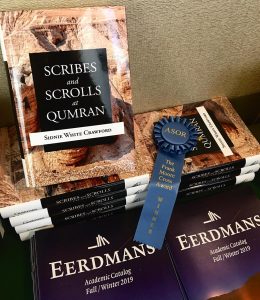
The Honors and Awards Committee seeks nominations to serve on the Frank Moore Cross Book Award sub-committee. ASOR invites nominations, including self-nominations, from ASOR members who are interested in being considered by the committee for this opening. Committee members will serve a three-year term with the possibility of two consecutive terms. Nominees must fill out the online form by February 28, 2022. The Honors and Awards Committee takes responsibility for determining the awardees for the three book awards, the field archaeology award, the “best poster” award, and the multiple membership service awards that ASOR gives annually; conducting the awards ceremony during the Members’ Meeting at the ASOR Annual Meeting; and discussing and advising the ASOR Board of Trustees about ASOR’s awards, including recommending to the Board the creation of new awards as deemed appropriate.

One candidate is sought for the Frank Moore Cross Award sub-committee. This award is presented to the author/editor of the most substantial volume(s) related to the history and/or religion of the ancient Near East and Eastern Mediterranean. Primary consideration will be given to historical, epigraphic, textual, and comparative literary studies; or to works that advance and/or evaluate new methodological approaches to the literary record(s). This work must be the result of original research published during the past two years. (One award is given annually.)

In order to receive full consideration by the committee the online form must be submitted by noon EDT on February 28, 2021. For questions and concerns, please contact Marta Ostovich (programs@asor.org) 
[/vc_wp_text][/vc_column][vc_column border_color=”rgba(170,170,170,0.01)” width=”1/6″ css=”.vc_custom_1496684098866{margin-right: 5px !important;margin-bottom: 20px !important;border-right-width: 2px !important;border-bottom-width: 2px !important;padding-top: 30px !important;padding-right: 10px !important;padding-left: 10px !important;background-color: #ffffff !important;border-right-color: rgba(227,228,228,0.75) !important;border-bottom-color: rgba(227,228,228,0.75) !important;}”][vc_wp_posts title=”BROWSE THE NEWS ARCHIVE” number=”4″][/vc_column][vc_column border_color=”rgba(170,170,170,0.01)” width=”1/6″ css=”.vc_custom_1496684008271{margin-right: 10px !important;margin-bottom: 30px !important;border-right-width: 2px !important;border-bottom-width: 2px !important;padding-top: 30px !important;padding-right: 20px !important;padding-left: 20px !important;background-color: #ffffff !important;border-right-color: rgba(227,228,228,0.75) !important;border-bottom-color: rgba(227,228,228,0.75) !important;}”][vc_column_text] [/vc_column_text][/vc_column][/vc_row]

Call for Nominations: DEI Committee

[vc_row fullwidth=”true” attached=”true” css=”.vc_custom_1496247803139{padding-top: 0px !important;padding-right: 0px !important;padding-bottom: 0px !important;padding-left: 0px !important;}”][vc_column][vc_single_image image=”71726″ img_size=”full” alignment=”center”][/vc_column][/vc_row][vc_row fullwidth=”true” css=”.vc_custom_1496682730308{padding-top: 10px !important;padding-right: 0px !important;padding-bottom: 0px !important;padding-left: 0px !important;}”][vc_column width=”1/12″ css=”.vc_custom_1496683820796{margin-right: 10px !important;}” offset=”vc_hidden-md vc_hidden-sm vc_hidden-xs”][vc_column_text]

 SHARE

[/vc_column_text][mk_image src=”http://www.asortest.org/wp-content/uploads/2017/01/social-fb-icon4.jpg” image_width=”42″ image_height=”42″ hover=”false” custom_url=”https://www.facebook.com/ASOResearch/” margin_bottom=”0″][mk_image src=”http://www.asortest.org/wp-content/uploads/2017/01/social-tw-icon4.jpg” image_width=”42″ image_height=”42″ hover=”false” custom_url=”https://twitter.com/ASOResearch?ref_src=twsrc%5Egoogle%7Ctwcamp%5Eserp%7Ctwgr%5Eauthor” margin_bottom=”0″][mk_image src=”http://www.asortest.org/wp-content/uploads/2017/01/social-in-icon4.jpg” image_width=”42″ image_height=”42″ hover=”false” custom_url=”https://www.linkedin.com/company/american-schools-of-oriental-research” margin_bottom=”0″][mk_image src=”http://www.asortest.org/wp-content/uploads/2017/01/social-ml-icon_7.jpg” image_width=”42″ image_height=”42″ hover=”false” custom_url=”mailto:info@asor.org” margin_bottom=”0″][mk_image src=”http://www.asortest.org/wp-content/uploads/2017/01/blog-icon3.jpg” image_width=”42″ image_height=”42″ hover=”false” custom_url=”http://asor.org/blog” margin_bottom=”0″][/vc_column][vc_column border_color=”rgba(255,255,255,0.01)” width=”1/6″ css=”.vc_custom_1496683923840{margin-right: 20px !important;border-left-width: 2px !important;padding-right: 20px !important;padding-left: 20px !important;border-left-color: #99422f !important;}”][mk_divider divider_color=”rgba(255,255,255,0.01)” thickness=”1″ margin_top=”3″ margin_bottom=”3″][vc_widget_sidebar sidebar_id=”ca-sidebar-39801″][/vc_column][vc_column border_color=”rgba(170,170,170,0.01)” width=”1/2″ css=”.vc_custom_1487276122024{margin-right: 10px !important;margin-bottom: 30px !important;border-right-width: 2px !important;border-bottom-width: 2px !important;padding-top: 30px !important;padding-right: 30px !important;padding-left: 20px !important;background-color: #ffffff !important;border-right-color: rgba(227,228,228,0.75) !important;border-bottom-color: rgba(227,228,228,0.75) !important;}”][vc_column_text responsive_align=”left”]

Call for DEI Committee Nominations

[/vc_column_text][mk_divider][vc_wp_text]
At its November 21, 2021, meeting, the ASOR Board of Trustees established a standing committee to work on fostering Diversity, Equity and Inclusion in our organization. The Board appointed Erin Darby of the University of Tennessee as the chair of the newly formed DEI Committee. This committee grew out of DEI Task Force established by President Sharon Herbert in the fall of 2020, and several members of that Task Force will serve on the Committee. We are now seeking volunteers and nominations for additional members of the Committee. Its responsibilities as envisioned by the Board are described briefly in section 5.21 of ASOR’s by-laws as advising ASOR leaders “regarding initiatives ASOR might undertake either individually or jointly with other bodies to reach out to and include diverse communities in ASOR activities in meaningful and sustainable ways. In North America, these communities include, but are not limited to, BIPOC, LGBTQ+, and other underserved groups. Overseas, ASOR will focus on serving its international membership and working with local archaeological communities to promote public engagement in ASOR activities.” Further information on ASOR’s DEI initiatives can be found in section 3 of the 2021-2025 Strategic Plan. Once its full membership is determined, the DEI Committee will work on an expanded charge. Nominations and applications should be sent to Erin Darby and Marta Ostovich. Nominations close Friday, March 11.[/vc_wp_text][/vc_column][vc_column border_color=”rgba(170,170,170,0.01)” width=”1/6″ css=”.vc_custom_1496684098866{margin-right: 5px !important;margin-bottom: 20px !important;border-right-width: 2px !important;border-bottom-width: 2px !important;padding-top: 30px !important;padding-right: 10px !important;padding-left: 10px !important;background-color: #ffffff !important;border-right-color: rgba(227,228,228,0.75) !important;border-bottom-color: rgba(227,228,228,0.75) !important;}”][vc_wp_posts title=”BROWSE THE NEWS ARCHIVE” number=”4″][/vc_column][vc_column border_color=”rgba(170,170,170,0.01)” width=”1/6″ css=”.vc_custom_1496684008271{margin-right: 10px !important;margin-bottom: 30px !important;border-right-width: 2px !important;border-bottom-width: 2px !important;padding-top: 30px !important;padding-right: 20px !important;padding-left: 20px !important;background-color: #ffffff !important;border-right-color: rgba(227,228,228,0.75) !important;border-bottom-color: rgba(227,228,228,0.75) !important;}”][vc_column_text] [/vc_column_text][/vc_column][/vc_row]

AASOR 73: Tel Jezreel

New Annual of ASOR Publication

An Examination of the Stratigraphy and Neolithic-Iron Age Pottery from Tel Jezreel, Area A

by Charlotte Whiting and Gloria London

This volume presents the results of the Tel Jezreel Post-Excavation and Publication Project, directed by Charlotte Whiting on behalf of the Council for British Research in the Levant (CBRL). The project analyzed the Tel Jezreel excavation archive stored at the CBRLs Kenyon Institute in Jerusalem. The current volume presents the stratigraphic sequence (by Charlotte Whiting) and the Neolithic to Iron Age pottery (by Gloria London) excavated during the 1995-1996 seasons. The Tel Jezreel stratigraphy and ceramics have been deemed relevant to determining Iron Age chronological and social issues, two topics that are highly debated in the literature. Despite the fragmentary nature of the deposits, they are published here in order to address these questions. In addition, the study of the ceramics revealed an unanticipated abundance of highly varied pre-Iron Age pottery. Social and technological aspects of the manufacturing techniques, including burnish practices, are discussed.

Annual of ASOR, Volume 73, Series Editor William Caraher, April 2021, 304 pages, 90 b/w figures, 3 tables, ISBN 978-0-89757-111-1, $84.95.

Special Offer for ASOR Members

ASOR members (with a mailing address in the USA) can purchase a copy of AASOR 73 at the discounted price of $25.00 (75% discount + $5.00 US shipping) through February 15, 2022, while supplies last. Purchases are restricted to one volume per member. We are unable to offer this discount to members without a US mailing address due to international shipping costs, but you can purchase and ship a copy through the ISD link below. Please contact programs@asor.org with any questions. Click here to purchase your discounted copy in ASOR’s online store.

Available from ISD — Distributor of Scholarly Books
www.isdistribution.com

Find One — Fund One

FIND ONE — FUND ONE

ASOR plans to celebrate our 122nd year (2022) by awarding more than $222,000 in fellowships, scholarships, and grants! This extraordinary commitment to our members has been made possible by donors who have established endowments or made annual contributions to these programs.

We invite you to FIND ONE (a scholarship, fellowship, or grant) or to help FUND ONE (designated gifts to enable us to award even more, or unrestricted gifts to help with the costs of administering and distributing the awards).

ASOR plans to make four types of awards:

The deadline to apply for fieldwork scholarships and grants is a little over a month away (February 18 for scholarships, February 28 for grants).

ASOR is only able to provide these scholarships with the partnership of our many donors. We are pleased with the progress that ASOR is making to establish new scholarships and grants through endowed funds, but we also need annual support from our friends and members to send these eager students and early-career scholars into the field. Please support archaeology’s next generation by making a gift today. Because of the ongoing pandemic, we especially need gifts to fund . Gifts to the  (unrestricted) will help defray the costs of administering and distributing the grants. We also invite you to make a designated gift by choosing any category from the drop-down menu on the donations module.

Please spread the word and don’t hesitate to contact us if you have any questions (e-mail or call [703-789-9229]).

-The ASOR Team

Stipend Report: Julian Hirsch

Using Experimental Wear to Study Early Bronze Age Wearers

Julian Hirsch, 2021 Eric and Carol Meyers Summer Stipend Recipient


The cemeteries of the Dead Sea Plain (Map by Austin “Chad” Hill).

During the Early Bronze Age I (c. 3700-3100 BCE), the eastern Dead Sea Plain was home to three massive cemeteries at Bab adh-Dhra’, es-Safi, and Fifa. The Bab adh-Dhra’ cemetery in particular has been extensively studied by scholars who have elucidated mortuary rituals carried out at the site and discussed the origins and potential functions of objects found in its tombs. While certain object categories such as pottery and basalt bowls have been extensively studied, research on the hundreds of beads found at each of the Dead Sea Plains cemeteries sites has been far more limited. My research employs a use-wear approach to better understand the use of beads found in different family’s tombs at Fifa. These beads appear to primarily be made out of carnelian and glazed steatite.

Tombs excavated at Fifa by Mohammad Najjar under the auspices of the Department of Antiquities in Jordan. (All photos by author).

Photo of the author reducing a bead blank to the proper size on a basalt slab (Photo by Author).

Use-wear analysis uses optical microscopy to look for regularly appearing patterns on archaeological objects. These patterns might say something about how the object was made, how it was used, or even how long it was used for. To understand these patterns however, it is crucial that use-wear analysts conduct a variety of archaeological experiments that focus on reproducing the same types of patterns found on archaeological examples. Since carnelian has already been the subject of several use-wear studies, I decided to focus my research this summer on reproducing steatite beads of the size and shape of those found at Fifa, and then wearing those beads to see if I could observe any changes over time.

Starting with a chunk of steatite, I used flint and metal blades to fashion a long cuboid. I then rolled the cuboid on grinding slabs made of basalt and sandstone. This transformed the steatite cuboid into a long tube. From there, I used either a flint or metal blade to saw off thin bead blanks. These were then drilled with either a bone drill, a flint drill, or a drill made out of copper wire. Lastly, I reduced the diameter and length of my bead to the size of those found in the archaeological record the same grinding stones. Each material I used to create my steatite beads was carefully chosen to be similar to ones that could have been used to produce the beads during the Early Bronze Age.

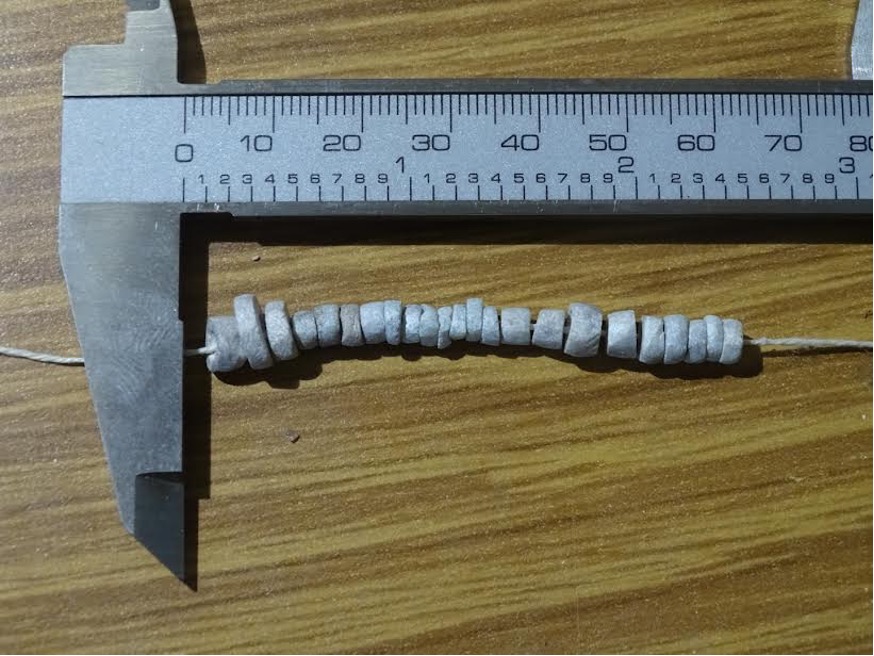
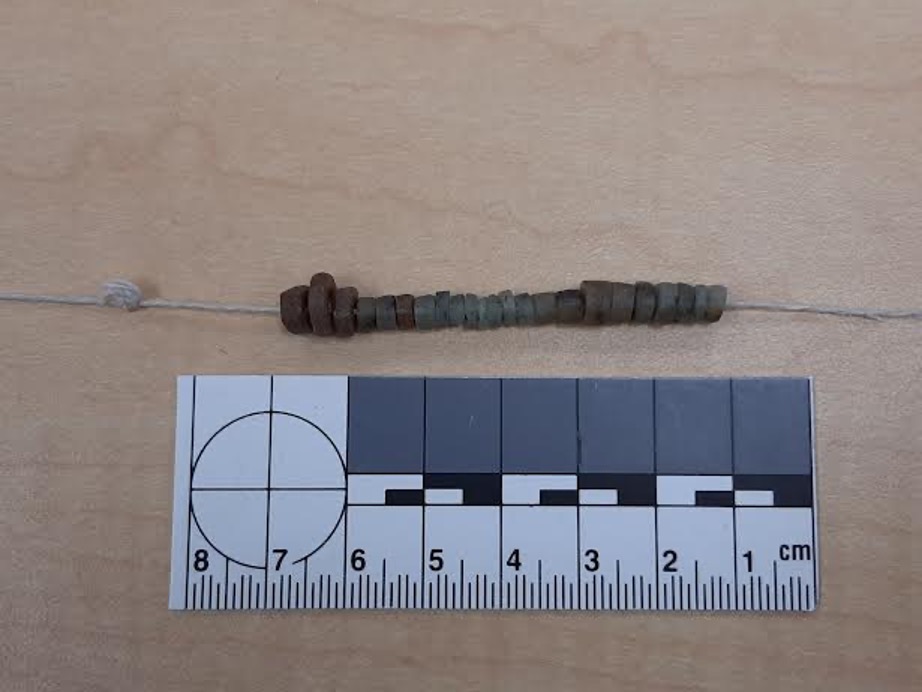
After creating my beads, I began wearing a group of them in a necklace, regularly observing how their surfaces changed over time. As steatite is very soft, it did not take long for manufacturing marks left behind from their slicing, grinding, and perforation to disappear.

A set of newly made unworn steatite beads.
The same set of beads after being worn for two months.

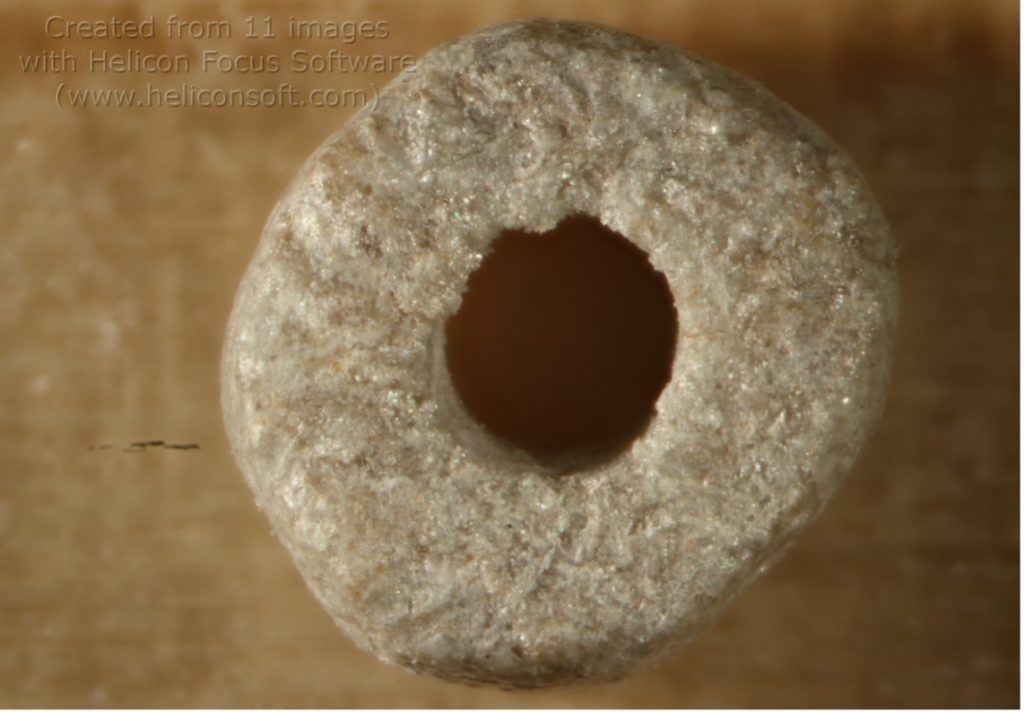
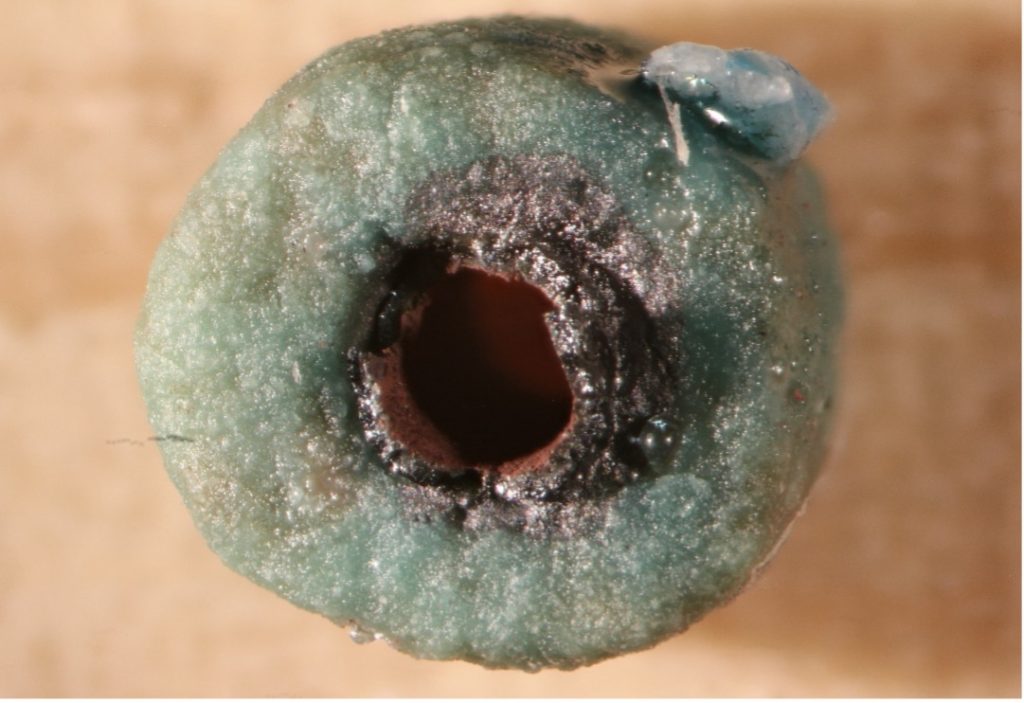
Once I established a baseline for understanding the development of wear on unglazed steatite beads, I turned my attention towards conducting a new set of experiments focused on replicating glazing techniques used in predynastic Egypt. To ensure I cast a wide enough net to replicate the patterns found on the beads found at Fifa, I used several different glazing recipes and methods. Despite following already published recipes, I unfortunately was only able to achieve success with one glazing method. In the coming months, I will observe the development of wear on this set of beads that I believe most closely correlate to those found at Fifa.


Beads covered with glazing mixture made of natron and malachite prior to being placed in a kiln (photo by author).

Bead prior to glazing.
Bead after glazing.

A strand of partially glazed beads that will be worn and observed in the coming months (photo by author).

My experimental research this summer, made possible by ASOR’s generous summer stipend program, has given me a chance to explore experimental archaeology, something entirely new to my archaeological toolkit. Despite the challenges posed by numerous broken beads, unsuccessful glazing attempts, and all too much time alone in a windowless room accompanied by only a kiln and large blocks of steatite, the experimental work I’ve done this summer will without a doubt allow me to better understand Fifa’s excavated bead assemblage. In turn, I believe that it will allow me use to use wear to better understand the bead’s wearers.

Julian Hirsch is a master’s student in Anthropological Archaeology at Trent University. His current research focuses on using use-wear to better understand the life histories of ornaments found in Early Bronze Age tombs. Julian also maintains an active research interest in the history of Biblical Archaeology.  

During the summer of 2021, ASOR supported 27 undergraduate and graduate students through the Summer Stipend Program. These students undertook non-fieldwork archaeological research projects led by ASOR-affiliated project directors. They also took part in monthly cohort group meetings hosted via zoom. Read a summary of these cohort meetings here.

Stay tuned for more updates from the 2021 Summer Stipend recipients!

Call for Publications Committee Nominations

Call for Publications Committee Nominations

ASOR’s Publications Committee seeks new members to serve renewable, three-year terms (January 2022-December 2024). All ASOR members are welcome to apply, though the committee is particularly interested in new members who have experience working in publishing. The committee is currently chaired by Kevin McGeough. The ASOR Bylaws state, “the Publications Committee shall appoint an editorial board for each ASOR publication. The Publications Committee also shall make recommendations to the Executive Committee and the Board regarding matters pertaining to ASOR publications.” The committee makes recommendations regarding ASOR’s journals (ANE Today, BASOR, JCS, and NEA) and ASOR books (AASOR and ASOR-ARS). The committee also makes recommendations regarding the Levantine Ceramics Project (LCP). Committee member responsibilities include attending committee meetings and recommending actions to the Chairs Coordinating Council.
Interested individuals should contact Kevin McGeough via email. All Committee members must be Individual Members of ASOR.

ASOR Annual Fund Appeal

ASOR Annual Fund Appeal

December 14, 2021

Dear Fellow ASOR Member,

Please consider a gift to ASOR before the end of 2021. Since the beginning of the pandemic, we have expanded our programs and outreach. You, our members, have volunteered and contributed in so many ways to keep ASOR moving forward and carrying out our mission. Thank you.

Here is a highlight of some accomplishments achieved during the pandemic (2020–2021):

  • 1100 Annual Meeting participants from 38 countries and 6 continents: Participants in the in-person and virtual components. More than 400 presentations available in the online library.
  • 559 Scholarships: 270 membership and 289 Annual Meeting scholarships = more than $55,000.
  • 26 FOA Webinars: Launched in August 2020, Friends of ASOR (FOA) has hosted 26 webinars (including a “webinarathon”) and raised almost $36,500 for scholarships and DEI.
  • 27 Summer Stipends: Summer research funds, including six for BIPOC students.
  • 4 Major Cultural Heritage Grants: Thanks to Department of State and anonymous funding, ASOR expanded our work in North Africa to Libya, Tunisia, Algeria, and Morocco.
  • More than $270,000 for Diversity, Equity, and Inclusion: More than 220 members established a $200,000 endowment to support BIPOC scholarships. We also invested $70,000 in special projects and scholarships, including videos to help recruit high school students to archaeology.
  • 3 Journals and 2 Book Series: ASOR continues to carry out our mission of disseminating research through our established publications.
  • More than 750 photos and maps: We added hundreds of images to the ASOR Photo Collection so that our members can confidently use them for teaching and research.
  • We will award more than $200,000 in 2022: 50 dig participation scholarships; 7 grants to dig directors / projects; $20,000+ in heritage mitigation grants; $10,000+ in research grants for members; and $18,000 for Mesopotamian research.
  • Continuation of membership and Annual Meeting scholarships in 2022: We want to continue to support the involvement in ASOR for all members with a financial need.


Thus, our request—all the above is made possible because of gifts and endowments. We ask that you join us in a year-end gift or pledge to support our organization so that we can continue to give back to our members in even more ways than listed here.

Warm regards,

Andrew G. Vaughn, Executive Director             Lynn Swartz Dodd, Chair, ASOR Development

Stipend Report: Lilly Hickox

Casting Light on Humayma’s Roman Town

Lilly Hickox, 2021 Eric and Carol Meyers Summer Stipend Recipient


Hickox studying the lamps of Humayma’s vicus. (photo courtesy of M. Schwenteck)

Humayma, located in the northwest corner of Jordan’s Hisma desert, is a site with a long history of permanent settlement with Nabataean, Roman, Byzantine, and early Islamic periods. Excavations at the Roman town (vicus) have been carried out since the 1990s under the direction of Dr. J.P. Oleson from 1991 to 2005 and Dr. M. Barbara Reeves from 2008 to present.

This summer, I researched the ceramic oil lamps and fragments from the vicus at Humayma remotely. The vicus emerged concurrently with the nearby Roman Fort, shortly after the conquest of the Nabataean Kingdom in 106 CE by Emperor Trajan. This research was made possible through ASOR’s Summer Stipend program and funding supported by the Eric and Carol Meyers Scholarship Fund.

The question driving my research was sparked by the findings from my 2020 undergraduate thesis project, Shedding Light on an Ancient Past: The Analysis of Ceramic Oil Lamps from the Roman Fort at Humayma. During this project, I identified a paucity of Roman-style lamps at the Roman Fort, while Nabataean and South Jordan lamps were prevalent. In order to understand why this was happening at the Fort and how the absence of Roman identity in the lamps relates to the activity of the overall settlement, I specifically looked at the corpus from the vicus this summer.

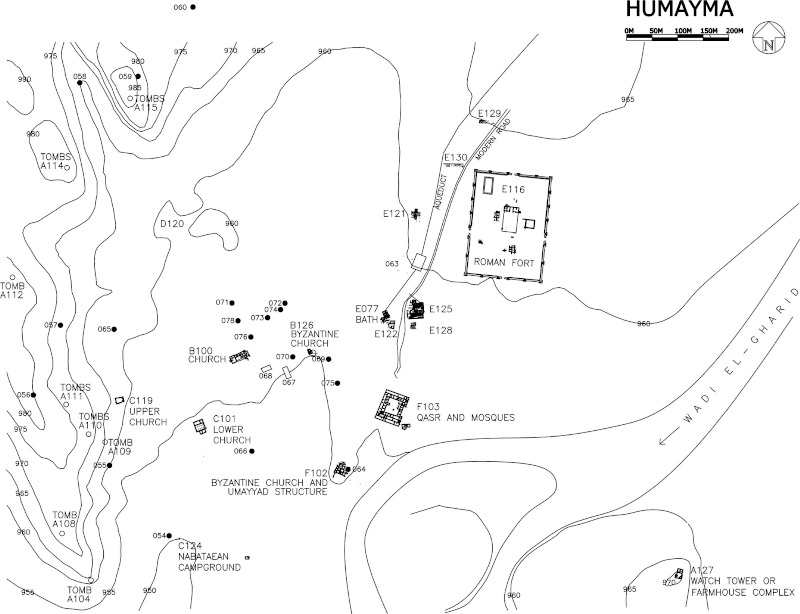
Map of Humayma. (adapted from Reeves 2019, 117 fig 2)

The methodology of this project involved visually examining photographs of lamps, lamp fragments, and mixed pottery fragments. Looking at attributes of shape, discus, shoulder pattern, nozzle, and filling hole, allowed me to identify and catalogue the lamps. These photographs and artefact descriptions were provided by Humayma’s excavators from the 1996, 1998, 2000, 2004, 2005, 2008, 2010, and 2012 field seasons. Neither a comprehensive catalogue nor analysis of the lamps had been carried out until now. This summer, I identified fourteen complete lamps and over 170 lamp fragments.

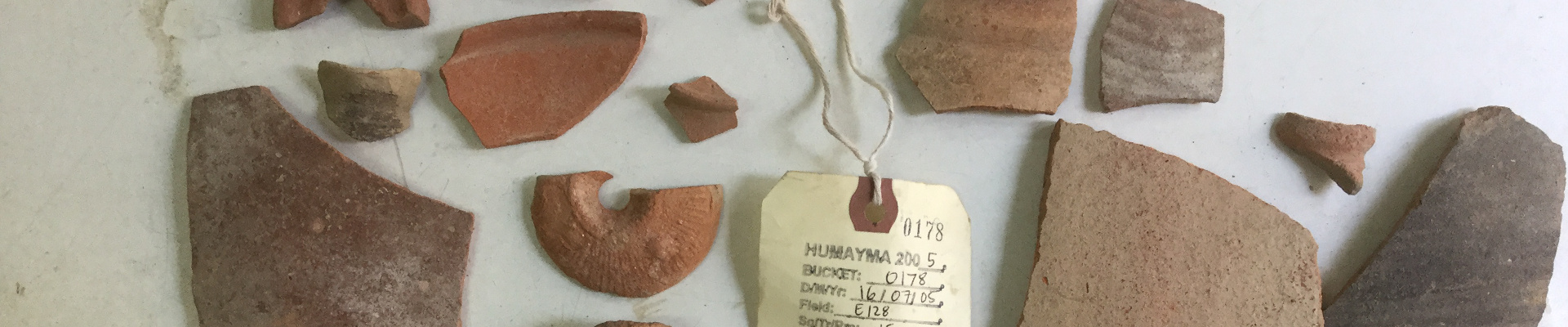
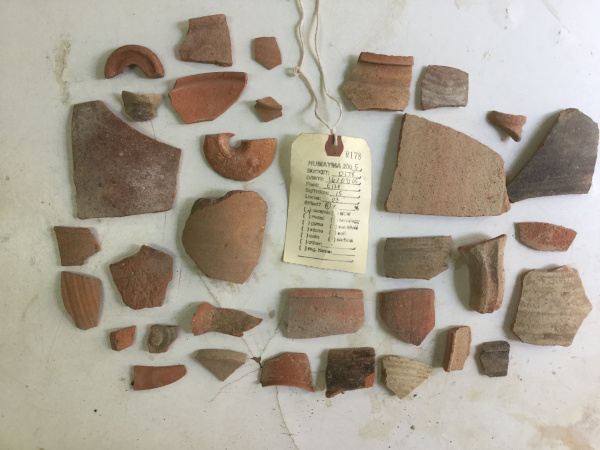
A sample of pottery from area E128. Can you spot a lamp fragment? (photo provided by Dr. M. Barbara Reeves, director of the Humayma Excavation Project)

A Nabataean rosette lamp, one of the most prolific types at the vicus. (photo provided by Dr. M. Barbara Reeves, director of the Humayma Excavation Project)

In this project, I investigated the ceramic oil lamps from three different areas of the vicus. The first area (E077) contained first century CE Nabataean structures that were built over by a bath-house in the Roman period. The Nabataean rosette lamp, dating to the first century CE, likely corresponds to the phase preceding the early second century destruction. Many early Byzantine lamps and some late Roman lamps signify the later occupation of the area.

The second area (E128), a Nabataean or Roman mudbrick structure, contained a majority of Nabataean-style lamps. This structure, made of eclectic materials, was built between the late first century and the middle of the second century. Remarkably, a figural lamp and a boot-shaped lamp were identified in this location, which are both rare for the corpus of the vicus. The boot-shape lamp may align with the later function of the structure in which the area was used as pottery dump until the sixth century CE.


A Roman discus lamp with a gladiatorial combat scene. (photo provided by Dr. M. Barbara Reeves, director of the Humayma Excavation Project)

The final area that I examined was E125, an area possessing a Nabataean-Roman shrine, and various domestic structures, such as a Roman insula. This area yielded the greatest number of lamp fragments, the vast majority being the Nabataean rosette lamp, while fewer were Roman in style. At least three figural lamps were identified, including a symplegma and gladiatorial combat scene. Overall, the lamps from the vicus show a strong parallel with those from Petra.

While this project did not constitute typical field work, it nevertheless presented its own unique challenges. For instance, I relied only on photographic media that was sometimes supplemented by artifact descriptions in order to make an assessment.


Lamp fragments from the E125 shrine. (photo provided by Dr. M. Barbara Reeves, director of the Humayma Excavation Project)

This project contributed to the understanding of the civilian activity at Humayma and may be used to help develop stratigraphic phasing for these areas in the vicus. My next steps will be to look more closely at several anomalous items in the corpus and their parallels. I presented a critical analysis of my findings, considering the corpus from the Fort, at the virtual component of ASOR’s Annual General Meeting in December 2021 (Click here to view the poster).

I would like to personally thank Dr. Reeves for her ongoing support, supervision, and expertise, as well as the Humayma Excavation team for their work, Carol and Eric Meyers for making this possible, and M. Schwenteck for assisting me in translations.

Lilly Hickox is an MA student of Classical and Near Eastern Archaeology at the University of British Columbia. She has been researching the ceramic oil lamps from various locations at Humayma since 2020.

References:

Reeves, M. B. 2019. “The Nabataean and Roman Towns at al-Ḥumayma: an Urban Design Perspective.” Studies in the History and Archaeology of Jordan 13: 115-127.

During the summer of 2021, ASOR supported 27 undergraduate and graduate students through the Summer Stipend Program. These students undertook non-fieldwork archaeological research projects led by ASOR-affiliated project directors. They also took part in monthly cohort group meetings hosted via zoom. Read a summary of these cohort meetings here.

Stay tuned for more updates from the 2021 Summer Stipend recipients!

ASOR Annual Year-End Appeal Letter

Year-End Appeal Letter From ASOR’s President

December 5, 2022

Dear ASOR Members and Friends,

I am writing today to ask you to consider a gift to ASOR before the end of the year. ASOR is leaving 2022 with a larger membership and wider reach than ever before. Our outreach efforts in cultural heritage and education continue to expand both in the U.S. and abroad. We just completed a resoundingly successful Annual Meeting in Boston, where many of you presented your fieldwork and other research in stimulating papers, posters, and workshops attended by nearly 900 participants. Members came from around the world, many for the first time thanks to travel fellowships made possible by members’ generous donations and State Department Embassy grants. ASOR now has over 100 affiliated fieldwork and publication projects in 18 countries, and our prestigious Archaeological Report Series is producing its 30th volume in as many years. Your gifts funded scholarships, fellowships, and grants for many of these programs. You enabled ASOR to award more than $222,000 in 2022.

In recent years, ASOR has been forging new partnerships in our ever changing 21st century world to broaden our investigations of the ancient world, our collective human past, and cultural heritage. We are now reaching new and underserved audiences in efforts to make ASOR’s work more accessible. These efforts range from simultaneous translation of papers to ambitious educational projects fostering community involvement from the people and scholars in the areas in which we work (see the call for such activities by Iraqi archaeologist Jaafar Jotheri in the most recent issue of our Friends of ASOR Newsletter, The Ancient Near East Today X, No. 12). Meanwhile, your support helps ASOR increase benefits to our original constituencies of biblical specialists and experts in Semitic languages and literatures. In 2023, you will see ASOR add Maarav: A Journal for the Study of the Northwest Semitic Languages and Literatures as our fourth journal. Maarav will be available for no additional charge to all ASOR members above the Associate level.

ASOR is an organization that strives to unite people and transcend ethnic, racial, and religious boundaries. We have made great strides in many areas, and with your continued help we can do much more. The secret to vibrant non-profit growth is a virtuous circle of work and support. The generous funding from you, our donors, enables ASOR to accomplish so much as an organization, but also to award member scholarships and grants for even more external research. The products of this work in turn attract more members and donors to produce and fund even more pioneering efforts. Please help to keep that circle unbroken. Give to ASOR today!

Best wishes for a safe and happy holiday season,

Sharon Herbert
ASOR President

Call for Nominations: DEI Committee

Call for DEI Committee Nominations

At its November 21, 2021, meeting, the ASOR Board of Trustees established a standing committee to work on fostering Diversity, Equity and Inclusion in our organization. The Board appointed Erin Darby of the University of Tennessee as the chair of the newly formed DEI Committee. This committee grew out of DEI Task Force established by President Sharon Herbert in the fall of 2020, and several members of that Task Force will serve on the Committee. We are now seeking volunteers and nominations for additional members of the Committee. Its responsibilities as envisioned by the Board are described briefly in section 5.21 of ASOR’s by-laws as advising ASOR leaders “regarding initiatives ASOR might undertake either individually or jointly with other bodies to reach out to and include diverse communities in ASOR activities in meaningful and sustainable ways. In North America, these communities include, but are not limited to, BIPOC, LGBTQ+, and other underserved groups. Overseas, ASOR will focus on serving its international membership and working with local archaeological communities to promote public engagement in ASOR activities.” Further information on ASOR’s DEI initiatives can be found in section 3 of the 2021-2025 Strategic Plan. Once its full membership is determined, the DEI Committee will work on an expanded charge. Nominations and applications should be sent to Erin Darby and Marta Ostovich.