By Dr. Ali. Y. Aljuboori
Dean of the College of Archaeology, Mosul University
Sr. Cultural Heritage Adviser, ASOR CHI
June 10. 2017
[/vc_column_text][vc_column_text]I am writing this article on June 10, 2017. Exactly three years ago, Mosul fell into the hands of ISIL.
On June 10, 2014, Mosul University was in the middle of final exams. At noon, the University ordered everyone to go home before the army and police began to enforce a curfew. At that time we heard that ISIL had entered western Mosul. By midnight they controlled the mayor’s office, the central bank, and all of the other major government buildings.
Over the course of the next morning, I saw many people leaving, including soldiers from the local military base who had thrown off their military uniforms and equipment in order to blend in with civilians. I told my son to flee with his wife and two children. My wife and I stayed behind.
At first, ISIL did not change much. Then, around a month after the conquest, they began to impose Shari’a law. ISIL treated different faiths in different ways. Sunni Muslims had to pay new Islamic taxes while Shi’a Muslims were killed. Other religious groups had three choices: convert to Islam, pay special taxes, or be killed. Every Friday at noon ISIL held public executions by decapitation or hanging as punishment for any resistance or disorder. In this cruel way, they controlled the people of Mosul.[/vc_column_text][mk_image src=”http://www.asor.org/wp-content/uploads/2017/07/ali-juboori-map-destruction2.jpg” image_width=”800″ image_height=”534″ hover=”false”][vc_column_text]
Density of Cultural Heritage Sites in Nineveh Province (Susan Penacho, ASOR CHI)
[/vc_column_text][vc_column_text]
Under ISIL, education and culture in Mosul and Nineveh Province suffered terribly. Shortly after they took over, ISIL began to blow up mosques, churches, and Yezidi shrines. This included Nebi Yunus Mosque, which they destroyed with explosives in July 2014.
[/vc_column_text][vc_column_text]In 2015 they started to erase our ancient heritage. In addition to the destruction of the Neo-Assyrian palace at Nimrud, they demolished the Nergal, Adad, and Mashki gates in the city wall of Nineveh as well as looted and smashed the collections of the Mosul Museum. They also started to dig tunnels into the mound below Nebi Yunus Mosque, which contained the remains of a Neo-Assyrian palace. In these tunnels they discovered inscribed stone reliefs of the Neo-Assyrian king Esarhaddon, a relief depicting a series of ladies, bull colossi, and other small finds from the Neo-Assyrian period.[/vc_column_text][mk_image src=”http://www.asor.org/wp-content/uploads/2017/07/ali-juboori-ratio-destruction2.jpg” image_width=”960″ image_height=”540″ hover=”false” margin_bottom=”5″][vc_column_text]
Ratio of Intentional Destruction of Cultural Heritage in Iraq and Syria (Susan Penacho, ASOR CHI)
[/vc_column_text][vc_column_text]ISIL also attempted to eliminate access to any knowledge that they considered un-Islamic. Schools and universities remained closed after the conquest. They burned the collections of the Public Library of Mosul and the Central Library of Mosul University.[/vc_column_text][mk_image src=”http://www.asor.org/wp-content/uploads/2017/07/ali-juboori-map-destruction-1.jpg” image_width=”919″ image_height=”652″ hover=”false” margin_bottom=”5″][vc_column_text]
Damage to Cultural Heritage Sites in Mosul (Susan Penacho, ASOR CHI)
[/vc_column_text][vc_column_text]However, knowledge persevered. Many teachers and professors fled to Dohuk, Erbil, and Kirkuk. Once there, they began to teach again. By October 2014, Mosul University had secondary locations in Dohuk and Kirkuk so that students could continue to learn.
Since January 15, eastern Mosul has been free from ISIL control. Life is beginning to gradually flourish once again. In February, the University of Mosul began classes for those who live in eastern Mosul. By July 1, all staff and faculty in the territory of the Kurdistan Regional Government will be back in Mosul and the secondary locations of Mosul University will be closed. The University intends to begin regular classes in October.
I have lived through many violent events in Iraq’s history. The destruction of the ancient and modern cultural heritage in Nineveh Province was an astonishing and sad moment that is impossible for me to describe. Now that ISIL is gone, my colleagues and I will do our best to restore what our nation has lost.
Editorial Comment: Dr. Ali Aljuboori is the Dean of the College of Archaeology of Mosul University and acts as a Senior Cultural Heritage Adviser for Iraq with ASOR CHI. Dr. Aljuboori is currently coordinating an ASOR CHI digital preservation initiative in the Mosul area to preserve textual collections. The project, funded by the Whiting Foundation, brings together the Hill Museum and Manuscript Library (HMML) and the Centre Numérique des Manuscrits Orientaux (CNMO) to preserve thousands of years of writing, Dr. Aljuboori is an expert in the ancient languages of Iraq and has most recently published the first Arabic-Sumerian dictionary.[/vc_column_text][vc_column_text]
Pp. 3-31: “Nonadministrative Documents from Archaic Ur and from Early Dynastic I–II Mesopotamia: A New Textual and Archaeological Analysis,” by Camille Lecompte and Giacomo Benati
The present paper addresses a subgroup of cuneiform documents from the so-called Archaic Texts from Ur in Mesopotamia. The documents in this subgroup can be isolated within the bulk of the Archaic Texts due to their nonadministrative content. A fresh textual analysis of this dataset is combined with a discussion of the archaeological context of their provenance to highlight patterns in early Ur scribal training methods. The results of this integrated analysis are used to frame more precisely the significance of “Archaic Ur” scribal traditions, dating to the first part of the Early Dynastic period, within the cultural transition from the Late Uruk to the Early Dynastic III (“Fāra”) period in Mesopotamia.
Click here to access the above article on JSTOR (ASOR membership with online access and/or subscription to JSTOR Current Content required).
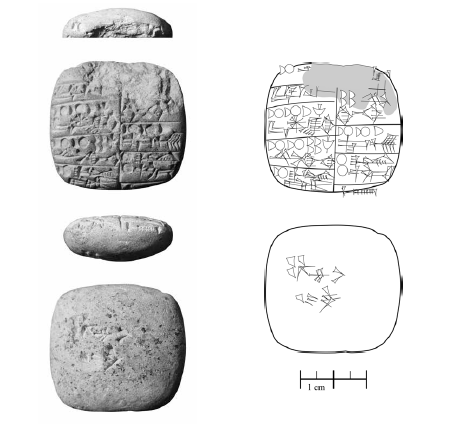
Pp. 33-47: “Three Administrative Texts from the Time of Me’annedu,” by Armando Bramanti
This article presents two land texts (allotments of field) and one grain text (barley loan) originating from Early Dynastic Zabala. The high year numbers allow for the attribution of these texts to the ensiship of Me’annedu. The edition is followed by a prosopographical study which, supported by paleographical considerations, provides some guidelines for the identification of more documents belonging to the same archive.
Click here to access the above article on JSTOR (ASOR membership with online access and/or subscription to JSTOR Current Content required).
Pp. 49-66: “The Sumerian Discourse Markers u4-ba and u4-bi-a,” by C. Jay Crisostomo
In Old Babylonian Sumerian literature, the temporal phrases u4-ba and u4-bi-a typically occur in complementary distribution. Previous analyses have focused on morphological disparity to differentiate the two. The present paper considers pragmatic functions within a larger discourse structure, analyzing them as discourse markers, specifically temporal connectives. In this study based on a corpus analysis of Old Babylonian literary compositions, I argue that in Sumerian discourse, u4-ba primarily marks perspectival shifts and refocusing, and u4-bi-a indexes sequential and consequential action.
Click here to access the above article on JSTOR (ASOR membership with online access and/or subscription to JSTOR Current Content required).
Pp. 67-108: “Goodbye, Princess: Iltani and the DUMU.MUNUS LUGAL,” by Seth Richardson
The Babylonian princess Iltani has been known to us since the 1899 copies of T. G. Pinches. Within fifty years, following a proliferation of published texts featuring the princess, it became probable there were at least two such persons by this name and title; by now, it can be shown there were at least three. But the problem hardly ends there: a close inspection of the disparate epistolary, administrative, and commercial evidence for these Iltani’s does little to clarify their activities or status, nor even their relation to the king. An analysis of that evidence leads me to propose a redefinition of the title DUMU.MUNUS LUGAL and a reinterpretation of the position and purpose of women bearing the name Iltani.
Click here to access the above article on JSTOR (ASOR membership with online access and/or subscription to JSTOR Current Content required).
Pp. 109-116: “Cultural Transformations from Mesopotamia to Hatti? The Case of the GALA,” by Ilan Peled
This article surveys the textual attestations of the cultic performer designated by the logogram GALA in Hittite texts. This logogram, which originated in Mesopotamia, was apparently used for the Hittite word šaḥtarili, but the nature of the activities performed by the Mesopotamian and Hittite cultic practitioners designated in this manner was not identical. This should be assessed against the background of the nature of Mesopotamian-Hittite connections and cultural transmissions and the multifaceted cultural influences that shaped Hittite cult.
Click here to access the above article on JSTOR (ASOR membership with online access and/or subscription to JSTOR Current Content required).
Pp. 117-124: “The Sumerogram KUR: Logogram or Determinative?,” by Maksim Kudrinski
The article deals with the problem of finding spoken correlates for combinations of the Sumerogram KUR and toponyms in Hittite texts. The discussion adds to our understanding of the relation between written and spoken language in the case of using foreign written templates by the Hittites.
Click here to access the above article on JSTOR (ASOR membership with online access and/or subscription to JSTOR Current Content required).
Pp. 125-150: “Teratomancy at Tigunānum: Structure, Hermeneutics, and Weltanschauung of a Northern Mesopotamian Omen Corpus,” by Nicla De Zorzi
This article examines the inner structure, building principles, and hermeneutic code of a group of late Middle Bronze age teratomantic tablets from Tigunānum in northern Mesopotamia. While in the final evaluation, the Tigunānum teratomantic corpus is of southern Babylonian inspiration, it represents a very specific local reworking of this tradition. This article posits as its distinctive feature the use of a strongly gendered imagery and language that reflect the worldview of an extremely androcentric and militarized society. It also demonstrates a connection between the cultural conceptions underlying the Tigunānum omen corpus and the Old Hittite sphere, the mid-second-millennium world of northern Mesopotamia, and later Assyria.
Click here to access the above article on JSTOR (ASOR membership with online access and/or subscription to JSTOR Current Content required).
Pp. 151-191: “The Nonintercalated Lunar Calendar of the Middle Assyrian Period,” by Joshua Jeffers
Scholars generally assume that Assyria employed a luni-solar calendrical system during the Middle Assyrian period—akin to the one used in Babylonia—that kept the months of its year synchronized with the seasons of the solar year through periodic intercalation. With this understanding, the regnal dates assigned to the Middle Assyrian kings have traditionally been expressed in terms of solar years. The present article, however, argues that the Assyrians did not use this type of system. The author draws upon a variety of administrative tablets—primarily from the reigns of Shalmaneser I, Tukultī-Ninurta I, and Tiglath-pileser I—to demonstrate that the months of the Assyrian year were in fact not permanently affixed to particular seasons of the solar year, revealing that its year was not intercalated and was thus perpetually rotating slowly through the solar year. This article also explores how such a calendrical system impacts the Middle Assyrian kings’ regnal dates, which would need to be lowered given that the unadjusted Assyrian lunar year was slightly shorter than its solar counterpart.
Click here to access the above article on JSTOR (ASOR membership with online access and/or subscription to JSTOR Current Content required).
Pp. 193-202: “The Case Marking of Sumerograms in Hittite,” Mojca Cajnko
The paper begins with a brief introduction to case and case marking and a description of the Hittite corpus and the corpus of the research. The main part is devoted to the case marking of Sumerograms, an as yet unresearched and undescribed topic in Hittitology. The paper examines different possibilities for the case marking of Sumerograms on the level of the sentence and the functional value of phonetic complements. It also attempts to discern whether competition between formally case-marked and case-unmarked Sumerograms in the grammatical roles of subject and direct object was driven by grammatical factors, economy of writing or by other reasons.
Click here to access the above article on JSTOR (ASOR membership with online access and/or subscription to JSTOR Current Content required).
Pp. 203-212: “Esarhaddon’s Prayer in the Inscription AsBbA as Related to the mīs pî Ritual,” by Amitai Baruchi-Unna
The prayer of Esarhaddon, incorporated in the inscription AsBbA, is the first prayer in an Assyrian royal inscription that is presented as a verbatim citation. The aim of this paper is to delineate the historiographical background for this innovation in a genre usually described as routine and formalistic. By examining descriptions of prayers said to have been recited by the king in Assyrian royal inscriptions, I analyze Esarhaddon’s prayer from the aspects of its content, context, and possible linkage to prayers external to the royal inscriptions. Specifically, I examine the possible relation between the prayer in this inscription and the mīs pî ritual performed during the last phases of the process of making a divine image. This comprehensive analysis suggests that the king’s prayer had been part of an early stage of such a ritual and was available to the authors of the Esarhaddon inscription.
Click here to access the above article on JSTOR (ASOR membership with online access and/or subscription to JSTOR Current Content required).
Pp. 213-220: “Comment Presentifier l’Invisible? Reflexions autour des termes ṣalmu, tamšīlu et uṣurtu,” by Jean-Jacques Glassner
Les Mésopotamiens créèrent des objets, des images et des signes qui avaient une fonction précise. À la suite d’une cristallisation de concepts produite par l’archéologie, on a pris l’habitude de parler à leur propos de « représentations ». Il est préférable d’y voir davantage des « présentification ». Tel fut le sens de šlm dans la Genèse, à propos du premier homme qui fut « à l’image de Dieu », entendons qu’il fut la manifestation de la puissance divine.
Click here to access the above article on JSTOR (ASOR membership with online access and/or subscription to JSTOR Current Content required).
Pp. 221-246: “From Text to Reading in Enūma Eliš,” by Johannes Haubold
This article makes two main points. First, the transmitted text of Enūma eliš can be more reliably construed than has hitherto been assumed, provided we take seriously the spelling of the manuscripts and the rules of Akkadian grammar. If we do this, and that is my second point, we can also make progress at the level of interpretation. To illustrate these claims, I look at two passages that have caused difficulties to modern readers. In Enūma eliš I.1–10 we encounter some forms that seem prima facie to defy the normal rules of Akkadian grammar. Through careful analysis of spelling, syntax, and poetic context I show that the text as it stands can in fact be securely construed. I then turn to a passage that the poet himself introduces as a masterpiece of verbal craft. In Enūma eliš II.61–70 the god Ea soothes the excited Anšar by reassuring him that he has the situation under control. I argue that existing translations misconstrue the personal pronoun šâši and consequently misinterpret the climactic final couplet of the speech. Clarifying the grammar of the passage enables us to establish not only what the text says, but also to appreciate it better.
Click here to access the above article on JSTOR (ASOR membership with online access and/or subscription to JSTOR Current Content required).
Pp. 247-260: “Additional MUL.APIN Fragments in the British Museum,” by Jeanette C. Fincke
The edition of the series MUL.APIN by Hermann Hunger and David Pingree (1989) granted modern scholars access to the rather objective descriptions of the stars, the intercalation scheme and the lengths of days and nights compiled by Mesopotamian astronomers in the first millennium BCE. This article provides the publication of three more Neo-Assyrian exemplars from Nineveh, and joins made by Enrique Jiménez, Irving Finkel, and me to two Late Babylonian fragments that have already been used in the edition.
Click here to access the above article on JSTOR (ASOR membership with online access and/or subscription to JSTOR Current Content required).
[/vc_column_text][mk_divider][vc_column_text]To view the entire article on JSTOR, click here.[/vc_column_text][/vc_column][vc_column border_color=”rgba(170,170,170,0.01)” width=”1/6″ css=”.vc_custom_1496684098866{margin-right: 5px !important;margin-bottom: 20px !important;border-right-width: 2px !important;border-bottom-width: 2px !important;padding-top: 30px !important;padding-right: 10px !important;padding-left: 10px !important;background-color: #ffffff !important;border-right-color: rgba(227,228,228,0.75) !important;border-bottom-color: rgba(227,228,228,0.75) !important;}”][vc_wp_posts title=”BROWSE THE NEWS ARCHIVE” number=”4″][/vc_column][vc_column border_color=”rgba(170,170,170,0.01)” width=”1/6″ css=”.vc_custom_1496684008271{margin-right: 10px !important;margin-bottom: 30px !important;border-right-width: 2px !important;border-bottom-width: 2px !important;padding-top: 30px !important;padding-right: 20px !important;padding-left: 20px !important;background-color: #ffffff !important;border-right-color: rgba(227,228,228,0.75) !important;border-bottom-color: rgba(227,228,228,0.75) !important;}”][vc_column_text]Tweets by ASOResearch [/vc_column_text][/vc_column][/vc_row]
REPORT FROM THE APRIL EXECUTIVE COMMITTEE & BOARD OF TRUSTEES MEETINGS
Susan Ackerman, ASOR President
Every spring, the ASOR Board of Trustees and the Board’s Executive Committee meet to engage in discussions and undertake items of business that have come forward since the Executive Committee’s and Board’s gatherings at the November Annual Meeting. This year, the Executive Committee and the Board met during the weekend of April 28-29, in Boston, MA.
The ASOR Budget
The major item on the agenda for the ASOR Board’s spring meetings is always the budget, both a review of the budget for the current fiscal year (FY 17), which will come to an end on June 30, and approving the budget for the upcoming fiscal year (FY 18), which starts on July 1. The FY 17 budget is balanced – indeed, almost perfectly so, as we imagine ending the year with just a small surplus of $239.34! For FY 18, the Board approved a balanced budget of just over $2,220,000.
As I remarked in my report after the April 2015 and April 2016 Board meetings, this is a rather astonishing figure for ASOR, given that as recently as FY 12, ASOR’s annual budget was $965,000. The reason for this dramatic increase is the funding we have received for ASOR’s Cultural Heritage Initiatives (CHI). This funding includes monies that comes via our cooperative agreement with the United States Department of State and also from the J. M. Kaplan Fund and the Whiting Foundation, with in-kind support from the Getty Conservation Institute, The World Monuments Fund, and Arnold and Porter, LLC.
More specifically, we were very pleased to receive a letter, about three weeks before the Board meeting, indicating that the Department of State intended to award us $900,000 to continue for a third year our collaborative “Safeguarding the Heritage of the Near East Initiative.” This new Department of State funding runs from March 31, 2017, through March 31, 2018.
As we noted in the press release that we sent to all of our members regarding this funding—we are particularly pleased that this new agreement allows us not only to continue our efforts preserve and protect the cultural heritage of Syria and Iraq, but also to extend the scope of work to include the preservation and protection of the cultural heritage of Libya. We are also very pleased that this new cooperative agreement includes increased support for in-country projects that connect local communities to historic places and heritage. For more, see as always, the ASOR CHI website.
In addition, I was pleased and proud to be able to announce to the Board at its April meeting that ASOR had been awarded a one-year, $244,000 grant from the Whiting Foundation, to fund an emergency assessment and digital preservation initiative for textual collections and repositories in Mosul. The texts to be assessed include Islamic manuscripts (folia, quires, codices, scrolls) from the rich holdings of the Mosul Central Library System, the Mosul University Library System, the Library of the Mosul Museum, and other, smaller textual repositories within Mosul, as well as cuneiform tablets, architectural and monumental inscriptions, and inscribed objects.
The grant, moreover, will pay to train local heritage professionals to conduct the assessment and preservation program. These Whiting monies thus provides not only for the preserving and protecting of Mosul’s intellectual and cultural legacy, but also for the empowerment and for the enhanced financial well-being of ASOR’s Iraqi members, colleagues, and friends.
The ASOR Office
ASOR learned in January 2016 that Boston University proposed to sell a block of nine buildings that it then owned in Kenmore Square, including 656 Beacon Street, where ASOR (and also the Archaeological Institute of America) had office space. These buildings subsequently were sold in August 2016, to a major real estate developer.
In neither case, was this information communicated to us by Boston University; rather, we learned it by reading BU’s daily e-newsletter. This means we received no concrete information from BU about what this sale would mean for us, although we heard through the grapevine that things would probably move slowly and that we would have until March 2018 to find new space.
But this is not what happened. As I wrote to the Board on March 16, 2017, we heard that afternoon from Ann Cudd, Dean of the College of Arts and Sciences at Boston University, that ASOR would have to vacate its offices at 656 Beacon Street by May 31, 2017. We did quickly decide that it was to our benefit to remain in the Boston area (and, ideally, within the BU geographical orbit) for the immediate future for several reasons, the most important being that this location serves our staff well, and the idea of moving somewhere inaccessible to our staff – and so facing the prospect of losing both our office space and our employees at the end of May – was unimaginable.
At the Board meeting on April 29th, I was able to report to the Board that we had identified two separate spaces very near our current offices in Kenmore Square to lease, one at 650 Beacon Street to house core ASOR staff and be the base for core ASOR functions; the other, .2 miles away, at 665 Beacon Street, to house the staff member who services the American Center for Oriental Research (ACOR) and the Cyprus American Archaeological Research Institute (CAARI) and to store documents and related materials that belong to ACOR and CAARI. This space could also house the Journal Exchange Program that ASOR runs on behalf of ACOR, CAARI, and AIAR. It could in addition be used by ASOR for storage and for some of its cultural heritage work.
Over the next month, we did secure leases for these two spaces – although it went down to the wire (we finally received a lease for 650 Beacon Street on May 26th, the Friday afternoon of Memorial Day weekend, for a move scheduled for Tuesday, May 30)! That lease also came with an unexpected and very unwelcome surprise: a lease period extending only to December 31, 2017, instead of December 31, 2018, as we had anticipated. It is in addition important to note that we have to pay rent for these two spaces, as opposed to the complimentary office space that Boston University has provided us for the last twenty years.
These are big changes for ASOR, of course—and, obviously, since we have a lease for 650 Beacon Street that runs only through December 31, 2017, there are more changes that are soon to come. We do have a “New Office Committee” in place, made up of six members of our Board and chaired by our Board Chair, Richard Coffman. This committee has been working diligently since last November, and continues to work, on the issue of ASOR’s next home.
But we all can help. Right now, we need suggestions, ideas, proposals, from all our members. Do you know of office space (we need about 2500-3000 square feet) available near or on a college, university, or seminary campus that ASOR might be able to rent at a reasonable cost (or, even better, space that is free)? Do you know philanthropists in your community who might like to support ASOR’s work by providing free or reduced-rent office space? Or maybe you want to give us a building. (Hey, it never hurts to ask!)
Some Happier News
The Board’s discussion of the ASOR office situation was, obviously, a difficult one, but we were able to follow it up with a preview of the new ASOR website, which is due to launch any day now. Everyone of the Board spoke enthusiastically of the design, and we hope all our members will enjoy it as well.
The Board also was pleased to hear very good news about the 2017 ASOR Annual Meeting, from the Programs Committee, which reported that it had received nearly 700 abstract submissions for the 2017 Annual Meeting program. This is as opposed to 540 abstract submissions for 2016. Because one must be a member to present at the Annual Meeting, the significant increase in abstracts submitted for 2017 has helped drive an increase in the number of ASOR members, currently about 1800 individuals (at about this time last year, the number was 1700).
In addition, the Board welcomed three new colleagues: Debra Foran, Heather Dana Davis Parker, and Elizabeth Macaulay-Lewis. We’re very happy to have these new colleagues on our Board!
Overall, the Board and Executive Committee had a busy set of meetings—but also a productive one. Even though I am worried about ASOR’s home going forward, I left the Boston meetings thankful, as I always am, for all that ASOR’s Board members do to ensure that ASOR continues to thrive.
LETTER ABOUT THE ADMINISTRATION’S DETAILED BUDGET PROPOSAL
MAY 26, 2017
Dear ASOR Colleagues and Friends,
Many of you, especially those of you who are United States citizens, have written me in the last two days to voice your concerns about the Trump administration’s budget proposal that was announced on Tuesday, May 23, 2017. ASOR is concerned too.
More specifically, ASOR is concerned that the administration’s budget proposal recommends—as we had anticipated—the elimination of the National Endowment for the Humanities (NEH), which has been committed to fostering ASOR’s work of scholarly and personal engagement in the Near Eastern and Mediterranean worlds as part of the NEH’s larger mission of supporting research, education, preservation, and public programs in the humanities and in those social sciences that use humanistic methods. The proposal also recommends the elimination of the National Endowment for the Arts (NEA) and the Institute of Museum and Library Services (IMLS), both of which have sustained ASOR members in their work by supporting museum exhibitions, care of collections, conservation, community engagement, and education activities.
More specifically still, the budget proposal recommends funding of $42 million for NEH in FY18 (as opposed to $150 million in FY17)—basically, according to our friends at the National Humanities Alliance (of which ASOR is a proud member), funds for salaries and the expenses required to shut the agency down and funds required to honor pre-existing grant commitments. Likewise, the $23 million that is recommended for the budget of the IMLS (as opposed to their FY17 budget of $231 million) is designated to pay for an “orderly close out.”
Equally disturbing: while we had thought that significant cuts would be proposed for the Department of Education’s International Education Programs, which include the Fulbright-Hays and Title VI programs that help support language and area studies and American Overseas Research Centers, we had anticipated—based on the so-called “skinny budget” that the Trump administration released in March—that Fulbright-Hays would be fully funded, whereas Title VI would suffer a proposed cut of 25% or so. This scenario was already devastating, given the degree to which ASOR’s affiliated Overseas Research Centers—the W. F. Albright Institute of Archaeological Research (AIAR) in Jerusalem, the American Center of Oriental Research (ACOR) in Amman, Jordan, and the Cyprus American Archaeological Research Institute (CAARI) in Nicosia, Cyprus—benefit from Title VI funding.
But the budget proposal that came out on May 23, 2017, seems more damaging: according, again, to our friends at the National Humanities Alliance, allocations of $144 million that, combined, went in FY17 to International Educational Programs, Title VI, and Fulbright-Hays are recommended to drop to $0. Furthermore, according to the American Association for the Advancement of Science, the Trump administration proposes that the budget of the National Science Foundation (NSF), which dispenses grants to (among other things) archaeological research endeavors, be trimmed by $776 million, an 11% cut. NSF had not been mentioned in the administration’s earlier budget outline, which was released in March, so this is new and obviously disturbing news.
For our members, especially our US members, and for their work, all these proposals have profoundly negative implications. So what can we as ASOR members do?
1. ASOR members can work with the National Humanities Alliance to take action on behalf of the NEH and other federal humanities programs: at http://www.nhalliance.org/take_action.
2. ASOR members who are US citizens can be in touch directly with your state’s congressional delegation, ideally, by personal letter or by phone call, to indicate your support for:
a. Level funding (at a minimum) for the NEH, the NEA, and the IMLS (it’s worth noting that the current budget of the NEH [$150 million], like the current budget of the NEA [$148 million], is equivalent to only one postage stamp per American citizen per year, surely an investment the richest nation on earth can afford);
b. Level funding (at a minimum) for Fulbright-Hays and Title VI (whose budgets, as indicated here, have already suffered devastating cuts in this decade: the Fulbright-Hays’ budget declined from $15.6 million in FY 2010 to $7.1 million in FY 2016, and Title VI’s budget declined from $110.3 in FY 2010 to $65.1 in FY 2016);
c. Level funding (at a minimum) for the NSF, especially the NSF Directorate for Social, Behavioral, and Economic (SBE) Sciences, which funds archaeological research.
3. ASOR members who are residents of US states whose congressional representatives sit on relevant appropriations committees should especially be in touch with these representatives—ideally, by personal letter or by phone call—to stress the importance of their representatives’ support in committee for reasonable appropriations for all the agencies cited above. Lists of congressional committee members that we can share at this point (thanks to our friends at the Council of American Overseas Research Centers) are catalogued below.
4. ASOR members should always feel free to be in touch with me (asorpres@bu.edu), or with ASOR’s Executive Director, Andy Vaughn (executive-director@asor.org), or with ASOR’s other officers—Board Chair Richard Coffman (link), Vice-President Sharon Herbert (link), Secretary Lynn Swartz Dodd (link), and Treasurer Chris White (link)—to tell us what ASOR can be doing to support your work during these challenging times.
ASOR is pleased to announce that Dr. Bruce Routledge of the Department of Archaeology, Classics and Egyptology at the University of Liverpool has been awarded the 2017 Harris Grant, to support the Dhiban Excavation and Development Project.
The Harris Endowment provides modest grants to worthy field projects that are CAP-affiliated, particularly to newer and smaller projects, to help them get started; and to discrete components of larger projects that can be completed with an award. The Endowment also provides support for off-season research, analysis, and publications.
Dr. Routledge, and his co-director, Dr. Katherine Adelsberger of the Department of Environmental Studies at Knox College, will use the Harris Grant to focus on one component of the larger 2017 Dhiban Excavation and Development Project, namely, work on the site’s water reservoir that was built during the Iron IIA/B transition. This reservoir, according to Dr. Routledge’s application, “consists of a plastered wall above, or very near, the surface, which encloses a karstic depression in bedrock.” Forty-four m. of this wall have so far been uncovered; the excavators estimate is must be at least 50 m long.
Harris funds will support the project’s work in “uncover[ing] and document[ing] the remainder of the reservoir wall,” and also “consolidat[ing] and prepar[ing] the wall for site interpretation purposes.” This will add to our knowledge of the “large, open-air, water reservoirs” that are “emerging as a distinct monumental component of Iron Age town sites in central Moab.”
It may also be that the Dhiban reservoir should be associated with “the retaining wall for the reservoir for the water in the midst of the city” that Mesha claims to have built in the Mesha inscription. If so, as Dr. Routledge’s application notes, the reservoir’s remains “will create the first visible monument at Tall Dhiban that can be connected to the story of Mesha,” which “seems vital to the development of Tall Dhiban for visitors” and thus for the development of the modern town of Dhiban as a tourist destination. In addition to providing funding for architectural conservation, therefore, the Harris Grant will also be used to purchase a sun/weather resistant ceramic sign that identifies the reservoir wall.
I hope this note finds you in good health and cheer we all prepare for the duties and joys of the summer season. For most of us that will mean refreshing ourselves by spending more time with family and friends, enjoying the outdoors, or traveling to familiar or new places. Many of us will be participating in one of the many ASOR-affiliated digs. I hope that this summer you enjoy in special ways whatever it is that inspires you most.
Before we all head off to our favorite summer activities, however, I want to bring an important opportunity to your attention. Our Strategic Plan clearly states that ASOR is here to serve you, and our Board of Trustees is enthusiastically dedicated to fulfilling that commitment. To do so we rely on the financial support of our members. We are approaching the end of our fiscal year, and I write today to ask you to make a donation to ASOR. I have stated that I would like to see 100% of ASOR members become ASOR donors. That is admittedly a very high goal for a society like ASOR, but I am convinced that we can reach it. For the short term, however, the Board has approved a bold challenge. If we can add one-hundred new donors before the end of our fiscal year, our Board (and a few other friends) has generously pledged to give an additional $33,000 to ASOR’s Annual Fund. This additional $33,000 will ensure that ASOR once again has a balanced budget so that we can continue to carry out our mission.
Friends, this is a great opportunity, and I know that we can rise to the challenge. Your gift of $10 or more to any ASOR fund between now and June 15th will help us qualify for our Board’s $33,000 challenge gift. Your gift will have a direct and measureable impact on your ASOR colleagues, and their gifts could potentially have a direct impact on you. We are in this together, and I ask you to join approximately 270 of your ASOR colleagues who have already made a donation to ASOR this year. I hope that we can count on you both to move toward the 100%-member participation goal and to meet our Board’s generous challenge. You can make your gift by clicking on the link on this webpage or by sending a check to the ASOR office by June 15th.
With my warm regards and best wishes for a refreshing and enjoyable summer season,
60 MORE DONORS NEEDED TO QUALIFY FOR A $33,000 CHALLENGE GIFT
Update (June 6)
Thanks for 40 new donors, ASOR is almost halfway to qualifying for $33,000!
In early May, ASOR Development Chair Ed Wright announced in a letter to ASOR members that the ASOR Board had made a $33,000 Challenge Gift. Board members collectively pledged to contribute $33,000 to the ASOR Annual Fund if we could recruit 100 new donors who had not yet made a gift this fiscal year (July 1, 2016 – June 30, 2017). We are getting close, but we still need 60 more people to make a gift of $10 or more by June 30th.
Not only do modest gifts add up to create significant support, now they can help ASOR qualify for $33,000 and help us have a balanced budget for the fiscal year. Do you prefer to contribute to something other than the Annual Fund? No problem! Contributions for this challenge campaign need not be limited to the Annual Fund—they may be designated for student support, fellowships, cultural heritage, endowment, publications, or any other area of ASOR’s work.
If you are one of the 310 people who has already made a gift to ASOR this fiscal year, thank you so much for your support. If you have not year made a gift between July 1st and June 30, please consider joining the ranks for ASOR donors. We have almost one more month to reach our goal, so please make a gift today!
Other ways you can donate:
Donate by Phone
Call ASOR at 617-437-6570
Donate by Mail
Send a check to:
ASOR
P. O. Box 15729
650 Beacon Street, 2nd Floor
Boston, MA 02215
Make a Pledge (Donate Later)
Send an e-mail to ASOR[/vc_column_text][/vc_column][vc_column border_color=”rgba(170,170,170,0.01)” width=”1/6″ css=”.vc_custom_1496684098866{margin-right: 5px !important;margin-bottom: 20px !important;border-right-width: 2px !important;border-bottom-width: 2px !important;padding-top: 30px !important;padding-right: 10px !important;padding-left: 10px !important;background-color: #ffffff !important;border-right-color: rgba(227,228,228,0.75) !important;border-bottom-color: rgba(227,228,228,0.75) !important;}”][vc_wp_posts title=”BROWSE THE NEWS ARCHIVE” number=”4″][/vc_column][vc_column border_color=”rgba(170,170,170,0.01)” width=”1/6″ css=”.vc_custom_1496684008271{margin-right: 10px !important;margin-bottom: 30px !important;border-right-width: 2px !important;border-bottom-width: 2px !important;padding-top: 30px !important;padding-right: 20px !important;padding-left: 20px !important;background-color: #ffffff !important;border-right-color: rgba(227,228,228,0.75) !important;border-bottom-color: rgba(227,228,228,0.75) !important;}”][vc_column_text]Tweets by ASOResearch [/vc_column_text][/vc_column][/vc_row]
Wake Forest School of Divinity holds classes in Wingate Hall during the week of March 20th, 2017 on its campus in Winston-Salem, NC.
ASOR is pleased to announce that Dr. Katherine A. Shaner of the Wake Forest University School of Divinity is the 2017 recipient of the William G. Dever Fellowship for Biblical Scholars. The fellowship was established in 2015 to award a qualified American non-tenured faculty member in the field of biblical studies with a $7000 grant to be used to gain elementary, first-hand experience in field archaeology and research in Israel.
The intent of the award is to help foster a dialogue between archaeology and biblical studies in colleges, universities, and seminaries, as well as in the larger discipline.
The fellowship provides funding for one month on a specified dig, combined with a one-month residency (room and half-board) at the W. F. Albright Institute of Archaeological Research in Jerusalem, which will allow the Dever Fellow to conduct research in the Albright library. During residency, the Albright Institute will facilitate visits to excavations active in the field.
Previously, in her book Enslaved Leadership in Early Christianity (forthcoming, Oxford University Press), Dr. Shaner researched the archaeological excavations at Ephesus to describe how the site’s inscriptions, built environment, and relief images “fundamentally change the context in which we read historical enslaved actors through early Christian texts 1 Corinthians, Philemon, 1 Timothy, Ignatius’s letters.”
Now, as she turns her attention to Israel, Katherine Shaner writes, “My research agenda for the next few years aims to develop new methodologies for working with the archaeological materials from Roman-era urban areas which provide context for and contact with both Jewish and Jesus-following communities . . . This introduction to archaeology in Israel affords me the opportunity to think with excavators about how archaeological methods can illuminate everyday life . . . and widen my perspectives on the material contexts of the earliest Jewish and Christian communities.”
Dr. Shaner will be participating in the Omrit Settlement Excavation Project.
To learn more about the archaeological site of Omrit, click here.[/vc_column_text][/vc_column][vc_column border_color=”rgba(170,170,170,0.01)” width=”1/6″ css=”.vc_custom_1496684098866{margin-right: 5px !important;margin-bottom: 20px !important;border-right-width: 2px !important;border-bottom-width: 2px !important;padding-top: 30px !important;padding-right: 10px !important;padding-left: 10px !important;background-color: #ffffff !important;border-right-color: rgba(227,228,228,0.75) !important;border-bottom-color: rgba(227,228,228,0.75) !important;}”][vc_wp_posts title=”BROWSE THE NEWS ARCHIVE” number=”4″][/vc_column][vc_column border_color=”rgba(170,170,170,0.01)” width=”1/6″ css=”.vc_custom_1496684008271{margin-right: 10px !important;margin-bottom: 30px !important;border-right-width: 2px !important;border-bottom-width: 2px !important;padding-top: 30px !important;padding-right: 20px !important;padding-left: 20px !important;background-color: #ffffff !important;border-right-color: rgba(227,228,228,0.75) !important;border-bottom-color: rgba(227,228,228,0.75) !important;}”][vc_column_text]Tweets by ASOResearch [/vc_column_text][/vc_column][/vc_row]
ASOR is pleased to announce that three scholars — Dr. Lesley Gregoricka of the Department of Sociology, Anthropology, & Social Work at the University of South Alabama; Dr. Gina Konstantopoulos, a Visiting Assistant Professor at the Institute for the Study of the Ancient World at New York University; and Dr. Samuel R. Wolff, of the Israeli Antiquities Authority — are the inaugural recipients of ASOR’s Study of Collections Fellowships.
These fellowships provide $2,000 to each recipient to support the study of collections, including museum and archival collections, repositories, or collections of national authorities. The fellowship funds may be used to support the recipient’s travel to the collection and per diem expenses.
Dr. Lesley Gregoricka will use the Study of Collections award to travel to the University of Notre Dame to work on the EB II-III materials from Bab adh-Dhra that have recently been consolidated there. More specifically, Dr. Gregoricka proposes to expand on her paper delivered at the 2016 ASOR Annual Meeting that used human skeletal remains from charnel houses A22 and A55 at EB II-III Bab adh-Dhra to examine the relationship between identity and mortuary practices. During her time at Notre Dame, Dr. Gregoricka will see if Notre Dame’s newly-acquired Bab adh-Dhra materials include additional teeth from charnel houses A22 and A55 and will perform biogeochemical analyses on tooth samples. This will allow her to expand — perhaps double — her sample size and so test her hypothesis that the individuals interred in charnel house A22 (hypothesized to all be members of one extended family group) were significantly more mobile and consumed a different diet than did the individuals of the (presumably) different extended family group who were interred in charnel house A55.
ASOR is pleased to support these fine projects, and we look forward to awarding more Study of Collections Fellowships to our members in 2018! Keep an eye out for information on Dr. Samuel R. Wolff and Dr. Gina Konstantopoulos.
Top image: Grgeoricka a few months ago during fieldwork in the Emirate of Ras al-Khaimah, UAE.
Bottom image: Gregoricka conducting isotope analysis at the Center for Environmental Science and Technology (CEST) at the University of Notre Dame in 2012. She will be working in the same lab this summer to conduct the work supported by the ASOR Travel to Collections Fellowship.[/vc_column_text][/vc_column][vc_column border_color=”rgba(170,170,170,0.01)” width=”1/6″ css=”.vc_custom_1496684098866{margin-right: 5px !important;margin-bottom: 20px !important;border-right-width: 2px !important;border-bottom-width: 2px !important;padding-top: 30px !important;padding-right: 10px !important;padding-left: 10px !important;background-color: #ffffff !important;border-right-color: rgba(227,228,228,0.75) !important;border-bottom-color: rgba(227,228,228,0.75) !important;}”][vc_wp_posts title=”BROWSE THE NEWS ARCHIVE” number=”4″][/vc_column][vc_column border_color=”rgba(170,170,170,0.01)” width=”1/6″ css=”.vc_custom_1496684008271{margin-right: 10px !important;margin-bottom: 30px !important;border-right-width: 2px !important;border-bottom-width: 2px !important;padding-top: 30px !important;padding-right: 20px !important;padding-left: 20px !important;background-color: #ffffff !important;border-right-color: rgba(227,228,228,0.75) !important;border-bottom-color: rgba(227,228,228,0.75) !important;}”][vc_column_text]Tweets by ASOResearch [/vc_column_text][/vc_column][/vc_row]
ASOR is pleased to announce that three scholars — Dr. Lesley Gregoricka of the Department of Sociology, Anthropology, & Social Work at the University of South Alabama; Dr. Gina Konstantopoulos, a Visiting Assistant Professor at the Institute for the Study of the Ancient World at New York University; and Dr. Samuel R. Wolff, of the Israeli Antiquities Authority — are the inaugural recipients of ASOR’s Study of Collections Fellowships.
These fellowships provide $2,000 to each recipient to support the study of collections, including museum and archival collections, repositories, or collections of national authorities. The fellowship funds may be used to support the recipient’s travel to the collection and per diem expenses.
Dr. Samuel R. Wolff will use the Study of Collections award to study the archival materials of Alan Rowe’s 1934 excavation at Tel Gezer, a small-scale excavation that has never been fully published. The materials Wolff will study (field notes, photographs, and plans) are housed in the archives of the Palestine Exploration Fund in London; he has already been able to examine the artifactual materials and registry of finds housed in the Rockefeller Museum in Jerusalem. Dr. Wolff’s goal is then to publish his results in the final report of the current Tandy Museum Excavation Project at Tel Gezer, of which Dr. Wolff is co-director. As Dr. Wolff notes in his application, “The main importance of this small excavation is that the majority of finds date . . . to the Early Bronze Age IB” (by Dr. Wolff’s reckoning), a period that is otherwise barely known from Gezer.
ASOR is pleased to support these three fine projects, and we look forward to awarding more Study of Collections Fellowships to our members in 2018! Keep an eye out for information on Dr. Gina Konstantopoulos and check out the Dr. Gregoricka’s spotlight page.[/vc_column_text][/vc_column][vc_column border_color=”rgba(170,170,170,0.01)” width=”1/6″ css=”.vc_custom_1496684098866{margin-right: 5px !important;margin-bottom: 20px !important;border-right-width: 2px !important;border-bottom-width: 2px !important;padding-top: 30px !important;padding-right: 10px !important;padding-left: 10px !important;background-color: #ffffff !important;border-right-color: rgba(227,228,228,0.75) !important;border-bottom-color: rgba(227,228,228,0.75) !important;}”][vc_wp_posts title=”BROWSE THE NEWS ARCHIVE” number=”4″][/vc_column][vc_column border_color=”rgba(170,170,170,0.01)” width=”1/6″ css=”.vc_custom_1496684008271{margin-right: 10px !important;margin-bottom: 30px !important;border-right-width: 2px !important;border-bottom-width: 2px !important;padding-top: 30px !important;padding-right: 20px !important;padding-left: 20px !important;background-color: #ffffff !important;border-right-color: rgba(227,228,228,0.75) !important;border-bottom-color: rgba(227,228,228,0.75) !important;}”][vc_column_text]Tweets by ASOResearch [/vc_column_text][/vc_column][/vc_row]



 ASOR is pleased to announce that Dr. Bruce Routledge of the Department of Archaeology, Classics and Egyptology at the University of Liverpool has been awarded the 2017 Harris Grant, to support the Dhiban Excavation and Development Project.
 [/vc_column_text][/vc_column][vc_column border_color=”rgba(170,170,170,0.01)” width=”1/6″ css=”.vc_custom_1496684098866{margin-right: 5px !important;margin-bottom: 20px !important;border-right-width: 2px !important;border-bottom-width: 2px !important;padding-top: 30px !important;padding-right: 10px !important;padding-left: 10px !important;background-color: #ffffff !important;border-right-color: rgba(227,228,228,0.75) !important;border-bottom-color: rgba(227,228,228,0.75) !important;}”][vc_wp_posts title=”BROWSE THE NEWS ARCHIVE” number=”4″][/vc_column][vc_column border_color=”rgba(170,170,170,0.01)” width=”1/6″ css=”.vc_custom_1496684008271{margin-right: 10px !important;margin-bottom: 30px !important;border-right-width: 2px !important;border-bottom-width: 2px !important;padding-top: 30px !important;padding-right: 20px !important;padding-left: 20px !important;background-color: #ffffff !important;border-right-color: rgba(227,228,228,0.75) !important;border-bottom-color: rgba(227,228,228,0.75) !important;}”][vc_column_text]
 I hope this note finds you in good health and cheer we all prepare for the duties and joys of the summer season. For most of us that will mean refreshing ourselves by spending more time with family and friends, enjoying the outdoors, or traveling to familiar or new places. Many of us will be participating in one of the many ASOR-affiliated digs. I hope that this summer you enjoy in special ways whatever it is that inspires you most.

 In early May, ASOR Development Chair Ed Wright announced in a

 ASOR is pleased to announce that three scholars — Dr. Lesley Gregoricka of the Department of Sociology, Anthropology, & Social Work at the University of South Alabama; Dr. Gina Konstantopoulos, a Visiting Assistant Professor at the Institute for the Study of the Ancient World at New York University; and Dr. Samuel R. Wolff, of the Israeli Antiquities Authority — are the inaugural recipients of ASOR’s Study of Collections Fellowships.
 ASOR is pleased to support these fine projects, and we look forward to awarding more Study of Collections Fellowships to our members in 2018! Keep an eye out for information on Dr. Samuel R. Wolff and Dr. Gina Konstantopoulos.
