An Examination of the Stratigraphy and Neolithic-Iron Age Pottery from Tel Jezreel, Area A
by Charlotte Whiting and Gloria London
This volume presents the results of the Tel Jezreel Post-Excavation and Publication Project, directed by Charlotte Whiting on behalf of the Council for British Research in the Levant (CBRL). The project analyzed the Tel Jezreel excavation archive stored at the CBRLs Kenyon Institute in Jerusalem. The current volume presents the stratigraphic sequence (by Charlotte Whiting) and the Neolithic to Iron Age pottery (by Gloria London) excavated during the 1995-1996 seasons. The Tel Jezreel stratigraphy and ceramics have been deemed relevant to determining Iron Age chronological and social issues, two topics that are highly debated in the literature. Despite the fragmentary nature of the deposits, they are published here in order to address these questions. In addition, the study of the ceramics revealed an unanticipated abundance of highly varied pre-Iron Age pottery. Social and technological aspects of the manufacturing techniques, including burnish practices, are discussed.
Annual of ASOR, Volume 73, Series Editor William Caraher, April 2021, 304 pages, 90 b/w figures, 3 tables, ISBN 978-0-89757-111-1, $84.95.
Special Offer for ASOR Members
ASOR members (with a mailing address in the USA) can purchase a copy of AASOR 73 at the discounted price of $25.00 (75% discount + $5.00 US shipping) through February 15, 2022, while supplies last. Purchases are restricted to one volume per member. We are unable to offer this discount to members without a US mailing address due to international shipping costs, but you can purchase and ship a copy through the ISD link below. Please contact programs@asor.org with any questions. Click here to purchase your discounted copy in ASOR’s online store.
ASOR plans to celebrate our 122nd year (2022) by awarding more than $222,000 in fellowships, scholarships, and grants! This extraordinary commitment to our members has been made possible by donors who have established endowments or made annual contributions to these programs.
We invite you to FIND ONE (a scholarship, fellowship, or grant) or to help FUND ONE (designated gifts to enable us to award even more, or unrestricted gifts to help with the costs of administering and distributing the awards).
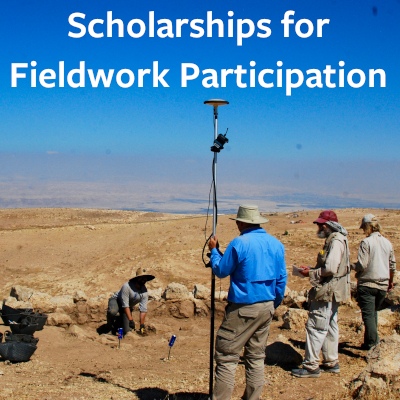
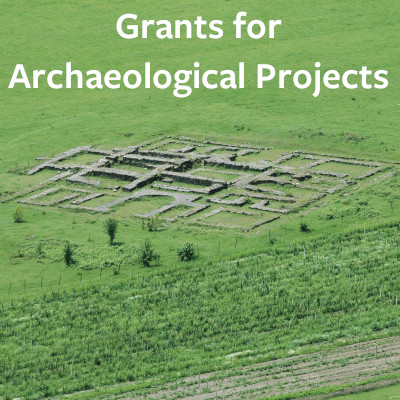
The deadline to apply for fieldwork scholarships and grants is a little over a month away (February 18 for scholarships, February 28 for grants).
ASOR is only able to provide these scholarships with the partnership of our many donors. We are pleased with the progress that ASOR is making to establish new scholarships and grants through endowed funds, but we also need annual support from our friends and members to send these eager students and early-career scholars into the field. Please support archaeology’s next generation by making a gift today. Because of the ongoing pandemic, we especially need gifts to fund membership and annual meeting scholarships. Gifts to the Annual Fund (unrestricted) will help defray the costs of administering and distributing the grants. We also invite you to make a designated gift by choosing any category from the drop-down menu on the donations module.
Please spread the word and don’t hesitate to contact us if you have any questions (e-mail or call [703-789-9229]).
Archived webpage for the 2022 Committee Members; This page has been replaced
The Publications Committee takes responsibility for overseeing ASOR publications, including ASOR’s three scholarly journals — the Bulletin of ASOR, Near Eastern Archaeology, and the Journal of Cuneiform Studies — and ASOR’s three monograph series — the Annual of ASOR (AASOR), the ASOR Archaeological Reports Series (ASOR – ARS), and the Journal of Cuneiform Studies Supplement Series (JCCSS). The committee oversees as well as ASOR’s digital database, the Levantine Ceramics Project, and ASOR’s Friends of ASOR e-newsletter, The ANE Today. In addition, the Publications Committee conducts searches for and recommends to the ASOR Board of Trustees individuals to serve as editors or in some cases co-editors of ASOR’s scholarly journals and monograph series. Typically, editors serve for three-year terms and can be renewed for a second term. Finally, the committee discusses and advises ASOR regarding new publication initiatives, especially digital publishing initiatives and making ASOR publications available through open access.
Kevin McGeough, Chair (until December 31, 2024)
Class of 2022
Gary Arbino
Charlotte Cable
Eric Kansa
Class of 2023
Mara Horowitz
Jeff Howry
Class of 2024
Jake Lauinger
Jennifer Singletary
Samuel Wolff
Editors of ASOR Journals and Monographs
Susan Cohen (BASOR)
Marwan Kilani (BASOR)
Jana Mynářová (BASOR)
Regine Pruzsinszky (BASOR)
Stephanie Lynn Budin (NEA)
Piotr Michalowski (JCS)
Bill Caraher (AASOR)
Jennie Ebeling (ASOR-ARS)
Alex Joffe (ANE Today)
Andrea Berlin (LCP)
Sharon Herbert (ex officio)
Andrew G. Vaughn (ex officio, non-voting)
Minutes
November 2013 November 2012 November 2011 November 2006 November 2005 April 2005 November 2004 November 2003 May 2003 November 2002 April 2002 November 2001 November 2000 April 2000 November 1999 November 1998[/vc_column_text][/vc_column][vc_column border_color=”rgba(170,170,170,0.01)” width=”1/6″ css=”.vc_custom_1490571214409{margin-right: 10px !important;margin-bottom: 30px !important;border-right-width: 2px !important;border-bottom-width: 2px !important;padding-top: 30px !important;padding-right: 20px !important;padding-left: 20px !important;background-color: #ffffff !important;border-right-color: rgba(227,228,228,0.75) !important;border-bottom-color: rgba(227,228,228,0.75) !important;}”][vc_wp_posts title=”BROWSE THE NEWS ARCHIVE” number=”4″][/vc_column][vc_column border_color=”rgba(170,170,170,0.01)” width=”1/6″ css=”.vc_custom_1490225688999{margin-right: 10px !important;margin-bottom: 30px !important;border-right-width: 2px !important;border-bottom-width: 2px !important;padding-top: 30px !important;padding-right: 30px !important;padding-left: 20px !important;background-color: #ffffff !important;border-right-color: rgba(227,228,228,0.75) !important;border-bottom-color: rgba(227,228,228,0.75) !important;}”][vc_column_text]Tweets by ASOResearch [/vc_column_text][/vc_column][/vc_row][vc_row][vc_column][vc_column_text]
Archived webpage for the 2022 Committee Members; This page has been replaced.
The Honors and Awards Committee takes responsibility for determining the awardees for the three book awards, the field archaeology award, the “best poster” award, and the multiple membership service awards that ASOR gives annually; conducting the awards ceremony during the Members’ Meeting at the ASOR Annual Meeting; and discussing and advising the ASOR Board of Trustees about ASOR’s awards, including recommending to the Board the creation of new awards as deemed appropriate.
Lynn Welton, Chair (until December 31, 2022)
Class of 2022
Pinar Durgun (1st term)
Robert Mullins (1st term)
Class of 2023
Ian Jones (2nd term)
Ra’anan Boustan (1st term)
Jessie DeGrado (1st term)
Mehrnoush Soroush (1st term)
Class of 2024
Mahri Leonard-Fleckman (2nd term)
Ted Lewis (1st term)
Sharon Herbert (ex officio)
Andy Vaughn (ex officio, non-voting)[/vc_column_text][mk_divider][vc_column_text]
Using Experimental Wear to Study Early Bronze Age Wearers
Julian Hirsch, 2021 Eric and Carol Meyers Summer Stipend Recipient
The cemeteries of the Dead Sea Plain (Map by Austin “Chad” Hill).
During the Early Bronze Age I (c. 3700-3100 BCE), the eastern Dead Sea Plain was home to three massive cemeteries at Bab adh-Dhra’, es-Safi, and Fifa. The Bab adh-Dhra’ cemetery in particular has been extensively studied by scholars who have elucidated mortuary rituals carried out at the site and discussed the origins and potential functions of objects found in its tombs. While certain object categories such as pottery and basalt bowls have been extensively studied, research on the hundreds of beads found at each of the Dead Sea Plains cemeteries sites has been far more limited. My research employs a use-wear approach to better understand the use of beads found in different family’s tombs at Fifa. These beads appear to primarily be made out of carnelian and glazed steatite.
Tombs excavated at Fifa by Mohammad Najjar under the auspices of the Department of Antiquities in Jordan. (All photos by author).
Photo of the author reducing a bead blank to the proper size on a basalt slab (Photo by Author).
Use-wear analysis uses optical microscopy to look for regularly appearing patterns on archaeological objects. These patterns might say something about how the object was made, how it was used, or even how long it was used for. To understand these patterns however, it is crucial that use-wear analysts conduct a variety of archaeological experiments that focus on reproducing the same types of patterns found on archaeological examples. Since carnelian has already been the subject of several use-wear studies, I decided to focus my research this summer on reproducing steatite beads of the size and shape of those found at Fifa, and then wearing those beads to see if I could observe any changes over time.
Starting with a chunk of steatite, I used flint and metal blades to fashion a long cuboid. I then rolled the cuboid on grinding slabs made of basalt and sandstone. This transformed the steatite cuboid into a long tube. From there, I used either a flint or metal blade to saw off thin bead blanks. These were then drilled with either a bone drill, a flint drill, or a drill made out of copper wire. Lastly, I reduced the diameter and length of my bead to the size of those found in the archaeological record the same grinding stones. Each material I used to create my steatite beads was carefully chosen to be similar to ones that could have been used to produce the beads during the Early Bronze Age.
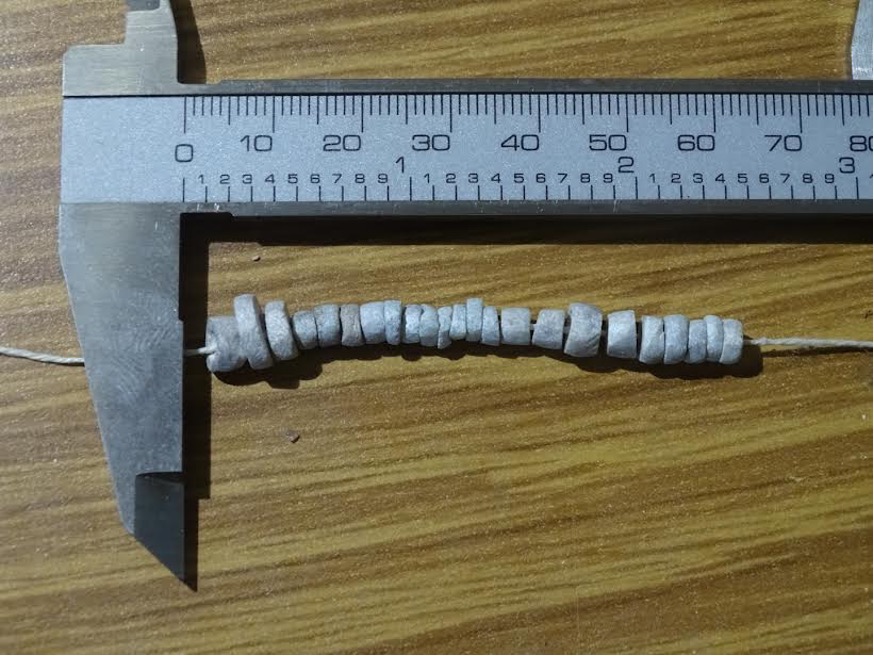
After creating my beads, I began wearing a group of them in a necklace, regularly observing how their surfaces changed over time. As steatite is very soft, it did not take long for manufacturing marks left behind from their slicing, grinding, and perforation to disappear.
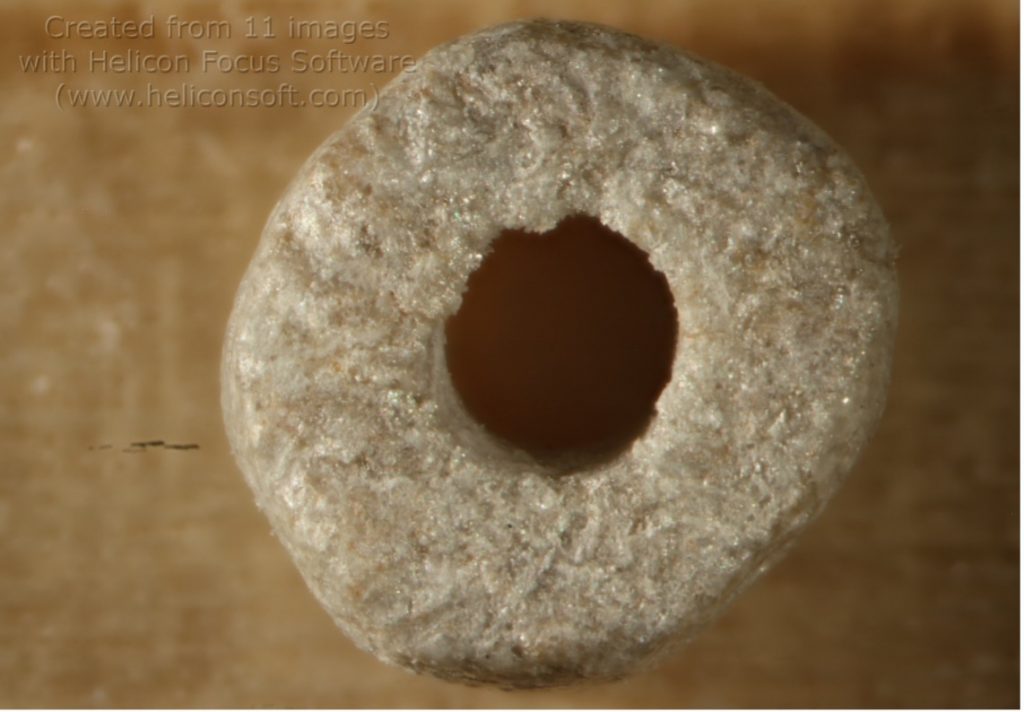
A set of newly made unworn steatite beads.
The same set of beads after being worn for two months.
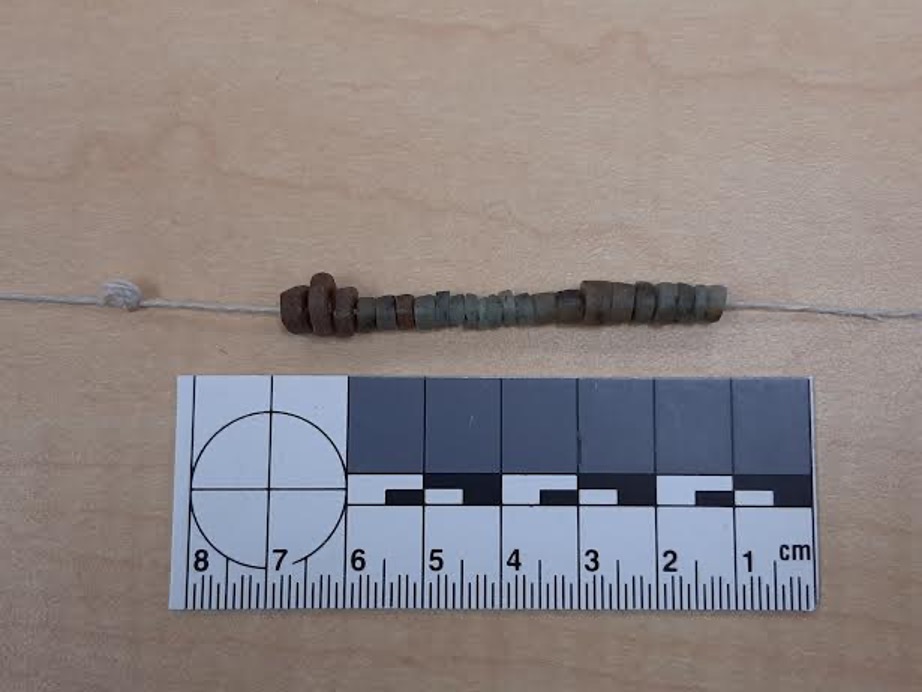
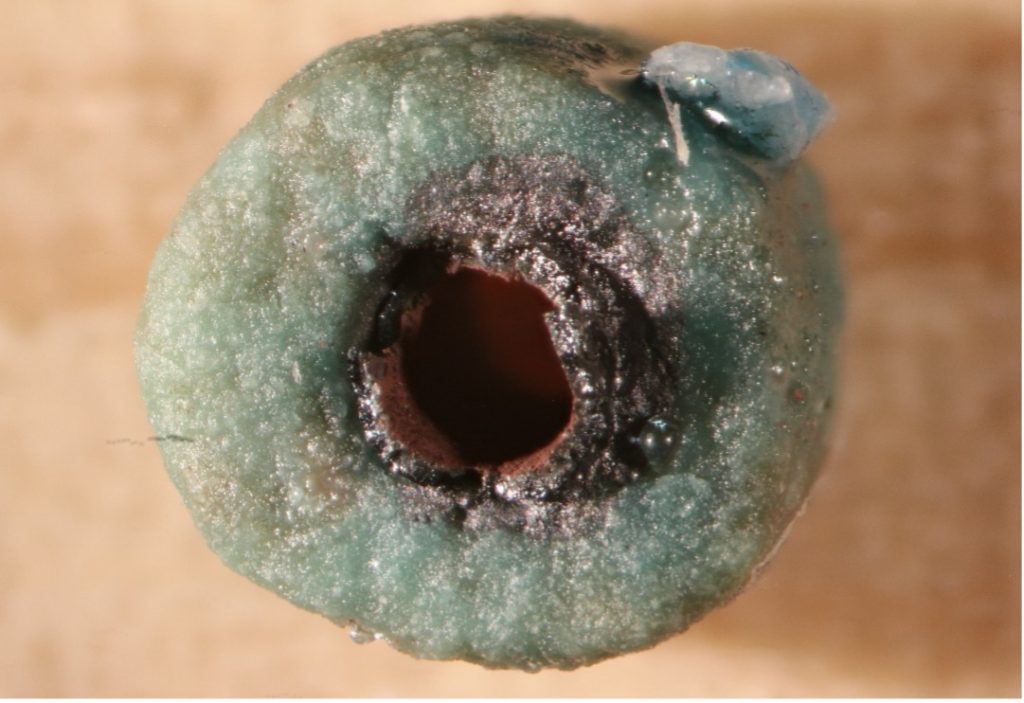
Once I established a baseline for understanding the development of wear on unglazed steatite beads, I turned my attention towards conducting a new set of experiments focused on replicating glazing techniques used in predynastic Egypt. To ensure I cast a wide enough net to replicate the patterns found on the beads found at Fifa, I used several different glazing recipes and methods. Despite following already published recipes, I unfortunately was only able to achieve success with one glazing method. In the coming months, I will observe the development of wear on this set of beads that I believe most closely correlate to those found at Fifa.
Beads covered with glazing mixture made of natron and malachite prior to being placed in a kiln (photo by author).
Bead prior to glazing.
Bead after glazing.
A strand of partially glazed beads that will be worn and observed in the coming months (photo by author).
My experimental research this summer, made possible by ASOR’s generous summer stipend program, has given me a chance to explore experimental archaeology, something entirely new to my archaeological toolkit. Despite the challenges posed by numerous broken beads, unsuccessful glazing attempts, and all too much time alone in a windowless room accompanied by only a kiln and large blocks of steatite, the experimental work I’ve done this summer will without a doubt allow me to better understand Fifa’s excavated bead assemblage. In turn, I believe that it will allow me use to use wear to better understand the bead’s wearers.
Julian Hirsch is a master’s student in Anthropological Archaeology at Trent University. His current research focuses on using use-wear to better understand the life histories of ornaments found in Early Bronze Age tombs. Julian also maintains an active research interest in the history of Biblical Archaeology.
During the summer of 2021, ASOR supported 27 undergraduate and graduate students through the Summer Stipend Program. These students undertook non-fieldwork archaeological research projects led by ASOR-affiliated project directors. They also took part in monthly cohort group meetings hosted via zoom. Read a summary of these cohort meetings here.
Stay tuned for more updates from the 2021 Summer Stipend recipients!
ASOR offers a variety of grants, fellowships and scholarships. Since 2007, ASOR has awarded well over $1 million to more than 1,000 researchers and students. We support work in the following broad areas:
Support ASOR’s Fellowships, Scholarships, and Grants!
ASOR is fortunate to have a growing number of named endowments that support membership research, excavation grants, and scholarships for fieldwork participation and scholarships for Membership and the Annual Meeting. However, we also need support from individual donors who make annual gifts or consider establishing endowments to support these programs in perpetuity. Support of ASOR’s Annual (Unrestricted) Fund enables us to support the operations of the ever-growing scholarship and grant programs. Please contact ASOR’s executive director, Andy Vaughn, for more information about ASOR’s grants, scholarship, and fellowship programs. Gifts of all amounts are needed and greatly appreciated.
Archived webpage for the 2022 CCC Members; This page has been replaced.
The Chairs Coordinating Council takes responsibility for (a) monitoring the activities of ASOR’s seven other standing committees, by receiving monthly reports about the committees’ discussions and business; (b) discussing and coordinating programs and policies that cut across the purview of two or more of the CCC’s constituent committees (e.g., policies regarding ethical issues or professional standards) and also adjudicating, if need be, between competing claims regarding jurisdiction or resource allocation among the CCC’s constituent committees; (c) annually receiving, from the Program Committee, recommendations regarding the plenary speaker for the ASOR Annual Meeting and then recommending to the ASOR President the name of an individual to invite; and (d) transmitting, through its chair (the ASOR Vice-President) reports regarding the work of the CCC, and its constituent committees, to the Board of Trustees, at the Board’s biannual meetings.
Charles (Chuck) Jones, ASOR Vice President and Chair
Sharon Herbert, ASOR President
Theodore (Teddy) Burgh, Chair of the Membership and Outreach Committee
Erin Darby, Chair of the Diversity, Equity, and Inclusion Committee
Helen Dixon, Co-Chair of the Program Committee
Tiffany Earley-Spadoni, Chair of the Early Career Scholars Committee
Jane DeRose Evans, Chair of the Cultural Heritage Committee
Steven Falconer, Chair of the Committee on Archaeological Research and Policy
Kevin McGeough, Chair of the Publications Committee
Allison Thomason, Co-Chair of the Program Committee
Andy Vaughn, ASOR Executive Director (ex officio, non-voting)
Lynn Welton, Chair of the Honors and Awards Committee
Vanessa Workman, Co-Chair of the Early Career Scholars Committee
Archived webpage for the 2022 Committee Members; This page has been replaced
The Early Career Scholars Committee takes responsibility for championing the views and needs of ASOR’s early career scholars (a group defined as including all ASOR members who qualify for the Undergraduate, Graduate, and Early Career membership rates); hosting a luncheon and other programming as deemed appropriate for Early Career Scholars at the ASOR Annual Meeting; and working with the ASOR staff, ASOR leadership, and the ASOR Board of Trustees to further the goal articulated in the ASOR 2021-2025 Strategic Plan, to develop strategies to foster the next generation of scholars of the Near East and wider Mediterranean and promote their success. ASOR Early Career Scholars include all ASOR members who qualify for the following levels of membership: Early Career, Graduate, and Undergraduate.
Tiffany Earley-Spadoni, Co-Chair (until December 31, 2024)
Vanessa Workman, Co-Chair (until December 31, 2022)
Shira Albaz, Early Career Scholar Member (until December 31, 2023)
Vicky Almansa, Graduate Student Member (until December 31, 2024)
Owen Chesnut, Early Career Scholar Member (until December 31, 2024)
Cecelia Chisdock, Graduate Student Member (until December 31, 2023)
Elena De Rosa, Early Career Scholar Member (until December 31, 2024)
Maggie Geoga, Early Career Scholar Member (until December 31, 2024)
Susan Kiskis, Undergraduate Student Member (until December 31, 2024)
Kara Larson, Graduate Student Member (until December 31, 2024)
Megan Lewis, Early Career Scholar Member (until December 31, 2023)
Marta Ostovich, ASOR Staff Member (ex officio, non-voting)
Tine Rassalle, Early Career Scholar Member (until December 31, 2024)
Steve Renette, Early Career Scholar Member (until December 31, 2023)
Leticia Rodriguez, Early Career Scholar Member (until December 31, 2024)
Avary Taylor, Graduate Student Member (until December 31, 2024)
Zachary Thomas, Early Career Scholar Member (until December 31, 2024)
Shane Thompson, Early Career Scholar Member (until December 31, 2024)
Jessica Tomkins, Early Career Scholar Member (until December 31, 2023)
Sarah Wenner, Graduate Student Member, Liaison to the Program Committee
Subcommittees
Advocacy
DEI Subcommittee: Avary Taylor (chair), Vicky Almansa, Cecelia Chisdock, Leticia Rodriguez
Community
Social Community Building: Tine Rassalle (chair), Zachary Thomas
Social Media: Megan Lewis (chair), Elena De Rosa, Susan Kiskis, Kara Larson
Professionalization
Academic and Professionalization Programming: Vanessa Workman (chair), Shira Albaz, Owen Chesnut, Steve Renette
Online Video and Professionalization Libraries: Jessica Tomkins (chair), Maggie Geoga, Shane Thompson
The Executive Committee of the ASOR Board of Trustees acts on behalf of the Board to manage the business and affairs of ASOR between the regular Board meetings is composed of the Board Chair, Vice Chair(s) of the Board (if any), President, Past President, Vice President, Treasurer, Secretary, Chair of the Development Committee, and two (2) or three (3) other Trustees.[/vc_column_text][mk_divider thickness=”1″ margin_top=”10″][vc_column_text responsive_align=”left”]
Richard L. Coffman
Chair of the Board (until December 31, 2022)
Richard L. Coffman, a native Texan, is a trial lawyer and managing partner of the Coffman Law Firm in Beaumont, Texas. His law practice focuses on class actions, mass actions, and business litigation throughout the United States. He has been named a Texas Super Lawyer.
Before attending law school, Coffman, who also is a Certified Public Accountant, worked for two international public accounting firms. He also served as an adjunct member of the accounting faculties of the University of Washington and University of Texas business schools. Coffman regularly travels on mission trips to South Sudan.
Prior to taking up his current position as ASOR Board Chair, on July 1, 2016, Coffman served as ASOR’s Assistant Treasurer in 2012 and as the ASOR Treasurer from January 1, 2013, through June 30, 2016. He also served on the ASOR 2016-2020 Strategic Planning Task Force and the ASOR Branding Task Force. As Chair of the Board, Coffman also sits on several ASOR committees.[/vc_column_text][mk_divider thickness=”1″ margin_top=”10″][vc_column_text responsive_align=”left”]
Sharon Herbert
President (until December 31, 2025)
Sharon Herbert is the Charles K. Williams II Distinguished University Professor of Classical Archaeology Emerita and Research Associate at the Kelsey Museum of Archaeology at the University of Michigan. Formerly, she served as the chair of the Department of Classical Studies and Director of the Interdepartmental Program in Classical Art and Archaeology at Michigan, where she has enjoyed a remarkable career as a field archaeologist, teacher, and academic administrator since she joined the Michigan faculty in 1973. She is also the former Curator of Greek and Hellenistic Collections and Director Emerita (1997-2013) of the University of Michigan’s Kelsey Museum.
Herbert’s research specialties include Hellenistic Egypt and the Near East and ancient ceramics. She is best known for her contributions to the archaeology of Israel, as director of the Tel Anafa excavations from 1978 to 1981 and as co-director of the Tel Kedesh excavations from 1997 to 2012. She has also conducted archaeological fieldwork in Greece, Italy, and Egypt.
Before assuming her position as ASOR’s President on January 1, 2020, Herbert served as ASOR Vice President from 2013-2019. Herbert also served as the President of the W. F. Albright Institute for Archaeological Research (AIAR) from 2013-2018. In November 2017, Herbert received ASOR’s W. F. Albright Service Award, in recognition of her work on behalf of the Albright.[/vc_column_text][mk_divider thickness=”1″ margin_top=”10″][vc_column_text responsive_align=”left”]
Susan Ackerman
Past President (until December 31, 2025)
Susan Ackerman is the Preston H. Kelsey Professor of Religion and Professor of Women’s, Gender, and Sexuality Studies at Dartmouth College, where she has been on the faculty since 1990. At Dartmouth, she served as the Chair of the Religion Department from 2004-2012 and as the Chair of the Program in Women’s, Gender, and Sexuality Studies from 2002-2004 and 2015-2019. Her research specialties include the religion of ancient Israel, women and gender in ancient Israel, myth and ritual studies in ancient Israel, and the Hebrew Bible.
Ackerman served as ASOR President from 2014-2019. Prior to that, Ackerman served as a member of the ASOR Board for seven years (2007-2013), during which time she was a member of the ASOR Capital Campaign Cabinet, the Task Force on the ASOR Strategic Plan for 2011-2015, and the Finance Committee. She has also served as President of the New England and Eastern Canada Region of the Society of Biblical Literature (2013-2014), as President of the Colloquium for Biblical Research (2008-2010), and as a member and then Secretary of the Board of Trustees of the W. F. Albright Institute for Archaeological Research (AIAR), from 2008-2013.
In November 2019, Ackerman received ASOR’s most prestigious award, the Richard J. Scheuer Medal, for lifetime achievement and professional service.[/vc_column_text][mk_divider thickness=”1″ margin_top=”10″][vc_column_text responsive_align=”left”]
Andrew G. Vaughn
Executive Director (until June 30, 2025)
Andrew G. (Andy) Vaughn became ASOR’s Interim Executive Director on January 1, 2007, and he was appointed Executive Director on July 1, 2007. Prior to this appointment, Vaughn taught at Gustavus Adolphus College in St. Peter, MN. There, from 1997–2007, he was Assistant Professor and later Associate Professor of Hebrew Bible. He also served as Chair of Department of Religion. His teaching and research interests include cultural heritage, history, archaeology, Semitic languages, and Israelite religion. He is a past recipient of the Mitchell Dahood Prize for Biblical Scholarship, and he was a Fulbright Fellow at Tel Aviv University from 1993–94.
Prior to taking up his position as Executive Director of ASOR, Vaughn served on ASOR’s Publications Committee from 2001–2006, and he was elected as Chair of the Publications Committee in 2005. As Chair, he served on the ASOR Board and Executive Committee from 2005–2006, and he was on the ASOR Management Committee from 2006–2007. He was editor of the joint ASOR/SBL Archaeology and Biblical Studies Book Series from 2001–2007. He has also served as Vice President of the Upper Midwest Region of the Society of Biblical Literature (2006-2007) and on the SBL Development Committee (2004–2007).[/vc_column_text][mk_divider thickness=”1″ margin_top=”10″][vc_column_text responsive_align=”left”]
Charles Ellwood Jones
Vice President (until December 31, 2025)
Charles Ellwood (Chuck) Jones is the Tombros Librarian for Classics and Humanities at The Pennsylvania State University Library, a position he has held since August 2013. At Penn State, he also holds a faculty appointment in the Department of Classics and Ancient Mediterranean Studies. Previously, Jones served as the Head of the Library for the Institute for the Study of the Ancient World (ISAW), in New York, where he also held a position as Senior Fellow and was a faculty member of the Institute’s 2012-13 Linked Ancient World Institute. Prior to his time at ISAW, Jones was the Head Librarian for the Blegen Library at the American School of Classical Studies, in Athens, and was the Research Archivist-Bibliographer for the Oriental Institute at the University of Chicago.
Jones is particularly known for developing online resources for ancient Near Eastern scholars, including AWOL (the Ancient World Online). In 2008, he won the ASOR Open Archaeology Award, for the Abzu website, and in 2015-2016, he won an award for Outstanding Work in Digital Archaeology from The Archaeological Institute of America.
Within ASOR, Jones has served as a session chair for programs on cyberinfrastructure and digital scholarship and as a member and then, from 2012-2018, as chair of the Publications Committee. In November 2018, Jones received ASOR’s Membership Service Award in recognition of his work as Publications Chair.[/vc_column_text][mk_divider thickness=”1″ margin_top=”10″][vc_column_text responsive_align=”left”]
Ann-Marie Knoblauch
Secretary (until December 31, 2024)
Ann-Marie Knoblauch is Associate Professor of Art History and Associate Director of the School of Visual Arts at Virginia Tech. Her research interests bridge east and west, especially Cyprus and Greece during the archaic and classical periods. She is especially concerned with articulating the voices of underrepresented groups in the ancient Mediterranean world — non-Athenian and non-male — through the material culture left behind. This approach to the ancient world manifests itself in two main research endeavors, investigations into the visual iconography of Athenian women and active fieldwork on the island of Cyprus. Knoblauch has been involved in the excavations of Idalion, Cyprus, since 1998, and on Cyprus, she has also excavated at Yeronisos Island. She has also excavated in Israel and Greece.
Knoblauch has chaired several ASOR sessions on Cyprus at the ASOR Annual Meeting, and she also served as guest co-editor for a special double issue of Near Eastern Archaeology (NEA 71/1-2) whose focus was “Ancient Cyprus: American Research.” In addition, she served as a member of the Near Eastern Archaeology editorial board from 2008 through 2016.
Knoblauch joined the ASOR Board in January 2013. While on the Board, she has been a member of the Executive Committee, the Finance Committee, the Officers Nominations Committee, and the Task Force for Implementing the ASOR 2011-2015 Strategic Plan, and she served as the chair of the Trustee Nominations Committee. She has also been a member of the Board of Trustees of the Cyprus American Archaeological Research Institute (CAARI) since 2002.
Knoblauch has been ASOR Secretary since January 1, 2019.[/vc_column_text][mk_divider thickness=”1″ margin_top=”10″][vc_column_text responsive_align=”left”]
Emily Miller Bonney
Treasurer (until December 31, 2023)
Emily Miller Bonney is a professor of Liberal Studies at California State University Fullerton, where she currently serves as Dean of the Pollak University Library. She has also served as Interim Assistant Vice President for Academic Human Resources. Her research focuses on Bronze Age Crete and specifically on the application of extended mind and material agency theories to the relationship between the archaeological record and social/political/economic change. In addition, she examines the ways in which the specific disciplinary frameworks affect the conclusions scholars reach. Her recent work re-examines the mortuary evidence for social organization transitions in the Early Bronze Age on Crete, particularly the circular stone tombs, and for cross-crafting in pottery and other media.
Bonney began attending ASOR meetings in 1999, after fifteen years in the world of law school and legal practice. Since 2016, she has served as the session chair of “Career Options for ASOR Members: The Academy and Beyond.” She currently serves as a member of the Board’s Finance Committee and she is Chair of the ad hoc committee charged with developing a Code of Conduct for the ASOR Annual Meeting.
Bonney joined the ASOR Board in January 2019.[/vc_column_text][mk_divider thickness=”1″ margin_top=”10″][vc_column_text responsive_align=”left”]
Lynn Swartz Dodd
(until December 31, 2024)
Lynn Swartz Dodd is Associate Professor of the Practice of Religion at the University of Southern California Dornsife College of Letters, Arts and Sciences. There, she has served as the Director of the Interdisciplinary Archaeology Undergraduate Major and the Director of Undergraduate Studies in Religion. She was also designated a USC Dornsife Distinguished Faculty Fellow.
Dodd’s research centers on archaeology and politics and ancient innovation and social change, particularly the ways that beliefs about the world figure in social change. As Curator of USC’s Archaeology Research Center, she is also engaged in technical material studies, excavation publication projects, and research involving the use of lasers and new imaging techniques in archaeological research and conservation. She is a staff member of the Amuq Valley Research Project Survey (Turkey), the Kenan Tepe Excavations (Tigris River, Turkey), and the Tell al-Judaidah Publication Project (Turkey), as well as the Native American Sacred Landscapes Project (California). Dodd is in addition the co-organizer of the Israeli Palestinian Archaeology Working Group.
Dodd has served ASOR in many capacities: for example, as a member of the Publications Committee and of the Committee on Archaeological Research and Policy (and as Chair of that committee’s Fellowships Subcommittee). She was the Chair of the Ad Hoc Ethics Working Group that authored the Policy on Professional Conduct adopted by the ASOR Board in April 2015. She served as ASOR Secretary from 2013-2018 and currently serves as a member of the Board’s Finance Committee and as Chair of the Board’s Development Committee.
In November 2015, Dodd received the ASOR Membership Service Award, and in November 2018, she received the Charles U. Harris Service Award, which is given in recognition of long term and/or special service as an ASOR officer or Trustee.[/vc_column_text][mk_divider thickness=”1″ margin_top=”10″][vc_column_text responsive_align=”left”]
Jane DeRose Evans
(until December 31, 2024)
Jane DeRose Evans is Professor and Chair of Art History at Temple University. She specializes in the archaeology of the Roman provinces and especially in ancient numismatics. She is a Fellow of the American Numismatic Society and a member of the Royal Numismatic Society. After excavating for many years in France, she is now project numismatist for the Harvard/Cornell Excavations in Sardis and the George Washington University excavations at Bir Madhkur (Jordan). Recently, she brought to publication The Mithraeum at Caesarea Maritima (ASOR Press) and is completing the final publication on the U-Shaped Building at Caesarea.
Evans has been a member of ASOR for many years, and from 2010-2015, she served on the Ad Hoc Ethics Working Group that authored the Policy on Professional Conduct adopted by the ASOR Board in April 2015. She currently serves on the Cultural Heritage Committee and has testified on behalf of the Memoranda of Understanding that allow intercepting illegally obtained antiquities from Cyprus and Egypt at the US border.
Evans served on the ASOR Board from 2011-2013 and then rejoined the Board again in January 2016. She is currently serving as the Chair of the Trustee Nominations Committee and as the Chair of the Cultural Heritage Committee.[/vc_column_text][mk_divider thickness=”1″ margin_top=”10″][vc_column_text responsive_align=”left”]
Eric M. Meyers
(until December 31, 2024)
Eric Meyers is the Bernice and Morton Lerner Emeritus Professor in Judaic Studies and Archaeology in the Department of Religious Studies of Trinity College of Arts and Sciences, Duke University. He served as Director of the Graduate Program in Religion at Duke from 1979-1985 and as Associate Director in 2000-2001. He became Director again in academic year 2001-2002, a position he held until 2007.
Meyers’s research interests include the Bible, Jewish history, and archaeology. Meyers has directed digs in Israel for forty years, including the Meiron Excavation Project, whose work included excavations of the nearby synagogues of Gush Ḥalav and Nabatrein, and the Sepphoris Regional Project.
Within ASOR, Meyers held the position of First Vice-President for Publications from 1982-1990, and from 1982-1992 he served as the editor of Biblical Archaeologist (BA). He served as well the associate editor of the Bulletin of ASOR (BASOR) from 1976-1993. Most notably, Meyers served as ASOR’s President from January 1, 1990, through July 1, 1996, and then again from May 2006 through December 2008.
In 2009, Meyers became Project Director of a major two-and-a-half year grant for archiving the history of American archaeology in the Middle East through ASOR. In addition, from 1975-1976, he served as Director of the W. F. Albright Institute of Archaeological Research (AIAR) in Jerusalem. Today, he is an Honorary Trustee of the Albright. He also currently serves as a member of the ASOR Board’s Development Committee.
In 1997, Meyers received ASOR’s G. Ernest Wright Publication Award, which is given to the editor/author of the most substantial volume(s) dealing with archaeological material, excavation reports, and material culture from the ancient Near East and eastern Mediterranean. A decade later, in November 2007, he received ASOR’s most prestigious award, the Richard J. Scheuer Medal, for lifetime achievement and professional service. The Eric and Carol Meyers Excavation Fellowships, established in 2014, also honor his long-standing service to ASOR.[/vc_column_text][mk_divider thickness=”1″ margin_top=”10″][vc_column_text responsive_align=”left”]
Joe D. Seger
(until December 31, 2023)
Joe D. Seger is Professor Emeritus in the Department of Anthropology and Middle Eastern Cultures and Director Emeritus of the Cobb Institute of Archaeology at Mississippi State University, whose faculty he joined in 1982. His research interests include Near Eastern archaeology and field methods, Old Testament history and literature, ancient Semitic languages, and ancient Near Eastern religions and cultures. He is an expert in ceramic analysis and excavation techniques.
Seger’s career as a field archaeologist began with the Joint Expedition to Tell Balatah, biblical Shechem, in 1962. He returned for the 1964 season and became Field Director in 1969. Since 1975 he has been the Project Director of the Lahav Research Project excavations at Tell Halif in Israel.
Seger first joined the ASOR Board in 1986 and has served on the Board ever since. From 1996-2002, he served as the ASOR President. Seger also served as the President of the W.F. Albright Institute of Archaeological Research (AIAR) from 1988-1994 and now he serves as an Honorary Trustee of the Albright. He also currently serves the ASOR Board as the Chair of the Officers Nominations Committee and as a member of the Development Committee.
In 2006, Seger received ASOR’s most prestigious award, the Richard J. Scheuer Medal, for lifetime achievement and professional service. The recently established Joe D. Seger Excavation Fund also honors his long-standing service to ASOR.[/vc_column_text][mk_divider thickness=”1″ margin_top=”10″][/vc_column][vc_column border_color=”rgba(170,170,170,0.01)” width=”1/6″ css=”.vc_custom_1490571214409{margin-right: 10px !important;margin-bottom: 30px !important;border-right-width: 2px !important;border-bottom-width: 2px !important;padding-top: 30px !important;padding-right: 20px !important;padding-left: 20px !important;background-color: #ffffff !important;border-right-color: rgba(227,228,228,0.75) !important;border-bottom-color: rgba(227,228,228,0.75) !important;}”][vc_wp_posts title=”BROWSE THE NEWS ARCHIVE” number=”4″][/vc_column][vc_column border_color=”rgba(170,170,170,0.01)” width=”1/6″ css=”.vc_custom_1490225688999{margin-right: 10px !important;margin-bottom: 30px !important;border-right-width: 2px !important;border-bottom-width: 2px !important;padding-top: 30px !important;padding-right: 30px !important;padding-left: 20px !important;background-color: #ffffff !important;border-right-color: rgba(227,228,228,0.75) !important;border-bottom-color: rgba(227,228,228,0.75) !important;}”][vc_column_text]Tweets by ASOResearch [/vc_column_text][/vc_column][/vc_row][vc_row][vc_column][vc_column_text]
The Committee on Membership and Outreach takes responsibility for discussing matters regarding ASOR institutional and individual memberships, including (but not limited to) strategies for membership growth, appropriate membership benefits, the most fitting way to categorize individual memberships (student, recent graduate, etc.), greater enfranchisement of ASOR’s international members, and resources that members might like ASOR to provide. The committee also oversees ASOR’s outreach efforts. These include, preeminently, the Friends of ASOR program (a program for individuals who share ASOR members’ interest in the archaeology and history of the Near East and wider Mediterranean but who are not themselves members). In addition, it advises the ASOR staff about the presentation and content of several of ASOR’s digital platforms, including the ASOR Facebook page, the ASOR Twitter account, ASORTv, and ASOR’s weekly bi-monthly e-newsletter News@ASOR.
Theodore (Teddy) Burgh, Chair (until December 31, 2022)
Class of 2022
Ian Cipin (1st term)
Sarah Costello (1st term)
Kara Larson (1st term)
Carolyn Rivers (1st term)
Class of 2023
Felix Höflmayer (1st term)
Kyle Keimer (2nd term)
Cynthia Shafer-Elliott (2nd term)
Ann Sahlman (1st term)
Class of 2024
Regine Hunziker-Rodewald (2nd term)
Richard Coffman (ex officio)
Sharon Herbert (ex officio)
Felice C. F. Herman (ex officio, non-voting)
Andrew G. Vaughn (ex officio, non-voting)
Education Outreach Committee
Neal Bierling
Ellen Dailey Bedell
Stefanie P. Elkins
Pam Gaber
Friends of ASOR Committee
Stevan B. Dana
Susan Laden
Alex MacAllister
Carolyn Midkiff Strange
Jennie Ebeling (non-voting)
Felice C. F. Herman (non-voting)
Andrew G. Vaughn (non-voting)[/vc_column_text][/vc_column][vc_column border_color=”rgba(170,170,170,0.01)” width=”1/6″ css=”.vc_custom_1490571214409{margin-right: 10px !important;margin-bottom: 30px !important;border-right-width: 2px !important;border-bottom-width: 2px !important;padding-top: 30px !important;padding-right: 20px !important;padding-left: 20px !important;background-color: #ffffff !important;border-right-color: rgba(227,228,228,0.75) !important;border-bottom-color: rgba(227,228,228,0.75) !important;}”][vc_wp_posts title=”BROWSE THE NEWS ARCHIVE” number=”4″][/vc_column][vc_column border_color=”rgba(170,170,170,0.01)” width=”1/6″ css=”.vc_custom_1490225688999{margin-right: 10px !important;margin-bottom: 30px !important;border-right-width: 2px !important;border-bottom-width: 2px !important;padding-top: 30px !important;padding-right: 30px !important;padding-left: 20px !important;background-color: #ffffff !important;border-right-color: rgba(227,228,228,0.75) !important;border-bottom-color: rgba(227,228,228,0.75) !important;}”][vc_column_text]Tweets by ASOResearch [/vc_column_text][/vc_column][/vc_row][vc_row][vc_column][vc_column_text]








 Richard L. Coffman


 Charles Ellwood Jones


