
Category Archives: Uncategorized
Protected: HIDDEN ASOR BOARD HANDOUTS, NOVEMBER 2017
Protected: HIDDEN ASOR BOARD HANDOUTS, APRIL 2009
DATA PROTECTION & PRIVACY

Browse the News Archive
2017 EXHIBITORS & SPONSORS
[vc_row fullwidth=”true” css=”.vc_custom_1490224714943{padding-top: 0px !important;padding-right: 0px !important;padding-bottom: 0px !important;padding-left: 0px !important;}”][vc_column][vc_single_image image=”30046″ img_size=”full” alignment=”center”][/vc_column][/vc_row][vc_row][vc_column][vc_column_text][/vc_column_text][/vc_column][/vc_row][vc_row fullwidth=”true” css=”.vc_custom_1490225468623{padding-top: 0px !important;padding-right: 0px !important;padding-bottom: 0px !important;padding-left: 0px !important;}”][vc_column width=”1/12″ css=”.vc_custom_1490225195470{margin-right: 10px !important;}” offset=”vc_hidden-sm vc_hidden-xs”][vc_column_text]
SHARE
[/vc_column_text][mk_image src=”http://www.asortest.org/wp-content/uploads/2017/01/social-fb-icon4.jpg” image_width=”42″ image_height=”42″ hover=”false” custom_url=”https://www.facebook.com/ASOResearch/” margin_bottom=”0″][mk_image src=”http://www.asortest.org/wp-content/uploads/2017/01/social-tw-icon4.jpg” image_width=”42″ image_height=”42″ hover=”false” custom_url=”https://twitter.com/ASOResearch?ref_src=twsrc%5Egoogle%7Ctwcamp%5Eserp%7Ctwgr%5Eauthor” margin_bottom=”0″][mk_image src=”http://www.asortest.org/wp-content/uploads/2017/01/social-in-icon4.jpg” image_width=”42″ image_height=”42″ hover=”false” custom_url=”https://www.linkedin.com/company/american-schools-of-oriental-research” margin_bottom=”0″][mk_image src=”http://www.asortest.org/wp-content/uploads/2017/01/social-ml-icon_7.jpg” image_width=”42″ image_height=”42″ hover=”false” custom_url=”mailto:asor@bu.edu” margin_bottom=”0″][mk_image src=”http://www.asortest.org/wp-content/uploads/2017/01/blog-icon3.jpg” image_width=”42″ image_height=”42″ hover=”false” custom_url=”http://asorblog.org/” margin_bottom=”0″][/vc_column][vc_column border_color=”rgba(255,255,255,0.01)” width=”1/6″ css=”.vc_custom_1490365673198{margin-right: 20px !important;border-left-width: 2px !important;padding-right: 20px !important;padding-left: 20px !important;border-left-color: #99422f !important;}” el_class=”sticky-sidenav”][mk_divider divider_color=”rgba(255,255,255,0.01)” thickness=”1″ margin_top=”3″ margin_bottom=”3″][vc_widget_sidebar sidebar_id=”ca-sidebar-38526″ el_class=”.widget { overflow: hidden; margin-bottom: 0; }”][/vc_column][vc_column border_color=”rgba(170,170,170,0.01)” width=”1/2″ css=”.vc_custom_1490225606852{margin-right: 10px !important;margin-bottom: 30px !important;border-right-width: 2px !important;border-bottom-width: 2px !important;padding-top: 30px !important;padding-right: 30px !important;padding-left: 20px !important;background-color: #ffffff !important;border-right-color: rgba(227,228,228,0.75) !important;border-bottom-color: rgba(227,228,228,0.75) !important;}”][vc_column_text]
2017 SPONSORS
PENNSYLVANIA STATE UNIVERSITY PRESS | PLATINUM SPONSOR
Contact: Patrick Alexander
920 N. University Drive, USB 1, Suite C
University Park, PA 16802
Tel: 1-814-865-1327
E-mail: pha3@psu.edu
Penn State University Press publishes scholarly works of exceptional quality in the humanities and social sciences. We’re pleased to announce that Eisenbrauns is now an imprint of our award-winning publication program. Visit us in the exhibit hall at the 2017 ASOR meeting or at PSUPress.org for more information.[/vc_column_text][mk_divider divider_color=”#d8d8d8″ thickness=”1″ margin_top=”10″ margin_bottom=”10″][vc_column_text]
THE UNIVERSITY OF CHICAGO PRESS | JOURNALS- SILVER SPONSOR
1427 East 60th Street
Chicago, IL 60637
E-mail: mar@uchicago.edu
P: (773) 702-8185 | F: (773) 834-3480
www.journals.uchicago.edu
The University of Chicago Press publishes more than 70 journals in print and electronic editions, presenting original research from international scholars. View our newly acquired journal, Res: Anthropology and aesthetics, and sample issues of the Journal of Near Eastern Studies, which covers Assyriology, Egyptology, Hittitology, Hebrew Bible, with an emphasis in early, medieval, and early-modern Islamic studies.
[/vc_column_text][mk_divider divider_color=”#d8d8d8″ thickness=”1″ margin_top=”10″ margin_bottom=”10″][vc_column_text]
2017 EXHIBITORS

ACCORDANCE BIBLE SOFTWARE
Jackie Bolton
Marketing Assistant
Altamonte Springs, FL
Tel: (407) 339-6051
E-mail: jackie@accordancebible.com
Accordance Bible Software for Windows, Mac, and iPhone/iPad provides powerful searches of a wide range of Biblical and related original language texts. Available additional resources include Archaeological journals, descriptions and photos of ancient sites, and scholarly works covering a range of ANE studies. Ideal for research and for teaching, Accordance is fast and easy to use, and offers discounted programs for academic institutions.[/vc_column_text][mk_divider divider_color=”#d8d8d8″ thickness=”1″ margin_top=”10″ margin_bottom=”10″][vc_column_text]ANDREWS UNIVERSITY PRESS 
Sam Neri, Customer Service
Sutherland House
Berrien Springs, MI 49104-1700
Tel: 269-471-6134;
E-mail: aupo@andrews.edu
www.universitypress.andrews.edu
The primary mission of Andrews Press is to publish books, journals and papers that make a scholarly and/or professional contribution to their respective fields and are in harmony with the mission of Andrews University. Publication emphases include such areas as archaeology, biblical studies, religion, education, and science.[/vc_column_text][mk_divider divider_color=”#d8d8d8″ thickness=”1″ margin_top=”10″ margin_bottom=”10″][vc_column_text]ARCHAEOLOGICAL INSTITUTE OF AMERICA 
Laurel Sparks
44 Beacon St.
Boston, MA 02108
Tel: 857-305-9360
E-mail: Lsparks@archaeological.org
www.archaeological.org
The Archaeological Institute of America (AIA) promotes archaeological inquiry and public understanding of the material record of the human past to foster an appreciation of diverse cultures and our shared humanity. The AIA supports archaeologists, their research and its dissemination, and the ethical practice of archaeology. The AIA educates people of all ages about the significance of archaeological discovery and advocates the preservation of the world’s archaeological heritage.[/vc_column_text][mk_divider divider_color=”#d8d8d8″ thickness=”1″ margin_top=”10″ margin_bottom=”10″][vc_column_text]BAKER ACADEMIC & BRAZOS PRESS
Contact: Steve Ayers
6030 E Fulton
Ada, MI 49301
Tel: 616-676-9185
E-mail: sayers@bakerpublishinggroup.com
At Baker Academic we count it a privilege to partner with authors who make vital contributions to conversations of consequence within the academic community. Our books serve the academy and the church, draw from a broad range of scholarship, and are published according to the highest standards.[/vc_column_text][mk_divider divider_color=”#d8d8d8″ thickness=”1″ margin_top=”10″ margin_bottom=”10″][vc_column_text]BASILEIA BOOKS
Contact: Jeffrey Paul Orrell
373 Salem Street
Andover, Massachusetts 01810
Tel: 978-475-7928
https://basileiabooks.wordpress.com
Basileia Books features rare, out-of-print, and recent books in religion and the humanities. The collection highlights Christianity and Judaism, incorporates Islam, and spans the arts and sciences. Our 2017 ASOR Exhibit showcases Ancient Egypt, the Holy Land, and Imperial Rome. Immerse yourself in Classical, Biblical, Byzantine, Medieval, and Antiquarian treasures.[/vc_column_text][mk_divider divider_color=”#d8d8d8″ thickness=”1″ margin_top=”10″ margin_bottom=”10″][vc_column_text] BRILL
Contact: Katelyn Chin
2 Liberty Square, 11th Floor
Boston, MA 02109
Tel: 617-263-2323
E-mail: chin@brill.com
Founded in 1683, Brill is a leading international academic publisher in the ancient Near East and Egypt; Middle East and Islamic Studies; Asian Studies; Classical Studies; History; Biblical and Religious Studies; and Language & Linguistics. Brill is also a major provider of primary source materials online and on microform through its imprint IDC.[/vc_column_text][mk_divider divider_color=”#d8d8d8″ thickness=”1″ margin_top=”10″ margin_bottom=”10″][vc_column_text] CAMBRIDGE UNIVERSITY PRESS
Contact: Kamini Ramphal, Sr. Events Associate
1 Liberty Plaza
New York, NY 10006
Tel: 212 337 5000
E-mail: kramphal@cambridge.org
Cambridge’s publishing in books and journals combines state-of-the-art content with the highest standards of scholarship, writing, and production. Visit our stand to browse new titles, available at a 20% discount, and to pick up sample issues of our journals. Visit our website to see everything we do: www.cambridge.org/us/academic.[/vc_column_text][mk_divider divider_color=”#d8d8d8″ thickness=”1″ margin_top=”10″ margin_bottom=”10″][vc_column_text] CASEMATE ACADEMIC
Michaela Goff
1950 Lawrence Rd.
Havertown PA 19083
United States
Tel: (610) 853-9131
E-mail: michaela.goff@
Casemate Academic (formerly the David Brown Book Company) is a leading distributor of academic archaeological publications. We represent publishers including Oxbow Books, the British Museum Press, the Oriental Institute at the University of Chicago, and Archaeopress Archaeology. Visit www.casemateacademic.com for a full list of our distributed titles.[/vc_column_text][mk_divider divider_color=”#d8d8d8″ thickness=”1″ margin_top=”10″ margin_bottom=”10″][vc_column_text] CORNUCOPIA BOOKS
John Scott, Editor
P.O. Box 13311
Hawick TD9 7YF
Scotland, UK
Tel: +44 1450 379933
E-mail: editor@cornucopia.net
www.cornucopia.net
Launched in 1992, Cornucopia, the biannual magazine on Turkey and Turkish culture combines the inspirational with the practical, historic treasures with up-to-the-minute comment. The Cornucopia Books imprint includes works on John Henry Haynes, father of American archaeological photography, and Ziyaret Tepe: Exploring the Anatolian frontier of the Assyrian Empire.[/vc_column_text][mk_divider divider_color=”#d8d8d8″ thickness=”1″ margin_top=”10″ margin_bottom=”10″][vc_column_text] COTSEN INSTITUTE OF ARCHAEOLOGY PRESS
Contact: Randi Danforth, Publications Director
308 Charles E. Young Drive North, Fowler A163
Los Angeles, CA 90095
Tel: 310-206-9384
E-mail: cioapress@ioa.ucla.edu
www.ioa.ucla.edu
The Cotsen Institute of Archaeology at UCLA is a premier research organization dedicated to the creation, dissemination, and conservation of archaeological knowledge and heritage. CIOA is also home to the Interdepartmental Archaeology Program, the UCLA/Getty Program in Archaeological and Ethnographic Conservation, and the Cotsen Institute of Archaeology Press.[/vc_column_text][mk_divider divider_color=”#d8d8d8″ thickness=”1″ margin_top=”10″ margin_bottom=”10″][vc_column_text] DE GRUYTER
Dr. Albrecht Döhnert
Genthiner Str. 13
10785 Berlin
Tel.
+49 30 26 005 195
E-mail:
Albrecht.doehnert@degruyter.com
As an independent academic publisher, De Gruyter can look back at a company history of over 260 years. Today, we publish more than 1,300 titles each year, available in print and as e-books, more than 700 journals, and a variety of digital products. See us at the bookstand or visit our website, www.deguyter.com.[/vc_column_text][mk_divider divider_color=”#d8d8d8″ thickness=”1″ margin_top=”10″ margin_bottom=”10″][vc_column_text] HENDRICKSON PUBLISHERS
Bobby Koduvalil
140 Summit Street
Peabody, MA 01961
Tel. 800-358-3111
E-mail: bkoduvalil@hendrickson.com
Hendrickson Publishers has a strong history of producing outstanding books for the religious studies academic community. We publish works on the Hebrew Bible, ancient Near Eastern studies and archaeology, New Testament and Greek language, theology, and religion. Hendrickson is also delighted to be partnering with the German Bible Society and Carta Jerusalem.[/vc_column_text][mk_divider divider_color=”#d8d8d8″ thickness=”1″ margin_top=”10″ margin_bottom=”10″][vc_column_text] INSTITUTE FOR EUROPEAN AND MEDITERRANEAN ARCHAEOLOGY
Tamara M. Dixon
Tel: 716-645-3960
E-mail: tmdixon2@buffalo.edu
www.buffalo.edu/cas/
The Institute for European and Mediterranean Archaeology (IEMA) is a premier research center at the University of Buffalo with interdisciplinary faculty drawn from Anthropology, Classics, Art History and Biological Sciences. IEMA offers interdisciplinary master’s programs, fieldwork opportunities in Europe, scholarships, laboratories, and publications with SUNY Press.[/vc_column_text][mk_divider divider_color=”#d8d8d8″ thickness=”1″ margin_top=”10″ margin_bottom=”10″][vc_column_text]THE INSTITUTE FOR FIELD RESEARCH
Dan Zborover
2999 Overland Ave. #103
Los Angeles CA
Tel: 877 839-4374
E-mail: info@ifrglobal.org
ifrglobal.org
The IFR is dedicated to supporting excellence in archaeological research through field schools. With over 40 programs across the world, we use economies of scale to ensure field schools are accessible & affordable. Each field school is peer-reviewed annually by our Academic Board and students earn 12 UCLA credit units.[/vc_column_text][mk_divider divider_color=”#d8d8d8″ thickness=”1″ margin_top=”10″ margin_bottom=”10″][vc_column_text] ISD
Ian Stevens
70 Enterprise Dr., Suite 2
Bristol, CT 06010
Tel. 860-584-6546
E-mail: ian@isdistribution.com
ISD is a full-service book distribution company focusing exclusively on scholarly and specialist books in the Humanities. We represent some of the world’s finest publishing houses—including Acumen Publishing, Brepols Publishers, Equinox Publishing, Harrassowitz Verlag, Peeters Publishers, and many more—and are located in Bristol, CT. Visit www.isdistribution.com to see our full range of distributed publications.[/vc_column_text][mk_divider divider_color=”#d8d8d8″ thickness=”1″ margin_top=”10″ margin_bottom=”10″][vc_column_text]LEARNING SITES, INC.
Donald H. Sanders, President
151 Bridges Road
Williamstown, MA 01267
E-mail: dsanders@learningsites.com
Tel: 413-458-2828
http://www.learningsites.com
Learning Sites creates educational and research visualizations using interactive 3D digital models based on actual archaeological evidence and reconstructed to the highest standards of scholarship. Our award-winning company pioneered the discipline of virtual heritage, integrating archaeological and historical data with advanced computer graphics for teaching, hypothesis testing, and the preservation of cultural heritage information.[/vc_column_text][mk_divider divider_color=”#d8d8d8″ thickness=”1″ margin_top=”10″ margin_bottom=”10″][vc_column_text]OXFORD UNIVERSITY PRESS 
www.oup.com/us
Oxford University Press is a department of the University of Oxford. It furthers the University’s objective of excellence in research, scholarship, and education by publishing worldwide, including an extensive collection of titles in Classical Studies, Ancient History, and Archaeology. Stop by our table to save 30% on a number of our latest titles or visit our website at www.oup.com/us for more selections.[/vc_column_text][mk_divider divider_color=”#d8d8d8″ thickness=”1″ margin_top=”10″ margin_bottom=”10″][vc_column_text]PROJECT 314 / PROJECT BETZALEL
Andrew Hoy, Project Director
P.O Box 1314
Grafton, WI 53024
Tel: (314) 628 – 0159
E-mail: betzalel@project314.org
Web: http://project314.org
Project 314 is dedicated to Exodus Tabernacle research and education. Uniquely applying engineering analysis to ancient Biblical Hebrew accounts, results of Project 314 Tabernacle research extend well into fields of archaeology, anthropology, astronomy, ancient architecture, cosmology, etymology, religious history, and temple studies. See website for more information.[/vc_column_text][mk_divider divider_color=”#d8d8d8″ thickness=”1″ margin_top=”10″ margin_bottom=”10″][vc_column_text]ROUTLEDGE PUBLISHING
Part of the Taylor & Francis Publishing Group
Rachel Young
Taylor & Francis
2-4 Park Square
Milton Park, Abingdon, Oxford, UK OX14 4RN
E-mail: Rachel.Young@tandf.co.uk
http://www.tandfonline.com
Routledge partners with researchers, scholarly societies, universities and libraries worldwide to bring knowledge to life. As one of the world’s leading publishers of scholarly journals, books, ebooks and reference works our content spans all areas of Humanities, Social Sciences, Behavioural Sciences, Science, and Technology and Medicine. From our network of offices in Oxford, New York, Philadelphia, Boca Raton, Boston, Melbourne, Singapore, Beijing, Tokyo, Stockholm, New Delhi and Johannesburg, Routledge staff provide local expertise and support to our editors, societies and authors and tailored, efficient customer service to our library colleagues.[/vc_column_text][mk_divider divider_color=”#d8d8d8″ thickness=”1″ margin_top=”10″ margin_bottom=”10″][vc_column_text]SOCIETY FOR BIBLICAL LITERATURE
Kathie Klein
Marketing Manager, SBL Press
Society of Biblical Literature
825 Houston Mill Road, Suite 350
Atlanta, GA USA 30329-4217
Tel: 1-404-727-2325
http://www.sbl-site.org
SBL Press publishes essential research in biblical studies for scholars and students. Cutting edge reference works, textbooks, monographs, anthologies, and translations cover everything from ancient Near Eastern and Greco-Roman texts to ancient and contemporary methods and interpretations. SBL Press is the publishing arm of the Society of Biblical Literature, the flagship organization for biblical studies.[/vc_column_text][mk_divider divider_color=”#d8d8d8″ thickness=”1″ margin_top=”10″ margin_bottom=”10″][vc_column_text]UNIVERSITY PRESS OF COLORADO

Contact: Beth Svinarich, Sales and Marketing Manager
5589 Arapahoe Ave., Ste 206C
Boulder, CO 80303
Tel: 720-406-8849 x803
E-mail: beth@upcolorado.com
http://www.upcolorado.com
The University Press of Colorado publishes books in Mesoamerican, Latin American, North American and Southwestern anthropology and archaeology, and is currently expanding this list into Near Eastern archaeology.[/vc_column_text][mk_divider divider_color=”#d8d8d8″ thickness=”1″ margin_top=”10″ margin_bottom=”10″][vc_column_text] WM. B. EERDMANS PUBLISHING COMPANY
Joel Lawrence, Field Sales Manager
2140 Oak Industrial Drive NE
Grand Rapids, MI 49505
Tel: 1-800-253-7521, x514
E-mail: JLawrence@eerdmans.com
Eerdmans Publishing Company, founded in 1911 and still independently owned, is based in Grand Rapids, Michigan. It has long been known for publishing a wide range of religious books, from academic works in theology, biblical studies, religious history, and reference to popular titles in spirituality, social and cultural criticism, and literature. For more information visit us online at www.eerdmans.com.[/vc_column_text][/vc_column][vc_column border_color=”rgba(170,170,170,0.01)” width=”1/6″ css=”.vc_custom_1490571214409{margin-right: 10px !important;margin-bottom: 30px !important;border-right-width: 2px !important;border-bottom-width: 2px !important;padding-top: 30px !important;padding-right: 20px !important;padding-left: 20px !important;background-color: #ffffff !important;border-right-color: rgba(227,228,228,0.75) !important;border-bottom-color: rgba(227,228,228,0.75) !important;}”][vc_wp_posts title=”BROWSE THE NEWS ARCHIVE” number=”4″][/vc_column][vc_column border_color=”rgba(170,170,170,0.01)” width=”1/6″ css=”.vc_custom_1490225688999{margin-right: 10px !important;margin-bottom: 30px !important;border-right-width: 2px !important;border-bottom-width: 2px !important;padding-top: 30px !important;padding-right: 30px !important;padding-left: 20px !important;background-color: #ffffff !important;border-right-color: rgba(227,228,228,0.75) !important;border-bottom-color: rgba(227,228,228,0.75) !important;}”][vc_column_text]Tweets by ASOResearch [/vc_column_text][/vc_column][/vc_row][vc_row][vc_column][vc_column_text]
[/vc_column_text][/vc_column][/vc_row]
ANE TODAY VOL VI n05 (2018)
[vc_row fullwidth=”true” css=”.vc_custom_1486761987223{padding-top: 0px !important;padding-right: 0px !important;padding-bottom: 0px !important;padding-left: 0px !important;}”][vc_column][vc_single_image image=”33901″ img_size=”full”][/vc_column][/vc_row][vc_row fullwidth=”true” css=”.vc_custom_1487275830783{padding-top: 10px !important;padding-right: 0px !important;padding-bottom: 0px !important;padding-left: 0px !important;}”][vc_column width=”1/12″ css=”.vc_custom_1493002455400{margin-right: 10px !important;}” offset=”vc_hidden-md vc_hidden-sm vc_hidden-xs”][vc_column_text]
SHARE
[/vc_column_text][mk_image src=”http://www.asortest.org/wp-content/uploads/2017/01/social-fb-icon4.jpg” image_width=”42″ image_height=”42″ hover=”false” custom_url=”https://www.facebook.com/ASOResearch/” margin_bottom=”0″][mk_image src=”http://www.asortest.org/wp-content/uploads/2017/01/social-tw-icon4.jpg” image_width=”42″ image_height=”42″ hover=”false” custom_url=”https://twitter.com/ASOResearch?ref_src=twsrc%5Egoogle%7Ctwcamp%5Eserp%7Ctwgr%5Eauthor” margin_bottom=”0″][mk_image src=”http://www.asortest.org/wp-content/uploads/2017/01/social-in-icon4.jpg” image_width=”42″ image_height=”42″ hover=”false” custom_url=”https://www.linkedin.com/company/american-schools-of-oriental-research” margin_bottom=”0″][mk_image src=”http://www.asortest.org/wp-content/uploads/2017/01/social-ml-icon_7.jpg” image_width=”42″ image_height=”42″ hover=”false” custom_url=”mailto:asor@bu.edu” margin_bottom=”0″][mk_image src=”http://www.asortest.org/wp-content/uploads/2017/01/blog-icon3.jpg” image_width=”42″ image_height=”42″ hover=”false” custom_url=”http://asorblog.org/” margin_bottom=”0″][/vc_column][vc_column border_color=”rgba(255,255,255,0.01)” width=”1/6″ css=”.vc_custom_1493004112151{margin-right: 20px !important;border-left-width: 2px !important;padding-right: 20px !important;padding-left: 20px !important;border-left-color: #99422f !important;}”][mk_divider divider_color=”rgba(255,255,255,0.01)” thickness=”1″ margin_top=”3″ margin_bottom=”3″][vc_widget_sidebar sidebar_id=”sidebar-16″ el_class=”.widget { overflow: hidden; margin-bottom: 0; }”][/vc_column][vc_column border_color=”rgba(170,170,170,0.01)” width=”8/12″ css=”.vc_custom_1487276122024{margin-right: 10px !important;margin-bottom: 30px !important;border-right-width: 2px !important;border-bottom-width: 2px !important;padding-top: 30px !important;padding-right: 30px !important;padding-left: 20px !important;background-color: #ffffff !important;border-right-color: rgba(227,228,228,0.75) !important;border-bottom-color: rgba(227,228,228,0.75) !important;}”][vc_row_inner][vc_column_inner width=”1/3″ css=”.vc_custom_1515087305797{padding-right: 20px !important;}”][mk_image src=”http://www.asor.org/wp-content/uploads/2017/12/foa-reduced-100.png” image_width=”190″ image_height=”100″ crop=”false” hover=”false”][/vc_column_inner][vc_column_inner width=”2/3″][vc_column_text responsive_align=”left”]
May 2018
Vol. 6, No. 5
[/vc_column_text][/vc_column_inner][/vc_row_inner][vc_row_inner][vc_column_inner][mk_divider thickness=”1″ margin_top=”10″][vc_column_text]
The Story of Hebrew
By Lewis Glinert
Is Hebrew an ancient language or a modern language? A sacred, literary, or vernacular language? The story of Hebrew’s survival, adaptations and revivals, shows that it is all these and more.
READ MORE
[/vc_column_text][mk_divider thickness=”1″ margin_top=”10″][vc_column_text]
The Levantine Ceramics Project
By Andrea M. Berlin
Pottery is the most common find on archaeological excavations in the Eastern Mediterranean. But studying pottery is increasingly difficult for specialists and non-specialists alike. A new crowd-sourced website is beginning to remedy the problem.
READ MORE
[/vc_column_text][mk_divider thickness=”1″ margin_top=”10″][vc_column_text]
Marduk, the Scribes, and the Problem of the Neo-Assyrian King
By Jennifer Finn
All kings depicted themselves as being wise, fair and just. Most weren’t, but in Mesopotamia, discontent with kings is hard to find. But Neo-Assyrian scribes unhappy with the treatment of Babylonia found subtle ways to express their criticism.
READ MORE
[/vc_column_text][mk_divider thickness=”1″ margin_top=”10″][vc_column_text]
Alchemy Between the Two Rivers?
By Maddalena Rumor
“Alchemy” makes us think of secret experiments with metals and stones heated in ovens, cauldrons and glimmering flasks. Its Mesopotamian origins were more prosaic; dyeing precious metals, stones and wool, but was this also the origin of chemistry?
READ MORE
[/vc_column_text][mk_divider thickness=”1″ margin_top=”10″][vc_column_text]
Three Israelite Psalms in an Ancient Egyptian Papyrus
By Karel van der Toorn
It is one of the most spectacular discoveries in ancient Near Eastern studies of recent years – an Egyptian papyrus from the mid-fourth century BCE containing three psalms that originated in the Kingdom of Israel before the fall of Samaria (722 BCE).
READ MORE
[/vc_column_text][mk_divider thickness=”1″ margin_top=”10″][/vc_column_inner][/vc_row_inner][/vc_column][/vc_row]
TRUSTEE PLEDGE
[vc_row fullwidth=”true” css=”.vc_custom_1490224714943{padding-top: 0px !important;padding-right: 0px !important;padding-bottom: 0px !important;padding-left: 0px !important;}”][vc_column][vc_single_image image=”36763″ img_size=”full”][/vc_column][/vc_row][vc_row][vc_column][vc_column_text][/vc_column_text][/vc_column][/vc_row][vc_row fullwidth=”true” css=”.vc_custom_1490225468623{padding-top: 0px !important;padding-right: 0px !important;padding-bottom: 0px !important;padding-left: 0px !important;}”][vc_column width=”1/12″ css=”.vc_custom_1490225195470{margin-right: 10px !important;}” offset=”vc_hidden-sm vc_hidden-xs”][vc_column_text]
SHARE
[/vc_column_text][mk_image src=”http://www.asortest.org/wp-content/uploads/2017/01/social-fb-icon4.jpg” image_width=”42″ image_height=”42″ hover=”false” custom_url=”https://www.facebook.com/ASOResearch/” margin_bottom=”0″][mk_image src=”http://www.asortest.org/wp-content/uploads/2017/01/social-tw-icon4.jpg” image_width=”42″ image_height=”42″ hover=”false” custom_url=”https://twitter.com/ASOResearch?ref_src=twsrc%5Egoogle%7Ctwcamp%5Eserp%7Ctwgr%5Eauthor” margin_bottom=”0″][mk_image src=”http://www.asortest.org/wp-content/uploads/2017/01/social-in-icon4.jpg” image_width=”42″ image_height=”42″ hover=”false” custom_url=”https://www.linkedin.com/company/american-schools-of-oriental-research” margin_bottom=”0″][mk_image src=”http://www.asortest.org/wp-content/uploads/2017/01/social-ml-icon_7.jpg” image_width=”42″ image_height=”42″ hover=”false” custom_url=”mailto:asor@bu.edu” margin_bottom=”0″][mk_image src=”http://www.asortest.org/wp-content/uploads/2017/01/blog-icon3.jpg” image_width=”42″ image_height=”42″ hover=”false” custom_url=”http://asorblog.org/” margin_bottom=”0″][/vc_column][vc_column border_color=”rgba(255,255,255,0.01)” width=”1/6″ css=”.vc_custom_1490365673198{margin-right: 20px !important;border-left-width: 2px !important;padding-right: 20px !important;padding-left: 20px !important;border-left-color: #99422f !important;}” el_class=”sticky-sidenav”][mk_divider divider_color=”rgba(255,255,255,0.01)” thickness=”1″ margin_top=”3″ margin_bottom=”3″][vc_widget_sidebar sidebar_id=”ca-sidebar-37292″ el_class=”.widget { overflow: hidden; margin-bottom: 0; }”][/vc_column][vc_column border_color=”rgba(170,170,170,0.01)” width=”1/2″ css=”.vc_custom_1490225606852{margin-right: 10px !important;margin-bottom: 30px !important;border-right-width: 2px !important;border-bottom-width: 2px !important;padding-top: 30px !important;padding-right: 30px !important;padding-left: 20px !important;background-color: #ffffff !important;border-right-color: rgba(227,228,228,0.75) !important;border-bottom-color: rgba(227,228,228,0.75) !important;}”][vc_column_text responsive_align=”left”]
ASOR’S MISSION AND TRUSTEE PLEDGE
MISSION
ASOR, founded in 1900, is an international organization whose mission is to initiate, encourage, and support research into, and public understanding of, the history and cultures of the Near East and wider Mediterranean, from the earliest times, by:
Fostering original research, exploration, and archaeological fieldwork;
Encouraging scholarship in the region’s languages, texts, traditions, and histories;
Disseminating research results and conclusions in a timely manner, through a robust publication program, annual meeting, and other venues;
Adhering to the highest ethical standards of scholarship and public discourse;
Upholding the highest academic standards in interdisciplinary research and teaching;
Promoting educational opportunities for undergraduates and graduates in institutions of higher education around the world;
Developing engaging programs of outreach for the general public; and
Supporting and participating in efforts to protect, preserve, and present to the public the historic and cultural heritage of the Near East and the wider Mediterranean and to raise awareness of its degradation.
TRUSTEE PLEDGE
I, (please print) agree to the following during my tenure on the ASOR Board of Trustees:
Affirmation of ASOR Mission
I affirm and support the Mission of the American Schools of Oriental Research.
ASOR Advocate
I will strive to be a passionate advocate and vigorous spokesperson for ASOR’s Mission, programs, work, governance, and members, and for the organization itself.
Understanding of the Organization
Concurrent with beginning my tenure on the Board, I will study the ASOR website and all other materials provided to me, including the ASOR Bylaws and Policies, to gain a thorough understanding of the organization, its Mission, its operations, and its governance. During my time on the Board, I will stay current in my understanding of ASOR’s work and the issues facing the organization.
Attendance at Board of Trustee Meetings
I will strive to attend and actively participate in all regularly scheduled Board meetings except in the case of a family or business emergency. I further agree to prepare for all Board meetings by reviewing the Committee reports and other materials posted on the ASOR website in advance of the Board meetings. I also agree that I will cast my votes in a manner reflecting the best interests of the organization.
Role as a Board Member
I understand my role as a Board member is to set organizational policy and hold ASOR’s Officers and Executive Director accountable to such policy in accordance with the ASOR Bylaws and Policies. As a representative of ASOR and the Board, I will strive to conduct myself in an appropriate and professional manner and work actively to complete any tasks assigned to me. I also will work to identify and nominate viable Trustee candidates, Officer candidates, and standing and ad hoc committee members. I further agree to refrain from contacting ASOR staff with requests or matters of concern that might interfere with their work and tasks as assigned by the Executive Director.
Committee Participation
I will be an active member of any ASOR standing, ad hoc, or unofficial working committee to which I am elected or appointed or for which I volunteer.
Confidentiality
I will keep Board matters confidential, and not discuss them with non- Board members.
Legal and Ethical Obligations
I will abide by the ASOR Articles of Incorporation (link), ASOR Bylaws (link), ASOR Policies and procedures (both formal and informal; link), and all applicable federal, state, and local laws and regulations governing the organization.
Financial Commitment/Fundraising
I will make annual financial contributions to ASOR. I understand that ASOR Individually-elected and Institutionally-elected Trustees strive to contribute at least $500 per fiscal year, and ASOR Board-elected Trustees strive to contribute $5,000 or more per fiscal year. I further agree to solicit others to join ASOR and/or make financial contributions to the organization.
Conflict of Interest
I will abide by the ASOR Conflict of Interest Policy (link), and file the annual disclosure form (link) on a timely basis so ASOR’s Officers and Executive Director will be aware of any potential conflicts of interest.
Notification and Response (on-going)
I agree to accept notices and other Board materials via email or through the ASOR website. I also agree to meet electronically or over the Internet should such be required. I understand that it is my responsibility to stay in touch with ASOR’s Officers, Executive Director, and other Board members. If ASOR’s Officers, Executive Director, or another Board member contacts me, I will strive to respond in a timely and professional manner.
UNDERSTOOD AND AGREED:
Signature:______________________________________________
Date: _______________________[/vc_column_text][/vc_column][vc_column border_color=”rgba(170,170,170,0.01)” width=”1/6″ css=”.vc_custom_1490571214409{margin-right: 10px !important;margin-bottom: 30px !important;border-right-width: 2px !important;border-bottom-width: 2px !important;padding-top: 30px !important;padding-right: 20px !important;padding-left: 20px !important;background-color: #ffffff !important;border-right-color: rgba(227,228,228,0.75) !important;border-bottom-color: rgba(227,228,228,0.75) !important;}”][vc_wp_posts title=”BROWSE THE NEWS ARCHIVE” number=”4″][/vc_column][vc_column border_color=”rgba(170,170,170,0.01)” width=”1/6″ css=”.vc_custom_1490225688999{margin-right: 10px !important;margin-bottom: 30px !important;border-right-width: 2px !important;border-bottom-width: 2px !important;padding-top: 30px !important;padding-right: 30px !important;padding-left: 20px !important;background-color: #ffffff !important;border-right-color: rgba(227,228,228,0.75) !important;border-bottom-color: rgba(227,228,228,0.75) !important;}”][vc_column_text]Tweets by ASOResearch [/vc_column_text][/vc_column][/vc_row][vc_row][vc_column][vc_column_text]
[/vc_column_text][/vc_column][/vc_row]
GIFT ACCEPTANCE POLICY
Browse the News Archive
WORKS TO REVIEW FOR BASOR
[vc_row fullwidth=”true” css=”.vc_custom_1490224714943{padding-top: 0px !important;padding-right: 0px !important;padding-bottom: 0px !important;padding-left: 0px !important;}”][vc_column][vc_single_image image=”30909″ img_size=”full” alignment=”center”][/vc_column][/vc_row][vc_row][vc_column][vc_column_text][/vc_column_text][/vc_column][/vc_row][vc_row fullwidth=”true” css=”.vc_custom_1490225468623{padding-top: 0px !important;padding-right: 0px !important;padding-bottom: 0px !important;padding-left: 0px !important;}”][vc_column width=”1/12″ css=”.vc_custom_1490225195470{margin-right: 10px !important;}” offset=”vc_hidden-sm vc_hidden-xs”][vc_column_text]
SHARE
[/vc_column_text][mk_image src=”http://www.asortest.org/wp-content/uploads/2017/01/social-fb-icon4.jpg” image_width=”42″ image_height=”42″ hover=”false” custom_url=”https://www.facebook.com/ASOResearch/” margin_bottom=”0″][mk_image src=”http://www.asortest.org/wp-content/uploads/2017/01/social-tw-icon4.jpg” image_width=”42″ image_height=”42″ hover=”false” custom_url=”https://twitter.com/ASOResearch?ref_src=twsrc%5Egoogle%7Ctwcamp%5Eserp%7Ctwgr%5Eauthor” margin_bottom=”0″][mk_image src=”http://www.asortest.org/wp-content/uploads/2017/01/social-in-icon4.jpg” image_width=”42″ image_height=”42″ hover=”false” custom_url=”https://www.linkedin.com/company/american-schools-of-oriental-research” margin_bottom=”0″][mk_image src=”http://www.asortest.org/wp-content/uploads/2017/01/social-ml-icon_7.jpg” image_width=”42″ image_height=”42″ hover=”false” custom_url=”mailto:asor@bu.edu” margin_bottom=”0″][mk_image src=”http://www.asortest.org/wp-content/uploads/2017/01/blog-icon3.jpg” image_width=”42″ image_height=”42″ hover=”false” custom_url=”http://asorblog.org/” margin_bottom=”0″][/vc_column][vc_column border_color=”rgba(255,255,255,0.01)” width=”1/6″ css=”.vc_custom_1490365673198{margin-right: 20px !important;border-left-width: 2px !important;padding-right: 20px !important;padding-left: 20px !important;border-left-color: #99422f !important;}” el_class=”sticky-sidenav”][mk_divider divider_color=”rgba(255,255,255,0.01)” thickness=”1″ margin_top=”3″ margin_bottom=”3″][vc_widget_sidebar sidebar_id=”ca-sidebar-38785″ el_class=”.widget { overflow: hidden; margin-bottom: 0; }”][/vc_column][vc_column border_color=”rgba(170,170,170,0.01)” width=”1/2″ css=”.vc_custom_1490225606852{margin-right: 10px !important;margin-bottom: 30px !important;border-right-width: 2px !important;border-bottom-width: 2px !important;padding-top: 30px !important;padding-right: 30px !important;padding-left: 20px !important;background-color: #ffffff !important;border-right-color: rgba(227,228,228,0.75) !important;border-bottom-color: rgba(227,228,228,0.75) !important;}”][vc_column_text responsive_align=”left”]
WORKS TO REVIEW FOR BASOR
Listed below are books that have been submitted to BASOR for review. Please send your resume and title of the books you would like to review to basorreviews@gmail.com with the subject “REQUEST TO REVIEW.” It is suggested that junior scholars attach a cv to their e-mail offer to review a volume, or provide a summary of their education, presentations, and publications. All who offer (via the aforementioned e-mail) to review a book must also send in that e-mail a preferred postal address (which we will use to send the volume to reviewers via means such as US Postal Office, FedEx, UPS, or DHL). We should like to emphasize that we anticipate we will sometimes have multiple scholars offering to review the same volume. In such cases, the editors will select the most suitable reviewer for the volume, based on a variety of academic factors.
Note also that (1) It will normally be necessary for potential reviewers already to have an earned doctorate in hand, although Ph.D. candidates who have successfully completed their comprehensive exams can sometimes be considered, at the discretion of the editors. (2) After receiving an offer from someone to review a volume, the editors or editorial board will normally take around three to six weeks before responding to the offer. Please be patient. (3) It will normally be necessary for reviewers to complete the review of a book within six months of receipt of the book, so that the review can appear in print within a reasonable time-frame after a book’s publication. Reviewers who do not complete the review within the required time-frame will be requested to return the volume so that it can be offered to a different reviewer. (4) Reviews are normally to be ca. 1500 to 2500 words long. (5) BASOR will publish some reviews in the print edition of BASOR, but some reviews may be published exclusively online. (6) Books will be removed from our list of available books, as they are commissioned, and books will be added to this list, as new volumes arrive.
Thank you very much for your interest in BASOR Reviews. We look forward to hearing from you.
Sincerely,
The BASOR Editors and Editorial Board
Click here to download list (updated 2/27/20)
[/vc_column_text][/vc_column][vc_column border_color=”rgba(170,170,170,0.01)” width=”1/6″ css=”.vc_custom_1490571214409{margin-right: 10px !important;margin-bottom: 30px !important;border-right-width: 2px !important;border-bottom-width: 2px !important;padding-top: 30px !important;padding-right: 20px !important;padding-left: 20px !important;background-color: #ffffff !important;border-right-color: rgba(227,228,228,0.75) !important;border-bottom-color: rgba(227,228,228,0.75) !important;}”][vc_wp_posts title=”BROWSE THE NEWS ARCHIVE” number=”4″][/vc_column][vc_column border_color=”rgba(170,170,170,0.01)” width=”1/6″ css=”.vc_custom_1490225688999{margin-right: 10px !important;margin-bottom: 30px !important;border-right-width: 2px !important;border-bottom-width: 2px !important;padding-top: 30px !important;padding-right: 30px !important;padding-left: 20px !important;background-color: #ffffff !important;border-right-color: rgba(227,228,228,0.75) !important;border-bottom-color: rgba(227,228,228,0.75) !important;}”][vc_column_text]Tweets by ASOResearch [/vc_column_text][/vc_column][/vc_row][vc_row][vc_column][vc_column_text]
[/vc_column_text][/vc_column][/vc_row]
Table of Contents for NEA 81.1 (March 2018)
[vc_row fullwidth=”true” attached=”true” css=”.vc_custom_1496247803139{padding-top: 0px !important;padding-right: 0px !important;padding-bottom: 0px !important;padding-left: 0px !important;}”][vc_column][mk_image src=”http://www.asor.org/wp-content/uploads/2018/01/NEA80_4toc-banner.png” image_width=”1920″ image_height=”400″ hover=”false” margin_bottom=”0″][/vc_column][/vc_row][vc_row fullwidth=”true” css=”.vc_custom_1496682730308{padding-top: 10px !important;padding-right: 0px !important;padding-bottom: 0px !important;padding-left: 0px !important;}”][vc_column width=”1/12″ css=”.vc_custom_1496683820796{margin-right: 10px !important;}” offset=”vc_hidden-md vc_hidden-sm vc_hidden-xs”][vc_column_text]
SHARE
[/vc_column_text][mk_image src=”http://www.asortest.org/wp-content/uploads/2017/01/social-fb-icon4.jpg” image_width=”42″ image_height=”42″ hover=”false” custom_url=”https://www.facebook.com/ASOResearch/” margin_bottom=”0″][mk_image src=”http://www.asortest.org/wp-content/uploads/2017/01/social-tw-icon4.jpg” image_width=”42″ image_height=”42″ hover=”false” custom_url=”https://twitter.com/ASOResearch?ref_src=twsrc%5Egoogle%7Ctwcamp%5Eserp%7Ctwgr%5Eauthor” margin_bottom=”0″][mk_image src=”http://www.asortest.org/wp-content/uploads/2017/01/social-in-icon4.jpg” image_width=”42″ image_height=”42″ hover=”false” custom_url=”https://www.linkedin.com/company/american-schools-of-oriental-research” margin_bottom=”0″][mk_image src=”http://www.asortest.org/wp-content/uploads/2017/01/social-ml-icon_7.jpg” image_width=”42″ image_height=”42″ hover=”false” custom_url=”mailto:asor@bu.edu” margin_bottom=”0″][mk_image src=”http://www.asortest.org/wp-content/uploads/2017/01/blog-icon3.jpg” image_width=”42″ image_height=”42″ hover=”false” custom_url=”http://asorblog.org/” margin_bottom=”0″][/vc_column][vc_column border_color=”rgba(255,255,255,0.01)” width=”1/6″ css=”.vc_custom_1496683923840{margin-right: 20px !important;border-left-width: 2px !important;padding-right: 20px !important;padding-left: 20px !important;border-left-color: #99422f !important;}”][mk_divider divider_color=”rgba(255,255,255,0.01)” thickness=”1″ margin_top=”3″ margin_bottom=”3″][vc_column_text]
[/vc_column_text][/vc_column][vc_column border_color=”rgba(170,170,170,0.01)” width=”1/2″ css=”.vc_custom_1487276122024{margin-right: 10px !important;margin-bottom: 30px !important;border-right-width: 2px !important;border-bottom-width: 2px !important;padding-top: 30px !important;padding-right: 30px !important;padding-left: 20px !important;background-color: #ffffff !important;border-right-color: rgba(227,228,228,0.75) !important;border-bottom-color: rgba(227,228,228,0.75) !important;}”][vc_column_text responsive_align=”left”]
Table of Contents for Near Eastern Archaeology 81.1 (March 2018)
Subscription Options
You can receive NEA (and other ASOR publications) through an ASOR Membership or through an Individual Subscription. Single issues (subject to availability) are available for purchase, with ASOR members receiving a discount. Please email us if you have any questions.
Pp. 4-5: “The Survey of the Site and Its Insights,” by Joe Uziel and Aren M. Maeir
Since its infancy, archaeological research has used survey as a major tool in both regional studies (see, e.g., Conder and Kitchener 1881) and as a tool for project planning. In the former, survey flourished—despite certain critiques as to the validity of the data collected (e.g., Waelkens and Poblome 2004)—whereas the latter was often used minimally in the interpretation of an individual site’s history. In this sense, the survey at Tell eṣ-Ṣâfi/Gath was groundbreaking in its approach— not only as a tool for planning the project, but as the basis for determining aspects of the history of the site (Uziel and Maeir 2005, 2012). The survey was planned by the division of the site into separate fields, based on discrete micro-topographical features. As opposed to an arbitrary grid, the use of the topography of the site considered that these features may have been formed by the changing settlement of the site over time. For example, the eastern slopes (Areas A and E), which have been extensively excavated, each had its own local phasing, which was determined through their separate survey. Had we used a random grid, it is likely the parts of each of these terraced steps would have been lumped together, making the survey a tool for overall evaluation of the site, but not determining differences in the various areas. This proved critical in the planning of the project, which later, through the implementation of the survey results, managed to determine excavation areas according to the research design of the project.
Click here to access the above article on JSTOR (ASOR membership with online access and/or subscription to JSTOR Current Content required).
Pp. 6-14: “New Insights into the Philistines in Light of Excavations at Tell eṣ-Ṣâfi/Gath,” by Louise A. Hitchcock and Aren M. Maeir
Even though the arrival of the Philistines in the southern Levant is an event that happens “off camera,” that is, before the appearance of their settlement remains, it is an event that was narrativized in the recent past by archaeologists working in Philistia who interpreted the local production of Aegean style pottery as evidence of a massive colonization by Mycenaean migrants (Hitchcock and Maeir 2016a). By and large, the understanding of the Philistines and their culture was centered around the biblical and Egyptian images of the Philistines, and their continued reception and interpretation until modern times.
Click here to access the above article on JSTOR (ASOR membership with online access and/or subscription to JSTOR Current Content required).
Pp. 15-18: “Philistine Decorated Pottery at Tell eṣ-Ṣâfi/Gath,” by Linda G. Meiberg
 Almost all of the excavated areas at Tell eṣ-Ṣâfi/Gath have yielded Philistine decorated pottery. This includes Areas A (Strata A6 and A5), E (Stratum E3), F (Stratum F11), and P (Stratum P2) on the upper tell, as well as Area D (Stratum D5) in the lower city, thus indicating that the consumption, if not actual production, of Philistine decorated pottery was quite widespread throughout the entire site during the twelfth through tenth centuries B.C.E.
Click here to access the above article on JSTOR (ASOR membership with online access and/or subscription to JSTOR Current Content required).
Pp. 19-21: “Philistine Burial Customs in Light of the Finds at Tell eṣ-Ṣâfi/Gath,” by Joe Uziel and Aren M. Maeir
Despite over a century of research conducted on the Philistines and their material culture, a very small quantity of finds relating to their burial customs has been reported.  This has led to quite a lot of speculation on Philistine mortuary customs, with little evidence in support. At a number of sites, suggestions to distinguish “Philistine” burials were attempted, most notably, the erroneous attribution of the anthropoid coffins to the Philistines (Dothan 1982), the suggested cremation burials found at Azor (Dothan and Dothan 1992; Ben-Shlomo 2008, 2012; Buchennino and Yannai 2010), and the burial caves yielding Philistine bichrome pottery at Tel Eton (Edelstein and Aurant 1992). However, the problematic interpretations of these finds, coupled with the fact that none of this evidence was found at the main urban sites of the Philistines, calls into question their centrality within the Philistine realm, and their attribution on a whole to the ethnic group that populated the southern Coastal Plain.
Click here to access the above article on JSTOR (ASOR membership with online access and/or subscription to JSTOR Current Content required).
Pp. 22-23: “What Language(s) Did the Philistines Speak?,” by Brent Davis
The evidence that we have for the language(s) spoken by the Philistines is not plentiful, but what we do have is interesting (though far from conclusive). Two types of evidence predominate: (1) inscriptions from Philistine sites (thus these inscriptions may have been produced by Philistines), and (2) Philistine words and names borrowed into other languages of the region and recorded (however imperfectly) in non-Philistine records.
Click here to access the above article on JSTOR (ASOR membership with online access and/or subscription to JSTOR Current Content required).
Pp. 24-27: “Microarchaeology at Tell eṣ-Ṣâfi/Gath, Area A,” by Steve Weiner and Elisabetta Boaretto
The overall objective of archaeological excavations is to extract as much reliable information as possible from the whole archaeological record: both macroscopic and  microscopic. An effective approach to achieve this goal is to integrate observations on the macroscopic and microscopic records as the excavation proceeds by operating an on-site analytical laboratory at the excavation. In this way important primary context locations can be better identified as they are exposed, and the excavation and sampling strategy can be adapted accordingly (Weiner 2010).
Click here to access the above article on JSTOR (ASOR membership with online access and/or subscription to JSTOR Current Content required).
Pp. 28-33: “Excavations in Area D of the Lower City: Philistine Cultic Remains and Other Finds,” by Amit Dagan, Maria Eniukhina and Aren M. Maeir
During the first decade of the Tell eṣ-Ṣâfi/Gath Excavation Project, various areas in the upper city were excavated. Based on the results of the surface survey, however, it was clear that there was extensive settlement in the area to the north of the upper city up until the Elah Valley riverbed. Ten years ago, the excavations were expanded to the lower city, commencing with Area D (fig. 1). Since then, Area D has been extensively excavated, with a broad range of finds mainly from the Iron Age (for additional excavations in Area K of the lower city, see Welch in this issue). Here we will describe some of these finds, with a particular focus on the Philistine cultic remains.
Click here to access the above article on JSTOR (ASOR membership with online access and/or subscription to JSTOR Current Content required).
Pp. 34-36: “Iron Age Metal Production at Tell eṣ-Ṣâfi/Gath,” by Adi Eliyahu-Behar and Vanessa Workman
While the increasing appearance of iron objects between the late twelfth and early eleventh centuries B.C.E. has been the greatest indicator for the shift from bronze to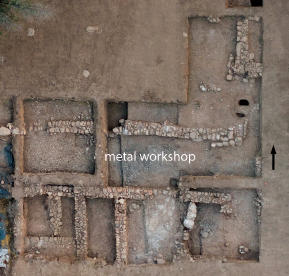 iron use that marks the transition to the Iron Age, a nuanced understanding of the technological phenomenon comes from evidence and artifacts of production. The origins of iron production technologies are still hotly debated. In recent years, new and pertinent archaeological data regarding actual iron production, has finally surfaced. Considerable iron production remains of both smelting and smithing had been identified at major sites throughout the region.
Click here to access the above article on JSTOR (ASOR membership with online access and/or subscription to JSTOR Current Content required).
Pp. 37-40: “Women in Distress: Victims of the Iron Age Destruction at Tell eṣ-Ṣâfi/Gath,” by Marina Faerman, Aren M. Maeir, Amit Dagan and Patricia Smith
The widespread signs of destruction and fire seen at Tell eṣ-Ṣâfi/Gath in the upper and lower parts of the city (Namdar et al. 2011; Zukerman and Maeir 2012) include the charred skeletal remains of three women found in Area D, Stratum D3, and five individuals found in Area A, Stratum A3. All appear to have been victims of the same event, namely, the destruction of the city at the end of the ninth century B.C.E. by Hazael of Aram (Maeir 2012). We provide here a detailed description of these remains and the circumstances surrounding their deaths using standards published in Bass 1995 to determine their age and sex, and the Munsell color chart (Ellingham et al. 2015) to estimate the extent and pattern of burning on the bodies.
Click here to access the above article on JSTOR (ASOR membership with online access and/or subscription to JSTOR Current Content required).
Pp. 41-44: “Iron Age Animal Husbandry at Tell eṣ-Ṣâfi/Gath: Notes on the Fauna from Area D,” by Ron Kehati, Amit Dagan and Liora Kolska Horwitz
Faunal remains comprise a significant portion of finds recovered from most archaeological sites in Israel. Among other issues relating to factors such as animal evolution and ecology, their examination can elucidate past human diet, symbolic and cultural behavior, technology relating to animals and animal products, as well as the site’s environment and even paleoclimate of a region (e.g., Reitz and Wing 2008; Russell 2011). These issues were considered when we examined the faunal assemblage recovered from the late Iron Age I (tenth century B.C.E.) through Iron Age IIA-B (post-830 B.C.E.) deposits excavated in Area D at Tell eṣ-Ṣâfi/Gath.
Click here to access the above article on JSTOR (ASOR membership with online access and/or subscription to JSTOR Current Content required).
Pp. 45-47: “Expanding the Lower City: Area K at Tell eṣ-Ṣâfi/Gath,” by Eric L. Welch
Excavations in the lower city of Gath have been ongoing since 2009. In Area D, in the westernmost excavated portion of the lower city, excavations have demonstrated the presence of a well-fortified lower city as early as the eleventh century B.C.E., with the most substantial remains dating to the ninth century B.C.E. (Dagan et al., this issue). With the discovery of a fortified lower city as early as Iron Age I, new research questions about the lower city began to emerge. Of particular interest were questions about the extent of ancient Gath’s lower city and the timeline for when the lower city was inhabited.
Click here to access the above article on JSTOR (ASOR membership with online access and/or subscription to JSTOR Current Content required).
Pp. 48-54: “Judahite Gath in the Eighth Century B.C.E.: Finds in Area F from the Earthquake to the Assyrians,” by Jeffrey R. Chadwick and Aren M. Maeir
After Philistine Gath fell to the Arameans in the late ninth century B.C.E. (Maeir 2008; 2012: 47–48) the huge city atop Tell eṣ-Ṣâfi/Gath was a ghost town for several decades. Some structures had been burnt or otherwise destroyed, but many were simply abandoned to the elements. As years passed, winter storms and the processes of nature eroded the roofs and walls of hundreds of ownerless houses and other buildings. The devastation was alluded to by the Judahite prophet Amos when he predicted the eventual demise of Samaria: “Go down to Gath of the Philistines,” he challenged the Israelites, to behold what complete desolation is like (Amost 6:2; Maeir 2004). Aside from the presence of a few squatters who settled in the north lower-city ruins near the Elah riverbed, the forlorn ghost town of Gath slowly decayed away, until a cataclysmic earthquake shook the entire region somewhere around 760 B.C.E. (Chadwick and Maeir, forthcoming; Maeir 2012:49–50).
Click here to access the above article on JSTOR (ASOR membership with online access and/or subscription to JSTOR Current Content required).
Pp. 55-58: “Textile Production at Iron Age Tell eṣ-Ṣâfi/Gath,” by Deborah Cassuto
Textiles in antiquity were multifunctional, and used much as they are in modern times.1 When we think of textiles, our first thoughts are of clothing. In antiquity, as in modern times, clothing demonstrated social status (e.g., royal, common), occupation (e.g., priestly, military) and ranged from simply constructed frocks to finely manufactured prestige garments. Textiles were also used as furnishings, such as rugs, wall carpets, cushions, and curtains, as boat sails and shelters, or sacks for storage or carriage. In short, they were consumed by everyone for a multitude of needs, ranging from the mundane to the festive, from the functional to the opulent.
Click here to access the above article on JSTOR (ASOR membership with online access and/or subscription to JSTOR Current Content required).
Pp. 59-62: “Iron Age Adornment at Tell eṣ-Ṣâfi/Gath,” by Josephine A. Verduci
Between 1998 and 2014, Iron Age strata from Areas A, C, D, E, F, and P yielded a rich assemblage of 172 objects of adornment. These objects come from contexts dated to the Late Bronze Age-Iron Age transition through to Iron Age IIB. Tomb T1, containing the skeletal remains of over 70 individuals (adults and children) and dated to late Iron I-early Iron IIA, also yielded a large and varied assemblage of 154 adornment objects, not including 65 items of shell that were most likely also used as items of adornment. Among these 326 objects, are examples of metal, stone, and vitreous materials, which are represented by beads, pendants, rings, bangles (bracelets, anklets, and armlets), earrings, and fibulae.
Click here to access the above article on JSTOR (ASOR membership with online access and/or subscription to JSTOR Current Content required).
Pp. 63-65: “Petrographic and Technological Analysis of the Tell eṣ-Ṣâfi/Gath Pottery,” by David Ben-Shlomo
In archaeological research, pottery analysis is of importance for relative dating and reconstructing daily life, as well as for understanding trade patterns and cultural contacts. Trade patterns in table ware and commodities carried in pottery containers can help illuminate the economy and administration of an ancient society. The production technology of pottery, and especially its mode of production, can also reflect social, economic, and political realities in a general manner. However, according to many ethnographic and archaeological studies, the technology of pottery production is relatively conservative, and does not change rapidly.
Click here to access the above article on JSTOR (ASOR membership with online access and/or subscription to JSTOR Current Content required).
Pp. 66-71: “Cooking Installations through the Ages at Tell eṣ-Ṣâfi/Gath,” by Shira Gur-Arieh
While it is debated when exactly humans began regularly to cook their food (Sandgathe and Berna 2017), it is clear that once they did, they never looked back. Cooking raw food improves its nutrient values by enabling more complete digestion, it kills bacteria, and it sometimes helps to preserve the food. But above all, cooking makes many food products taste much better. The combination of such practical benefits, which are essential for our wellbeing, with the communal and social aspects of eating, are what makes cooking and cuisine so central in the culture of many societies worldwide. Yet, although archaeologists are aware of the important role of cooking in the overall assemblage that defines different human cultures, comprehensive study of archaeological cooking installations is still not commonly practiced in excavations of Levantine protohistoric and historic sites (Ebeling and Rogel 2015: 343–44). Such comprehensive studies of cooking technologies, fuel materials, and their spatial and chronological development over time, have the potential to provide invaluable information on topics such as human interaction with the environment, subsistence practice, intercultural transformation, and cultural affiliation, to mention just a few.
Click here to access the above article on JSTOR (ASOR membership with online access and/or subscription to JSTOR Current Content required).
Pp. 72-76: “Seals and Sealings at Tell eṣ-Ṣâfi/Gath,” by Stefan Münger
The currently published glyptic assemblage from Tell eṣ-Ṣâfi/Gath comprises more than sixty seals and sealings (Keel 2013: 94–123; see also Maeir, Shai, and Kolska  Horwitz 2011). This corpus provides sound evidence that seals—mostly worn as adornments—and the practice of sealing were part of daily life at Tell eṣ-Ṣâfi/Gath throughout the centuries. In the following, a few outstanding glyptic finds by the current expedition are presented.
Click here to access the above article on JSTOR (ASOR membership with online access and/or subscription to JSTOR Current Content required).
Pp. 77-80: “Plant Use in the Bronze and Iron Ages at Tell eṣ-Ṣâfi/Gath,” by Suembikya Frumin and Ehud Weiss
The long history of settlement at Tell eṣ-Ṣâfi/Gath provides an opportunity to study changes in vegetation and its use in different cultures and periods, as well as aspects relating to local biodiversity over time. These changes may shed light on the local development of agriculture, on cultural changes, on ancient human migrations, and foreign influences. Analyzing archaeological data from several time periods and cultures within the same landscape offers new directions in the study of past cultures, and the origins of their formation (Frumin et al. 2015; Frumin 2017). In the case of the appearance of Philistine culture, which occurred partly through migration, this type of data enables analysis of invasion events using archaeological data, with the aim of reconstructing changes in diet, land use, and in regional and interregional linkages associated with a specific migrant culture.
Click here to access the above article on JSTOR (ASOR membership with online access and/or subscription to JSTOR Current Content required).
Pp. 81-84: “What We Can Learn from the Flint Industries at Tell eṣ-Ṣâfi/Gath,” by Francesco Manclossi and Steven A Rosen
Within Levantine archaeology, the analysis of chipped stone tools from the Metal Ages is reasonably well established. Chipped stone tool manufacture is a reductive process, leaving large quantities of diagnostic waste products, allowing detailed reconstruction not only of the specifics of technologies and function, but also of such issues as on-site/off-site production, trade, and degrees of craft specialization—and ultimately offering insights into social and economic processes not always available from other sources. The materials from Tell eṣ-Ṣâfi/Gath from the Early Bronze (EB), Late Bronze (LB), and Iron Ages (IA) provide a long-term view of these processes at the site, and offer a case study for larger-scale processes.
Click here to access the above article on JSTOR (ASOR membership with online access and/or subscription to JSTOR Current Content required).
Pp. 85-91: “‘The Archaeological Picture Went Blank’: Historical Archaeology and GIS analysis of the Landscape of the Palestinian Village of Tell eṣ-Ṣâfi,” by Liora Kolska Horwitz, Rona Winter-Livneh and Aren M. Maeir
Referring to the dearth of historical archaeological research in Israel, in Between Past and Present: Archaeology, Ideology, and Nationalism in the Modern Middle East, author Neil Silberman states: “Just as the story was beginning to get interesting—when the modern cultures of the region were in the process of formation—the archaeological picture went blank” (1989:233). Since Silberman published his book, the status of historical-archaeological research—notably of the Islamic and Ottoman periods in Israel—has certainly improved. To a large extent, the same cannot be said of archaeological research—either on objects, sites, or historic landscapes—relating to the British Mandate and the early years of the State of Israel.
Click here to access the above article on JSTOR (ASOR membership with online access and/or subscription to JSTOR Current Content required).
[/vc_column_text][mk_divider][vc_column_text]To view the entire issue on JSTOR, click here.[/vc_column_text][/vc_column][vc_column border_color=”rgba(170,170,170,0.01)” width=”1/6″ css=”.vc_custom_1496684098866{margin-right: 5px !important;margin-bottom: 20px !important;border-right-width: 2px !important;border-bottom-width: 2px !important;padding-top: 30px !important;padding-right: 10px !important;padding-left: 10px !important;background-color: #ffffff !important;border-right-color: rgba(227,228,228,0.75) !important;border-bottom-color: rgba(227,228,228,0.75) !important;}”][vc_wp_posts title=”BROWSE THE NEWS ARCHIVE” number=”4″][/vc_column][vc_column border_color=”rgba(170,170,170,0.01)” width=”1/6″ css=”.vc_custom_1496684008271{margin-right: 10px !important;margin-bottom: 30px !important;border-right-width: 2px !important;border-bottom-width: 2px !important;padding-top: 30px !important;padding-right: 20px !important;padding-left: 20px !important;background-color: #ffffff !important;border-right-color: rgba(227,228,228,0.75) !important;border-bottom-color: rgba(227,228,228,0.75) !important;}”][vc_column_text]Tweets by ASOResearch [/vc_column_text][/vc_column][/vc_row]