UNEARTHING THE PAST SINCE 1900
  • BECOME A MEMBER
  • RENEW
  • GIVE NOW
  • SEARCH
  • ONLINE PORTAL
  • American Society of Overseas Research (ASOR)American Society of Overseas Research (ASOR)
  • ABOUT
    • WELCOME FROM ASOR OFFICERS
    • HISTORY OF ASOR
    • MISSION, BYLAWS, & STRATEGIC PLAN
    • Board of Trustees
    • COMMITTEES
    • POLICIES
    • FINANCIAL DOCUMENTS
    • CONTACT US
  • CULTURAL
    HERITAGE
    • ABOUT CULTURAL HERITAGE INITIATIVES
    • UPDATES
    • TUTORIALS
    • Who We Are
  • ANNUAL
    MEETING
    • REGISTRATION
    • HOTEL RESERVATIONS
    • ANNUAL MEETING SCHEDULES
    • SPONSOR & EXHIBIT
    • ASOR Online Library
    • 125th Anniversary Celebration
    • HONORS & AWARDS
    • ANNUAL MEETING SCHOLARSHIPS
    • PAST & FUTURE ANNUAL MEETINGS
  • MEMBERSHIP
    & RESOURCES
    • INDIVIDUAL MEMBERSHIPS
    • INSTITUTIONAL MEMBERSHIPS
    • NEWS@ASOR
    • AFFILIATED PROJECTS
    • AFFILIATED RESEARCH CENTERS
    • ARCHIVES
    • PAST ASOR NEWS, MONTH BY MONTH
    • ONLINE RESOURCES
      • PHOTO COLLECTION
    • EARLY CAREER MEMBER RESOURCES
  • FELLOWSHIPS
    & GRANTS
    • SCHOLARSHIPS FOR FIELDWORK PARTICIPATION
    • GRANTS FOR ARCHAEOLOGICAL PROJECTS
    • RESEARCH FELLOWSHIPS FOR MEMBERS
    • MEMBERSHIP & ANNUAL MEETING SCHOLARSHIPS
    • ASOR-AFFILIATED RESEARCH CENTERS FELLOWSHIPS
    • OTHER FELLOWSHIP PROGRAMS
  • PUBLICATIONS
    • BOOK SERIES & MONOGRAPHS
    • BULLETIN OF ASOR
    • JOURNAL OF CUNEIFORM STUDIES
    • MAARAV
    • NEAR EASTERN ARCHAEOLOGY
    • THE ANCIENT NEAR EAST TODAY
    • News@ASOR
    • LEVANTINE CERAMICS PROJECT
  • FRIENDS
    OF ASOR
    • Webinars
    • TOURS
    • THE ANCIENT NEAR EAST TODAY
    • ASOR ONLINE LIBRARY
  • Donate
    • FY25 HONOR ROLL OF DONORS
    • LIFETIME HONOR ROLL OF DONORS
    • ASOR LEGACY CIRCLE
    • WAYS TO DONATE
Hall-banner4

 SHARE


NEWS@ASOR E-NEWSLETTER

ANCIENT NEAR EAST TODAY E-NEWSLETTER

PAST ASOR NEWS, MONTH BY MONTH

ASOR LEGACY CIRCLE MEMBERS

LIFETIME HONOR ROLL OF DONORS

FY25 HONOR ROLL OF DONORS

ASOR ANNUAL MEETING

Disturbance and Discovery: Learning from Looting at Humayma

Kearyn Hall, 2025 Harva L. Sheeler Fieldwork Scholarship Recipient

The 2025 field school began in Amman, the capital of Jordan, where our first week was devoted to lab-based training. Under the guidance of our instructors, we handled ceramics, practiced drawing profiles, reconstructed fragments, and grew accustomed to the meticulous process of cataloging. This initial week was invaluable; it allowed us to encounter the material record in a controlled environment before confronting its fragmentary and often damaged reality in the field. By the time we left Amman, I carried with me not only a set of practical skills but also a growing awareness of how even small sherds and fragments could speak volumes when studied carefully.

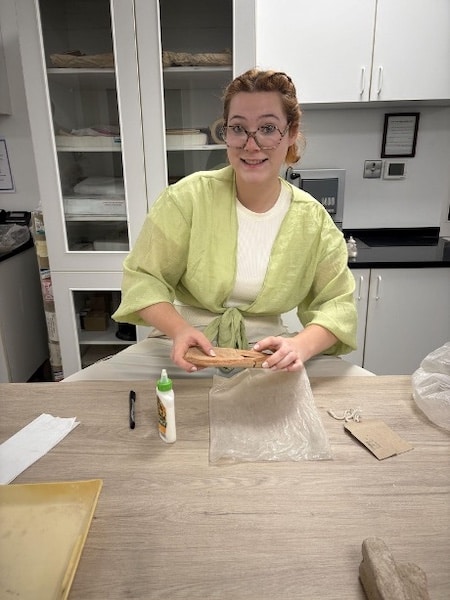
In the lab at Amman, gluing fragments to reassemble a ceramic tile.
During the first week in the lab, we not only became familiar with local pottery typologies and classifications, but also received training in photogrammetry and the collection of RTK points.

Travelling south to Humayma shifted our focus dramatically. The site itself lies in an austere yet striking landscape of desert plains framed by sandstone ridges. At first glance, it appears modest compared to monumental Nabataean or Roman centers, yet its significance lies precisely in its layered history. Established as a Nabataean settlement, later transformed by the presence of a Roman fort, and subsequently home to Byzantine churches and early Islamic occupation, Humayma presents a unique cross-section of centuries of cultural, religious, and social change. Standing within its ruins, one could trace how different communities shaped the same terrain, leaving behind traces that are at once fragile and enduring.
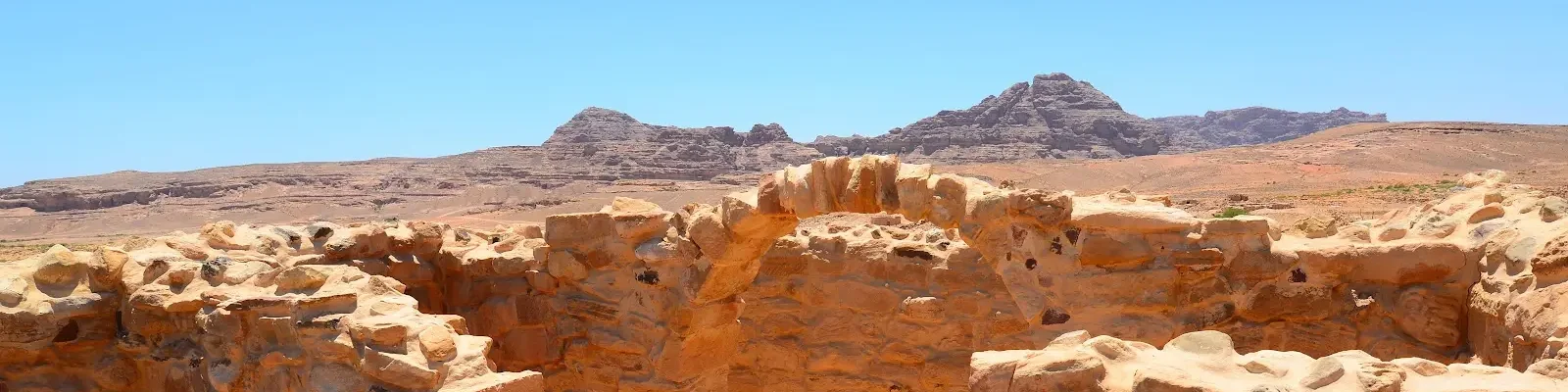
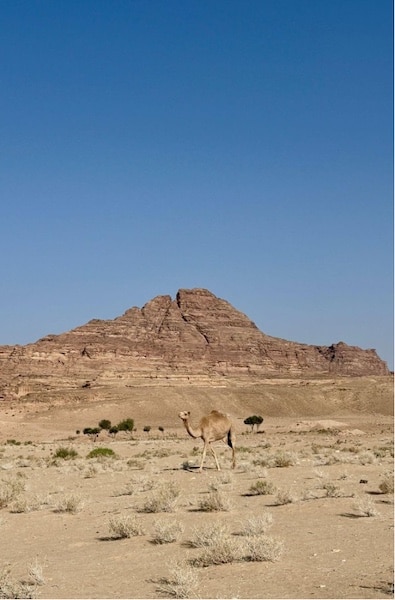
A camel standing before the Jebel Qalkha at Humayma, which was venerated as the source of water in antiquity.

Life at Humayma quickly settled into a rhythm. Early mornings were spent in the field, where small teams divided their efforts among photogrammetry, architectural recording, survey, and midden documentation. Some days were devoted to tracing architectural features with RTK mapping, others to carefully noting the distribution of ceramics within middens. Afternoons were often spent reviewing notes, comparing interpretations, and discussing questions raised by the day’s work. Evenings, though quieter, were filled with writing, preparation, and the informal but equally important conversations that come with living and learning in close quarters.

Among the many tasks we undertook, the reality of looting stood out most starkly. It was impossible to ignore; it was everywhere. Some disturbances were recent, the scars from metal detectors fresh in the soil. Graves had been torn open, leaving human remains displaced, stripped of the context that would have allowed us to understand their original placement and significance. In another area, a marble platform had been ripped apart, apparently under the assumption that it concealed valuables. In truth, it was nothing more than a built surface, its destruction a senseless erasure of evidence. These episodes made clear how devastating looting is, not only for material culture but for the fragile stories of lives once lived.

Looting also shaped our daily practice. It was evident that looters were aware of our presence, and we were advised not to linger in any single area for too long. This necessity forced us to adapt; recording and documentation were carried out with a heightened sense of urgency, trying to get everything done at once so we didn’t have to worry about it still being there tomorrow to document. It was a sobering reminder that the work of archaeology does not unfold in isolation, but in a living landscape where the past and present are in constant negotiation.

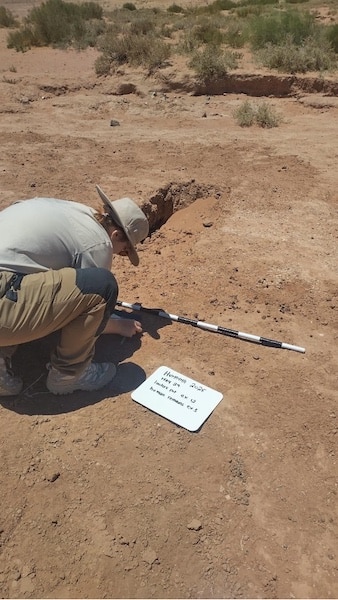
Setting up the north arrow before photographing a looter’s pit that contained human remains.

For me, the most difficult moments were those involving disturbed human remains. Confronting looted graves was unsettling; faced with the incivility of leaving someone once buried to wither away on the surface, at first, I questioned whether I was truly suited to pursue bioarchaeology. Yet when I was able to contribute to the documentation of these remains, I realized how meaningful it was simply to approach them with care and respect. That experience did not erase the destruction I witnessed, but it gave me a sense of purpose in responding to it. It reminded me that archaeology is not only about recovering knowledge, but also about honouring the people and cultures whose traces we encounter.

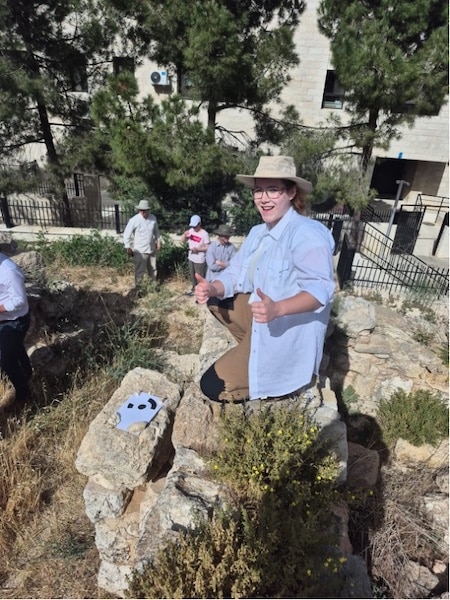
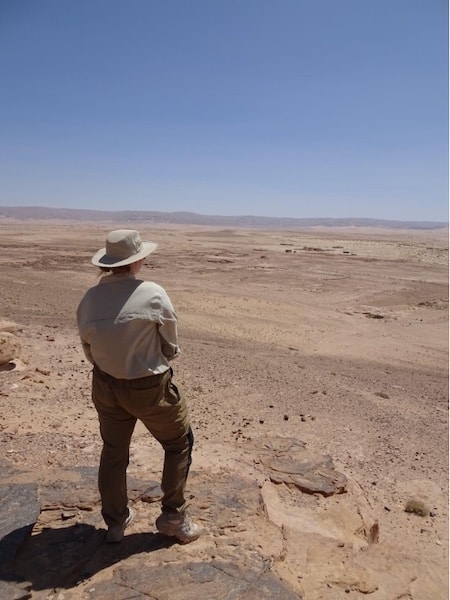
Overlooking the site of Humayma during the hike on our final day in the field.
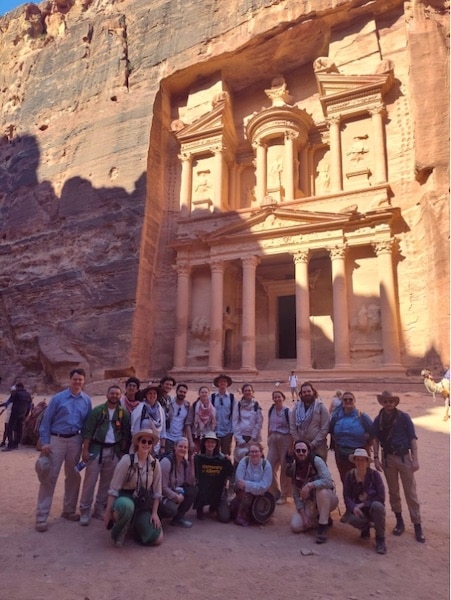
Field School group photograph at the Treasury in Petra, taken on our excursion en route from Amman to Aqaba.

I am deeply grateful to ASOR and to the Sheelers for supporting my participation in this project. This opportunity not only allowed me to gain invaluable field experience, but also helped me realize that I have found something I truly love to do. Thank you for supporting my dream and helping me take these first steps toward a career in archaeology.

Kearyn is in her final year of her Bachelor of Arts in Anthropology and Classics at the University of Alberta. She is currently applying to Master’s programs with a focus on Osteoarchaeology.

Learn more about this project here.

Want to help more students and early career archaeologists get into the field? Donate to the cause today by selecting “Fieldwork Scholarships” as your gift purpose!

Recent Posts

  • Table of Contents for Near Eastern Archaeology 88.4 (2025)
  • Call for Early Career Scholars Social Media Content Creator
  • Honors and Awards Committee Seeks New Members
  • FOA Webinar: Amanda Hope Haley
  • Fieldwork Report: Yishu Deng

Latest Posts from @ASORResearch

asor_research

Initiating and supporting research of the history and cultures of the Near East and wider Mediterranean world.


ASOR invites members to propose new member-organiz
ASOR invites members to propose new member-organized sessions and workshops for the 2026 Annual Meeting. The meeting will be held in Chicago and online, November 18-21. The brief proposal form asks for a description of the session/workshop, as well as a list of 4 to 5 potential speakers and topics. The deadline to propose sessions and workshops is January 15. More info can be found by clicking the link (https://www.asor.org/am/2026/call-for-sessions-2026) in our bio.


Our #ObjectoftheWeek: Alabastron from the tomb of
Our #ObjectoftheWeek: Alabastron from the tomb of Nubian king Aspelta in Nuri, Sudan, ca. 593-568 BCE. MFA 20.1070. Photo credit: Harvard University—Boston Museum of Fine Arts Expedition.
#Nubia #Alabastron


Register for the next FOA webinar on January 7, 20
Register for the next FOA webinar on January 7, 2026, at 7:00 pm ET, presented by Amanda Hope Haley: "Beyond Edutainment: Reclaiming Archaeology in a Clickbait World". This webinar will be free and open to the public. Register here: https://www.asor.org/news/2025/12/webinar-haley


Heritage protection is a fundamental part of the w
Heritage protection is a fundamental part of the work of ASOR’s Cultural Heritage Initiatives. To help fight the illicit antiquities trade in Lebanon and Syria, ASOR hosted an Antiquities Trafficking Documentation workshop in Beirut, Lebanon on December 8-12, 2025, with the generous support of the U.S. Embassy in Beirut @USEmbassyBeirut. 

The workshop brought together representatives of the American, Lebanese, and Syrian governments to discuss current conditions and challenges in Lebanon and Syria, local priorities, and ways for all participants to work together to achieve them. Read more by clicking the link (https://buff.ly/lB5EEHO) in our bio.

Photo credits: U.S. Embassy Beirut and ASOR


Check out the November issue of BASOR 394, featuri
Check out the November issue of BASOR 394, featuring articles such as: Boulos el-ʿAraj: A Palestinian Quaker Archaeologist of the British Mandate Era (1926–1936); Unveiling the Obscure: Exploring the Function and Meaning of Levantine Shrine Models through an Ethnoarchaeological Lens; Paleoenvironment and Fruit Tree Horticulture at Early Bronze Age Tel Bet Yerah: Evidence from Charcoal Remains; and more. Read the Table of Contents by clicking the link (https://www.asor.org/news/2025/12/basor394-toc/) in our bio.


ASOR is pleased to share information from Overseas
ASOR is pleased to share information from Overseas Institute @caari_cyprus. The CAARI-HFF fellowship offers one grant of ÂŁ2000 to a graduate student of any nationality, with a preference given to scholars from Egypt, Cyprus, Lebanon, and Syria. The purpose of the time at CAARI must be to conduct research on a project relevant to the maritime archaeology or maritime heritage of Cyprus. Applications are due 12 January 2026. Read more by clicking the link (https://honorfrostfoundation.org/2025/11/24/caari-hff-graduate-fellowship/) in our bio.


Kearyn Hall, a Harva L. Sheeler Fieldwork Scholars
Kearyn Hall, a Harva L. Sheeler Fieldwork Scholarship Recipient, joined the Humayma Excavation Project in Jordan in 2025. Kearyn's experience at Humayma strengthened her interest in bioarchaeology while highlighting the urgent challenges of protecting heritage in looted landscapes. Read more by clicking the link (https://www.asor.org/news/2025/12/fieldwork-report-hall) in our bio.
#Archaeology #Fieldwork #Jordan


ASOR invites applications from members to fill Ses
ASOR invites applications from members to fill Session Chair openings for several ASOR Standing Sessions. Session Chairs volunteer to serve one term (three years, 2026-2028) with the possibility of renewing for a second term. Applications may be submitted by one person or by co-applicants and are due by December 22, 2025. The application can be found by clicking the link (https://buff.ly/Bv5lLOf) in our bio.


Tune in for TONIGHT's FOA webinar, "What is a God?
Tune in for TONIGHT's FOA webinar, "What is a God? The Bible and the Ancient Near East," presented by Michael Hundley at 7:00 PM ET. You can still register for the free Zoom webinar here: https://buff.ly/lPi80Uq


ASOR is proud to announce the signing of a Memoran
ASOR is proud to announce the signing of a Memorandum of Understanding (MOU) with the Libyan Department of Antiquities, formalizing years of collaboration to protect and preserve Libya’s rich cultural heritage.

The agreement builds on long-standing cooperation and advances shared goals, including professional training, site conservation, youth engagement, and efforts to address illicit trafficking of cultural property. Signed during the U.S.–Libya Cultural Heritage Protection Workshop in Tunis, the MOU reinforces our shared commitment to safeguarding heritage sites—including ongoing work at Cyrene, a UNESCO World Heritage Site.

See the link (https://buff.ly/voCGZVk) in our bio to read more.

#CulturalHeritage #Libya #Archaeology


In 2025 with the support of ASOR and a Dana Grant,
In 2025 with the support of ASOR and a Dana Grant, the Erbil Plain Archaeological Survey focused on expanding and completing the image database that underpins EPAS’s ceramic typology. Read more about the project here: https://www.asor.org/news/2025/12/dana-grant-report-erbil-plain


The 2025 ASOR Annual Meeting took place November 1
The 2025 ASOR Annual Meeting took place November 19–22 at the Hilton Boston Park Plaza and online. More than 1,100 people registered for the hybrid meeting with approximately 950 attending in Boston. The academic program included more than 600 presentations with presenters representing over 30 countries. For a summary of the meeting and photo highlights, read more here: https://www.asor.org/news/2025/12/am-recap-2025


Our #ObjectoftheWeek: Limestone statuette of a tem
Our #ObjectoftheWeek: Limestone statuette of a temple boy, from Cyprus. 4th century BCE. Metropolitan Museum of Art, 74.51.2767. Public Domain (https://www.metmuseum.org/art/collection/search/242318).
#Cyprus #Statues


Read the Top Archaeological Discoveries of 2025 in
Read the Top Archaeological Discoveries of 2025 in the newest ANE Today!

Our editor, Jessica Nitschke, curates standout discoveries from across the Middle East, North Africa, and Mediterranean—from buried inscriptions to submerged landscapes and everything in between.

Is your favorite excavation or announcement missing?
Drop it below! 👇

#ANEToday #ArchaeologyMag #MiddleEastArchaeology #MediterraneanHistory #Discoveries2025 
📸 T-pillar carved with human face, Karahantepe, Turkey. Photo credit: Turkish Ministry of Culture and Tourism


ASOR seeks candidates for part-time internship pos
ASOR seeks candidates for part-time internship positions to begin in mid-January. These paid internships are for the spring semester (January-May) with the possibility of renewal for the summer and/or fall semester. Interns are expected to work 10–15 hours per week at ASOR’s headquarters in Alexandria, VA. Hours and schedule are flexible depending on school or other commitments. Read more here: https://www.asor.org/news/2025/12/spring-internships


Friends of ASOR is pleased to share information on
Friends of ASOR is pleased to share information on BAF & BASONOVA lectures. On Wednesday, December 10 at 8pm ET via Zoom, Michael Cosmopoulos (University of Missouri at St. Louis) will present "Myths, Monument, and Memory: Archaeology and the Creation of the Iliad and the Odyssey". This lecture examines how the physical remnants of the past, ruins, monuments, and long-lived “places of memory”, shaped the creation of the Homeric epics. Register here: https://buff.ly/qC5Y1GA


Don't miss the next FOA webinar, "What is a God? T
Don't miss the next FOA webinar, "What is a God? The Bible and the Ancient Near East," presented by Michael Hundley on Wednesday, December 17th at 7:00 PM ET. This webinar will be free and open to the public. Registration through Zoom with an email address is required. Click the link (https://asor-org.zoom.us/webinar/register/WN_PhCmXIYvSuyTijMVm5bYsw#/registration) in our bio to register.


During the summer, Aleyna Uyanik joined the Phoeni
During the summer, Aleyna Uyanik joined the Phoenix Archaeological Project to conduct fieldwork in southwestern Turkey. Aleyna, a classical archaeology and philosophy student at Johannes Gutenberg University Mainz, reports on day-to-day life in the field, conducting surveys, and the bonds formed during fieldwork. Read Aleyna's report here: https://www.asor.org/news/2025/10/fieldwork-report-uyanik

Photo credits: Ayse Ozaydin @peepingtom


Deadline is Dec. 5: The ASOR Program Committee (PC
Deadline is Dec. 5: The ASOR Program Committee (PC) is seeking 4 new members to each serve a three-year term (2026–2028) with the possibility of renewing for a second term. We are particularly interested in applications from ASOR members whose area(s) of research and expertise are complementary to or not represented by current members of the PC. The brief application form is due by 12:00 pm ET on December 5: https://buff.ly/3QvqGwd


When you give to ASOR this Giving Tuesday, you’re
When you give to ASOR this Giving Tuesday, you’re investing directly in the next generation of archaeologists and scholars.
Your support funds fellowships, mentoring, training, and opportunities that open doors for early-career researchers.
Thank you for helping us shape the future of the field and protect the study of the ancient world.
đź’™ Be part of the impact. #GivingTuesday #ASOR #SupportArchaeology 
https://members.asor.org/fundraising/give


Instagram

Stay updated with the latest insights, photos, and news by following us on Instagram!

Follow Us on Instagram

American Society of Overseas Research
The James F. Strange Center
209 Commerce Street
Alexandria, VA 22314

E-mail: info@asor.org

© 2025 ASOR
All rights reserved.
Images licensed under a Creative Commons Attribution-NonCommercial-ShareAlike 4.0 International License

Contact Us
Membership
Give
Friends of ASOR
ASOR Cultural Heritage Initiatives
Terms of Use
News

Please follow & like us :)
Facebook
YouTube
LinkedIn