
UNEARTHING THE PAST SINCE 1900
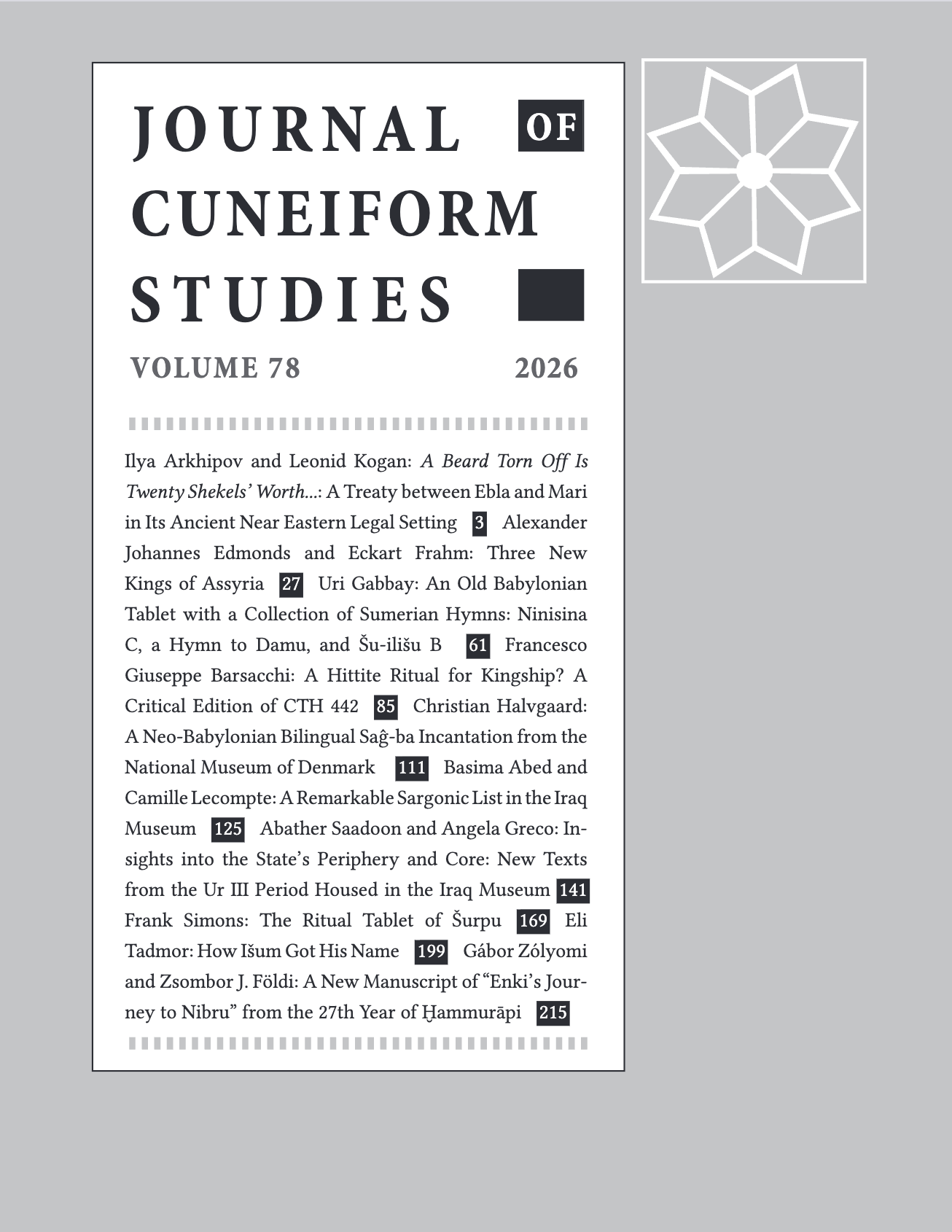

Until recently, Assyriologists have been mostly unaware of the existence of prescriptive cuneiform law as early as in the Early Dynastic period. A deeper inquiry into the so-called chancery texts from Ebla has allowed Massimo Maiocchi and the present authors to independently conclude that compendia of prescriptive legal provisions, in their typology broadly identical to such well-known later codes as the Laws of Hammurabi, were produced (and, in all probability, implemented) in northwestern Syria as early as the latter third of the third millennium BCE (that is, ca. two hundred years before the Laws of Ur-Namma, the earliest known Mesopotamian specimen of the kind). In the present article, a detailed annotated reedition of a key source representing this text type—a collection of (mostly penal) stipulations embedded in the context of a treaty between Ebla and Mari—is proposed, with a special focus on the striking commonalities uniting ARET 16: 30 with the later Mesopotamian, Anatolian, and biblical legal codes.
ASOR Members with online access: log into ASOR’s Online Portal here. Tutorials for how to log in to the Online Portal as well as how to navigate to the Portal Journals page can be found here.

In this contribution, we critically examine the claim that the Assyrian King List (AKL) reliably contains all Neo-Assyrian monarchs up to Shalmaneser V, presenting three historical scenarios in which it can be demonstrated that short-lived Assyrian kings ruled parallel to or between those listed in the AKL’s first-millennium BCE portion. The first of these is a new rebel king Tiglath-pileser who rose up against his nephew Aššur-dān III in 763 BCE (most likely in the wake of a dramatic solar eclipse) and was enthroned in Aššur, before being toppled again by Aššur-dān III’s forces. The second is a new Shalmaneser who we assume succeeded Aššur-nārārī V to the Assyrian throne late in 747 BCE but lost his throne to Tiglath-pileser III a little more than a year later in 745 BCE. The third is earlier in date, a short-lived Aššur-uballiṭ whose reign was usurped by Adad-nārārī II in 912* BCE. Each king was enthroned at Aššur, and enjoyed support from some, if not all of Assyria, but was subsequently defeated or deposed. Evidence of the partial erasure of two of these kings from the historical record can be identified. The new insights thus gained into the cutthroat Assyrian “game of thrones” demonstrate that the AKL is not a reliable list of all Neo-Assyrian rulers, but rather of those who reigned long and successfully enough to be included by its editors in an idealized, consecutive order. This reframes our perspective on the motivations behind the compilation of this remarkable text, and the nature of Assyrian kingship itself.
ASOR Members with online access: log into ASOR’s Online Portal here. Tutorials for how to log in to the Online Portal as well as how to navigate to the Portal Journals page can be found here.

The article presents an edition of a previously unpublished Old Babylonian tablet in the collection of the Kramer Institute of Assyriology of Bar Ilan University. The tablet contains three Sumerian compositions: Ninisina’s Journey to Nippur (Ninisina C), a hymn to Damu, and a hymn to An with wishes for Šu-ilišu (Šu-ilišu B). Besides the philological edition, the article deals with formal features on the tablet such as subscripts, as well as with the possible reason(s) for grouping the three compositions together on one tablet.
ASOR Members with online access: log into ASOR’s Online Portal here. Tutorials for how to log in to the Online Portal as well as how to navigate to the Portal Journals page can be found here.

This article offers the first edition of the Hittite ritual composition cataloged as n. 442 in the Catalogue des Textes Hittites. The text is preserved on three fragments, with the best-preserved fragment represented by KUB 9.28. The synoptic edition of all manuscripts is introduced by a paleographic analysis and followed by a systematic commentary on all relevant grammatical and linguistic features. The structure and content of the ritual are examined in the broader framework represented by the Hittite ritual tradition of Hurrian origin. The paleography of the tablets, along with the presence of specific elements found also in the ritual of Ammiḫatna and in the itkalzi ritual, bring us to interpret the document as a late fourteenth century scribal product that reworks ritual traditions likely dating to the time of King Tutḫaliya II/III.
ASOR Members with online access: log into ASOR’s Online Portal here. Tutorials for how to log in to the Online Portal as well as how to navigate to the Portal Journals page can be found here.

This article presents the first edition of a Neo-Babylonian cuneiform tablet containing a Sumerian Saĝ-ba incantation with an interlinear Akkadian translation. The purpose of the incantation was to strengthen an apotropaic design made of flour paste to keep demons away from the bed or house of a patient. It was utilized in a variety of different ritual settings. The tablet’s relationship to other known Saĝ-ba manuscripts is examined, and a Sippar provenience in the sixth century BCE or later is suggested based on paleographic and textual evidence.
ASOR Members with online access: log into ASOR’s Online Portal here. Tutorials for how to log in to the Online Portal as well as how to navigate to the Portal Journals page can be found here.

The present article publishes a remarkable school text housed in the Iraq Museum, likely originating from Sargonic Adab. The text, conical in shape, contains a list of fields, each measuring 1 iku, associated with a compilation of ad hoc personal names and unexpected terms. This study discusses the text’s content, origin, date, paleography, and its unusual names or expressions.
ASOR Members with online access: log into ASOR’s Online Portal here. Tutorials for how to log in to the Online Portal as well as how to navigate to the Portal Journals page can be found here.

The present contribution offers the edition of eight texts from the Ur III period that were confiscated by the Iraqi authorities and subsequently entrusted to the Iraq Museum. These tablets, believed to have originated from royal archives, provide insights into economic activities of royal concern in peripheral areas or within the hinterland of the state’s core. Thereby, they contribute to adding new pieces to the puzzle of our understanding of the economy and society of the Ur III state, beyond the provincial perspective that has traditionally shaped our understanding of the period.
ASOR Members with online access: log into ASOR’s Online Portal here. Tutorials for how to log in to the Online Portal as well as how to navigate to the Portal Journals page can be found here.

This article presents a new edition of the ritual Tablet of the ritual and incantation series Šurpu (“Burning”), based on a newly identified manuscript, BM 38656, which supplements and significantly extends the previously unique exemplar VAT 13613. The new fragment preserves much of the Tablet’s lost second half, clarifies numerous damaged passages, and restores the conclusion of the ritual, including additional incantation incipits and ritual instructions. Together, the two manuscripts reveal the stable transmission of the ritual Tablet for the α version of Šurpu, and confirm that an entire stage of associated incantations—omitted in modern editions—formed part of the ceremony. This study refines the structure, sequence, and performance of Šurpu, contributes improved readings throughout, and provides a more secure textual basis for understanding first-millennium ritual practice.
ASOR Members with online access: log into ASOR’s Online Portal here. Tutorials for how to log in to the Online Portal as well as how to navigate to the Portal Journals page can be found here.

CT 15: 5–6, an Old Babylonian tablet of unknown provenience, tells of the origins of Išum, the divine night watchman: Ninlil bore him to her grandson Šamaš, set him on fire, and left him in the street. We learn of these events from words that Ištar, whom we find fostering the newborn in Ekur, addresses to Enlil. First, this article proposes that Ninlil’s setting alight of Išum and his subsequent fostering by Ištar serve as a native Babylonian explanation for the long-since noted similarity between the name Išum and the word išātum, “fire”: Ištar, finding a baby on fire, named him after fire itself. Second, the article defends its preference for translating the key verbal form uštāḫizma as “set ablaze.” Third, it argues that CT 15: 5–6 reflects a Mesopotamian, and more broadly ancient Near Eastern, motif of a young woman rescuing and naming a foundling. Fourth, it highlights the perennial difficulty of ascertaining the social reality underlying sources pertaining to Mesopotamian foundlings. And fifth, it reanalyzes Emar 256, an administrative document reflecting that difficulty.
ASOR Members with online access: log into ASOR’s Online Portal here. Tutorials for how to log in to the Online Portal as well as how to navigate to the Portal Journals page can be found here.

This article presents a new manuscript of the Sumerian literary composition “Enki’s Journey to Nibru,” housed in the collection of the Musées royaux d’Art et d’Histoire, Brussels. MRAH O.343 is a two-column, Type I Old Babylonian tablet of uncertain provenance, preserving the complete text of the composition in 127 lines. The colophon permits its dating to the twenty-seventh year of Ḫammurāpi. Analysis of scribal errors suggests that MRAH O.343 was copied from memory. Based on this manuscript, the obscure line 68a of the composition can now be restored with certainty.
ASOR Members with online access: log into ASOR’s Online Portal here. Tutorials for how to log in to the Online Portal as well as how to navigate to the Portal Journals page can be found here.