Me and We in the Mirror. A Study of Self and Other from Mesopotamia to the Levantine Coast during the Fourth and Second Millennia BCE
Laura Alvarez, University of Cambridge, 2025 Study of Collections Fellowship Recipient
From the beginning of the fourth millennium BCE, small circular mirrors in copper alloy started appearing in funerary and temple contexts across Mesopotamia and the Levantine coast. What might seem a banal object in fact marks a major milestone in the history of both technology and perception, as mirrors offer a means of accessing what would otherwise be invisible to us directly: the face, in a left–right reversed and sometimes distorted image. Where reflections had previously been fleeting glimpses in water, mirrors now provided a more stable, manipulable, and portable medium.
Map of the earliest dates of metal mirror from Western Asia to Europe, with possible paths of spread across Eurasia.
For many years, I have wondered how mirrors may have altered perceptions of oneself and others, disrupted relational structures, or suggested new ways of conceptualising the world. A well-known historical parallel is the development of mirrors in seventeenth-century Europe, which coincided with the rise of the bourgeoisie, new notions of individuality, and the emergence of intimacy and personal comfort. But even earlier, in 12th Dynasty Egypt, Ipuwer evoked the image of a woman who once had to gaze at her reflection in water but now owned a mirror (Papyrus Leiden I 344 recto) as a way of expressing the upheaval of social revolution: access to self-awareness, once dictated by hierarchy, was shifting. Much like the performative nature of status at Versailles, this demonstrates how mirrors could become instruments of social and ideological transformation as far back as the Chalcolithic and Bronze Age periods.
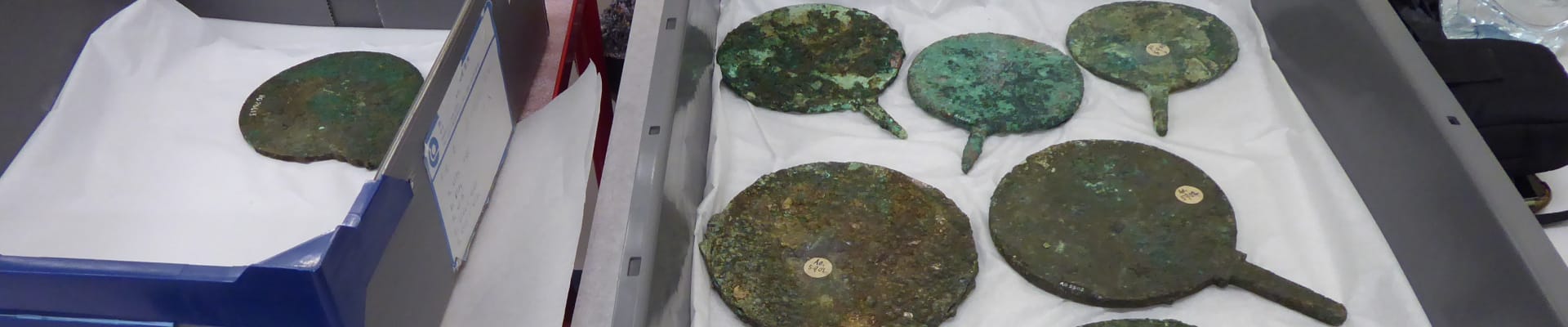
Copper-alloy mirrors from the collections of the Louvre Museum (photograph: Laura Alvarez).
In this project, my aim is to attempt to reconstruct the experiences of people interacting with mirrors, seeking insights into their perceptions of reflections and the symbolism attached to these objects. Since 2022 I have been building a dataset of mirrors from Syria, Palestine–Israel, Lebanon, Jordan, Iraq and western Iran, and have studied numerous collections worldwide.
The ASOR Study of Collections Fellowship provided the critical final support needed to complete the data collection phase of the project, which involved visiting the archaeological collections at the Louvre and the Baghdad Museum. The latter houses numerous mirrors from Agrab, Khafajeh and Kish-Tell Ingharra, Ur, Uruk, Khafajeh and Asmar, most of which remain unpublished. Although part of the work was hindered by the closure of regional airspace in mid-June, which forced the postponement of travel, I expect to conduct research in Iraq in the autumn or winter. The ultimate goal of this project is to produce a monograph, the Corpus Speculorum Orientis, restoring to this material a scholarly standing long minimised.
Undated aerial photograph of Ugarit, from the Schaeffer fonds, Collège de France, archival reference 16 Fi 1/329-h.
At the Louvre, I investigated ten mirrors from Sidon, acquired through the museum’s antiquities networks of Louvre curator Eugène Ledrain, whom aimed to expand the French knowledge of Levantine culture with the institutional objective of enriching the museum’s collections. I also studied mirrors from the coastal site of Ugarit (Ras Shamra), brought to Paris in the course of French excavations during the colonial and Mandate periods of the early twentieth century. In examining these objects, I paid particular attention to any surviving traces of engraved decoration, similar to those I have observed on mirrors from the Diyala region in Iraq.
During this stay, I took the opportunity to consult the Collège de France archives, which preserve excavation documents of Claude Schaeffer, who directed work at Ras Shamra in the first half of the twentieth century, as well as to visit the National Museum of Archaeology at Saint-Germain-en-Laye (Musée d’archéologie nationale, MAN), located about an hour from Paris, which preserves material from Ugarit and its harbour, Minet el-Beida.
Entrance of the Collège de France from Place Marcelin Berthelot (photograph: Laura Alvarez).