UNEARTHING THE PAST SINCE 1900
  • BECOME A MEMBER
  • RENEW
  • GIVE NOW
  • SEARCH
  • ONLINE PORTAL
  • American Society of Overseas Research (ASOR)American Society of Overseas Research (ASOR)
  • ABOUT
    • WELCOME FROM ASOR OFFICERS
    • HISTORY OF ASOR
    • MISSION, BYLAWS, & STRATEGIC PLAN
    • Board of Trustees
    • COMMITTEES
    • POLICIES
    • FINANCIAL DOCUMENTS
    • CONTACT US
  • CULTURAL
    HERITAGE
    • ABOUT CULTURAL HERITAGE INITIATIVES
    • UPDATES
    • TUTORIALS
    • Who We Are
  • ANNUAL
    MEETING
    • REGISTRATION
    • HOTEL RESERVATIONS
    • ANNUAL MEETING SCHEDULES
    • SPONSOR & EXHIBIT
    • ASOR Online Library
    • 125th Anniversary Celebration
    • HONORS & AWARDS
    • ANNUAL MEETING SCHOLARSHIPS
    • PAST & FUTURE ANNUAL MEETINGS
  • MEMBERSHIP
    & RESOURCES
    • INDIVIDUAL MEMBERSHIPS
    • INSTITUTIONAL MEMBERSHIPS
    • NEWS@ASOR
    • AFFILIATED PROJECTS
    • AFFILIATED RESEARCH CENTERS
    • ARCHIVES
    • PAST ASOR NEWS, MONTH BY MONTH
    • ONLINE RESOURCES
      • PHOTO COLLECTION
    • EARLY CAREER MEMBER RESOURCES
  • FELLOWSHIPS
    & GRANTS
    • SCHOLARSHIPS FOR FIELDWORK PARTICIPATION
    • GRANTS FOR ARCHAEOLOGICAL PROJECTS
    • RESEARCH FELLOWSHIPS FOR MEMBERS
    • MEMBERSHIP & ANNUAL MEETING SCHOLARSHIPS
    • ASOR-AFFILIATED RESEARCH CENTERS FELLOWSHIPS
    • OTHER FELLOWSHIP PROGRAMS
  • PUBLICATIONS
    • BOOK SERIES & MONOGRAPHS
    • BULLETIN OF ASOR
    • JOURNAL OF CUNEIFORM STUDIES
    • MAARAV
    • NEAR EASTERN ARCHAEOLOGY
    • THE ANCIENT NEAR EAST TODAY
    • News@ASOR
    • LEVANTINE CERAMICS PROJECT
  • FRIENDS
    OF ASOR
    • Webinars
    • TOURS
    • THE ANCIENT NEAR EAST TODAY
    • ASOR ONLINE LIBRARY
  • Donate
    • FY25 HONOR ROLL OF DONORS
    • LIFETIME HONOR ROLL OF DONORS
    • ASOR LEGACY CIRCLE
    • WAYS TO DONATE

 SHARE


NEWS@ASOR E-NEWSLETTER

ANCIENT NEAR EAST TODAY E-NEWSLETTER

PAST ASOR NEWS, MONTH BY MONTH

ASOR LEGACY CIRCLE MEMBERS

LIFETIME HONOR ROLL OF DONORS

FY25 HONOR ROLL OF DONORS

ASOR ANNUAL MEETING

Dusty, Sweaty but very Happy!

Aleyna Uyanik, 2025 Katherine Barton Platt Fellowship Recipient. 

Spending the summer in Marmaris with the Phoenix Archaeological Project has been nothing short of incredible.

The people I worked with in the project are more than just colleagues. For me, this is one of the most beautiful aspects of our discipline. Every summer, people from different corners of the world come together in one place: Taslica. While we have scientific goals, we also share daily challenges, laughter, and mutual support under often demanding conditions. Looking back, I realize that the moments from the summer that stay with me most are the ones with the Phoenix Project team in Marmaris. It might sound cliché, but it is here that I learned the most. It was not only about archaeology, it was about so many other things. Even something as simple as a song playing on the radio on our way to the field became part of that shared memory, one that I value just as much as the ancient press stones and pottery finds we documented.

Exactly: teamwork is dreamwork.

Life in the Field

At the Phoenix Archaeological Project, we work in the ancient region of Caria, today’s Marmaris area in southwestern Turkey. The terrain is demanding: steep hills and rocky paths (which made me cry once, though thinking about it now actually makes me laugh), but that is also what makes the work so rewarding. A typical day begins early. By sunrise, we have breakfast, and shortly after, we pack our equipment and head into the hills. Every evening, during team meetings, the we set the plan for the following day. That means that when we leave in the morning, we know exactly where we are going and what we are searching for. Of course, the land itself has the power to change plans. Sometimes we encounter unexpected things, or we find a site denser in material than anticipated, which forces us to adjust our schedule.

Fieldwork in the hills of "carian chersonese".
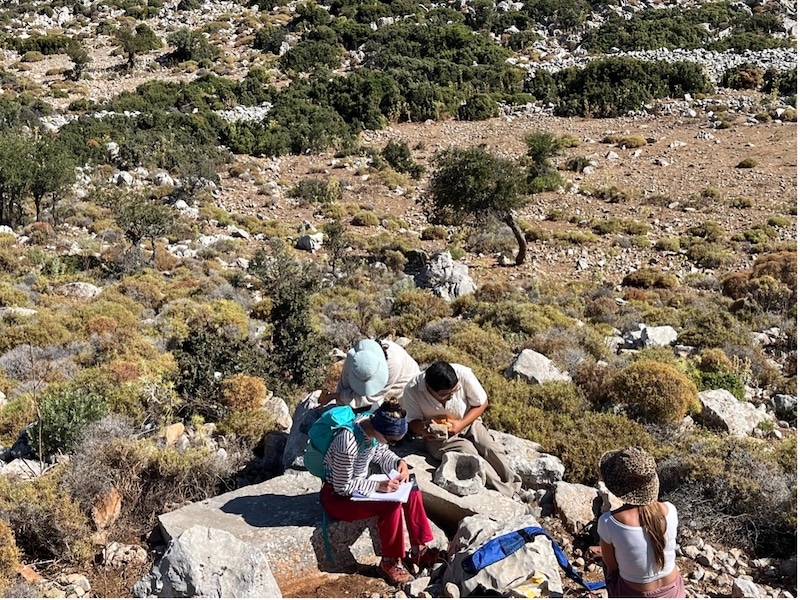
With my dear professor, Assoc. Prof. Dr. Koray Konuk and our project director Dr. Asil Yaman (top right), together with my colleague and friend Ilayda Alikaya (bottom left) and myself (bottom right).

By midday, the heat in Marmaris becomes little overwhelming. Before temperatures rise too high and our water bottles empty, we return to our research center for lunch. At lunch we discuss the morning’s work, observations from the field, and sometimes also share jokes about an oversized rabbit that startled us. Yes, we enjoyed documenting even the tiniest sherds, since they contribute meaningfully to our academic work, but we also enjoyed the moments of laughter which made the long and tiring days at the field both productive and memorable.

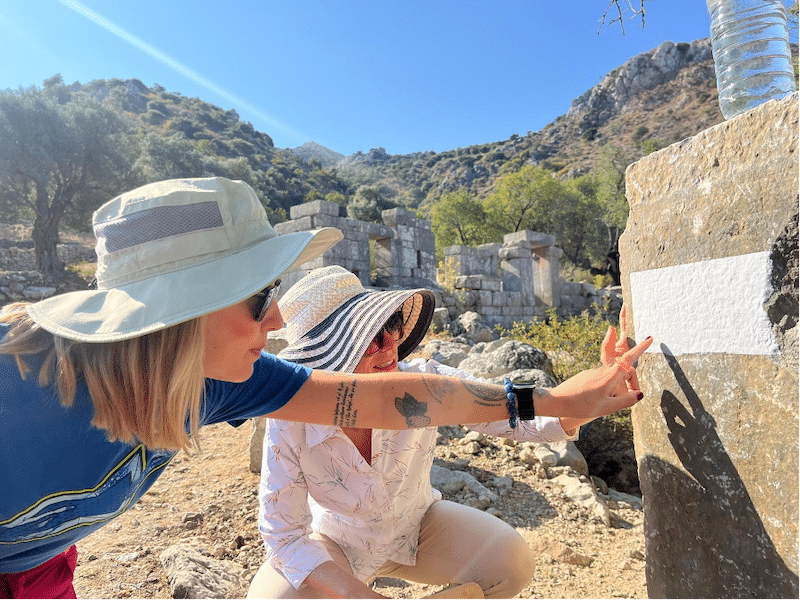
Me and my dear professor Dr. Anna Sitz during our sunday "estampage" practice in the field.

After lunch, we usually take  a pause to rest and take care of personal needs. In the late afternoon, office work begins. This is where “fieldwork” is turned into more scientific data. Out in the field we spent a lot of time around agricultural terraces and farm structures. We came across press stones, cisterns, and weight stones, which I helped measure and record with my teammates. Even small things like roof tiles or amphora bases around old farmhouses became important to document, because these small finds tell us a lot about the history of the place. Every time we found ceramics, we carefully recorded them, since pottery is one of the best ways to figure out the age of a structure.

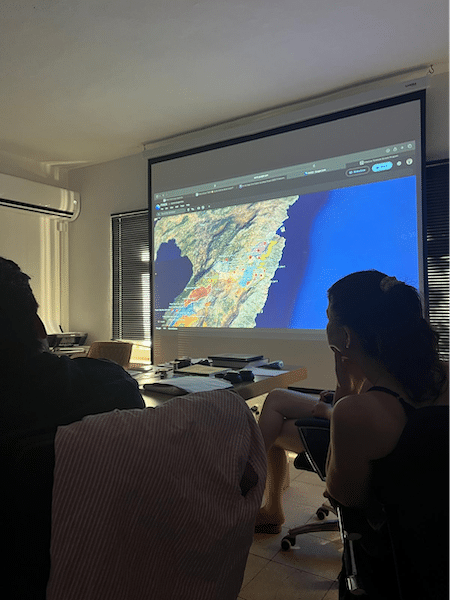
One of our daily team meetings.

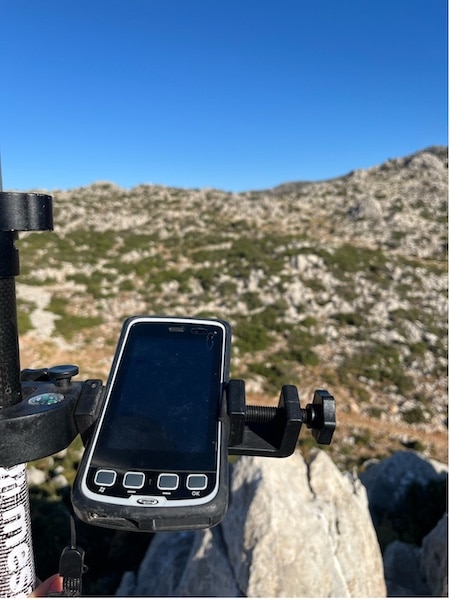
One of my main responsibilities was working with the GNSS device (the Spectra Sp60). I often walked along ancient paths and terraces to record the exact coordinates of structures and finds. At the end of the day, I would hand these over to my dear friend Bahar Cansel, who put them into QGIS so that all of our data came together in one big map. It was nice to see how the dots and lines we collected in the field turned into a detailed picture of the area.

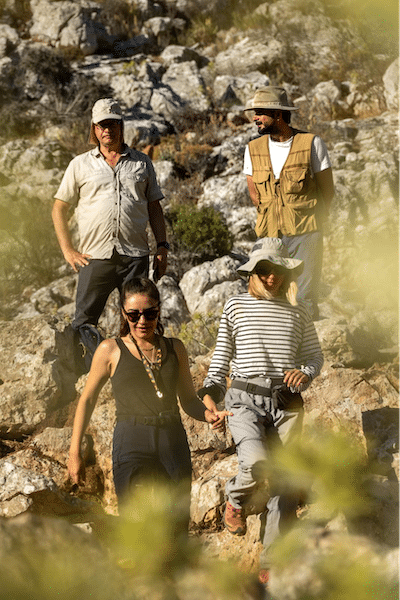
Me in the field carrying our GNSS.
Me recording GPS points during the morning survey.

Community and Camaraderie

What makes the Phoenix Project great is not only the research but also the community it creates. After office hours, we often gather in the garden. Dinners in the evening are followed by late-night conversations (sometimes it was not the best idea, since we have to wake up around 5am, oopsie!) with friends who, in just a few weeks, come to feel like family. Balancing personal space and constant teamwork on archaeological projects can be challenging. We live and work together nearly every hour of the day. but we always find a way to overcome any negativities.

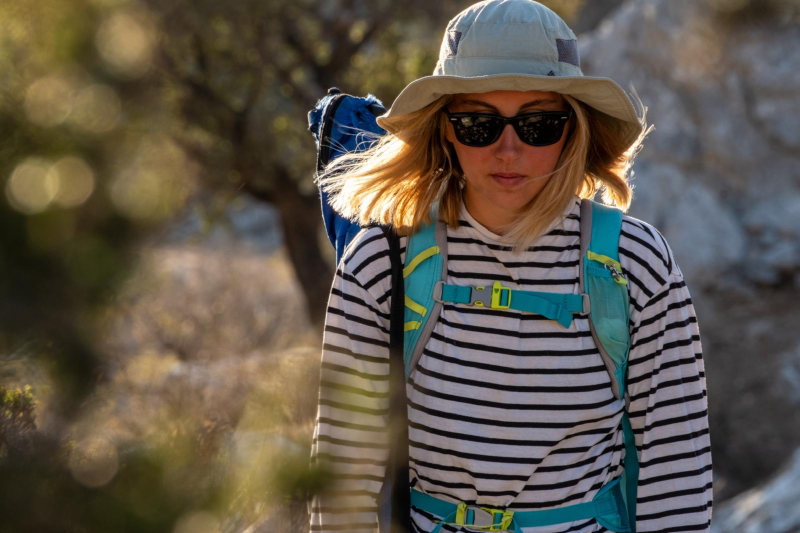
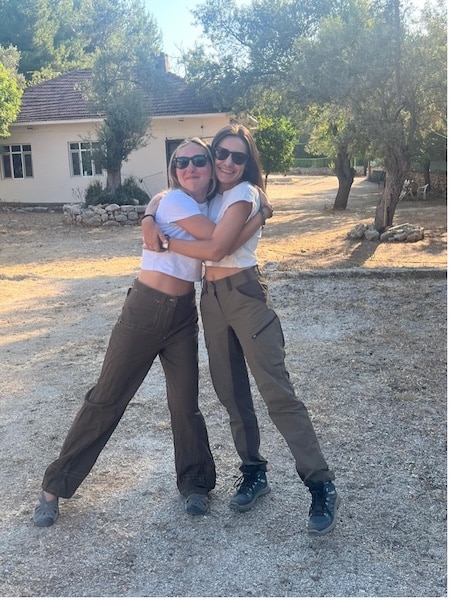
A fun coincidence: my teammate Ilayda Alikaya and I accidentally wore the same clothes on the same morning without planning it. Girlhood is everywhere.

Participating in an archaeology project can be physically demanding, but also mentally and emotionally taxing. To be honest, it is also incredibly rewarding. Every sunrise over the mountains, every small find, or architectural complexes we find, every conversation with a teammate adds to whole experience. For me, the Phoenix Project was more than a regular survey experience, it was a place where I learned academic work as well as being a team. I am so glad to continue to work with them in 2026!

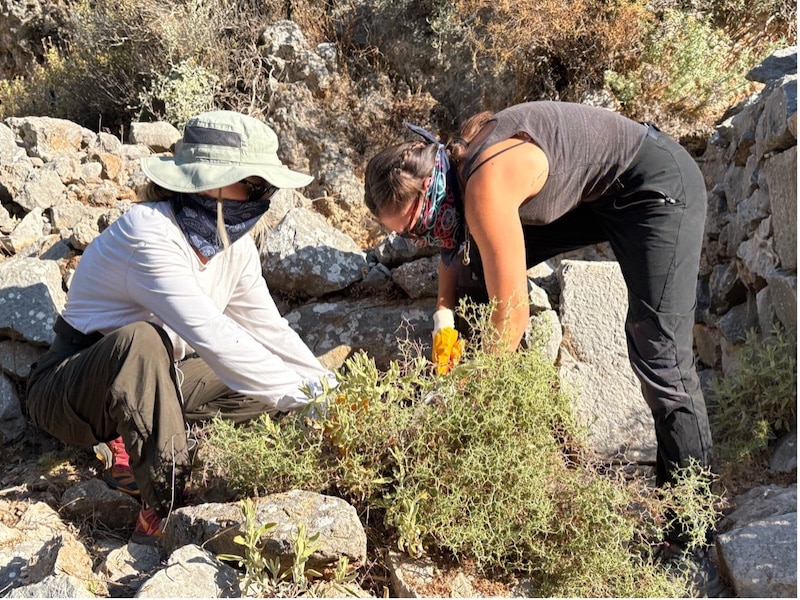
Cleaning some thorny plants to see the structure of the ancient walls and other remains.

Aleyna Uyanik is a Classical Archaeology and Philosophy student at Johannes Gutenberg University Mainz. She has worked in archaeology and museum projects in Turkey and Germany, with a focus on Greek and Roman material culture.

Phoenix Archaeological Project Website: https://www.phoenixprojesi.com/en/homepage/

Want to help more students and early career archaeologists get into the field? Donate to the cause today by selecting “Fieldwork Scholarships” as your gift purpose!
BROWSE THE NEWS ARCHIVE

  • Silent Auction at ASOR’s 125th Anniversary Celebration
  • Fieldwork Report: Aleyna Uyanik
  • FOA Webinar: Igor Kreimerman, Mike Freikman, and Rachel Hallote
  • New BASOR Editors Announced

Latest Posts from @ASORResearch

asor_research

Initiating and supporting research of the history and cultures of the Near East and wider Mediterranean world.


Andrew Rivadeneira, a 2025 Katherine Barton Platt
Andrew Rivadeneira, a 2025 Katherine Barton Platt Fellowship Recipient, joined the Brač Island Project in Croatia this summer. In his third year on the project, Andrew focused on processing archaeobotanical samples this year. Read his fieldwork report by clicking the link (https://www.asor.org/news/2025/10/fieldwork-report-rivadeneira) in our bio.
#Fieldwork #Croatia


The ASOR Program Committee (PC) is seeking 4 new m
The ASOR Program Committee (PC) is seeking 4 new members to each serve a three-year term (2026–2028) with the possibility of renewing for a second term. We are particularly interested in applications from ASOR members whose area(s) of research and expertise are complimentary to or not represented by current members of the PC. The brief application form is due by November 10: https://buff.ly/jEnXl5U


Attention all 2025 Annual Meeting presenters: whet
Attention all 2025 Annual Meeting presenters: whether you’re joining us in Boston or presenting virtually, the deadline to submit your presentation slides is Friday, November 7. Visit https://buff.ly/ImITLle for more info.


Join Friends of ASOR for our next webinar on Novem
Join Friends of ASOR for our next webinar on November 12, at 12:00pm ET: "American Archaeology Through the Lens of Albright’s Work at Tell Beit Mirsim, and Beyond". Nearly a century after W. F. Albright’s pioneering excavations at Tell Beit Mirsim helped define the chronology of the southern Levant, scholars are reexamining his legacy with new tools and perspectives. Panelists Igor Kreimerman, Michael Freikman, and Rachel Hallote will explore Albright’s influence and its lasting impact on American archaeology. Click the link (https://www.asor.org/news/2025/10/webinar-kreimerman) in our bio to register for free.


ASOR is proud to be a co-sponsor of @lasierra_cnea
ASOR is proud to be a co-sponsor of @lasierra_cnea's 17th annual Archaeology Discovery Weekend held on November 15-16, 2025. This year’s theme is “Alexander the Great & How He Changed the World” featuring guest lectures, reception, family-friendly lab activities, and more. Register online at lasierra.edu/cnea/discovery-weekend (link in bio).


Our #ObjectoftheWeek: A gold coin (solidus) of eas
Our #ObjectoftheWeek: A gold coin (solidus) of eastern Roman emperor Justinian I, holding the globus cruciger in right hand and bearing shield with horseman device on left shoulder. Dated to 537-542 CE. Source: Dumbarton Oaks/https://buff.ly/3DlUMFP
#Roman #Byzantine #Justinian #Coins


We often imagine the ancient Egyptians as obsessed
We often imagine the ancient Egyptians as obsessed with death and the afterlife. But what if the familiar story of judgment and salvation owes more to modern ideas than ancient ones? Click the link (https://anetoday.org/european-egyptian-afterlife/) in our bio to read the newest ANE Today by Rune Nyord.
#AncientEgypt #Afterlife


Make sure to join us TODAY at 12:00pm ET for our n
Make sure to join us TODAY at 12:00pm ET for our next webinar: "Alexander the Great in Jerusalem: Myth and History," presented by Dr. Ory Amitay. Register now if you haven't: https://buff.ly/ZjmU1he


You never know where in the world Near Eastern arc
You never know where in the world Near Eastern archaeology will take you! Erin Darby’s 2025 ASOR Collections Fellowship took her to Laramie, Wyoming where the American Heritage Center houses the ASOR Archives (1900-2023) at the University of Wyoming. Read her fellowship report here: https://www.asor.org/news/2025/10/collections-fellowship-darby


Remember to sign up for the free Museum Literacy W
Remember to sign up for the free Museum Literacy Workshop available to all ASOR Annual Meeting attendees led by Dr. Jen Thum at the Harvard Art Museums! The workshop will be on Wednesday, November 19 from 3:00–5:00pm. Space is limited to 18 people, advance registration is required, click the link (https://buff.ly/kuF57r9) in our bio to register.


We can’t wait to see you at ASOR’s Annual Meet
We can’t wait to see you at ASOR’s Annual Meeting in Boston this November! But have you reserved your seat at the 125th Anniversary Celebration on Saturday night? Tickets must be purchased by November 3, and seats are going fast! Register by clicking the link (https://2025-asor-125-anniversary-celebration.events.asor.org) in our bio.


Last chance to reserve a room at the Hilton Boston
Last chance to reserve a room at the Hilton Boston Park Plaza for the 2025 Annual Meeting! ASOR’s discounted block of rooms is almost full and the last day to book is Wednesday, 10/29. Book now while there is still space: https://book.passkey.com/e/50946019


Discover Tunisia’s extraordinary blend of ancien
Discover Tunisia’s extraordinary blend of ancient cities, sacred landscapes, and desert fortresses on this new Friends of ASOR journey coming Spring 2026. From Carthage to Djerba, explore millennia of history shaped by Phoenician, Roman, Islamic, and Amazigh cultures—a memorable experience for travelers who love archaeology, history, and heritage! Click the link (https://buff.ly/vgkDq9N) in our bio to learn more and reserve your spot on this captivating journey today.
#FOATours #Tunisia


A 2025 Shepard Grant funded conservation on newly
A 2025 Shepard Grant funded conservation on newly discovered Middle Bronze Age cuneiform tablets and sealings from the site of Kurd Qaburstan in the Kurdistan Region of Iraq. These unfired clay artifacts from the early second millennium BCE deteriorate rapidly and require immediate conservation in order to preserve them for study by epigraphers. The grant also funded a two-day workshop on conservation training for local museum professionals. Click the link (https://buff.ly/btMG44L) in our bio to read the full report from Tiffany Earley-Spadoni.
#Archaeology #BronzeAge #Iraq


We are glad to announce a walking tour of Boston’s "Little Syria", which thrived between the 1880s and 1950s in today’s Chinatown and South End, for ASOR Annual Meeting attendees. Led by the Boston Little Syria Project, the tour will be on Wednesday, November 19 from 3:00–5:00pm. Space is limited, and advance sign-up is required, click the link (https://buff.ly/LxbQLN5) in our bio to register.


The Ancient Near East Today is seeking new members
The Ancient Near East Today is seeking new members for its Editorial Advisory Committee. The committee supports and advises the editor of ANE Today regarding matters of content and strategy for both the main platform and the corresponding Substack Newsletter. All ASOR members are welcome to apply, and we especially encourage early-career scholars to apply. To receive full consideration, please fill out the online form by October 31, 2025: click the link (https://buff.ly/2MyvjcP) in our bio to access the form.


Happy International Archaeology Day! 🏛️📜🏺Today we celebrate the discoveries, stories, and people who bring the ancient world to life. ASOR supports research, preserving cultural heritage, and connecting people across the globe through humanity’s shared history. From excavations to digital archives, publications, and handbooks, from our Annual Meeting, webinars, and tours to community engagement, archaeology connects us all.
📸: @mozia.unipa
#InternationalArchaeologyDay #IAD2025 #ASOR #CulturalHeritage


Our #ObjectoftheWeek: A Cypriot terracotta statuet
Our #ObjectoftheWeek: A Cypriot terracotta statuette depicts a bearded charioteer driving a biga (two-horse chariot), dating to c. 6th century BCE. Source: The J. Paul Getty Museum Collection/https://www.getty.edu/art/collection/object/103SR1
#Archaeology #Cyprus


One of the famous scenes of antiquity is that of t
One of the famous scenes of antiquity is that of the visit purportedly paid by Alexander the Great to the temple of Jerusalem. But did Alexander actually visit Jerusalem? And does it matter? Read the newest ANE Today by Ory Amitay by clicking the link (https://anetoday.org/alexander-great-jerusalem/) in our bio.
#AlexandertheGreat #Jerusalem


This October, two anonymous donors have generously
This October, two anonymous donors have generously pledged $3,000 in matching gifts to support the Friends of ASOR webinar program. Every gift through Oct. 31 will be matched dollar for dollar until we reach $3,000. Be a part of ensuring our webinar program can continue to be free and available for all! Make your gift today to help ASOR meet the October Webinar Challenge (please select “Webinars” when making your gift). https://buff.ly/ppDKVDZ


Instagram

Stay updated with the latest insights, photos, and news by following us on Instagram!

Follow Us on Instagram

American Society of Overseas Research
The James F. Strange Center
209 Commerce Street
Alexandria, VA 22314

E-mail: info@asor.org

© 2025 ASOR
All rights reserved.
Images licensed under a Creative Commons Attribution-NonCommercial-ShareAlike 4.0 International License

Contact Us
Membership
Give
Friends of ASOR
ASOR Cultural Heritage Initiatives
Terms of Use
News

Please follow & like us :)
Facebook
YouTube
LinkedIn