
UNEARTHING THE PAST SINCE 1900
  • BECOME A MEMBER
  • RENEW
  • GIVE NOW
  • SEARCH
  • ONLINE PORTAL
  • American Society of Overseas Research (ASOR)American Society of Overseas Research (ASOR)
  • ABOUT
    • WELCOME FROM ASOR OFFICERS
    • HISTORY OF ASOR
    • MISSION, BYLAWS, & STRATEGIC PLAN
    • Board of Trustees
    • COMMITTEES
    • POLICIES
    • FINANCIAL DOCUMENTS
    • CONTACT US
  • CULTURAL
    HERITAGE
    • ABOUT CULTURAL HERITAGE INITIATIVES
    • UPDATES
    • TUTORIALS
    • Who We Are
  • ANNUAL
    MEETING
    • REGISTRATION
    • HOTEL RESERVATIONS
    • ANNUAL MEETING SCHEDULES
    • SPONSOR & EXHIBIT
    • ASOR Online Library
    • 125th Anniversary Celebration
    • HONORS & AWARDS
    • ANNUAL MEETING SCHOLARSHIPS
    • PAST & FUTURE ANNUAL MEETINGS
  • MEMBERSHIP
    & RESOURCES
    • INDIVIDUAL MEMBERSHIPS
    • INSTITUTIONAL MEMBERSHIPS
    • NEWS@ASOR
    • AFFILIATED PROJECTS
    • AFFILIATED RESEARCH CENTERS
    • ARCHIVES
    • PAST ASOR NEWS, MONTH BY MONTH
    • ONLINE RESOURCES
      • PHOTO COLLECTION
    • EARLY CAREER MEMBER RESOURCES
  • FELLOWSHIPS
    & GRANTS
    • SCHOLARSHIPS FOR FIELDWORK PARTICIPATION
    • GRANTS FOR ARCHAEOLOGICAL PROJECTS
    • RESEARCH FELLOWSHIPS FOR MEMBERS
    • MEMBERSHIP & ANNUAL MEETING SCHOLARSHIPS
    • ASOR-AFFILIATED RESEARCH CENTERS FELLOWSHIPS
    • OTHER FELLOWSHIP PROGRAMS
  • PUBLICATIONS
    • BOOK SERIES & MONOGRAPHS
    • BULLETIN OF ASOR
    • JOURNAL OF CUNEIFORM STUDIES
    • MAARAV
    • NEAR EASTERN ARCHAEOLOGY
    • THE ANCIENT NEAR EAST TODAY
    • News@ASOR
    • LEVANTINE CERAMICS PROJECT
  • FRIENDS
    OF ASOR
    • Webinars
    • TOURS
    • THE ANCIENT NEAR EAST TODAY
    • ASOR ONLINE LIBRARY
  • Donate
    • FY25 HONOR ROLL OF DONORS
    • LIFETIME HONOR ROLL OF DONORS
    • ASOR LEGACY CIRCLE
    • WAYS TO DONATE
Ory Amitay Webinar banner

 SHARE


NEWS@ASOR E-NEWSLETTER

ANCIENT NEAR EAST TODAY E-NEWSLETTER

PAST ASOR NEWS, MONTH BY MONTH

ASOR LEGACY CIRCLE MEMBERS

LIFETIME HONOR ROLL OF DONORS

FY25 HONOR ROLL OF DONORS

ASOR ANNUAL MEETING

FRIENDS OF ASOR WEBINARS

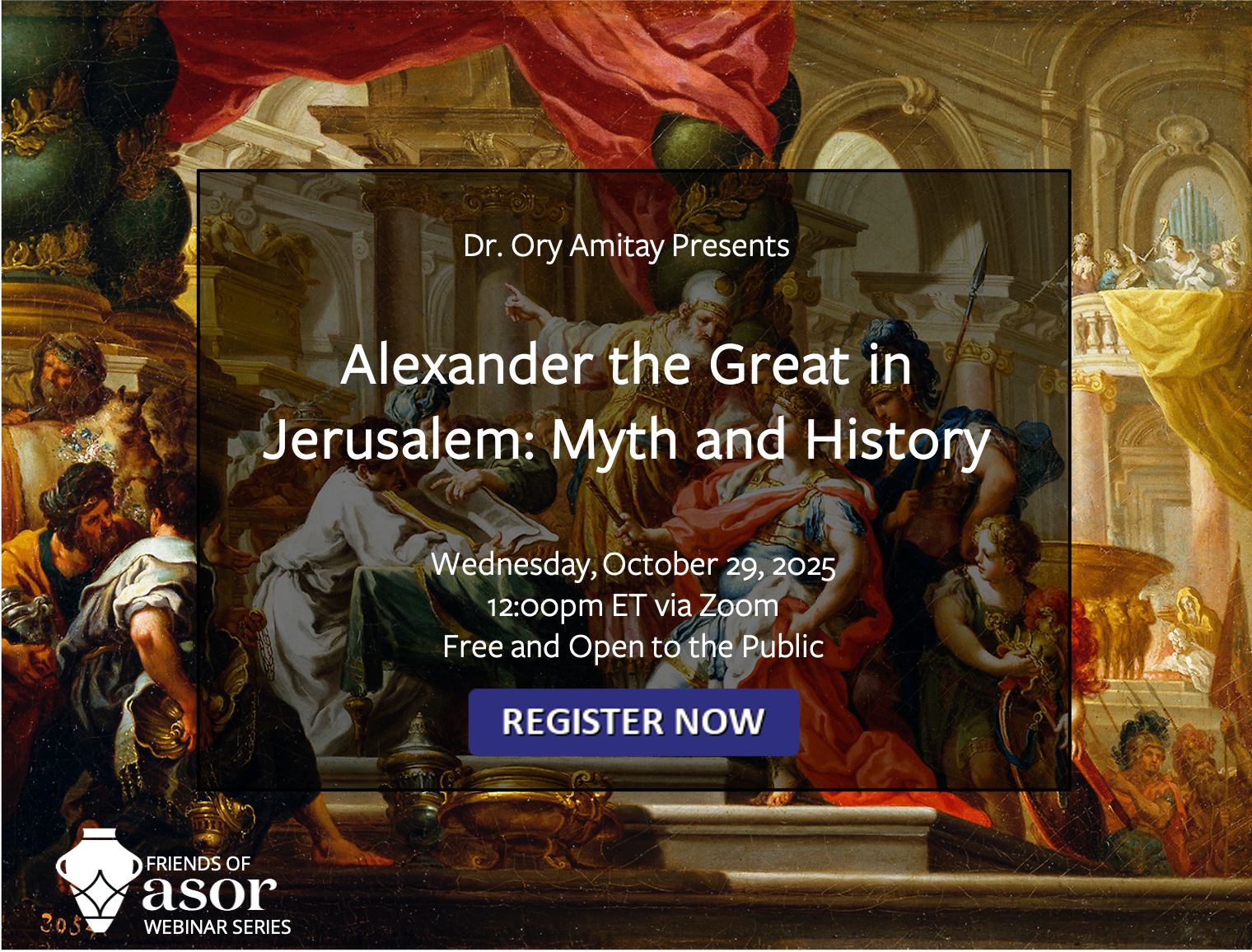
Alexander the Great in Jerusalem: Myth and History

Friends of ASOR present the next webinar of the 2025-2026 season on October 29, 2025, at 12:00 pm EDT, presented by Dr. Ory Amitay. This webinar will be free and open to the public. Registration through Zoom (with a valid email address) is required. This webinar will be recorded and all registrants will be sent a recording link in the days following the webinar.

The episode of Alexander’s visit to Jerusalem is familiar mostly through the story of Flavius Josephus. This version of the story dominates not only the public imagination but also scholarly discussion. It is generally assumed that Josephus’ story is derived from the earliest source(s) relating the story; it is consequently also the most often discussed in scholarship, mostly at the expense of any discussion of the other versions of the story. A main conclusion of Dr. Amitay’s recent book, Alexander the Great in Jerusalem: Myth and History (2025, Oxford UP), is that among the four different versions of the Alexander in Jerusalem story – which are quite different from one another – Josephus’ version is not the earliest but rather the latest, and clearly relies on two earlier versions. A second conclusion, which conforms with the consensus of previous scholarship, is that the story, in all its versions, cannot be regarded as history; it is a political myth. Therefore, rather than look in the stories for clues that might reveal some details about the history of Alexander, Dr. Amitay analyzed each of the stories for indicators that would reveal the respective contexts of their creation.

All these contexts taken together bring us to the third major conclusion, a common denominator that dominates the tradition as a whole: new stories of Alexander in Jerusalem (at least the ones that reached us) were born as a result of a major change in the relationship between the people of Judea and their foreign rulers. These major changes include the Seleukid takeover of the southern Levant, the first arrival of Roman arms in Judea, the abolishment of Judean kingship and the institution of provincia Judaea, and the rearrangement of Judea as an independent province after the destruction of the temple. Given the continued status of Judea as a province of some empire or other during the second temple period (Hasmonean period excluded), and the suddenness and totality of the change brought about by Alexander, it is small wonder that his arrival in Jerusalem became the subject of political myths dealing with major shifts in the relationship of Judea with its foreign rulers.

For the last twenty odd years, Ory Amitay has been teaching and conducting research in the University of Haifa. His research is situated at the intersection of two crossroads: one between myth and history, the other between various peoples of the ancient west. The topic of his new book, and of this lecture, is a clear example. Amitay’s main research strategy in analyzing historical (or rather pseudo-historical) myths is locating the obvious false factoids – parts of the story that are in blatant contradiction to known historical facts – and interpreting them not as the products of carelessness or ignorance, but rather as intentional fabrications. As such, they have both a context, where they make sense historically, and an agenda. The underlying assumption is that false factoids are fabricated with a purpose in mind. The goal is to identify both context and agenda.

In terms of teaching, Amitay has taught courses on the Hellenistic world; Archaic Rome; Imperial Rome; Athenian Democracy and Empire; Hellenistic History; Second Temple Judaism; Myth and History; and is the author of an online course called The Ancient West, treating the area from eastern Iran to the Atlantic, from the Neolithic Revolution to the age before the rise of Islam. He has also led field coursework in Rome and Athens.

SUPPORT THE WEBINAR PROGRAM!

Friends of ASOR is pleased to announce that the first webinars of the 2025-2026 season will once again be free and open to the public with a goal to raise $10,000 so that the entire webinar season will be free. Will you support this outreach effort with a tax-deductible contribution? All donors/sponsors with gifts of $100 or more will be recognized in subsequent webinars. This October, two anonymous donors have generously pledged $3,000 in matching gifts to support the webinars. That means for every gift you make between now and October 31st, these generous donors will match your gift one-to-one until we hit $3,000. Make your gift today and select “webinars” from the dropdown menu.

Designate your gift for “Webinars” in the drop-down menu.

BROWSE THE NEWS ARCHIVE

  • Call for Early Career Scholars Social Media Content Creator
  • Honors and Awards Committee Seeks New Members
  • FOA Webinar: Amanda Hope Haley
  • Fieldwork Report: Yishu Deng

Latest Posts from @ASORResearch

asor_research

Initiating and supporting research of the history and cultures of the Near East and wider Mediterranean world.


Register for the next FOA webinar on January 7, 20
Register for the next FOA webinar on January 7, 2026, at 7:00 pm ET, presented by Amanda Hope Haley: "Beyond Edutainment: Reclaiming Archaeology in a Clickbait World". This webinar will be free and open to the public. Register here: https://www.asor.org/news/2025/12/webinar-haley


Heritage protection is a fundamental part of the w
Heritage protection is a fundamental part of the work of ASOR’s Cultural Heritage Initiatives. To help fight the illicit antiquities trade in Lebanon and Syria, ASOR hosted an Antiquities Trafficking Documentation workshop in Beirut, Lebanon on December 8-12, 2025, with the generous support of the U.S. Embassy in Beirut @USEmbassyBeirut. 

The workshop brought together representatives of the American, Lebanese, and Syrian governments to discuss current conditions and challenges in Lebanon and Syria, local priorities, and ways for all participants to work together to achieve them. Read more by clicking the link (https://buff.ly/lB5EEHO) in our bio.

Photo credits: U.S. Embassy Beirut and ASOR


Check out the November issue of BASOR 394, featuri
Check out the November issue of BASOR 394, featuring articles such as: Boulos el-ʿAraj: A Palestinian Quaker Archaeologist of the British Mandate Era (1926–1936); Unveiling the Obscure: Exploring the Function and Meaning of Levantine Shrine Models through an Ethnoarchaeological Lens; Paleoenvironment and Fruit Tree Horticulture at Early Bronze Age Tel Bet Yerah: Evidence from Charcoal Remains; and more. Read the Table of Contents by clicking the link (https://www.asor.org/news/2025/12/basor394-toc/) in our bio.


ASOR is pleased to share information from Overseas
ASOR is pleased to share information from Overseas Institute @caari_cyprus. The CAARI-HFF fellowship offers one grant of £2000 to a graduate student of any nationality, with a preference given to scholars from Egypt, Cyprus, Lebanon, and Syria. The purpose of the time at CAARI must be to conduct research on a project relevant to the maritime archaeology or maritime heritage of Cyprus. Applications are due 12 January 2026. Read more by clicking the link (https://honorfrostfoundation.org/2025/11/24/caari-hff-graduate-fellowship/) in our bio.


Kearyn Hall, a Harva L. Sheeler Fieldwork Scholars
Kearyn Hall, a Harva L. Sheeler Fieldwork Scholarship Recipient, joined the Humayma Excavation Project in Jordan in 2025. Kearyn's experience at Humayma strengthened her interest in bioarchaeology while highlighting the urgent challenges of protecting heritage in looted landscapes. Read more by clicking the link (https://www.asor.org/news/2025/12/fieldwork-report-hall) in our bio.
#Archaeology #Fieldwork #Jordan


ASOR invites applications from members to fill Ses
ASOR invites applications from members to fill Session Chair openings for several ASOR Standing Sessions. Session Chairs volunteer to serve one term (three years, 2026-2028) with the possibility of renewing for a second term. Applications may be submitted by one person or by co-applicants and are due by December 22, 2025. The application can be found by clicking the link (https://buff.ly/Bv5lLOf) in our bio.


Tune in for TONIGHT's FOA webinar, "What is a God?
Tune in for TONIGHT's FOA webinar, "What is a God? The Bible and the Ancient Near East," presented by Michael Hundley at 7:00 PM ET. You can still register for the free Zoom webinar here: https://buff.ly/lPi80Uq


ASOR is proud to announce the signing of a Memoran
ASOR is proud to announce the signing of a Memorandum of Understanding (MOU) with the Libyan Department of Antiquities, formalizing years of collaboration to protect and preserve Libya’s rich cultural heritage.

The agreement builds on long-standing cooperation and advances shared goals, including professional training, site conservation, youth engagement, and efforts to address illicit trafficking of cultural property. Signed during the U.S.–Libya Cultural Heritage Protection Workshop in Tunis, the MOU reinforces our shared commitment to safeguarding heritage sites—including ongoing work at Cyrene, a UNESCO World Heritage Site.

See the link (https://buff.ly/voCGZVk) in our bio to read more.

#CulturalHeritage #Libya #Archaeology


In 2025 with the support of ASOR and a Dana Grant,
In 2025 with the support of ASOR and a Dana Grant, the Erbil Plain Archaeological Survey focused on expanding and completing the image database that underpins EPAS’s ceramic typology. Read more about the project here: https://www.asor.org/news/2025/12/dana-grant-report-erbil-plain


The 2025 ASOR Annual Meeting took place November 1
The 2025 ASOR Annual Meeting took place November 19–22 at the Hilton Boston Park Plaza and online. More than 1,100 people registered for the hybrid meeting with approximately 950 attending in Boston. The academic program included more than 600 presentations with presenters representing over 30 countries. For a summary of the meeting and photo highlights, read more here: https://www.asor.org/news/2025/12/am-recap-2025


Our #ObjectoftheWeek: Limestone statuette of a tem
Our #ObjectoftheWeek: Limestone statuette of a temple boy, from Cyprus. 4th century BCE. Metropolitan Museum of Art, 74.51.2767. Public Domain (https://www.metmuseum.org/art/collection/search/242318).
#Cyprus #Statues


Read the Top Archaeological Discoveries of 2025 in
Read the Top Archaeological Discoveries of 2025 in the newest ANE Today!

Our editor, Jessica Nitschke, curates standout discoveries from across the Middle East, North Africa, and Mediterranean—from buried inscriptions to submerged landscapes and everything in between.

Is your favorite excavation or announcement missing?
Drop it below! 👇

#ANEToday #ArchaeologyMag #MiddleEastArchaeology #MediterraneanHistory #Discoveries2025 
📸 T-pillar carved with human face, Karahantepe, Turkey. Photo credit: Turkish Ministry of Culture and Tourism


ASOR seeks candidates for part-time internship pos
ASOR seeks candidates for part-time internship positions to begin in mid-January. These paid internships are for the spring semester (January-May) with the possibility of renewal for the summer and/or fall semester. Interns are expected to work 10–15 hours per week at ASOR’s headquarters in Alexandria, VA. Hours and schedule are flexible depending on school or other commitments. Read more here: https://www.asor.org/news/2025/12/spring-internships


Friends of ASOR is pleased to share information on
Friends of ASOR is pleased to share information on BAF & BASONOVA lectures. On Wednesday, December 10 at 8pm ET via Zoom, Michael Cosmopoulos (University of Missouri at St. Louis) will present "Myths, Monument, and Memory: Archaeology and the Creation of the Iliad and the Odyssey". This lecture examines how the physical remnants of the past, ruins, monuments, and long-lived “places of memory”, shaped the creation of the Homeric epics. Register here: https://buff.ly/qC5Y1GA


Don't miss the next FOA webinar, "What is a God? T
Don't miss the next FOA webinar, "What is a God? The Bible and the Ancient Near East," presented by Michael Hundley on Wednesday, December 17th at 7:00 PM ET. This webinar will be free and open to the public. Registration through Zoom with an email address is required. Click the link (https://asor-org.zoom.us/webinar/register/WN_PhCmXIYvSuyTijMVm5bYsw#/registration) in our bio to register.


During the summer, Aleyna Uyanik joined the Phoeni
During the summer, Aleyna Uyanik joined the Phoenix Archaeological Project to conduct fieldwork in southwestern Turkey. Aleyna, a classical archaeology and philosophy student at Johannes Gutenberg University Mainz, reports on day-to-day life in the field, conducting surveys, and the bonds formed during fieldwork. Read Aleyna's report here: https://www.asor.org/news/2025/10/fieldwork-report-uyanik

Photo credits: Ayse Ozaydin @peepingtom


Deadline is Dec. 5: The ASOR Program Committee (PC
Deadline is Dec. 5: The ASOR Program Committee (PC) is seeking 4 new members to each serve a three-year term (2026–2028) with the possibility of renewing for a second term. We are particularly interested in applications from ASOR members whose area(s) of research and expertise are complementary to or not represented by current members of the PC. The brief application form is due by 12:00 pm ET on December 5: https://buff.ly/3QvqGwd


When you give to ASOR this Giving Tuesday, you’re
When you give to ASOR this Giving Tuesday, you’re investing directly in the next generation of archaeologists and scholars.
Your support funds fellowships, mentoring, training, and opportunities that open doors for early-career researchers.
Thank you for helping us shape the future of the field and protect the study of the ancient world.
💙 Be part of the impact. #GivingTuesday #ASOR #SupportArchaeology 
https://members.asor.org/fundraising/give


Our #ObjectoftheWeek: Two-headed statue from Ain G
Our #ObjectoftheWeek: Two-headed statue from Ain Ghazal, on the outskirts of Amman, Jordan. Pre-pottery Neolithic period B, ca. 6500 BCE. On display at the Jordan Archaeological Museum. Source: Osama Shukir Muhammed Asmin FRCP(Glasg), CC By-SA 4.0/https://w.wiki/GJBC
#Jordan #Statues #Neolithic


Long before coal or oil, fire depended on whatever
Long before coal or oil, fire depended on whatever you could gather. In the ancient Near East, animal dung was essential fuel. What cultural, political, and legal rules governed its acquisition and use? Read the newest ANE Today by clicking the link (https://anetoday.org/animal-dung-energy/) in our bio.
#Mesopotamia


Instagram

Stay updated with the latest insights, photos, and news by following us on Instagram!

Follow Us on Instagram

American Society of Overseas Research
The James F. Strange Center
209 Commerce Street
Alexandria, VA 22314

E-mail: info@asor.org

© 2025 ASOR
All rights reserved.
Images licensed under a Creative Commons Attribution-NonCommercial-ShareAlike 4.0 International License

Contact Us
Membership
Give
Friends of ASOR
ASOR Cultural Heritage Initiatives
Terms of Use
News

Please follow & like us :)
Facebook
YouTube
LinkedIn