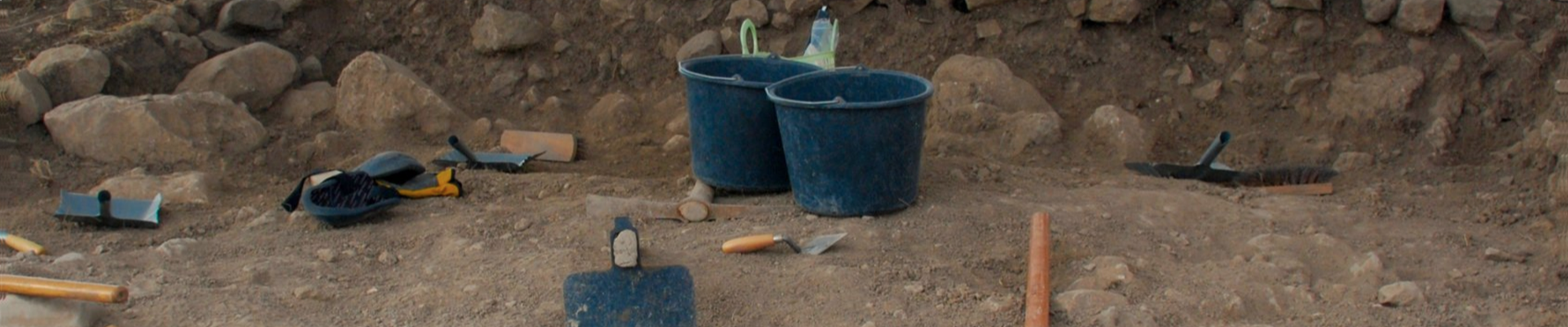
The generosity of Carol and Eric Meyers allowed me to return to Huqoq, Israel for a second season in the summer of 2018. My first season as a field school student in 2017 introduced me to the methods, specialties, and processes of what happens on an archaeological dig. Every day except Saturday we would wake up at 4AM, walk to the site, and begin digging at 5AM all the students would take turns providing a lavish mid-morning field breakfast to the team, then continue working. I became acquainted with archaeological terms that would help me in the excavations, such as: stratigraphy, balk, potsherd, sandbag and bucket chain. On Saturdays we would take trips to archaeological sites in the area, and this year we took a few extra days to journey to Petra. The welcoming environment and exciting nature of the site itself, workers and staff, and overall experience made it a very easy place to want to return.
The site of Huqoq sits in the northern region of the Galilee  about three miles from the sea’s edge, where there was a modern Ottoman village called Yakuk. Occupied during the Hellenistic, Early Roman, Abbasid, Fatimid, and Mamluk periods, the area reached the height of its prosperity in the Late Roman and Byzantine periods. In 2011, excavations began at Huqoq to carefully excavate through the later occupation periods to reach the ancient village and define the chronology of its synagogue, which since 2012 has received much attention due to the very unique images uncovered on its mosaic floor. However, the mosaics are not the only focus of the project. Much of the ongoing excavation is working through the modern era down into the period of the ancient synagogue’s construction.
I returned for the 2018 season working in the same square  in which I had worked the previous season – area 3000 SW. This area is south of the ancient synagogue, where I continued excavating through the remains of the modern village and the periods of occupation preceding it. After cleaning the area of the accumulation from the past year, the defining features of the area were well visible. The area was defined by collapse and ash pits with bits of plastered floors and partition walls peeking out sporadically. Evidence from previous years’ excavations pulled out many pieces of tabun installations across the ash filled area. My square in particular, however, did not have well defined ash pits, but rather very patchy remnants of a layering of plaster floors. The collapse of the structures above the surface in this area effectively destroyed most of the top layer of the plaster, and the limestone in the soil made it hard to tell whether it was plaster, stone, or something in between. Removal of this first surface showed another layer of patchy plaster that seemed to have no discernible area, then another, then another. Identifying, tracing, and clarifying the spans of plaster was a very time consuming process- at some points incredibly frustrating. Ultimately, the multiple layers of plaster here and the pottery recovered in association with them provided us with data for the sub-phasing of the occupation in this period, and although occasionally grueling, this area taught me much about analyzing stratigraphy and seeing the relations among elements visible in the soil.
Under these first few centimeters excavated, we soon came  down on a layer of loose fill, which continued down in almost the entire square for nearly a meter. It seemed as if the fill would never end, as the excavation of this feature of the square took nearly two weeks. Within the fill, pieces of tabun similar to the ones found throughout the area were present, as well as other datable material to provide this construction with a good date range. Bordering this region of fill in the square a large rim peaked out almost completely in-tact, beneath what was before a collection of very large collapse. We had no idea what it was; some people speculated that it was a cistern, others an in-tact tabun. Within the fill a few centimeters away from this rim, fist sized stones were the most common sized stones, however there were several rather large stones in line that appeared as we reached the bottom of the fill on its western edge. Once the fill was completely taken away, these large stones continued, and quickly we found a line of ashlar stones that revealed a very surprising find hidden inside! Wedged between two rows of blocks- and surrounded by a ring of fist sized stones, the unidentified rim turned out to be a large storage vessel. The most fascinating aspect of this vessel was not the quality of the find itself but rather its very intentional and peculiar context. The vessel was wedged so tightly into this niche that I had to use a ladle and a set of tablespoons and teaspoons to excavate it. This vessel is a true mystery at this point, because areas surrounding it seem to have not been in any interaction with the vessel.
This particular find prompted questions and inquiries that led  me to join an excavation in the first place: what is this? why is it here? who put it here? More importantly, what can this tell us of the inhabitants and how they lived and interacted with their environment? This shows just how fascinating and puzzling an excavation can be and how accurate and precise documentation are necessary for the preservation of history and culture. Again, it would not be possible for me to have this experience without the generosity of Carol and Eric Meyers and their wish to allow students to see first-hand what an excavation is.
John Huggins is in his final year of undergraduate study at Austin College in Sherman, Texas. He is a Classics major. Currently, he is applying for master’s and PhD programs for Classical Archaeology.
Want to help more students and young archaeologists like John get into the field? Donate to the cause today by selecting “Excavation Scholarships” as your gift purpose!