UNEARTHING THE PAST SINCE 1900
  • BECOME A MEMBER
  • RENEW
  • GIVE NOW
  • SEARCH
  • ONLINE PORTAL
  • American Society of Overseas Research (ASOR)American Society of Overseas Research (ASOR)
  • ABOUT
    • WELCOME FROM ASOR OFFICERS
    • HISTORY OF ASOR
    • MISSION, BYLAWS, & STRATEGIC PLAN
    • Board of Trustees
    • COMMITTEES
    • POLICIES
    • FINANCIAL DOCUMENTS
    • CONTACT US
  • CULTURAL
    HERITAGE
    • ABOUT CULTURAL HERITAGE INITIATIVES
    • UPDATES
    • TUTORIALS
    • Who We Are
  • ANNUAL
    MEETING
    • REGISTRATION
    • HOTEL RESERVATIONS
    • ANNUAL MEETING SCHEDULES
    • SPONSOR & EXHIBIT
    • ASOR Online Library
    • 125th Anniversary Celebration
    • HONORS & AWARDS
    • ANNUAL MEETING SCHOLARSHIPS
    • PAST & FUTURE ANNUAL MEETINGS
  • MEMBERSHIP
    & RESOURCES
    • INDIVIDUAL MEMBERSHIPS
    • INSTITUTIONAL MEMBERSHIPS
    • NEWS@ASOR
    • AFFILIATED PROJECTS
    • AFFILIATED RESEARCH CENTERS
    • ARCHIVES
    • PAST ASOR NEWS, MONTH BY MONTH
    • ONLINE RESOURCES
      • PHOTO COLLECTION
    • EARLY CAREER MEMBER RESOURCES
  • FELLOWSHIPS
    & GRANTS
    • SCHOLARSHIPS FOR FIELDWORK PARTICIPATION
    • GRANTS FOR ARCHAEOLOGICAL PROJECTS
    • RESEARCH FELLOWSHIPS FOR MEMBERS
    • MEMBERSHIP & ANNUAL MEETING SCHOLARSHIPS
    • ASOR-AFFILIATED RESEARCH CENTERS FELLOWSHIPS
    • OTHER FELLOWSHIP PROGRAMS
  • PUBLICATIONS
    • BOOK SERIES & MONOGRAPHS
    • BULLETIN OF ASOR
    • JOURNAL OF CUNEIFORM STUDIES
    • MAARAV
    • NEAR EASTERN ARCHAEOLOGY
    • THE ANCIENT NEAR EAST TODAY
    • News@ASOR
    • LEVANTINE CERAMICS PROJECT
  • FRIENDS
    OF ASOR
    • Webinars
    • TOURS
    • THE ANCIENT NEAR EAST TODAY
    • ASOR ONLINE LIBRARY
  • Donate
    • FY25 HONOR ROLL OF DONORS
    • LIFETIME HONOR ROLL OF DONORS
    • ASOR LEGACY CIRCLE
    • WAYS TO DONATE

 SHARE


NEWS@ASOR E-NEWSLETTER

ANCIENT NEAR EAST TODAY E-NEWSLETTER

PAST ASOR NEWS, MONTH BY MONTH

ASOR LEGACY CIRCLE MEMBERS

LIFETIME HONOR ROLL OF DONORS

FY25 HONOR ROLL OF DONORS

ASOR ANNUAL MEETING

2025 Harris Grant Report: Documenting Archival Dynamics in the Late Bronze Age: A New Archive of Cuneiform Tablets from Alalakh/Tell Atchana

Jacob Lauinger, Johns Hopkins University; Zeynep Türker, Johns Hopkins University; Murat Akar, Hatay Mustafa Kemal Üniversitesi[1]

This past summer, with the generous support of a Charles Harris Project Grant, a team of PhD students in the Departments of Near Eastern Studies and History of Art at Johns Hopkins University joined the ASOR affiliated Turkish Ministry of Culture & Tourism and Mustafa Kemal University excavations at Tell Atchana, ancient Alalakh, in Hatay, Türkiye, which are under the direction of Murat Akar, to investigate one of the most promising discoveries made at the site in recent years: the possible remains of a Late Bronze Age archive of cuneiform tablets. What made this group of excavators distinctive was that each student had been trained not only in archaeology but also in reading Akkadian cuneiform, bringing together the two areas of expertise needed to recover and document such an archive with exceptional care.

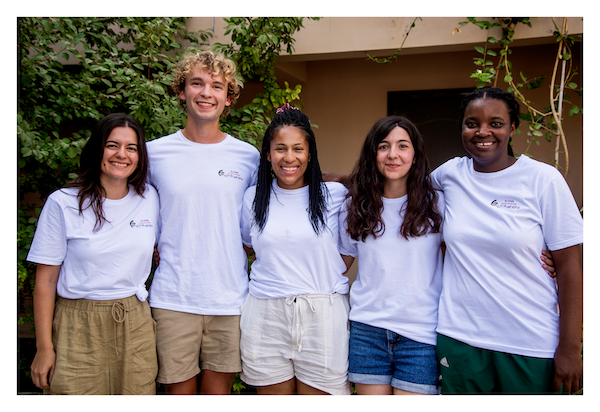
Figure 1: Johns Hopkins PhD students (left to right): Defne Bilgili; Kyle Dillon; Lauren Cook; Zeynep Türker; and Faith Myrick.

Background to the Project

Following the devastating 2023 earthquakes, over the past three years the excavation team has focused on restoring the iconic Bronze Age monuments originally excavated by Sir Leonard Woolley in the 1930s and 1940s. Further restoration efforts have included the stabilization of sections of the Area 1 squares excavated between 2003 and 2016, adjacent to the Level IV Palace and the Administrative Castle Complex. This large-scale restoration program, partially funded by the ASOR Shepard Urgent Action Grant in 2023, has also led to new discoveries at the site.

In particular, four cuneiform tablets were discovered during cleaning and stabilization operations conducted in the southern section of Sq. 32.54 in the 2024 season. One of the team’s experienced field supervisors, Baran Kerim Ecer, spotted the tablets within an extremely burnt deposit sealed by the succeeding building phase known as the Hittite Fortress. To test the possibility that additional texts may have survived, the 2025 excavation season was planned to include work in Sq. 32.64 (south of Sq. 32.54), which had previously been explored only on a limited scale.

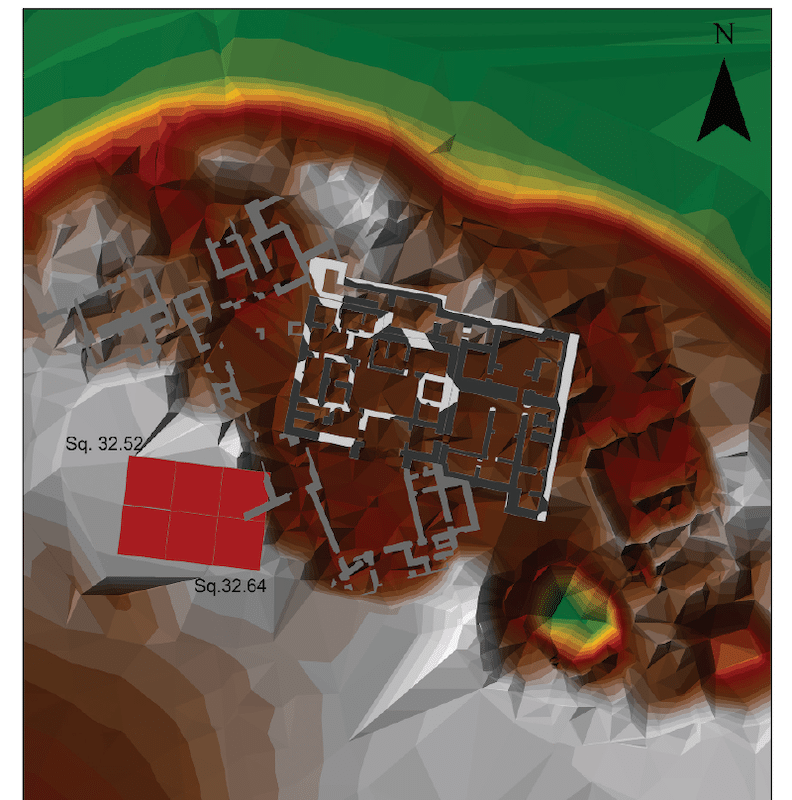
Accordingly, project excavation’s staff epigraphers, Jacob Lauinger and Zeynep Türker, applied to ASOR for a Charles Harris Project Grant. The funds provided by the Turkish Ministry of Culture and Tourism and ASOR enabled the excavation team to carry out 16 weeks (!) of intensive fieldwork. The targeted burnt deposit was sealed beneath the massive mudbrick foundations of the Hittite Fortress, previously explored in the adjacent squares and published as part of the Alalakh Excavations second monograph (Figure 2).

Figure 2: The location of Sq.32.64 in relation to Level IV Palace and the Administrative Castle Complex.

Excavations in Sq. 32.64

Excavations began in May, and the first eight weeks were devoted solely to understanding the architectural layout and the stratigraphic relationship between the Level II–III Hittite Fortress and the burnt deposit (Level IV) beneath it. This initial phase of work was conducted by Arman Alp, an MKU graduate student trained at Tell Atchana. The team of PhD students from Johns Hopkins arrived at the Tell Atchana Excavations and Amuq Valley Reseach Center in July to begin the excavation of the Level IV burnt deposit. The square was under the supervision of Zeynep Türker and Lauren Cook, both of whom had previously gained field experience at Tell Atchana and were familiar with the site’s stratigraphy thanks to ASOR’s travel grant program for PhD students.

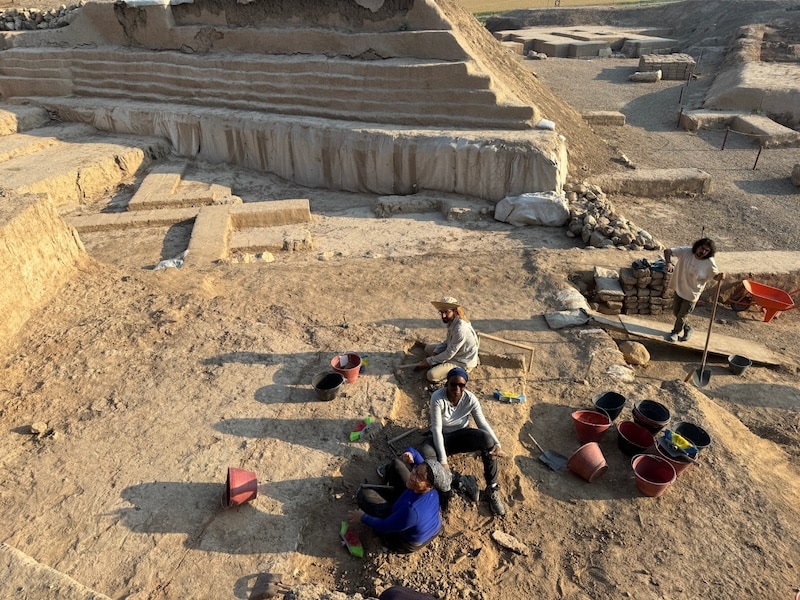
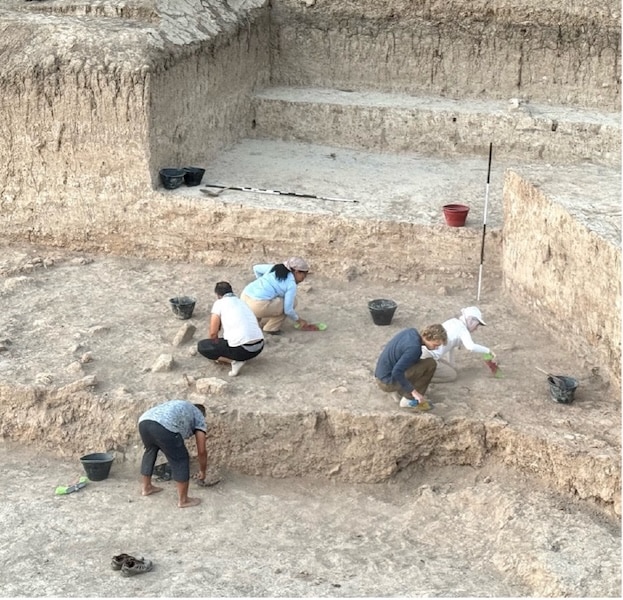
Once the Hittite Fortress level had been fully explored within the boundaries of the square, an area measuring 7 × 5 meters in the northern half was initially leveled down to reach the burnt deposit. Following the removal of the fortress foundations, and contrary to the typical practice in Near Eastern archaeology, the project adopted a “Do-It-Yourself” policy. Only a skilled and experienced team of archaeologists, assisted by archaeology students, worked in the trench due to the extremely delicate nature of the context (Figs 3-6). The excavations almost immediately confirmed our initial assessments: more than a dozen tablets and fragments were recovered from this relatively small exposure, along with seal impressions and sealing materials (Fig 7).

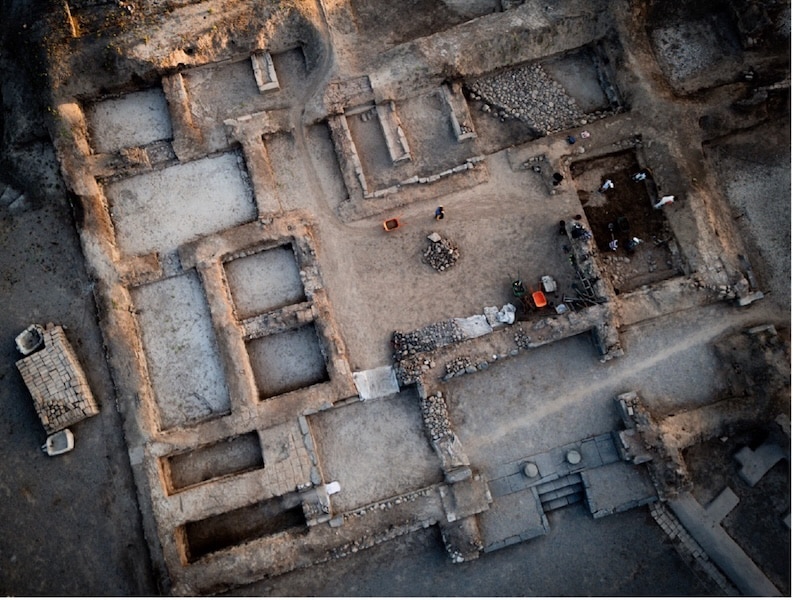
Many of the tablets were discovered in the burnt destruction layer containing collapsed mudbricks, large carbon deposits, and dense concentrations of pottery, as well as ornaments made of gold and faience. The burnt deposit partially exposed on the northern section of Sq.32.64 is understood to be very thick and due to delicate and slow excavation methodology applied, the associated floor levels has not been reached yet. Therefore, it was decided to explore this level to the full extent of the square in order to better understand the architectural layout and the contextual distribution of the finds. At present, excavations are still ongoing at the site, carried out by the core members of the Alalakh excavation team, with the aim of removing the remaining portions of the Hittite Fortress, preparing the area for continued exploration that will further investigate the burnt level beneath, in 2026 (Fig. 8).

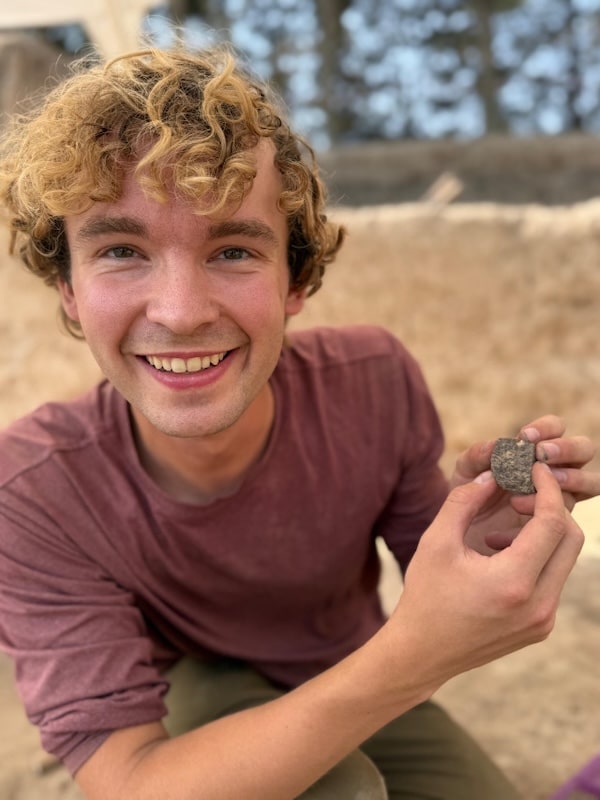
Figure 3: Kyle Dillon holding a cuneiform tablet that he discovered.
Figure 4: Lauren Cook. Faith Myrick, Arman Alp, and Baran Kerim Ecer excavating in Sq. 32.64 in which the cuneiform tablets were found.
Figure 5: Lauren Cook, Kathrine Shields, Kyle Dillon, Abdullah Öz, and Haluk Ergil cleaning in Sq. 32.64.
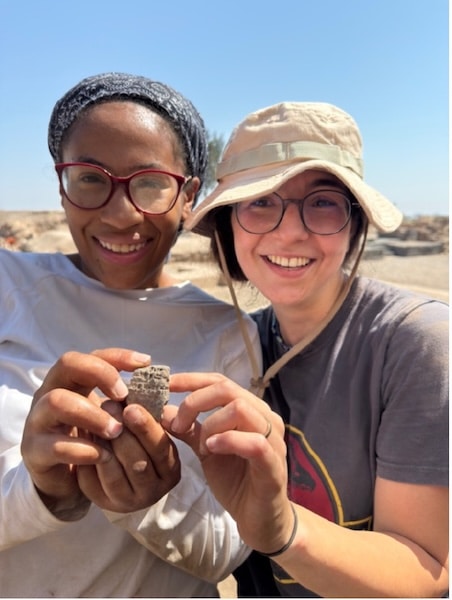
Figure 6: Lauren Cook and Zeynep Türker, holding a cuneiform tablet that they discovered.
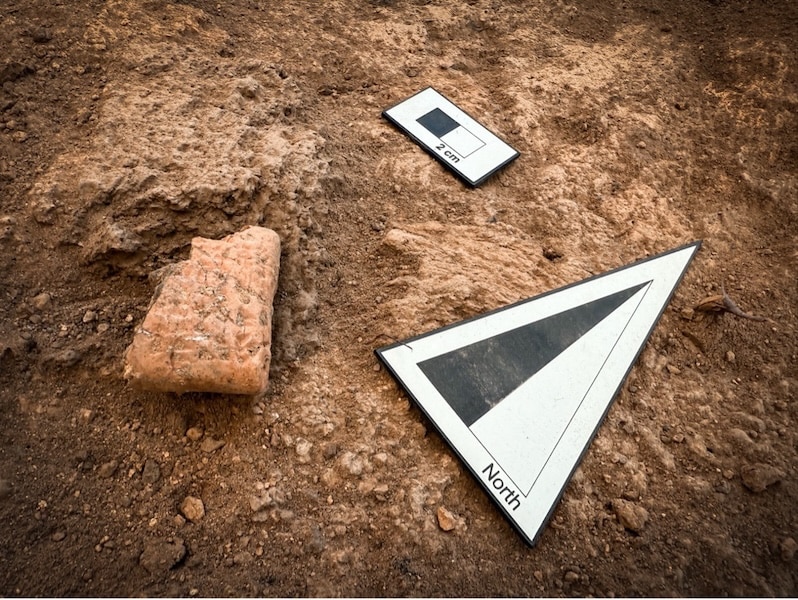
Figure 7: A tablet fragment photographed in situ.
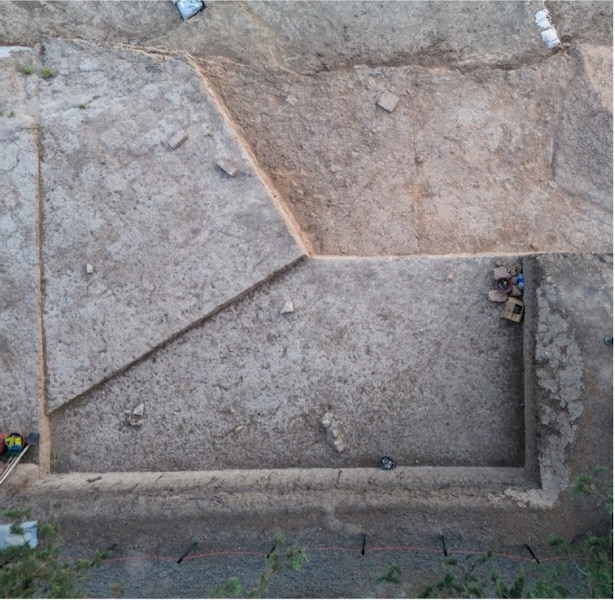
Figure 8: Aerial view of Sq. 32.64 with the Hittite Fortress above (Level II-III) and the exposed burnt deposit below (Level IV) where tablets were revealed.

Most of Alalakh’s tablets were excavated in the 1930s and 1940s, often with limited documentation of their archaeological context. The discovery of this new archive provides a rare opportunity to examine such material in situ. Each tablet was photographed and recorded with a total station to document their spatial distribution in a three-dimensional context. The associated organic materials were collected for radiocarbon analysis, and soil samples were carefully taken to preserve contextual information for future study. All excavated soil was sifted, allowing the recovery of additional seal impressions and tablet fragments smaller than a thumbnail, demonstrating the necessity of employing a meticulous excavation strategy. The finds were then carefully transferred to the Tell Atchana Excavations and the Amuq Valley Research Center. In close cooperation with Jacob Lauinger and Zeynep Türker, the cleaning and conservation of the tablets were carried out by Hatice Nur Aydın, a highly skilled conservator who has specialized in tablet restoration due to the large number of tablets recovered at the site over the past three years (Fig 9). This process was followed by high-resolution photographic documentation prior to in-depth epigraphic study.

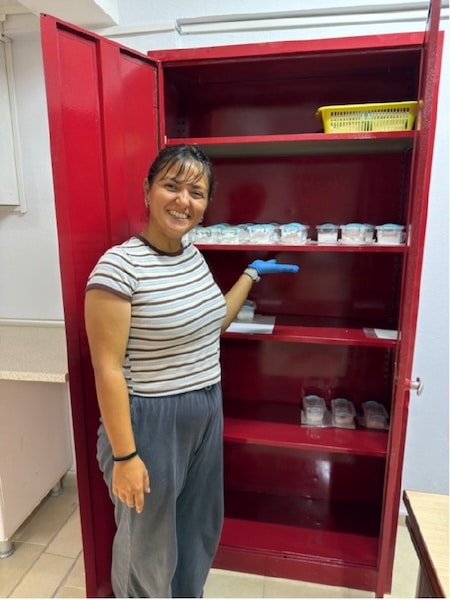
Figure 9: The red cabinet of curiosity at Tell Atchana Excavations laboratory where newly found tablets are stored prior to their allocation to the Hatay Archaeological Musuem.

Re-Excavating the Level IV Palace

While the Sq. 32.64 team focused on exploring this previously untouched area of the Royal Precinct of Alalakh, another team concentrated their efforts on re-excavating the Level IV Palace. Many of the rooms had been filled with decayed mudbrick following the original excavations of the monument in the 1930s, while others contained backfill from Woolley’s excavation dumps. This line of work has also led to exciting new discoveries, including additional tablets from the palace that are contemporary with those from Sq. 32.64. Together, these finds provide new perspectives on Woolley’s legacy excavations at Tell Atchana and the associated archival data (Fig 10).

Figure 10: Re-excavation and restoration of the Level IV Palace which revealed new epigraphic data.

Conclusion

Although further excavation will be necessary to confirm the architectural layout and extent of the deposit and further conservation and study of the cuneiform tablets is required to fully grasp the nature of their documentation and to integrate them with other cuneiform tablets from both the site and the larger region, this new archive promises to add valuable new data to our understanding of Alalakh and its Late Bronze Age society.

Preliminary assessment of the content of the tablets suggests that most of them are administrative in nature (although two are legal texts). The administrative texts record diverse matters such as personnel, the disbursement of goods, and furniture. In other words, both the context and also the content of the tablets strongly suggest that we are dealing with the remains of an archive located in a building in this area of Alalakh’s palace-castle complex. This brings up to possibility of exploring another self-contained administrative building adjacent to the Level IV palace.

The 2025 season brought exciting leads but also with many open questions. In 2026, excavation of the square will continue in order to clarify the extent of the archive and the nature of the space in which it was stored. The international team of archaeologists including the Johns Hopkins University graduate students are eager to be back at the site. Working closely with the Hatay Archaeological Museum, the team is committed to preserving these finds and sharing their significance with both scholars and the local community. We are deeply grateful to ASOR for supporting this work possible. Your support allowed our team to carefully excavate, document, and study what may prove to be one of the most important discoveries at Alalakh since the renewed excavations began at the site over twenty years ago.

[1] The excavations at Tell Atchana, Alalakh are carried out with the generous support of the Republic of Türkiye’s Ministry of Culture and Tourism, the Geleceğe Miras (Heritage for the Future) initiative, and funds provided through the Hatay Governorship. Special acknowledgment is extended to Governor Mustafa Masatlı for his invaluable support of the 2025 excavation season. The authors also thank Lauren Cook for sharing her report on Sq. 32.64. Of course, any errors are entirely our own responsibility.
BROWSE THE NEWS ARCHIVE

  • Harris Grant Report: Alalakh/Tell Atchana
  • Table of Contents for Near Eastern Archaeology 88.4 (2025)
  • Call for Early Career Scholars Social Media Content Creator
  • Honors and Awards Committee Seeks New Members

Latest Posts from @ASORResearch

asor_research

Initiating and supporting research of the history and cultures of the Near East and wider Mediterranean world.


Happy New Year from ASOR! We wish you all the best
Happy New Year from ASOR! We wish you all the best for 2026!


Before we turn the page to 2026, swipe through and
Before we turn the page to 2026, swipe through and take a look at ASOR's 2025 Year in Review! Thank you for being part of ASOR's historic 125th year — we couldn't have accomplished it without your support!
#ASOR2025 #ASORwrapped


The newest issue of Near East Archaeology includes
The newest issue of Near East Archaeology includes articles like: Burial Practices of the Bronze Age: An Archaeological Study of the Deh Dumen Cemetery in Southern Zagros, Iran; Time Capsules: Evidence for Foundation and Abandonment Practices at Middle Bronze Age Erimi, Cyprus; Āb Bād Rock-cut Tomb: Tracking Post-Achaemenid Burial Customs in Qir-o Karzin, Southern Pars, Iran; First Observations on the Excavations in the Terrace Area of Uluköy Cave, Mardin/Türkiye; and more. Check out the Table of Contents here: https://www.asor.org/news/2025/12/nea88.4-toc/


ASOR invites members to propose new member-organiz
ASOR invites members to propose new member-organized sessions and workshops for the 2026 Annual Meeting. The meeting will be held in Chicago and online, November 18-21. The brief proposal form asks for a description of the session/workshop, as well as a list of 4 to 5 potential speakers and topics. The deadline to propose sessions and workshops is January 15. More info can be found by clicking the link (https://www.asor.org/am/2026/call-for-sessions-2026) in our bio.


Our #ObjectoftheWeek: Alabastron from the tomb of
Our #ObjectoftheWeek: Alabastron from the tomb of Nubian king Aspelta in Nuri, Sudan, ca. 593-568 BCE. MFA 20.1070. Photo credit: Harvard University—Boston Museum of Fine Arts Expedition.
#Nubia #Alabastron


Register for the next FOA webinar on January 7, 20
Register for the next FOA webinar on January 7, 2026, at 7:00 pm ET, presented by Amanda Hope Haley: "Beyond Edutainment: Reclaiming Archaeology in a Clickbait World". This webinar will be free and open to the public. Register here: https://www.asor.org/news/2025/12/webinar-haley


Heritage protection is a fundamental part of the w
Heritage protection is a fundamental part of the work of ASOR’s Cultural Heritage Initiatives. To help fight the illicit antiquities trade in Lebanon and Syria, ASOR hosted an Antiquities Trafficking Documentation workshop in Beirut, Lebanon on December 8-12, 2025, with the generous support of the U.S. Embassy in Beirut @USEmbassyBeirut. 

The workshop brought together representatives of the American, Lebanese, and Syrian governments to discuss current conditions and challenges in Lebanon and Syria, local priorities, and ways for all participants to work together to achieve them. Read more by clicking the link (https://buff.ly/lB5EEHO) in our bio.

Photo credits: U.S. Embassy Beirut and ASOR


Check out the November issue of BASOR 394, featuri
Check out the November issue of BASOR 394, featuring articles such as: Boulos el-ʿAraj: A Palestinian Quaker Archaeologist of the British Mandate Era (1926–1936); Unveiling the Obscure: Exploring the Function and Meaning of Levantine Shrine Models through an Ethnoarchaeological Lens; Paleoenvironment and Fruit Tree Horticulture at Early Bronze Age Tel Bet Yerah: Evidence from Charcoal Remains; and more. Read the Table of Contents by clicking the link (https://www.asor.org/news/2025/12/basor394-toc/) in our bio.


ASOR is pleased to share information from Overseas
ASOR is pleased to share information from Overseas Institute @caari_cyprus. The CAARI-HFF fellowship offers one grant of £2000 to a graduate student of any nationality, with a preference given to scholars from Egypt, Cyprus, Lebanon, and Syria. The purpose of the time at CAARI must be to conduct research on a project relevant to the maritime archaeology or maritime heritage of Cyprus. Applications are due 12 January 2026. Read more by clicking the link (https://honorfrostfoundation.org/2025/11/24/caari-hff-graduate-fellowship/) in our bio.


Kearyn Hall, a Harva L. Sheeler Fieldwork Scholars
Kearyn Hall, a Harva L. Sheeler Fieldwork Scholarship Recipient, joined the Humayma Excavation Project in Jordan in 2025. Kearyn's experience at Humayma strengthened her interest in bioarchaeology while highlighting the urgent challenges of protecting heritage in looted landscapes. Read more by clicking the link (https://www.asor.org/news/2025/12/fieldwork-report-hall) in our bio.
#Archaeology #Fieldwork #Jordan


ASOR invites applications from members to fill Ses
ASOR invites applications from members to fill Session Chair openings for several ASOR Standing Sessions. Session Chairs volunteer to serve one term (three years, 2026-2028) with the possibility of renewing for a second term. Applications may be submitted by one person or by co-applicants and are due by December 22, 2025. The application can be found by clicking the link (https://buff.ly/Bv5lLOf) in our bio.


Tune in for TONIGHT's FOA webinar, "What is a God?
Tune in for TONIGHT's FOA webinar, "What is a God? The Bible and the Ancient Near East," presented by Michael Hundley at 7:00 PM ET. You can still register for the free Zoom webinar here: https://buff.ly/lPi80Uq


ASOR is proud to announce the signing of a Memoran
ASOR is proud to announce the signing of a Memorandum of Understanding (MOU) with the Libyan Department of Antiquities, formalizing years of collaboration to protect and preserve Libya’s rich cultural heritage.

The agreement builds on long-standing cooperation and advances shared goals, including professional training, site conservation, youth engagement, and efforts to address illicit trafficking of cultural property. Signed during the U.S.–Libya Cultural Heritage Protection Workshop in Tunis, the MOU reinforces our shared commitment to safeguarding heritage sites—including ongoing work at Cyrene, a UNESCO World Heritage Site.

See the link (https://buff.ly/voCGZVk) in our bio to read more.

#CulturalHeritage #Libya #Archaeology


In 2025 with the support of ASOR and a Dana Grant,
In 2025 with the support of ASOR and a Dana Grant, the Erbil Plain Archaeological Survey focused on expanding and completing the image database that underpins EPAS’s ceramic typology. Read more about the project here: https://www.asor.org/news/2025/12/dana-grant-report-erbil-plain


The 2025 ASOR Annual Meeting took place November 1
The 2025 ASOR Annual Meeting took place November 19–22 at the Hilton Boston Park Plaza and online. More than 1,100 people registered for the hybrid meeting with approximately 950 attending in Boston. The academic program included more than 600 presentations with presenters representing over 30 countries. For a summary of the meeting and photo highlights, read more here: https://www.asor.org/news/2025/12/am-recap-2025


Our #ObjectoftheWeek: Limestone statuette of a tem
Our #ObjectoftheWeek: Limestone statuette of a temple boy, from Cyprus. 4th century BCE. Metropolitan Museum of Art, 74.51.2767. Public Domain (https://www.metmuseum.org/art/collection/search/242318).
#Cyprus #Statues


Read the Top Archaeological Discoveries of 2025 in
Read the Top Archaeological Discoveries of 2025 in the newest ANE Today!

Our editor, Jessica Nitschke, curates standout discoveries from across the Middle East, North Africa, and Mediterranean—from buried inscriptions to submerged landscapes and everything in between.

Is your favorite excavation or announcement missing?
Drop it below! 👇

#ANEToday #ArchaeologyMag #MiddleEastArchaeology #MediterraneanHistory #Discoveries2025 
📸 T-pillar carved with human face, Karahantepe, Turkey. Photo credit: Turkish Ministry of Culture and Tourism


ASOR seeks candidates for part-time internship pos
ASOR seeks candidates for part-time internship positions to begin in mid-January. These paid internships are for the spring semester (January-May) with the possibility of renewal for the summer and/or fall semester. Interns are expected to work 10–15 hours per week at ASOR’s headquarters in Alexandria, VA. Hours and schedule are flexible depending on school or other commitments. Read more here: https://www.asor.org/news/2025/12/spring-internships


Friends of ASOR is pleased to share information on
Friends of ASOR is pleased to share information on BAF & BASONOVA lectures. On Wednesday, December 10 at 8pm ET via Zoom, Michael Cosmopoulos (University of Missouri at St. Louis) will present "Myths, Monument, and Memory: Archaeology and the Creation of the Iliad and the Odyssey". This lecture examines how the physical remnants of the past, ruins, monuments, and long-lived “places of memory”, shaped the creation of the Homeric epics. Register here: https://buff.ly/qC5Y1GA


Don't miss the next FOA webinar, "What is a God? T
Don't miss the next FOA webinar, "What is a God? The Bible and the Ancient Near East," presented by Michael Hundley on Wednesday, December 17th at 7:00 PM ET. This webinar will be free and open to the public. Registration through Zoom with an email address is required. Click the link (https://asor-org.zoom.us/webinar/register/WN_PhCmXIYvSuyTijMVm5bYsw#/registration) in our bio to register.


Instagram

Stay updated with the latest insights, photos, and news by following us on Instagram!

Follow Us on Instagram

American Society of Overseas Research
The James F. Strange Center
209 Commerce Street
Alexandria, VA 22314

E-mail: info@asor.org

© 2025 ASOR
All rights reserved.
Images licensed under a Creative Commons Attribution-NonCommercial-ShareAlike 4.0 International License

Contact Us
Membership
Give
Friends of ASOR
ASOR Cultural Heritage Initiatives
Terms of Use
News

Please follow & like us :)
Facebook
YouTube
LinkedIn