UNEARTHING THE PAST SINCE 1900
  • BECOME A MEMBER
  • RENEW
  • GIVE NOW
  • SEARCH
  • ONLINE PORTAL
  • American Society of Overseas Research (ASOR)American Society of Overseas Research (ASOR)
  • ABOUT
    • WELCOME FROM ASOR OFFICERS
    • HISTORY OF ASOR
    • MISSION, BYLAWS, & STRATEGIC PLAN
    • Board of Trustees
    • COMMITTEES
    • POLICIES
    • FINANCIAL DOCUMENTS
    • CONTACT US
  • CULTURAL
    HERITAGE
    • ABOUT CULTURAL HERITAGE INITIATIVES
    • UPDATES
    • TUTORIALS
    • Who We Are
  • ANNUAL
    MEETING
    • REGISTRATION
    • HOTEL RESERVATIONS
    • ANNUAL MEETING SCHEDULES
    • SPONSOR & EXHIBIT
    • ASOR Online Library
    • 125th Anniversary Celebration
    • HONORS & AWARDS
    • ANNUAL MEETING SCHOLARSHIPS
    • PAST & FUTURE ANNUAL MEETINGS
  • MEMBERSHIP
    & RESOURCES
    • INDIVIDUAL MEMBERSHIPS
    • INSTITUTIONAL MEMBERSHIPS
    • NEWS@ASOR
    • AFFILIATED PROJECTS
    • AFFILIATED RESEARCH CENTERS
    • ARCHIVES
    • PAST ASOR NEWS, MONTH BY MONTH
    • ONLINE RESOURCES
      • PHOTO COLLECTION
    • EARLY CAREER MEMBER RESOURCES
  • FELLOWSHIPS
    & GRANTS
    • SCHOLARSHIPS FOR FIELDWORK PARTICIPATION
    • GRANTS FOR ARCHAEOLOGICAL PROJECTS
    • RESEARCH FELLOWSHIPS FOR MEMBERS
    • MEMBERSHIP & ANNUAL MEETING SCHOLARSHIPS
    • ASOR-AFFILIATED RESEARCH CENTERS FELLOWSHIPS
    • OTHER FELLOWSHIP PROGRAMS
  • PUBLICATIONS
    • BOOK SERIES & MONOGRAPHS
    • BULLETIN OF ASOR
    • JOURNAL OF CUNEIFORM STUDIES
    • MAARAV
    • NEAR EASTERN ARCHAEOLOGY
    • THE ANCIENT NEAR EAST TODAY
    • News@ASOR
    • LEVANTINE CERAMICS PROJECT
  • FRIENDS
    OF ASOR
    • Webinars
    • TOURS
    • THE ANCIENT NEAR EAST TODAY
    • ASOR ONLINE LIBRARY
  • Donate
    • FY25 HONOR ROLL OF DONORS
    • LIFETIME HONOR ROLL OF DONORS
    • ASOR LEGACY CIRCLE
    • WAYS TO DONATE
Sunset at Brac Island Croatia

 SHARE


NEWS@ASOR E-NEWSLETTER

ANCIENT NEAR EAST TODAY E-NEWSLETTER

PAST ASOR NEWS, MONTH BY MONTH

ASOR LEGACY CIRCLE MEMBERS

LIFETIME HONOR ROLL OF DONORS

FY25 HONOR ROLL OF DONORS

ASOR ANNUAL MEETING

Floating in the Adriatic

Andrew Victor Rivadeneira, 2025 Katherine Barton Platt Fieldwork Scholarship Recipient 

After 3 years of excavations at the hillfort Gradina Rat on Brač Island in Croatia, this year was a study season. The site is about an hour ferry ride from Split on the mainland. Gradina Rat has a long history of occupation from the Bronze Age through the 19th century. The focus this season was on analyzing and cataloging artifacts previously excavated, instead of on uncovering new material. As researchers, we focused on the processing of the finds and started to build a clearer picture for the function of the site for reports and publication. This was my third year as part of the project and second as a staff member. My role was to aid in processing archaeobotanical samples and help with the field reports.

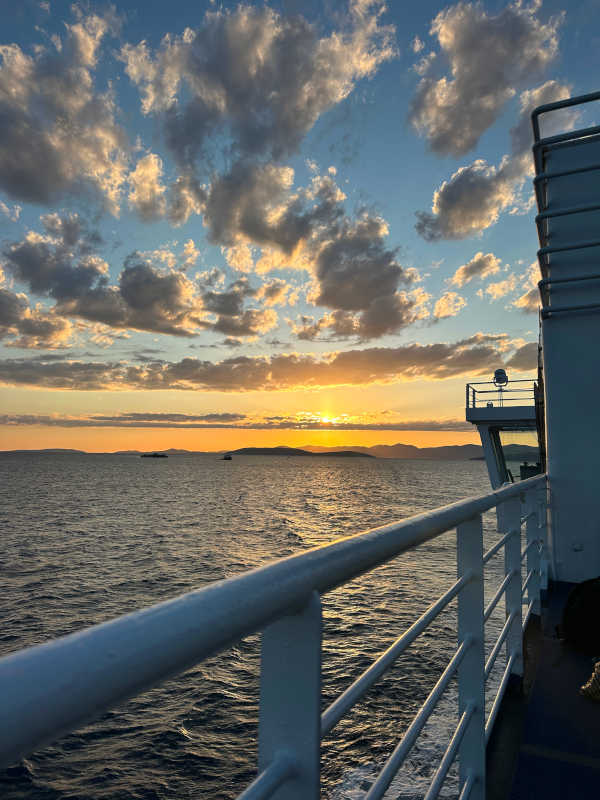
Views from the ferry boat going from Split to Supetar on Brač.

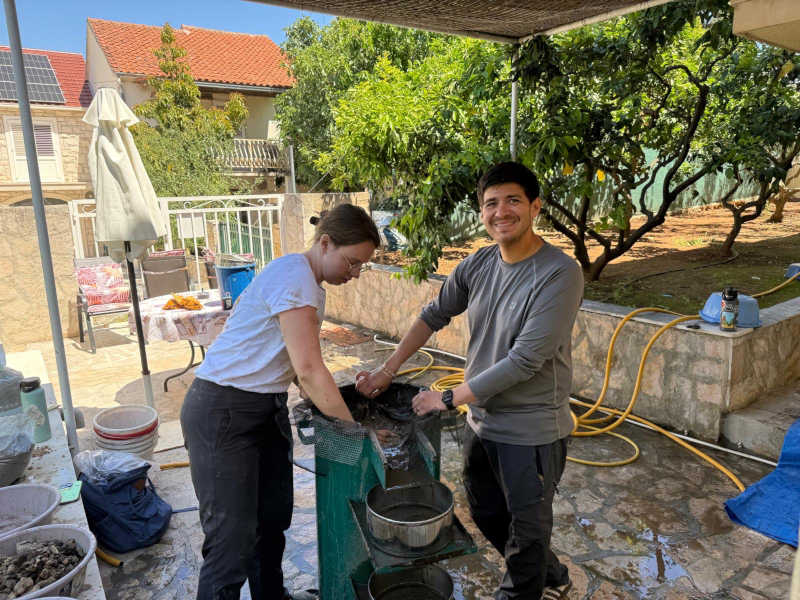
Flotation is a key archaeological method for recovering small scale artifacts such as seeds, charcoal, and fish bones from sediment. These smaller materials are hard to see during excavation of the deposits. Yet their low density allows them to float and become more visible in water, hence the flotation method. Samples were taken from each context after the modern layers and kept separated throughout the process. We used a full-sized metal water sieve device that was loaned from the University of Zadar for the last two field seasons. The drum was filled with water near the bottom, and then soil was poured from the top over the mesh in the drum. The mesh allowed the dirt to pass through while keeping larger material on the top of the mesh, and for the smaller material to float. The floating material and water then were slowly pushed out of an opening near the top of the drum. There were two different sized micro mesh trays that would then catch the material while allowing the water to filter through and out of the device. Afterwards the collected micro material was dried and later sorted.

Floating a soil sample with my colleague Hannah Hungerford.
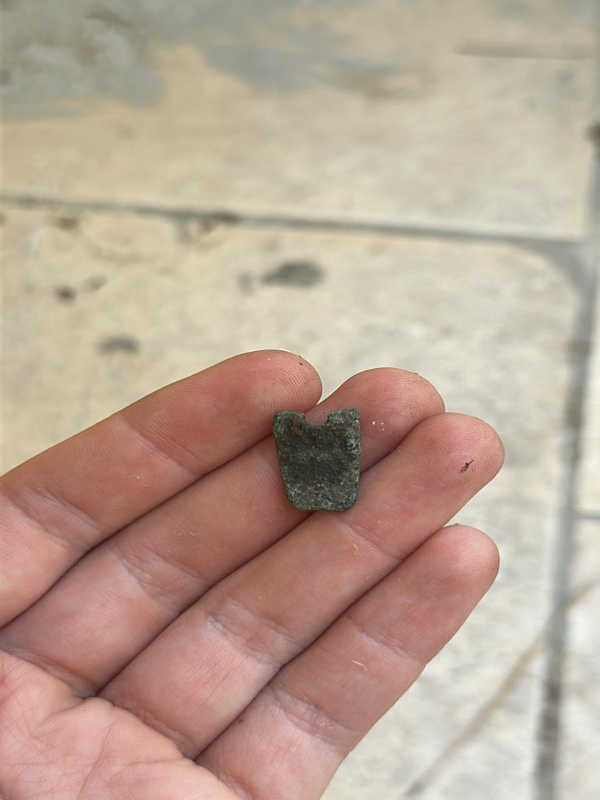
Piece of metal found during flotation.

Sorting the floated material proved a meticulous and at times painstaking process.  Once dried, samples were transferred onto plastic trays, and then tweezers were used to separate tiny seeds, charcoal, bone, and shell. Trying to distinguish this material from compact dirt or rocks was another challenge especially for seeds. The material then was treated separately, seeds were saved for our archaeobotanist to study to help get a better understanding of possible diet, agriculture, and environment. Fish bones and scales were of particular interest when found since they are so small, and this method is one of the best ways to find them. Other bones are often too shattered and small to be identifiable in most instances to be particularly useful. Larger material gathered from the top mesh were sherds of ceramics, lithics, and metals. Sorting the top mesh was much easier and partially done during flotation.

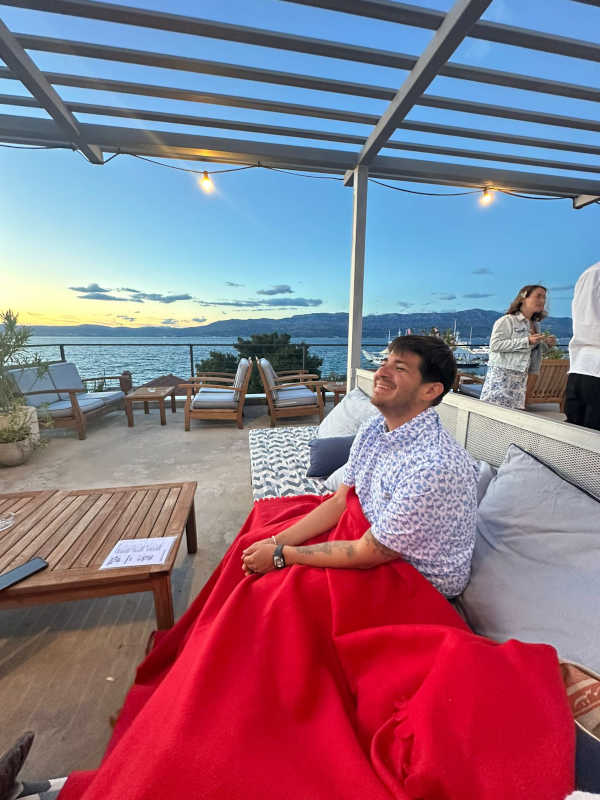
Spending a night out with the team after the work week.

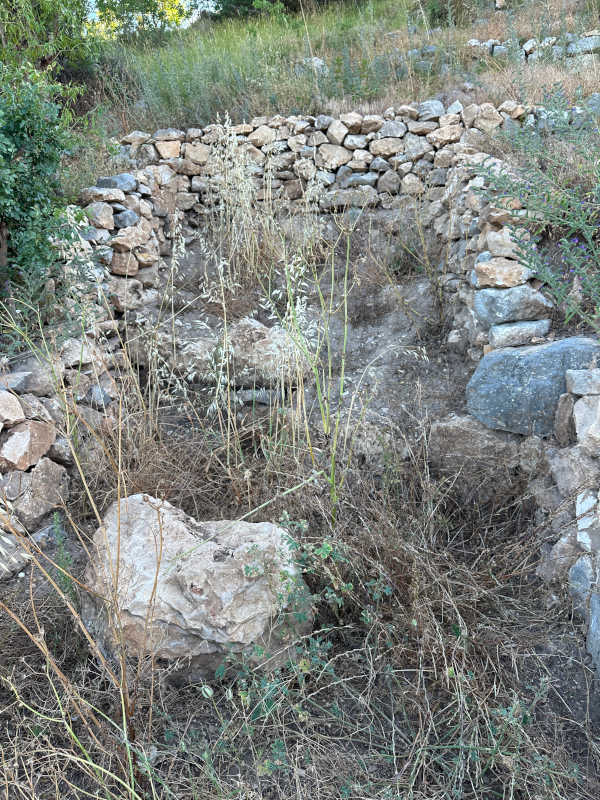
Working on this project has been extremely rewarding personally and professionally. There is still much to discover and understand about Croatian archaeology. This site provides a fascinating component in helping us understand something about the past. A portion of an early fortification wall was found on the terraced hillside, and there are plans to try to preserve it for the public. There appear to be other signs of domestic structures on the hilltop and slopes, and there is evidence for trade—both locally and abroad—with other Mediterranean civilizations for over a thousand years. The complete story of this site still needs further investigation, though for now we must work with what we currently have. Hopefully this site will soon be accessible to hikers and bikers with signage directing people to the prehistoric wall as part of a Croatian state conservation project!

Preliminary preservation of section of an early fortification wall.

Andrew Rivadeneira is a second year PhD student in Anthropology: Archaeology of the Mediterranean World at the University of Arizona. His research interests are in migration and entanglement in the central Mediterranean, digital/cyber-archaeology, and ways of bringing the ancient world to modern people.

Learn more about this project here.

Want to help more students and early career archaeologists get into the field? Donate to the cause today by selecting “Fieldwork Scholarships” as your gift purpose!

Recent Posts

  • Call for Early Career Scholars Social Media Content Creator
  • Honors and Awards Committee Seeks New Members
  • FOA Webinar: Amanda Hope Haley
  • Fieldwork Report: Yishu Deng
  • Table of Contents for BASOR 394 (November 2025)

Latest Posts from @ASORResearch

asor_research

Initiating and supporting research of the history and cultures of the Near East and wider Mediterranean world.


Heritage protection is a fundamental part of the w
Heritage protection is a fundamental part of the work of ASOR’s Cultural Heritage Initiatives. To help fight the illicit antiquities trade in Lebanon and Syria, ASOR hosted an Antiquities Trafficking Documentation workshop in Beirut, Lebanon on December 8-12, 2025, with the generous support of the U.S. Embassy in Beirut @USEmbassyBeirut. 

The workshop brought together representatives of the American, Lebanese, and Syrian governments to discuss current conditions and challenges in Lebanon and Syria, local priorities, and ways for all participants to work together to achieve them. Read more by clicking the link (https://buff.ly/lB5EEHO) in our bio.

Photo credits: U.S. Embassy Beirut and ASOR


Check out the November issue of BASOR 394, featuri
Check out the November issue of BASOR 394, featuring articles such as: Boulos el-ʿAraj: A Palestinian Quaker Archaeologist of the British Mandate Era (1926–1936); Unveiling the Obscure: Exploring the Function and Meaning of Levantine Shrine Models through an Ethnoarchaeological Lens; Paleoenvironment and Fruit Tree Horticulture at Early Bronze Age Tel Bet Yerah: Evidence from Charcoal Remains; and more. Read the Table of Contents by clicking the link (https://www.asor.org/news/2025/12/basor394-toc/) in our bio.


ASOR is pleased to share information from Overseas
ASOR is pleased to share information from Overseas Institute @caari_cyprus. The CAARI-HFF fellowship offers one grant of £2000 to a graduate student of any nationality, with a preference given to scholars from Egypt, Cyprus, Lebanon, and Syria. The purpose of the time at CAARI must be to conduct research on a project relevant to the maritime archaeology or maritime heritage of Cyprus. Applications are due 12 January 2026. Read more by clicking the link (https://honorfrostfoundation.org/2025/11/24/caari-hff-graduate-fellowship/) in our bio.


Kearyn Hall, a Harva L. Sheeler Fieldwork Scholars
Kearyn Hall, a Harva L. Sheeler Fieldwork Scholarship Recipient, joined the Humayma Excavation Project in Jordan in 2025. Kearyn's experience at Humayma strengthened her interest in bioarchaeology while highlighting the urgent challenges of protecting heritage in looted landscapes. Read more by clicking the link (https://www.asor.org/news/2025/12/fieldwork-report-hall) in our bio.
#Archaeology #Fieldwork #Jordan


ASOR invites applications from members to fill Ses
ASOR invites applications from members to fill Session Chair openings for several ASOR Standing Sessions. Session Chairs volunteer to serve one term (three years, 2026-2028) with the possibility of renewing for a second term. Applications may be submitted by one person or by co-applicants and are due by December 22, 2025. The application can be found by clicking the link (https://buff.ly/Bv5lLOf) in our bio.


Tune in for TONIGHT's FOA webinar, "What is a God?
Tune in for TONIGHT's FOA webinar, "What is a God? The Bible and the Ancient Near East," presented by Michael Hundley at 7:00 PM ET. You can still register for the free Zoom webinar here: https://buff.ly/lPi80Uq


ASOR is proud to announce the signing of a Memoran
ASOR is proud to announce the signing of a Memorandum of Understanding (MOU) with the Libyan Department of Antiquities, formalizing years of collaboration to protect and preserve Libya’s rich cultural heritage.

The agreement builds on long-standing cooperation and advances shared goals, including professional training, site conservation, youth engagement, and efforts to address illicit trafficking of cultural property. Signed during the U.S.–Libya Cultural Heritage Protection Workshop in Tunis, the MOU reinforces our shared commitment to safeguarding heritage sites—including ongoing work at Cyrene, a UNESCO World Heritage Site.

See the link (https://buff.ly/voCGZVk) in our bio to read more.

#CulturalHeritage #Libya #Archaeology


In 2025 with the support of ASOR and a Dana Grant,
In 2025 with the support of ASOR and a Dana Grant, the Erbil Plain Archaeological Survey focused on expanding and completing the image database that underpins EPAS’s ceramic typology. Read more about the project here: https://www.asor.org/news/2025/12/dana-grant-report-erbil-plain


The 2025 ASOR Annual Meeting took place November 1
The 2025 ASOR Annual Meeting took place November 19–22 at the Hilton Boston Park Plaza and online. More than 1,100 people registered for the hybrid meeting with approximately 950 attending in Boston. The academic program included more than 600 presentations with presenters representing over 30 countries. For a summary of the meeting and photo highlights, read more here: https://www.asor.org/news/2025/12/am-recap-2025


Our #ObjectoftheWeek: Limestone statuette of a tem
Our #ObjectoftheWeek: Limestone statuette of a temple boy, from Cyprus. 4th century BCE. Metropolitan Museum of Art, 74.51.2767. Public Domain (https://www.metmuseum.org/art/collection/search/242318).
#Cyprus #Statues


Read the Top Archaeological Discoveries of 2025 in
Read the Top Archaeological Discoveries of 2025 in the newest ANE Today!

Our editor, Jessica Nitschke, curates standout discoveries from across the Middle East, North Africa, and Mediterranean—from buried inscriptions to submerged landscapes and everything in between.

Is your favorite excavation or announcement missing?
Drop it below! 👇

#ANEToday #ArchaeologyMag #MiddleEastArchaeology #MediterraneanHistory #Discoveries2025 
📸 T-pillar carved with human face, Karahantepe, Turkey. Photo credit: Turkish Ministry of Culture and Tourism


ASOR seeks candidates for part-time internship pos
ASOR seeks candidates for part-time internship positions to begin in mid-January. These paid internships are for the spring semester (January-May) with the possibility of renewal for the summer and/or fall semester. Interns are expected to work 10–15 hours per week at ASOR’s headquarters in Alexandria, VA. Hours and schedule are flexible depending on school or other commitments. Read more here: https://www.asor.org/news/2025/12/spring-internships


Friends of ASOR is pleased to share information on
Friends of ASOR is pleased to share information on BAF & BASONOVA lectures. On Wednesday, December 10 at 8pm ET via Zoom, Michael Cosmopoulos (University of Missouri at St. Louis) will present "Myths, Monument, and Memory: Archaeology and the Creation of the Iliad and the Odyssey". This lecture examines how the physical remnants of the past, ruins, monuments, and long-lived “places of memory”, shaped the creation of the Homeric epics. Register here: https://buff.ly/qC5Y1GA


Don't miss the next FOA webinar, "What is a God? T
Don't miss the next FOA webinar, "What is a God? The Bible and the Ancient Near East," presented by Michael Hundley on Wednesday, December 17th at 7:00 PM ET. This webinar will be free and open to the public. Registration through Zoom with an email address is required. Click the link (https://asor-org.zoom.us/webinar/register/WN_PhCmXIYvSuyTijMVm5bYsw#/registration) in our bio to register.


During the summer, Aleyna Uyanik joined the Phoeni
During the summer, Aleyna Uyanik joined the Phoenix Archaeological Project to conduct fieldwork in southwestern Turkey. Aleyna, a classical archaeology and philosophy student at Johannes Gutenberg University Mainz, reports on day-to-day life in the field, conducting surveys, and the bonds formed during fieldwork. Read Aleyna's report here: https://www.asor.org/news/2025/10/fieldwork-report-uyanik

Photo credits: Ayse Ozaydin @peepingtom


Deadline is Dec. 5: The ASOR Program Committee (PC
Deadline is Dec. 5: The ASOR Program Committee (PC) is seeking 4 new members to each serve a three-year term (2026–2028) with the possibility of renewing for a second term. We are particularly interested in applications from ASOR members whose area(s) of research and expertise are complementary to or not represented by current members of the PC. The brief application form is due by 12:00 pm ET on December 5: https://buff.ly/3QvqGwd


When you give to ASOR this Giving Tuesday, you’re
When you give to ASOR this Giving Tuesday, you’re investing directly in the next generation of archaeologists and scholars.
Your support funds fellowships, mentoring, training, and opportunities that open doors for early-career researchers.
Thank you for helping us shape the future of the field and protect the study of the ancient world.
💙 Be part of the impact. #GivingTuesday #ASOR #SupportArchaeology 
https://members.asor.org/fundraising/give


Our #ObjectoftheWeek: Two-headed statue from Ain G
Our #ObjectoftheWeek: Two-headed statue from Ain Ghazal, on the outskirts of Amman, Jordan. Pre-pottery Neolithic period B, ca. 6500 BCE. On display at the Jordan Archaeological Museum. Source: Osama Shukir Muhammed Asmin FRCP(Glasg), CC By-SA 4.0/https://w.wiki/GJBC
#Jordan #Statues #Neolithic


Long before coal or oil, fire depended on whatever
Long before coal or oil, fire depended on whatever you could gather. In the ancient Near East, animal dung was essential fuel. What cultural, political, and legal rules governed its acquisition and use? Read the newest ANE Today by clicking the link (https://anetoday.org/animal-dung-energy/) in our bio.
#Mesopotamia


Check out the new 2025 issue of Maarav (29.1-2), a
Check out the new 2025 issue of Maarav (29.1-2), a journal for the Study of the Northwest Semitic Languages and Literatures. Read the Table of Contents by clicking the link (https://www.asor.org/news/2025/11/maarav29.1-2-toc/) in our bio.


Instagram

Stay updated with the latest insights, photos, and news by following us on Instagram!

Follow Us on Instagram

American Society of Overseas Research
The James F. Strange Center
209 Commerce Street
Alexandria, VA 22314

E-mail: info@asor.org

© 2025 ASOR
All rights reserved.
Images licensed under a Creative Commons Attribution-NonCommercial-ShareAlike 4.0 International License

Contact Us
Membership
Give
Friends of ASOR
ASOR Cultural Heritage Initiatives
Terms of Use
News

Please follow & like us :)
Facebook
YouTube
LinkedIn