UNEARTHING THE PAST SINCE 1900
  • BECOME A MEMBER
  • RENEW
  • GIVE NOW
  • SEARCH
  • ONLINE PORTAL
  • American Society of Overseas Research (ASOR)American Society of Overseas Research (ASOR)
  • ABOUT
    • WELCOME FROM ASOR OFFICERS
    • HISTORY OF ASOR
    • MISSION, BYLAWS, & STRATEGIC PLAN
    • Board of Trustees
    • COMMITTEES
    • POLICIES
    • FINANCIAL DOCUMENTS
    • MEDIA RELEASES
    • CONTACT US
  • CULTURAL
    HERITAGE
    • ABOUT CULTURAL HERITAGE INITIATIVES
    • UPDATES
    • PAST GRANTS
    • TUTORIALS
    • Who We Are
  • ANNUAL
    MEETING
    • REGISTRATION
    • HOTEL RESERVATIONS
    • ANNUAL MEETING SCHEDULES
    • SPONSOR & EXHIBIT
    • ASOR Online Library
    • HONORS & AWARDS
    • ANNUAL MEETING SCHOLARSHIPS
    • PAST & FUTURE ANNUAL MEETINGS
  • MEMBERSHIP
    & RESOURCES
    • INDIVIDUAL MEMBERSHIPS
    • INSTITUTIONAL MEMBERSHIPS
    • NEWS@ASOR
    • PAST ASOR NEWS, MONTH BY MONTH
    • AFFILIATED PROJECTS
    • AFFILIATED RESEARCH CENTERS
    • ARCHIVES
    • ONLINE RESOURCES
      • PHOTO COLLECTION
    • EARLY CAREER MEMBER RESOURCES
  • FELLOWSHIPS
    & GRANTS
    • SCHOLARSHIPS FOR FIELDWORK PARTICIPATION
    • GRANTS FOR ARCHAEOLOGICAL PROJECTS
    • RESEARCH FELLOWSHIPS FOR MEMBERS
    • MEMBERSHIP & ANNUAL MEETING SCHOLARSHIPS
    • ASOR-AFFILIATED RESEARCH CENTERS FELLOWSHIPS
    • OTHER FELLOWSHIP PROGRAMS
  • PUBLICATIONS
    • BOOK SERIES & MONOGRAPHS
    • BULLETIN OF ASOR
    • JOURNAL OF CUNEIFORM STUDIES
    • MAARAV
    • NEAR EASTERN ARCHAEOLOGY
    • THE ANCIENT NEAR EAST TODAY
    • News@ASOR
    • LEVANTINE CERAMICS PROJECT
  • FRIENDS
    OF ASOR
    • Webinars
    • TOURS
    • THE ANCIENT NEAR EAST TODAY
    • ASOR ONLINE LIBRARY
  • Donate
    • FY25 HONOR ROLL OF DONORS
    • LIFETIME HONOR ROLL OF DONORS
    • ASOR LEGACY CIRCLE
    • WAYS TO DONATE

 SHARE


NEWS@ASOR E-NEWSLETTER

ANCIENT NEAR EAST TODAY E-NEWSLETTER

PAST ASOR NEWS, MONTH BY MONTH

ASOR LEGACY CIRCLE MEMBERS

LIFETIME HONOR ROLL OF DONORS

FY25 HONOR ROLL OF DONORS

ASOR ANNUAL MEETING

Table of Contents for Maarav 29.1-2 (2025)
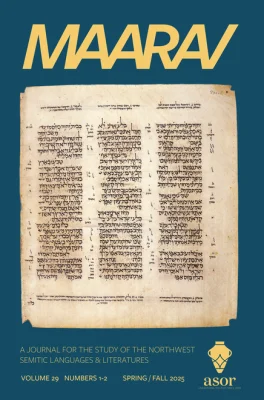
Maarav.29.2025.cover
You can receive Maarav (and other ASOR publications) through an ASOR Membership.
Please e-mail the Membership office if you have any questions.

Pp. 1-25: ““The Anger of the Queen Has Gone Forth”: Ilimilku’s Warning to Urtenu in a Ugaritic Piggyback Letter (RS 94.2406 [KTU3 2.88])” by Heath D. Dewrell

The present essay begins with a reexamination of a “piggyback” letter from Late Bronze Ugarit, RS 94.2406 (KTU3 2.88), offering a fresh edition of this letter from an unnamed queen of Ugarit to Urtenu that contains a second letter from a certain Ilimilku to the same appended to the end. The edition presented here notes a previously unacknowledged difficulty that, once recognized and accounted for, serves to reveal a degree of tension between the queen of Ugarit and Ilimilku, her scribe. Once properly understood, it becomes clear that Ilimilku’s piggyback letter at the very least recontextualizes the queen’s letter and may well even go so far as to contradict the queen’s instructions outright. The second portion of the essay embarks on a comparison with other analogous piggyback letters from the Late Bronze age, written in both Akkadian and Hittite, to reveal that Ilimilku’s piggyback letter is hardly unique in these regards and that it was not especially uncommon for scribes to append their own letters to those of their patrons, apparently without the latter’s knowledge, often with the goal of advancing the scribes’ own interests and agendas.

ASOR Members with online access: log into ASOR’s Online Portal here. Once logged in, click the JOURNALS tab in the top navigation bar. From here you may select which journal you would like to read. If you have online access, you will see your selected journal’s current issue Table of Contents. Click on the “Current Issue” button and you will then be redirected to the University of Chicago Press’s (UCP) platform to immediately start reading any issue of your choice. Tutorials for how to log in to the Online Portal as well as how to navigate to the Portal Journals page can be found here.

Pp. 27-119: “‘The Rise of “National” Scripts in the Iron Age II: A Proposal” by Nathaniel E. Greene and Jeremy M. Hutton

Northwest Semitic paleographic data has inspired a consensus that several “national” scripts had become well-established by the Iron IIB. Many treat these scripts as expressions of self-contained identity. Moreover, they are often framed in ways that gloss over aspects of scribal training. Questions remain, however, regarding the behavioral processes that affected such developments. To account for these processes, we propose a “franchise” model of scribal training: a few centers produced scribal lineages that, once established, operated semi-independently. While some scribes may have been held “on retainer,” most likely hired themselves out on a localized “freelance” system. The selection of national scripts was thus inadvertent and not motivated by exertions of “national” identity. Royal courts of the Iron Age IIB unintentionally adopted “micro-features” of the alphabetic script that had been formalized in the scribal lineage(s) prestigious enough to enjoy employment in major centers. Rather than serving as a distinctive marker of national consciousness imposed from the top-down, the development of “national scripts” was the natural effect of local patronage and “elite emulation” of micro-features by more peripheral scribes. The nationalization of scripts was therefore incidental to the emergent national consciousness and driven by individual scribes and the training regimens connecting them.

ASOR Members with online access: log into ASOR’s Online Portal here. Once logged in, click the JOURNALS tab in the top navigation bar. From here you may select which journal you would like to read. If you have online access, you will see your selected journal’s current issue Table of Contents. Click on the “Current Issue” button and you will then be redirected to the University of Chicago Press’s (UCP) platform to immediately start reading any issue of your choice. Tutorials for how to log in to the Online Portal as well as how to navigate to the Portal Journals page can be found here.

Pp. 121-178: “Conflate Readings and the Lamentations Textual Tradition” by F. W. Dobbs-Allsopp

One dimension of Lamentations’s textual tradition, namely, its propensity for conflate readings, provides the chief focus of inquiry in this essay. As I work to collect, elucidate, and clarify these conflate readings, other dimensions of these poems’ extant and reconstructable textualities come into view, viz. their rough chronology, prevalence of variability and multiformity. The phenomenon of conflate readings is well known to textual scholars of the Bible. The presenting peculiarity in Lamentations is the breakage in form to no apparent end that the preservation of such readings inevitably entails. Given how integral form is to this poetry’s operative poetics, such deformations require explanation. The solution posed posits shifts over time in the literary values that guided scribal practice when it came to the collecting and recording of variant readings. The resulting view of Lamentations’s literary history is far richer, more complex, and truer to scribal realia than that usually presumed by students of these poems.

ASOR Members with online access: log into ASOR’s Online Portal here. Once logged in, click the JOURNALS tab in the top navigation bar. From here you may select which journal you would like to read. If you have online access, you will see your selected journal’s current issue Table of Contents. Click on the “Current Issue” button and you will then be redirected to the University of Chicago Press’s (UCP) platform to immediately start reading any issue of your choice. Tutorials for how to log in to the Online Portal as well as how to navigate to the Portal Journals page can be found here.

BROWSE THE NEWS ARCHIVE

  • FOA Webinar: Carl Walsh
  • Call for Early Career Scholars Committee Members
  • Friends of ASOR Tours: Philadelphia 2026
  • FOA Webinar: Benyamin Storchan

Latest Posts from @ASORResearch

asor_research

Initiating and supporting research of the history and cultures of the Near East and wider Mediterranean world.


At Tall Hisban in Jordan, the Lawrence T. Geraty C
At Tall Hisban in Jordan, the Lawrence T. Geraty Community Archaeology Endowment has supported educational opportunities, heritage events, and community engagement. In 2025, the Geraty Endowment helped make possible the Hisban Heritage Festival, student-led community history projects, and the Madaba Region Heritage Internship. Read more in this grant report: https://www.asor.org/news/2026/01/geraty-grant-report
#Jordan #Madaba #Heritage


ASOR’s room block at the Hilton Chicago for the 20
ASOR’s room block at the Hilton Chicago for the 2026 Annual Meeting is now open. Registered Annual Meeting attendees can reserve a room at the discounted rate of $159 (plus tax) at this iconic downtown hotel overlooking Grant Park and Lake Michigan. To make your reservations, click here: https://www.asor.org/am/2026/hotel-city-2026


Join us for the next FOA webinar on Wednesday, Feb
Join us for the next FOA webinar on Wednesday, February 4th at 12:30pm ET: "Unearthing an Imperially Glorious Byzantine Church near Bet Shemesh: From Fieldwork to Virtual Reality," presented by Benyamin Storchan. In the heart of the Holy Land, just 15 miles southwest of Jerusalem, lies one of the most remarkable Byzantine churches discovered in recent decades. The archaeological excavations at the Church of the Glorious Martyr unearthed a fascinating five-century story of faith and pilgrimage, yet the greatest mystery remains unsolved: who was the Glorious Martyr venerated in the sacred crypt? Read more and register here: https://www.asor.org/news/2026/01/webinar-storchan


Call for papers: The William F. Albright Institute
Call for papers: The William F. Albright Institute of Archaeological Research announces the 25th Annual Sean W. Dever Memorial Prize. The prize awards $750 for the best conference paper in Syro-Palestinian or Biblical Archaeology.

Eligibility:
• Ph.D. candidates (as of Spring 2026)
• Paper must be in English
• Must be an unpublished/not prepared for publication conference paper

Deadline: February 15, 2026
Winner announced: March 9, 2026
Apply via the Albright Fellowships Portal: https://aiar.org/fellowships


The deadline to apply for ASOR's 2026-27 Mesopotam
The deadline to apply for ASOR's 2026-27 Mesopotamian Fellowships is Monday, January 26! These fellowships are primarily intended to support fieldwork/research on ancient Mesopotamian culture carried out in the Middle East. Apply now: https://www.asor.org/fellowships/mesopotamian-fellowship/


Our #ObjectoftheWeek: A limestone statue of an eag
Our #ObjectoftheWeek: A limestone statue of an eagle wrestling with a serpent found at Khirbet et-Tannur, an ancient Nabataean temple in southern Jordan. ca. 100-200 CE. CAM 1939.222. Photo credit: Cincinnati Art Museum.
#Archaeology #Jordan #Nabataean


Since the Neolithic, mudbrick architecture has bee
Since the Neolithic, mudbrick architecture has been one of the most widespread building traditions across the world. But a mudbrick is more than a structural unit: it is also a repository of information. Read the newest ANE Today by Marta Lorenzon by clicking the link (https://anetoday.org/mudbrick-architecture-meaning/) in our bio.
#Architecture #Mudbrick


Last summer, Helen Wong joined the University of P
Last summer, Helen Wong joined the University of Palermo Archaeological Project at Motya, an island near western Sicily. Helen, a PhD candidate at University of Pennsylvania, was the digital archaeology specialist on the project and helped with the ongoing geophysical survey mapping the ancient city. Read her report here: https://www.asor.org/news/2026/01/fieldwork-report-wong
#Archaeology #Survey #Sicily


Be sure to watch the next FOA webinar TOMORROW at
Be sure to watch the next FOA webinar TOMORROW at 7:00pm ET presented by Dr. Sarah Wenner: "Experiencing Khirbet et-Tannur: The Story of a Nabatean Temple from the Second through 21st Century." Register for free if you haven't already: https://buff.ly/CtzwPOm
#Jordan #Nabatean


ASOR is putting together a map of where our member
ASOR is putting together a map of where our members have worked in the world. You're invited to submit your own excavations, survey, laboratory, or museum and conservation projects to the map with stories and photos. Click the link in our bio to complete a brief survey to add yourself to the map: https://buff.ly/LYYJVlZ


The Honors and Awards Committee seeks nominations
The Honors and Awards Committee seeks nominations for at least 3 candidates. Committee members will serve a three-year term with the possibility of two consecutive terms. Nominees must fill out the online form by January 30. Learn more by clicking the link in our bio: https://www.asor.org/news/2025/12/honors-awards-members-call


This past summer, a group from Johns Hopkins Unive
This past summer, a group from Johns Hopkins University traveled to Türkiye to help excavate a Late Bronze Age archive of cuneiform tablets at Alalakh/Tell Atchana. This team, funded by an ASOR Harris Grant, was uniquely qualified for the task, as they were trained in both archaeology and in reading Akkadian cuneiform. Read their grant report by clicking the link in our bio: https://www.asor.org/news/2025/12/harris-grant-report-alalakh
#Archaeology #Fieldwork #Cuneiform #Turkiye


Reminder: the deadline to propose new member-organ
Reminder: the deadline to propose new member-organized sessions and workshops for the 2026 Annual Meeting in Chicago is Thursday, January 15. Find more info and fill out a brief proposal here: https://buff.ly/Kqui65X


Don't miss the upcoming FOA webinar on Wednesday,
Don't miss the upcoming FOA webinar on Wednesday, January 21 at 7:00pm ET: "Experiencing Khirbet et-Tannur: The Story of a Nabatean Temple from the Second through 21st Century," presented by Dr. Sarah Wenner. In the 2nd century CE, after Rome annexed the Nabataean Kingdom and transformed it into the Roman province of Arabia, the Nabataean temple at Khirbet et-Tannur was constructed in Central Jordan. This lecture travels the site’s two millennia history and explores how Khirbet et-Tannur’s excavations, the collection at the Cincinnati Art Museum, and 21st century innovations have changed our understanding of the Nabataeans. Read more and register by clicking the link in our bio: https://www.asor.org/news/2026/01/webinar-wenner


Our #ObjectoftheWeek: An Egyptian “New Year’s Bott
Our #ObjectoftheWeek: An Egyptian “New Year’s Bottle”, a type of lentoid-shaped flask that was filled with perfumed oil or water from the Nile, gifted in connection to the New Year. ca. 664-525 BCE. MMA 30.8.214. Photo credit: Metropolitan Museum of Art.
#Archaeology #Egypt #NewYear


The archaeological record and the cuneiform litera
The archaeological record and the cuneiform literature provide us with compelling information to assess how children lived 3000 years ago. This should open our eyes to current realities, which are not so different. Read the newest ANE Today article, "Children in the Ancient (and Present-day) Near East", by clicking the link in our bio: https://anetoday.org/children-near-east/


In town for the #AIASCS2026 Annual Meeting? 🏺

Mak
In town for the #AIASCS2026 Annual Meeting? 🏺

Make sure to stop by the ASOR table in the Exhibit Hall to learn more about our programs and publications, and reconnect with colleagues and friends from across the field.

ASOR Exhibit Hall Hours:
• Wed, Jan 7 | 3:00–6:00 PM
• Thu–Fri, Jan 8–9 | 9:30 AM–5:30 PM
• Sat, Jan 10 | 8:00 AM–12:00 PM

We can’t wait to see you—come say hello! 

#ASOR #AIAAnnualMeeting #MeetUsThere


The 2026 ASOR Annual Meeting will begin on Wednesd
The 2026 ASOR Annual Meeting will begin on Wednesday, November 18, at 7:00pm CST with the plenary address by Dr. Kim Benzel: Lapis, Clay, Copper, Water: Presenting Ancient West Asian Art at The Met. Dr. Benzel is Curator in Charge of The Metropolitan Museum of Art. She holds a Ph.D. in Art History and Archaeology from Columbia University and has participated in archaeological excavations in Syria. Currently, Kim and her colleagues are working on a full rethink and renovation of The Met’s permanent galleries of Ancient West Asian Art, scheduled to reopen in June 2027. Read more about the 2026 Plenary Address here: https://www.asor.org/am/2026/plenary-address-2026


Make sure to tune in TOMORROW at 7:00 pm ET for th
Make sure to tune in TOMORROW at 7:00 pm ET for the next FOA webinar presented by Amanda Hope Haley: "Beyond Edutainment: Reclaiming Archaeology in a Clickbait World". If you haven't already signed up, click the link (https://buff.ly/cDQEBdk) in our bio to register for free.


ASOR plans to award two Mesopotamian Fellowships f
ASOR plans to award two Mesopotamian Fellowships for 2026-2027; one for $9,000 and one for $4,000. These fellowships are primarily intended to support fieldwork/research on ancient Mesopotamian culture carried out in the Middle East, but other projects such as travel to work on museum collections or archives related to ancient Mesopotamia will also be considered. The deadline for applications is January 26, 2026. More info can be found here: https://www.asor.org/fellowships/mesopotamian-fellowship/


Instagram

Stay updated with the latest insights, photos, and news by following us on Instagram!

Follow Us on Instagram

American Society of Overseas Research
The James F. Strange Center
209 Commerce Street
Alexandria, VA 22314

E-mail: info@asor.org

© 2025 ASOR
All rights reserved.
Images licensed under a Creative Commons Attribution-NonCommercial-ShareAlike 4.0 International License

Contact Us
Membership
Give
Friends of ASOR
ASOR Cultural Heritage Initiatives
Terms of Use
News

Please follow & like us :)
Facebook
YouTube
LinkedIn