UNEARTHING THE PAST SINCE 1900
  • BECOME A MEMBER
  • RENEW
  • GIVE NOW
  • SEARCH
  • ONLINE PORTAL
  • American Society of Overseas Research (ASOR)American Society of Overseas Research (ASOR)
  • ABOUT
    • WELCOME FROM ASOR OFFICERS
    • HISTORY OF ASOR
    • MISSION, BYLAWS, & STRATEGIC PLAN
    • Board of Trustees
    • COMMITTEES
    • POLICIES
    • FINANCIAL DOCUMENTS
    • CONTACT US
  • CULTURAL
    HERITAGE
    • ABOUT CULTURAL HERITAGE INITIATIVES
    • UPDATES
    • TUTORIALS
    • Who We Are
  • ANNUAL
    MEETING
    • REGISTRATION
    • HOTEL RESERVATIONS
    • ANNUAL MEETING SCHEDULES
    • SPONSOR & EXHIBIT
    • ASOR Online Library
    • 125th Anniversary Celebration
    • HONORS & AWARDS
    • ANNUAL MEETING SCHOLARSHIPS
    • PAST & FUTURE ANNUAL MEETINGS
  • MEMBERSHIP
    & RESOURCES
    • INDIVIDUAL MEMBERSHIPS
    • INSTITUTIONAL MEMBERSHIPS
    • NEWS@ASOR
    • AFFILIATED PROJECTS
    • AFFILIATED RESEARCH CENTERS
    • ARCHIVES
    • PAST ASOR NEWS, MONTH BY MONTH
    • ONLINE RESOURCES
      • PHOTO COLLECTION
    • EARLY CAREER MEMBER RESOURCES
  • FELLOWSHIPS
    & GRANTS
    • SCHOLARSHIPS FOR FIELDWORK PARTICIPATION
    • GRANTS FOR ARCHAEOLOGICAL PROJECTS
    • RESEARCH FELLOWSHIPS FOR MEMBERS
    • MEMBERSHIP & ANNUAL MEETING SCHOLARSHIPS
    • ASOR-AFFILIATED RESEARCH CENTERS FELLOWSHIPS
    • OTHER FELLOWSHIP PROGRAMS
  • PUBLICATIONS
    • BOOK SERIES & MONOGRAPHS
    • BULLETIN OF ASOR
    • JOURNAL OF CUNEIFORM STUDIES
    • MAARAV
    • NEAR EASTERN ARCHAEOLOGY
    • THE ANCIENT NEAR EAST TODAY
    • News@ASOR
    • LEVANTINE CERAMICS PROJECT
  • FRIENDS
    OF ASOR
    • Webinars
    • TOURS
    • THE ANCIENT NEAR EAST TODAY
    • ASOR ONLINE LIBRARY
  • Donate
    • FY25 HONOR ROLL OF DONORS
    • LIFETIME HONOR ROLL OF DONORS
    • ASOR LEGACY CIRCLE
    • WAYS TO DONATE

 SHARE


NEWS@ASOR E-NEWSLETTER

ANCIENT NEAR EAST TODAY E-NEWSLETTER

PAST ASOR NEWS, MONTH BY MONTH

ASOR LEGACY CIRCLE MEMBERS

LIFETIME HONOR ROLL OF DONORS

FY25 HONOR ROLL OF DONORS

ASOR ANNUAL MEETING

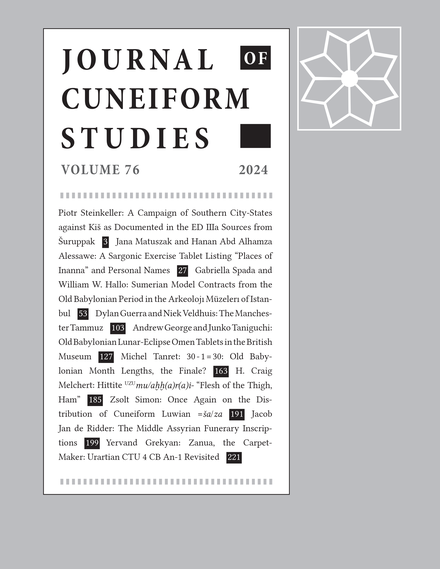
Table of Contents for Journal of Cuneiform Studies 76 (2024)

You can receive JCS (and other ASOR publications) through an ASOR Membership.
Please e-mail the Membership office if you have any questions.
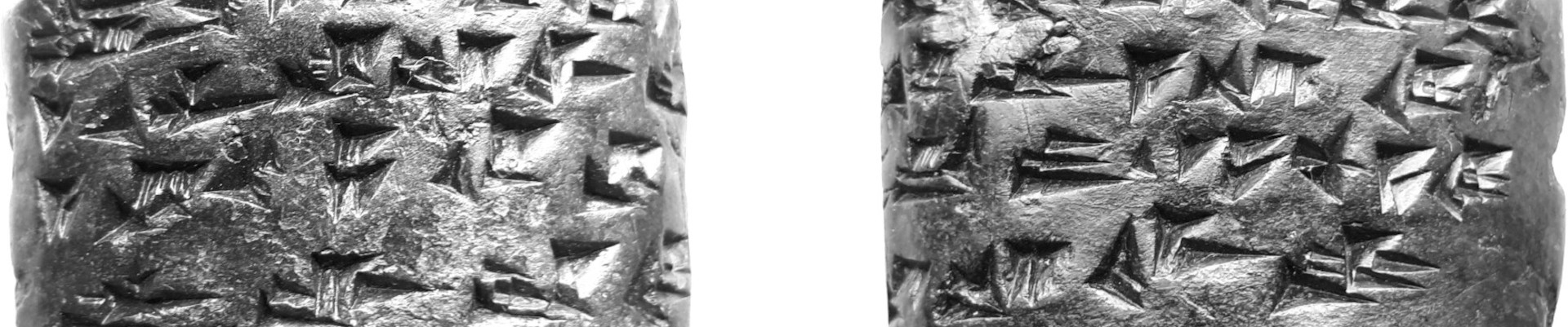
JCS 76 article 1 banner

Pp. 3–26: “A Campaign of Southern City-States against Kiš as Documented in the ED IIIa Sources from Šuruppak (Fara),” by Piotr Steinkeller

A group of ED IIIa texts from Šuruppak (Fara) describes a mobilization of troops from Uruk, Adab, Nippur, Lagaš, Umma, and Šuruppak, clearly in anticipation of a major military operation. It is argued that the target of that campaign, which was led by Uruk, was the city-state of Kiš. The analysis of various other sources further suggests that, during the ED IIIa period, Uruk was able to bring significant portions of southern Babylonia under its control. This development was a reversal of the situation existing in ED I and II, when much of that region remained under the hegemony of Kiš.

ASOR Members with online access: log into ASOR’s Online Portal here. Once logged in, click the JOURNALS tab in the top navigation bar. From here you may select which journal you would like to read. If you have online access, you will see your selected journal’s current issue Table of Contents. Click on the “Current Issue” button and you will then be redirected to the University of Chicago Press’s (UCP) platform to immediately start reading any issue of your choice. Tutorials for how to log in to the Online Portal as well as how to navigate to the Portal Journals page can be found here.

JCS 76 article 2 banner

Pp. 27-52: “A Sargonic Exercise Tablet Listing ‘Places of Inanna’ and Personal Names,” by Jana Matuszak and Hanan Abd Alhamza Alessawe

This article publishes a remarkable school tablet, probably from Sargonic Umma, which contains two lexical exercises. While the reverse appears to be an ad hoc list of personal names, many of which start with or contain the sign a, the obverse compiles “places” (ki) where certain mythological events involving the goddess Inanna had occurred. Unusually for lexical lists, each of these places is described in a complete sentence following a loosely alternating structure, which gives the list almost literary qualities. After discussing the list-like vs. literary features and comparing the compilation of places to a similar lexical fragment of Ur III date and the Early Dynastic Word List F, we analyze the mythological allusions and potential ritual associations.

ASOR Members with online access: log into ASOR’s Online Portal here. Once logged in, click the JOURNALS tab in the top navigation bar. From here you may select which journal you would like to read. If you have online access, you will see your selected journal’s current issue Table of Contents. Click on the “Current Issue” button and you will then be redirected to the University of Chicago Press’s (UCP) platform to immediately start reading any issue of your choice. Tutorials for how to log in to the Online Portal as well as how to navigate to the Portal Journals page can be found here.

JCS 76 article 3 banner

Pp. 53-101: “Sumerian Model Contracts from the Old Babylonian Period in the Arkeoloji Müzeleri of Istanbul,” by Gabriella Spada and William W. Hallo

This article presents twenty fragmentary multicolumn tablets containing Sumerian model contracts from Old Babylonian Nippur, which are currently kept at the Arkeoloji Müzeleri in Istanbul, Turkey. Initial work on these was initiated by the late William W. Hallo in 1971 but he was unable to complete the project so it was taken over and completed by Gabriella Spada. Their content is limited to loan contracts of silver or barley, sometimes with the presence of antichretic pledges (slaves, fields, gardens, and lumps of silver).

ASOR Members with online access: log into ASOR’s Online Portal here. Once logged in, click the JOURNALS tab in the top navigation bar. From here you may select which journal you would like to read. If you have online access, you will see your selected journal’s current issue Table of Contents. Click on the “Current Issue” button and you will then be redirected to the University of Chicago Press’s (UCP) platform to immediately start reading any issue of your choice. Tutorials for how to log in to the Online Portal as well as how to navigate to the Portal Journals page can be found here.

JCS 76 article 4 banner

Pp. 103-126: “The Manchester Tammuz,” by Dylan Guerra and Niek Veldhuis

This contribution provides a new edition of the Manchester Tammuz, a sequence of Emesal love songs concerning Inana and Dumuzi. The text offers many irregular spellings, some of which may be resolved by means of a fragmentary duplicate from Nippur. The relationship between the Manchester text and several other Old Babylonian Emesal liturgies that share characteristics of orthography, paleography, and layout is discussed briefly. A line-drawing of the object by Theophilus G. Pinches, published in 1904, is added to the end of the article.

ASOR Members with online access: log into ASOR’s Online Portal here. Once logged in, click the JOURNALS tab in the top navigation bar. From here you may select which journal you would like to read. If you have online access, you will see your selected journal’s current issue Table of Contents. Click on the “Current Issue” button and you will then be redirected to the University of Chicago Press’s (UCP) platform to immediately start reading any issue of your choice. Tutorials for how to log in to the Online Portal as well as how to navigate to the Portal Journals page can be found here.

JCS 76 article 5 banner

Pp. 127-161: “Old Babylonian Lunar-Eclipse Omen Tablets in the British Museum,” by Andrew George and Junko Taniguchi

This article presents a first edition of four clay tablets inscribed with omens arising from eclipses of the moon. As products of the middle and late Old Babylonian periods they represent the oldest examples of compendia of lunar-eclipse omens yet discovered and thus provide important new information about celestial divination among the peoples of southern Mesopotamia in the early second millennium BCE. The tablets are edited with appended philological apparatus. They are all found to bear witness to a single text, which organizes the omens of lunar eclipse by time of night, movement of shadow, duration, and date. A composite translation also takes account of two other early versions of the text published eleven years ago. The article is concluded by discussions of variants and scribal annotations in the text. The cuneiform texts are illustrated by scale drawings of the tablets.

ASOR Members with online access: log into ASOR’s Online Portal here. Once logged in, click the JOURNALS tab in the top navigation bar. From here you may select which journal you would like to read. If you have online access, you will see your selected journal’s current issue Table of Contents. Click on the “Current Issue” button and you will then be redirected to the University of Chicago Press’s (UCP) platform to immediately start reading any issue of your choice. Tutorials for how to log in to the Online Portal as well as how to navigate to the Portal Journals page can be found here.

JCS 76 article 6 banner

Pp. 163-183: “30 − 1 = 30: Old Babylonian Month Lengths, the Finale?,” by Michel Tanret

The Old Babylonian administrative calendar always consisted of thirty days, regardless of early moon sightings. The ud.da.gíd.da days, viewed by some as days to be excluded due to an early moon sighting, were not used to shorten the month; rather, they denoted the number of days when no rations were distributed. This is demonstrated on the basis of Old Babylonian documentary texts.

ASOR Members with online access: log into ASOR’s Online Portal here. Once logged in, click the JOURNALS tab in the top navigation bar. From here you may select which journal you would like to read. If you have online access, you will see your selected journal’s current issue Table of Contents. Click on the “Current Issue” button and you will then be redirected to the University of Chicago Press’s (UCP) platform to immediately start reading any issue of your choice. Tutorials for how to log in to the Online Portal as well as how to navigate to the Portal Journals page can be found here.

JCS 76 article 7 banner

Pp. 185-190: “Hittite UZUmu/aḫḫ(a)r(a)i– ‘Flesh of the Thigh, Ham,'” by H. Craig Melchert

Hittite UZUmu/aḫḫ(a)r(a)i– is a body part belonging to various mammals, including humans, but almost exclusively attested as a component of cooked meat offerings to deities. New evidence supports its identification as the fleshy part of the thigh, thus English “ham” in the anatomical sense, but when served as food in Hittite removed from the thigh bone. A recent text join furnishes not only a further instance of juxtaposition with the expression for “thigh bone,” but also the crucial detail that the m. is skewered before being cooked.

ASOR Members with online access: log into ASOR’s Online Portal here. Once logged in, click the JOURNALS tab in the top navigation bar. From here you may select which journal you would like to read. If you have online access, you will see your selected journal’s current issue Table of Contents. Click on the “Current Issue” button and you will then be redirected to the University of Chicago Press’s (UCP) platform to immediately start reading any issue of your choice. Tutorials for how to log in to the Online Portal as well as how to navigate to the Portal Journals page can be found here.

Pp. 191-197: “Once Again on the Distribution of Cuneiform Luwian =ša/za,” by Zsolt Simon

This article argues that the Cuneiform Luwian nominal particle =ša/za was not assigned on a word-by-word basis in the -r-, -r/n-, -l-stem classes but followed a regular pattern, thus Jasanoff’s rule of the distribution of this particle can be extended and confirmed.

ASOR Members with online access: log into ASOR’s Online Portal here. Once logged in, click the JOURNALS tab in the top navigation bar. From here you may select which journal you would like to read. If you have online access, you will see your selected journal’s current issue Table of Contents. Click on the “Current Issue” button and you will then be redirected to the University of Chicago Press’s (UCP) platform to immediately start reading any issue of your choice. Tutorials for how to log in to the Online Portal as well as how to navigate to the Portal Journals page can be found here.

Pp. 199-220: “The Middle Assyrian Funerary Inscriptions,” by Jacob Jan de Ridder

This article presents revised editions of a group of four similar funerary inscription from Assyria, dating to about the thirteenth century BCE. The paleography of these texts is unusual, characterized by similarities with the writing from Tell Taban and the kingdom of Ḫana. However, the invocation of the Hurrian deity Šuriḫa, the patron of the town of Šūru, suggests this ancient settlement as its provenance. These funerary inscriptions would be among the earliest texts from the Middle Assyrian settlement that existed at this location.

ASOR Members with online access: log into ASOR’s Online Portal here. Once logged in, click the JOURNALS tab in the top navigation bar. From here you may select which journal you would like to read. If you have online access, you will see your selected journal’s current issue Table of Contents. Click on the “Current Issue” button and you will then be redirected to the University of Chicago Press’s (UCP) platform to immediately start reading any issue of your choice. Tutorials for how to log in to the Online Portal as well as how to navigate to the Portal Journals page can be found here.

Pp. 221-227: “Zanua, the Carpet-Maker: Urartian CTU 4 CB An-1 Revisited,” by Yervand Grekyan

Evidence of Urartian textiles is mostly limited to pictorial representations, along with a few textual references and finds of fragments of textiles in archaeological contexts. The study of an Urartian royal letter gives some new idea on craftsmen who wove textiles in Urartu.

ASOR Members with online access: log into ASOR’s Online Portal here. Once logged in, click the JOURNALS tab in the top navigation bar. From here you may select which journal you would like to read. If you have online access, you will see your selected journal’s current issue Table of Contents. Click on the “Current Issue” button and you will then be redirected to the University of Chicago Press’s (UCP) platform to immediately start reading any issue of your choice. Tutorials for how to log in to the Online Portal as well as how to navigate to the Portal Journals page can be found here.

BROWSE THE NEWS ARCHIVE

  • Table of Contents for Near Eastern Archaeology 88.4 (2025)
  • Call for Early Career Scholars Social Media Content Creator
  • Honors and Awards Committee Seeks New Members
  • FOA Webinar: Amanda Hope Haley

Latest Posts from @ASORResearch

asor_research

Initiating and supporting research of the history and cultures of the Near East and wider Mediterranean world.


Our #ObjectoftheWeek: Alabastron from the tomb of
Our #ObjectoftheWeek: Alabastron from the tomb of Nubian king Aspelta in Nuri, Sudan, ca. 593-568 BCE. MFA 20.1070. Photo credit: Harvard University—Boston Museum of Fine Arts Expedition.
#Nubia #Alabastron


Register for the next FOA webinar on January 7, 20
Register for the next FOA webinar on January 7, 2026, at 7:00 pm ET, presented by Amanda Hope Haley: "Beyond Edutainment: Reclaiming Archaeology in a Clickbait World". This webinar will be free and open to the public. Register here: https://www.asor.org/news/2025/12/webinar-haley


Heritage protection is a fundamental part of the w
Heritage protection is a fundamental part of the work of ASOR’s Cultural Heritage Initiatives. To help fight the illicit antiquities trade in Lebanon and Syria, ASOR hosted an Antiquities Trafficking Documentation workshop in Beirut, Lebanon on December 8-12, 2025, with the generous support of the U.S. Embassy in Beirut @USEmbassyBeirut. 

The workshop brought together representatives of the American, Lebanese, and Syrian governments to discuss current conditions and challenges in Lebanon and Syria, local priorities, and ways for all participants to work together to achieve them. Read more by clicking the link (https://buff.ly/lB5EEHO) in our bio.

Photo credits: U.S. Embassy Beirut and ASOR


Check out the November issue of BASOR 394, featuri
Check out the November issue of BASOR 394, featuring articles such as: Boulos el-ʿAraj: A Palestinian Quaker Archaeologist of the British Mandate Era (1926–1936); Unveiling the Obscure: Exploring the Function and Meaning of Levantine Shrine Models through an Ethnoarchaeological Lens; Paleoenvironment and Fruit Tree Horticulture at Early Bronze Age Tel Bet Yerah: Evidence from Charcoal Remains; and more. Read the Table of Contents by clicking the link (https://www.asor.org/news/2025/12/basor394-toc/) in our bio.


ASOR is pleased to share information from Overseas
ASOR is pleased to share information from Overseas Institute @caari_cyprus. The CAARI-HFF fellowship offers one grant of £2000 to a graduate student of any nationality, with a preference given to scholars from Egypt, Cyprus, Lebanon, and Syria. The purpose of the time at CAARI must be to conduct research on a project relevant to the maritime archaeology or maritime heritage of Cyprus. Applications are due 12 January 2026. Read more by clicking the link (https://honorfrostfoundation.org/2025/11/24/caari-hff-graduate-fellowship/) in our bio.


Kearyn Hall, a Harva L. Sheeler Fieldwork Scholars
Kearyn Hall, a Harva L. Sheeler Fieldwork Scholarship Recipient, joined the Humayma Excavation Project in Jordan in 2025. Kearyn's experience at Humayma strengthened her interest in bioarchaeology while highlighting the urgent challenges of protecting heritage in looted landscapes. Read more by clicking the link (https://www.asor.org/news/2025/12/fieldwork-report-hall) in our bio.
#Archaeology #Fieldwork #Jordan


ASOR invites applications from members to fill Ses
ASOR invites applications from members to fill Session Chair openings for several ASOR Standing Sessions. Session Chairs volunteer to serve one term (three years, 2026-2028) with the possibility of renewing for a second term. Applications may be submitted by one person or by co-applicants and are due by December 22, 2025. The application can be found by clicking the link (https://buff.ly/Bv5lLOf) in our bio.


Tune in for TONIGHT's FOA webinar, "What is a God?
Tune in for TONIGHT's FOA webinar, "What is a God? The Bible and the Ancient Near East," presented by Michael Hundley at 7:00 PM ET. You can still register for the free Zoom webinar here: https://buff.ly/lPi80Uq


ASOR is proud to announce the signing of a Memoran
ASOR is proud to announce the signing of a Memorandum of Understanding (MOU) with the Libyan Department of Antiquities, formalizing years of collaboration to protect and preserve Libya’s rich cultural heritage.

The agreement builds on long-standing cooperation and advances shared goals, including professional training, site conservation, youth engagement, and efforts to address illicit trafficking of cultural property. Signed during the U.S.–Libya Cultural Heritage Protection Workshop in Tunis, the MOU reinforces our shared commitment to safeguarding heritage sites—including ongoing work at Cyrene, a UNESCO World Heritage Site.

See the link (https://buff.ly/voCGZVk) in our bio to read more.

#CulturalHeritage #Libya #Archaeology


In 2025 with the support of ASOR and a Dana Grant,
In 2025 with the support of ASOR and a Dana Grant, the Erbil Plain Archaeological Survey focused on expanding and completing the image database that underpins EPAS’s ceramic typology. Read more about the project here: https://www.asor.org/news/2025/12/dana-grant-report-erbil-plain


The 2025 ASOR Annual Meeting took place November 1
The 2025 ASOR Annual Meeting took place November 19–22 at the Hilton Boston Park Plaza and online. More than 1,100 people registered for the hybrid meeting with approximately 950 attending in Boston. The academic program included more than 600 presentations with presenters representing over 30 countries. For a summary of the meeting and photo highlights, read more here: https://www.asor.org/news/2025/12/am-recap-2025


Our #ObjectoftheWeek: Limestone statuette of a tem
Our #ObjectoftheWeek: Limestone statuette of a temple boy, from Cyprus. 4th century BCE. Metropolitan Museum of Art, 74.51.2767. Public Domain (https://www.metmuseum.org/art/collection/search/242318).
#Cyprus #Statues


Read the Top Archaeological Discoveries of 2025 in
Read the Top Archaeological Discoveries of 2025 in the newest ANE Today!

Our editor, Jessica Nitschke, curates standout discoveries from across the Middle East, North Africa, and Mediterranean—from buried inscriptions to submerged landscapes and everything in between.

Is your favorite excavation or announcement missing?
Drop it below! 👇

#ANEToday #ArchaeologyMag #MiddleEastArchaeology #MediterraneanHistory #Discoveries2025 
📸 T-pillar carved with human face, Karahantepe, Turkey. Photo credit: Turkish Ministry of Culture and Tourism


ASOR seeks candidates for part-time internship pos
ASOR seeks candidates for part-time internship positions to begin in mid-January. These paid internships are for the spring semester (January-May) with the possibility of renewal for the summer and/or fall semester. Interns are expected to work 10–15 hours per week at ASOR’s headquarters in Alexandria, VA. Hours and schedule are flexible depending on school or other commitments. Read more here: https://www.asor.org/news/2025/12/spring-internships


Friends of ASOR is pleased to share information on
Friends of ASOR is pleased to share information on BAF & BASONOVA lectures. On Wednesday, December 10 at 8pm ET via Zoom, Michael Cosmopoulos (University of Missouri at St. Louis) will present "Myths, Monument, and Memory: Archaeology and the Creation of the Iliad and the Odyssey". This lecture examines how the physical remnants of the past, ruins, monuments, and long-lived “places of memory”, shaped the creation of the Homeric epics. Register here: https://buff.ly/qC5Y1GA


Don't miss the next FOA webinar, "What is a God? T
Don't miss the next FOA webinar, "What is a God? The Bible and the Ancient Near East," presented by Michael Hundley on Wednesday, December 17th at 7:00 PM ET. This webinar will be free and open to the public. Registration through Zoom with an email address is required. Click the link (https://asor-org.zoom.us/webinar/register/WN_PhCmXIYvSuyTijMVm5bYsw#/registration) in our bio to register.


During the summer, Aleyna Uyanik joined the Phoeni
During the summer, Aleyna Uyanik joined the Phoenix Archaeological Project to conduct fieldwork in southwestern Turkey. Aleyna, a classical archaeology and philosophy student at Johannes Gutenberg University Mainz, reports on day-to-day life in the field, conducting surveys, and the bonds formed during fieldwork. Read Aleyna's report here: https://www.asor.org/news/2025/10/fieldwork-report-uyanik

Photo credits: Ayse Ozaydin @peepingtom


Deadline is Dec. 5: The ASOR Program Committee (PC
Deadline is Dec. 5: The ASOR Program Committee (PC) is seeking 4 new members to each serve a three-year term (2026–2028) with the possibility of renewing for a second term. We are particularly interested in applications from ASOR members whose area(s) of research and expertise are complementary to or not represented by current members of the PC. The brief application form is due by 12:00 pm ET on December 5: https://buff.ly/3QvqGwd


When you give to ASOR this Giving Tuesday, you’re
When you give to ASOR this Giving Tuesday, you’re investing directly in the next generation of archaeologists and scholars.
Your support funds fellowships, mentoring, training, and opportunities that open doors for early-career researchers.
Thank you for helping us shape the future of the field and protect the study of the ancient world.
💙 Be part of the impact. #GivingTuesday #ASOR #SupportArchaeology 
https://members.asor.org/fundraising/give


Our #ObjectoftheWeek: Two-headed statue from Ain G
Our #ObjectoftheWeek: Two-headed statue from Ain Ghazal, on the outskirts of Amman, Jordan. Pre-pottery Neolithic period B, ca. 6500 BCE. On display at the Jordan Archaeological Museum. Source: Osama Shukir Muhammed Asmin FRCP(Glasg), CC By-SA 4.0/https://w.wiki/GJBC
#Jordan #Statues #Neolithic


Instagram

Stay updated with the latest insights, photos, and news by following us on Instagram!

Follow Us on Instagram

American Society of Overseas Research
The James F. Strange Center
209 Commerce Street
Alexandria, VA 22314

E-mail: info@asor.org

© 2025 ASOR
All rights reserved.
Images licensed under a Creative Commons Attribution-NonCommercial-ShareAlike 4.0 International License

Contact Us
Membership
Give
Friends of ASOR
ASOR Cultural Heritage Initiatives
Terms of Use
News

Please follow & like us :)
Facebook
YouTube
LinkedIn