FRIENDS OF ASOR WEBINAR SYMPOSIUMS
Tel Rehov: A Major Bronze and Iron Age City in the Jordan Valley
- 4 hours of lectures and panel discussion
- 5 internationally renowned scholars
- Proceeds fund membership scholarships & online resources
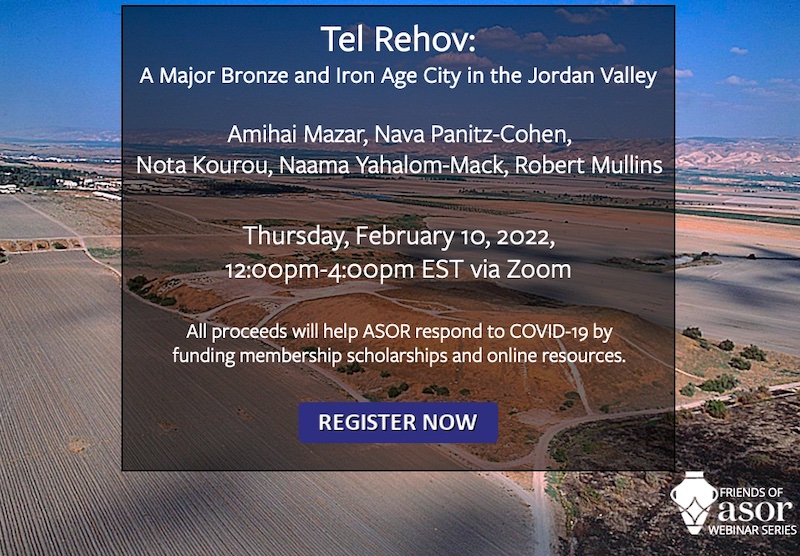
Friends of ASOR presents a webinar symposium on February 10, 2022 from 12:00pm to 4:00pm EST, “Tel Rehov: A Major Bronze and Iron Age City in the Jordan Valley,” featuring Prof. Amihai Mazar, Dr. Nava Panitz-Cohen, Prof. Nota Kourou, Prof. Naama Yahalom-Mack, and Prof. Robert Mullins. This special event will showcase the newly published findings from the site of Tel Rehov in Israel. The program will include 7 unique lectures covering such topics as the primary results from the site, the publication of the excavations, the Iron Age apiary, Tel Rehov in its Biblical historical context, Greek pottery from the site, the 8th century BCE Assyrian conquest, and metal-working. Each 20 minute lecture will be followed by Q&A with the audience and discussion among these distinguished panelists. Join us for an afternoon of exploration and celebration of years of work at this important site. The full program is below. The event will be recorded.

ASOR Sustaining Members: $0 | ASOR Members: $25 | Public: $50
Program Schedule
THURSDAY, FEBRUARY 10, 2022
12:00pm – 12:45pm
Amihai Mazar
The Hebrew University of Jerusalem
Introducing Tel Rehov: The Regional Project, the Site and its Identification, and Survey of the Main Results and Historical Implications
Read the Description
This lecture will provide a general introduction to the Tel Rehov excavations and will present some of the main results. The most significant points are the unusual foundation of a new large city in the Late Bronze Age, the continuity of Canaanite urban life with no significant break until the beginning of the Iron Age II, and the plethora of finds from the Iron Age IIA (10-9th centuries B.C.E). All these discoveries make this city one of the most important sites for studying society, economy, religious practices, and historical issues of the northern kingdom of Israel and the origin of the Nimshite Dynasty.
12:45pm – 1:05pm
Nava Panitz-Cohen
The Hebrew University of Jerusalem
From Spade to Shelf: The Research and Publication of the Tel Rehov Excavations
Read the Description
All archaeology enthusiasts are familiar with the excavation report as presented in a handsome volume sitting on a shelf in the library or in our homes. As someone who has participated in the process of bringing what the spade unearths in an excavation to the final product on your shelf, I will share with you some of the highlights – and frustrations – of this process and why it is, on the one hand, the bane of many archaeologists, yet on the other hand, perhaps the most-important part of any excavation.
1:05pm – 1:15pm
Break
1:15pm – 1:40pm
Amihai Mazar & Nava Panitz-Cohen
The Hebrew University of Jerusalem
What’s the Buzz? The Iron Age Apiary at Tel Rehov
Read the Description
A unique apiary was discovered at Tel Rehov during excavations from 2005 to 2007. About 30 hives made of unfired clay and straw were found in a destruction layer. Reconstruction indicates that there were 100-200 hives arranged in a well-organized system. This is the only apiary discovered so far in the ancient Near East and the Mediterranean world. Remains of charred honeycombs found in the hives contained charred bees, which were identified as most probably an Anatolian subspecies. These discovery raises many questions about subsistence and the economy that will be addressed in this lecture.
1:40pm – 2:05pm
Nava Panitz-Cohen
The Hebrew University of Jerusalem
The Unique Northwestern Quarter at Tel Rehov in its Biblical Historical Context
Read the Description
Among the numerous and fascinating finds from the Tel Rehov excavations is a quarter in the northwestern part of the tell, overlooking the Beth-Shean Valley. The quarter is composed of a series of inter-related buildings, each one with a unique plan. All of the buildings contain a plethora of objects left untouched since the violent destruction; some of them unique, some with evidence of intense weaving and grinding as well as feasting and ritual activities. Among the highlights are inscriptions bearing the names “Nimshi” and “Elisha,” both figures mentioned in the Bible, who played pivotal roles in events that took place in this part of the Israelite kingdom.
2:05pm – 2:30pm
Nota Kourou
The University of Athens
Connections between Greece and the Levant as Reflected by Greek Pottery from Tel Rehov
Read the Description
After the end of the Mycenaean period, Greek pottery appears again in Eastern Mediterranean in the early first millennium BCE, mainly at coastal sites. The astonishing recovery from well-dated contexts at Tel Rehov in the Beth Shean Valley of 14 Greek sherds in Late Protogeometric and Middle Geometric style (late 10th to middle 8th century BCE) forms the largest assemblage of this kind of pottery from an inland site. This dating suggests a connection with newly identified trading routes with the Arabah Valley in Jordan, a location from which copper was exported to Aegean communities, according to recent analytical data from bronze tripods from Olympia. Thus, the Tel Rehov sherds and the exported copper from Jordan could provide a new approach to Greek and Near Eastern relations at the beginning of the first millennium BCE.
2:30pm – 2:40pm
Break
2:40pm – 3:05pm
Robert Mullins
Azusa University, California
Tel Rehov in the 8th Century BCE: Partial Revival and Assyrian Conquest and Domination
Read the Description
Following the destruction of Stratum IV, a smaller city was rebuilt on the upper mound. Two strata can be attributed to Iron IIB. These consist of dwellings in Areas A, B, and J. The fortification system included a casemate wall in the earlier phase and a wide city wall in the latter phase. The slaughter of people in their homes in Area A bears witness to the severity of the Assyrian destruction. Squatter activity that followed included seven burials, some with Assyrian-type bottles, possibly indicating Assyrian presence. One burial was especially rich in finds and perhaps belonged to an elite.
3:05pm -3:30pm
Naama Yahalom-Mack
The Hebrew University of Jerusalem
Metal Working at Tel Rehov
Read the Description
The excavations at Tel Rehov yielded hundreds of metal objects and numerous metallurgical remains that attest to on-site metalworking. The study of such remains and their distribution sheds light on metalworking practices at the site, indicating a considerable change between the Late Bronze and Iron Ages, which are defined by the choice of raw materials, their origin, and metalworking traditions. Particularly significant is the evidence for an Egyptian metalworking tradition during the Late Bronze Age, and the introduction of iron into common use during the Iron IIA (10th and 9th centuries BCE).
3:30pm – 4:00pm
Audience Q&A with all Panelists
ASOR Sustaining Members: $0 | ASOR Members: $25 | Public: $50
To receive your ASOR member discount, log into the online store. If you are new to ASOR, please click on the “New Visitor Registration” link to register your e-mail address and choose password for our online store. Once logged in, navigate to “Meeting and Event Registration” to register for the symposium and pay the fee. Each paid registrant will receive a confirmation e-mail when you pay for the event. If you do not receive this e-mail, then you are not registered. Please e-mail membership@asor.org with any questions or issues with registering.
All proceeds from this symposium are used to fund scholarships for members impacted by COVID-19 as well as increasing ASOR’s online resources, which are free to the public.
Sponsors will be acknowledged during the event. Sponsorships are available at the following levels:
- Bronze Sponsor: $50
- Silver Sponsor: $100
- Gold Sponsor: $500
- Platinum Sponsor: $1,000
Each sponsor will receive a confirmation e-mail. If you do not receive this e-mail, then we did not receive your sponsorship online. If you prefer to register or sponsor over the phone, please call 703-789-9230. Please e-mail membership@asor.org with any questions or issues.
 Nota Kourou is Professor Emerita, Athens University, Greece. She studied Archaeology at Athens University (BA) and continued for her Ph.D at Oxford University, (Somerville College 1974-1979). She taught first as a lecturer and later became a Professor at Athens University from 1979-2012. In 2013, she became a Visiting Professor at Brussells University (ULB). Kourou has lectured at several Universities in the United States, Australia, and Europe, and was an Onassis Senior Lecturer in the United States in 2005. She participated in various excavations in Greece and has directed the Athens University Excavation at Xobourgo on Tenos, Cyclades since 1995, which has revealed a major island settlement.
 Amihai Mazar is Professor Emeritus at the Institute of Archaeology of the Hebrew University of Jerusalem. His main fields of interest are the archaeology of the Levant in the Bronze and Iron Ages and the relationship between archaeology and biblical history. He directed large-scale archaeological excavations at Tell Qasile (1973–1974, 1982–1988), Tel Batash (biblical Timnah) (1977–1989), Tel Beth Shean (1989–1996), and Tel Reḥov (1997–2012), as well as several smaller-scale projects. He is the author and editor of numerous publications, including Archaeology of the Land of the Bible, and fourteen volumes of final archaeological field reports. Mazar is a member of the Israel Academy of Sciences and Humanities and laureate of the Israel Prize for archaeological research.
 Robert Mullins is Professor and Chair in the Department of Biblical and Religious Studies at Azusa Pacific University. He received his Ph.D from The Hebrew University of Jerusalem. Prior to joining the faculty of APU, he served as a research assistant to Prof. Amihai Mazar and the Beth-Shean Valley Archaeological Project. In addition to his work at Beth-Shean, Rehov, and Gezer, Mullins has also excavated at Tell Atchana (Alalakh) and Zincirli (Sam’al) in southeastern Turkey. He currently co-directs joint excavations at Tel Abel Beth Maacah with the Hebrew University of Jerusalem. His recent publications include the Atlas of the Biblical World (Fortress Press, 2019).
 Nava Panitz-Cohen is a researcher at the Institute of Archaeology of the Hebrew University of Jerusalem, where earned her Ph.D, and is now an adjunct instructor and editor of the Qedem Monograph Series of the Institute. Her field work included Tel Batash, Tel Beth-Shean and Tel Rehov, and she participated in the publication of these sites. She is currently co-director of excavations at Tel Abel Beth Maacah in the Hula Valley in northern Israel alongside Naama Yahlom-Mack and Robert Mullins. Her research interests include Bronze and Iron Age ceramics, ceramic technology, household, gender, and experimental archaeology.
 Naama Yahalom-Mack is an associate professor of Bronze and Iron Age archaeology at the Institute of Archaeology, The Hebrew University of Jerusalem, and is head of the Institute’s Laboratory for Archaeological Materials and Ancient Technologies. She is currently co-director of the Tel Abel Beth Maacah excavations in the Hula Valley. Her research focuses on archaeometallurgy and on the provenancing of archaeological materials as a proxy for reconstructing ancient trade and economic interaction.

ASOR is grateful for your support. Each registrant will receive an automated confirmation e-mail. If you do not receive this e-mail, please check you Spam folder and then contact ASOR. If you prefer to register over the phone, please call 703-789-9230. Please e-mail membership@asor.org with any questions or issues.
PAST WEBINARS
You can now purchase the link to the recording of any webinar. You can also purchase the bundle packages of all webinars from the 2020-2022 seasons. Please e-mail membership@asor.org for purchase details.
To see a printable pdf of the webinar titles from the 2020-2021 season, please click here. To see a printable pdf of the webinar titles from the 2021-2022 season, please click here.
Pricing:
Members: $6.00 per recording
Non-Members: $12.00 per recording
Bundle of 2020-2021 Webinars: $75.00
Bundle of 2021-2022 Webinars: $75.00
Bundle of 2020-2022 Webinars: $125.00
2021-2022 Season
A World at War: Protecting Cultural Heritage in Times of Conflict
Patty Gerstenblith (DePaul University), Lisa Ackerman (Columbus Citizens Foundation), Andrew Cohen (Government Professional and Cultural Heritage Expert) | May 12, 2022
Preserving Cultural Heritage in Hisban and Umm al-Jimal, Jordan
Øystein LaBianca (Andrews University), Elizabeth Osinga (Umm al-Jimal Archaeological Project), Darrell Rohl (Calvin University) | April 24, 2022
Back to the Field: Recent Discoveries & Summer Plans 2022
Lorenzo d’Alfonso (ISAW), Kathryn Grossman (NC State University), James R. Strange (Samford University) | April 3, 2022
Uncovering What is Nubian Beneath the Veneer of Egyptianness: Excavating the Archives
Debora Heard (University of Chicago) | March 20, 2022
Where Are They Now?: A Preview of 2022 ASOR-Affiliated Fieldwork Projects
Michael Given (University of Glasgow), Xenia-Paula Kyriakou (Florida Gulf Coast University), Stephen Batiuk (University of Toronto), Monique Roddy (Walla Walla University), Kent Bramlett (La Sierra University), Friedbert Ninow (La Sierra University), and Michael Hoff (University of Nebraska-Lincoln) | March 8, 2022
Excavations at Tel Gezer: A Personal Story
Sam Wolff (Tel Gezer Laboratory) | February 20, 2022
Tel Rehov: A Major Bronze and Iron Age City in the Jordan Valley
Amihai Mazar (Hebrew University of Jerusalem), Nava Panitz-Cohen ( Hebrew University of Jerusalem), Nota Kourou (Athens University), Naama Yahalom-Mack (Hebrew University of Jerusalem), Robert Mullins (Azusa Pacific University) | February 10, 2022
The Not-So-Innocents Abroad: The Beginnings of American Biblical Archaeology
Rachel Hallote (Samford University) | January 20, 2022
Synagogues as Jesus Knew Them
James R. Strange (Samford University) | December 2, 2021
Under Jerusalem: The Buried History of the World’s Most Contested City
Andrew Lawler | November 4, 2021
Jesus and Jerusalem on TV: How Do Bible Documentaries Get Made?
Robert Cargill (University of Iowa) | October 17, 2021
Digging the Divine?: Judahite Pillar Figurines and the Archaeology of Israelite Religion
Erin Darby (University of Tennessee) | October 7, 2021
David, Solomon, and Rehoboam’s Kingdom—The Archaeological Evidence
Yosef Garfinkel (Hebrew University of Jerusalem) | September 19, 2021
From Standing Stones to Sacred Emptiness: Textual and Visual Portrayals of Israel’s God
Theodore Lewis (Johns Hopkins University) | August 29, 2021
2020-2021 Season
Making May Matter: Webinarathon to Endow Diversity
Multiple Speakers | May 21-23, 2021
Archaeogaming: Why Video Games Deserve Their Own Archaeology
Tine Rassalle (University of North Carolina at Chapel Hill), Shannon Martino (Morton College), Matthew Winter (University of Arizona), Michael Zimmerman (Rhode Island) | April 18, 2021
How the Bible Became a Book
William Schniedewind (UCLA) | March 21, 2021
The Mysteries of Mithras in Caesarea: Exploring the Cult’s Rites and Remains
Jane DeRose Evans (Temple University), Alexandra Ratzlaff (Brandeis University) | March 11, 2021
Archaeology and the Hidden Religious Culture of Israelite Women
Carol Meyers (Duke University) | February 21, 2021
Meet the Directors—Fundraiser to Support ASOR’s Affiliated Overseas Research Centers
Matthew J. Adams (AIAR), Pearce Paul Creasman (ACOR), Lindy Crewe (CAARI) | February 11, 2021
Early Synagogues, Jesus, and Galilee—A Jewish Perspective
Eric Meyers (Duke University) | December 13, 2020
Home Sweet Home: Ancient Israelite Households in Context
Cynthia Shafer-Elliott (William Jessup University) | October 18, 2020
Priestesses in the Days of Solomon and Ahab
Susan Ackerman (Dartmouth College) | September 13, 2020
Digging Deeper: How Archaeology Works
Eric H. Cline (The George Washington University) | August 9, 2020