UNEARTHING THE PAST SINCE 1900
  • BECOME A MEMBER
  • RENEW
  • GIVE NOW
  • SEARCH
  • ONLINE PORTAL
  • American Society of Overseas Research (ASOR)American Society of Overseas Research (ASOR)
  • ABOUT
    • WELCOME FROM ASOR OFFICERS
    • HISTORY OF ASOR
    • MISSION, BYLAWS, & STRATEGIC PLAN
    • Board of Trustees
    • COMMITTEES
    • POLICIES
    • FINANCIAL DOCUMENTS
    • MEDIA RELEASES
    • CONTACT US
  • CULTURAL
    HERITAGE
    • ABOUT CULTURAL HERITAGE INITIATIVES
    • UPDATES
    • PAST GRANTS
    • TUTORIALS
    • Who We Are
  • ANNUAL
    MEETING
    • REGISTRATION
    • HOTEL RESERVATIONS
    • ANNUAL MEETING SCHEDULES
    • SPONSOR & EXHIBIT
    • ASOR Online Library
    • HONORS & AWARDS
    • ANNUAL MEETING SCHOLARSHIPS
    • PAST & FUTURE ANNUAL MEETINGS
  • MEMBERSHIP
    & RESOURCES
    • INDIVIDUAL MEMBERSHIPS
    • INSTITUTIONAL MEMBERSHIPS
    • NEWS@ASOR
    • PAST ASOR NEWS, MONTH BY MONTH
    • AFFILIATED PROJECTS
    • AFFILIATED RESEARCH CENTERS
    • ARCHIVES
    • ONLINE RESOURCES
      • PHOTO COLLECTION
    • EARLY CAREER MEMBER RESOURCES
  • FELLOWSHIPS
    & GRANTS
    • SCHOLARSHIPS FOR FIELDWORK PARTICIPATION
    • GRANTS FOR ARCHAEOLOGICAL PROJECTS
    • RESEARCH FELLOWSHIPS FOR MEMBERS
    • MEMBERSHIP & ANNUAL MEETING SCHOLARSHIPS
    • ASOR-AFFILIATED RESEARCH CENTERS FELLOWSHIPS
    • OTHER FELLOWSHIP PROGRAMS
  • PUBLICATIONS
    • BOOK SERIES & MONOGRAPHS
    • BULLETIN OF ASOR
    • JOURNAL OF CUNEIFORM STUDIES
    • MAARAV
    • NEAR EASTERN ARCHAEOLOGY
    • THE ANCIENT NEAR EAST TODAY
    • News@ASOR
    • LEVANTINE CERAMICS PROJECT
  • FRIENDS
    OF ASOR
    • Webinars
    • TOURS
    • THE ANCIENT NEAR EAST TODAY
    • ASOR ONLINE LIBRARY
  • Donate
    • FY25 HONOR ROLL OF DONORS
    • LIFETIME HONOR ROLL OF DONORS
    • ASOR LEGACY CIRCLE
    • WAYS TO DONATE

 SHARE


NEWS@ASOR E-NEWSLETTER

ANCIENT NEAR EAST TODAY E-NEWSLETTER

PAST ASOR NEWS, MONTH BY MONTH

ASOR LEGACY CIRCLE MEMBERS

LIFETIME HONOR ROLL OF DONORS

FY25 HONOR ROLL OF DONORS

ASOR ANNUAL MEETING

Construction: The Ancient Anatolian Way

Lauren Cook, 2024 BIPOC Scholarship Fieldwork Recipient

This summer, I had the opportunity to excavate for the first time at the site of Alalakh (Tell Atchana) in Hatay, Türkiye. Although I had obtained my masters in Archaeology back in 2021, I had not had the chance to participate in archaeological fieldwork at that time because of the COVID-19 pandemic. When I was accepted to excavate at Alalakh this July I could not wait for the project to begin, however, I was surprised by the unique and interesting work I got to be a part of there. Apart from our normal excavation project, my fellow colleagues and I got to be a part of an exciting and groundbreaking experimental archaeological initiative where we worked to reconstruct the site’s mudbrick walls and protect its ancient foundations.

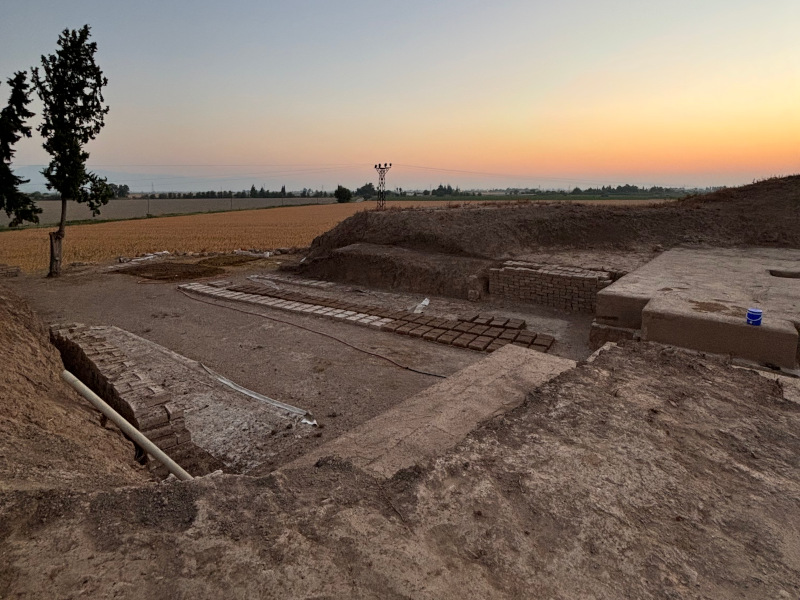
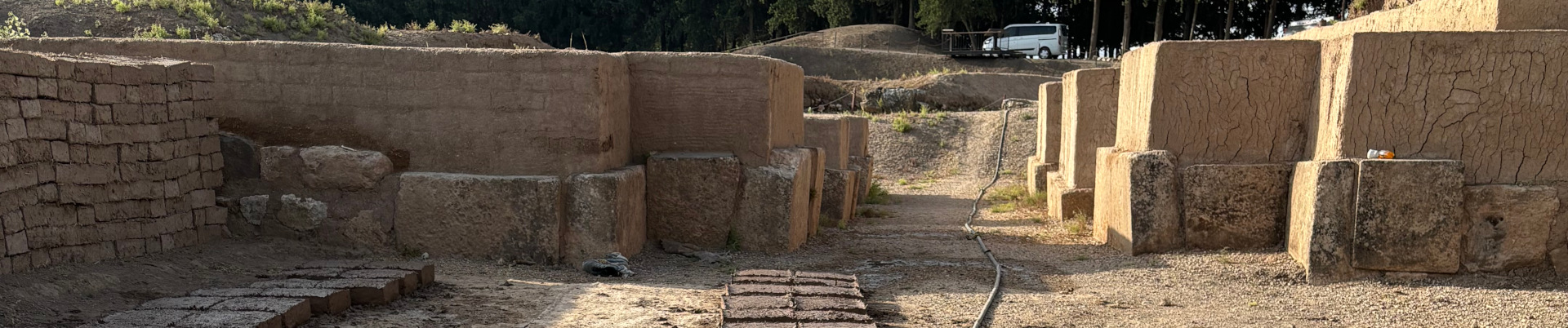
Elevated view of completed and finished mudbricks

On my first day at the site Dr. Akar, our site director, stated that although one of our goals was to uncover the site’s mudbrick architecture; exposing the ancient mudbrick to the elements causes it to rapidly deteriorate. In order to preserve the site’s ancient foundation and to give visitors a better sense of what the site would have looked like in antiquity we would spend part of the summer’s excavation season creating mudbricks and reinforcing the site’s mudbrick walls using ancient building techniques.

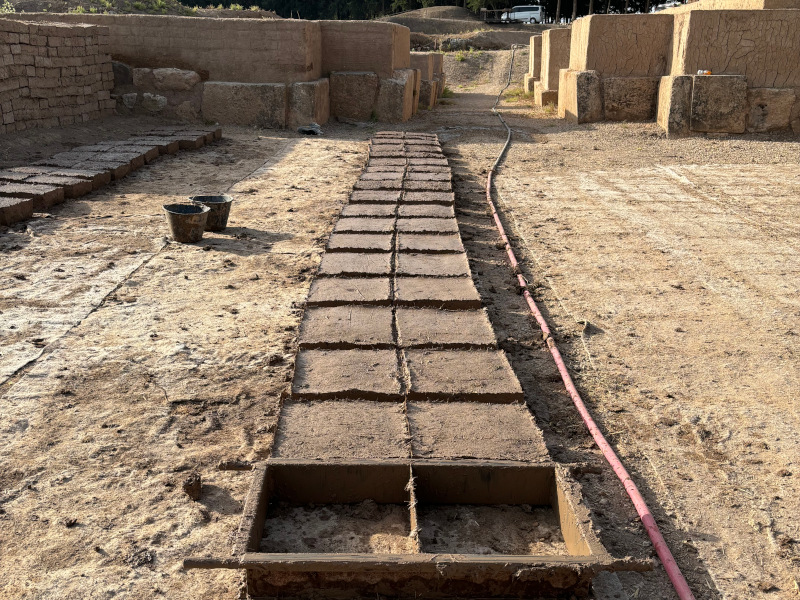
To begin making a mudbrick wall you first need to create the mud bricks. Dr. Akar consulted with members of the local community on mud brick recipes, as up until relatively recently in the adjoining village of Tayfursökmen and the surrounding areas people where still building with mudbrick. However, the practice had sharply fallen out of favor, being replaced by more modern building techniques. The mud that we used was a mixture of soil, straw, and water which we would mix until it was wet and could hold shape. Working in pairs we would then throw the mud into brick shaped molds; the trick was to make sure that copious mud was packed into the corners as this gives the brick its stability. Once the molds were filled, my workmate and I, would remove the mold with one swift, fluid movement – leaving a mud cube behind. Then we would re-set and start the process all over again.

Line of mudbricks and mold
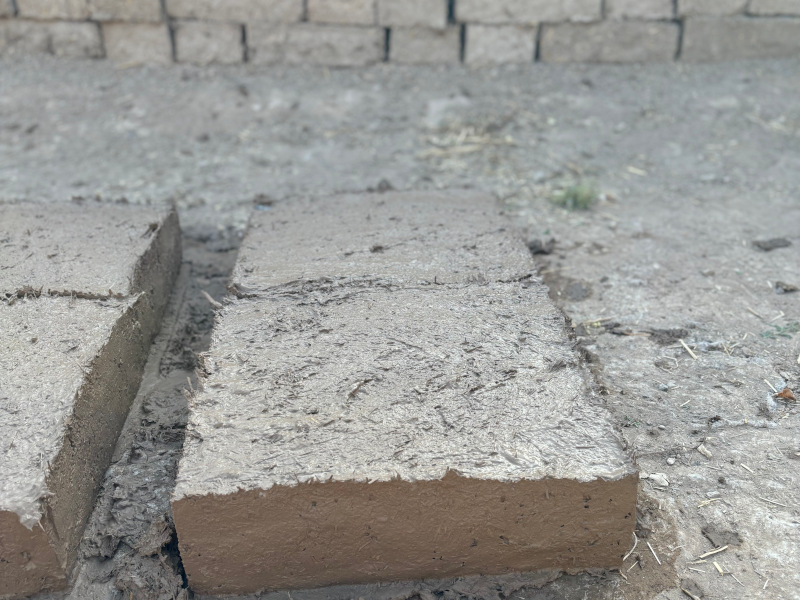
Pair of mudbricks

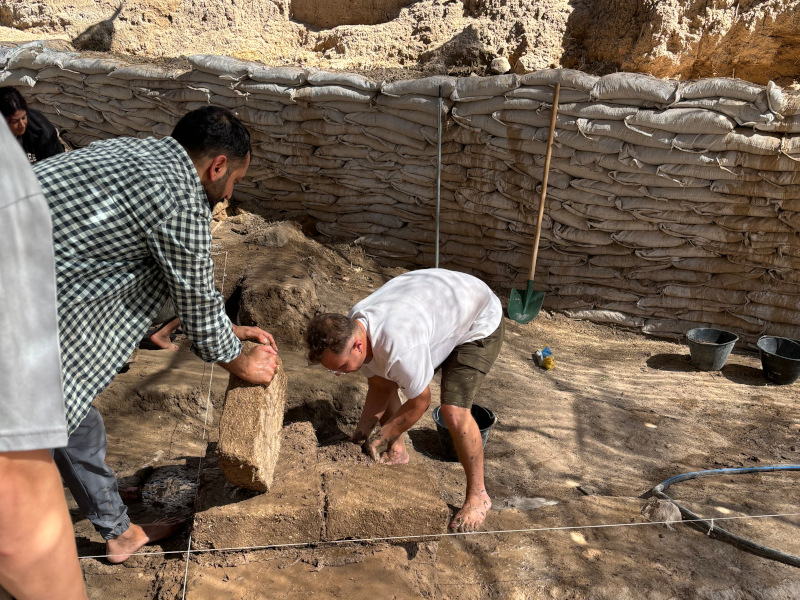
These bricks would be set aside to dry for at least a week before they would be utilized in the next stage of the process, construction. Water was the key ingredient in this step as it allowed us to adhere and secure the bricks to the foundations and to each other. We would wet the surface on which the bricks were to be set and add a substantial, but flattened layer of mud to act as an adhesive. We would then wet the bricks and carefully place them in the mud, adding layers of mud between them so that they would adhere. Finally, we would cover the newly created wall with a final layer of mud and leave it to dry. Once the wall had dried over several days, we would go back and add a final layer of mud in order to smooth and plaster the wall.

Building the wall

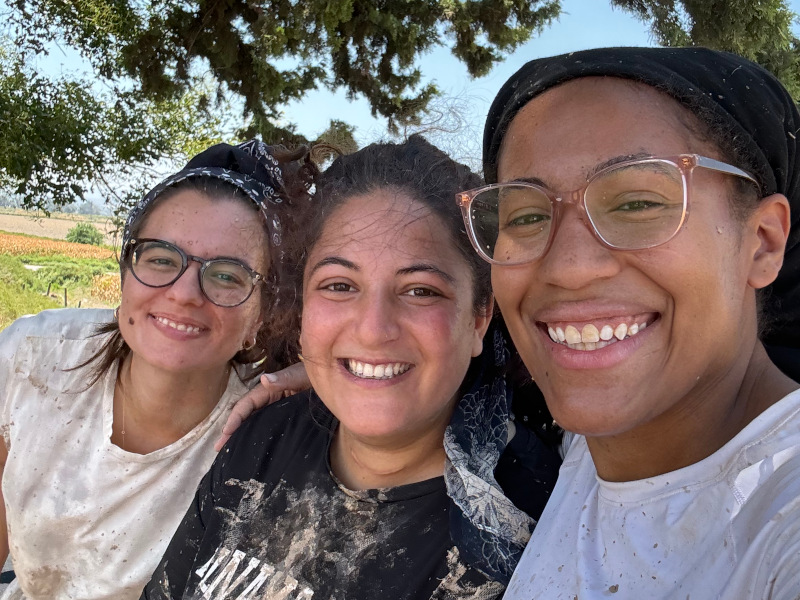
This was a messy and labor-intensive process to be sure and we would always end these days covered in mud from head-to-toe, but the days where we made mudbricks and built walls were also the most fun. Some of my best memories from Alalakh were when we would plaster the mudbrick walls while dancing to YMCA, or when the team would get into an inevitable mud fight! There was also something magical about the process of building as working with the mud would often transport us back to the Middle Bronze Age where we could see in real time the problems that ancient builders would have encountered, and following in their footsteps often used stones, ceramic fragments, water, mud, and straw as solutions. Once we were done with our work looking down at the freshly made walls from the top of the tell, I was often filled with a strong sense of pride knowing that these efforts would help to preserve the site for years to come.

Covered in mud but still having fun

Lauren Cook is a Baltimore-based doctoral student studying Art History at Johns Hopkins University. She is interested in imperialism and alterity in Ancient West Asia. Lauren received a dual BA in Art History and Archaeology from Pitzer College as well as a MPHIL in Mesopotamian Archaeology from the University of Cambridge.

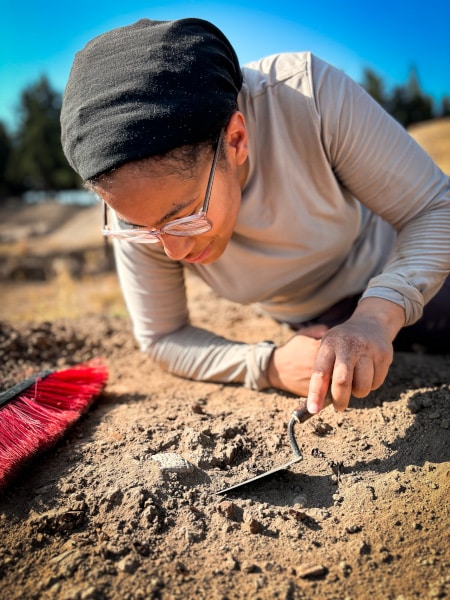
Lauren excavating a Late Bronze Age tablet. Photo courtesy of Murat Akar.

ASOR is now accepting applications for 2025 Fieldwork Participation Scholarships. Learn how to apply here.

Want to help more students and early career archaeologists get into the field? Donate to the cause today by selecting “Fieldwork Scholarships” as your gift purpose!
BROWSE THE NEWS ARCHIVE

  • Table of Contents for BASOR 395 (May 2026)
  • FOA Webinar: Danielle Candelora
  • 2025 Dana Grant Report: Rediscovering Ancient Clay Landscapes
  • Fieldwork Report: Joshua Feland

Latest Posts from @ASORResearch

asor_research

Initiating and supporting research of the history and cultures of the Near East and wider Mediterranean world.


Our #ObjectoftheWeek is a terracotta kitchen mold
Our #ObjectoftheWeek is a terracotta kitchen mold of an anthropomorphic woman, found at the Amorite royal palace complex in Mari (modern-day Syria). ca. 1782-1759 BCE. Louvre AO 18913. Credit: 2022 Musée du Louvre, Dist. GrandPalaisRmn / Raphaél Chipault
#Archaeology #Amorite #Syria


The Cultural Heritage Watch platform not only docu
The Cultural Heritage Watch platform not only documents the damage to Iran’s heritage in wartime but preserves the social memories and meanings of these places. Read the newest ANE Today by Kiersten Neumann by clicking the link (https://anetoday.org/cultural-heritage-watch-iran/) in our bio.
#Iran #CulturalHeritage


Join us for the LAST Friends of ASOR webinar of th
Join us for the LAST Friends of ASOR webinar of the season on Wednesday, May 6th at 7:00pm ET: “'I am the border': Borders and Immigration in Ancient Egypt” presented by Dr. Danielle Candelora. Issues of borders, citizenship, and immigration are at the forefront of media headlines around the globe, and are examined across fields as diverse as Political Science and Sociology to Comparative Literature and the Visual Arts. Exploring these multiple approaches allows for new insights into the entangled concepts of borders, immigration, and identity in ancient Egypt. 
Register at the link in our bio: https://www.asor.org/news/2026/04/webinar-candelora
#AncientEgypt


Make sure to tune in TOMORROW at 12:30 pm ET for t
Make sure to tune in TOMORROW at 12:30 pm ET for the next FOA webinar presented by Yana Tchekhanovets: "New Excavations at Nessana, Negev: Late Antique Pilgrimage Hub on the Desert Fringe." If you haven't already signed up, click here to register for free: https://www.asor.org/news/2026/04/webinar-tchekhanovets


Last chance to nominate! Know a standout recent bo
Last chance to nominate! Know a standout recent book 📖 on the ancient Near East or Eastern Mediterranean? Make sure it gets the recognition it deserves by submitting it for an ASOR Book Award. Nominations close May 1. Press the link in our bio to learn more: https://buff.ly/jt6dx1G
📸 Winner of the 2025 Lapp Award


ASOR invites Roundtable Proposals from members who
ASOR invites Roundtable Proposals from members who plan to attend the 2026 Annual Meeting in Chicago, November 18-21. Roundtables are an ideal format for informal discussion or focused conversations on topics of general interest to meeting attendees. Roundtable proposals of 250 words or fewer will be reviewed through October 31 (or until space fills). Learn more and submit your roundtable proposal at the link in our bio: https://www.asor.org/am/2026/round-tables-2026


Our spring book sale is ending soon! These books,
Our spring book sale is ending soon! These books, plus several other titles, are available for the low price of $10.00 each. All proceeds go towards membership scholarships, helping expand access to ASOR’s programs and resources. Check out the sale on our website before it's over: https://buff.ly/Vn3LEZy


Joshua Feland, a master’s student at the Universit
Joshua Feland, a master’s student at the University of Alberta, received an Eric and Carol Meyers Fieldwork Scholarship in 2025 to excavate in Humayma, Jordan. As a supervisor on the project, Joshua was tasked with teaching photogrammetry techniques to students using the structures at Humayma and previously excavated material. Read his fieldwork report at the link in our bio: https://www.asor.org/news/2026/04/fieldwork-report-feland
#Jordan #Humayma #Archaeology


ASOR's Early Career Scholars hosted Dr. Danielle M
ASOR's Early Career Scholars hosted Dr. Danielle Macdonald (The University of Tulsa) for their Spring 2026 Brown Bag lecture, "Scientific Publishing in Archaeology: Ask an Editor." Dr. Macdonald provides insights into the publication process, including understanding peer review, manuscript preparation best practices, responding to reviewer comments, and current trends in scientific archaeological publishing, such as open access models. Watch the lecture on YouTube at the link in our bio: https://www.youtube.com/watch?v=JDQxb_I0A3Y


Join us for the next Friends of ASOR webinar on We
Join us for the next Friends of ASOR webinar on Wednesday, April 29th at 12:30pm ET: “New Excavations at Nessana, Negev: Late Antique Pilgrimage Hub on the Desert Fringe” presented by Yana Tchekhanovets. The ancient settlement of Nessana, located in the southwestern Negev, on the modern Israeli–Egyptian border, is a key site for the study of early Christian pilgrimage. This lecture will present the preliminary results of the first four seasons of renewed excavations at the site. Read more and register at the link in our bio: https://www.asor.org/news/2026/04/webinar-tchekhanovets


Our #ObjectoftheWeek is a terracotta model of a bo
Our #ObjectoftheWeek is a terracotta model of a boat with multiple persons and birds, decorated with geometric patterns. From Cyprus, Middle Bronze Age, ca. 2000-1600 BCE. Louvre AM972. Credit: Musée du Louvre, Dist. GrandPalaisRmn / Raphaél Chipault
#Archaeology #Cyprus #BronzeAge


Ancient Nessana is not associated with any biblica
Ancient Nessana is not associated with any biblical events or major relics. However, during the Byzantine period, it emerged as a prominent Christian center for pilgrims traveling to Sinai. Read more in the latest ANE Today at the link in our bio: https://anetoday.org/ancient-nessana-pilgrimage/
📸 ©Nessana Expedition
#Byzantine #Christianity #Negev


Don't forget to tune in TONIGHT at 7:00 pm ET for
Don't forget to tune in TONIGHT at 7:00 pm ET for the next FOA webinar presented by Dr. Kevin Fisher: "Kalavasos and Maroni Revisited: New Explorations of Late Bronze Age Urban Landscapes in Southcentral Cyprus." If you haven't already signed up, click the link in our bio to register for free: https://buff.ly/Me2Ax1K


Atakan Atabas, a PhD student at the University of
Atakan Atabas, a PhD student at the University of Central Florida, received a Shirlee Meyers/G. Ernest Wright Fellowship to excavate at Kerkenes, Türkiye in 2025. During the 2025 season, Atakan contributed to survey and geophysical work, including electrical resistivity mapping, while also engaging with local communities and exploring how interdisciplinary approaches can be applied. Read more at the link in our bio: https://www.asor.org/news/2026/03/fieldwork-report-atabas
#Turkiye


April 15 is the last day to register for the 2026
April 15 is the last day to register for the 2026 Annual Meeting and take advantage of Early Bird savings. If you are planning to join us in Chicago, November 18–21, don’t miss your chance to save $50 by registering today. A full and exciting program is taking shape, featuring engaging sessions and workshops, new research, and plenty of opportunities to connect with friends and colleagues. We look forward to welcoming you this November at the Hilton Chicago. Register now at the link in our bio: https://www.asor.org/am/2026/annual-meeting-registration-2026


Since launching in January, ASOR’s Sudan National
Since launching in January, ASOR’s Sudan National Museum Access Project has made steady progress in strengthening site security and restoring key infrastructure at the Sudan National Museum in Khartoum. Over the last three months, the work has focused on two main priorities: repairing a damaged enclosure wall and clearing the property’s sewage drainage system. Read the project update here: https://www.asor.org/chi/updates/2026/04/sudan-museum-project-update
#Sudan


Do you know of a recently published great book 📚️
Do you know of a recently published great book 📚️ on the ancient Near East and Eastern Mediterranean? Nominate it for a Book Award today! ASOR is proud to give three awards annually: the Frank Moore Cross Award, the Nancy Lapp Popular Book Award, and the G. Ernest Wright Award. Nominations are due by May 1: https://www.asor.org/about-asor/honors-awards/
📸 winner of the 2025 Cross Award


Join us for the next Friends of ASOR webinar on We
Join us for the next Friends of ASOR webinar on Wednesday, April 15th at 7:00pm ET: “Kalavasos and Maroni Revisited: New Explorations of Late Bronze Age Urban Landscapes in Southcentral Cyprus,” presented by Dr. Kevin Fisher. Compared with some of its better-known neighbors in the ancient eastern Mediterranean and Near East, Cyprus sees the relatively late emergence of urbanism. Its first cities appear in the Late Bronze Age (c. 1700-1100 BCE), along with other changes to the built environment. This talk presents the results of recent work by the Kalavasos and Maroni Built Environments (KAMBE) Project, a collaborative and interdisciplinary investigation of the relationship between urban landscapes and social change in south-central Cyprus during the Late Bronze Age. Register at the link in our bio: https://www.asor.org/news/2026/03/webinar-fisher
#Cyprus #BronzeAge


The cuneiform sources of ancient Mesopotamian hist
The cuneiform sources of ancient Mesopotamian history are abundant. They are nevertheless incomplete, having been filtered by ancient processes of preservation and destruction, shaped by chance discoveries and scientific practices. Read the newest ANE Today by clicking the link in our bio: https://anetoday.org/cuneiform-written-artifacts/
#Mesopotamia #Cuneiform
📸: © Cécile Michel


Happy Passover! Our #ObjectoftheWeek is a hexagona
Happy Passover! Our #ObjectoftheWeek is a hexagonal glass pilgrim's jar from ca. 578-636 CE, with Jewish symbols such as the menorah on it. Such jars were often made for pilgrims visiting holy sites or for use in burial rituals. Credit: Metropolitan Museum of Art. 1972.118.180
#Archaeology #Byzantine #Passover


Instagram

Stay updated with the latest insights, photos, and news by following us on Instagram!

Follow Us on Instagram

American Society of Overseas Research
The James F. Strange Center
209 Commerce Street
Alexandria, VA 22314

E-mail: info@asor.org

© 2025 ASOR
All rights reserved.
Images licensed under a Creative Commons Attribution-NonCommercial-ShareAlike 4.0 International License

Contact Us
Membership
Give
Friends of ASOR
ASOR Cultural Heritage Initiatives
Terms of Use
News

Please follow & like us :)
Facebook
YouTube
LinkedIn