Fieldwork Report: Olivia Spink
Olivia Spink, 2025 Eric and Carol Meyers Fieldwork Scholarship Recipient
I had the privilege and pleasure of attending the Tell Timai International Training Program this July in Egypt. I am so thankful to ASOR and Profs. Eric and Carol Meyers for making this dream a reality. Tell Timai or ancient Thmuis is situated in the Nile Delta, about two hours from Cairo. The site is a town that mostly dates to the Greco-Roman Period. While this was not a typical excavation season, the lectures, workshops, field trips, and training sessions working with Egyptian, American, British, and Australian colleagues was an unforgettable, unique, and informative experience. In this report, I will recount several aspects of the Program and reflect upon the skills learned experiences that ultimately armed me with not only archaeological skills applicable to my career but also with an amplified enthusiasm and drive to focus more on Egyptian archaeology in my graduate studies.
After all team members had arrived in Cairo, we spent a day in the city and our learning began immediately. After an early morning trip to see the Pyramids in Giza, we had the opportunity to visit the American Research Center in Egypt (ARCE) where we went on a guided tour of the Center and gained insight into their digital archival process. Following the visit, we attended a lecture on 19th century cultural heritage in Luxor by Sylvie Weens at the Netherlands-Flemish Institute in Cairo.

We soon departed Cairo and headed to the dig house, which was about 2 hours from the city. Once everyone was settled, we wasted no time in beginning training. Egyptian classical archaeology professor Dr. Mohamed Abouarab from Kafr El Sheikh University presented an introduction to archaeology lecture. After the lecture, we had our first fieldwork training session. Using the floor as a mock trench, with rocks and features included, we were guided through making plan drawings. Over the next few days, we had lectures on all things Timai — history, history of excavations, recent finds, technologies used, and more — delivered by project co-director Dr. JaySilverstein from Nottingham Trent University.
One of the most notable elements of the history of Timai was its destruction in the early second century BC. The destruction layer revealed evidence of widespread burning, the sudden abandonment of dwellings, the destruction of a kiln complex, the presence of weapons like arrowheads alongside numerous unburied human remains across North Tell Timai that indicate that the city of Thmouis was destroyed violently. The pattern of destruction at Timai closely resembles accounts of the destruction of Lycopolis, a city in the Busiris nome also in the Nile Delta, during the Great Revolt, which was recorded on the Rosetta Stone in 196 BC.
One particularly fascinating find was the remains of a male human body inside a kiln. The team at Timai has agreed that the body was of a man who went into hiding in a kiln to escape the violence and was then killed while he was inside of the kiln. Osteological evidence has revealed that the man was a warrior and was wounded in the armin a previous battle as shown by the healed callous fusing together his radius and ulna. However, they have also concluded that this man was also fighting in this “destruction layer’s” episode of battle, as evidenced by an unhealed fracture in his radius consistent with the ancient combat defensive parry fracture of the “shield arm.” (Silverstein and Littman 2022).
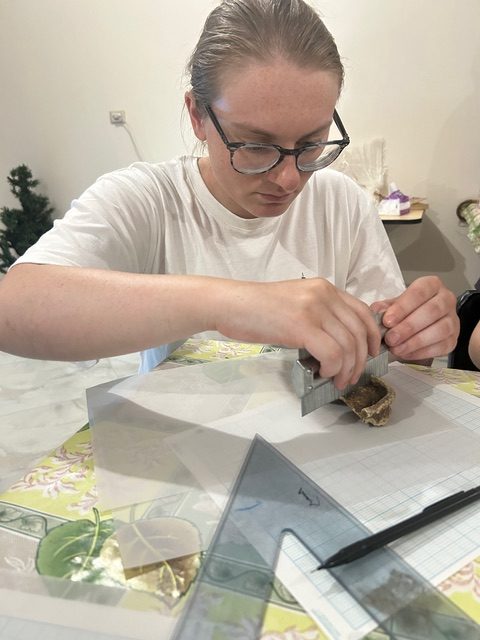
The next week, we were joined by ceramic specialist Dr. Amany Shabaan, who delivered several lectures on ceramics at Timai and also in general, everything from what to do when we find a sherd in the field through digital pottery drawing. She also helped us through workshops on sherd identification and hand pottery drawing. I have experience with sorting and cataloguing pottery, but I did not have experience with pottery drawing, which was a skill that is needed to work on the pottery team at many excavations. These training sessions learning ceramic archaeological skills were my favorite workshops! Moving from ceramecology to Zooarchaeology, we also examined a camel skeleton and a horse skeleton, both of which I had never seen before.

Later in the session, we also visited our Egyptian colleagues at their university museum, the Kafr El Sheikh Museum and attended a lecture outlining the contents of the exhibit, which was fantastic and traced the theme of a horseman killing a monster, which also signals the victory of good over evil. The early Egyptian examples include Horus killing his uncle Seth on horseback, a theme that can be seen also in later Christian examples depicting a Saint killing a monster. During my undergrad at New York University, I completed a project exploring iconographic representation of generational succession myths on the Archaic Athenian Acropolis, specifically the Hekatompedon. My project proposes that the Greeks took its inspiration from the Ancient Near East who also tended to portray their succession myths in art as well, but earlier. When I continue this research, I will absolutely include the Egyptian examples of Horus contending Seth that were exhibited at the Kafr El Sheikh Museum.
To conclude, I will mention a few of the most relevant sites and cultural trips that we went on during the Training Period; firstly, our trip to Luxor. In addition to seeing sites like theValley of the Kings, Valley of the Queens, Karnak and Luxor temple, we met with Rais Mahmood, who was an important directing archaeologist at Karnak Temple. We met him in his family home for tea and mango juice and heard about his incredible experiences and accomplishments. He graciously invited us over again the next day to have lunch. We had koshari, which is a staple of Egyptian cuisine and might be my new favorite food. He also showed us how ancient Egyptians moved blocks of stone. Later onin the day, he walked us through Luxor Temple. Thank you to Rais Mahmood and the entire Farouk family for bringing us into their home and treating our team like family.

The last days of the program were spent in Alexandria, which was the perfect end to weeks spent learning about the Greco-Roman period of Timai. Arriving at the Archaeology Museum of Alexandria, I anxiously awaited my first glimpse at the pièce de résistance, arguably the most famous piece uncovered in the history of excavations at Timai: the mosaic of Ptolemaic queen Arsinoe II with the ship on her head as the personification of the city of Alexandria. Dr. Jay Silverstein led us through several rooms that had artifacts from Timai, including the aforementioned mosaic. He pointed out severalinaccuracies in the labels and exhibition signage in relation to Timai throughout the museum. Ideas about what sources and authorities to trust were discussed amongst the group. Regardless, it was a privilege to see the pieces in such a renowned museum. While leading us through the museum, Dr. Jay reminded us of next year’s excavation plans and told us to stay tuned, and it was at that moment that I was convinced that I wanted to return to Timai to excavate next summer.
My experience at the Tell Timai International Training Program was nothing short of spectacular. This program not only strengthened my archaeological skills in areas such as site plan drawing and pottery illustration but also invigorated my academic focus, fueling a renewed passion for Egyptian archaeology that I will carry forward into my graduate research at Cornell University in the MA program in Archaeology. I leave with a clearer vision, strengthened skills, lasting connections, and an eagerness to join the next excavation season (inshaallah). My deepest gratitude goes to the Tell Timai team, ASOR, and Profs. Eric and Carol Meyers.
Olivia Spink is currently pursuing her MA in Archaeology at Cornell’s Institute of Archaeology and Material Studies.
Want to help more students and early career archaeologists get into the field? Donate to the cause today by selecting “Fieldwork Scholarships” as your gift purpose!