UNEARTHING THE PAST SINCE 1900
  • BECOME A MEMBER
  • RENEW
  • GIVE NOW
  • SEARCH
  • ONLINE PORTAL
  • American Society of Overseas Research (ASOR)American Society of Overseas Research (ASOR)
  • ABOUT
    • WELCOME FROM ASOR OFFICERS
    • HISTORY OF ASOR
    • MISSION, BYLAWS, & STRATEGIC PLAN
    • Board of Trustees
    • COMMITTEES
    • POLICIES
    • FINANCIAL DOCUMENTS
    • MEDIA RELEASES
    • CONTACT US
  • CULTURAL
    HERITAGE
    • ABOUT CULTURAL HERITAGE INITIATIVES
    • UPDATES
    • PAST GRANTS
    • TUTORIALS
    • Who We Are
  • ANNUAL
    MEETING
    • REGISTRATION
    • HOTEL RESERVATIONS
    • ANNUAL MEETING SCHEDULES
    • SPONSOR & EXHIBIT
    • ASOR Online Library
    • HONORS & AWARDS
    • ANNUAL MEETING SCHOLARSHIPS
    • PAST & FUTURE ANNUAL MEETINGS
  • MEMBERSHIP
    & RESOURCES
    • INDIVIDUAL MEMBERSHIPS
    • INSTITUTIONAL MEMBERSHIPS
    • NEWS@ASOR
    • PAST ASOR NEWS, MONTH BY MONTH
    • AFFILIATED PROJECTS
    • AFFILIATED RESEARCH CENTERS
    • ARCHIVES
    • ONLINE RESOURCES
      • PHOTO COLLECTION
    • EARLY CAREER MEMBER RESOURCES
  • FELLOWSHIPS
    & GRANTS
    • SCHOLARSHIPS FOR FIELDWORK PARTICIPATION
    • GRANTS FOR ARCHAEOLOGICAL PROJECTS
    • RESEARCH FELLOWSHIPS FOR MEMBERS
    • MEMBERSHIP & ANNUAL MEETING SCHOLARSHIPS
    • ASOR-AFFILIATED RESEARCH CENTERS FELLOWSHIPS
    • OTHER FELLOWSHIP PROGRAMS
  • PUBLICATIONS
    • BOOK SERIES & MONOGRAPHS
    • BULLETIN OF ASOR
    • JOURNAL OF CUNEIFORM STUDIES
    • MAARAV
    • NEAR EASTERN ARCHAEOLOGY
    • THE ANCIENT NEAR EAST TODAY
    • News@ASOR
    • LEVANTINE CERAMICS PROJECT
  • FRIENDS
    OF ASOR
    • Webinars
    • TOURS
    • THE ANCIENT NEAR EAST TODAY
    • ASOR ONLINE LIBRARY
  • Donate
    • FY25 HONOR ROLL OF DONORS
    • LIFETIME HONOR ROLL OF DONORS
    • ASOR LEGACY CIRCLE
    • WAYS TO DONATE
Borotsik-AthenianAgora-2025-Banner

 SHARE


NEWS@ASOR E-NEWSLETTER

ANCIENT NEAR EAST TODAY E-NEWSLETTER

PAST ASOR NEWS, MONTH BY MONTH

ASOR LEGACY CIRCLE MEMBERS

LIFETIME HONOR ROLL OF DONORS

FY25 HONOR ROLL OF DONORS

ASOR ANNUAL MEETING

Just a Girl and Her Whiteboard

Hannah Borotsik, 2025 P. E. MacAllister Fellowship Recipient

Athens holds a very special place in my heart, and it has become one of my favourite cities in the world. I have met some of my best friends and have had some of the coolest experiences of my life here. I was so excited to be able to return to Greece for a fourth summer and for my third summer working at the Athenian Agora excavations with the American School of Classical Studies at Athens. I started in 2023 as a volunteer, and then in 2024, I returned as an assistant supervisor assigned to work in the apotheke. This past summer, I had the privilege of moving up to the role of apotheke supervisor. I never thought I would get the chance to say that I was a supervisor at the Athenian Agora Excavations, but this was the summer when I got the opportunity of a lifetime.

A common position to find me in… laying out tile. Photo by James Razumoff

My position involved managing the material coming into the apotheke and supervising all the volunteers who were assigned to flotation and pottery/bone/shell/tile wash. At the beginning of the season, my main goal was to make the processing of material coming to the apotheke as smooth as possible for everyone involved. I established different organizational systems, including having a large whiteboard, inboxes, labels, and designated spaces for different workflows. Since I worked with many different areas and members of the project on a daily basis, I thought a brief example of a “day in the life” for me at the Athenian Agora would be the best way to share how I spent my summer:

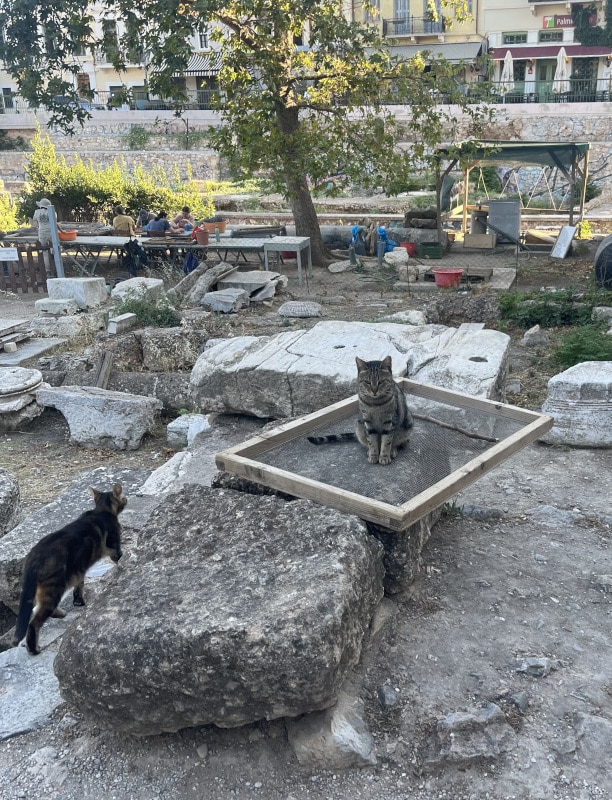
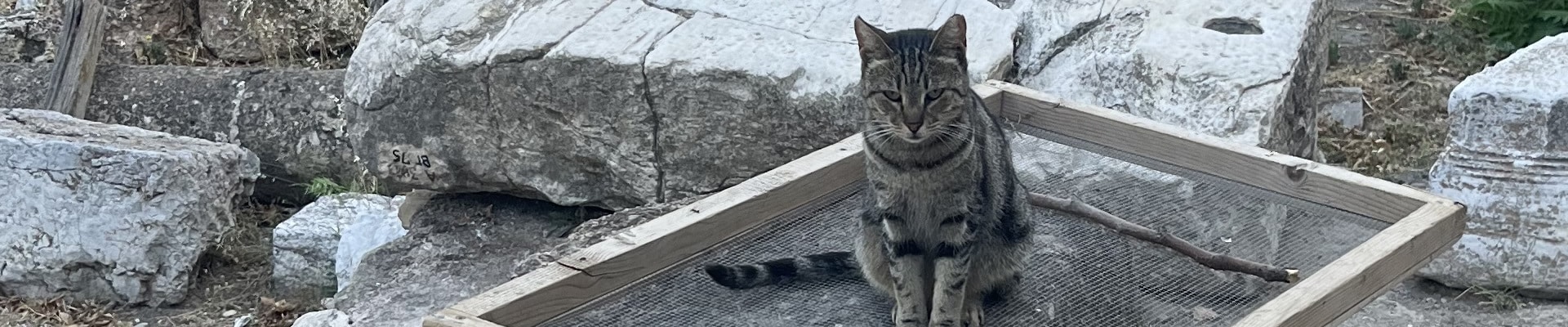
We get many cat visitors every day and some even liked to hang out in our trays. Photo by Hannah Borotsik

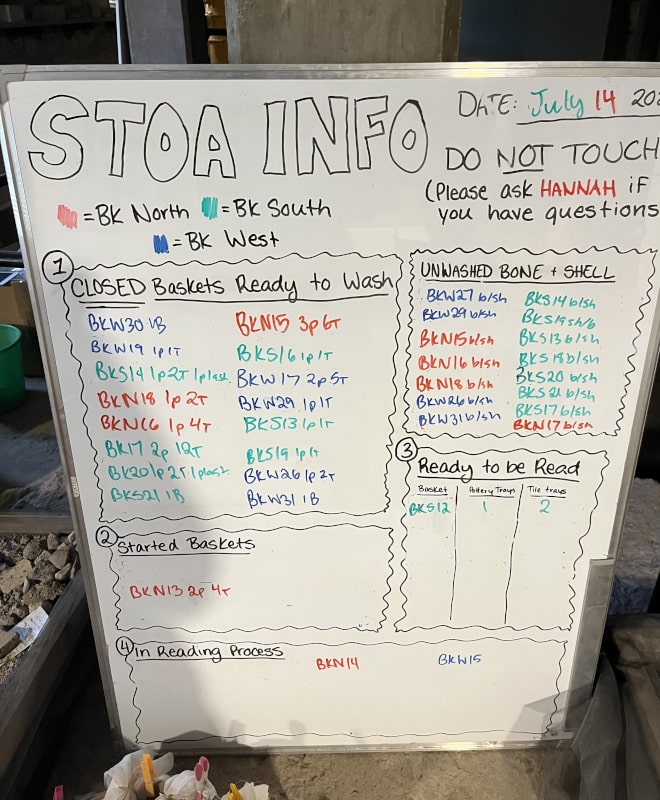
At the beginning of each day, I would start in the basement of the Stoa of Attalos, which serves as the apotheke for the Agora excavations. I would review the unwashed material and update my whiteboard with the information about the material that came up from the site at the end of the previous day. The whiteboard contained information for closed baskets from each trench in order to track the progress of washing, sorting, and reading by our wonderful pottery, bone, and shell specialists. Since the Agora is a total collection excavation, there is a lot of material coming up, and being able to communicate where all the material was at any given moment was extremely important. This was a method that I established in the 2024 season, and it became a staple of the basement’s organization (as well as a staple of my identity on the project).

The 2025 version of my whiteboard when the number of buckets of pottery felt like it would never end. Photo by Hannah Borotsik

Next, I would decide on which basket, or more often than not, baskets of pottery would be washed for the day. This depended on many different factors, including the number of volunteers assigned to wash, the number of available trays, and the number of buckets of pottery and tile belonging to a basket. The largest number of buckets in one basket from this season was three full buckets of pottery and thirteen tile buckets (this one took a while to wash). At this point, the volunteers assigned to the pottery wash area would arrive from the site for the day, and after bringing everything outside, I would divide the group into flotation and pottery wash.

Besides training and helping volunteers wash material, I had many responsibilities that I took care of during our work hours. I had to make sure that the dried ceramics, including the tile, were ready for our pottery specialists to analyse and count, weigh, and photograph. In some cases, I assisted with these procedures (for example, choosing the tile samples). I bagged and weighed dried bone and shell, after which I recorded the information into our iDig system. I made sure that any material that was ready for the trench supervisors to pack or things that needed to be made a special finds were in their respective inboxes. I wrote tags for trays inside and outside. I organized the baskets that were in queue to be washed. I strategized the best way to tackle the large backlog of tile, once larger baskets began to appear. At the end of the day, I facilitated the clean-up and organization of the apotheke, which mostly consisted of me giving the volunteers directions on what order I wanted each tray to go in and where I wanted them to go in the basement (and they did a great job every day!). These are just a few of my daily responsibilities, since every day came with new opportunities to improve workflows. After work, I sometimes stayed later to finish organizing and prepare for the following day or I worked on the procedural manual for the apotheke. At the end of most days, I went home and took a nap. One of the most important aspects of my job was to be the point of communication between our three open trenches and those working in the apotheke. As a result, my job consisted of many moving parts and more often than not, learning something new every day.
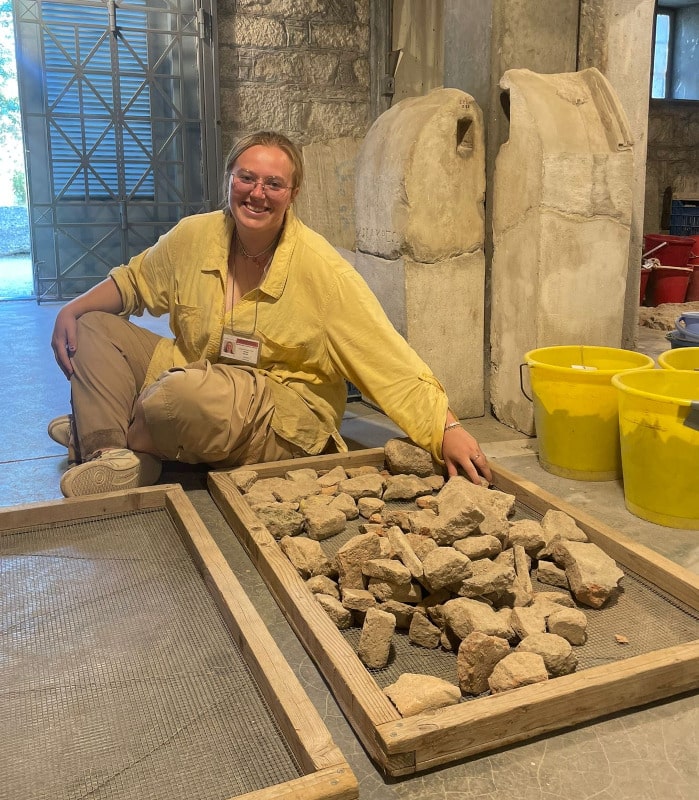
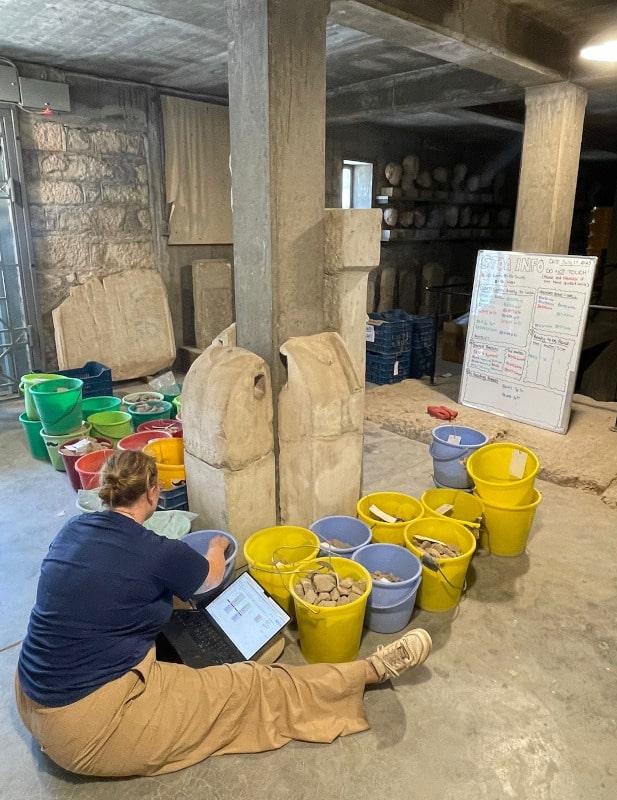
I am sitting with my buckets and whiteboard, updating the information for the unwashed shell and bone on my spreadsheet. Photo by James Razumoff

I was grateful to return to the Agora for my third summer and, although I was nervous to hold a supervisor position at such a well-known dig with only a few years of experience, my fellow supervisors, field director, and director were wonderful role models and helped me to become confident in my position. I learned so much more about being a leader and finding my leadership style, and I got more in-depth training on the many procedures that take place on excavation after the material comes out of the ground. All of these lessons have made me a better archaeologist. I am so thankful for the trust that was placed in me, and I will never forget my first-ever summer as a supervisor.

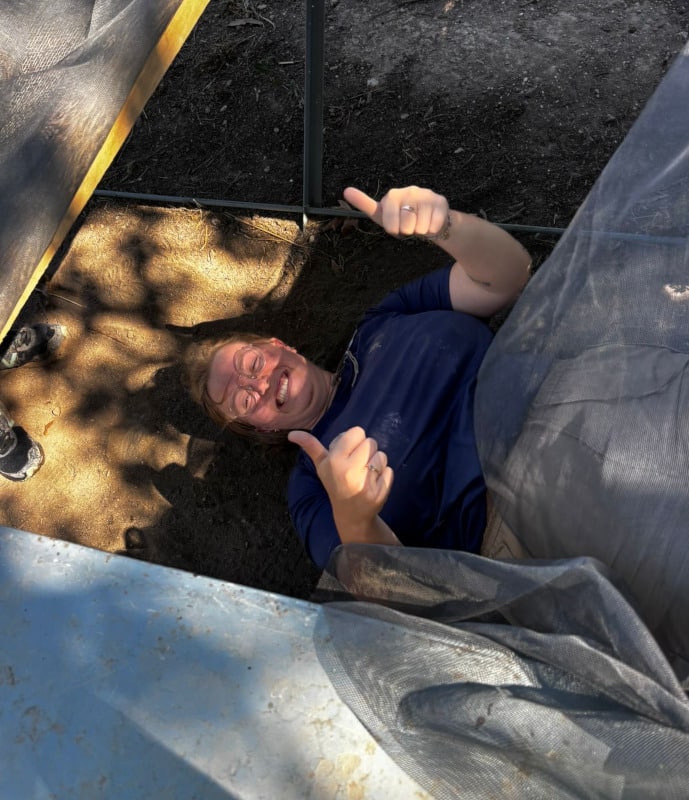
I am taking a break under the flotation trays. Photo by Theresa Cole

Hannah Borotsik is a first year PhD student in Classics at the University of Western Ontario, where she has just completed her Masters. She is also a graduate of Memorial University of Newfoundland and Labrador. She is interested in Ancient Greek religion, specifically traditions and rituals, and their relationship to social and political contexts. She has participated in digs at the Helike project and the Athenian Agora and has also worked on material from Newfoundland and Labrador.

Want to help more students and early career archaeologists get into the field? Donate to the cause today by selecting “Fieldwork Scholarships” as your gift purpose!

Recent Posts

  • Fieldwork Report: Hannah Borotsik
  • AM25 Recordings Now Available on ASOR’s Online Library
  • FOA Webinar: Carl Walsh
  • Call for Early Career Scholars Committee Members
  • Friends of ASOR Tours: Philadelphia 2026

Latest Posts from @ASORResearch

asor_research

Initiating and supporting research of the history and cultures of the Near East and wider Mediterranean world.


Registration is now open for the Friends of ASOR t
Registration is now open for the Friends of ASOR two-day Philadelphia Tour on April 16–17! Join us for exclusive, behind-the-scenes access at the Penn Museum, the Barnes Foundation, and the Philadelphia Art Museum, featuring expert-led tours, special lectures, and insights into archaeology, art, and conservation. Learn more and register here: https://www.asor.org/news/2026/01/tour-philadelphia-2026


The Levantine Ceramics Project (LCP) is partnering
The Levantine Ceramics Project (LCP) is partnering with @pennmuseum for a "Data Day" as part of their Museum Workshop Program. Join them for a day of ancient pottery and data entry (and free food)! Register your interest by January 30th: https://docs.google.com/forms/d/e/1FAIpQLSdws1Ml2Ku-X7Yg-vBUoy6AZv54zRqvvLgdrIJaPsL5H688Ow/viewform


At Tall Hisban in Jordan, the Lawrence T. Geraty C
At Tall Hisban in Jordan, the Lawrence T. Geraty Community Archaeology Endowment has supported educational opportunities, heritage events, and community engagement. In 2025, the Geraty Endowment helped make possible the Hisban Heritage Festival, student-led community history projects, and the Madaba Region Heritage Internship. Read more in this grant report: https://www.asor.org/news/2026/01/geraty-grant-report
#Jordan #Madaba #Heritage


ASOR’s room block at the Hilton Chicago for the 20
ASOR’s room block at the Hilton Chicago for the 2026 Annual Meeting is now open. Registered Annual Meeting attendees can reserve a room at the discounted rate of $159 (plus tax) at this iconic downtown hotel overlooking Grant Park and Lake Michigan. To make your reservations, click here: https://www.asor.org/am/2026/hotel-city-2026


Join us for the next FOA webinar on Wednesday, Feb
Join us for the next FOA webinar on Wednesday, February 4th at 12:30pm ET: "Unearthing an Imperially Glorious Byzantine Church near Bet Shemesh: From Fieldwork to Virtual Reality," presented by Benyamin Storchan. In the heart of the Holy Land, just 15 miles southwest of Jerusalem, lies one of the most remarkable Byzantine churches discovered in recent decades. The archaeological excavations at the Church of the Glorious Martyr unearthed a fascinating five-century story of faith and pilgrimage, yet the greatest mystery remains unsolved: who was the Glorious Martyr venerated in the sacred crypt? Read more and register here: https://www.asor.org/news/2026/01/webinar-storchan


Call for papers: The William F. Albright Institute
Call for papers: The William F. Albright Institute of Archaeological Research announces the 25th Annual Sean W. Dever Memorial Prize. The prize awards $750 for the best conference paper in Syro-Palestinian or Biblical Archaeology.

Eligibility:
• Ph.D. candidates (as of Spring 2026)
• Paper must be in English
• Must be an unpublished/not prepared for publication conference paper

Deadline: February 15, 2026
Winner announced: March 9, 2026
Apply via the Albright Fellowships Portal: https://aiar.org/fellowships


The deadline to apply for ASOR's 2026-27 Mesopotam
The deadline to apply for ASOR's 2026-27 Mesopotamian Fellowships is Monday, January 26! These fellowships are primarily intended to support fieldwork/research on ancient Mesopotamian culture carried out in the Middle East. Apply now: https://www.asor.org/fellowships/mesopotamian-fellowship/


Our #ObjectoftheWeek: A limestone statue of an eag
Our #ObjectoftheWeek: A limestone statue of an eagle wrestling with a serpent found at Khirbet et-Tannur, an ancient Nabataean temple in southern Jordan. ca. 100-200 CE. CAM 1939.222. Photo credit: Cincinnati Art Museum.
#Archaeology #Jordan #Nabataean


Since the Neolithic, mudbrick architecture has bee
Since the Neolithic, mudbrick architecture has been one of the most widespread building traditions across the world. But a mudbrick is more than a structural unit: it is also a repository of information. Read the newest ANE Today by Marta Lorenzon by clicking the link (https://anetoday.org/mudbrick-architecture-meaning/) in our bio.
#Architecture #Mudbrick


Last summer, Helen Wong joined the University of P
Last summer, Helen Wong joined the University of Palermo Archaeological Project at Motya, an island near western Sicily. Helen, a PhD candidate at University of Pennsylvania, was the digital archaeology specialist on the project and helped with the ongoing geophysical survey mapping the ancient city. Read her report here: https://www.asor.org/news/2026/01/fieldwork-report-wong
#Archaeology #Survey #Sicily


Be sure to watch the next FOA webinar TOMORROW at
Be sure to watch the next FOA webinar TOMORROW at 7:00pm ET presented by Dr. Sarah Wenner: "Experiencing Khirbet et-Tannur: The Story of a Nabatean Temple from the Second through 21st Century." Register for free if you haven't already: https://buff.ly/CtzwPOm
#Jordan #Nabatean


ASOR is putting together a map of where our member
ASOR is putting together a map of where our members have worked in the world. You're invited to submit your own excavations, survey, laboratory, or museum and conservation projects to the map with stories and photos. Click the link in our bio to complete a brief survey to add yourself to the map: https://buff.ly/LYYJVlZ


The Honors and Awards Committee seeks nominations
The Honors and Awards Committee seeks nominations for at least 3 candidates. Committee members will serve a three-year term with the possibility of two consecutive terms. Nominees must fill out the online form by January 30. Learn more by clicking the link in our bio: https://www.asor.org/news/2025/12/honors-awards-members-call


This past summer, a group from Johns Hopkins Unive
This past summer, a group from Johns Hopkins University traveled to Türkiye to help excavate a Late Bronze Age archive of cuneiform tablets at Alalakh/Tell Atchana. This team, funded by an ASOR Harris Grant, was uniquely qualified for the task, as they were trained in both archaeology and in reading Akkadian cuneiform. Read their grant report by clicking the link in our bio: https://www.asor.org/news/2025/12/harris-grant-report-alalakh
#Archaeology #Fieldwork #Cuneiform #Turkiye


Reminder: the deadline to propose new member-organ
Reminder: the deadline to propose new member-organized sessions and workshops for the 2026 Annual Meeting in Chicago is Thursday, January 15. Find more info and fill out a brief proposal here: https://buff.ly/Kqui65X


Don't miss the upcoming FOA webinar on Wednesday,
Don't miss the upcoming FOA webinar on Wednesday, January 21 at 7:00pm ET: "Experiencing Khirbet et-Tannur: The Story of a Nabatean Temple from the Second through 21st Century," presented by Dr. Sarah Wenner. In the 2nd century CE, after Rome annexed the Nabataean Kingdom and transformed it into the Roman province of Arabia, the Nabataean temple at Khirbet et-Tannur was constructed in Central Jordan. This lecture travels the site’s two millennia history and explores how Khirbet et-Tannur’s excavations, the collection at the Cincinnati Art Museum, and 21st century innovations have changed our understanding of the Nabataeans. Read more and register by clicking the link in our bio: https://www.asor.org/news/2026/01/webinar-wenner


Our #ObjectoftheWeek: An Egyptian “New Year’s Bott
Our #ObjectoftheWeek: An Egyptian “New Year’s Bottle”, a type of lentoid-shaped flask that was filled with perfumed oil or water from the Nile, gifted in connection to the New Year. ca. 664-525 BCE. MMA 30.8.214. Photo credit: Metropolitan Museum of Art.
#Archaeology #Egypt #NewYear


The archaeological record and the cuneiform litera
The archaeological record and the cuneiform literature provide us with compelling information to assess how children lived 3000 years ago. This should open our eyes to current realities, which are not so different. Read the newest ANE Today article, "Children in the Ancient (and Present-day) Near East", by clicking the link in our bio: https://anetoday.org/children-near-east/


In town for the #AIASCS2026 Annual Meeting? 🏺

Mak
In town for the #AIASCS2026 Annual Meeting? 🏺

Make sure to stop by the ASOR table in the Exhibit Hall to learn more about our programs and publications, and reconnect with colleagues and friends from across the field.

ASOR Exhibit Hall Hours:
• Wed, Jan 7 | 3:00–6:00 PM
• Thu–Fri, Jan 8–9 | 9:30 AM–5:30 PM
• Sat, Jan 10 | 8:00 AM–12:00 PM

We can’t wait to see you—come say hello! 

#ASOR #AIAAnnualMeeting #MeetUsThere


The 2026 ASOR Annual Meeting will begin on Wednesd
The 2026 ASOR Annual Meeting will begin on Wednesday, November 18, at 7:00pm CST with the plenary address by Dr. Kim Benzel: Lapis, Clay, Copper, Water: Presenting Ancient West Asian Art at The Met. Dr. Benzel is Curator in Charge of The Metropolitan Museum of Art. She holds a Ph.D. in Art History and Archaeology from Columbia University and has participated in archaeological excavations in Syria. Currently, Kim and her colleagues are working on a full rethink and renovation of The Met’s permanent galleries of Ancient West Asian Art, scheduled to reopen in June 2027. Read more about the 2026 Plenary Address here: https://www.asor.org/am/2026/plenary-address-2026


Instagram

Stay updated with the latest insights, photos, and news by following us on Instagram!

Follow Us on Instagram

American Society of Overseas Research
The James F. Strange Center
209 Commerce Street
Alexandria, VA 22314

E-mail: info@asor.org

© 2025 ASOR
All rights reserved.
Images licensed under a Creative Commons Attribution-NonCommercial-ShareAlike 4.0 International License

Contact Us
Membership
Give
Friends of ASOR
ASOR Cultural Heritage Initiatives
Terms of Use
News

Please follow & like us :)
Facebook
YouTube
LinkedIn