UNEARTHING THE PAST SINCE 1900
  • BECOME A MEMBER
  • RENEW
  • GIVE NOW
  • SEARCH
  • ONLINE PORTAL
  • American Society of Overseas Research (ASOR)American Society of Overseas Research (ASOR)
  • ABOUT
    • WELCOME FROM ASOR OFFICERS
    • HISTORY OF ASOR
    • MISSION, BYLAWS, & STRATEGIC PLAN
    • Board of Trustees
    • COMMITTEES
    • POLICIES
    • FINANCIAL DOCUMENTS
    • MEDIA RELEASES
    • CONTACT US
  • CULTURAL
    HERITAGE
    • ABOUT CULTURAL HERITAGE INITIATIVES
    • UPDATES
    • PAST GRANTS
    • TUTORIALS
    • Who We Are
  • ANNUAL
    MEETING
    • REGISTRATION
    • HOTEL RESERVATIONS
    • ANNUAL MEETING SCHEDULES
    • SPONSOR & EXHIBIT
    • ASOR Online Library
    • HONORS & AWARDS
    • ANNUAL MEETING SCHOLARSHIPS
    • PAST & FUTURE ANNUAL MEETINGS
  • MEMBERSHIP
    & RESOURCES
    • INDIVIDUAL MEMBERSHIPS
    • INSTITUTIONAL MEMBERSHIPS
    • NEWS@ASOR
    • PAST ASOR NEWS, MONTH BY MONTH
    • AFFILIATED PROJECTS
    • AFFILIATED RESEARCH CENTERS
    • ARCHIVES
    • ONLINE RESOURCES
      • PHOTO COLLECTION
    • EARLY CAREER MEMBER RESOURCES
  • FELLOWSHIPS
    & GRANTS
    • SCHOLARSHIPS FOR FIELDWORK PARTICIPATION
    • GRANTS FOR ARCHAEOLOGICAL PROJECTS
    • RESEARCH FELLOWSHIPS FOR MEMBERS
    • MEMBERSHIP & ANNUAL MEETING SCHOLARSHIPS
    • ASOR-AFFILIATED RESEARCH CENTERS FELLOWSHIPS
    • OTHER FELLOWSHIP PROGRAMS
  • PUBLICATIONS
    • BOOK SERIES & MONOGRAPHS
    • BULLETIN OF ASOR
    • JOURNAL OF CUNEIFORM STUDIES
    • MAARAV
    • NEAR EASTERN ARCHAEOLOGY
    • THE ANCIENT NEAR EAST TODAY
    • News@ASOR
    • LEVANTINE CERAMICS PROJECT
  • FRIENDS
    OF ASOR
    • Webinars
    • TOURS
    • THE ANCIENT NEAR EAST TODAY
    • ASOR ONLINE LIBRARY
  • Donate
    • FY25 HONOR ROLL OF DONORS
    • LIFETIME HONOR ROLL OF DONORS
    • ASOR LEGACY CIRCLE
    • WAYS TO DONATE
default

 SHARE


NEWS@ASOR E-NEWSLETTER

ANCIENT NEAR EAST TODAY E-NEWSLETTER

PAST ASOR NEWS, MONTH BY MONTH

ASOR LEGACY CIRCLE MEMBERS

LIFETIME HONOR ROLL OF DONORS

FY25 HONOR ROLL OF DONORS

ASOR ANNUAL MEETING

FRIENDS OF ASOR WEBINARS

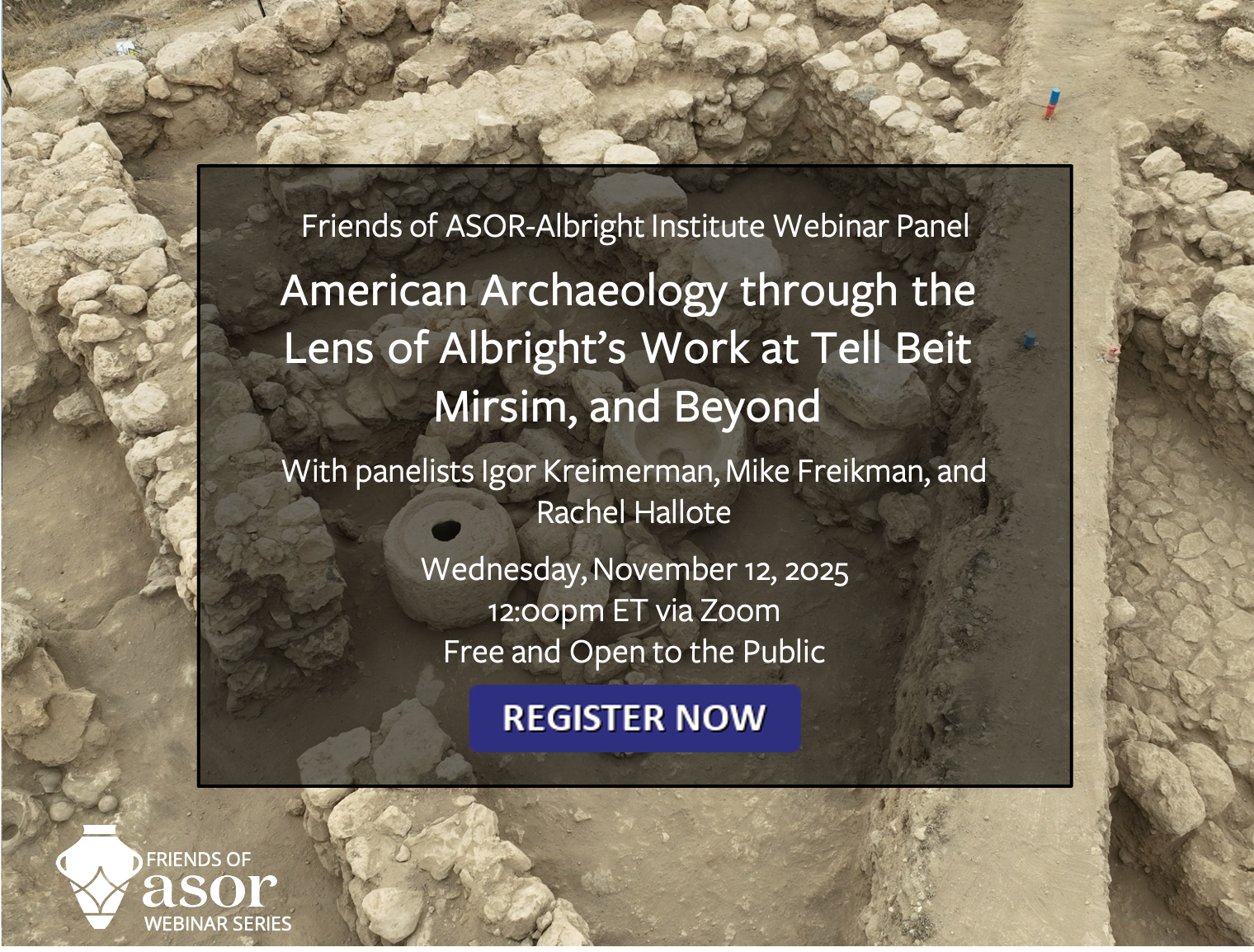
American Archaeology through the Lens of Albright’s Work at Tell Beit Mirsim, and Beyond

Friends of ASOR (in partnership with the W.F. Albright Institute of Archaeological Research) present the next webinar of the 2025-2026 season on November 12, 2025, at 12:00 pm EST, with panelists Igor Kreimerman, Michael Freikman, and Rachel Hallote. This webinar will be free and open to the public. Registration through Zoom (with a valid email address) is required. This webinar will be recorded and all registrants will be sent a recording link in the days following the webinar.


Presentation 1: “Tell Beit Mirsim in Perspective: Revisiting Albright’s excavations in Light of Renewed Work” with Igor Kreimerman

Albright’s excavations at Tell Beit Mirsim marked a turning point in the development of Biblical Archaeology, establishing the site as a key type-site for the discipline. The innovative methods applied in both excavation and publication resonated for decades and provided the foundation for Albright’s wide-ranging synthetic studies. Over time, however, many of his conclusions and theories have been challenged and re-evaluated. The renewed excavations at Tell Beit Mirsim invite a fresh assessment of Albright’s work, comparing his insights with new evidence from the field. This presentation will reconsider the validity of his reports in light of modern scholarship and reflect on the enduring impact of his excavations.

Dr. Igor Kreimerman is a Senior Lecturer in Archaeology and Ancient Near Eastern Studies at the Hebrew University of Jerusalem. He directs the Selz Foundation Hazor Excavations in Memory of Yigael Yadin and serves as scientific advisor to the Renewed Excavations at Tell Beit Mirsim. His research focuses on the social and economic structures of Bronze and Iron Age Levantine societies, as well as on human-induced site formation processes, particularly those related to construction and destruction.


Presentation 2: “Going Where No One has gone Before: A Peek Into the Intricacies of Albright’s Expedition at Tell Beit Mirsim” with Michael Freikman

The excavation of this little-known tell became groundbreaking in the history of biblical archaeology. As one of the earliest American expeditions in the Near East, Albright drew on his wide learning and field experience, effectively turning Tell Beit Mirsim into an open-air laboratory and, in many respects, helping to shape biblical archaeology as we know it today. We will highlight key aspects of his experience at the site—the team’s methodology, day-to-day life in the field, and Albright’s relationships with his team and local population—together forming the enduring legacy of one of the foremost forefathers of modern archaeology.

Dr. Michael Friekman holds a Ph.d in Archaeology at Hebrew Univeristy in Jerusalem. He has studied the megalithic architecture in the Ancient Near East, excavated at Rujm el Hiri, and participated at the excavation and publication of Kh. Qeyiafa, Sha’ar Hagolan, and Tel Tsaf. He presently directs the renewed excavation of Tell Beit Mirsim.


Presentation 3: “Tell Beit Mirsim in Context: The American Archaeological Presence in Ottoman and Mandatory Palestine Before and After Albright” with Rachel Hallote

This talk will put W. F. Albright’s Tell Beit Mirsim excavations into the historical context of archaeological work that had previously been done in Ottoman controlled Palestine. The arrival of Albright at the American Schools of Oriental Studies in Jerusalem immediately after World War I marks the beginnings the a real American presence in archaeology that had not been acknowledged previously. Although the Americans did not dominate the field, the Tell Beit Mirsim excavations came to be known for its concentration on ceramic and stratigraphic methodologies, and continued to influence the discipline in later decades.

Rachel Hallote is Professor of History at Purchase College SUNY. Her research involves British and American archaeologists who excavated in Ottoman-controlled Palestine in the 19th century. She has worked at numerous archaeological sites in Israel, including Tell Miqne and Megiddo. Her publications include Bible, Map, and Spade: The American Exploration Society, Frederick Jones Bliss, and the Forgotten Story of Early American Biblical Archaeology and the co-authored volume, The Photographs of the American Palestine Exploration Society as well as many articles about archaeology and the history of the discipline. She currently co-hosts an archaeology podcast called This Week in the Ancient Near East.

SUPPORT THE WEBINAR PROGRAM!

Friends of ASOR is pleased to announce that the first webinars of the 2025-2026 season will once again be free and open to the public with a goal to raise $10,000 so that the entire webinar season will be free. Will you support this outreach effort with a tax-deductible contribution? All donors/sponsors with gifts of $100 or more will be recognized in subsequent webinars. Help ensure these webinars stay free and available to all by donating today!

Designate your gift for “Webinars” in the drop-down menu.

BROWSE THE NEWS ARCHIVE

  • 2026 Fieldwork Opportunities
  • FOA Webinar: Sarah Wenner
  • Harris Grant Report: Alalakh/Tell Atchana
  • Table of Contents for Near Eastern Archaeology 88.4 (2025)

Latest Posts from @ASORResearch

asor_research

Initiating and supporting research of the history and cultures of the Near East and wider Mediterranean world.


ASOR is putting together a map of where our member
ASOR is putting together a map of where our members have worked in the world. You're invited to submit your own excavations, survey, laboratory, or museum and conservation projects to the map with stories and photos. Click the link in our bio to complete a brief survey to add yourself to the map: https://buff.ly/LYYJVlZ


The Honors and Awards Committee seeks nominations
The Honors and Awards Committee seeks nominations for at least 3 candidates. Committee members will serve a three-year term with the possibility of two consecutive terms. Nominees must fill out the online form by January 30. Learn more by clicking the link in our bio: https://www.asor.org/news/2025/12/honors-awards-members-call


This past summer, a group from Johns Hopkins Unive
This past summer, a group from Johns Hopkins University traveled to Türkiye to help excavate a Late Bronze Age archive of cuneiform tablets at Alalakh/Tell Atchana. This team, funded by an ASOR Harris Grant, was uniquely qualified for the task, as they were trained in both archaeology and in reading Akkadian cuneiform. Read their grant report by clicking the link in our bio: https://www.asor.org/news/2025/12/harris-grant-report-alalakh
#Archaeology #Fieldwork #Cuneiform #Turkiye


Reminder: the deadline to propose new member-organ
Reminder: the deadline to propose new member-organized sessions and workshops for the 2026 Annual Meeting in Chicago is Thursday, January 15. Find more info and fill out a brief proposal here: https://buff.ly/Kqui65X


Don't miss the upcoming FOA webinar on Wednesday,
Don't miss the upcoming FOA webinar on Wednesday, January 21 at 7:00pm ET: "Experiencing Khirbet et-Tannur: The Story of a Nabatean Temple from the Second through 21st Century," presented by Dr. Sarah Wenner. In the 2nd century CE, after Rome annexed the Nabataean Kingdom and transformed it into the Roman province of Arabia, the Nabataean temple at Khirbet et-Tannur was constructed in Central Jordan. This lecture travels the site’s two millennia history and explores how Khirbet et-Tannur’s excavations, the collection at the Cincinnati Art Museum, and 21st century innovations have changed our understanding of the Nabataeans. Read more and register by clicking the link in our bio: https://www.asor.org/news/2026/01/webinar-wenner


Our #ObjectoftheWeek: An Egyptian “New Year’s Bott
Our #ObjectoftheWeek: An Egyptian “New Year’s Bottle”, a type of lentoid-shaped flask that was filled with perfumed oil or water from the Nile, gifted in connection to the New Year. ca. 664-525 BCE. MMA 30.8.214. Photo credit: Metropolitan Museum of Art.
#Archaeology #Egypt #NewYear


The archaeological record and the cuneiform litera
The archaeological record and the cuneiform literature provide us with compelling information to assess how children lived 3000 years ago. This should open our eyes to current realities, which are not so different. Read the newest ANE Today article, "Children in the Ancient (and Present-day) Near East", by clicking the link in our bio: https://anetoday.org/children-near-east/


In town for the #AIASCS2026 Annual Meeting? 🏺

Mak
In town for the #AIASCS2026 Annual Meeting? 🏺

Make sure to stop by the ASOR table in the Exhibit Hall to learn more about our programs and publications, and reconnect with colleagues and friends from across the field.

ASOR Exhibit Hall Hours:
• Wed, Jan 7 | 3:00–6:00 PM
• Thu–Fri, Jan 8–9 | 9:30 AM–5:30 PM
• Sat, Jan 10 | 8:00 AM–12:00 PM

We can’t wait to see you—come say hello! 

#ASOR #AIAAnnualMeeting #MeetUsThere


The 2026 ASOR Annual Meeting will begin on Wednesd
The 2026 ASOR Annual Meeting will begin on Wednesday, November 18, at 7:00pm CST with the plenary address by Dr. Kim Benzel: Lapis, Clay, Copper, Water: Presenting Ancient West Asian Art at The Met. Dr. Benzel is Curator in Charge of The Metropolitan Museum of Art. She holds a Ph.D. in Art History and Archaeology from Columbia University and has participated in archaeological excavations in Syria. Currently, Kim and her colleagues are working on a full rethink and renovation of The Met’s permanent galleries of Ancient West Asian Art, scheduled to reopen in June 2027. Read more about the 2026 Plenary Address here: https://www.asor.org/am/2026/plenary-address-2026


Make sure to tune in TOMORROW at 7:00 pm ET for th
Make sure to tune in TOMORROW at 7:00 pm ET for the next FOA webinar presented by Amanda Hope Haley: "Beyond Edutainment: Reclaiming Archaeology in a Clickbait World". If you haven't already signed up, click the link (https://buff.ly/cDQEBdk) in our bio to register for free.


ASOR plans to award two Mesopotamian Fellowships f
ASOR plans to award two Mesopotamian Fellowships for 2026-2027; one for $9,000 and one for $4,000. These fellowships are primarily intended to support fieldwork/research on ancient Mesopotamian culture carried out in the Middle East, but other projects such as travel to work on museum collections or archives related to ancient Mesopotamia will also be considered. The deadline for applications is January 26, 2026. More info can be found here: https://www.asor.org/fellowships/mesopotamian-fellowship/


Yishu Deng, a 2025 Eric and Carol Meyers Fieldwork
Yishu Deng, a 2025 Eric and Carol Meyers Fieldwork Participation Scholarship Recipient,
excavated at Kani Shaie in the Kurdistan Region of Iraq. Yishu was able to participate in ongoing archaeological research in the Near East and further her interest in ancient metal production. Read her fieldwork report here: https://www.asor.org/news/2025/12/fieldwork-report-deng


Happy New Year from ASOR! We wish you all the best
Happy New Year from ASOR! We wish you all the best for 2026!


Before we turn the page to 2026, swipe through and
Before we turn the page to 2026, swipe through and take a look at ASOR's 2025 Year in Review! Thank you for being part of ASOR's historic 125th year — we couldn't have accomplished it without your support!
#ASOR2025 #ASORwrapped


The newest issue of Near East Archaeology includes
The newest issue of Near East Archaeology includes articles like: Burial Practices of the Bronze Age: An Archaeological Study of the Deh Dumen Cemetery in Southern Zagros, Iran; Time Capsules: Evidence for Foundation and Abandonment Practices at Middle Bronze Age Erimi, Cyprus; Āb Bād Rock-cut Tomb: Tracking Post-Achaemenid Burial Customs in Qir-o Karzin, Southern Pars, Iran; First Observations on the Excavations in the Terrace Area of Uluköy Cave, Mardin/Türkiye; and more. Check out the Table of Contents here: https://www.asor.org/news/2025/12/nea88.4-toc/


ASOR invites members to propose new member-organiz
ASOR invites members to propose new member-organized sessions and workshops for the 2026 Annual Meeting. The meeting will be held in Chicago and online, November 18-21. The brief proposal form asks for a description of the session/workshop, as well as a list of 4 to 5 potential speakers and topics. The deadline to propose sessions and workshops is January 15. More info can be found by clicking the link (https://www.asor.org/am/2026/call-for-sessions-2026) in our bio.


Our #ObjectoftheWeek: Alabastron from the tomb of
Our #ObjectoftheWeek: Alabastron from the tomb of Nubian king Aspelta in Nuri, Sudan, ca. 593-568 BCE. MFA 20.1070. Photo credit: Harvard University—Boston Museum of Fine Arts Expedition.
#Nubia #Alabastron


Register for the next FOA webinar on January 7, 20
Register for the next FOA webinar on January 7, 2026, at 7:00 pm ET, presented by Amanda Hope Haley: "Beyond Edutainment: Reclaiming Archaeology in a Clickbait World". This webinar will be free and open to the public. Register here: https://www.asor.org/news/2025/12/webinar-haley


Heritage protection is a fundamental part of the w
Heritage protection is a fundamental part of the work of ASOR’s Cultural Heritage Initiatives. To help fight the illicit antiquities trade in Lebanon and Syria, ASOR hosted an Antiquities Trafficking Documentation workshop in Beirut, Lebanon on December 8-12, 2025, with the generous support of the U.S. Embassy in Beirut @USEmbassyBeirut. 

The workshop brought together representatives of the American, Lebanese, and Syrian governments to discuss current conditions and challenges in Lebanon and Syria, local priorities, and ways for all participants to work together to achieve them. Read more by clicking the link (https://buff.ly/lB5EEHO) in our bio.

Photo credits: U.S. Embassy Beirut and ASOR


Check out the November issue of BASOR 394, featuri
Check out the November issue of BASOR 394, featuring articles such as: Boulos el-ʿAraj: A Palestinian Quaker Archaeologist of the British Mandate Era (1926–1936); Unveiling the Obscure: Exploring the Function and Meaning of Levantine Shrine Models through an Ethnoarchaeological Lens; Paleoenvironment and Fruit Tree Horticulture at Early Bronze Age Tel Bet Yerah: Evidence from Charcoal Remains; and more. Read the Table of Contents by clicking the link (https://www.asor.org/news/2025/12/basor394-toc/) in our bio.


Instagram

Stay updated with the latest insights, photos, and news by following us on Instagram!

Follow Us on Instagram

No media attachments are selected for image gallery shortcode.

American Society of Overseas Research
The James F. Strange Center
209 Commerce Street
Alexandria, VA 22314

E-mail: info@asor.org

© 2025 ASOR
All rights reserved.
Images licensed under a Creative Commons Attribution-NonCommercial-ShareAlike 4.0 International License

Contact Us
Membership
Give
Friends of ASOR
ASOR Cultural Heritage Initiatives
Terms of Use
News

Please follow & like us :)
Facebook
YouTube
LinkedIn