Missing Ritual Objects from the Nelson Glueck Excavations of Kheleifeh in the ASOR Archives at the American Heritage Center
Erin Darby, University of Tennessee, 2025 Study of Collections Fellowship Recipient
Paul Flesher, American Heritage Center
You never know where in the world Near Eastern archaeology will take you! Erin Darby’s 2025 ASOR Study of Collections Fellowship took her to Laramie, Wyoming where the American Heritage Center (AHC) houses the American Society of Overseas Research (ASOR) Archives (1900-2023) at the University of Wyoming. Since 2022, the AHC has been the caretaker of this important repository that includes not only documents associated with the history of ASOR but also several collections of records from American-led excavations from the early twentieth century. In her particular case, Erin was on the hunt for unpublished religious artifacts from the Nelson Glueck excavations at Tell el-Kheleifeh.
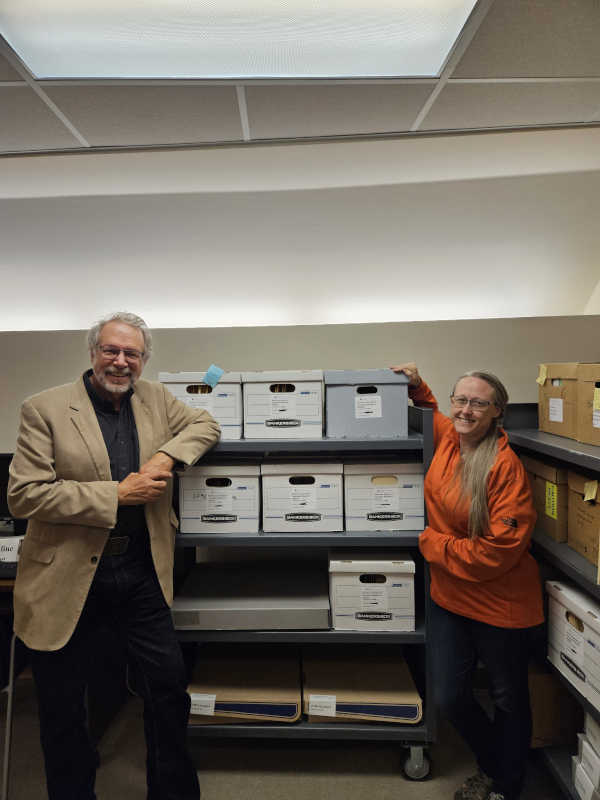
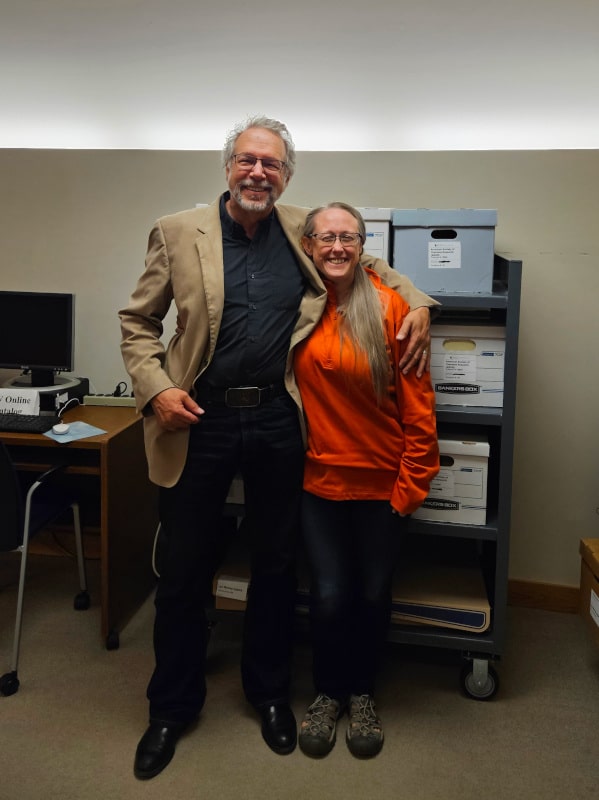
Paul and Erin with the Tell el-Kheleifeh records from the ASOR Archives in the AHC.
Kheleifeh plays a prominent role in attempts to understand the geopolitical organization of southern Israel and Jordan, particularly in the Iron IIB-C. Since its excavation in 1938-1940, scholars have been interested in whether the site was controlled by the Israelites, Judahites, Edomites, unaffiliated tribal communities, or the Neo-Assyrian and Neo-Babylonian Empires. When it comes to the study of cultic artifacts, however, Kheleifeh is most notable for its absence from the conversation. With the support of AHC staff this past June, Erin was able to excavate a number of unpublished artifacts from the archive and create a database of cultic remains from the site. Owing to the importance of the collection, the University of Tennessee and the AHC are teaming up this coming year to digitize the site’s artifact registration lists so that scholars from anywhere in the world who are interested in the objects from Kheleifeh will be able to identify the relevant records in the AHC holdings.
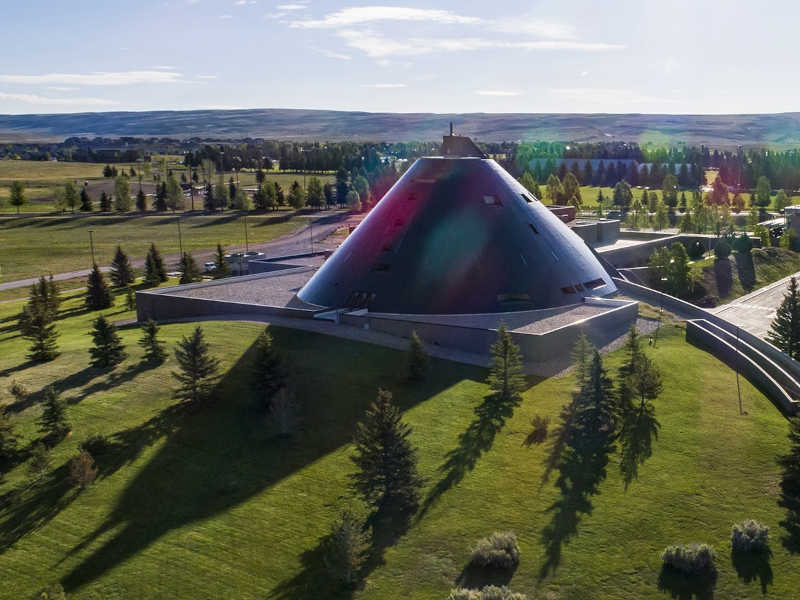
The American Heritage Center at the University of Wyoming.
Tell el-Kheleifah is only one of several sets of excavation records in the AHC’s ASOR archives. The collection also holds materials from: Khirbet et Tannur, Dibon, Issawiya, Jerash, Nippur, Beth-Zur and Carthage, as well as small holdings of records from Jerash, Lehav and Tell Hesban, and others. (In general, note that artifacts, as opposed to records, are held by Harvard University’s Museum of the Ancient Near East.) There are several collections of Middle East photographs, with the earliest from 1875. Other sections of the collection hold records of past ASOR presidents, including those of W.F. Albright, Nelson Glueck, G. Ernest Wright, Carl Kraeling, Paul Lapp and William Dever. And of course there are ASOR administrative materials from across the decades, including records of ASOR committees and awarded grants. Overall, the American Society of Overseas Research collection holds 180 cubic feet of materials plus 155 GB of digital copies.
The American Heritage Center is an excellent home for the ASOR collection. Even though it is one of the ten largest non-government public archives in the USA and so is large enough to have the resources to look after the collection, it is small enough to care about all its collections and to look after each patron personally. The AHC has a number of services that enable scholars to access the ASOR collection. Laramie, Wyoming, the home of the American Heritage Center, is less than a three-hour drive north of Denver, or just 30 minutes by plane. Start planning a trip by consulting the finding aid for the ASOR collection, readily available online, and then request materials ahead of time from the Reference Services Department (AHCref@uwyo.edu, 307-766-3756).
Collection materials can also be accessed remotely. The Center’s Reference Services department can easily be contacted to answer remote inquiries. (Recently, we looked up old municipal records for the Albright Institute in Jerusalem.) The AHC has a large digitization lab and can digitize collection materials at cost. Finally, the Center has the RRAD program (Remote Research and Discovery) that matches a researcher with a research assistant via Zoom and document camera for a nominal cost. This enables researchers to look through collection materials remotely and identify materials they wish to study. These can then be digitized for more careful examination. The AHC looks forward to helping archaeologists and other scholars from around the world to research its historic ASOR collection.
 Collection materials can also be accessed remotely. The Center’s Reference Services department can easily be contacted to answer remote inquiries. (Recently, we looked up old municipal records for the Albright Institute in Jerusalem.) The AHC has a large digitization lab and can digitize collection materials at cost. Finally, the Center has the RRAD program (Remote Research and Discovery) that matches a researcher with a research assistant via Zoom and document camera for a nominal cost. This enables researchers to look through collection materials remotely and identify materials they wish to study. These can then be digitized for more careful examination. The AHC looks forward to helping archaeologists and other scholars from around the world to research its historic ASOR collection.