UNEARTHING THE PAST SINCE 1900
  • BECOME A MEMBER
  • RENEW
  • GIVE NOW
  • SEARCH
  • ONLINE PORTAL
  • American Society of Overseas Research (ASOR)American Society of Overseas Research (ASOR)
  • ABOUT
    • WELCOME FROM ASOR OFFICERS
    • HISTORY OF ASOR
    • MISSION, BYLAWS, & STRATEGIC PLAN
    • Board of Trustees
    • COMMITTEES
    • POLICIES
    • FINANCIAL DOCUMENTS
    • MEDIA RELEASES
    • CONTACT US
  • CULTURAL
    HERITAGE
    • ABOUT CULTURAL HERITAGE INITIATIVES
    • UPDATES
    • PAST GRANTS
    • TUTORIALS
    • Who We Are
  • ANNUAL
    MEETING
    • REGISTRATION
    • HOTEL RESERVATIONS
    • ANNUAL MEETING SCHEDULES
    • SPONSOR & EXHIBIT
    • ASOR Online Library
    • HONORS & AWARDS
    • ANNUAL MEETING SCHOLARSHIPS
    • PAST & FUTURE ANNUAL MEETINGS
  • MEMBERSHIP
    & RESOURCES
    • INDIVIDUAL MEMBERSHIPS
    • INSTITUTIONAL MEMBERSHIPS
    • NEWS@ASOR
    • PAST ASOR NEWS, MONTH BY MONTH
    • AFFILIATED PROJECTS
    • AFFILIATED RESEARCH CENTERS
    • ARCHIVES
    • ONLINE RESOURCES
      • PHOTO COLLECTION
    • EARLY CAREER MEMBER RESOURCES
  • FELLOWSHIPS
    & GRANTS
    • SCHOLARSHIPS FOR FIELDWORK PARTICIPATION
    • GRANTS FOR ARCHAEOLOGICAL PROJECTS
    • RESEARCH FELLOWSHIPS FOR MEMBERS
    • MEMBERSHIP & ANNUAL MEETING SCHOLARSHIPS
    • ASOR-AFFILIATED RESEARCH CENTERS FELLOWSHIPS
    • OTHER FELLOWSHIP PROGRAMS
  • PUBLICATIONS
    • BOOK SERIES & MONOGRAPHS
    • BULLETIN OF ASOR
    • JOURNAL OF CUNEIFORM STUDIES
    • MAARAV
    • NEAR EASTERN ARCHAEOLOGY
    • THE ANCIENT NEAR EAST TODAY
    • News@ASOR
    • LEVANTINE CERAMICS PROJECT
  • FRIENDS
    OF ASOR
    • Webinars
    • TOURS
    • THE ANCIENT NEAR EAST TODAY
    • ASOR ONLINE LIBRARY
  • Donate
    • FY25 HONOR ROLL OF DONORS
    • LIFETIME HONOR ROLL OF DONORS
    • ASOR LEGACY CIRCLE
    • WAYS TO DONATE
banner 1920x400

 SHARE


NEWS@ASOR E-NEWSLETTER

ANCIENT NEAR EAST TODAY E-NEWSLETTER

PAST ASOR NEWS, MONTH BY MONTH

ASOR LEGACY CIRCLE MEMBERS

LIFETIME HONOR ROLL OF DONORS

FY25 HONOR ROLL OF DONORS

ASOR ANNUAL MEETING

FRIENDS OF ASOR WEBINARS

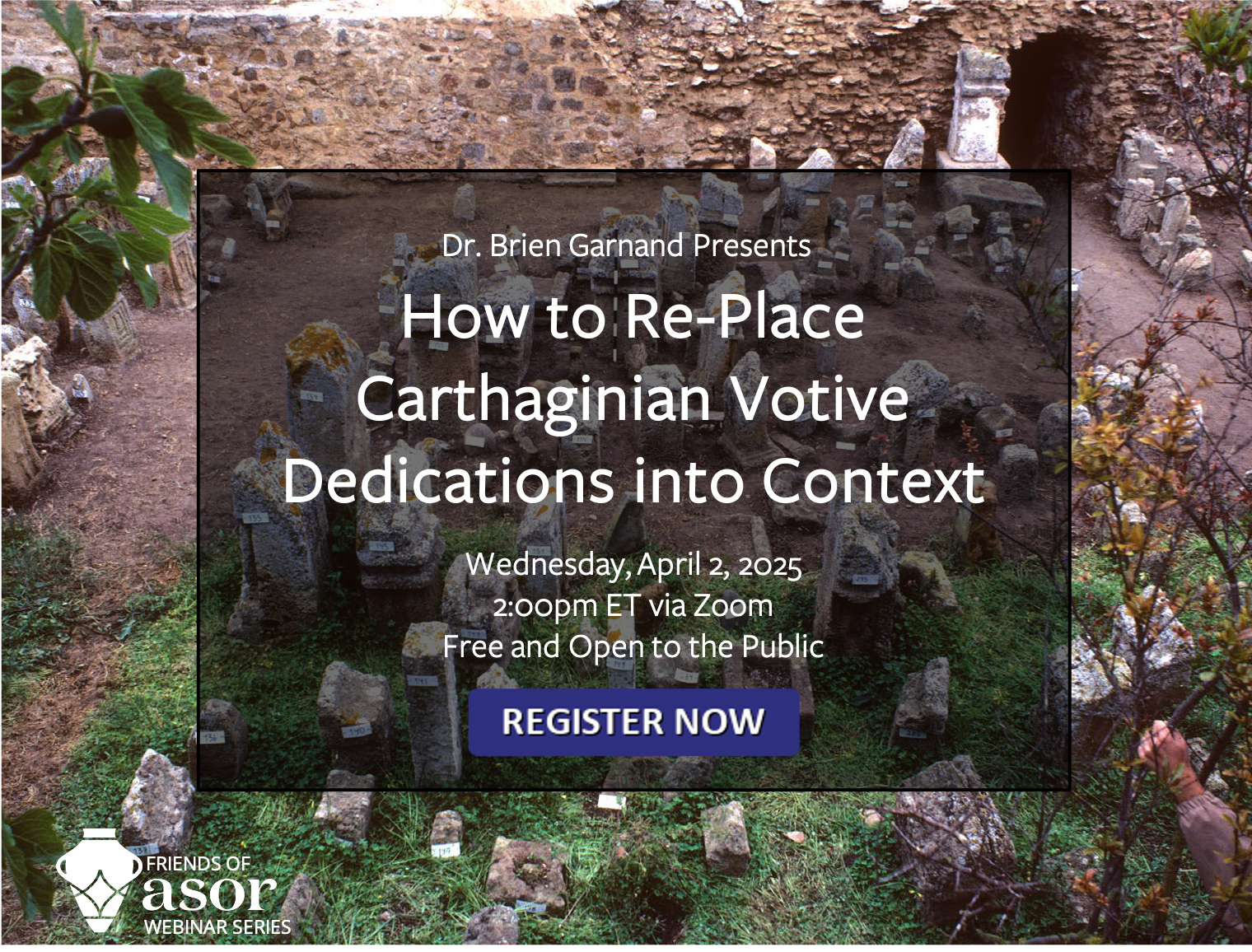
How to Re-Place Carthaginian Votive Dedications into Context

Friends of ASOR present the next webinar of the 2024-2025 season on April 2, 2025, at 2:00 pm EDT, presented by Dr. Brien Garnand. This webinar will be free and open to the public. Registration through Zoom (with a valid email address) is required. This webinar will be recorded and all registrants will be sent a recording link in the days following the webinar.

Upcoming anniversaries of American excavations offer an opportunity to reassess the importance of Carthage, famous for its contacts and conflicts with Greeks and Romans across the Mediterranean and infamous for its alleged ritual infanticide. Two American teams conducted excavations at the city’s liminal open-air votive precinct, where one finds cremated infant remains buried in urns beneath stone memorials bearing dedications to the Mistress, Tinnit Visage-of-Ba‘l, and to the Lord, Ba‘l Hammon.

The Carthaginian precinct remained in use from the city’s foundation (ca.800 BCE) until its destruction by Rome (146 BCE). Thousands of inscribed stelae found there provide the vast majority ( > 90%) of the Phoenician-Punic epigraphic corpus and provide evidence for the development of alphabetic writing; uninscribed stelae add to iconographic repertoires; and key amulet and urn typologies arise from this site. In sum, no Phoenician precinct stands anywhere near equal in importance to this singular sanctuary, one of the most studied and least understood cultural features of Phoenician-Punic society. Interpretation of the site remains difficult—in no small part due to a lack of stratigraphic data since final reports have not been forthcoming.

The centennial and golden anniversaries of American excavations fast approach—one hundred years ago, F. W. Kelsey of the University of Michigan led a campaign under the auspices of the AIA (1925); fifty years ago, L. E. Stager of University of Chicago led another under the auspices of ASOR (1976-1979). Both teams excavated in the same propriété Regulus-Salammbô, with Stager’s Punic Project excavations picking up where Kelsey had left off. Even before the American campaigns, many stelae had already been extracted through clandestine or amateur excavation, including hasty extractions made just before Kelsey arrived on site, depriving us of their context. Nevertheless, our archival research at the University of Michigan has uncovered excavation records that, in combination with the Punic Project records, allow us to locate stela in plan and section. We have made practice scans of stelae, in the Netherlands and Denmark, in anticipation of scanning individual stela now held in Tunisian museum store rooms. This talk will demonstrate how 3D models of individual stelae can be replaced into their original positions by using archival site plans and annotated photographs and in reference to the positions of those stelae still in situ, and it will demonstrate how we can create a precise scale model of the Regulus-Salammbô sector.

Brien Garnand is a research associate of the Harvard Museum of the Ancient Near East (HMANE) and a visiting researcher at the Netherlands Institute for the Near East (NINO), currently a member of a research group at the Israel Institute for Advanced Studies (IIAS). He has contributed to the final excavation report from the ASOR Punic Project Carthage excavations since 1993, recently co-editing a preview of that report in a thematic volume of the Journal of Ancient History (Infants as Votive Offerings 2023). Besides cataloging artifacts in the basement of the HMANE and in the store rooms of the Musée national de Carthage, he has scoured the archives of the F. W. Kelsey Museum of Archaeology at the University of Michigan and the J. B. Chabot archives at the Université catholique de Louvain in preparation for an exhibition timed to correspond with the issue of the Punic Project final report on the the 50th/100th anniversaries of American excavations. He once served as assistant director of the Stanford University Excavations at Mt. Polizzo in Sicily, and he has extensive experience in North Africa, both in field survey (Project Jerba—University of Pennsylvania/AAR/INP) and in excavation (Carthage Bir Messaouda—University of Amsterdam/INP). His current research focuses on votive stelae, both putting the formulaic-poetic language of Phoenician inscriptions into the context of Ancient Near Eastern literature and putting the sanctuary of Tinnit and Ba‘l in Carthage into the context of votive precincts across the Mediterranean. A mobility grant from NINO (2022) allowed him to test 3D scanning methods, and a recent ASOR Dar Ben Gacem fellowship (2023) supported a research visit to the Carthage precinct where he prepared a preliminary 3D site model.

SPONSOR A WEBINAR!

Several levels of support from $50-$1,000 are available. Proceeds go towards membership scholarships and towards increasing ASOR’s virtual resources. Each sponsorship is tax-deductible and includes benefits! Sponsor a webinar here. 

WHY SPONSOR ONLY ONE?

Season Sponsorships are also available from the ASOR Online Store here!

Click here for more information on the benefits of becoming a season sponsor or sponsoring a single webinar.

BROWSE THE NEWS ARCHIVE

  • Fieldwork Report: Hannah Borotsik
  • AM25 Recordings Now Available on ASOR’s Online Library
  • FOA Webinar: Carl Walsh
  • Call for Early Career Scholars Committee Members

Latest Posts from @ASORResearch

asor_research

Initiating and supporting research of the history and cultures of the Near East and wider Mediterranean world.


ASOR is pleased to announce that recordings from t
ASOR is pleased to announce that recordings from the 2025 Annual Meeting in Boston are now available to view on the 2025 ASOR Online Schedule and ASOR’s Online Library. This initiative not only helps preserve the wealth of knowledge shared but also ensures that those who couldn’t attend the event in person still have access to session and workshop presentations (nearly 500 in total). Learn how to access the recordings by clicking the link (https://www.asor.org/news/2026/02/am25-recordings) in our bio.


Don't forget to tune in TOMORROW at 12:30 pm ET fo
Don't forget to tune in TOMORROW at 12:30 pm ET for the next FOA webinar presented by Benyamin Storchan: "Unearthing an Imperially Glorious Byzantine Church near Bet Shemesh: From Fieldwork to Virtual Reality". If you haven't already signed up, click here to register for free: https://www.asor.org/news/2026/01/webinar-storchan


Registration is now open for the Friends of ASOR t
Registration is now open for the Friends of ASOR two-day Philadelphia Tour on April 16–17! Join us for exclusive, behind-the-scenes access at the Penn Museum, the Barnes Foundation, and the Philadelphia Art Museum, featuring expert-led tours, special lectures, and insights into archaeology, art, and conservation. Learn more and register here: https://www.asor.org/news/2026/01/tour-philadelphia-2026


The Levantine Ceramics Project (LCP) is partnering
The Levantine Ceramics Project (LCP) is partnering with @pennmuseum for a "Data Day" as part of their Museum Workshop Program. Join them for a day of ancient pottery and data entry (and free food)! Register your interest by January 30th: https://docs.google.com/forms/d/e/1FAIpQLSdws1Ml2Ku-X7Yg-vBUoy6AZv54zRqvvLgdrIJaPsL5H688Ow/viewform


At Tall Hisban in Jordan, the Lawrence T. Geraty C
At Tall Hisban in Jordan, the Lawrence T. Geraty Community Archaeology Endowment has supported educational opportunities, heritage events, and community engagement. In 2025, the Geraty Endowment helped make possible the Hisban Heritage Festival, student-led community history projects, and the Madaba Region Heritage Internship. Read more in this grant report: https://www.asor.org/news/2026/01/geraty-grant-report
#Jordan #Madaba #Heritage


ASOR’s room block at the Hilton Chicago for the 20
ASOR’s room block at the Hilton Chicago for the 2026 Annual Meeting is now open. Registered Annual Meeting attendees can reserve a room at the discounted rate of $159 (plus tax) at this iconic downtown hotel overlooking Grant Park and Lake Michigan. To make your reservations, click here: https://www.asor.org/am/2026/hotel-city-2026


Join us for the next FOA webinar on Wednesday, Feb
Join us for the next FOA webinar on Wednesday, February 4th at 12:30pm ET: "Unearthing an Imperially Glorious Byzantine Church near Bet Shemesh: From Fieldwork to Virtual Reality," presented by Benyamin Storchan. In the heart of the Holy Land, just 15 miles southwest of Jerusalem, lies one of the most remarkable Byzantine churches discovered in recent decades. The archaeological excavations at the Church of the Glorious Martyr unearthed a fascinating five-century story of faith and pilgrimage, yet the greatest mystery remains unsolved: who was the Glorious Martyr venerated in the sacred crypt? Read more and register here: https://www.asor.org/news/2026/01/webinar-storchan


Call for papers: The William F. Albright Institute
Call for papers: The William F. Albright Institute of Archaeological Research announces the 25th Annual Sean W. Dever Memorial Prize. The prize awards $750 for the best conference paper in Syro-Palestinian or Biblical Archaeology.

Eligibility:
• Ph.D. candidates (as of Spring 2026)
• Paper must be in English
• Must be an unpublished/not prepared for publication conference paper

Deadline: February 15, 2026
Winner announced: March 9, 2026
Apply via the Albright Fellowships Portal: https://aiar.org/fellowships


The deadline to apply for ASOR's 2026-27 Mesopotam
The deadline to apply for ASOR's 2026-27 Mesopotamian Fellowships is Monday, January 26! These fellowships are primarily intended to support fieldwork/research on ancient Mesopotamian culture carried out in the Middle East. Apply now: https://www.asor.org/fellowships/mesopotamian-fellowship/


Our #ObjectoftheWeek: A limestone statue of an eag
Our #ObjectoftheWeek: A limestone statue of an eagle wrestling with a serpent found at Khirbet et-Tannur, an ancient Nabataean temple in southern Jordan. ca. 100-200 CE. CAM 1939.222. Photo credit: Cincinnati Art Museum.
#Archaeology #Jordan #Nabataean


Since the Neolithic, mudbrick architecture has bee
Since the Neolithic, mudbrick architecture has been one of the most widespread building traditions across the world. But a mudbrick is more than a structural unit: it is also a repository of information. Read the newest ANE Today by Marta Lorenzon by clicking the link (https://anetoday.org/mudbrick-architecture-meaning/) in our bio.
#Architecture #Mudbrick


Last summer, Helen Wong joined the University of P
Last summer, Helen Wong joined the University of Palermo Archaeological Project at Motya, an island near western Sicily. Helen, a PhD candidate at University of Pennsylvania, was the digital archaeology specialist on the project and helped with the ongoing geophysical survey mapping the ancient city. Read her report here: https://www.asor.org/news/2026/01/fieldwork-report-wong
#Archaeology #Survey #Sicily


Be sure to watch the next FOA webinar TOMORROW at
Be sure to watch the next FOA webinar TOMORROW at 7:00pm ET presented by Dr. Sarah Wenner: "Experiencing Khirbet et-Tannur: The Story of a Nabatean Temple from the Second through 21st Century." Register for free if you haven't already: https://buff.ly/CtzwPOm
#Jordan #Nabatean


ASOR is putting together a map of where our member
ASOR is putting together a map of where our members have worked in the world. You're invited to submit your own excavations, survey, laboratory, or museum and conservation projects to the map with stories and photos. Click the link in our bio to complete a brief survey to add yourself to the map: https://buff.ly/LYYJVlZ


The Honors and Awards Committee seeks nominations
The Honors and Awards Committee seeks nominations for at least 3 candidates. Committee members will serve a three-year term with the possibility of two consecutive terms. Nominees must fill out the online form by January 30. Learn more by clicking the link in our bio: https://www.asor.org/news/2025/12/honors-awards-members-call


This past summer, a group from Johns Hopkins Unive
This past summer, a group from Johns Hopkins University traveled to Türkiye to help excavate a Late Bronze Age archive of cuneiform tablets at Alalakh/Tell Atchana. This team, funded by an ASOR Harris Grant, was uniquely qualified for the task, as they were trained in both archaeology and in reading Akkadian cuneiform. Read their grant report by clicking the link in our bio: https://www.asor.org/news/2025/12/harris-grant-report-alalakh
#Archaeology #Fieldwork #Cuneiform #Turkiye


Reminder: the deadline to propose new member-organ
Reminder: the deadline to propose new member-organized sessions and workshops for the 2026 Annual Meeting in Chicago is Thursday, January 15. Find more info and fill out a brief proposal here: https://buff.ly/Kqui65X


Don't miss the upcoming FOA webinar on Wednesday,
Don't miss the upcoming FOA webinar on Wednesday, January 21 at 7:00pm ET: "Experiencing Khirbet et-Tannur: The Story of a Nabatean Temple from the Second through 21st Century," presented by Dr. Sarah Wenner. In the 2nd century CE, after Rome annexed the Nabataean Kingdom and transformed it into the Roman province of Arabia, the Nabataean temple at Khirbet et-Tannur was constructed in Central Jordan. This lecture travels the site’s two millennia history and explores how Khirbet et-Tannur’s excavations, the collection at the Cincinnati Art Museum, and 21st century innovations have changed our understanding of the Nabataeans. Read more and register by clicking the link in our bio: https://www.asor.org/news/2026/01/webinar-wenner


Our #ObjectoftheWeek: An Egyptian “New Year’s Bott
Our #ObjectoftheWeek: An Egyptian “New Year’s Bottle”, a type of lentoid-shaped flask that was filled with perfumed oil or water from the Nile, gifted in connection to the New Year. ca. 664-525 BCE. MMA 30.8.214. Photo credit: Metropolitan Museum of Art.
#Archaeology #Egypt #NewYear


The archaeological record and the cuneiform litera
The archaeological record and the cuneiform literature provide us with compelling information to assess how children lived 3000 years ago. This should open our eyes to current realities, which are not so different. Read the newest ANE Today article, "Children in the Ancient (and Present-day) Near East", by clicking the link in our bio: https://anetoday.org/children-near-east/


Instagram

Stay updated with the latest insights, photos, and news by following us on Instagram!

Follow Us on Instagram

American Society of Overseas Research
The James F. Strange Center
209 Commerce Street
Alexandria, VA 22314

E-mail: info@asor.org

© 2025 ASOR
All rights reserved.
Images licensed under a Creative Commons Attribution-NonCommercial-ShareAlike 4.0 International License

Contact Us
Membership
Give
Friends of ASOR
ASOR Cultural Heritage Initiatives
Terms of Use
News

Please follow & like us :)
Facebook
YouTube
LinkedIn