
Shepard Urgent Action Grant: Emergency Excavation for Data Collection from the Late Neolithic Settlement at Khramis Didi Gora, Georgia
Mariam Eloshvili (Ilia State University)
Khramis Didi Gora is one of the largest and most significant Neolithic settlements in the South Caucasus. Situated on the Kvemo Kartli Plain in southern Georgia, within the middle Kura River valley, the site belongs to the Shomu–Shulaveri culture, the earliest farming communities of the region dating to the sixth millennium BC. Together with sites such as Shulaveris Gora, Gadachrili Gora, Arukhlo, Imiris Gora, Göytepe, Hacı Elamxanlı Tepe, and Mentesh Tepe, Khramis Didi Gora forms an essential component of the archaeological record documenting the emergence of sedentary farming societies in the South Caucasus.

Excavated between 1972 and 1986 under the direction of Dr. Alexander Javakhishvili and later Dr. Tengiz Kiguradze, the site yielded one of the deepest Neolithic stratigraphic sequences in Georgia, with nearly eleven metres of cultural deposits and nine architectural horizons. Despite its importance, much of the excavation remained unpublished, while the exposed excavation trench was left open for almost four decades. During this period, natural erosion, vegetation growth, and repeated seasonal weathering threatened both the preservation of the exposed archaeological deposits and the invaluable stratigraphic information they contained.
The renewed excavations at Khramis Didi Gora were initiated in 2023 as an emergency rescue project in response to the ongoing expansion of a modern cemetery, which had already covered more than one-third of the Neolithic mound. As new graves continued to destroy intact archaeological deposits, it became essential to document the site’s significance and demonstrate its outstanding scientific value. The results of the project provided the basis for protecting and fencing the remaining archaeological area, helping to prevent further destruction of one of the most important Neolithic settlements in the South Caucasus.

The ASOR Shepard Urgent Action Grant provided a unique opportunity to preserve this endangered archaeological resource while simultaneously applying modern archaeological methods to one of the most important legacy excavations in the Caucasus. Rather than reopening extensive excavation areas, the project concentrated on the rescue documentation and scientific reassessment of the southern profile of the original trench, generating new archaeological data while preserving information that would otherwise have continued to deteriorate.
Project Objectives
The project was designed around several interconnected objectives.
The first objective was the emergency documentation and preservation of the exposed southern profile through systematic cleaning, recording, and digital documentation. Because the profile represented almost forty years of natural degradation, immediate intervention was necessary before further erosion resulted in the irreversible loss of archaeological information.
The second objective was to establish a new high-resolution stratigraphic sequence for the investigated section of the site. Previous excavations had identified nine construction horizons, but many relationships between architectural features had never been documented according to contemporary stratigraphic recording standards.
A third objective involved developing an updated chronological framework through AMS radiocarbon dating. Only three radiocarbon determinations had previously been available for Khramis Didi Gora, limiting regional chronological comparisons. The acquisition of new data represented one of the project’s highest priorities.
Finally, the project aimed to reassess the archaeological assemblages recovered from the renewed investigations, including ceramics, lithics, and bone artefacts, and integrate the site into current international discussions concerning Neolithic settlement development, technological innovation, and the spread of early farming communities across the South Caucasus.
Fieldwork and Documentation
Field investigations commenced with the careful removal of vegetation, root systems, and decades of accumulated collapse deposits covering the southern profile. Once cleaned, the profile revealed an exceptionally well-preserved sequence exceeding six metres in height and extending across approximately thirty metres of the original excavation trench.
A seventeen-metre central section was selected for intensive investigation owing to its outstanding state of preservation and stratigraphic clarity. This section was divided into south-western and south-eastern sectors, allowing each stratigraphic unit to be documented individually. Contexts were defined following the principles of archaeological stratigraphy, and their relationships were established through the construction of a Harris Matrix.
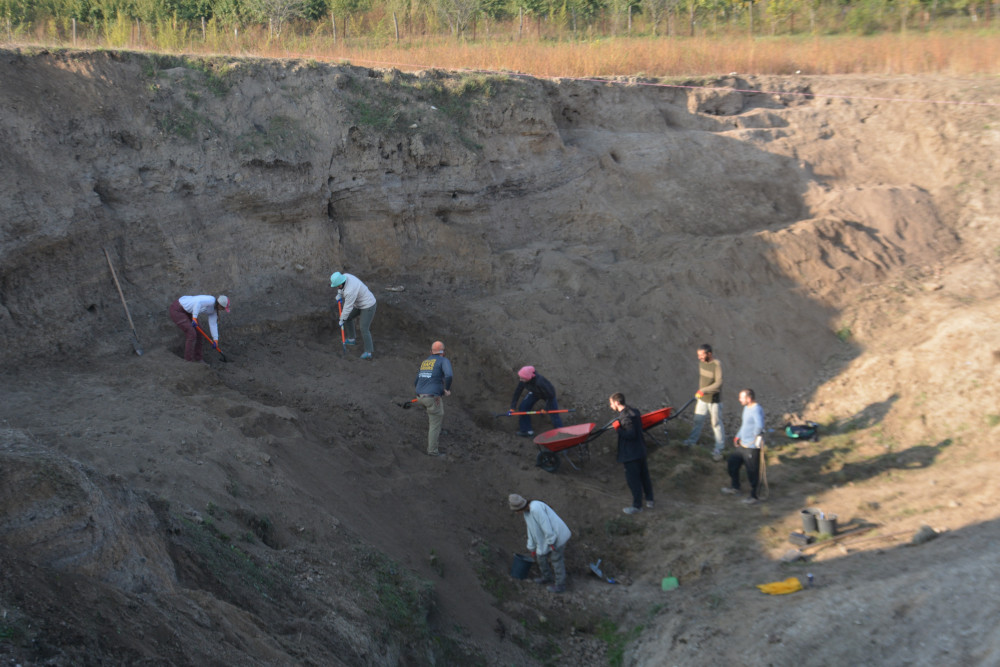

All exposed archaeological features were photographed, measured, described, and digitally documented using drone photography, photogrammetry, GIS, and traditional archaeological drawing techniques. Elevations of each sampled context were recorded using total station surveying equipment, ensuring precise spatial control for future analyses.
During fieldwork, thirty bioarchaeological samples were collected from secure stratigraphic contexts, including charcoal and animal bone. Ten samples representing key occupational phases were selected for AMS radiocarbon dating, significantly expanding the chronological dataset available for the site.


Stratigraphic Results
The renewed investigation demonstrated that the southern profile preserves a remarkably complex architectural sequence representing repeated cycles of construction, occupation, destruction, and rebuilding (Eloshvili, 2026).
Numerous mud-brick walls, compacted clay floors, plastered surfaces, hearth installations, burnt occupation layers, ash deposits, and architectural collapse horizons were identified throughout both sectors of the profile. Rather than representing isolated structures, these remains document the gradual development of successive buildings and activity areas over several centuries (Eloshvili, 2026).
One of the most important observations concerns the architectural organisation of the settlement. The investigated profile indicates that construction was not carried out as a single settlement-wide rebuilding episode. Instead, individual buildings appear to have been demolished, reconstructed, and modified independently, producing a dynamic settlement characterised by overlapping occupational histories. Burnt deposits and courtyard surfaces suggest that open communal spaces coexisted alongside domestic structures, while multiple superimposed floor levels illustrate continuous maintenance and rebuilding throughout the occupation of the site (Eloshvili, 2026).
The new stratigraphic sequence provides a far more detailed understanding of settlement formation processes than previously available and establishes a reliable framework for future excavations elsewhere on the mound (Eloshvili, 2026).

Establishing a New Chronological Framework
Perhaps the most significant achievement of the project has been the development of a substantially revised chronological framework for Khramis Didi Gora (Eloshvili, 2026).
Eight new AMS radiocarbon dates, combined with the recalibration of three legacy determinations, have transformed our understanding of the site’s occupational history. The new results indicate that the investigated sector was occupied approximately between 5754 and 5369 cal BC, placing it firmly within the middle and later developmental stages of the Shomu–Shulaveri culture (Eloshvili, 2026).
The chronological evidence identifies at least three successive occupational phases represented within the investigated profile. Rather than indicating continuous uniform occupation, the radiocarbon sequence demonstrates gradual expansion and repeated rebuilding through time. Importantly, these dates correlate closely with chronological sequences established at other major Neolithic settlements, including Aknashen, Arukhlo, Göytepe, Gadachrili Gora, Mashavera Gora, Hacı Elamxanlı Tepe, and Mentesh Tepe (Eloshvili, 2026).
These new dates considerably improve the chronological resolution of the Caucasus Neolithic and establish Khramis Didi Gora as one of the most securely dated settlements within the regional sequence.

Material Culture
The archaeological assemblage recovered during the project provides valuable insights into the technological traditions and everyday activities of Neolithic communities.
The ceramic assemblage demonstrates considerable technological diversity, including multiple fabric groups distinguished by different tempering materials, manufacturing techniques, firing conditions, and decorative practices. The pottery reflects well-developed ceramic production traditions comparable with contemporary settlements across Georgia, Armenia, and Azerbaijan, illustrating the close cultural relationships that characterised the Shomu–Shulaveri horizon (Eloshvili, et al., 2027).
Lithic analysis revealed an extensive obsidian industry dominated by systematic blade production. Prepared cores, blades, bladelets, scrapers, racloirs, burins, sickle inserts, and retouched tools demonstrate highly organised lithic technology supported by sophisticated reduction strategies. Several sickle blades retain preserved bitumen hafting, providing direct evidence for composite harvesting tools associated with early agricultural practices (Eloshvili, et al., 2027).
The bone industry further illustrates technological specialisation within the settlement. Worked bone artefacts were manufactured primarily from domesticated animal remains using percussion, scraping, grinding, abrasion, and polishing techniques. Functional analyses indicate that pointed implements dominate the assemblage, reflecting activities associated with hide working, basketry, textile production, and other domestic crafts. Together, these artefacts provide important evidence for specialised household production and technological adaptation during the Neolithic (Eloshvili, et al., 2027).
Scientific Significance
The project represents the first comprehensive modern reassessment of Khramis Didi Gora in almost forty years. Beyond preserving a vulnerable archaeological resource, it has generated entirely new scientific data that fundamentally improves our understanding of one of the most important Neolithic settlements in the South Caucasus.
The integration of modern stratigraphic recording, digital documentation, AMS radiocarbon dating, and detailed material culture analyses demonstrates the remarkable research potential of legacy excavations. Rather than merely confirming previous interpretations, the project has refined the settlement’s chronology, clarified its architectural development, and placed Khramis Didi Gora within a much broader regional framework of Neolithic cultural development.
The results also contribute directly to wider discussions concerning the emergence of farming societies, architectural organisation, technological innovation, and interaction networks throughout the Caucasus and neighbouring regions of Southwest Asia.
Equally important, the project illustrates the value of targeted rescue investigations. By documenting archaeological deposits before further natural degradation occurred, the ASOR Shepard Urgent Action Grant has ensured that irreplaceable archaeological information has been preserved for future generations of researchers.
Dissemination and Scholarly Impact
The results of the 2023 project have already made a significant contribution to Neolithic research in the South Caucasus. Preliminary findings were presented at the 30th Annual Meeting of the European Association of Archaeologists (EAA 2024), where the project introduced the revised stratigraphic sequence and the new radiocarbon framework of Khramis Didi Gora to the international archaeological community. The presentation generated valuable discussion regarding Neolithic chronology, settlement formation, and the broader development of the Shomu–Shulaveri culture.

The project has also resulted in substantial scholarly output. Two research articles have been prepared based on the ASOR-funded investigations. One article presents the revised stratigraphic sequence and updated radiocarbon chronology of the southern profile, while the second examines the archaeological assemblage recovered during the 2023 investigations. One of these studies is currently in press, while the other has been published. Together, these publications provide the first comprehensive modern reassessment of Khramis Didi Gora since the original excavations conducted between 1972 and 1986 and establish an important foundation for future research on the Neolithic of the South Caucasus.
Beyond publications, the project has created a comprehensive digital archive consisting of stratigraphic documentation, GIS datasets, photogrammetric models, and radiocarbon data that will serve as the basis for future investigations and heritage management of the site.
Long-Term Impact and Future Research
One of the most significant outcomes of the ASOR Shepard Urgent Action Grant has been its role in re-establishing active archaeological research at Khramis Didi Gora after nearly four decades. The success of the 2023 season demonstrated both the exceptional and outstanding scientific potential, providing the impetus for the continuation and expansion of the project.
Building directly upon the results of the ASOR-funded work, archaeological investigations resumed in 2025 with the opening of a new excavation trench in an area that had never previously been explored. This new phase of research is allowing us to investigate additional architectural remains, refine the settlement’s developmental sequence, and evaluate how the newly identified occupation phases relate to those documented in the southern profile.
Equally important has been the initiation of a long-term heritage management strategy aimed at protecting Khramis Didi Gora from ongoing disturbance. A substantial portion of the archaeological mound has long been occupied by a modern cemetery, severely limiting archaeological investigation and posing an increasing threat to the preservation of the site. Following the 2023 project, discussions were initiated with local authorities and the cultural heritage agency to establish a clear separation between the archaeological monument and the active cemetery. This process has now begun and represents a major step toward safeguarding the surviving archaeological deposits. The creation of a protected archaeological zone will allow future excavations to proceed in previously inaccessible areas while ensuring the long-term preservation of one of the South Caucasus’ most important Neolithic settlements.
Future research will continue to integrate archaeological excavation with geoarchaeological, bioarchaeological, archaeobotanical, zooarchaeological, and chronological analyses. Combined with GIS-based spatial modelling, drone photogrammetry, and additional radiocarbon dating, these investigations aim to reconstruct the complete developmental history of Khramis Didi Gora and further clarify its role within the emergence and expansion of early farming communities across the South Caucasus.