Kissonerga-Skalia is a Bronze Age settlement on the western coast of Cyprus, 10km north of Paphos. The site was occupied from the Early Cypriot Bronze Age (c. 2500 BC) to the beginning of the Late Bronze Age (c. 1600 BC). This ASOR-affiliated project is directed by Lindy Crewe (CAARI) and Ian Hill (HARP Archaeology). This is a remarkably interesting, and sometimes puzzling, site to excavate. The soil does not usually have distinct color changes, due to being baked in the sun, so it is important to pay attention to the soil’s texture. Additionally, the site is in a plow-zone, causing the different chronological layers and artifacts to be mixed together. While these aspects may seem daunting at first, they help archaeology students learn how to excavate meticulously.
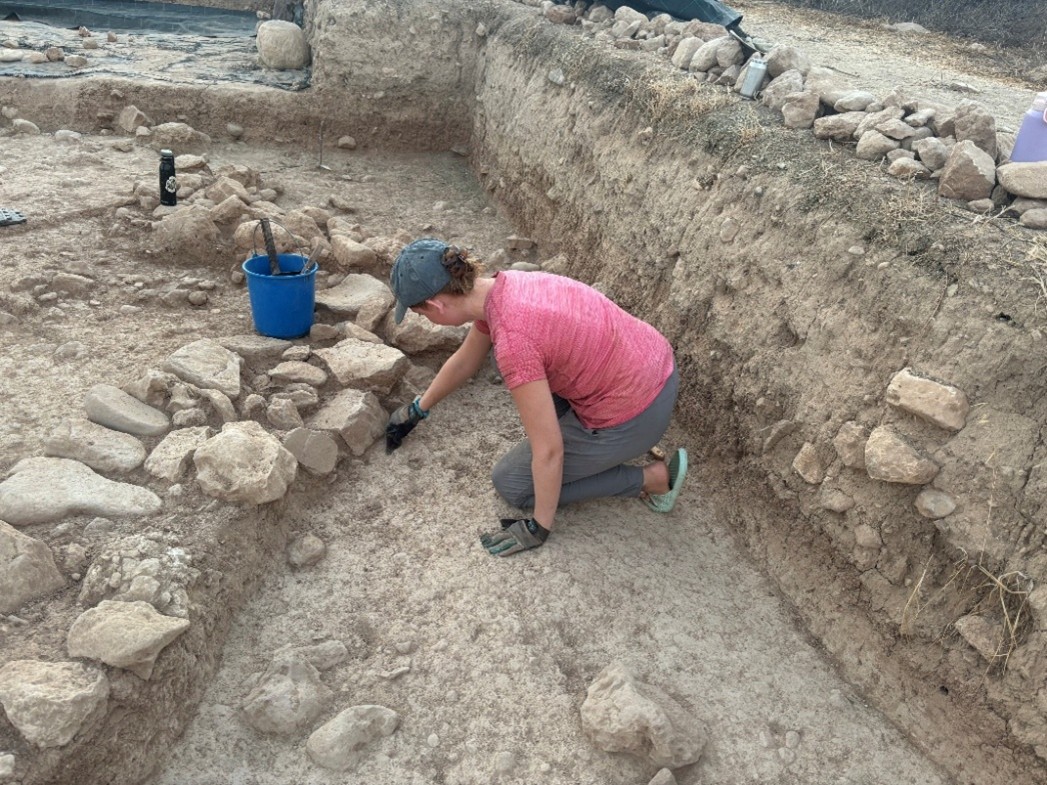
This summer was my second season at Kissonerga-Skalia, and I happily returned to my old unit, Trench Q, to pick up where I left off last year. This trench features an intact pithos, querns as well as other ground stones, and metal artifacts. Trench Q is also riddled with several wall constructions and pits. These walls cut into each other from various directions, and they feature different concentrations and sizes of stones, suggesting that they are not contemporaneous with each other. Trench Q also has a large number of rocks, many of which form the circular boundaries of pits running parallel to the walls. In order to confirm the presence of a pit, we had to identify the pit edges by defining the rocks and lightly trowelling the surrounding area to find where the soil texture transitioned from being compact to soft.
Mandy defining a compact surface and wall in Trench Q.
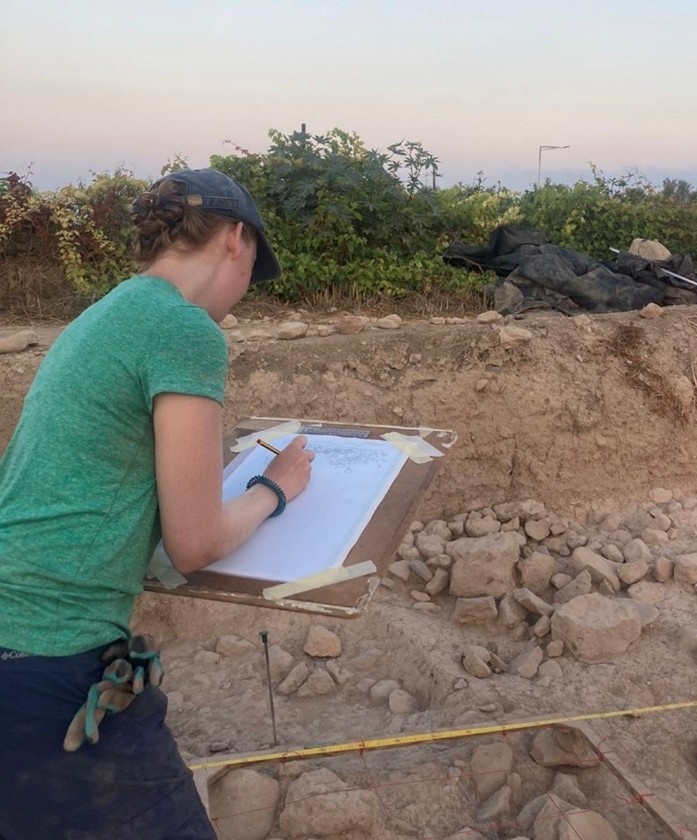
Another part of my trench features a jumbled heap of rocks, which I worked with most of last year. This season we attempted to articulate the pile by removing smaller, loose rocks from the top to see if we could identify the edges of a pit. We discovered that with each rock removed, it felt like two more rocks were found underneath it. The rocks will ultimately keep their secrets, but we interpret them to be either a rubble pile or the filling of a pit. This part of my trench demonstrates how archaeologists sometimes come across features that are difficult to identify or study. I spent the second half of the excavation exposing a flat, compact surface, which was probably a floor, and defining one of the walls. As we were following this surface, we realized that it continued on the other side of the wall, suggesting that this wall was not associated with the surface but that it was constructed later, cutting the floor. We concluded the season by planning every excavated section of the trench to assist future excavations at Kissonerga-Skalia.
Mandy drawing an archaeological site plan.
Alongside my role on the project, my personal goals were to increase my skills in photogrammetry, begin to delve into the use of digital modelling technology, and work on my instructional skills. I have only recently begun my journey in digital archaeology, but I am increasingly interested in the use of digital tools to enhance archaeological excavation and data collection. My use of digital modelling technology has been interesting. The feeling of creating an explorable model is wonderful but the process requires an incredible amount of patience. Teaching students in the archaeological field technique was a wonderful and amazing learning opportunity.
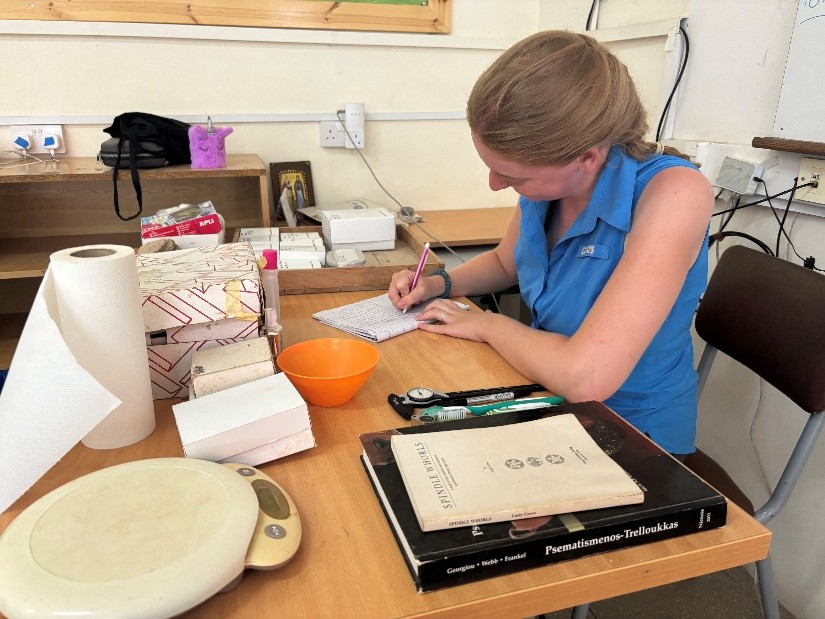
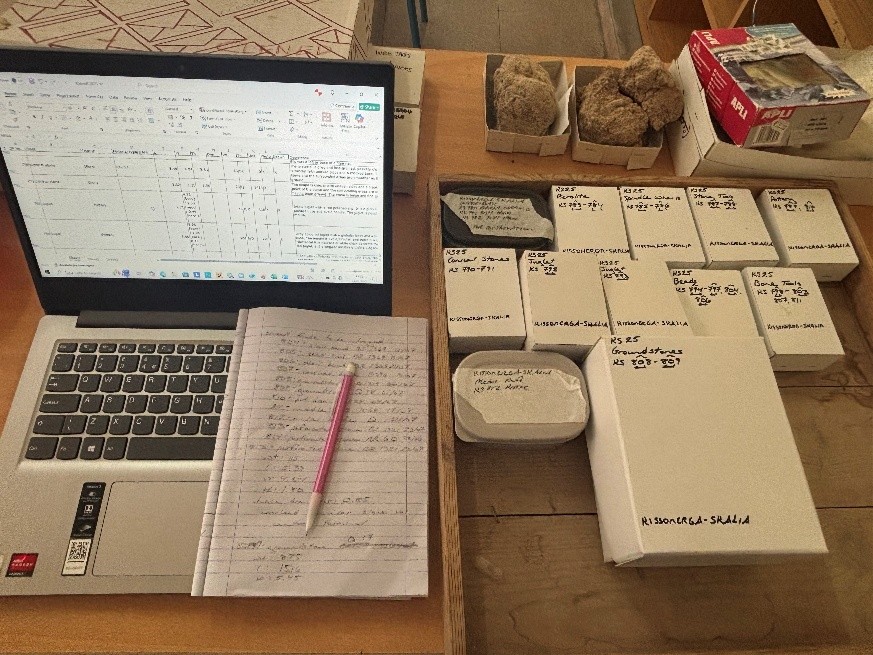
During post-excavation activities, I served as the Small Finds Registrar. In this role, I worked closely with prehistoric Cypriot material culture and studied the artifacts that my fellow students and I had excavated. The artifacts dated between the Late Chalcolithic and Middle Bronze Age. The range of small finds this season included juglets, ground stones, beads, and metal objects. I cleaned, measured, weighed, and catalogued these small finds firsthand. Some objects were too fragile to wash, so I dry brushed them to gently remove excess dirt and to articulate their shape. I researched these artifacts for typologies and comparable examples in site reports from other Cypriot sites, and I collaborated with the project’s specialists. Additionally, I made boxes for each artifact type so that the small finds could be securely transported to museum storage for future study. Through this unique opportunity, I gained experience handling artifacts as well as familiarity with various materials and object types that will be beneficial for future work in excavations or museums.
Mandy researching small finds during post-excavation activities.
Small finds from the 2025 season.
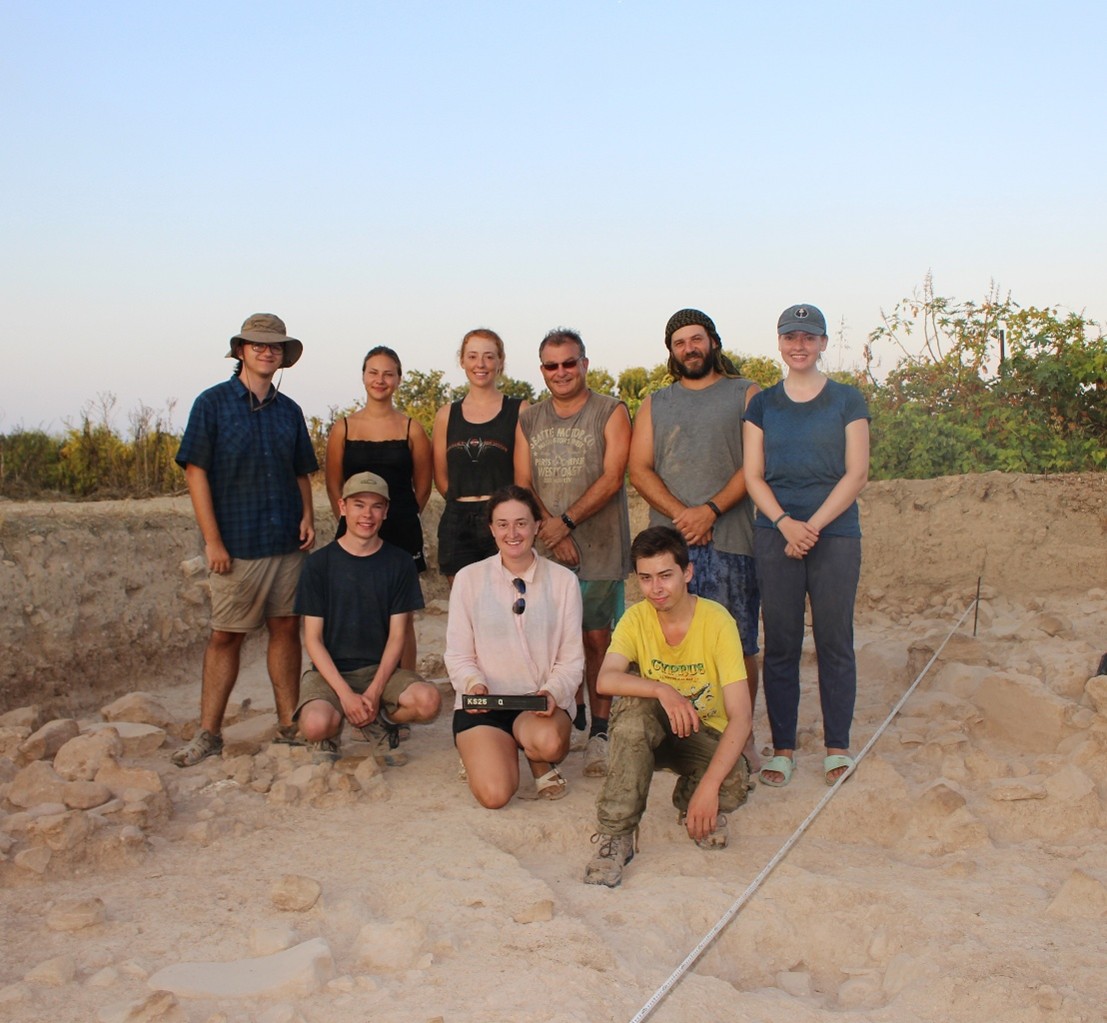
Team photo of Trench Q, Kissonerga-Skalia 2025.
Mandy Porter is a master’s student at Columbia University studying Museum Anthropology. She has a master’s degree in Classical Archaeology from the University of Oxford and a bachelor’s degree in Archaeology and Classical Studies from Dickinson College. She is also an active member of both ASOR’s Early Career Scholars Committee and Honors and Awards Committee.
Want to help more students and early career archaeologists get into the field? Donate to the cause today by selecting “Fieldwork Scholarships” as your gift purpose!