SHARE
[/vc_column_text][mk_image src=”http://www.asortest.org/wp-content/uploads/2017/01/social-fb-icon4.jpg” image_width=”42″ image_height=”42″ hover=”false” custom_url=”https://www.facebook.com/ASOResearch/” margin_bottom=”0″][mk_image src=”http://www.asortest.org/wp-content/uploads/2017/01/social-tw-icon4.jpg” image_width=”42″ image_height=”42″ hover=”false” custom_url=”https://twitter.com/ASOResearch?ref_src=twsrc%5Egoogle%7Ctwcamp%5Eserp%7Ctwgr%5Eauthor” margin_bottom=”0″][mk_image src=”http://www.asortest.org/wp-content/uploads/2017/01/social-in-icon4.jpg” image_width=”42″ image_height=”42″ hover=”false” custom_url=”https://www.linkedin.com/company/american-schools-of-oriental-research” margin_bottom=”0″][mk_image src=”http://www.asortest.org/wp-content/uploads/2017/01/social-ml-icon_7.jpg” image_width=”42″ image_height=”42″ hover=”false” custom_url=”mailto:asor@bu.edu” margin_bottom=”0″][mk_image src=”http://www.asortest.org/wp-content/uploads/2017/01/blog-icon3.jpg” image_width=”42″ image_height=”42″ hover=”false” custom_url=”http://asorblog.org/” margin_bottom=”0″][/vc_column][vc_column border_color=”rgba(255,255,255,0.01)” width=”1/6″ css=”.vc_custom_1496683923840{margin-right: 20px !important;border-left-width: 2px !important;padding-right: 20px !important;padding-left: 20px !important;border-left-color: #99422f !important;}”][mk_divider divider_color=”rgba(255,255,255,0.01)” thickness=”1″ margin_top=”3″ margin_bottom=”3″][vc_column_text] [/vc_column_text][/vc_column][vc_column border_color=”rgba(170,170,170,0.01)” width=”1/2″ css=”.vc_custom_1487276122024{margin-right: 10px !important;margin-bottom: 30px !important;border-right-width: 2px !important;border-bottom-width: 2px !important;padding-top: 30px !important;padding-right: 30px !important;padding-left: 20px !important;background-color: #ffffff !important;border-right-color: rgba(227,228,228,0.75) !important;border-bottom-color: rgba(227,228,228,0.75) !important;}”][vc_column_text responsive_align=”left”]Table of Contents for Near Eastern Archaeology 81.3 (September 2018)
Subscription Options
You can receive NEA (and other ASOR publications) through an ASOR Membership or through an Individual Subscription. Single issues (subject to availability) are available for purchase, with ASOR members receiving a discount. Please e-mail us if you have any questions.
Pp. 164-173: “Sanctifying the House: Child Burial in Prehistoric Anatolia,” by Burcu Yıldırım, Laurel D. Hackley, and Sharon R. Steadman
Intramural burials are common on the Anatolian plateau, beginning in early prehistory. Neolithic examples indicate that the incorporation of human remains into domestic architecture was a regular part of the rhythm of family life. 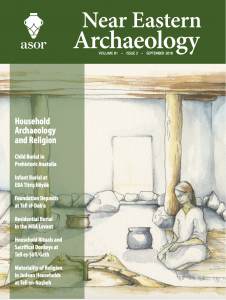 By the Late Chalcolithic, adult burials have largely moved into extramural cemeteries, although there are some exceptions. Infants and small children, however, continue to be buried within the house and these interments are a common feature on the Anatolian plateau. At the site of Çadır Höyük in central Anatolia, well over one dozen Chalcolithic infant burials were placed in corners of existing rooms, in areas of possible ritual function, and incorporated in walls at the time of construction. This study investigates the relationship between the spatial context of these burials and their function in the domestic context, and considers the possibility that some infant burials served as foundation deposits in the architecture at Chalcolithic Çadır.
Click here to access the above article on JSTOR (ASOR membership with online access and/or subscription to JSTOR Current Content required).
Pp. 174-181: “Infant Burial Practices as Domestic Funerary Ritual at Early Bronze Age Titriş Höyük,” by Timothy Matney
The Early Bronze Age tradition of intramural tombs at settlements in the Middle Euphrates region is well established, with examples from many excavations.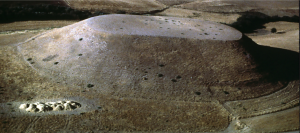 Often these intramural tombs comprise stone-built cist chambers with adult or juvenile occupants and a range of funerary offerings. They are located within domestic residences and interpreted as family crypts. Less well explored are contemporary infant burials, which, in addition to poor preservation, are often located beneath the living floors of domestic houses but not within the cist tombs. This study reviews the evidence for the intramural burial of infants at mid-to late Early Bronze Age Titriş Höyük in southeastern Turkey in the context of broader funerary traditions at the site and in the region. The author suggests that the division between adult/juvenile and infant burial treatments might be more pragmatic than dogmatic; the implications of this observation for domestic funerary rituals and household cults are explored.
Click here to access the above article on JSTOR (ASOR membership with online access and/or subscription to JSTOR Current Content required).
Pp. 182-190: “Foundation Deposits and Strategies of Place-Making at Tell el-Dab’a/Avaris,” by Miriam Müller
Foundation ceremonies are well known from the Egyptian royal and sacred spheres: They mark the beginning of construction work and ensure the effectiveness and longevity of the building to which they belong. One important component of these ceremonies is the foundation deposit, which is often placed under the corners of a temple or tomb and contain various items. Although foundation deposits are also attested in connection with profane architecture, such as storage buildings belonging to the royal household, they are uncommon in the nonelite sphere. The author discusses the evidence for this practice from a neighborhood of the ancient city of Avaris (Tell el-Dab’a) in the eastern Nile Delta. These finds are evaluated in light of comparative evidence from other parts of Egypt and the Near East. The author concludes that domestic foundation rituals are essentially poorer versions of royal ones, serving to sanctify, protect, commemorate, and elaborate. The evidence for this practice at Tell el-Dab’a furthermore hints at a mixture of Near Eastern and Egyptian elements at the site, opening up a new area of research in Egyptian domestic architecture.
Click here to access the above article on JSTOR (ASOR membership with online access and/or subscription to JSTOR Current Content required).
Pp. 191-201: “Residential Burial and Social Memory in the Middle Bronze Age Levant,” by Melissa S. Cradic
Disposal of the dead within occupied buildings of the Middle Bronze Age Levant, or intramural burial, offered inhabitants a way of closely interacting with the physical remains of the deceased.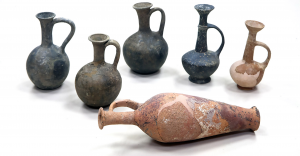 Residential burials provided permanent spatial connections between the living and the dead and served as loci of social memory for the intergenerational household. Drawing on archaeological evidence from Tel Megiddo, this article presents a model for residential burial and social memory focusing on the diversity of body disposal methods. Burials inside the settlement varied significantly in terms of type and architecture, body disposal methods, and grave goods. In several cases, burials were reopened periodically to reposition corpses while others were never disturbed. The author argues that the high degree of diversity within this mortuary corpus relates to differential social roles of the deceased after burial, and that mourners’ close encounters with deceased bodies transformed the status of the dead in a complex and protracted sequence of funerary rituals.
Click here to access the above article on JSTOR (ASOR membership with online access and/or subscription to JSTOR Current Content required).
Pp. 202-211: “Household Rituals and Sacrificial Donkeys: Why Are There So Many Domestic Donkeys Buried in an Early Bronze Age Neighborhood at Tell eṣ-Ṣâfi/Gath?,” by Haskel J. Greenfield, Tina L. Greenfield, Itzhaq Shai, Shira Albaz and Aren M. Maeir
A few years ago, a domestic donkey (Equus asinus), or ass, was discovered at Tell eṣ-Ṣafi/Gath in modern Israel and determined to have been sacrificed and buried as a foundation deposit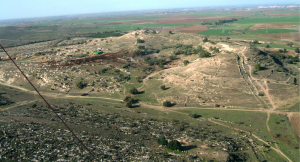 beneath the floor of an Early Bronze III house. Since then, three additional complete domestic donkey burials have been revealed beneath the floors of another house in the same Early Bronze neighborhood. These animals were buried within a nonelite domestic neighborhood at the edge of the city. The authors suggest that this urban space may have been the location of the homes and work spaces of merchants who relied upon donkeys as “beasts of burden” to transport their goods regionally and interregionally.
Click here to access the above article on JSTOR (ASOR membership with online access and/or subscription to JSTOR Current Content required).
Pp. 212-221: “Materiality of Religion in Judean Households: A Contextual Analysis of Ritual Objects from Iron II Tell en-Naṣbeh,” by Aaron Brody
The author highlights household religion through a direct, contextual presentation of ritual artifacts from one Judean household compound at Tell en-Naṣbeh in their original contexts. 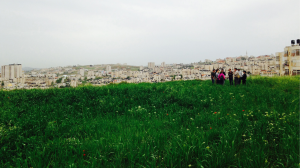 The compound is made of five conjoined pillared houses that constitute the living space of one extended family. The author takes a gendered approach to the artifacts, which include female pillar figurines, animal figurines, horse-and-rider figurines, incense stands, and zoomorphic vessels. Ritualized utilitarian objects are also taken into account. This approach to ritual at the site adds to our understanding of the religious culture of women, men, children, families, and households at Naṣbeh. Most notably the author proposes that the concentration of ritual objects near the two kitchen spaces in the compound suggests that the female head of household who provided sustenance for the extended family and its dependents also presided over the religious health of the household.
Click here to access the above article on JSTOR (ASOR membership with online access and/or subscription to JSTOR Current Content required).
[/vc_column_text][mk_divider][vc_column_text]To view the entire issue on JSTOR, click here.[/vc_column_text][/vc_column][vc_column border_color=”rgba(170,170,170,0.01)” width=”1/6″ css=”.vc_custom_1496684098866{margin-right: 5px !important;margin-bottom: 20px !important;border-right-width: 2px !important;border-bottom-width: 2px !important;padding-top: 30px !important;padding-right: 10px !important;padding-left: 10px !important;background-color: #ffffff !important;border-right-color: rgba(227,228,228,0.75) !important;border-bottom-color: rgba(227,228,228,0.75) !important;}”][vc_wp_posts title=”BROWSE THE NEWS ARCHIVE” number=”4″][/vc_column][vc_column border_color=”rgba(170,170,170,0.01)” width=”1/6″ css=”.vc_custom_1496684008271{margin-right: 10px !important;margin-bottom: 30px !important;border-right-width: 2px !important;border-bottom-width: 2px !important;padding-top: 30px !important;padding-right: 20px !important;padding-left: 20px !important;background-color: #ffffff !important;border-right-color: rgba(227,228,228,0.75) !important;border-bottom-color: rgba(227,228,228,0.75) !important;}”][vc_column_text]Tweets by ASOResearch [/vc_column_text][/vc_column][/vc_row]