SHARE
[/vc_column_text][mk_image src=”http://www.asortest.org/wp-content/uploads/2017/01/social-fb-icon4.jpg” image_width=”42″ image_height=”42″ hover=”false” custom_url=”https://www.facebook.com/ASOResearch/” margin_bottom=”0″][mk_image src=”http://www.asortest.org/wp-content/uploads/2017/01/social-tw-icon4.jpg” image_width=”42″ image_height=”42″ hover=”false” custom_url=”https://twitter.com/ASOResearch?ref_src=twsrc%5Egoogle%7Ctwcamp%5Eserp%7Ctwgr%5Eauthor” margin_bottom=”0″][mk_image src=”http://www.asortest.org/wp-content/uploads/2017/01/social-in-icon4.jpg” image_width=”42″ image_height=”42″ hover=”false” custom_url=”https://www.linkedin.com/company/american-schools-of-oriental-research” margin_bottom=”0″][mk_image src=”http://www.asortest.org/wp-content/uploads/2017/01/social-ml-icon_7.jpg” image_width=”42″ image_height=”42″ hover=”false” custom_url=”mailto:asor@bu.edu” margin_bottom=”0″][mk_image src=”http://www.asortest.org/wp-content/uploads/2017/01/blog-icon3.jpg” image_width=”42″ image_height=”42″ hover=”false” custom_url=”http://asorblog.org/” margin_bottom=”0″][/vc_column][vc_column border_color=”rgba(255,255,255,0.01)” width=”1/6″ css=”.vc_custom_1496683923840{margin-right: 20px !important;border-left-width: 2px !important;padding-right: 20px !important;padding-left: 20px !important;border-left-color: #99422f !important;}”][mk_divider divider_color=”rgba(255,255,255,0.01)” thickness=”1″ margin_top=”3″ margin_bottom=”3″][vc_column_text] [/vc_column_text][/vc_column][vc_column border_color=”rgba(170,170,170,0.01)” width=”1/2″ css=”.vc_custom_1487276122024{margin-right: 10px !important;margin-bottom: 30px !important;border-right-width: 2px !important;border-bottom-width: 2px !important;padding-top: 30px !important;padding-right: 30px !important;padding-left: 20px !important;background-color: #ffffff !important;border-right-color: rgba(227,228,228,0.75) !important;border-bottom-color: rgba(227,228,228,0.75) !important;}”][vc_column_text responsive_align=”left”]REPORT FROM CAARI (CYPRUS AMERICAN ARCHAEOLOGICAL RESEARCH INSTITUTE)
By Dr. Andrew McCarthy, CAARI Director
[/vc_column_text][vc_column_text] In the spring of 2013, CAARI is returning to what can be called a “new normal”. A frenzy of developments took place over the past few months, including hiring a new member of staff, renovating the library, improving the residence facility, upgrading the laboratories and holding a major international conference.
Since November 2012, there have been some distractions at the Nicosia institute, 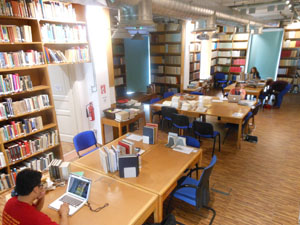 but our core functionality has continued throughout. For several months, the library was closed for renovations as part of a larger Library Expansion Project. During this time, we converted the lobby of CAARI into a library reading room. It was not ideal, but the entire Cyprus collection of books, nearly all of the journals and the usual number of desks were still available. Our current Fulbright Fellows, Dr. Young Kim from Calvin College studying the ‘heretic-hunter’ St. Epiphanius, and Ms. Catherine Kearns, PhD student at Cornell University studying Iron Age environmental and landscape archaeology, have been fixtures at CAARI throughout all of these changes. Their patience with the building works and occasional disruptions has been admirable.
Since there were building works taking place anyway, we took advantage of the cheap prices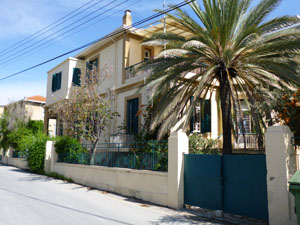 and the presence of contractors to revitalize the upstairs residence too. Every upstairs room has had a new lick of paint, the wooden floors have been refinished, the toilets and showers replaced, the kitchen refurbished and a new balcony roof is on the way. I am confident residents will appreciate the freshness of the living space, which will make living and working at CAARI a thoroughly productive and enjoyable experience.
Since February 2013, we have a newly renovated library with state-of-the-art IT and electronic infrastructure, new climate control and lighting, expanded library space and a new librarian’s office, which will be followed by a second phase of construction that will see to the building of a two-story subterranean extension.
This winter’s completion of ‘Phase 1’ of the Library Expansion Project coincided with CAARI hosting the “J.R.B. Stewart: an Archaeological Legacy” conference. This event posthumously celebrated the life and work of James Stewart on the 100th anniversary of his birth. Stewart, an Australian, was a seminal figure in Near Eastern archaeology, perhaps most importantly for defining the Bronze Age ceramics of Cyprus and ancient Cypriot connections to Anatolia, his work on numismatics, and his work in Australia as a Museum Curator and for conducting excavations in Cyprus and the mainland of southeast Asia. Importantly, after James Stewart’s untimely death in 1952, his widow Eve (a trained archaeologist) worked tirelessly to publish his lingering works and was instrumental in helping CAARI to gain its footing in the institute’s early years. It is because of her that the CAARI residence bears J.R. Stewart’s name.
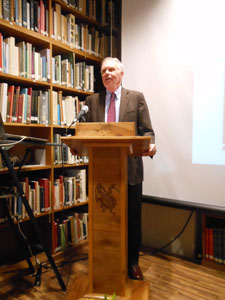 The conference had a lovely spirit, with attendees and presenters giving an honest account of historiography, biography and the archaeological legacy of Stewart. The conference was opened by Dr. Robert Merrillees, former CAARI Director, retired Australian diplomat, and one of Stewart’s own former students. Dr. Merrillees keynote lecture also inaugurated the renovated library and was followed by a display of historical and ethnographic items that were bequeathed to CAARI by Eve Stewart. Several fine receptions were generously sponsored by Dr. Merrillees, CAARI Trustee Maria Kyriacou and His Excellency, Australian High Commissioner Mr. Trevor Peacock and his wife Pattie. The conference itself received support from Beta Analytic, ISD Distributor of Scholarly Books and several local businesses. Presenters came from far and wide, including the Australia, Cyprus, Israel, New Zealand, the United Kingdom, the United States and Sweden, and the audience filled the new library to capacity. The presentations were of the highest quality and the co-Organizers, CAARI Trustee Prof. Bernard Knapp, Dr. Jenny Webb from La Trobe University and I, intend to publish the proceedings as the next volume in the CAARI monograph series.
Also debuting at this conference was the newly appointed Librarian, Ms. Katerina 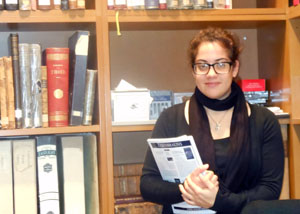 Mavromichalou. Taking up the position in February, Katerina was in charge of putting the library back together in time for the conference. An archaeology graduate from the University of Cyprus and the University of Southampton in the UK, her energy and knowledge of archaeology and libraries has already been a great asset to CAARI. Users of the library will be welcomed by Katerina as the new face of the library after Ms. Evi Karyda’s depature last year to pursue her PhD.
Now CAARI is in the process of developing the laboratories to bring them up to modern standards, including the purchase of petrographic thin-section equipment, forming a thin-section reference collection, the refurbishment of the ecological and bone lab space and the establishment of a GIS microlab. These new labs at CAARI will also be accompanied by an investment in the library collection to make the reference materials match the laboratory capabilities.
As we approach the summer, CAARI is ready to deal with the researchers using the library, laboratory and infrastructure and staying at our residence. With the recent renovations and plans for future developments, we are poised to continue to serve as a hub for research in the eastern Mediterranean well into the future. To keep our CAARI friends abreast of the program and other updates, CAARI has now joined Facebook. I encourage you to follow us as we move forward.[/vc_column_text][/vc_column][vc_column border_color=”rgba(170,170,170,0.01)” width=”1/6″ css=”.vc_custom_1496684098866{margin-right: 5px !important;margin-bottom: 20px !important;border-right-width: 2px !important;border-bottom-width: 2px !important;padding-top: 30px !important;padding-right: 10px !important;padding-left: 10px !important;background-color: #ffffff !important;border-right-color: rgba(227,228,228,0.75) !important;border-bottom-color: rgba(227,228,228,0.75) !important;}”][vc_wp_posts title=”BROWSE THE NEWS ARCHIVE” number=”4″][/vc_column][vc_column border_color=”rgba(170,170,170,0.01)” width=”1/6″ css=”.vc_custom_1496684008271{margin-right: 10px !important;margin-bottom: 30px !important;border-right-width: 2px !important;border-bottom-width: 2px !important;padding-top: 30px !important;padding-right: 20px !important;padding-left: 20px !important;background-color: #ffffff !important;border-right-color: rgba(227,228,228,0.75) !important;border-bottom-color: rgba(227,228,228,0.75) !important;}”][vc_column_text]Tweets by ASOResearch [/vc_column_text][/vc_column][/vc_row]