UNEARTHING THE PAST SINCE 1900
  • BECOME A MEMBER
  • RENEW
  • GIVE NOW
  • SEARCH
  • ONLINE PORTAL
  • American Society of Overseas Research (ASOR)American Society of Overseas Research (ASOR)
  • ABOUT
    • WELCOME FROM ASOR OFFICERS
    • HISTORY OF ASOR
    • MISSION, BYLAWS, & STRATEGIC PLAN
    • Board of Trustees
    • COMMITTEES
    • POLICIES
    • FINANCIAL DOCUMENTS
    • MEDIA RELEASES
    • CONTACT US
  • CULTURAL
    HERITAGE
    • ABOUT CULTURAL HERITAGE INITIATIVES
    • UPDATES
    • PAST GRANTS
    • TUTORIALS
    • Who We Are
  • ANNUAL
    MEETING
    • REGISTRATION
    • HOTEL RESERVATIONS
    • ANNUAL MEETING SCHEDULES
    • SPONSOR & EXHIBIT
    • ASOR Online Library
    • HONORS & AWARDS
    • ANNUAL MEETING SCHOLARSHIPS
    • PAST & FUTURE ANNUAL MEETINGS
  • MEMBERSHIP
    & RESOURCES
    • INDIVIDUAL MEMBERSHIPS
    • INSTITUTIONAL MEMBERSHIPS
    • NEWS@ASOR
    • PAST ASOR NEWS, MONTH BY MONTH
    • AFFILIATED PROJECTS
    • AFFILIATED RESEARCH CENTERS
    • ARCHIVES
    • ONLINE RESOURCES
      • PHOTO COLLECTION
    • EARLY CAREER MEMBER RESOURCES
  • FELLOWSHIPS
    & GRANTS
    • SCHOLARSHIPS FOR FIELDWORK PARTICIPATION
    • GRANTS FOR ARCHAEOLOGICAL PROJECTS
    • RESEARCH FELLOWSHIPS FOR MEMBERS
    • MEMBERSHIP & ANNUAL MEETING SCHOLARSHIPS
    • ASOR-AFFILIATED RESEARCH CENTERS FELLOWSHIPS
    • OTHER FELLOWSHIP PROGRAMS
  • PUBLICATIONS
    • BOOK SERIES & MONOGRAPHS
    • BULLETIN OF ASOR
    • JOURNAL OF CUNEIFORM STUDIES
    • MAARAV
    • NEAR EASTERN ARCHAEOLOGY
    • THE ANCIENT NEAR EAST TODAY
    • News@ASOR
    • LEVANTINE CERAMICS PROJECT
  • FRIENDS
    OF ASOR
    • Webinars
    • TOURS
    • THE ANCIENT NEAR EAST TODAY
    • ASOR ONLINE LIBRARY
  • Donate
    • FY25 HONOR ROLL OF DONORS
    • LIFETIME HONOR ROLL OF DONORS
    • ASOR LEGACY CIRCLE
    • WAYS TO DONATE

 SHARE


NEWS@ASOR E-NEWSLETTER

ANCIENT NEAR EAST TODAY E-NEWSLETTER

PAST ASOR NEWS, MONTH BY MONTH

ASOR LEGACY CIRCLE MEMBERS

LIFETIME HONOR ROLL OF DONORS

FY25 HONOR ROLL OF DONORS

ASOR ANNUAL MEETING

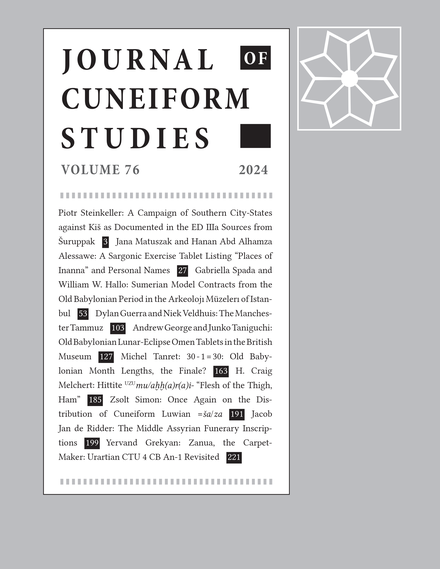
Table of Contents for Journal of Cuneiform Studies 76 (2024)

You can receive JCS (and other ASOR publications) through an ASOR Membership.
Please e-mail the Membership office if you have any questions.
JCS 76 article 1 banner

Pp. 3–26: “A Campaign of Southern City-States against Kiš as Documented in the ED IIIa Sources from Šuruppak (Fara),” by Piotr Steinkeller

A group of ED IIIa texts from Šuruppak (Fara) describes a mobilization of troops from Uruk, Adab, Nippur, Lagaš, Umma, and Šuruppak, clearly in anticipation of a major military operation. It is argued that the target of that campaign, which was led by Uruk, was the city-state of Kiš. The analysis of various other sources further suggests that, during the ED IIIa period, Uruk was able to bring significant portions of southern Babylonia under its control. This development was a reversal of the situation existing in ED I and II, when much of that region remained under the hegemony of Kiš.

ASOR Members with online access: log into ASOR’s Online Portal here. Once logged in, click the JOURNALS tab in the top navigation bar. From here you may select which journal you would like to read. If you have online access, you will see your selected journal’s current issue Table of Contents. Click on the “Current Issue” button and you will then be redirected to the University of Chicago Press’s (UCP) platform to immediately start reading any issue of your choice. Tutorials for how to log in to the Online Portal as well as how to navigate to the Portal Journals page can be found here.

JCS 76 article 2 banner

Pp. 27-52: “A Sargonic Exercise Tablet Listing ‘Places of Inanna’ and Personal Names,” by Jana Matuszak and Hanan Abd Alhamza Alessawe

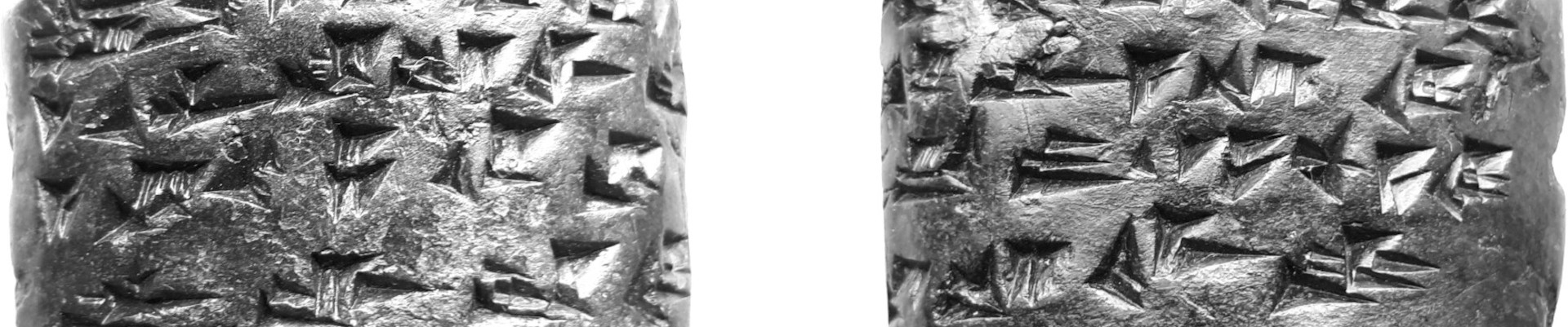
This article publishes a remarkable school tablet, probably from Sargonic Umma, which contains two lexical exercises. While the reverse appears to be an ad hoc list of personal names, many of which start with or contain the sign a, the obverse compiles “places” (ki) where certain mythological events involving the goddess Inanna had occurred. Unusually for lexical lists, each of these places is described in a complete sentence following a loosely alternating structure, which gives the list almost literary qualities. After discussing the list-like vs. literary features and comparing the compilation of places to a similar lexical fragment of Ur III date and the Early Dynastic Word List F, we analyze the mythological allusions and potential ritual associations.

ASOR Members with online access: log into ASOR’s Online Portal here. Once logged in, click the JOURNALS tab in the top navigation bar. From here you may select which journal you would like to read. If you have online access, you will see your selected journal’s current issue Table of Contents. Click on the “Current Issue” button and you will then be redirected to the University of Chicago Press’s (UCP) platform to immediately start reading any issue of your choice. Tutorials for how to log in to the Online Portal as well as how to navigate to the Portal Journals page can be found here.

JCS 76 article 3 banner

Pp. 53-101: “Sumerian Model Contracts from the Old Babylonian Period in the Arkeoloji Müzeleri of Istanbul,” by Gabriella Spada and William W. Hallo

This article presents twenty fragmentary multicolumn tablets containing Sumerian model contracts from Old Babylonian Nippur, which are currently kept at the Arkeoloji Müzeleri in Istanbul, Turkey. Initial work on these was initiated by the late William W. Hallo in 1971 but he was unable to complete the project so it was taken over and completed by Gabriella Spada. Their content is limited to loan contracts of silver or barley, sometimes with the presence of antichretic pledges (slaves, fields, gardens, and lumps of silver).

ASOR Members with online access: log into ASOR’s Online Portal here. Once logged in, click the JOURNALS tab in the top navigation bar. From here you may select which journal you would like to read. If you have online access, you will see your selected journal’s current issue Table of Contents. Click on the “Current Issue” button and you will then be redirected to the University of Chicago Press’s (UCP) platform to immediately start reading any issue of your choice. Tutorials for how to log in to the Online Portal as well as how to navigate to the Portal Journals page can be found here.

JCS 76 article 4 banner

Pp. 103-126: “The Manchester Tammuz,” by Dylan Guerra and Niek Veldhuis

This contribution provides a new edition of the Manchester Tammuz, a sequence of Emesal love songs concerning Inana and Dumuzi. The text offers many irregular spellings, some of which may be resolved by means of a fragmentary duplicate from Nippur. The relationship between the Manchester text and several other Old Babylonian Emesal liturgies that share characteristics of orthography, paleography, and layout is discussed briefly. A line-drawing of the object by Theophilus G. Pinches, published in 1904, is added to the end of the article.

ASOR Members with online access: log into ASOR’s Online Portal here. Once logged in, click the JOURNALS tab in the top navigation bar. From here you may select which journal you would like to read. If you have online access, you will see your selected journal’s current issue Table of Contents. Click on the “Current Issue” button and you will then be redirected to the University of Chicago Press’s (UCP) platform to immediately start reading any issue of your choice. Tutorials for how to log in to the Online Portal as well as how to navigate to the Portal Journals page can be found here.

JCS 76 article 5 banner

Pp. 127-161: “Old Babylonian Lunar-Eclipse Omen Tablets in the British Museum,” by Andrew George and Junko Taniguchi

This article presents a first edition of four clay tablets inscribed with omens arising from eclipses of the moon. As products of the middle and late Old Babylonian periods they represent the oldest examples of compendia of lunar-eclipse omens yet discovered and thus provide important new information about celestial divination among the peoples of southern Mesopotamia in the early second millennium BCE. The tablets are edited with appended philological apparatus. They are all found to bear witness to a single text, which organizes the omens of lunar eclipse by time of night, movement of shadow, duration, and date. A composite translation also takes account of two other early versions of the text published eleven years ago. The article is concluded by discussions of variants and scribal annotations in the text. The cuneiform texts are illustrated by scale drawings of the tablets.

ASOR Members with online access: log into ASOR’s Online Portal here. Once logged in, click the JOURNALS tab in the top navigation bar. From here you may select which journal you would like to read. If you have online access, you will see your selected journal’s current issue Table of Contents. Click on the “Current Issue” button and you will then be redirected to the University of Chicago Press’s (UCP) platform to immediately start reading any issue of your choice. Tutorials for how to log in to the Online Portal as well as how to navigate to the Portal Journals page can be found here.

JCS 76 article 6 banner

Pp. 163-183: “30 − 1 = 30: Old Babylonian Month Lengths, the Finale?,” by Michel Tanret

The Old Babylonian administrative calendar always consisted of thirty days, regardless of early moon sightings. The ud.da.gíd.da days, viewed by some as days to be excluded due to an early moon sighting, were not used to shorten the month; rather, they denoted the number of days when no rations were distributed. This is demonstrated on the basis of Old Babylonian documentary texts.

ASOR Members with online access: log into ASOR’s Online Portal here. Once logged in, click the JOURNALS tab in the top navigation bar. From here you may select which journal you would like to read. If you have online access, you will see your selected journal’s current issue Table of Contents. Click on the “Current Issue” button and you will then be redirected to the University of Chicago Press’s (UCP) platform to immediately start reading any issue of your choice. Tutorials for how to log in to the Online Portal as well as how to navigate to the Portal Journals page can be found here.

JCS 76 article 7 banner

Pp. 185-190: “Hittite UZUmu/aḫḫ(a)r(a)i– ‘Flesh of the Thigh, Ham,'” by H. Craig Melchert

Hittite UZUmu/aḫḫ(a)r(a)i– is a body part belonging to various mammals, including humans, but almost exclusively attested as a component of cooked meat offerings to deities. New evidence supports its identification as the fleshy part of the thigh, thus English “ham” in the anatomical sense, but when served as food in Hittite removed from the thigh bone. A recent text join furnishes not only a further instance of juxtaposition with the expression for “thigh bone,” but also the crucial detail that the m. is skewered before being cooked.

ASOR Members with online access: log into ASOR’s Online Portal here. Once logged in, click the JOURNALS tab in the top navigation bar. From here you may select which journal you would like to read. If you have online access, you will see your selected journal’s current issue Table of Contents. Click on the “Current Issue” button and you will then be redirected to the University of Chicago Press’s (UCP) platform to immediately start reading any issue of your choice. Tutorials for how to log in to the Online Portal as well as how to navigate to the Portal Journals page can be found here.

Pp. 191-197: “Once Again on the Distribution of Cuneiform Luwian =ša/za,” by Zsolt Simon

This article argues that the Cuneiform Luwian nominal particle =ša/za was not assigned on a word-by-word basis in the -r-, -r/n-, -l-stem classes but followed a regular pattern, thus Jasanoff’s rule of the distribution of this particle can be extended and confirmed.

ASOR Members with online access: log into ASOR’s Online Portal here. Once logged in, click the JOURNALS tab in the top navigation bar. From here you may select which journal you would like to read. If you have online access, you will see your selected journal’s current issue Table of Contents. Click on the “Current Issue” button and you will then be redirected to the University of Chicago Press’s (UCP) platform to immediately start reading any issue of your choice. Tutorials for how to log in to the Online Portal as well as how to navigate to the Portal Journals page can be found here.

Pp. 199-220: “The Middle Assyrian Funerary Inscriptions,” by Jacob Jan de Ridder

This article presents revised editions of a group of four similar funerary inscription from Assyria, dating to about the thirteenth century BCE. The paleography of these texts is unusual, characterized by similarities with the writing from Tell Taban and the kingdom of Ḫana. However, the invocation of the Hurrian deity Šuriḫa, the patron of the town of Šūru, suggests this ancient settlement as its provenance. These funerary inscriptions would be among the earliest texts from the Middle Assyrian settlement that existed at this location.

ASOR Members with online access: log into ASOR’s Online Portal here. Once logged in, click the JOURNALS tab in the top navigation bar. From here you may select which journal you would like to read. If you have online access, you will see your selected journal’s current issue Table of Contents. Click on the “Current Issue” button and you will then be redirected to the University of Chicago Press’s (UCP) platform to immediately start reading any issue of your choice. Tutorials for how to log in to the Online Portal as well as how to navigate to the Portal Journals page can be found here.

Pp. 221-227: “Zanua, the Carpet-Maker: Urartian CTU 4 CB An-1 Revisited,” by Yervand Grekyan

Evidence of Urartian textiles is mostly limited to pictorial representations, along with a few textual references and finds of fragments of textiles in archaeological contexts. The study of an Urartian royal letter gives some new idea on craftsmen who wove textiles in Urartu.

ASOR Members with online access: log into ASOR’s Online Portal here. Once logged in, click the JOURNALS tab in the top navigation bar. From here you may select which journal you would like to read. If you have online access, you will see your selected journal’s current issue Table of Contents. Click on the “Current Issue” button and you will then be redirected to the University of Chicago Press’s (UCP) platform to immediately start reading any issue of your choice. Tutorials for how to log in to the Online Portal as well as how to navigate to the Portal Journals page can be found here.

BROWSE THE NEWS ARCHIVE

  • FOA Webinar: Yana Tchekhanovets
  • Spring 2026 Book Sale
  • Fieldwork Report: Atakan Atabas
  • FOA Webinar: Kevin Fisher

Latest Posts from @ASORResearch

asor_research

Initiating and supporting research of the history and cultures of the Near East and wider Mediterranean world.


Don't forget to tune in TONIGHT at 7:00 pm ET for
Don't forget to tune in TONIGHT at 7:00 pm ET for the next FOA webinar presented by Dr. Kevin Fisher: "Kalavasos and Maroni Revisited: New Explorations of Late Bronze Age Urban Landscapes in Southcentral Cyprus." If you haven't already signed up, click the link in our bio to register for free: https://buff.ly/Me2Ax1K


Atakan Atabas, a PhD student at the University of
Atakan Atabas, a PhD student at the University of Central Florida, received a Shirlee Meyers/G. Ernest Wright Fellowship to excavate at Kerkenes, Türkiye in 2025. During the 2025 season, Atakan contributed to survey and geophysical work, including electrical resistivity mapping, while also engaging with local communities and exploring how interdisciplinary approaches can be applied. Read more at the link in our bio: https://www.asor.org/news/2026/03/fieldwork-report-atabas
#Turkiye


April 15 is the last day to register for the 2026
April 15 is the last day to register for the 2026 Annual Meeting and take advantage of Early Bird savings. If you are planning to join us in Chicago, November 18–21, don’t miss your chance to save $50 by registering today. A full and exciting program is taking shape, featuring engaging sessions and workshops, new research, and plenty of opportunities to connect with friends and colleagues. We look forward to welcoming you this November at the Hilton Chicago. Register now at the link in our bio: https://www.asor.org/am/2026/annual-meeting-registration-2026


Since launching in January, ASOR’s Sudan National
Since launching in January, ASOR’s Sudan National Museum Access Project has made steady progress in strengthening site security and restoring key infrastructure at the Sudan National Museum in Khartoum. Over the last three months, the work has focused on two main priorities: repairing a damaged enclosure wall and clearing the property’s sewage drainage system. Read the project update here: https://www.asor.org/chi/updates/2026/04/sudan-museum-project-update
#Sudan


Do you know of a recently published great book 📚️
Do you know of a recently published great book 📚️ on the ancient Near East and Eastern Mediterranean? Nominate it for a Book Award today! ASOR is proud to give three awards annually: the Frank Moore Cross Award, the Nancy Lapp Popular Book Award, and the G. Ernest Wright Award. Nominations are due by May 1: https://www.asor.org/about-asor/honors-awards/
📸 winner of the 2025 Cross Award


Join us for the next Friends of ASOR webinar on We
Join us for the next Friends of ASOR webinar on Wednesday, April 15th at 7:00pm ET: “Kalavasos and Maroni Revisited: New Explorations of Late Bronze Age Urban Landscapes in Southcentral Cyprus,” presented by Dr. Kevin Fisher. Compared with some of its better-known neighbors in the ancient eastern Mediterranean and Near East, Cyprus sees the relatively late emergence of urbanism. Its first cities appear in the Late Bronze Age (c. 1700-1100 BCE), along with other changes to the built environment. This talk presents the results of recent work by the Kalavasos and Maroni Built Environments (KAMBE) Project, a collaborative and interdisciplinary investigation of the relationship between urban landscapes and social change in south-central Cyprus during the Late Bronze Age. Register at the link in our bio: https://www.asor.org/news/2026/03/webinar-fisher
#Cyprus #BronzeAge


The cuneiform sources of ancient Mesopotamian hist
The cuneiform sources of ancient Mesopotamian history are abundant. They are nevertheless incomplete, having been filtered by ancient processes of preservation and destruction, shaped by chance discoveries and scientific practices. Read the newest ANE Today by clicking the link in our bio: https://anetoday.org/cuneiform-written-artifacts/
#Mesopotamia #Cuneiform
📸: © Cécile Michel


Happy Passover! Our #ObjectoftheWeek is a hexagona
Happy Passover! Our #ObjectoftheWeek is a hexagonal glass pilgrim's jar from ca. 578-636 CE, with Jewish symbols such as the menorah on it. Such jars were often made for pilgrims visiting holy sites or for use in burial rituals. Credit: Metropolitan Museum of Art. 1972.118.180
#Archaeology #Byzantine #Passover


The newest issue of Near East Archaeology includes
The newest issue of Near East Archaeology includes articles like: Evolution, Resilience, and Collapse of Prehistoric Settlements in the Bavanat River Basin, Southern Iran; Script over Sealings: Proto-Elamite Bureaucratic Innovation at Tepe Sofalin, Iran; Intramural Nonadult Burials at Tell Muhammad (in Baghdad) during the Old Babylonian Period (1894–1595 BCE): A Preliminary Assessment of Legacy Data; Khirbet el-‘Eika: A Hellenistic Estate in the Lower Galilee; An Example of the Architectural Integrity of Historical Bridges: The Agora Bridge from the Period of Justinian I in Dara (Anastasiopolis); and more. Check out the Table of Contents here: https://www.asor.org/news/2026/03/nea89.1-toc/


With over $4,000 raised, ASOR's March Fellowship M
With over $4,000 raised, ASOR's March Fellowship Madness has reached our final push. Help us get to $6,000 so 3 students can receive dig scholarships this summer—and stay tuned to see which artifact will emerge victorious! https://buff.ly/XPKQcGL
#MarchMadness


A reminder to check out ASOR's spring book sale be
A reminder to check out ASOR's spring book sale before it ends! ASOR members (with a US mailing address) can purchase ASOR books 2+ years old at the discounted price of $10.00. Check our website for the list of titles still available.


ASOR Board Member Rick St. Hilaire was recently pu
ASOR Board Member Rick St. Hilaire was recently published in The Hill for his opinion piece on protecting Iran's cultural heritage. You can find the article link in our bio.
#Archaeology #CulturalHeritage #Iran #Preservation

Image: Investiture scene, rock relief of Sasanian king Bahram Ist at Bishapur (said Bishapur V). Iran, province of Fars. Credit: Pentocelo/Wikimedia Commons.


Reminder: the final deadline to submit paper abstr
Reminder: the final deadline to submit paper abstracts and workshop presentation proposals for the 2026 Annual Meeting is April 1! ASOR academic membership and Annual Meeting registration are required to access the submission form in the ASOR Abstract Center. Read the Call for Papers on how to submit by clicking the link in our bio: https://www.asor.org/am/2026/call-for-papers-2026


Make sure to tune in TONIGHT at 7:00 pm ET for the
Make sure to tune in TONIGHT at 7:00 pm ET for the next FOA webinar presented by Neville McFerrin: "'Lions, Rams, and Kings: Interpreting Animals at Persepolis". If you haven't already signed up, click the link in our bio to register for free: https://www.asor.org/news/2026/03/webinar-mcferrin


As March Madness hits the Sweet 16, ASOR's March F
As March Madness hits the Sweet 16, ASOR's March Fellowship Madness has reached our first goal! With over $2,000 raised so far—thus one more student receiving a fieldwork scholarship—our artifacts have advanced to the next round. Help us get to $4,000 so we can send another student on a dig this summer, and follow along to see which artifact will be crowned a winner! 
#MarchMadness #Archaeology #Scholarships


Join ASOR’s Early Career Scholars on April 3 from
Join ASOR’s Early Career Scholars on April 3 from 12:00-1:00pm ET via Zoom for a virtual Brown Bag talk on scientific publishing in archaeology, led by Dr. Danielle Macdonald, co-Editor of the Journal of Archaeological Science: Reports. This session will provide insights into the publication process including understanding peer review, manuscript preparation best practices, responding to reviewer comments, and current trends in scientific archaeological publishing such as open access models. Register for the free lecture by clicking the link (https://www.asor.org/news/2026/03/ecs-macdonald) in our bio.


Eid Mubarak to those celebrating! Our #Objectofthe
Eid Mubarak to those celebrating! Our #ObjectoftheWeek is a ceramic bowl likely from Samarqand, Uzbekistan—with "blessings, prosperity, well-being, happiness" inscribed in Arabic—dated to late 10th-11th century CE. Credit: Metropolitan Museum of Art. 40.170.15
#Archaeology #Uzbekistan #Calligraphy


Why do so many of the ancient world’s most famous
Why do so many of the ancient world’s most famous kings share the same unlikely origin story? The answer may lie in a mythical template first forged in Mesopotamia. Read the newest ANE Today, The Myth of the Servant: A New Tale of Kingship from the Ancient Near East, by clicking the link (https://anetoday.org/myth-servant-kingship/) in our bio.


Join us for the next FOA webinar on Wednesday, Mar
Join us for the next FOA webinar on Wednesday, March 25th at 7:00pm ET: "Lions, Rams, and Kings: Interpreting Animals at Persepolis," presented by Dr. Neville McFerrin. Shortly after 515 BCE, the Achaemenid king Darius I began construction on a new imperial center: Persepolis. Across the site, a vision of an inclusive empire, one that celebrates diversity as strength, emerges. This talk argues that in reliefs across the site, the designers of Persepolis turn to depictions of animal encounters as a way to demonstrate to visitors the potentials of their imperial system. Click the link (https://www.asor.org/news/2026/03/webinar-mcferrin) in our bio to read more and register!
#Persia #Achaemenid #Persepolis


As part of March Fellowship Madness, we invite you
As part of March Fellowship Madness, we invite you to step into our Bracket of Impact, where every gift advances the next generation of archaeologists. Our goal is to raise $6,000 by March 31 which would fund scholarships for three more students. 

As donations come in, we’ll update our Bracket of Impact so you can track our progress and see which of your favorite artifacts below advances to the next round. Who do you have winning?
#MarchMadness


Instagram

Stay updated with the latest insights, photos, and news by following us on Instagram!

Follow Us on Instagram

American Society of Overseas Research
The James F. Strange Center
209 Commerce Street
Alexandria, VA 22314

E-mail: info@asor.org

© 2025 ASOR
All rights reserved.
Images licensed under a Creative Commons Attribution-NonCommercial-ShareAlike 4.0 International License

Contact Us
Membership
Give
Friends of ASOR
ASOR Cultural Heritage Initiatives
Terms of Use
News

Please follow & like us :)
Facebook
YouTube
LinkedIn